
Enough Quiet
Story Written & Told by
Elena Calla
Shared with care & reverence by
Scott Bryant
Note from Elena Calla
I didn’t write this to be inspiring. I wrote it because I needed to understand something.
For a long time, I thought I had lost my voice. Not literally—I was still talking plenty. Ask anyone who knows me. But somewhere between deadlines, expectations, gallery openings, and other people’s opinions, I stopped being able to hear my own thoughts clearly.
So I went looking for quiet.
Not answers.
Not enlightenment.
Just enough space to figure out what was mine and what wasn’t.
I came to Muirwood because I had forgotten how to hear myself think.
This is what happened next.
If you’re hoping for a perfectly structured redemption story where every problem is solved by the final page, you may be disappointed. Life has never been that cooperative.
But if you’ve ever stood in front of a blank canvas—literal or otherwise—and wondered who you are when nobody is watching, then perhaps you’ll understand why this story mattered to me.
It isn’t perfect.
Neither am I.
These days, that bothers me a lot less than it used to.
—Elena
Lost in Los Angeles
The forest loomed over me with the kind of confidence only ancient things possess. The redwoods rose so high above the road that they seemed to swallow the sky, their trunks disappearing into shadows and branches I couldn’t quite follow. It felt less like driving into a retreat and more like entering a place that had existed long before I arrived and would continue just fine after I left.
“Come to find yourself,” the trees seemed to whisper.
Or maybe that was the brochure talking.
Muirwood Haven promised restoration, creativity, and self-discovery for women seeking a break from the noise of everyday life. Personally, I was expecting overpriced trail mix, aggressively herbal tea, and at least one spider large enough to qualify for local government.
The gravel parking lot appeared around a bend in the road, crunching beneath my tires as I pulled in. For a moment, I sat there with my hands resting on the steering wheel and looked at the lodge ahead.
It was exactly the sort of place retreat brochures love. Weathered wood. Stone chimney. Forest wrapping around it on all sides. The building seemed determined to project timeless wisdom, as though it spent its free time offering life advice to exhausted women from Los Angeles.
I wasn’t entirely convinced.
Then again, I wasn’t entirely convinced about myself either.
Flashback: Los Angeles Studio
The brush felt heavy in my hand. Outside the studio windows, Los Angeles glittered against the night sky, all movement and certainty, while the canvas in front of me sat buried beneath weeks of revisions. Every color I’d loved had been painted over. Every risk had been softened. What remained wasn’t terrible.
That was the problem.
Across the room, Sophia sat in the corner with one leg crossed over the other, absentmindedly tapping her fingers against her knee as she watched me stare at the painting.
“You’re stuck, Elena.”
I laughed under my breath.
“Well, that’s encouraging.”
“I’m serious.”
The room fell quiet again.
Back then, I thought she was talking about the painting.
Now I know she wasn’t.
I tightened my grip on the brush and looked back at the canvas. Gallery owners always seemed to describe my work with the same handful of words. Delicate. Intimate. Feminine. As if I’d spent years learning how to paint just to become an adjective.
“I know,” I muttered.
Sophia studied me for a moment before speaking again.
“You’re not letting yourself let go.”
I finally turned toward her.
“What does that even mean?”
“It means every time you start to say something honest, you pull back.”
The words landed harder than I wanted them to.
I crossed my arms.
“I’m doing the best I can.”
“I know.”
“No, I don’t think you do.” My voice came out sharper than intended. “I don’t even know what I’m trying to say anymore.”
Sophia’s expression softened, though not enough to let me off the hook.
“Maybe that’s because you’re too worried about what it’ll look like if you do.”
I looked away.
Outside, headlights moved through the city below.
For a long moment, neither of us spoke.
I hated how easily she could find the thing I was trying not to look at.
Muirwood
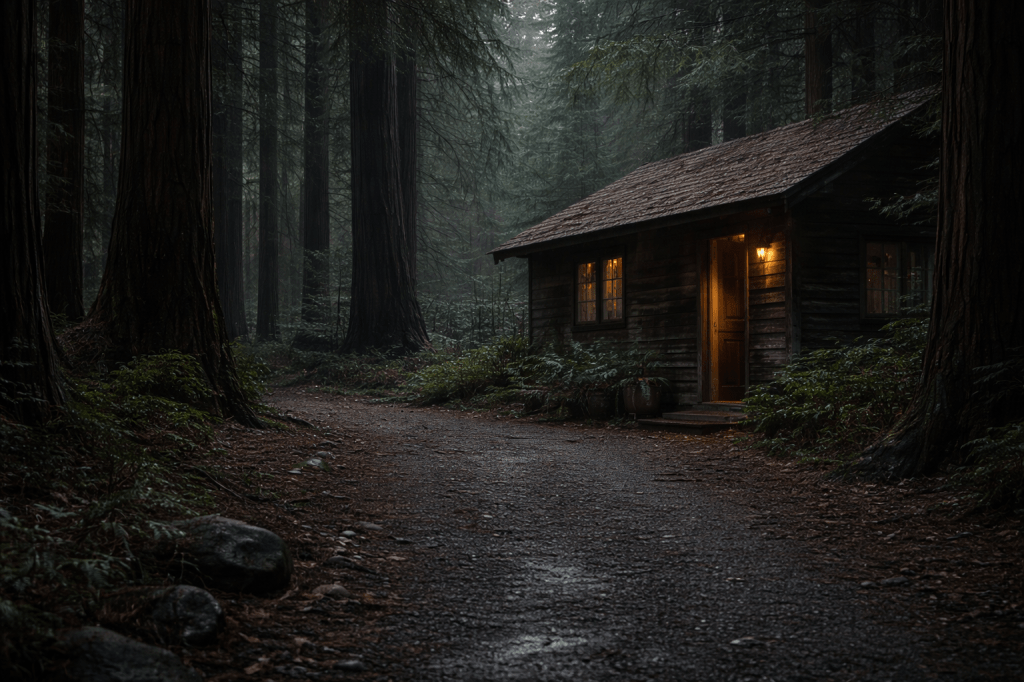
My feet crunched over the gravel path as I made my way toward the cabin. Of course it was the one furthest from the lodge, tucked deep among the trees as though Muirwood had looked at a map and thought, Let’s give the emotionally exhausted artist the longest possible walk.
The redwoods towered overhead, their trunks rising straight into the fading light. Back in Los Angeles there was always noise lurking somewhere—a siren several blocks away, a car rolling through an intersection, the low electrical hum of a city that never seemed capable of sitting still. Here, the silence felt different. Older. Large enough to notice.
By the time I reached the cabin, my shoulders had begun to loosen.
A little.
Not much.
Let’s not get carried away.
I kicked off my shoes at the door and immediately sank into soft earth.
“Oh, excellent,” I muttered. “Nothing says healing and self-discovery quite like muddy feet.”
The cabin smelled faintly of pine, old wood, and the sort of mustiness every retreat brochure politely avoids mentioning. A quilt covered the bed. A stone fireplace occupied one corner. A small window overlooked the forest.
And leaning against the far wall was a blank canvas.
I stopped.
Naturally.
What else would be waiting for me?
A forest retreat dedicated to creativity wasn’t about to let me spend a week avoiding the very thing that had brought me there.
I dropped my bag onto the bed and stared at the canvas.
The last time I had painted, really painted, had been months ago. Since then I’d sketched. Planned. Revised. Rearranged. Thought endlessly about painting.
Which, as it turns out, is not the same thing.
Sophia’s voice drifted into my thoughts.
You’re stuck, Elena.
I rolled my eyes.
“Easy for you to say.”
The canvas remained unimpressed.
For a long moment, neither of us moved.
Then I picked up a brush.
The first stroke came fast, before I could talk myself out of it. A slash of green cut across the white surface. Not careful. Not elegant. Just there.
The sight of it startled me.
For weeks I had been trying to control every mark before it existed. Now there was paint on the canvas and no taking it back.
Good.
I reached for another color.
Then another.
Soon green collided with blue. Burnt orange pushed through both. Paint dripped down the surface and onto the floorboards. Some landed on my hands. More landed on my sleeves. I didn’t stop to wipe any of it away.
For once, the mess felt honest.
A laugh escaped before I could stop it.
“Sophia would definitely have something to say about this.”
The thought lingered for a moment.
Then I smiled.
“Good.”
The Painting
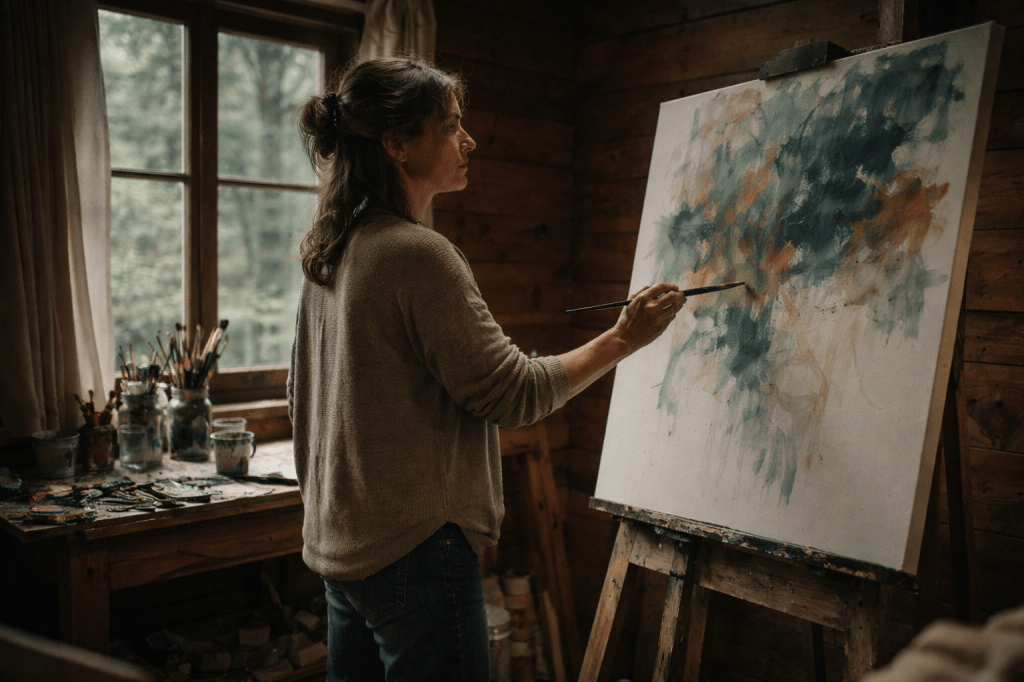
The painting had long since stopped resembling anything I could easily explain.
Colors crossed and collided without asking permission. A streak of orange cut through layers of blue. Brown emerged beneath both, grounding the chaos just enough to keep it from flying apart entirely. Every time I thought I recognized what the painting wanted to become, another brushstroke changed the conversation.
Normally that would have terrified me.
Instead, I found it strangely exhilarating.
“Well,” I said, studying the canvas, “this certainly won’t be ending up over someone’s beige sofa.”
The thought made me laugh.
Paint covered my hands and forearms. A smear of blue had somehow found its way onto my cheek, though I had no memory of putting it there. The floor around the easel looked like a small color explosion had occurred, and honestly, I was beginning to view that as a sign of progress.
Outside, the wind picked up, rattling the branches high above the cabin. The sound rolled through the redwoods and drifted in through the open window.
For a moment I stopped painting and simply listened.
The forest had a way of making everything feel less urgent.
The critics felt far away.
The galleries felt far away.
Even Sophia felt far away.
Not erased.
Just distant enough that I could finally hear my own thoughts.
I picked up the brush again.
The next stroke wasn’t careful.
It wasn’t strategic.
It wasn’t trying to impress anyone.
It simply felt right.
And for the first time in a long while, that seemed like reason enough.
At some point I stopped paying attention to what the painting was becoming.
For years that would have been unthinkable. Every brushstroke used to arrive with a committee meeting attached to it. Is this working? Does it belong? What will people think? Should I change it? Should I start over?
The questions never seemed to run out.
Tonight they were oddly quiet.
Not gone.
Just far enough away that I could finally hear something else.
My brush moved across the canvas in quick, confident strokes. Orange pushed through blue. Purple collided with brown. Colors I once would have separated now occupied the same space without apology, creating something messy and unpredictable and completely uninterested in my approval.
Honestly, I respected that.
Paint covered my robe.
My hands.
My legs.
A streak of cobalt blue had somehow appeared near my elbow, and I had long since accepted that trying to determine how paint arrived anywhere was a waste of valuable creative energy.
I stepped back and laughed.
Then laughed harder.
The kind of laugh that starts somewhere deep in your chest and catches you completely off guard.
To my horror, it was followed by tears.
“Oh, come on,” I muttered, wiping at my face. “We’re not doing a breakthrough montage.”
The tears ignored me.
Rude.
So I laughed some more.
Then I painted.
I painted with brushes.
I painted with a palette knife.
At one point I used the side of a ceramic mug because it happened to be nearby and because apparently I had abandoned all adult supervision.
The canvas became a riot of color and movement. A kindergarten rebellion. A fever dream. Bob Ross on three espressos screaming about the wage gap.
It should have been ridiculous.
Instead, it felt honest.
Outside, the wind moved through the redwoods.
Inside, paint continued finding its way onto every available surface.
Including me.
Especially me.
When I finally stepped back, breathing hard, I looked at the canvas for a long moment.
It wasn’t perfect.
Thank God.
Perfection had gotten me into enough trouble already.
This was something else.
Something louder.
Something stranger.
Something that belonged entirely to me.
For the first time, that felt like more than enough.
The Redwoods
The cool air wrapped around me as I wandered deeper into the trees, following a narrow path that disappeared between the redwoods. Evening had settled across the forest, softening the light beneath the canopy and turning everything beyond a few yards into shadow.
The trees rose impossibly high above me.
Back in Los Angeles, everything always seemed to be competing for attention. Buildings climbed higher. Billboards shouted louder. Even silence felt temporary, waiting for the next interruption.
The redwoods didn’t seem interested in any of that.
They simply stood.
Storms had come and gone. Fires. Droughts. Centuries of weather and change. Yet here they were, rooted exactly where they had chosen to be.
I stopped beside one of the larger trunks and rested my hand against the bark.
The surface was rough beneath my palm, solid in a way that felt almost reassuring.
For a long time, I had spent more energy than I cared to admit worrying about how I was perceived. Whether my work was good enough. Whether I was too much. Too loud. Too difficult. Too emotional. Not emotional enough.
The list changed depending on who was judging.
The redwood, meanwhile, appeared completely unconcerned.
I laughed quietly.
There was something almost enviable about that.
The forest wasn’t asking me to improve myself. It wasn’t demanding answers. It wasn’t offering life lessons disguised as inspirational wall art.
It was simply giving me space.
Space to think.
Space to breathe.
Space to exist without immediately turning that existence into a performance.
The silence here felt different from the silences I knew back home. It wasn’t empty. It wasn’t lonely. It wasn’t the silence of waiting for something to happen.
It felt generous.
I stood there for several minutes, listening to the wind move through the branches overhead.
The forest didn’t care whether my paintings succeeded or failed.
It didn’t care whether the colors clashed.
It didn’t care whether anyone understood what I was trying to say.
The trees simply stood where they stood.
For the first time all day, I found myself doing the same.
When I finally turned back toward the cabin, the night felt a little lighter than it had before. Maybe Muirwood wasn’t trying to fix me after all.
Maybe it was simply giving me enough quiet to hear myself again.
The Clearing
I stood at the edge of the clearing and watched the last light settle across the forest.
The redwoods no longer felt distant or unknowable. A few days earlier they had seemed impossibly large, the kind of ancient presence that made me feel small simply by standing beneath them. Now they felt familiar. Not because I understood them, but because I had stopped trying to.
The sky above the trees faded through layers of pink and violet as evening settled in.
Of course, pink.
For a color so often used to define women, it certainly seemed determined to follow us everywhere.
I shook my head and laughed quietly.
“Fine. You win this round.”
The breeze carried the scent of pine and damp earth through the clearing. Somewhere deeper in the forest, branches shifted softly against one another. The sound was gentle enough that it never demanded attention, yet impossible to ignore once you noticed it.
Back in Los Angeles, silence always felt temporary. It existed only in the brief space between interruptions.
Here, silence felt complete.
I stood barefoot in the cool grass and let the evening settle around me. There was nothing I needed to solve. No argument to rehearse. No future version of myself to chase down and become.
For once, simply being present felt like enough.
When I eventually glanced back toward the cabin, the painting was visible through the open window.
Color covered nearly every inch of the canvas now.
From a distance it looked chaotic.
Up close it probably looked even worse.
I smiled.
For years I would have worried about that.
Whether it worked.
Whether people would understand it.
Whether it fit neatly into the version of myself I thought I was supposed to present to the world.
Standing there, I realized I wasn’t particularly interested in any of those questions anymore.
The painting mirrored the forest in ways I hadn’t intended. Layers of color crossed and collided. Nothing matched. Nothing behaved. Nothing stayed neatly inside the lines.
Neither did life.
Neither did people.
And maybe that was the point.
The wind moved through the trees again, carrying the sound across the clearing.
I listened for a moment before heading back toward the cabin.
The painting was waiting.
Not for approval.
Just for me.
The Night Sophia Walked Away
The studio smelled of oil paint and turpentine, a scent so familiar I barely noticed it anymore unless I stopped and paid attention. Rain slid down the windows in uneven trails, blurring the city lights beyond the glass until Los Angeles looked less like a city and more like an impressionist painting that couldn’t decide what it wanted to be.
I’d spent most of the evening pacing.
Not working.
Not painting.
Just pacing.
There’s a difference.
Artists like to pretend pacing is part of the creative process. Sometimes it is. Other times you’re just avoiding the thing you already know and don’t want to admit.
Sophia stood by the window with her back to me, one hand resting against the sill.
“You’re afraid.”
I stopped walking.
Not because she was wrong.
Because she was right.
“You say that like you’ve uncovered some great mystery.”
Her reflection shifted faintly in the glass.
“Maybe I have.”
I laughed, though there wasn’t much humor in it.
“Trust me. I’m well aware I’m afraid.”
The unfinished canvas sat on the easel between us. We’d both been staring at it for weeks, though neither of us seemed particularly eager to discuss it directly.
Sophia turned toward me.
“Then what are you afraid of?”
I opened my mouth.
Nothing came out.
Which was annoying.
When you’re an artist, people assume you’re good with expression. They imagine you moving effortlessly through emotion and meaning and truth.
Meanwhile, I couldn’t answer a simple question.
Finally, I looked away.
“I don’t know anymore.”
The words hung in the air.
Rain tapped softly against the glass.
Somewhere outside, a siren wailed and disappeared.
“I used to know,” I continued. “At least I think I did. Somewhere along the way everything became about expectations. Galleries. Reviews. What sells. What doesn’t. What’s feminine enough. What’s too feminine. What’s bold. What’s marketable.”
I shook my head.
“Half the time I don’t even know whether I’m painting what I want anymore.”
Sophia didn’t immediately respond.
She rarely rushed into conversations the way I did.
It was one of the things I admired about her.
One of the things that occasionally drove me insane.
“And me?” she asked quietly.
The question landed harder than anything else she’d said.
I looked at her then.
Really looked at her.
The woman who had spent years encouraging me, challenging me, frustrating me, supporting me, and occasionally making me want to throw a paintbrush through a wall.
“Sometimes I can’t tell where everyone else’s expectations end and yours begin.”
The words escaped before I could soften them.
For a moment neither of us spoke.
Sophia looked down.
When she looked back up, something in her expression had changed.
Not dramatically.
Just enough.
“I never wanted that.”
“I know.”
And I did know.
That was what made it harder.
I took a slow breath.
“This isn’t really about you.”
The moment I said it, I realized that wasn’t entirely true.
I tried again.
“It isn’t only about you.”
That felt more honest.
A faint smile appeared at the corner of Sophia’s mouth.
“Better.”
I rolled my eyes.
Even then she was editing me.
“I need space,” I said.
The words felt less frightening now that they’d finally been spoken aloud. “Not because you’ve done something wrong. Not because I don’t care about you. I just… I don’t know how to hear myself anymore.”
The rain continued falling outside.
For a long moment Sophia said nothing.
Then she nodded.
Not happily.
Not angrily.
Just with the quiet understanding that sometimes people arrive at a point where they have to walk a difficult road alone.
“Space won’t fix everything, Elena.”
“I know.”
“And it won’t magically answer all your questions.”
“I know.”
Her gaze lingered on me for another moment.
Then she smiled sadly.
“Then take it.”
Those were the last words she said before she picked up her coat and walked out of the studio.
The door closed softly behind her.
I stood there for a long time afterward, listening to the rain against the windows and staring at the unfinished canvas.
For years I had wanted more freedom.
Standing alone in that studio, I discovered something nobody tells you about freedom.
Sometimes it arrives hand in hand with loneliness.
Morning
The next morning, I stepped outside with a mug of coffee and found the forest waiting exactly where I’d left it.
The redwoods stood motionless in the pale morning light. A thin layer of mist lingered between the trees, softening the edges of everything beyond the clearing. Somewhere overhead, a bird called once and then fell silent again.
I pulled my robe a little tighter around myself and took a slow sip.
For the first time since arriving at Muirwood, I wasn’t thinking about what came next.
No five-year plan.
No artistic reinvention.
No dramatic personal transformation accompanied by inspirational music.
Just coffee.
Just trees.
Just morning.
A small rabbit emerged from the brush near the edge of the clearing and paused as though considering whether I belonged there. We regarded each other for a moment.
The rabbit remained unconvinced.
Fair enough.
A second later it disappeared back into the forest.
I smiled.
The painting waited inside the cabin, but I felt no urgency to return to it. That surprised me. A week earlier I would have been obsessing over whether it was finished, whether it worked, whether it was saying the right thing.
Now it simply existed.
And somehow that felt enough.
A breeze moved through the clearing, stirring the branches high above me. The sound rolled softly through the trees, familiar now rather than intimidating.
I looked toward the cabin.
The painting was still there.
The questions were still there too.
Most of my life was still waiting for me beyond the forest.
Los Angeles hadn’t changed.
The galleries hadn’t changed.
The world certainly hadn’t changed.
But standing there in the cool morning air, I realized I wasn’t particularly interested in changing myself into someone else anymore.
That felt like progress.
I finished the last of my coffee and headed back toward the cabin.
The rabbit was gone.
The trees remained.
And for the first time in a very long while, I felt ready to meet whatever came next—not because I had all the answers, but because I had finally stopped demanding them from myself.

You must be logged in to post a comment.