
In the Winter of 2010, I had the opportunity to write this research paper for ARH 492 Modern Art, a course taught by the esteemed Dr. Sue Taylor at Portland State University. During this time, I visited the Portland Art Museum, where I closely studied two significant works of art on display. Originally titled Abstract Utopia, this paper—which was recognized by Dr. Taylor’s graduate students as one of the best they had read—explores the themes of abstract utopia through the analysis of Naum Gabo’s Linear Construction (No. 1 Variation) and Josef Albers’ Late Reminder.
Introduction
Naum Gabo’s Linear Construction (No. 1 Variation) and Josef Albers’ Late Reminder reflect a desire for abstract utopia through color, form and space.
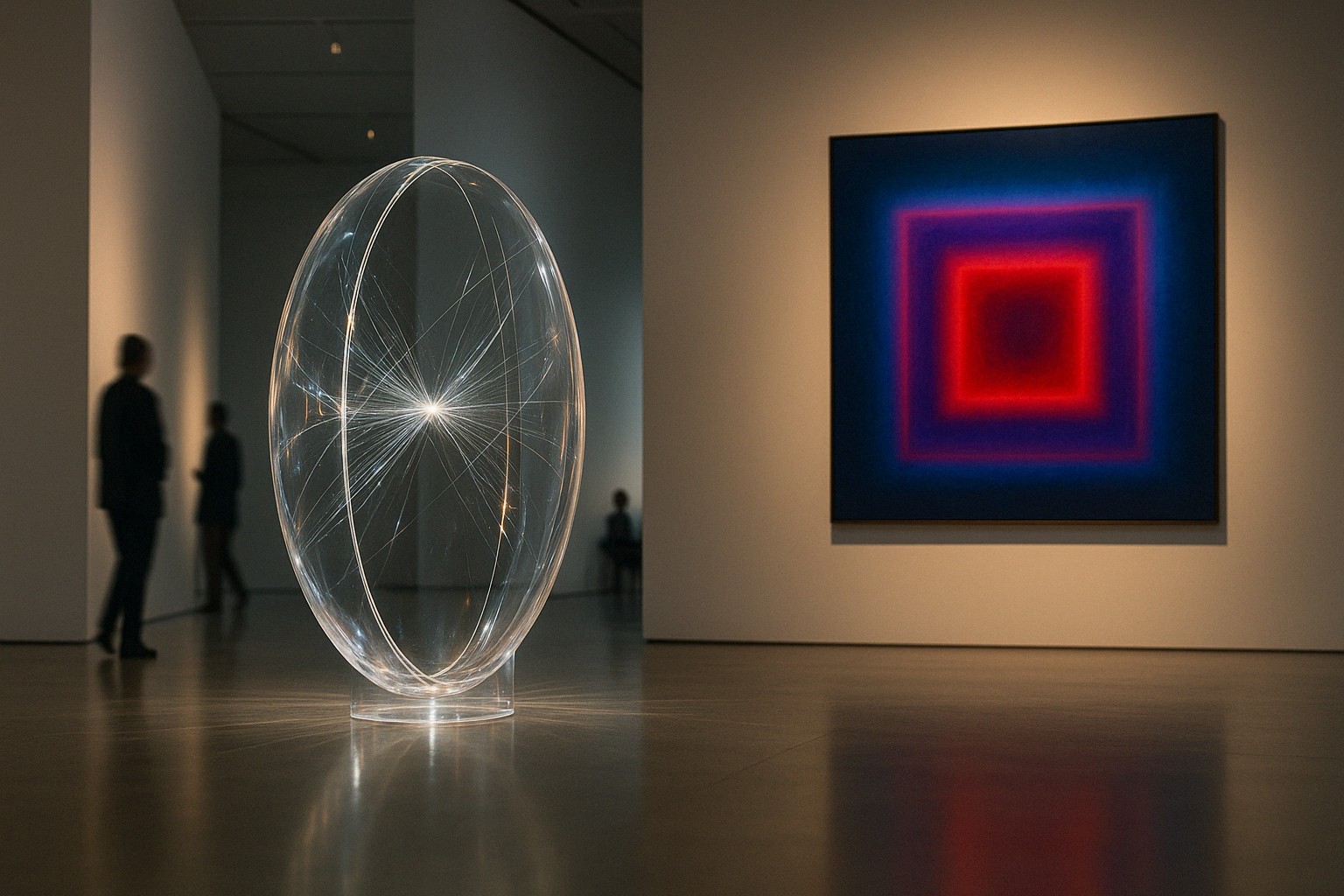
Naum Gabo. Linear Construction (No. 1 Variation).c. 1942-43.
Plastic and monofilament. 78.15.
Josef Albers. Late Reminder. c. 1953. Oil on masonite. 55.165.
Abstract Utopia in Color
One could see that color was an area that seemed to allow many artists, from the De Stijl movement through the Bauhaus, a new way to achieve a desire for abstract utopia. Emphasis on the flatness of the picture plane, autonomy of colour, banishment of literary subject matter—all traits seen today as typical of modernism—were thought to herald a collective style.[1] When the viewer observes Albers’ Late Reminder, a two-dimensional oil painting depicting three squares—a solid dark blue, red violet and red square—layered on top of each other, he or she could almost indicate the use of a simple color palette. The first thing the viewer may point out, if he or she had prior knowledge of basic painting, is that blue and red paint, when mixed together, create a dark purple color. But, while it’s also safe to assume that Late Reminder is just an ordinary color painting, it seems as though showcasing primary colors on masonite may not have been the overall goal in Late Reminder. What seems to be happening in Late Reminder is clearly a very basic layering of the contrasting dark violet, red and dark blue colors as if creating a visual experience for the viewer’s eyes. Instead of working together as a harmonious group, the colors now seem to work against each other and almost create an uncomfortable vibration from the viewpoint of the viewer’s eyes. Even the appearance of a rough textured beige border around the entire composition almost adds another layer of contrast that gives the viewer’s eyes a relief from the three contrasting colors. It’s safe to say then that Albers’ Late Reminder is clearly a composition made to challenge the viewer in how he or she sees and read color on a two-dimensional surface, similar to reading a normal eye chart at the eye doctor’s office.
When looking at Gabo’s Linear Construction, a small, three-dimensional plastic sculpture consisting of a large cutout oval circle, very thin monofilament strands and basic but slanted plastic framing, one may be confused as to how color is being applied to the sculpture. To the viewer, he or she may assume that the plastic material being used, which has a smooth, transparent look, may seem less than colorful. However, when the viewer views Linear Construction, he or she could see that the intention may have been to make the transparent plastic and monofilament materials become the actual color of the entire sculpture. And while the same qualities of transparency and shadowless form could also be effected in glass, the versatility of plastic gave a new dimension to the constructive technique, making possible subtle shapes and visual nuances as well as introducing connotations of modernity.[2] Also, by observing the transparency in Linear Construction up close—especially in a well-lit environment—the viewer starts to see tiny reflections of light from within the monofilament strands. Seeing this reflection of light within the monofilament strands almost gives the impression that Gabo’s Linear Construction is a new unwrapped toy—a new artistic idea—waiting for artists to experiment with.
The Role of Form in Modern Art
Though color was one area of exploration, form was another area that seemed to have provided many artists the opportunity to create a new and progressive desire for abstract utopia. “Progress” is properly a function of a collective, and it is measured through “objective” symbols of “revision” and “resolution.”[3] Looking back at Albers’ Late Reminder, it’s safe to say that the three squares created stand for more than just basic design shapes. It’s as if the three squares are meant to symbolize a form of “back-to-the-basics” attitude, an attitude—which could be similarly seen in the De Stijl movement—that seems to focus on the actual rendering of lines in a basic square shape. De Stijl rejected organic forms that they deemed animalistic and wild, instead emphasizing a harmonious balance of straight vertical and horizontal lines.[4] With Late Reminder, the three squares clearly show perfect vertical and horizontal lines. However, unlike the heavy bold lines seen in De Stijl artist Piet Mondrian’s Composition II in Red, Yellow and Blue from 1930, the squares in Late Reminder are clearly formed through an overlapping of color within the three squares. With a simple representation of invisible lines and filled squares, Late Reminder almost gives the viewer the impression that he or she is meant to visually connect-the-dots with his or her own eyes to see all three squares interacting with each other within the pictorial space.
But in the case of Gabo’s Linear Construction, the viewer can make the assumption that the De Stijl theory of Neo-Plasticism may have played an inspirational role for taking basic, three-dimensional form to a new level of meaning. The “plastic vision,” or Neo-Plasticism, of De Stijl saw itself as reaching beyond the changing appearance of natural things to bring us into intimate contact with an immutable core of reality, a reality that was not so much a visible fact as an underlying spiritual vision.[5] From this, the viewer may be compelled to make an assumption that Linear Construction almost represents a desire to strip away excessive and decorative architecture and instead bring more focus back to elementary shapes as a template for a new and simple way to create art.
Therefore, what Gabo’s Linear Construction seems to present to the viewer could be interpreted by he or she as a blueprint to a new view in art and architecture: one that seems to focus on the “material” as the heart of a design. In a way, the viewer could automatically look back to the Bauhaus and see how many of its artists engaged in explorations into form. By fusing aesthetic principles with the materials and methods of modern production, the Bauhaus attempted to establish a “humanistic technological culture” in which workers regained their status as artisans, and commodities maintained ethical as well as functional value.[6] In a way, the viewer could make the assumption that artists may have been striving for a new form of art that could become mass produced for the average person’s home instead of being displayed in a museum gallery.
Also, upon closer inspection, the viewer can see plastic and monofilament working together like a symphony within Gabo’s Linear Construction. The thin monofilament strands almost create an overlapping yet smooth barrier of lines around the center oval circle with plastic acting as a slightly tilted square frame around the monofilament strands. What the viewer may also find interesting, if he or she were to step away and view the sculpture from a distance, is the thin monofilament strands blending in within the sculpture, giving an illusionary look of a free-form shape blossoming within the center oval circle. By seeing this illusionary shape within the monofilaments, the viewer could make the assumption that what he or she is seeing is almost a rebirth of the basic shape, where now instead of a shape being a secondary support to a design, the shape becomes the important piece to the overall look of a design.
One other interesting aspect the viewer can see in Gabo’s Linear Construction is how both sides of the slanted plastic frame are formed into the shape of a pointing arrow. If the viewer were to draw a crude picture of an arrow on a piece of paper, he or she could say an arrow stands for a basic symbol of direction. Therefore, in Albers’ Linear Construction, it’s as if the arrow-shaped frame is communicating to the viewer that plastic and organic shaped-construction is a new direction in art where the artist can build and rebuild ideas using simpler methods and materials.
Spatial Exploration and Abstract Utopia
Lastly, the desire for abstract utopia clearly didn’t end with explorations in color and form. Space was another area that provided an opportunity for artists to further develop their desire for abstract utopia. According to Susan A. Denker, the early beginnings of De Stijl included “a characteristically restful and harmonious resolution of pictorial or architectural balance; the inclination to work with the picture plane not as a window of space, but rather as a front-facing, two-dimensional surface first and foremost.”[7] With that, the viewer can clearly see this same De Stijl principle being used within Albers’ Late Reminder. However, it’s safe to say that more focus is being placed on having color and shape interacting within a static, pictorial space. Also, the way the three squares are arranged in the composition also seem to present an interesting look into the arrangement of objects within the pictorial space. Here, the viewer can see the three squares placed in an organized way with even margin space around the center two squares and near even margins around each of the overlapping squares. With these margins, it’s as if Late Reminder now becomes a large-scale layer of windows that, if the viewer were to open one window and then another, he or she can see depth gradually fading into the horizon line giving the impression of being in a long, never-ending hallway.
With Gabo’s Linear Construction, one could see the De Stijl concept of Neo-Plasticism being used again in terms of creating a sense of space. According to Jonneke Jobse in his book, De Stijl Continued The Journal Structure, with Neo-Plasticism, “pure constructive art can now develop towards an increasingly strong spatial and cosmic expression.”[8] Whether or not the viewer can determine if Linear Construction has any cosmic meanings, he or she can automatically see instances of spatial interaction at work. A perfect example the viewer may point out would be in the setup of the monofilament strands surrounding the center cutout oval shape. Here, the monofilament strands seem to parallel each other which, when viewed from a certain angle, create an interesting illusionary effect of lines splitting off and weaving together with each other. Seeing this static but interactive weaving of monofilament lines almost represents a visual thread guiding the monofilament lines and stitching them together into a complete and complex sculpture. Thus an entirely new sense of directional freedom within a three-dimensional space is created, an interpenetration of lines of force, and a dynamic balance.[9] With this, it’s almost as if Linear Construction becomes a work of art that places the materials within the three-dimensional space and allows the materials to combine and create the work of art itself. Therefore, it’s safe to say that Gabo’s Linear Construction may have been more concerned with how certain materials of all shapes and sizes interact with each other in a three-dimensional space to create a unified object.
Conclusion
Abstract art has been—and certainly will remain for years to come—a staple in the world of modern art. Even as new techniques and materials emerge that allow an artist or group of artists to expand his or her desire to communicate a new form of art, the work of art will always remain timeless. It’s safe to conclude then that Gabo’s Linear Construction (No. 1 Variation) and Albers’ Late Reminder are two of the best examples that reflect a desire for abstract utopia through color, form and space.
References
1. Michael White, De Stijl and Dutch modernism (Manchester: Manchester University Press, 2003), 12.
2. Elizabeth Rankin. “A Betrayal of Material: Problems of Conservation in the Constructivist Sculpture of Naum Gabo and Antoine Pevsner.” Leonardo, vol. 21, no. 3 (1988), 286.
3. Lucian Krukowski. “Hegel, “Progress,” and the Avant-Garde.” The Journal of Aesthetics and Art Criticism, vol. 44, no. 3 (Spring 1986), 281.
4. Leah Modigliani. “Shape Shifting: The Changing Objects of Modernism and its Aftermath.” Art Criticism, vol. 22, no. 2 (2007), 75.
5. Susan A. Denker. “De Stijl: 1917-1931, Visions of Utopia.” Art Journal, vol. 42, no. 3, Earthworks: Past and Present (Autumn 1982), 243.
6. Michelle Ferranti. “Utopia and Its End: Karl Mannheim’s “Sociology of Knowledge” and the Private Writings of Oskar Schlemmer.” Utopian Studies, vol. 15, no. 2 (2004), 40.
7. Denker. “De Stijl: Visions of Utopia,” 242.
8. Jonneke Jobse, De Stijl Continued: The Journal Structure (1958-1964): An Artists’ Debate (Rotterdam: 010 Publishers, 2005), 230.
9. Robert Goldwater and René d’Harnoncourt. “Modern Art in Your Life.” The Bulletin of the Museum of Modern Art, vol. 17, no. 1 (1949), 19.
 Scott Bryant
You must be logged in to post a comment.