
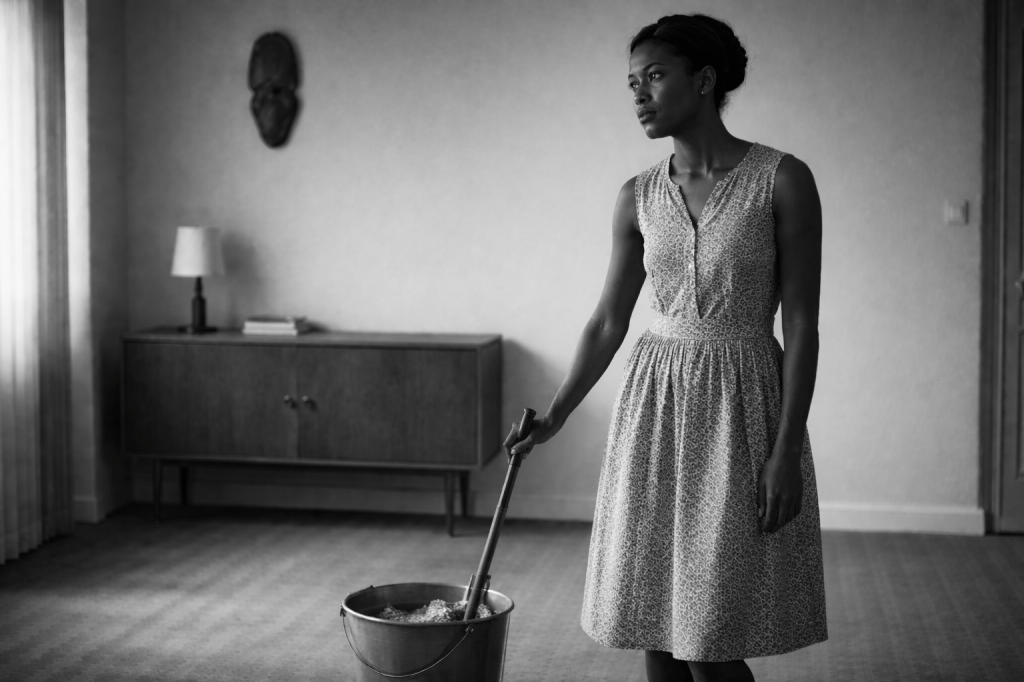
There’s a moment in Ousmane Sembene’s 1966 film Black Girl when Diouana (Mbissine Thérèse Diop), the young Senegalese woman at the heart of the story, sits alone in her employer’s stark French apartment. She stares ahead, her face a mask of exhaustion and quiet despair. The camera lingers, drawing us into her solitude. Without a word, we feel the weight of her reality—her isolation, the betrayal of her dreams, and the slow erosion of her dignity.
Sembène’s Black Girl (1966) thrives on such moments. The story—of a woman who leaves Dakar for France to work as a domestic servant, only to find herself trapped and dehumanized—is devastating in its simplicity. But it’s through the visuals, particularly the close-ups of Diouana’s face, that the film captures the depth of her experience.
At first, Diouana’s face glows with hope and pride. She wears a floral dress and high heels as she arrives at her employers’ apartment, imagining a life of opportunity. But as her reality sets in—the endless chores, the indifference of her employers, and the suffocating confinement of the apartment—that light dims. Her expressions grow distant, her hope fading into frustration and resignation.
One of the film’s most poignant moments comes when Diouana’s employer takes the white mask she brought from Senegal and hangs it on the wall like an ornament. The mask, a piece of her heritage, becomes just another decoration in the apartment, its meaning erased. When Diouana reclaims it, holding it close, it feels like an act of quiet defiance—a way to cling to her identity in the face of erasure.
Sembène uses these quiet visual moments to tell Diouana’s story. In one scene, she scrubs the floors while her employers lounge on the balcony. The stark contrast between their lives and hers underscores her exploitation. The camera stays with her, capturing the flickers of anger and exhaustion on her face. In these subtle gestures and glances, the film reveals her alienation and humanity.
By the time Diouana stops eating and retreats into herself, her silence says everything. In one of the film’s final moments, she sits on the bed clutching the mask, her gaze heavy with despair. It’s not just a sign of resignation—it’s a refusal to participate in a world that has reduced her to nothing more than a servant.
Watching Black Girl, I was struck by how much we communicate through expression alone. Sembène’s focus on Diouana’s face reminds us that even in silence, there’s a voice. In every glance, there’s a story waiting to be understood.
Diouana’s story is specific, yet universal. It’s about the dehumanization of labor, the weight of cultural displacement, and the yearning to be seen as more than a role or label. Through her eyes, Sembène makes us witness not only her pain but her resilience—a reminder of the quiet, powerful ways people resist being erased.
In the end, Black Girl is not just a tragedy; it’s a testament to humanity. And through Diouana’s gaze, we are reminded of the strength and fragility that comes with simply being seen.
Watch the trailer for Black Girl (1966) to experience Sembène’s striking visual storytelling and Diouana’s poignant journey of resilience.
 Scott Bryant
You must be logged in to post a comment.