
A Wolf in Red’s Woods – Part I
Story Written & Told by
Red Valois, Élode Valois,
Madeline Valois, & Sylvie Châtillon
Visuals & Imagery Created by
Red Valois, Élode Valois, Madeline Valois, Sylvie Châtillon, Faylinn Willowshade,
Rowena Brightmoor, & Scott Bryant
With care and reverence, their story is shared by
Scott Bryant at the request of Red Valois, Élode Valois, Madeline Valois, & Sylvie Châtillon
❦
Not Your Average Fairy Tale
Once upon a time, at the edge of a vast and ancient forest, at the edge of the Forêt d’Orne, older than the kings of France and filled with whispers older still. Near Bois-de-Rouge, where the church bells still ring at sunset, a brave, kind-hearted, fabulous, and fiercely determined woman lived in a small cottage with her mother.
That woman?
Me. Red Valois.
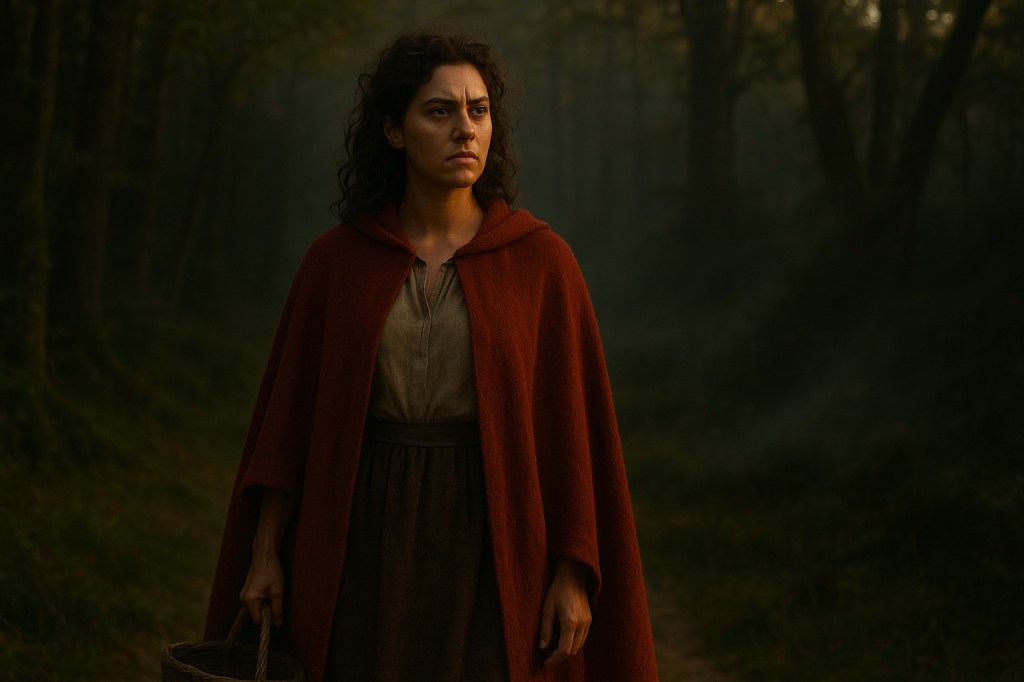
Now, I know what you’re thinking: “Oh, great, another retelling of Little Red Riding Hood.”
Wrong.
This is nothing like the fairy tales you’ve heard. Because this time? The story is mine to tell, and trust me—it’s a lot better without the patriarchal nonsense.
Cue my mother, Élodie, chiming in.
(Élodie’s Voice)
“Red, darling, don’t forget to mention that you inherited your courage from me.”
Yes, Mother.
Everyone, meet Élodie—the Guardian of the Sacred Grove, dispenser of ancient wisdom, and master of sly interjections.
(Élodie’s Voice, with a chuckle)
“And don’t you forget it.”
But let’s not get ahead of ourselves. The forest may seem peaceful now, but it holds secrets—some of them dark, some of them deadly.
Known throughout the village for her adventurous spirit, I inherited my courage from my mother, Élodie, and my grandmother, Madeleine. Both are fearless, independent women who taught me everything I know.
Wearing a cloak woven in the Basque tradition, passed down from her mother, mother Élodie moved purposefully through the village, nodding in quiet acknowledgment as the villagers bowed their heads not out of fear but with the old hand-to-heart gesture once used for priestesses in the Loire Valley. Élodie wasn’t just my mother—she was the Guardian of the Sacred Grove, and the villagers treated her with the kind of reverence usually reserved for royalty.
(Élodie’s Voice)
“Red, you’ve been standing there staring for far too long. Are you coming with me or not?”
“Good morning to you too, Mother. And no, I’ll meet you at the Grove later. I have a few errands to run in the village.”
My mother rolled her eyes but gave me one of her rare, almost-smiles.
(Élodie’s Voice)
“Suit yourself, but don’t get distracted. I have things to discuss with you later.”
My mother was like that—always poised, always knowing more than she let on. She strode toward the edge of the forest, her steps confident and deliberate, as if the trees themselves were watching her.
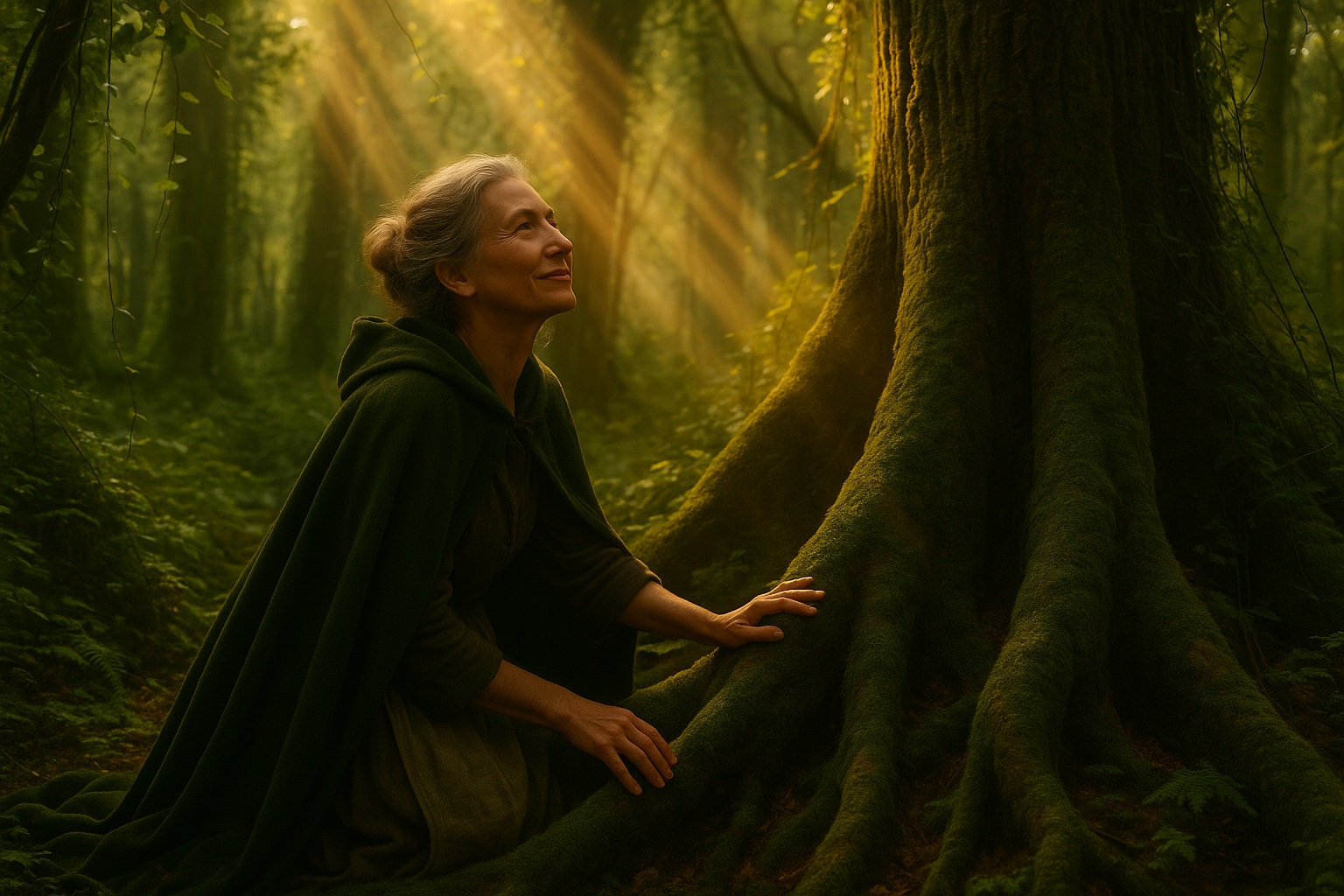
Later, as I approached the Sacred Grove, I watched her kneel, her hands resting lightly on the forest floor. The Grove seemed to hum around her, a faint breeze whispering through the trees as if answering her silent prayers.
The Sacred Grove was more than just a place—it was a bond, a sacred connection between the forest and its Guardian. They say the trees here once crowned Gallic queens before Julius Caesar ever crossed the Rhône.
The village elders had entrusted my mother with its secrets years ago, and she’d protected it ever since. Watching her now, I felt a mixture of awe and pride. My mother knelt in the Grove’s mossy clearing, hands pressed to the soil like it was her own pulse she was feeling. Around her, the air trembled—not just with wind, but with memory. They say this forest once belonged to Arduinna herself, goddess of the wild and protector of women.
And today? It still does
“How do you do it, Mother? Keep the balance, I mean.”
(Élodie’s Voice, without looking up)
“You listen. The forest will always tell you what it needs.”
That was my mother—quiet strength and endless wisdom wrapped in a woman who could command both spirits and stubborn villagers without raising her voice.
Growing up, she taught me the forest’s secrets, how to read its signs, and how to befriend the creatures that called it home. We’d spend hours exploring together, her calm guidance teaching me not just survival, but respect—for nature, for the spirits, and for myself.
And then there’s Grandmother Madeleine.
She’s… something else entirely.
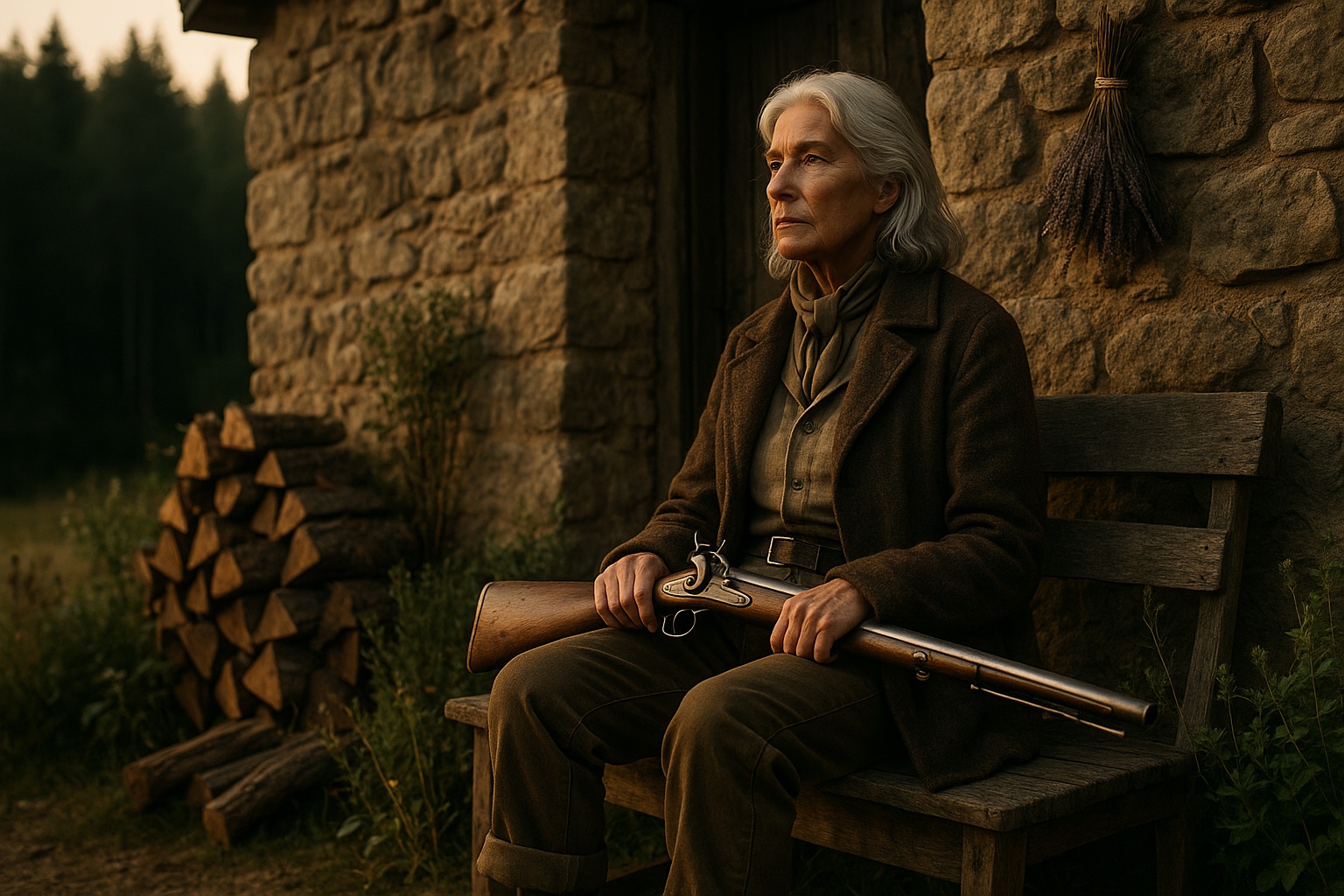
My grandmother, Madeleine, is a legend in her own right. She’s trekked across deserts, jungles, and mountains, her tales of adventure filling my childhood with wonder.
(Élodie’s Voice, with a sigh)
“And unpredictability.”
You know you admire her.
(Élodie’s Voice)
“I admire her resilience. I question her timing.”
Timing or not, Grandmother Madeleine has never let age slow her down. When I’d last seen her, she was rallying a group of women to deal with a certain problem plaguing the forest: Fenris, a cursed wolf whose arrogance and cruelty knew no bounds.
“Mother, do you think we’ll ever be rid of Fenris?”
(Élodie’s Voice)
“Not without effort. But we’ll handle him as we always do—with precision and purpose.”
She turned her gaze toward me, her expression steady but kind.
(Élodie’s Voice)
“And, Red, it’s time you took a greater role. The forest needs you, just as it needed me and your grandmother before you.”
The weight of her words settled over me, heavy but not unwelcome. This wasn’t just her story—or even Madeleine’s. It was ours.
❦
Morning Preparations
One sunny morning, my mother, Élodie, was busy preparing a basket: a wedge of Comté, two slices of pain de campagne still warm from Madame Fournier’s bakery, and a small jar of quince jam.
The aroma of baked goods filled our cozy cottage, mingling with the wildflowers adorning the windowsills.
It was the kind of morning that made everything feel peaceful—except for the fact that I already knew what was coming next.

(Élodie’s Voice)
“Red, dear, take this basket to your grandmother before you head off on another one of your ‘adventures.”
“Again? We just gave her a basket last week. Those treats should’ve lasted her for weeks. Wasn’t she just up at the Northern Peaks last month? Honestly, Mother, this is what I deal with every day.”
(Élodie’s Voice, smirking)
“Well, you can let her know how you feel—after you’ve delivered this. I promised her a fresh basket a week ago, and I don’t break promises.”
“Right, because you never get caught up in village negotiations and endless haggling…”
(Élodie’s Voice)
“And that’s why I’m sending you to handle the delivery.”
She gave me a knowing smile as she finished packing the basket with ease, the smell of freshly baked bread practically taunting me.
“Sometimes I think you enjoy this too much.”
(Élodie’s Voice)
“I heard that.”
She handed me the basket.
For a moment, she didn’t say anything. Just looked at me, like she was memorizing the shape of my face.
(Élodie’s Voice)
“And be careful. You know the forest isn’t as safe as it once was. The birds stopped singing near the old pine grove. Even the moss doesn’t grow the same way anymore.”
“Mother, you worry too much. I’ve got this.”
(Élodie’s Voice)
“That’s what worries me.”
With that, she turned back to her work, leaving me standing there with the basket and a mix of amusement and exasperation. Typical Élodie—always one step ahead, always in quiet control.
“Oh, my adventurous, witty mother. I can always count on you for the village news and humor.”
(Élodie’s Voice, with a sly smile)
“Now that you mention it, Red… Have you heard about that Jack character? You know, the one over the green hills near what used to be the witch’s gingerbread house?”
“Encore cette idiote de Jack. Il mérite une claque, pas un conte.”
(That idiot Jack again. He deserves a slap, not a story)
(Élodie’s Voice)
“Now, now Red…”
“Yes, Mother, I know that Jack. The one who climbed a beanstalk, robbed a giant, and somehow came out the hero? What’s he done now—pushed Jill and the other Jack down the hill again?”
Mother let out a soft chuckle, her eyes sparkling with amusement.
(Élodie’s Voice)
“Worse. His mother said he climbed some enchanted beanstalk into a giant’s castle and made off with gold, a golden goose, and a harp. She’s been pulling her hair out, poor thing. Says she raised a boy, not a climbing fool.”
“Of course he did. He’s a man. And now he’s back, stirring up more chaos, I bet. He picked up an axe, chopped down the beanstalk, and killed the giant with minimal effort and gets the glory. I bet either his mother or the harp told him to and he took the credit. But really, in a world where nobody listens to women, why is Jack always the headline act? He doesn’t need more fairy tale clout than he already has. Jack’s life is like a one-way cobblestone street of disaster. Even for him.”
Mother laughed, shaking her head as she placed a cloth over the basket.
(Élodie’s Voice)
“That’s a good one, Red. I’ll have to borrow that line the next time I’m at the market. And you’re not wrong—just be glad the giant didn’t follow him down. We’d be dealing with 15 stories of fury right now. And that’s the last thing this fairy tale economy needs—another massive problem. But enough about Jack. You’d better get going. And, Red…”
I raised an eyebrow, already knowing what was coming.
Watch out for the wolf.
“Yes, Mother, we’ve been over this a hundred times.”
She didn’t answer right away. Instead, she stepped closer, smoothing a stray strand of hair behind my ear.
(Élodie’s Voice, softly)
“Every adventure might make a great story, but only if you come back to tell it.”
I smiled, grabbing the basket from the counter.
“Don’t worry, Mother. I’ll be back before you know it.”
Mother gave me one of her trademark winks, the kind that managed to be equal parts reassuring and knowing.
(Élodie’s Voice)
“Good. Now go before your grandmother wonders where her treats are. And don’t let her rope you into her next wild adventure—at least not before dinner. Tiens-toi droite, ma fille (Stand tall, my girl).”
“Pas de promesses. Et les bois savent quand j’arrive.”
No promises. And the woods know when I arrive.
As I took a deep breath, I glanced back at mother, who was busy tending to the garden.
There’s something about watching your mother work, isn’t there? It’s like she’s always in control, always one step ahead.
❦
Sylvie the Woodsperson
The familiar path stretched out before me, the forest alive with the rustling of leaves and birdsong. Sunlight filtered through the canopy in shifting patterns. The scent of pine and earth filled the air, grounding me as I walked.
Rounding a bend, I spotted Sylvie, standing tall and steady, like the trees she protected.
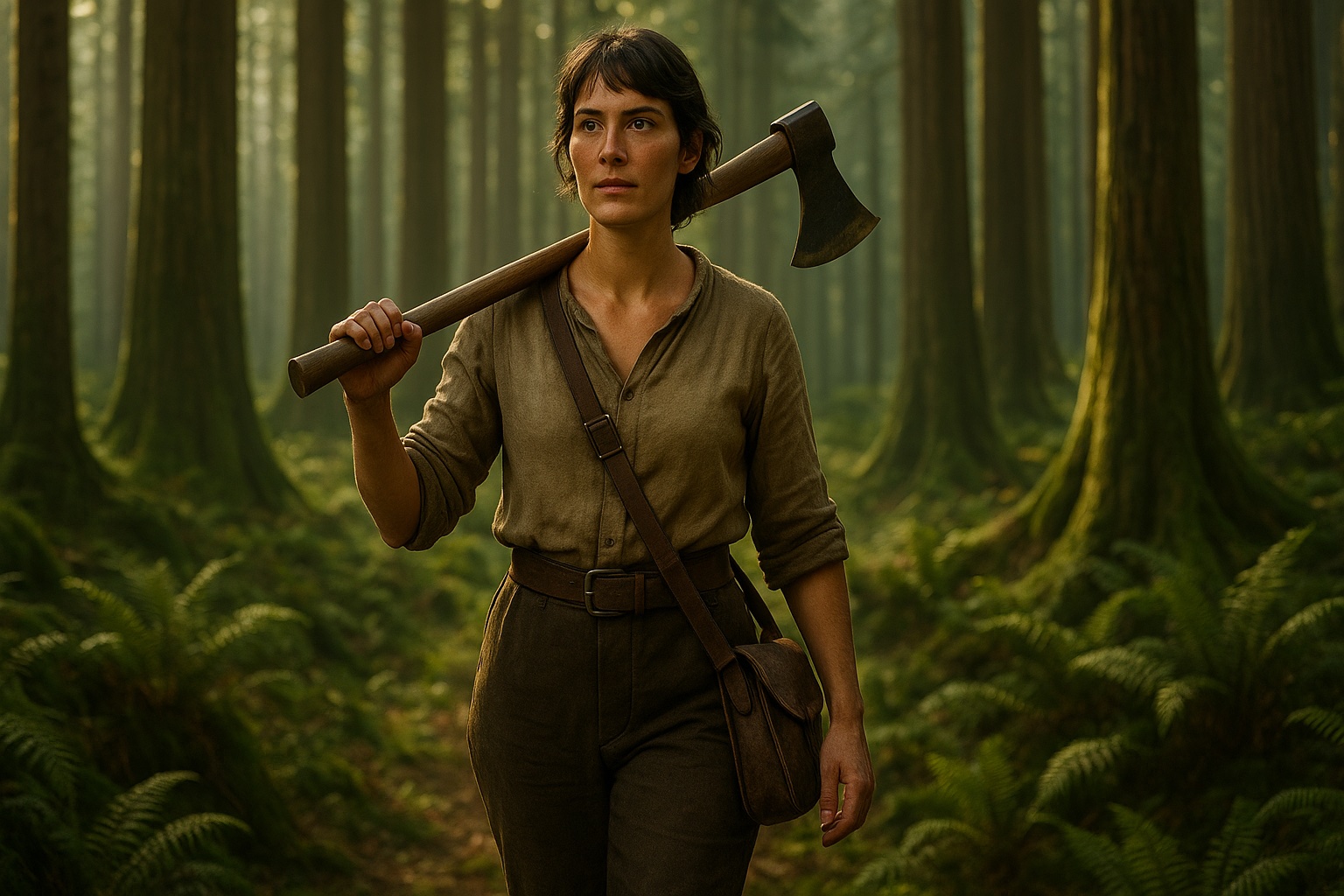
She wasn’t alone with the woods—she was part of them.
Before she saw me, she paused at an ancient waystone, half-buried in moss. The stone was etched with weathered symbols—scratched in haste, long ago.
(“Put here during the Fronde,” she once told me, “when women smuggled letters past royal patrols. They left signs here—so others could find the way.”)
Her fingers brushed the carved lines like greeting an old friend. Her axe hung over her shoulder, worn but lethal—forged, she’d said, in the same blacksmith’s forge where Résistantes once hid during the war, sharpening their blades in silence.
“Tools of defiance,” she had called them. “In the hands of women? They become legacy.”
(Sylvie’s Voice, calm and warm)
“Well, if it isn’t Red Valois. Off to your grandmother’s again?”
“Another delivery, another adventure plan. The Northern Peaks this time.”
(Sylvie’s Voice, smirking)
“That woman doesn’t rest. Neither do you.”
Sylvie’s sharp eyes swept the trees.
Protector, mentor, family. The village told stories of her legendary hunts—the Silver Fox, the Fire-Feathered Roc—but I knew the truth. Sylvie hunted for justice. A sister lost long ago.
I kept it light.
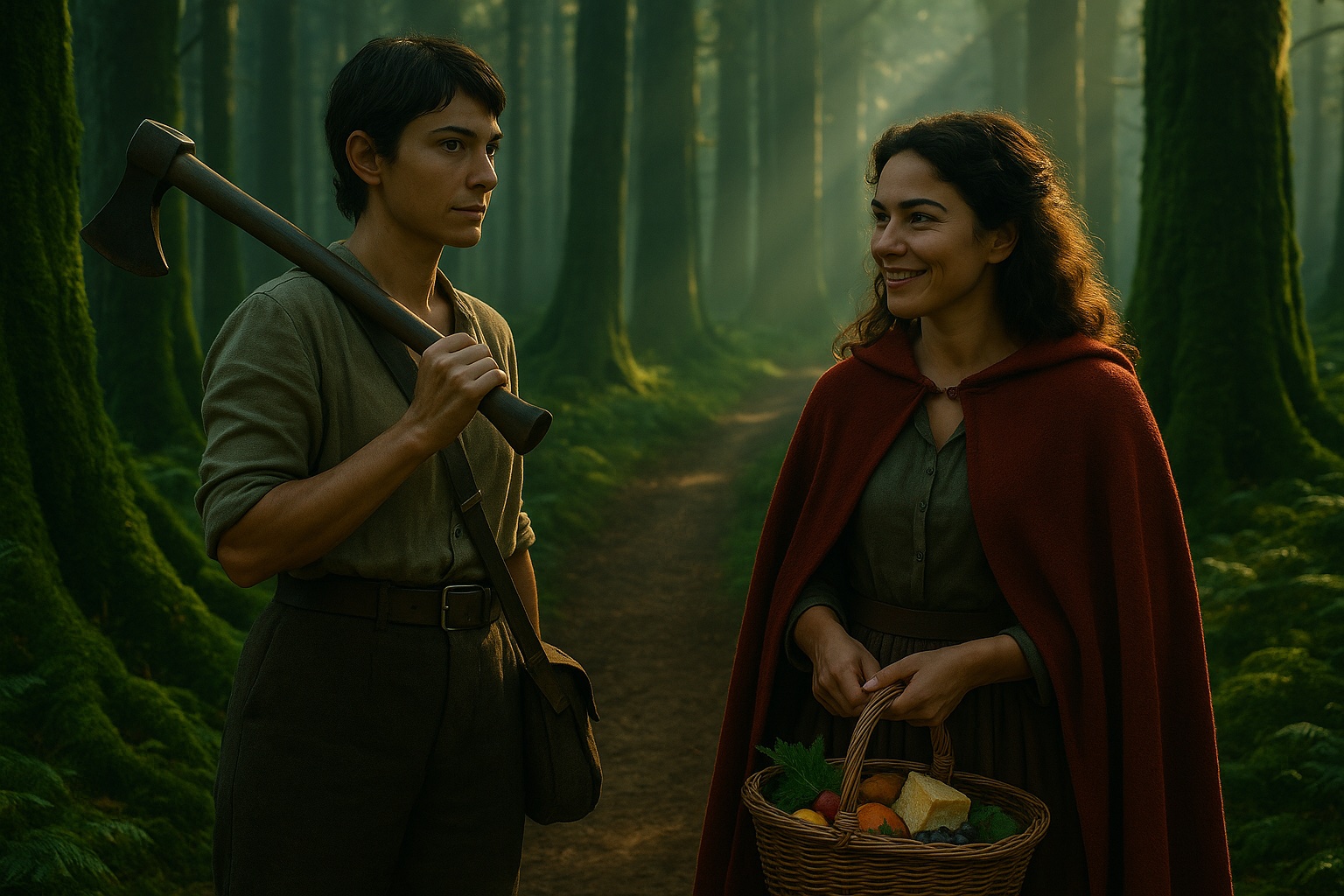
“You’re turning into my mother. ‘Stay on the path, watch for wolves.’ Competing for most worried, are we?”
(Sylvie’s Voice, dry)
“Someone has to. Fenris is still out there. And I can’t follow you around with an axe.”
“Relax. I’ve handled worse.”
(Sylvie’s Voice)
“He’s patient. One mistake is all he needs.”
“Good thing I’m not making any.” I grinned. “But hey, if you get tired of tree patrol, there’s always court jester in the queen’s court.”
(Sylvie’s Voice, with a rare laugh)
“I don’t do silly hats.”
We shared a nod. Sylvie turned to her patrol, and I continued on. But her words lingered.
I started walking again. But the leaves didn’t sound the same.
Something in her voice—like she knew more than she said.
(Sylvie’s Voice, over her shoulder)
“Eyes open, Red.”
“Always.”
❦
The Wolf
As I turned a bend in the path, the forest grew darker. I pulled my hood up. Shadows thickened around the trees, and the air turned unnaturally still.
Then I saw him—a large, dark figure stepping onto the path ahead.
The wolf. Fenris.
The villagers once called him le Loup du Silence, the Wolf of Silence, because every girl he stalked stopped singing. Their voices faded from the fields, their laughter from the wells. Mothers would hush daughters when the air grew still, whispering,
“Il rôde quand les chansons meurent.”
He prowls when songs die.
His eyes gleamed with a predatory glint, and his smile stretched too wide, teeth glinting like blades.
Fenris wasn’t just a cursed man. Etched into the twisted fur along his neck, the black sigil pulsed faintly—its lines carved in curling, ancient Langue d’Oc script, lost to all but the most devoted keepers of southern folklore. It spoke of famine-wolves, of mountain curses, of deals struck in forgotten abbeys.
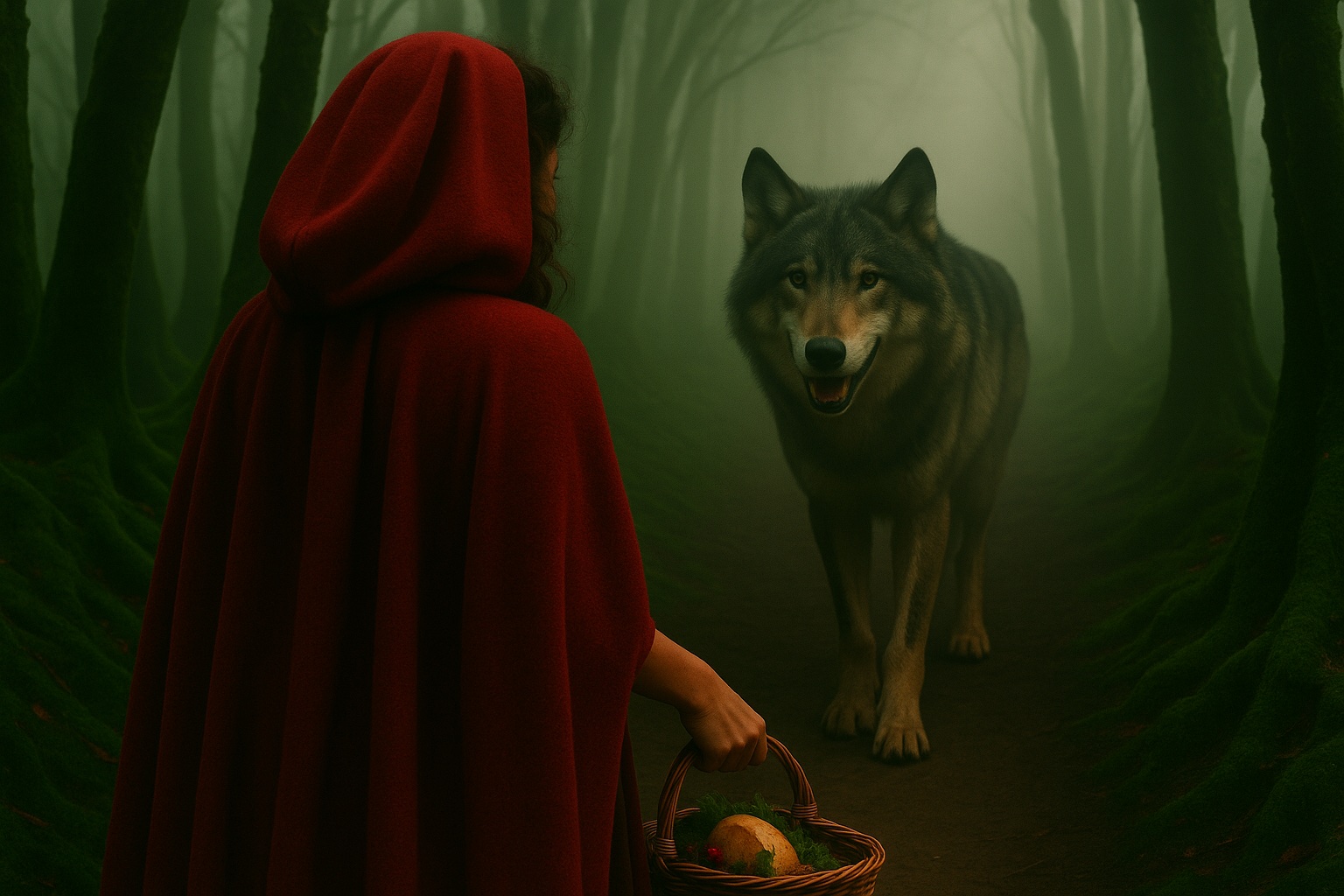
His eyes gleamed with a predatory glint, and his smile stretched too wide, teeth glinting like blades.
Great. Just my luck. Of course, I’d run into Fenris today.
Fenris was no ordinary wolf. Once, he’d been a man—a cruel, ambitious hunter who reveled in taking whatever he wanted: gold, livestock, lives. But his greed had led him to challenge forces far beyond his understanding. The curse didn’t humble him; it turned him into something far worse—a beast who relished in his monstrous form.
And now, here he was, blocking my path.
Fenris’ Voice, smooth and mocking)
“Well, well, what do we have here? A little girl all alone in the woods? Tell me, my dear, is that basket for me?”
“Oh, Fenris, please. Don’t tell me this is your best attempt at intimidation. The whole ‘big bad wolf’ act is getting a little tired.”
His smile faltered, just slightly, before returning with a more dangerous edge.
And then—his voice dropped. Lower. Quieter.
(Fenris’ Voice, thoughtful)
“You know, Red… they never ask why I became this way.”
(Fenris’ Voice, eyes gleaming)
“You hear the forest too—the whispers, the things beneath the roots.”
I saw it then—a black sigil curling along his collarbone, pulsing faintly like a dying ember.
For a moment, I thought I felt it pulse in me too. But I’m not him.
I pressed my boots into the earth, steadying myself. The ground was solid beneath me. The wind in the trees was only wind. And the fear… was his, not mine.
The mark on Fenris was a warning.
One I had already answered.
(Fenris’ Voice, voice lowering)
“You don’t even know its name, do you? The thing that waits beneath the roots. They once called it Noxmar, the Hollow Hunger. It feeds on silence. On secrets. On the fear women are taught to swallow.”
His eyes burned now—not just with hate, but reverence. Like he was its chosen mouthpiece.
(Fenris’ Voice, voice lowering)
“It found me first,” he whispered, “but it’s watching you now.”
A slow grin spread across his face, teeth gleaming.
(Fenris’ Voice, almost giddy)
“Oh, Red. You think you won’t hear it? You think it won’t call to you, like it called to me?”
My fingers tightened on the basket handle.
“Does this usually work? The whole cryptic, ‘oh, the real horror is yet to come’ speech? Because I gotta be honest, Fenris, I’ve heard better.”
But even as I said it, the wind carried something through the trees—a whisper, too faint to understand.
His chuckle sent a shiver through the air.
(Fenris’ Voice, barely above a whisper)
“The darkness that made me, Red… it’s older than your grandmother, older than your precious Grove. And it’s still watching.”
My grip on the basket tightened.
(Fenris’ Voice, stepping back into the shadows)
“You think this fight is over? You’re standing on the edge of something far bigger than you realize.”
My heartbeat pounded in my ears.
But I didn’t let him see my doubt.
“Then I guess I’ll be the one to end it.”
His grin was sharp now, slicing through the silence like a blade.
(Fenris’ Voice, stepping closer)
“You think I was cursed by accident? Do you really think the darkness that made me… just disappeared?”
He grinned, disappearing into the darkness.
(Fenris’ Voice)
“Careful, girl. These woods can be dangerous for someone so… vulnerable.”
“Sweet thing? Vulnerable? You’re the one cursed to roam these woods alone, Fenris. Maybe you should be worried.”
His low chuckle rumbled like distant thunder, and he stepped closer, his massive paws silent on the forest floor.
(Fenris’ Voice)
“You have a sharp tongue. I like that. But the woods remember, Red. They know who belongs—and who doesn’t.”
“Is that supposed to scare me? Because it’s not working.”
I stepped forward. He blocked the path.
(Fenris’ Voice)
“You should know by now, Red—nothing in these woods moves without my permission. Least of all, you.”
“Still playing king, Fenris? You’re a bitter shadow with teeth.”
(Fenris’ Voice, snarling)
“You mock me like you’ve already won.”
“I have.”
I raised my chin, steady and sure.
“Ceux qui crient à la force cachent souvent leur faiblesse.”
Those who shout about strength are usually hiding weakness.
His snarl deepened, but I didn’t flinch. Fenris had always been a monster—first as a man, then as a beast.
He didn’t deserve pity.
He deserved exactly what was coming to him.
(Fenris’ Voice, voice lowering dangerously)
“Mock me all you want, girl. But mark my words—you’ll beg for my mercy before this is over.”
“Mercy from you? I’d rather take my chances with the forest.”
I turned, voice calm and clear.
“Tu n’es pas un roi. Tu n’es qu’un avertissement.”
You’re not a king. You’re a warning.
For a moment, he simply stared at me, his dark eyes narrowing as if trying to read something in my face. Then, with a low growl, he stepped back into the shadows.
(Fenris’ Voice, fading into the darkness)
“Run along, Red. But remember—I’m never far behind.”

As he disappeared into the trees, I let out a slow breath, my grip on the basket handle tightening.
Typical. Some men are bad enough, but give them sharp teeth, and they turn into nightmares. The forest seemed to exhale with me, the shadows shifting as I stepped forward.
Fenris might be gone for now, but his presence lingered like a storm cloud on the horizon.
 Scott Bryant
You must be logged in to post a comment.