
The Debt of Ancestors
Story Written & Told by
Ama Sekou
Visuals & Imagery Created by
Ama Sekou, Nolwazi Mthembu,
Sibabalwe Gcabashe,
Xitshembiso Baloyi, & Scott Bryant
With care and reverence, their story is shared by
Scott Bryant at the request of Ama Sekou, Nolwazi Mthembu, Sibabalwe Gcabashe, Bokamoso Radebe, & Xitshembiso Baloyi
A Note from Ama Sekou, with Nolwazi Mthembu,
Sibabalwe Gcabashe, & Xitshembiso Baloyi
This story belongs to us—our ancestors, our mothers, our grandmothers, and every woman who has carried the weight of debts she did not create. The Debt of Ancestors (Ityala Labokhokho) is not just a story; it is a reckoning. A reminder that history does not forget. That the past walks beside us—in truth and in the stories we carry. That what is taken must one day be returned. And that the women who bear these burdens will not only remember—they will make sure they are never forgotten.
With reverence, we offer this tale as it was meant to be told. Authentic, unburdened by outside voices, held by the women who carry its truth. But every storyteller needs an ally—not to speak for us, but to hold the door open. Scott Bryant is that ally. He does not claim this story. He does not own it. He simply stands beside us, making sure it is heard.
While inspired by folklore and the weight of inherited history, this is a work of fiction—imagined from the echoes of stories passed down through generations. We tell this tale for those who came before us. For those who carry their stories in their bones. And for those still to come.
– Ama Sekou, Nolwazi Mthembu, Sibabalwe Gcabashe, Bokamoso Radebe, & Xitshembiso Baloyi
Stories Begin with a Bargain – or Debt
Some stories begin with a bargain. Others begin with silence. This one begins with a debt—not one of money, but of memory. And memory, as every daughter knows, is not easily paid.
I, Ama Sekou, don’t believe in ghosts or monsters.
I don’t believe in curses, or spirits, or the kind of magic that turns men into whispers in the wind. I believe in contracts—legally binding ones. In debts you can measure in money, in interest rates, in signed agreements with ink that dries in the light of a bank office.
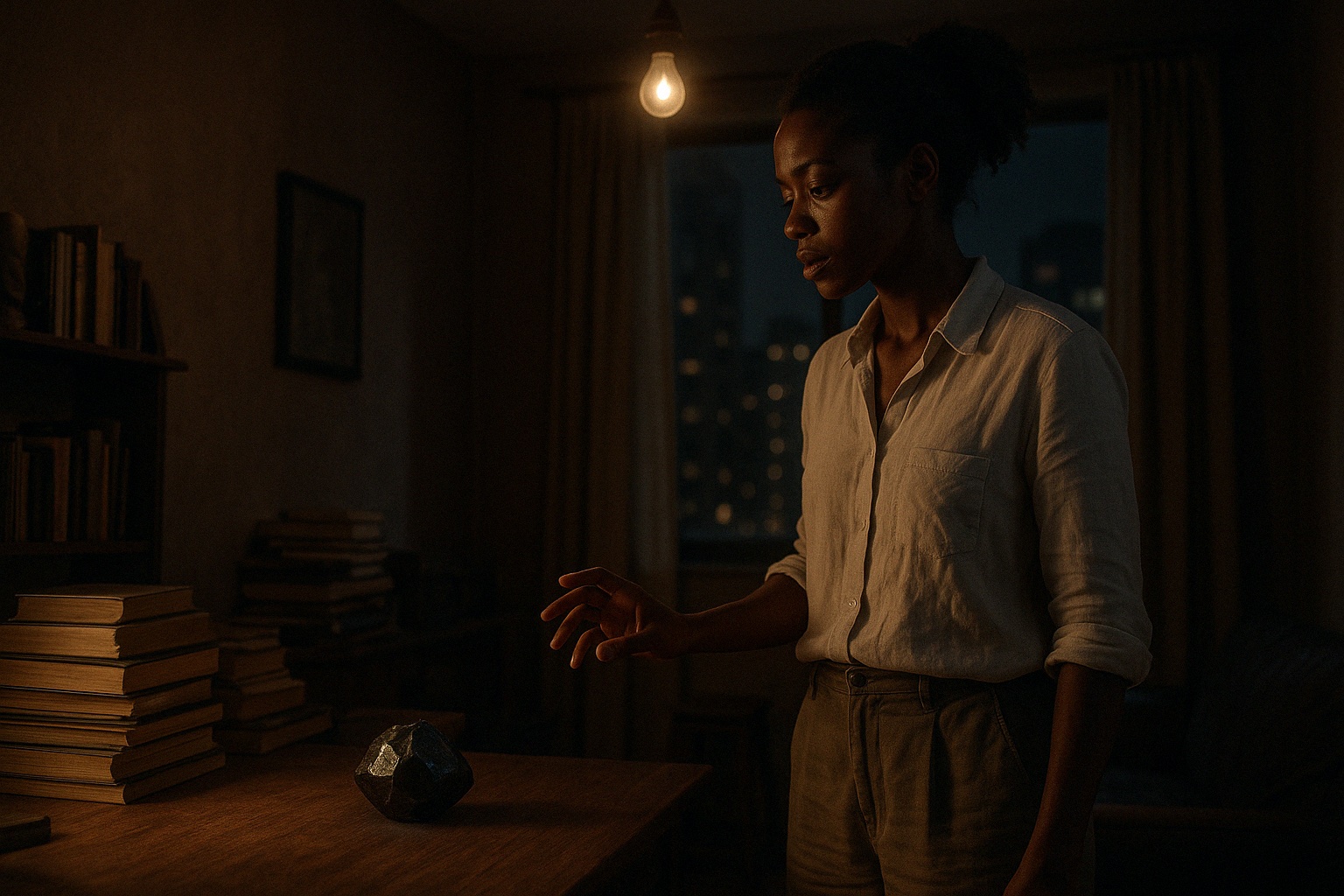
So when I wake up to find a black diamond sitting on my desk—one I never put there—I don’t think of spirits.
I think of a prank. A thief. A mistake.

But when I pick it up, the lights flicker. A draft snakes through the room, though the windows are shut. And then, the air stills.
And then, I hear it.
A voice like stone shifting in the dark. Slow. Coiling. Near.
“It is time.”
The voice is deep, old. Not a sound, exactly. More like a feeling, pressing against my ribs, curling up behind my ears like it’s been waiting for me to listen.
I drop the diamond. It doesn’t clatter like a normal stone. It lands heavy, like I’ve just set down something alive.
I back away, pulse hammering in my throat. My apartment is too quiet. The city hum outside feels muffled, like I’m standing in a vacuum. I stare at the diamond, willing it to disappear the way it appeared.
It doesn’t.
It just sits there, dark and pulsing, waiting.
A Final Message from my Grandmother
I should have ignored it. Should have picked it up and tossed it into the street, let it become someone else’s problem. But something in me—the lawyer, the rationalist—refuses to let things go without an explanation. And the explanation, apparently, lies in my grandmother’s house.
She died two weeks ago. A good woman. A stubborn woman. The kind of woman who always had one foot in the past, in old stories, in hushed warnings.
When I was little, she once told me that caves remember names. That a creature older than the land itself waits in the dark, listening. I thought it was a ghost story. A scare tactic. Something to keep children from wandering too far. She never said the word Grootslang. But I remember the way she paused when we drove past mountains, like she was listening for something she hoped not to hear.*
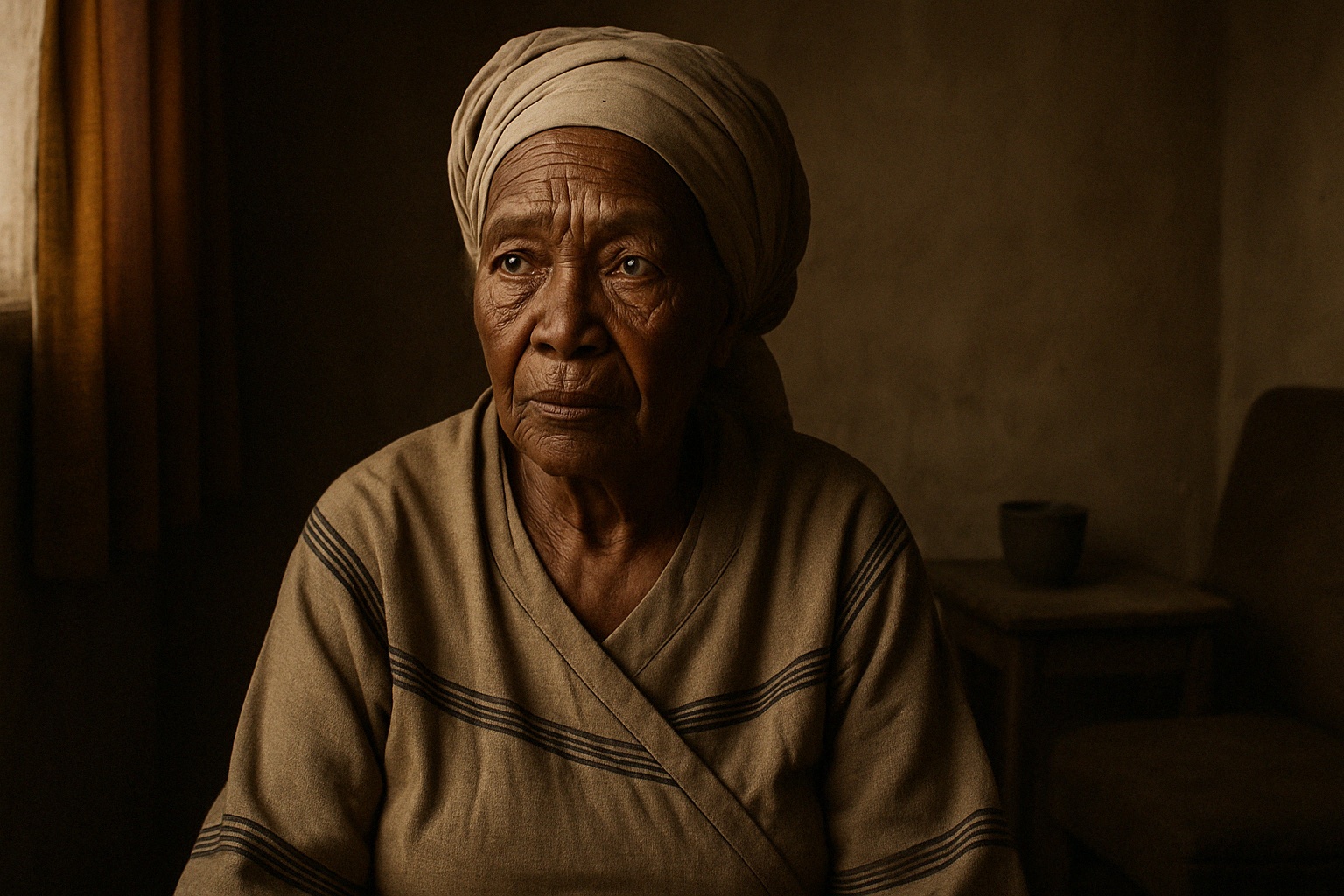
“You must never owe more than you can repay, Ama,” my grandmother used to warn me, her voice echoing softly in my memories, as though it were spoken only yesterday. She always called me Mntanami when she spoke of such things—my child, my responsibility, my fate.
I never thought she meant anything more than money.
But now, I wonder. She had been sick for years, but her mind had remained sharp—too sharp. She knew things before they happened. She would sit by the window at night, whispering under her breath, fingers tracing invisible symbols into the air. The elders said she had been fighting something for decades, that she had paid in ways I would never understand.
When I asked her about it, she only said, “Some debts must be held at bay as long as we can,” she would say—but once, when she thought I wasn’t listening, she added, “And some… some are not meant to be repaid at all. Only remembered.”
Had she known this was coming? Had she spent her last years trying to delay the inevitable?
I search through her house, unsettled by how little of her remains. My aunt—her sister—watched me in silence as I rummaged through the house.
“Ngiyaphila, Ama,” she said softly, but her eyes told me more than her words.
Her heart was heavy with the weight of what was coming.
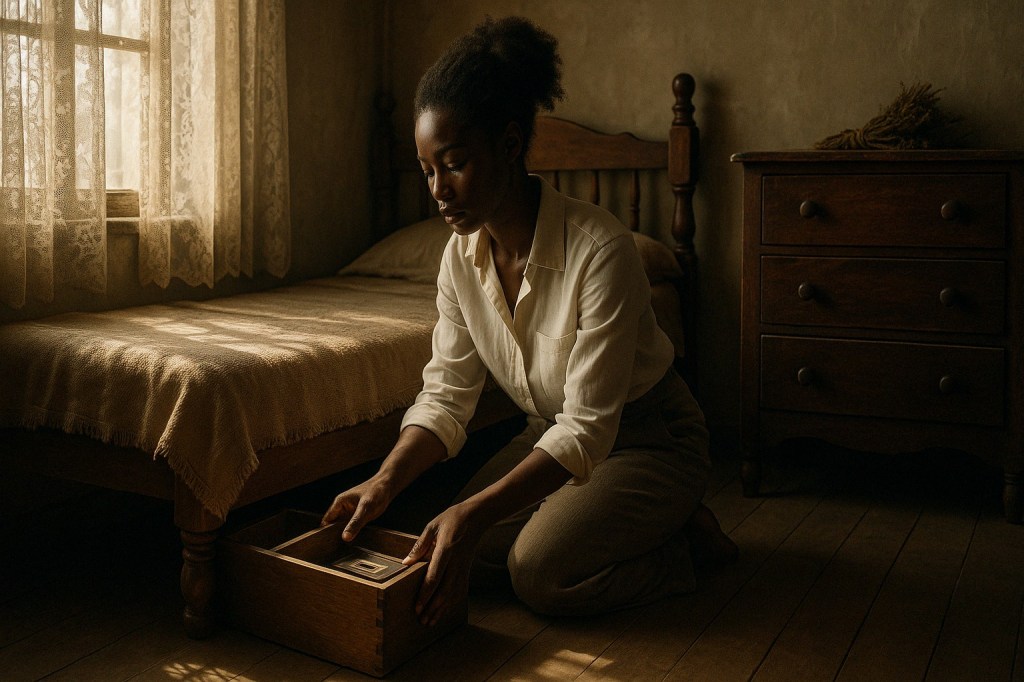
Then I find it.
An old wooden box, locked and tucked away beneath her bed. The key is hidden in her dresser, wrapped in a worn scrap of fabric. My hands shake as I turn it in the lock.
Inside is a single cassette tape, brittle with age.
I take it to my grandmother’s old radio, pressing play.
Her voice—soft, older, rasping—fills the room.
“Awu, Mntanami,” the voice croaked from the tape—so familiar, yet distant now.
“If you are listening, then you have seen the diamond. You have heard the voice. You must go to the Richtersveld. You must settle the debt.”
“I tried, child. I tried to offer myself in your place. But the Grootslang does not want the old. It wants the young. It wants you.
And now, it calls to you.”
“Do not bargain with it. Do not try to run. Just give it back what was stolen, and hope it will be enough. If it takes more… well, pray that it only takes what it came for.”
The tape clicks off.

The Grootslang from the stories I heard throughout my childhood?
That Grootslang?
The ancient serpent-elephant hybrid said to dwell in deep caves, luring the greedy to their doom? A creature older than the earth itself, born from the gods’ first and greatest mistake? And it’s alive?
Grandmother had a sense of humor, sure—but even she wouldn’t go this far.
My grandmother’s voice echoes in my mind.
“Some debts must be held at bay as long as we can.”
She always said that, though she never spoke of why.
Her words, when I was younger, were just warnings. But now, I knew the truth she couldn’t bring herself to tell me—she hadn’t been trying to protect me from superstition. She had been trying to shield me from something real.
I hadn’t realized until now. The debt wasn’t just the Grootslang’s—it was hers. And now, here I stood, bound by blood and history.
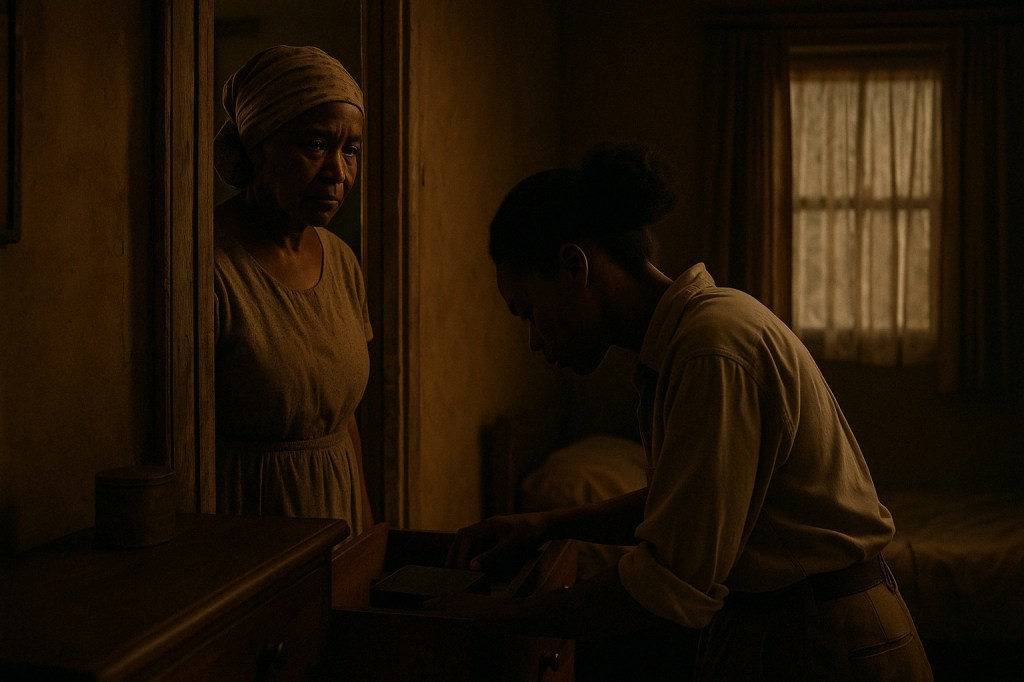
My grandmother hadn’t been trying to protect me from superstition; she had been trying to shield me from something real… something far worse.
I was too young to understand it then, but now I was not.
“Shwele, Ama,” my grandmother’s voice seemed to whisper from the past—just a warning. Now, I understood the weight behind her words.
A knot tightened in my chest. Why me? Why not my grandmother? I wasn’t sure what to make of it, but I had to do what I needed to do, despite my skepticism. After all, I had no choice. The past had already decided my future, and there was no running from it. Not anymore.
The Cave
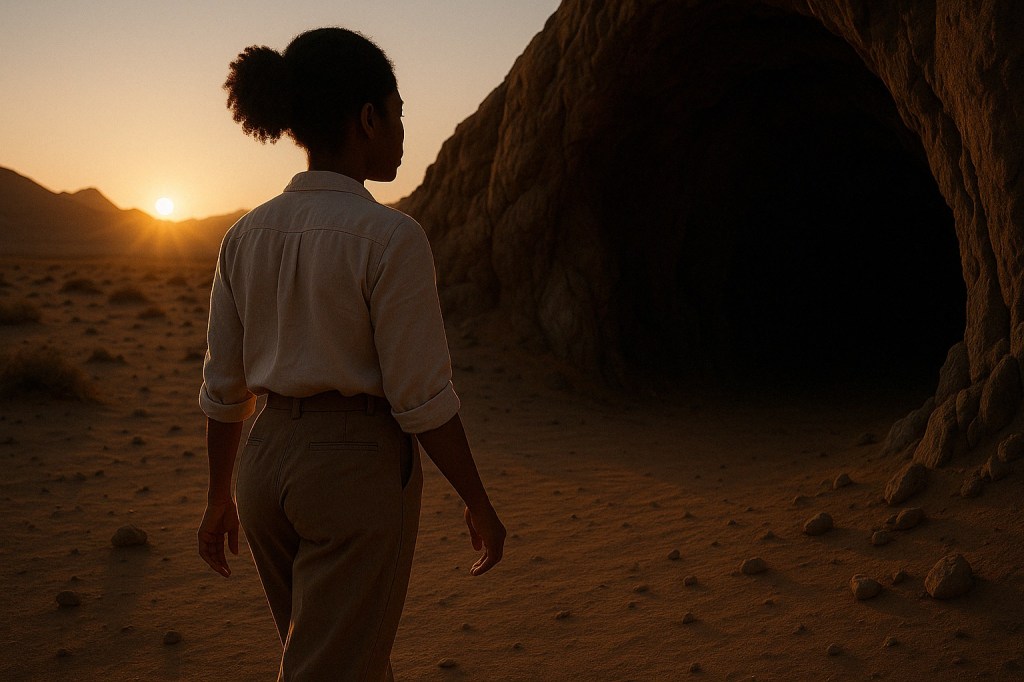
Two days later, I stand at the edge of the Richtersveld desert, staring into the mouth of a cave that shouldn’t exist.
The air outside the cave felt still, too still, but the moment I stepped into the dark mouth of the cave, a shiver of cold washed over me.
“Awu…”
The word slipped out before I could stop it. My breath turned shallow. The diamond pulsed heavier in my pocket, as if it knew—it was home.
I take a step forward.
The voice returns, curling around my mind like smoke.
“It is time.”
I step into the dark.
And the debt is ready to be paid.
The Grootslang’s Bargain
The air inside is thick with something ancient. Not just dust, but memory. The walls breathe with it, the ground trembles beneath it. The deeper I go, the more the earth itself seems to recognize me.
The stones under my feet feel too smooth, too worn—as if thousands before me have walked this path. As if they never left.
Then I see it.
Eish… Grandmother wasn’t kidding.

A vast shape uncoils from the dark, a presence before it is a form, a nightmare before it is real. Its scales drink the light, a pit of shifting void, swallowing torches, shadows, and breath itself. Its tusks—curved like ivory scythes, like weapons forged before man knew fire.
Twin pools of molten gold, flickering with something too deep to be anger, too vast to be hunger. It sees me. It sees through me. It sees not just me, but every woman before me, every broken promise, every desperate prayer whispered too late.
The air shifts. Something much larger than myself has just awoken.
My breath turns shallow. The ground beneath me feels less solid, as if I stand on the edge of something vast and waiting.
I see now why Grandmother never spoke of this place.
The cave is too quiet. The air is too still.
Then, the voice emerges—not from one place, but from everywhere.
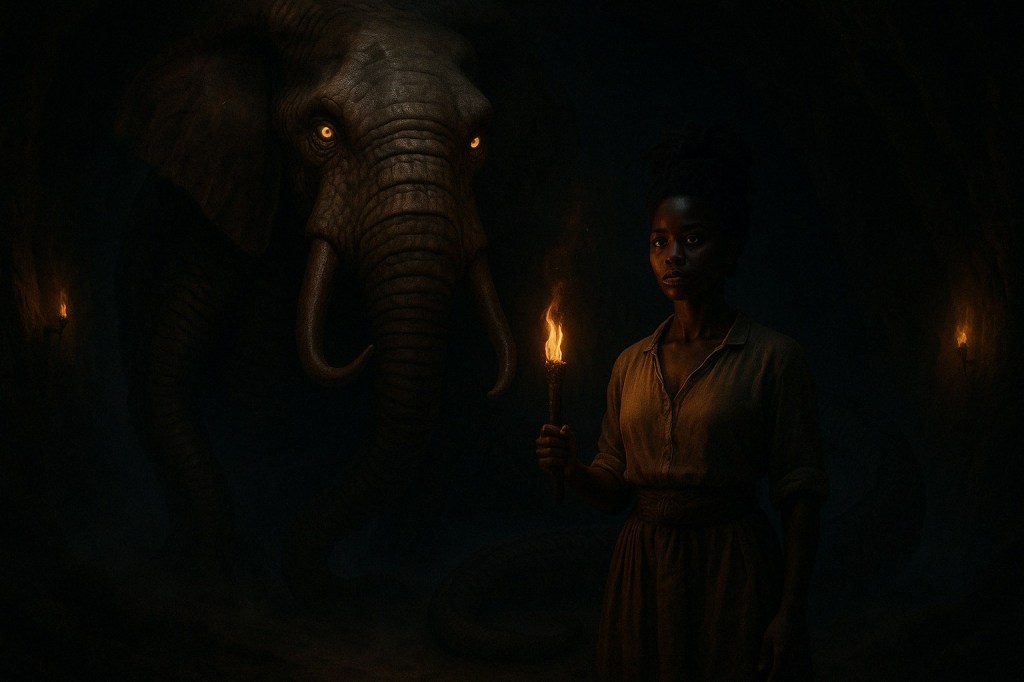
“Igazi alikhokhelwa ngamazwi (Blood is not repaid with words.). Amaaaaa… Sekou… you carry the debt of your ancestor.”
The weight of its words settles inside my bones, inside my blood. The sound is everywhere. Not just around me—within me.
“Do you come to beg? Or to bargain?”
The words hit like a blow. I force myself to stand taller, though the weight of the diamond in my hand is crushing.
“A debt that isn’t mine,” I mutter, my voice steady despite the flood of fear in my veins. “My great-grandmother made the mistake, not me.”
But even as I say it, doubt coils in my gut. Was it really a mistake? Or survival?
I want to defend her. I want to believe she had no other choice. That the ones who took from her—the colonizers, the bureaucrats, the men with signatures and seals—left her nothing but desperation and a story about a cave. Maybe she thought she could trade one myth for another.
My great-grandmother had lived through drought, war, land stripped bare by those who came with laws and guns.
“What was taken… was it greed? Or the price of keeping a family alive for another season? Had she stolen something sacred—or bargained with the only coin she had: hope?”
Or was it the price of keeping a family alive for another season? Had she stolen something sacred, or had she bargained with the only coin she had left—hope?
I realize I don’t know. I don’t know who she was when she made her choice. Only that I stand here now because of it.
A pause. Then—something worse than silence.
A low, rattling hum vibrates through the cave. Not a growl, not a threat—A laugh.
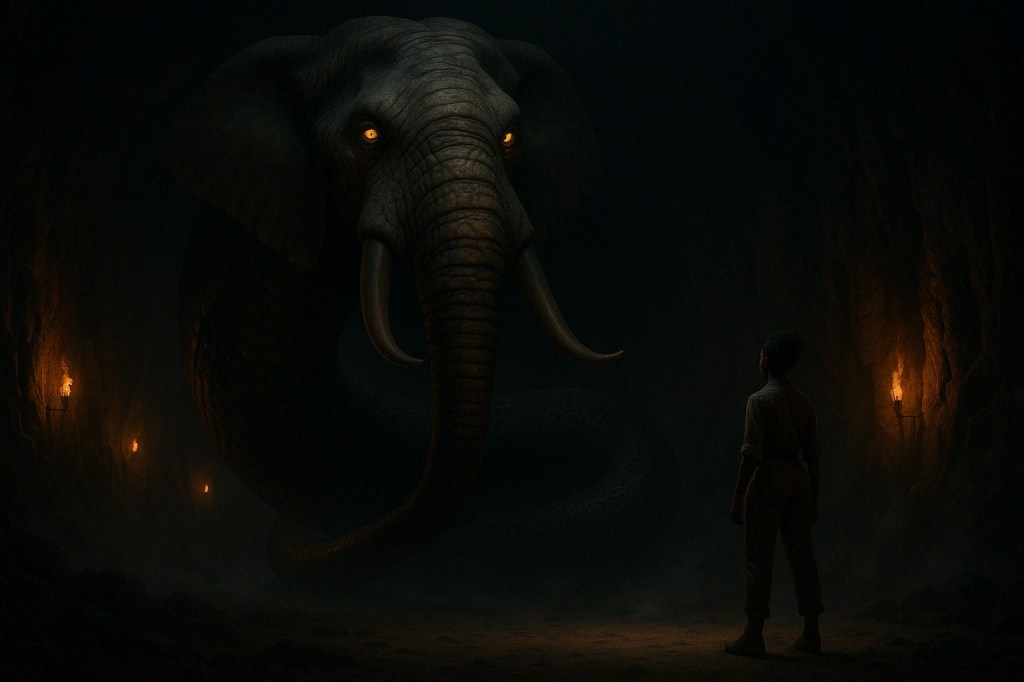
The Grootslang exhales. A sound that is almost—almost—a sigh of boredom.
“Mistake?” it rumbles. “She knew what she was doing. You all do.”
The words are slow. Amused. As if this has all happened before.
“Yet you carry her name. You carry her blood. The debt was never settled. And now, it passes to you.”
A vision flickers—so fast, so sharp, that it cuts.

A woman, standing where I stand. Her breath is shallow. Her hands tremble over something unseen. The scent of damp earth. The scent of rot. The scent of fear. She has tried. Tried to escape. Tried to undo what had already been written in blood. Had she thought she could outwit it? Had she promised something in return?
The Grootslang does not forget.
The Grootslang does not forgive.
The Grootslang only waits.
The realization sinks like a stone in my gut, dragging me down into something cold and final.
This diamond was never just a diamond. It was never just an inheritance.
It was a marker — a contract written in blood.
It had come for her once. For my grandmother, in whispers and warnings. And now, it had come for me.
“But why me?” The question leaves my lips before I can stop it.
The Grootslang does not answer. Because it does not need to.
The diamond pulses in my hand, as if answering for it. As if it is alive.
As if it has been waiting.
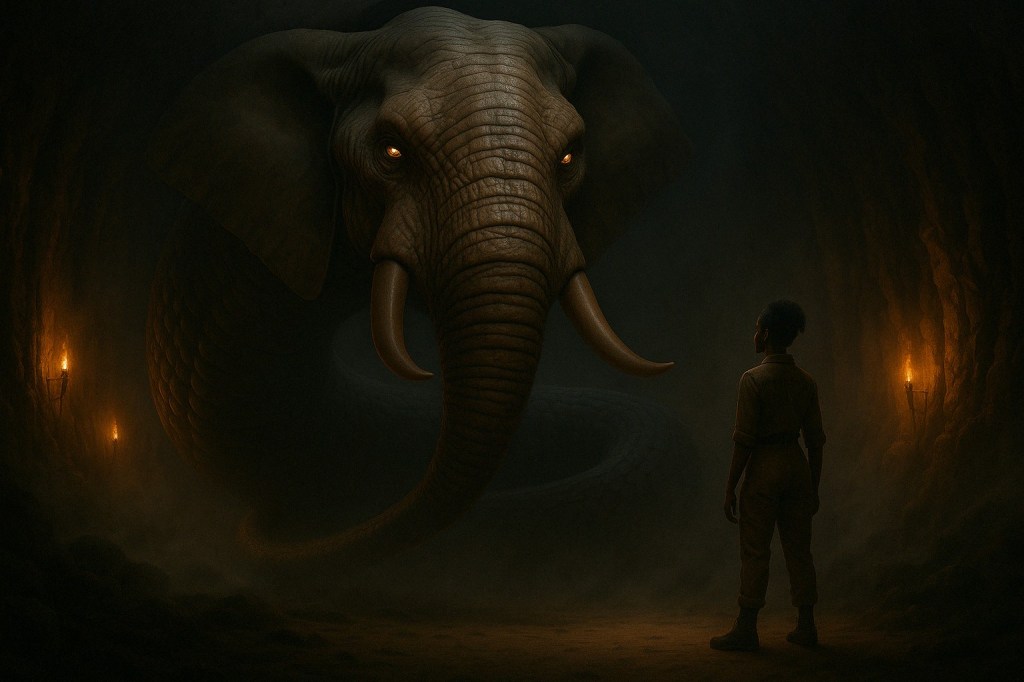
Then the Grootslang leans forward.
The walls groan. The shadows tighten. The air folds into itself.
“Perhaps I will accept another bargain, Ama Sekou.”
The cave shifts. The darkness ripples.
And then, a pause—long enough that I wonder if it waits for me to ask why. Its voice returns, slow, deliberate.
“I have waited lifetimes beneath this earth. I have watched as your kind forget. As they take and forget the price. You are not the first, but perhaps you will be the last who remembers to ask what the debt was for.”
It’s not mercy. It’s not pity. It’s something else. A creature this old, this patient, does not bargain out of kindness. But maybe it respects truth. Or remembers a time before the first lie was told.
The diamond in my hand flickers between being there and not there.
“You may leave now,” the Grootslang whispers. “Walk away. Pretend this never happened.”
For a second, the mouth of the cave seems closer. The air lighter.
Could I leave? Could I truly be free?
But I remember the stories they never finished. The ones that trailed off in whispers. The names the elders spoke once and never again.
The ones who walked away.
No graves. No prayers. Just silence.
I tighten my grip on the diamond, its pulse beneath my fingers screaming at me.
I see the trick now. The offer of escape. The illusion of choice.
And I am not ready to be a name they no longer speak.
But I also see something my grandmother might not have.
The debt can’t be delayed forever. It has to be faced. Someone has to stand here and answer.
She spent her life holding the door shut — hoping I’d find another way. Or simply too tired to keep holding it closed.
And maybe, just maybe, that’s why I’m still here.
Not because I was chosen. But because I chose.
The diamond in my palm is freezing now, its weight pressing me downward, as if the earth itself means to swallow me whole. My legs won’t move. My breath won’t steady. There is no leaving. There never was.
“You won’t let me leave,” I say, my voice barely steady, though the weight of the diamond threatens to pull me into the earth itself.
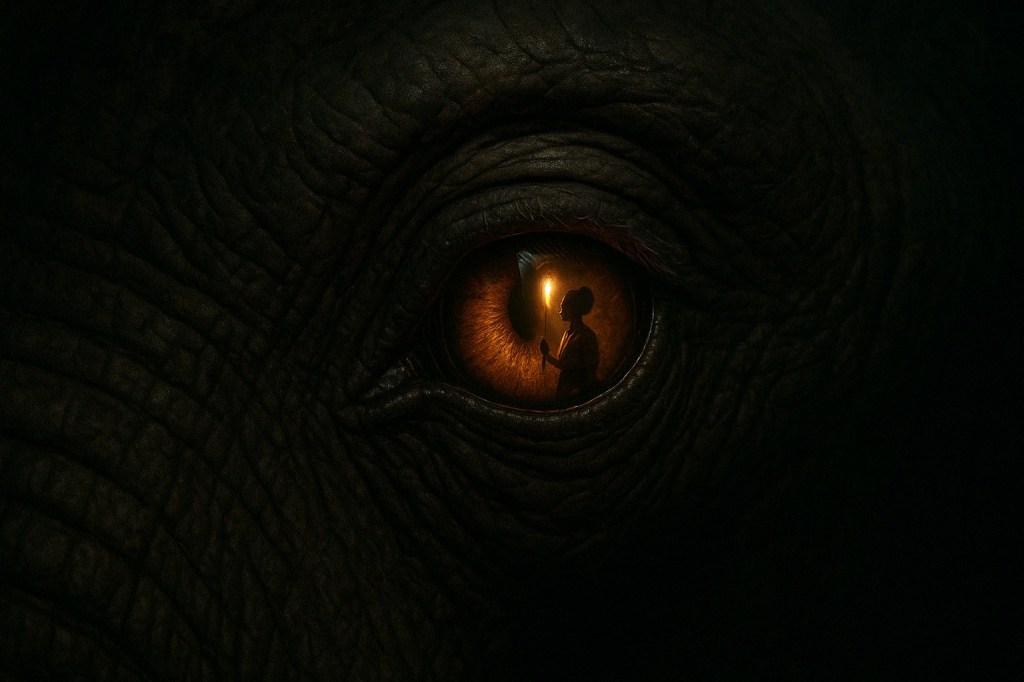
“Very good.” The Grootslang’s golden eyes flicker. “You are learning. But knowledge is no escape, Ama Sekou. Only a heavier chain.”
“And you have only begun to carry it. She thought she was clever,” the Grootslang rumbles. “Thought she could take without giving. That she could cheat the oldest law.”
A pause. A low, rattling hum.
“And now, here you are.”
The Debt is Paid… or Is It?
I stand before the Grootslang, my heart pounding in my chest. I wanted to fight, to scream, to refuse to play along with this sick game. But something about the Grootslang’s presence, the weight of the diamond, the history—my grandmother’s warnings—kept me rooted to the ground. I couldn’t run from this. I couldn’t escape what had been set in motion. The debt was mine now. There was no turning back.
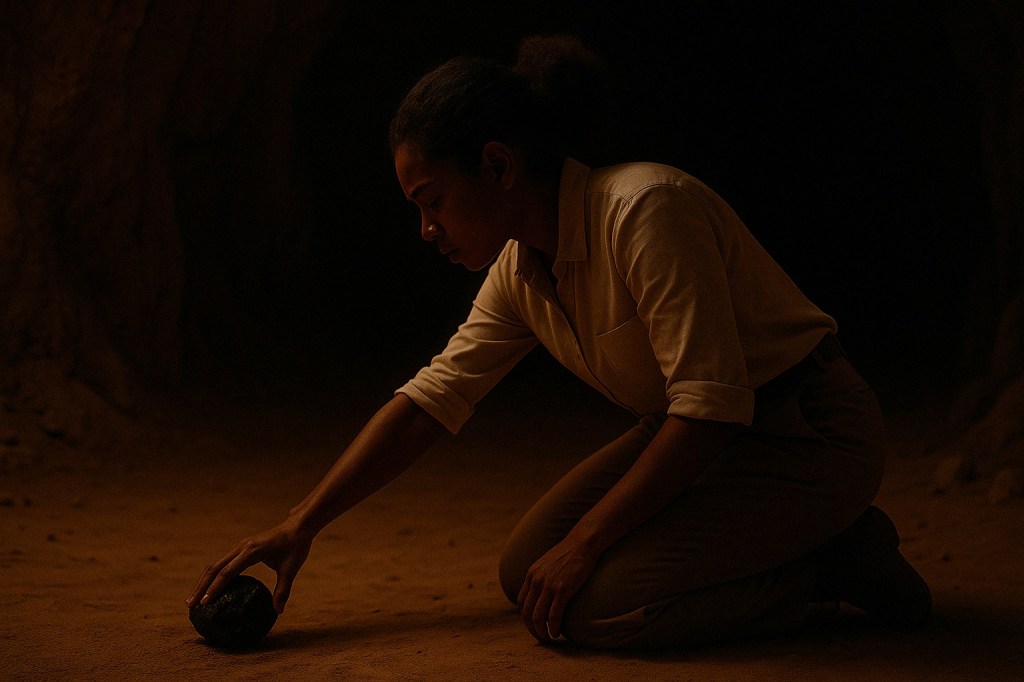
I kneel, pressing the diamond to the ground. A tremor runs through the cave. The air shifts, the weight lifting as something unseen is released. A sigh moves through the dark, old and weary, and the Grootslang closes its eyes.
When I stand, the cave is empty. The diamond is gone.
And so is the debt.

I walk out of the cave, toward the first rays of morning light breaking over the sand. The Grootslang does not follow.
For a moment, I breathe. The wind brushes my skin. A bird calls in the distance—ordinary, alive, a reminder that the world still turns. I close my eyes.
But just as I take that first breath of peace, the voice returns—softer this time. A whisper like scales sliding over stone.*
“Some debts never truly end.”
I shudder. The wind shifts, carrying something deeper than words. A promise. A warning.
I don’t look back.
But as I reach into my pocket, my fingers brush against something small and rough.
A scale.
A single, black scale.
It wasn’t there before.
I froze, as a whisper, no louder than the rustling of leaves, brushed past my ears, like the whisper of something older than time.
“Not all debts can be repaid. Not all debts can be escaped.” it whispered softly.
A promise, a warning. I didn’t need to hear it again, but I knew now—it was always watching. I shuddered as I felt something warm, something too familiar, pulse in my pocket.
A whisper curls at the edges of my mind—not words, not quite. A feeling.
I don’t look back.
But for the first time, I wonder if something is looking through me.
The End
“Some Debts Never End”
By Ama Sekou
I was taught that debts must be repaid. That what is taken must one day be returned. But no one warned me that some debts are carried in blood—that they do not die with the dead.
I used to think I could argue my way out. That I could negotiate. But some things are older than words. Older than reason.
And yet, standing there, I made a choice my grandmother never could: to face it, instead of holding it off for another day.
I wonder if that was enough. I wonder if it ever will be.
But I carry the weight now.
And I will not forget.
I thought I could argue my way out of it. That logic, reason, and law could undo what had already been written into the bones of my ancestors. I was wrong.
But here I stand. Alive. Unchanged. Or so I tell myself.
The diamond is gone, but the past does not vanish so easily. I have done what was asked — yet I wonder if I only delayed what is still to come.
Some debts never truly end.
Some things never let go.
And somewhere, deep beneath the earth, I know it is still watching.
– Ama Sekou
 Scott Bryant
You must be logged in to post a comment.