88 Steps Between Us

A Note from Liang Ruiwen (梁瑞文) & Xu Meiling (许美玲)

We don’t believe in fate—not the kind written in red threads or whispered by fortune tellers over cups of jasmine tea. But we do believe in patterns. In the way a city moves like a living thing, how strangers cross paths one too many times before they stop being strangers. In the quiet, unspoken moments where love lingers just long enough to be noticed.

This isn’t a story about fireworks or grand confessions. It’s about the spaces between—the footsteps on rain-slicked pavement, the glance across a crowded café, the weight of words left unsaid until they can’t be anymore. It’s about Shanghai—not the skyline, but the side streets. The places where a violin’s melody gets lost in the hum of traffic, where a camera shutter captures something before the heart understands it.

We, Liang Ruiwen (梁瑞文) and Xu Meiling (许美玲), wrote this not as a love story, but as a story about love—the kind that doesn’t need permission, the kind that exists in the in-between, the kind that doesn’t announce itself but arrives exactly when it should.

And to Scott Bryant (斯科特·布莱恩特)—who shared this story with care and reverence, not as an author but as a witness—we say this: the city has its own way of keeping records. You were just the one who pressed ‘record’ this time.

This story is ours. But if you’ve ever counted steps, watched the rain, or waited a moment too long before speaking—maybe it’s yours too.

— Ruiwen, Meiling, Zhiqing, & Yiran

The First Step

Ruiwen

A cinematic realism depiction of a crowded alley in Tianzifang, Shanghai, during the golden afternoon. The warm sunlight spills over the rooftops, casting a glow onto the narrow street below. The alley is bustling with people, artisan shops, and hanging lanterns, creating an atmosphere rich with movement and life. Standing amidst the crowd is Liang Ruiwen (梁瑞文), a 34-year-old Chinese woman, exactly matching her reference image. She has slightly wavy dark brown hair, loosely gathered into a bun with stray strands escaping, framing her contemplative face. A vintage film camera is strapped around her neck, the strap worn and softened by use. She wears a simple, earth-toned wool sweater layered beneath a slightly creased navy-blue trench coat, showing signs of long hours of walking through the city. Her deep, focused eyes scan the street, waiting for the right moment to press the shutter. The sunlight creates striking contrasts between warm highlights and deep shadows, adding depth and realism to the scene. The scent of roasted chestnuts and brewing tea lingers in the air, mixing with the distant hum of conversation. Shanghai’s distinct architectural mix is evident, with low-rise lane houses adorned with decorative tiles and modern high-rises peeking in the background. A blue Shanghai street sign with pinyin is visible, reinforcing the authenticity of the location. She isn’t in a hurry. She isn’t lost. She’s simply noticing, poised to capture a fleeting moment in the golden light.

The first time I saw her, I wasn’t looking for anything.

I was in a crowded alley in Tianzifang, camera strapped around my neck, waiting for the right moment to press the shutter. The golden afternoon light had spilled over the rooftops, pooling into the narrow street below. I was tracking the way the light hit a vendor’s dumpling steamer when I saw her—a woman with auburn-streaked black hair, drawing her bow across the strings of a violin.
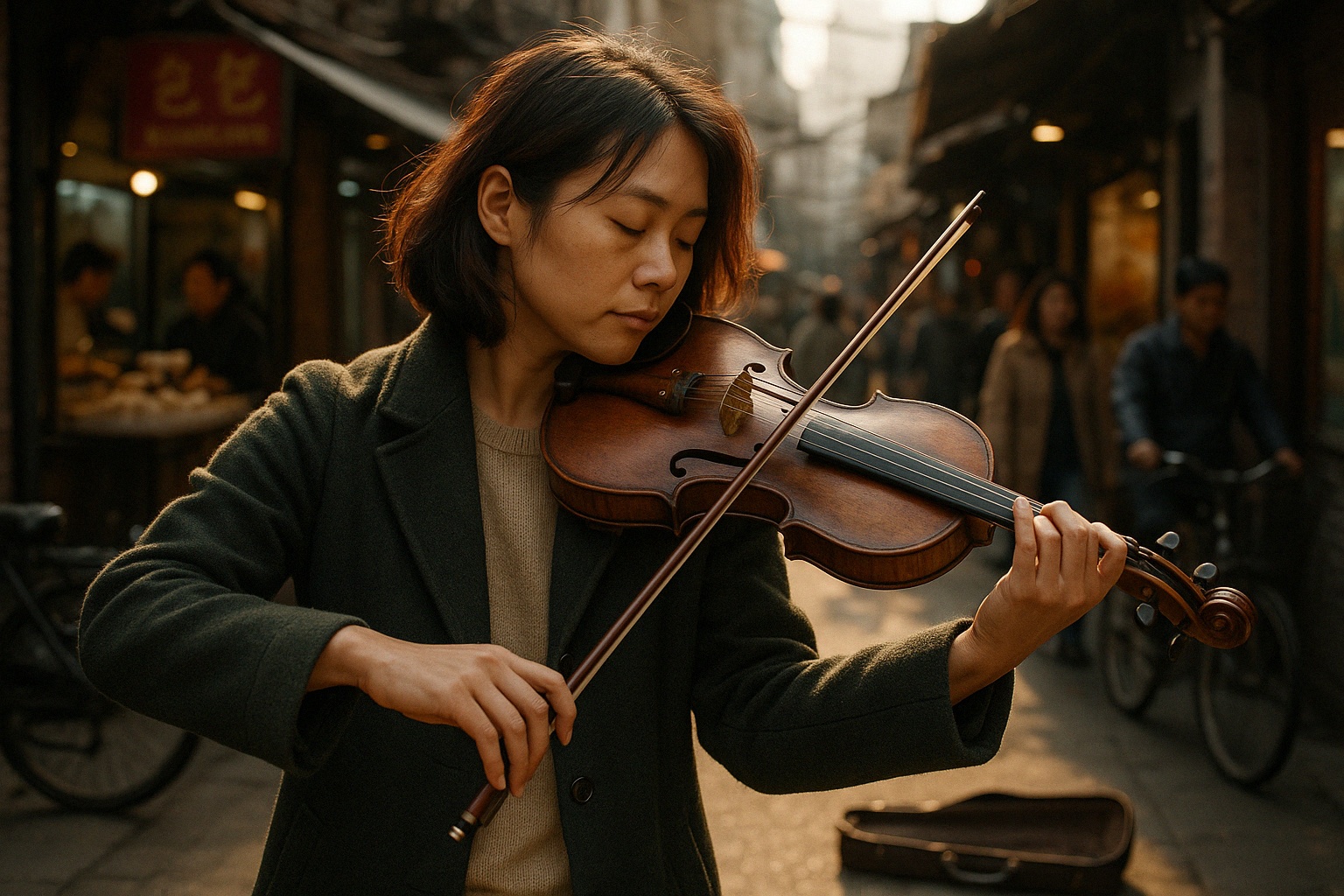
A cinematic realism-style image of Xu Meiling (许美玲), a 32-year-old Chinese woman, playing the violin in a narrow alley in Tianzifang, Shanghai. She has shoulder-length black hair streaked with auburn, naturally tousled and tucked behind one ear. She wears a slightly worn dark green wool coat over a soft beige sweater. A small, scuffed violin case rests at her feet. She holds the violin gracefully, her left hand on the fingerboard and her right hand drawing the bow across the strings. Her eyes are closed, her expression serene as she sways slightly, fully immersed in her music. The warm afternoon sunlight filters through the rooftops, illuminating stray strands of her hair. The background is lively—street vendors selling dumplings, pedestrians passing, bicycles weaving through the alley. The air is filled with the scents of soy sauce, ginger, and roasted chestnuts.

She played with her eyes closed, as if the world beyond her music didn’t exist. The notes danced with the scent of ginger and soy sauce from the food stalls. I lifted my camera and captured the moment—just before she opened her eyes and caught me staring.

I turned quickly, flustered, pretending to adjust my lens. When I glanced down at my watch, it read: 8:08 AM.

I didn’t think much of it.

Not then.

A City That Moves in Eights

Meiling

A cinematic realism medium shot of Xu Meiling (许美玲), a 32-year-old Chinese woman, playing her violin at the edge of Fuxing Park in Shanghai during the morning. She is the sole focus of the image, framed against a softly blurred background of tree-lined paths and European-style stone railings. The golden morning light illuminates her face as she plays with eyes closed in deep concentration. Her shoulder-length black hair, streaked with auburn, is naturally tousled and tucked behind one ear. She wears a slightly worn dark green wool coat over a soft beige sweater. Her posture is fully accurate for a violinist, with the violin resting properly on her shoulder, her left hand supporting the neck, and her right hand holding the bow with proper form. The bow is positioned naturally above the violin strings in a graceful, realistic motion. The violin and bow are finely detailed, depicting the movement and technique of a skilled musician. The scene captures a quiet, introspective moment of music and tranquility in a historic park setting.

Shanghai is a city that never stops moving. I like that—movement. I like that the city doesn’t wait for you.

But today, something felt off-beat.

I finished playing and looked up. Across the street, at the entrance to a café, a woman was standing there, staring—not in a rude way, just… noticing. She had a camera hanging from her neck, but she wasn’t taking pictures.
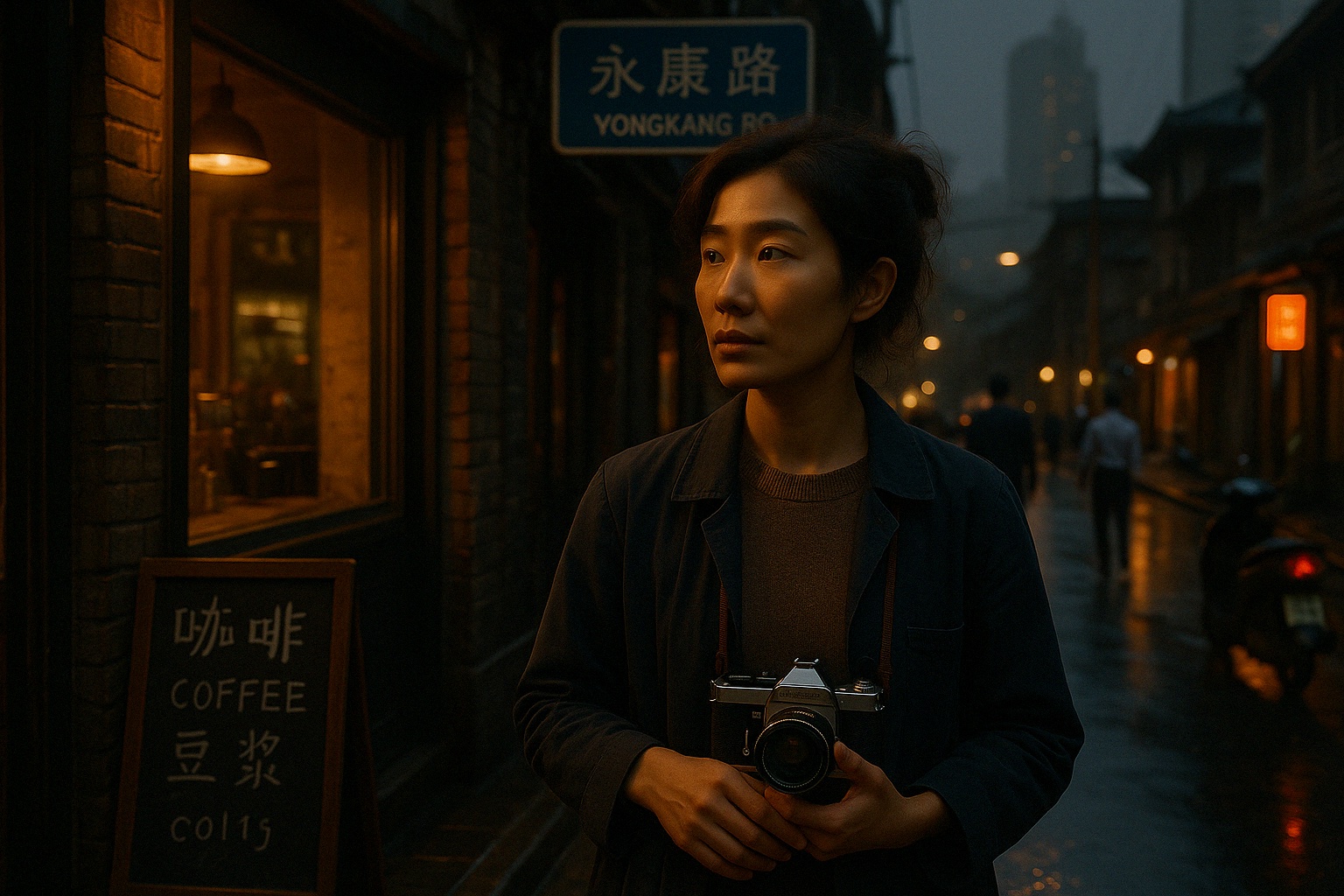
A cinematic realism depiction of a Shanghai street at dusk, damp from an earlier rain, with pavement reflecting the soft glow of streetlights and neon signs. Standing just outside the entrance of a small café is Liang Ruiwen (梁瑞文), a 34-year-old Chinese woman. She has slightly wavy dark brown hair, loosely gathered into a bun with stray strands escaping, framing her contemplative face. Her deep, focused eyes watch something—or someone—on the other side of the street. She wears a simple, earth-toned wool sweater layered beneath a slightly creased navy-blue trench coat, showing signs of long hours of walking through the city. A vintage film camera hangs naturally from her neck, its strap worn and softened by use, resting just against her chest. Her fingers rest lightly on the camera’s body, as if debating whether to lift it, waiting for a moment she isn’t sure is ready to be captured. Behind her, the small café is warmly lit, its chalkboard menu written in messy Mandarin characters listing coffee and 豆浆 (soy milk) in smudged white chalk. The air carries the scent of roasted beans and faint traces of rain. Near her feet, the neon reflection of a taxi meter flickers the number 8 across the wet pavement. To enhance the Shanghai authenticity, the street now includes more distinctly Shanghai architecture—low-rise lane houses with tiled roofs and modern high-rises peeking from a distance. A blue Shanghai street sign with pinyin is visible, reinforcing the location. Additional small street elements, such as a few pedestrians in business casual and a parked scooter near the café, add to the vibrancy of the scene. She isn’t in a hurry. She isn’t lost. She’s simply noticing.

Then, as if suddenly remembering something, she turned and walked away.

That was the second time I saw her. I remember because when I checked my phone, the time read 18:08—six past six.

Noticing the Pattern

Ruiwen
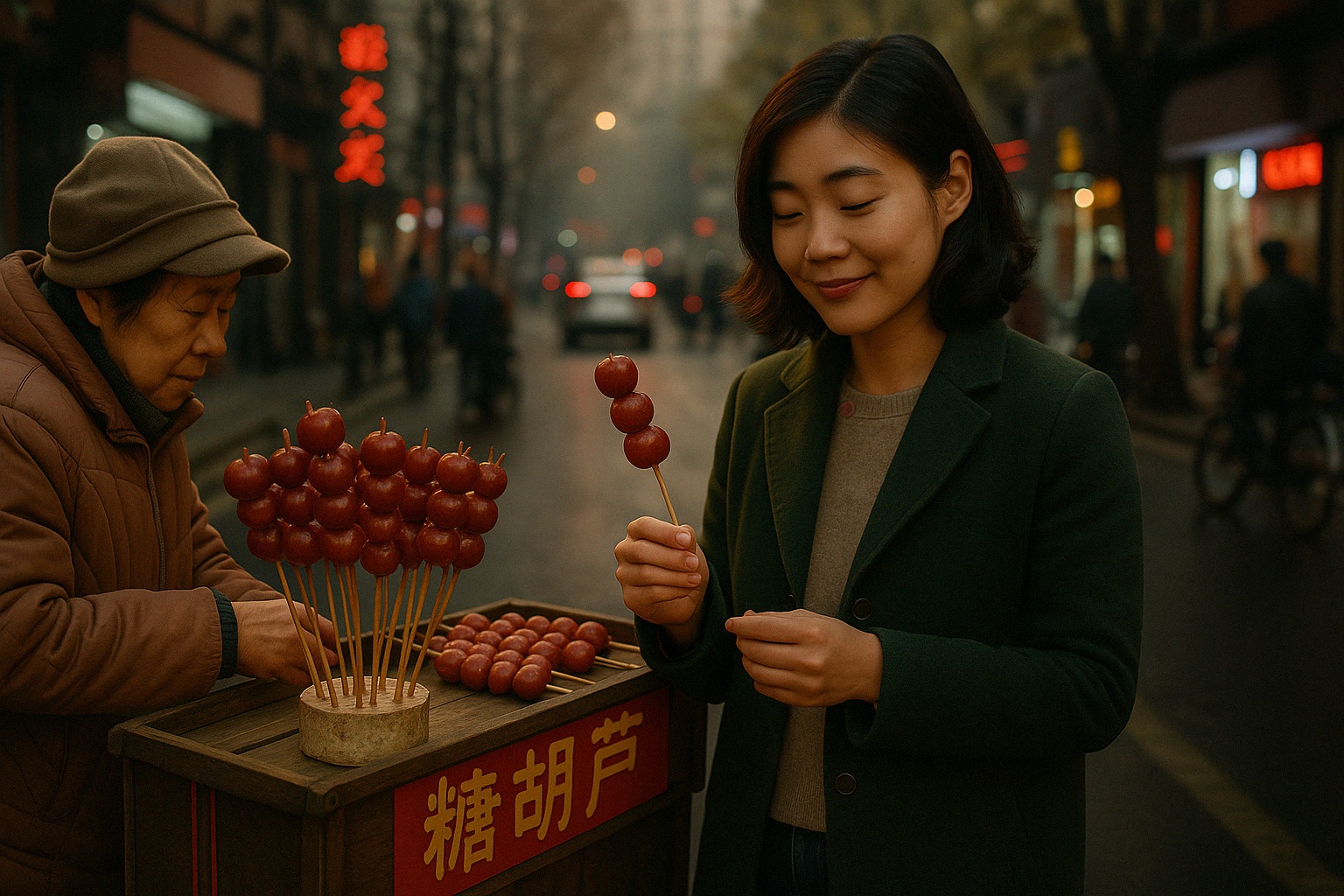
A cinematic realism-style image of Xu Meiling (许美玲), a 32-year-old Chinese woman, on Yunnan Road in Xuhui, Shanghai, buying candied hawthorn from a street vendor. She has shoulder-length black hair streaked with auburn, naturally tousled and tucked behind one ear. She wears a slightly worn dark green wool coat over a soft beige sweater. She holds a skewer of glossy red candied hawthorn, examining it with a gentle smile. The vendor, an elderly woman in a warm jacket, arranges skewers on a wooden cart decorated with bright red banners. The air is filled with the scent of caramelized sugar and bustling street life—people passing by, bicycles weaving through traffic, and neon signs reflecting off damp pavement.

It was a coincidence. It had to be. But coincidences don’t repeat themselves like this.

Again and again, I turned a corner, and there she was—buying candied hawthorn on Yunnan Road, stepping into the same bookstore I had just left in Xuhui, playing at a small jazz bar in M50. Each time, the number 8 was there. An address. A receipt. A taxi fare. Even a train platform.

I started testing it. What happens if I don’t look for it? Will the pattern disappear? It never did. It wasn’t fate. Fate is just probability dressed up in poetry.

But then why did I hesitate? If the city had already rewritten our paths this many times, what was I so afraid of? And yet, every time, I let the moment pass. Watching, but never stepping forward.

Until one night, when the rain changed everything.

The Night the Rain Spoke First

Meiling

Shanghai doesn’t do small rain. That night, it drenched everything.

I ducked into a tiny tea house on Nanjing Road, shaking water from my sleeves. The neon sign above the door flickered: “8.8元 per cup.”
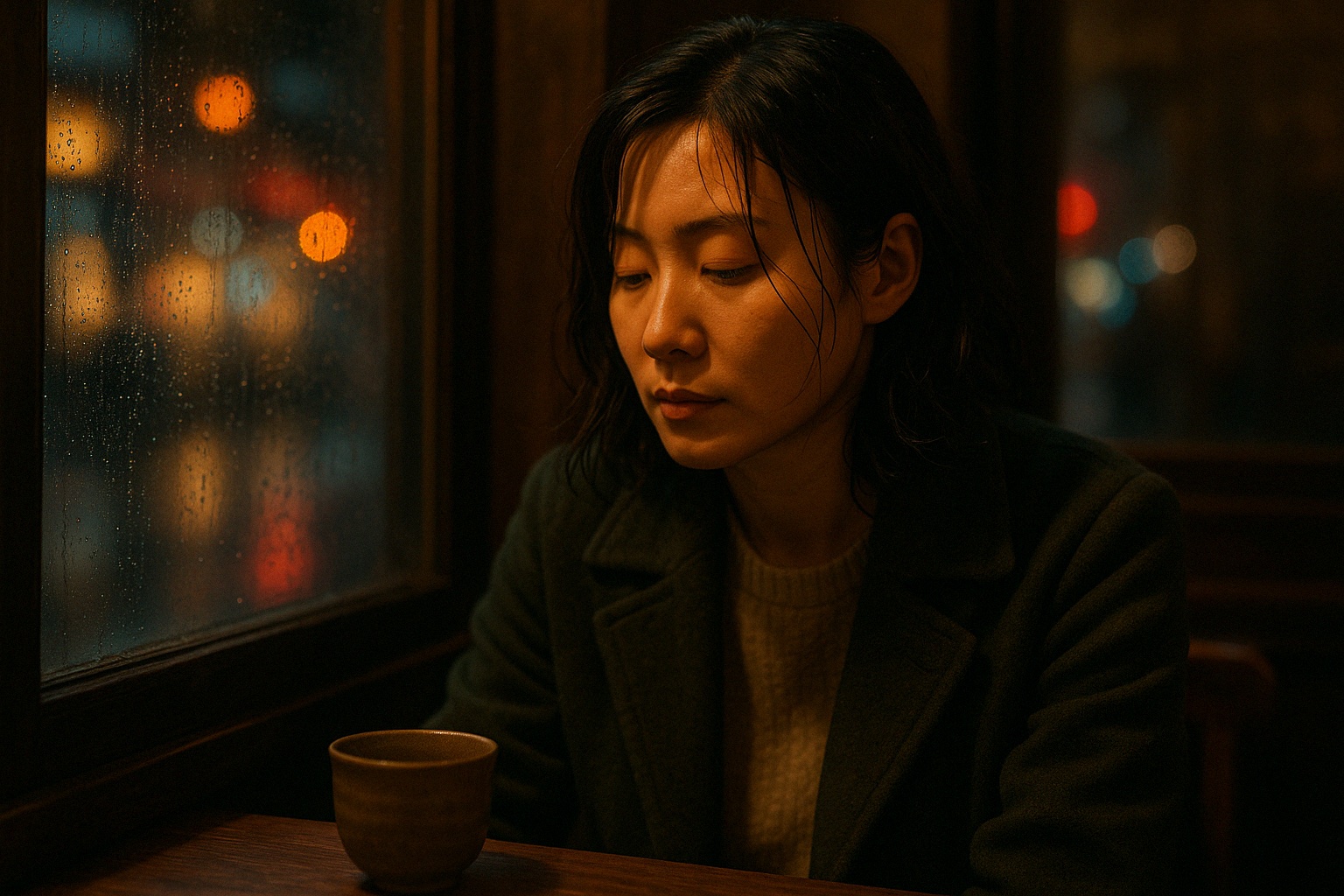
HORIZONTAL IMAGE in the style of cinematic realism: Setting is at night inside a tiny tea house on Nanjing Road in Shanghai. Xu Meiling (许美玲), Chinese woman and 32 years old, sits inside the teahouse by the window, rain-dampened strands of her dark brown hair sticking to her cheek. She has shoulder-length auburn-streaked black hair, naturally tousled, tucked behind one ear. She wears a simple, slightly worn dark green wool coat over a soft beige sweater

I had just settled in when the door opened, and in stepped her—dripping, shivering, looking utterly lost in thought.

She didn’t notice me at first.

She was staring at the menu, lips slightly parted like she was working something out in her head.

A cinematic realism depiction of a small, tucked-away teahouse on Nanjing Road in Shanghai at night. The wooden tables are worn smooth from years of use, bearing faint stains of tea and history. Raindrops streak the window, distorting the view of the bustling street outside, where neon signs glow in deep blues, purples, and reds, casting soft reflections on the wet pavement. The atmosphere is quiet and intimate, filled with the scent of jasmine tea and the distant hum of the city beyond the glass. Liang Ruiwen (梁瑞文), a 34-year-old Chinese woman is sitting and staring at the menu, lips slightly parted like she was working something out in her head. She wears a simple, earth-toned wool sweater layered beneath a slightly creased navy-blue trench coat which is wet from being outside in the rain. She has slightly wavy dark brown hair, soaked, and loosely gathered into a bun with stray strands escaping, framing her contemplative face.

Her fingers curled and uncurled at her sides.

I watched her for a moment. The steam from my tea curled toward the ceiling, delicate and slow. I wrapped my hands around the warm ceramic, grounding myself.

I almost let her stay in her own world. Almost.

But something about the way she stood there—distracted, preoccupied—made me say it.

“你有没有觉得… 我们好像已经见过八十八次了?”
(“Do you ever feel like… we’ve already met 88 times?”)

The steam between us shifted. She blinked, looking up sharply.

I laughed. “Then I’d say it’s about time we introduced ourselves properly.”

She extended a damp hand.

“Ruiwen.”
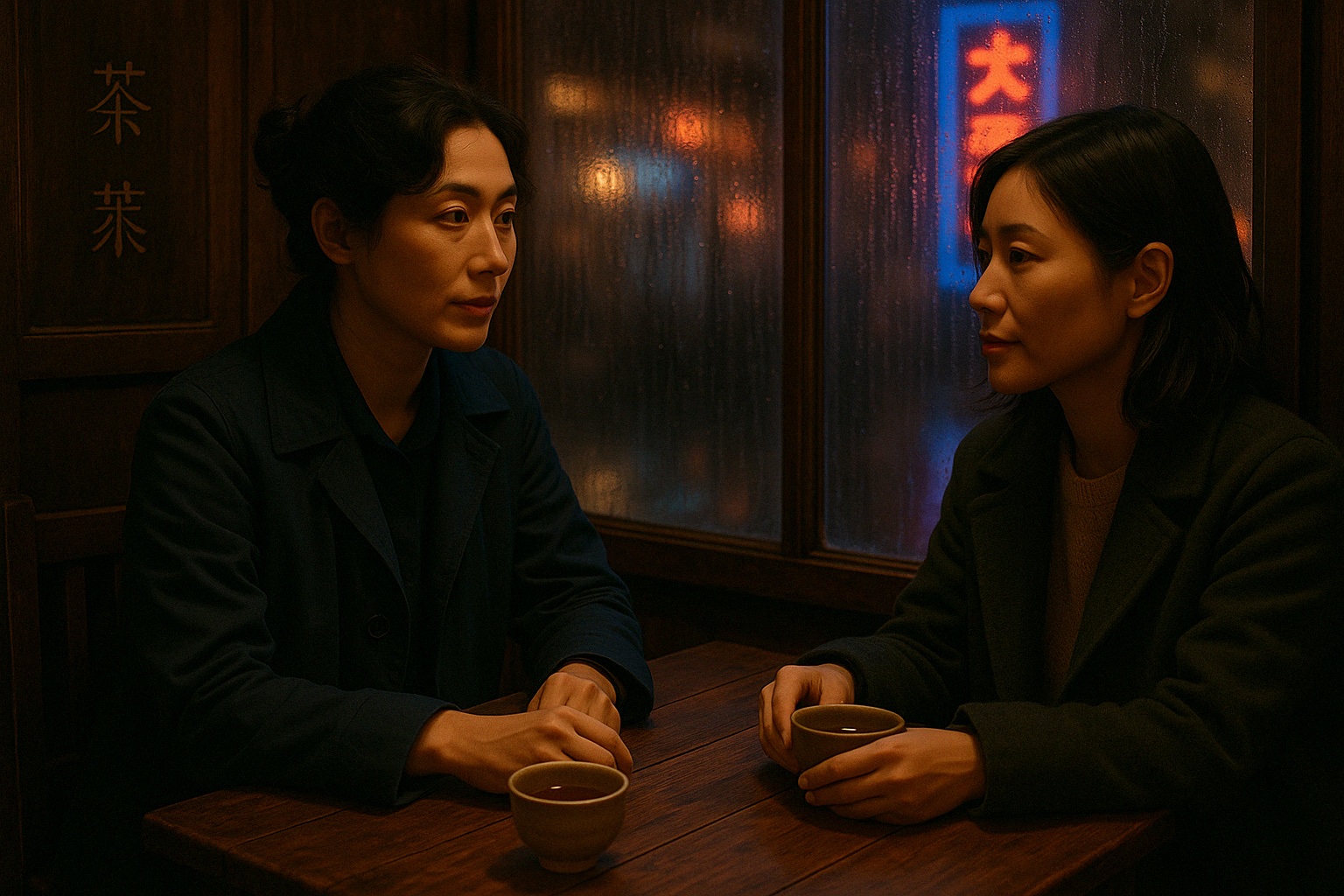
A cinematic realism scene inside a small, tucked-away teahouse on Nanjing Road in Shanghai at night. The wooden tables are worn smooth from years of use, bearing faint stains of tea and history. Raindrops streak the window, distorting the view of the bustling street outside, where neon signs glow in deep blues, purples, and reds, casting soft reflections on the wet pavement. The atmosphere is quiet and intimate, filled with the scent of jasmine tea and the distant hum of the city beyond the glass. At a table by the window, two Chinese women sit across from each other, facing one another. Liang Ruiwen (梁瑞文), a Chinese woman age 34, wears a navy-blue trench coat, darkened by the mist, and her slightly wavy dark brown hair is loosely gathered in a bun, a few damp strands clinging to her cheek. Across from her, Xu Meiling (许美玲), a Chinese woman age 32, is wrapped in a dark green wool coat, her auburn-streaked black hair tucked behind one ear. Their features are distinct: Liang Ruiwen has a contemplative, watchful gaze, while Xu Meiling has a quiet, knowing expression. Their posture is intimate, their hands resting near their tea cups, as something unspoken lingers between them. The rain-slicked city hums beyond the window, but inside, the world holds still, waiting.

The Final Steps

Ruiwen

We stepped outside. The rain had slowed, the city glistening like a painting made of light and reflections.

As we walked along the Bund, I counted the steps under my breath.

88 steps.

The moment I stopped, I turned to her.
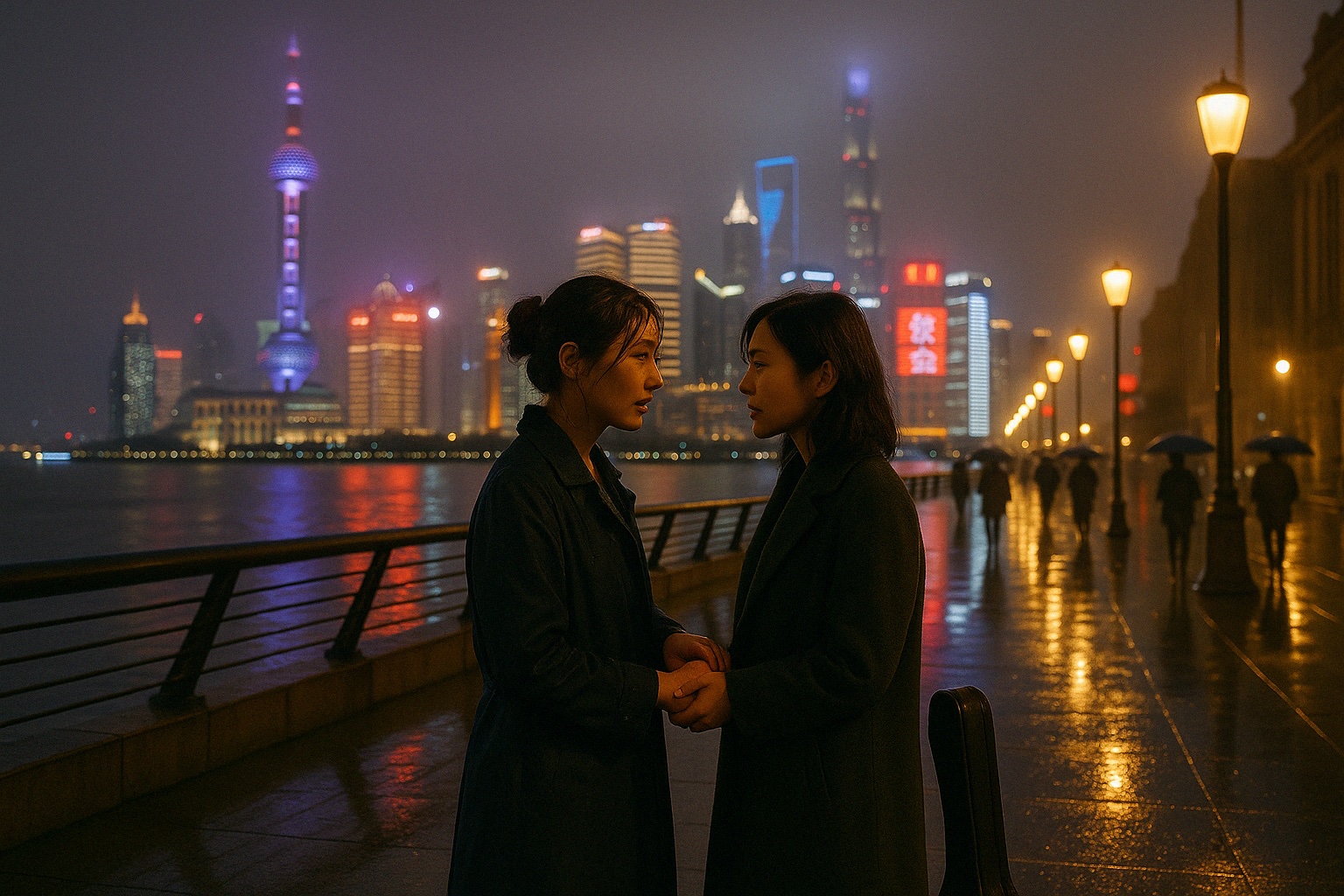
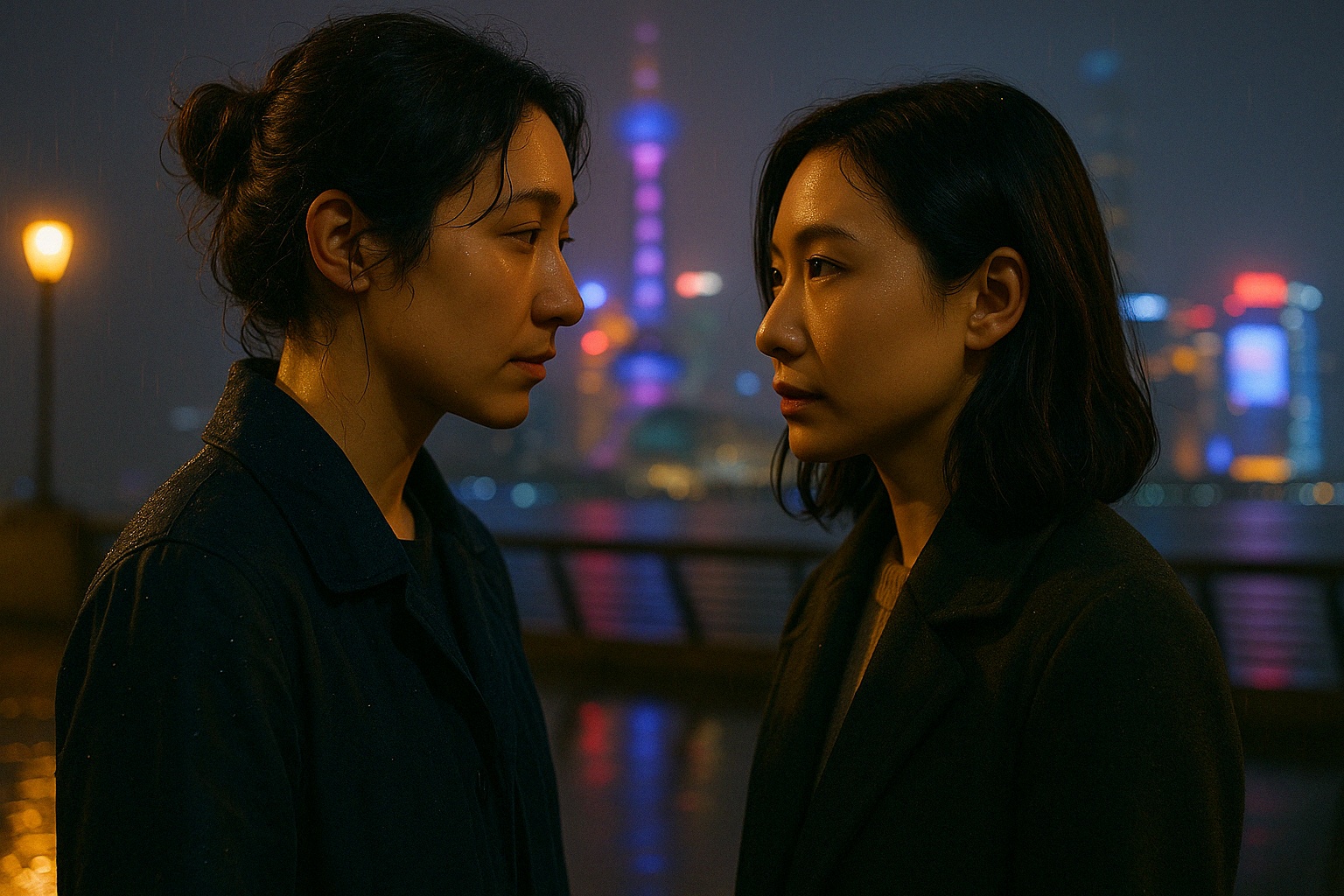
A cinematic realism, medium shot scene of a rainy night on the Bund, Shanghai. The neon skyline glows over the Huangpu River, with shimmering reflections rippling in the water. The wet pavement gleams under golden streetlights, capturing the soft haze of rain still lingering in the air. The hum of the city fades into the background, with no cars present on the streets. The Bund's distinctive street elements are visible, including its waterfront promenade railing and colonial-era architecture across the river. Occasional red lanterns add to the authenticity of the Shanghai setting. The city is alive, with distant blurred figures carrying umbrellas or moving through the rain, reinforcing the busy yet atmospheric energy of the location. In the foreground, two Chinese women stand close, facing each other—Liang Ruiwen, age 34, in a damp navy-blue trench coat, her dark brown hair loosely gathered in a bun, and Xu Meiling, age 32, wrapped in a dark green wool coat, her violin case resting at her feet. Their posture is intimate, their hands lightly touching as if caught between hesitation and certainty. The city glows around them, but they are still, lost in the moment. The mist softens the edges of the world, but nothing between them feels unclear. One woman’s hand lingers at the other’s coat sleeve, the other tilts her face ever so slightly upward. The rain-slicked streets mirror their closeness, the world holding its breath with them—alive, waiting. In the background, distant silhouettes with umbrellas move through the rain, adding to the realism of the busy Shanghai streets.
A cinematic realism close-up shot of two Chinese women standing face to face on a rainy night in Shanghai, with the neon-lit Bund and misty skyline softly blurred in the background. In the foreground, two Chinese women stand close, facing each other—Liang Ruiwen, age 34, in a damp navy-blue trench coat, her dark brown hair loosely gathered in a bun, and Xu Meiling, age 32, wrapped in a dark green wool coat. Xu Meiling’s black hair, streaked with auburn, is tucked behind one ear, and she looks directly into Liang Ruiwen’s eyes, her gaze fully locked onto Liang’s with quiet intensity. Raindrops cling to their coats and skin, catching the ambient city lights. The cool mist swirls around them, the warm golden glow of nearby streetlights contrasting with the sharp blues and purples of neon reflections in the wet pavement. The atmosphere is charged, intimate, with the quiet hum of the city around them.

“这次,我不会错过了。”
(“This time, I won’t miss it.”)

Her smile softened. “Then don’t.”

I kissed her before the next step could take us somewhere else.

Epilogue

We still don’t believe in fate.

But I do believe in Shanghai.

And we believe in 88 steps—the ones that led us to each other.


Liang Ruiwen (梁瑞文)
There are moments you only realize mattered after they’re gone. A glance across a café. The sound of rain against a window. The extra second you wait before speaking.

Xu Meiling (许美玲)
Shanghai is full of stories like ours—two people taking the same train, walking the same streets, standing on opposite sides of the same city before finally meeting in the middle.

Liang Ruiwen (梁瑞文)
Was it fate? Probability? Just a city playing matchmaker? I don’t know.

Xu Meiling (许美玲)
But I do know this: there were 88 steps between us that night. And I wouldn’t change a single one.