
Recovered from a 2019 museum visit, this reflection traces the evolution of kabuki, gender, and theatrical memory — from Edo’s stages to modern drag artistry.
While revisiting photos from my 2019 archive, I found a small sequence from a visit to the Portland Art Museum — a moment I’d almost forgotten. The gallery was still and amber-lit, its walls lined with faces caught mid-expression. The exhibition was titled Dramatic Impressions: Japanese Actor Prints, a study in how performance could live on in paper and pigment.
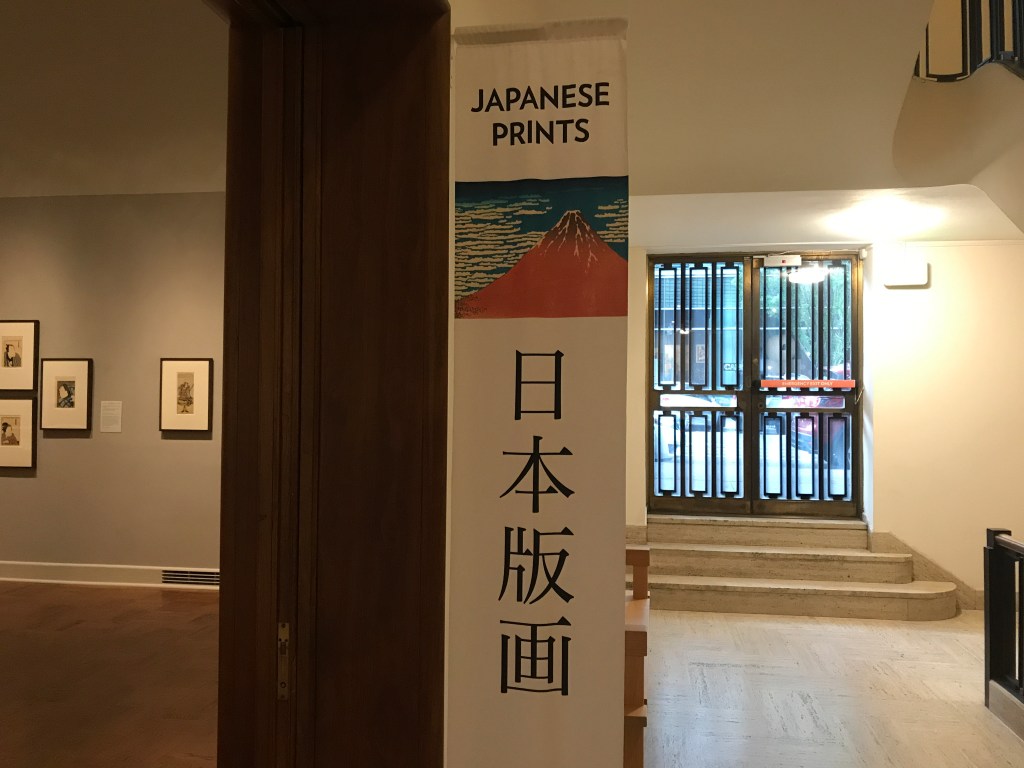
The show traced the rise of yakusha-e, or kabuki actor prints, which flourished in Japan’s great cities from the late seventeenth century onward.
These portraits transformed live theater into collectible art, turning performers into icons long before film or photography existed. Each print distilled the tension of performance into a single gesture: the flick of a sleeve, the flash of a glance, and the breath before revelation.
What struck me most, though, was the origin story: kabuki began with women. The earliest troupes were entirely female, led by traveling actors who blurred the line between artistry and rebellion.
It was only later, under the Tokugawa shogunate, that women were banned from performing — their roles handed to men who mimicked their poise and gestures on stage. In a sense, it seems like an early form of drag — a theatrical reimagining of femininity long before the language, visibility, and artistry celebrated in Jennie Livingston’s influential 1990 documentary, Paris Is Burning, or embodied by icons such as RuPaul and Darcelle XV, ever existed.
Even so, the echo of those early women lingered in every print. Their absence had shaped the form itself.
As I moved through the gallery, it felt less like an exhibit about fame than about inheritance — how performance remembers, even when history forgets.
The Stage Beneath the Moon
One work in particular held me there — a triptych by Toyohara Kunichika (1835–1900) titled The Ghost Story of the Moon at Kasamori (Kaidan tsuki no Kasamori, 1865). It depicts three kabuki actors caught in the heat of confrontation: Ichikawa Kuzō III, Sawamura Tanosuke III, and Nakamura Shikan IV, performing as Nakama Ichisuke, Osen’s younger sister Onobu, and Kakurega no Mohei.
The story, written by Kawatake Mokuami (1816–1893), follows Osen — a teahouse beauty of Edo — as she seeks vengeance after her sister’s murder by the man she once loved. For a modern audience, the story might feel like a cross between a Netflix true-crime thriller and an Agatha Christie murder mystery — only reimagined through the heightened spectacle and stylized emotion of kabuki theater, and without the deductions.
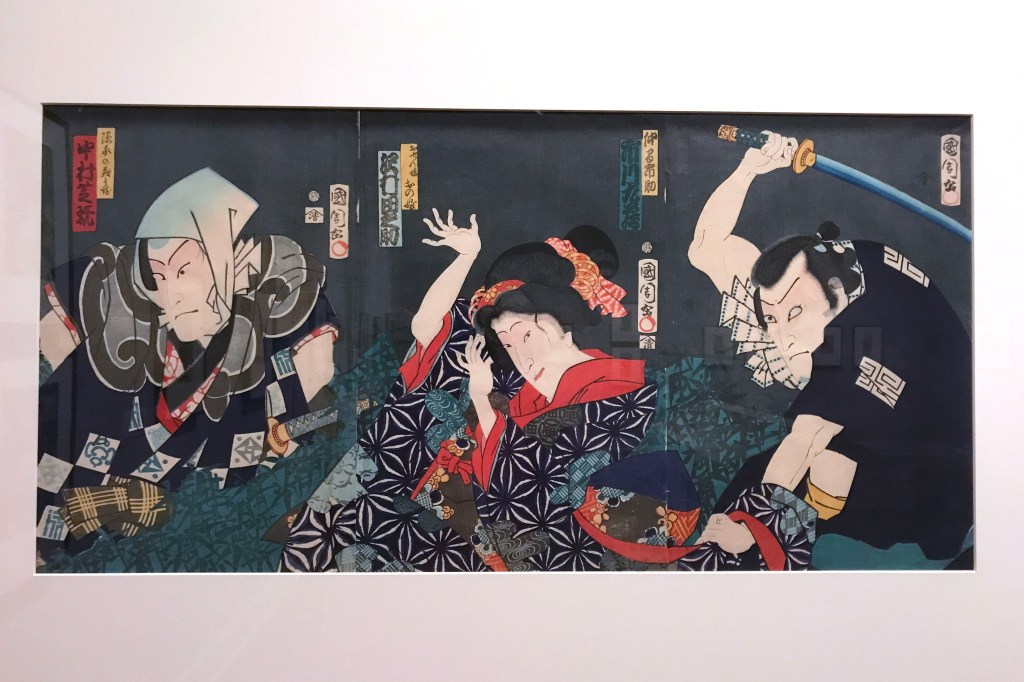
Kunichika captures that instant before violence: anguish and resolve colliding beneath a ghostly moon. Every fold of indigo and vermilion fabric feels choreographed, every expression etched with theatrical precision.
It’s as though the print still holds the heartbeat of the stage.
Performance as Permanence
Kabuki actor prints were more than souvenirs — they were early forms of celebrity portraiture. In Edo’s bustling print shops, fans could purchase likenesses of their favorite performers much as people once collected pop-culture posters — think of the 1990s bedroom walls lined with images of musicians and movie idols. The impulse is the same: to hold on to a moment of admiration, to preserve a face that once felt larger than life.
Kunichika was a master of that transformation — of turning fleeting performance into something permanent. His compositions thrum with theatrical rhythm, their layered colors reflecting both costume and emotion. Even in stillness, the image feels alive, suspended between reality and performance.
Echoes of the Stage
I remember standing in that gallery, surrounded by the quiet hum of history. The print’s surface shimmered slightly under the museum lights, as if the paper itself remembered the warmth of footlights and the sound of a distant audience.
That’s what Dramatic Impressions offered — not just prints, but echoes. The remnants of movement. The ghosts of applause. Art that outlasts the moment it was made for.
Kunichika’s Ghost Story of the Moon at Kasamori reminds me that theater never truly ends; it simply changes form. What was once a cry or gesture becomes an impression — one that still speaks, softly, across time.
Catalogue Notes
Title: Actors Ichikawa Kuzō III as Nakama Ichisuke, Sawamura Tanosuke III as Osen’s younger sister Onobu, and Nakamura Shikan IV as Kakurega no Mohei in the play Kaidan tsuki no Kasamori (The Ghost Story of the Moon at Kasamori)
Artist: Toyohara Kunichika (Japanese, 1835–1900)
Publisher: Shimizuya Naojirō (active mid-19th century)
Date: 1865 (Eighth month), Edo period (1615–1868)
Medium: Color woodblock print on paper; nishiki-e triptych
Dimensions: (A) 14 7/16 × 9 5/8 in; (B) 14 5/8 × 9 1/2 in; (C) 14 3/4 × 9 11/16 in
Collection: Portland Art Museum, Asian Art; Graphic Arts
Credit Line: Gift of Dr. Norris Perkins in memory of Mary A. Gray
Accession Number: 2015.144.1a–c
Status: Public domain
Postscript
Looking back, I realize that the drag parallel I sensed that day wasn’t invention so much as recognition — a thread of performance stretching across centuries.
From Edo’s candle-lit stages to the ballrooms of Harlem to the glittering runways of today, artists have always used gesture, costume, and transformation to tell the truth of who they are. What I saw in those prints — men performing the memory of women — was not parody but preservation, an act of remembrance disguised as spectacle.
Art keeps finding new forms for the same desire: to be seen, to become, to endure.
 Scott Bryant
You must be logged in to post a comment.