
Isoldes Requiem – Part I
Story Written by
Emilia Müller, Ella Steiner,
& Isolde Krüger
Story Told by
Emilia Müller
Visuals & Imagery Created by
Emilia Müller, Ella Steiner,
Katharina Schmid, Eva Berger,
Birgit Schwarz, & Scott Bryant
Their story is shared by
Scott Bryant at the request of Emilia Müller,
Ella Steiner, & Isolde Krüger
Morning in Vienna
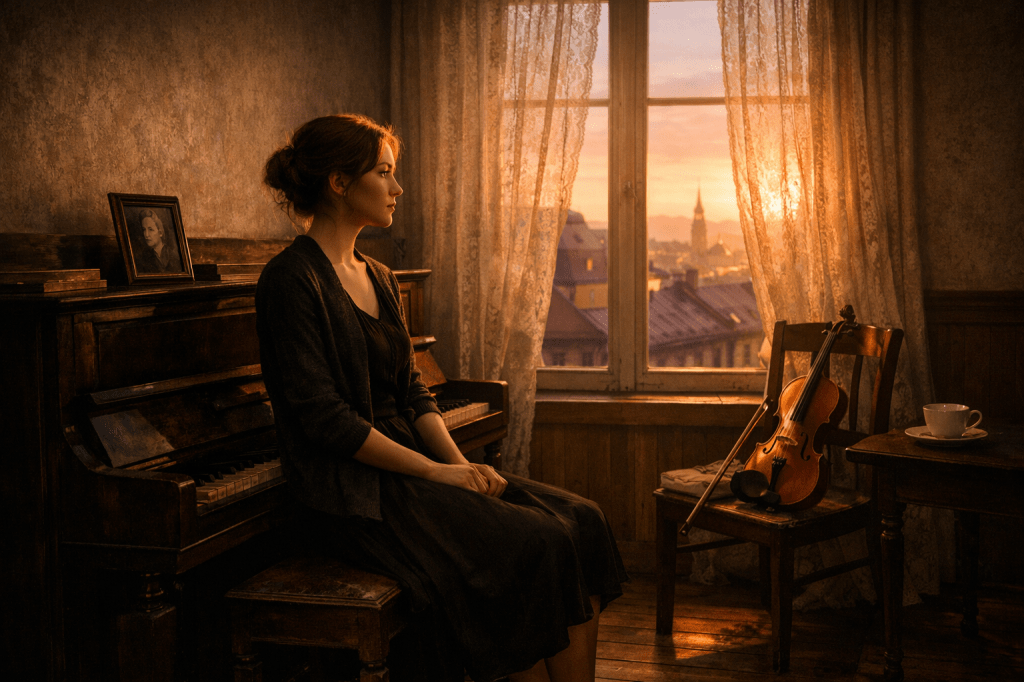
Dawn’s first light barely touched my apartment as I, Emilia Müller of Vienna, sat at the piano, fingers poised over the keys. For weeks, the melody had stubbornly resisted me, slipping away each time I thought I’d grasped it. Frustration tugged at my every thought. I sighed, my eyes drifting to the faded photograph of my grandmother perched on the piano.
“Musik ist die Sprache der Seele,” Music is the language of the soul, her voice echoed in my mind. “Lass sie durch dich sprechen.” Let it speak through you.
But it wasn’t speaking. No matter how hard I tried, the notes refused to come. “Why can’t I find it?” I muttered, pushing back from the piano. The gnawing sense of failure was unbearable. Maybe a walk would clear my head—or at least keep me from staring at those stubborn keys.
I’d grown up in a small Austrian town where my grandmother nurtured my love for music. She played the piano like no one else I’d ever seen. Moving to Vienna had been my dream—a chance to become the musician I believed I could be.
But Vienna, for all its beauty and grandeur, had its way of humbling you. I hadn’t made a name for myself yet, and that pressure weighed heavier with each passing day.
I stood abruptly and began to pace the room, the clatter of horse-drawn carriages on the cobblestone streets below adding a nostalgic charm to the morning. I reached for my grandmother’s journal on the bookshelf, its pages filled with her handwritten notes on music. “Keep pushing through, never give up,” her words read. She had lived by that mantra, and I tried to draw strength from it.
At the window, I leaned against the sill, letting the city stir around me. Below, a flower vendor arranged vibrant blooms, their colors a stark contrast to the gray streets. The aroma of fresh bread mingled with the faint strains of a violinist’s morning performance. Vienna lived and breathed art, demanding greatness while celebrating it. I closed my eyes and let the city’s rhythm remind me why I had come here in the first place.
“Komm schon, Emilia,” Come on, Emilia, I whispered, leaning my forehead against the cool glass. “Don’t bury your head in the sand.” Grandmother wouldn’t have. I couldn’t give up—not now, not when I’d come so far.
My gaze fell on the violin resting by the window, and I couldn’t resist. Drawing the bow across the strings, I played a simple, familiar melody. The notes soothed my tension, but the elusive tune I sought still lingered just out of reach, teasing me at the edges of my mind.
I couldn’t stay cooped up any longer. Grabbing my coat, I stepped outside, hoping the city’s streets might offer some inspiration. Crisp autumn air greeted me, carrying the scent of fallen leaves and chimney smoke. Cobblestones echoed beneath my boots as I wandered past ornate facades, catching glimpses of street musicians. Vienna whispered its music everywhere.
But even then, my thoughts clung stubbornly to that unfinished melody, refusing to let go.
Hartmann’s Antiques
I wandered aimlessly through Vienna’s streets until a sign caught my eye: Hartmann’s Antiques. Without thinking, I stepped inside, unaware that this visit would change everything.
The shop was dimly lit, the air thick with the scent of aged wood and polished brass. Dust motes floated lazily in the narrow beams of light from small, stained-glass windows. Shelves were crammed with ornate candlesticks, vintage jewelry, and objects humming with the weight of forgotten stories. The musty scent of leather and paper seemed to pull me further inside.
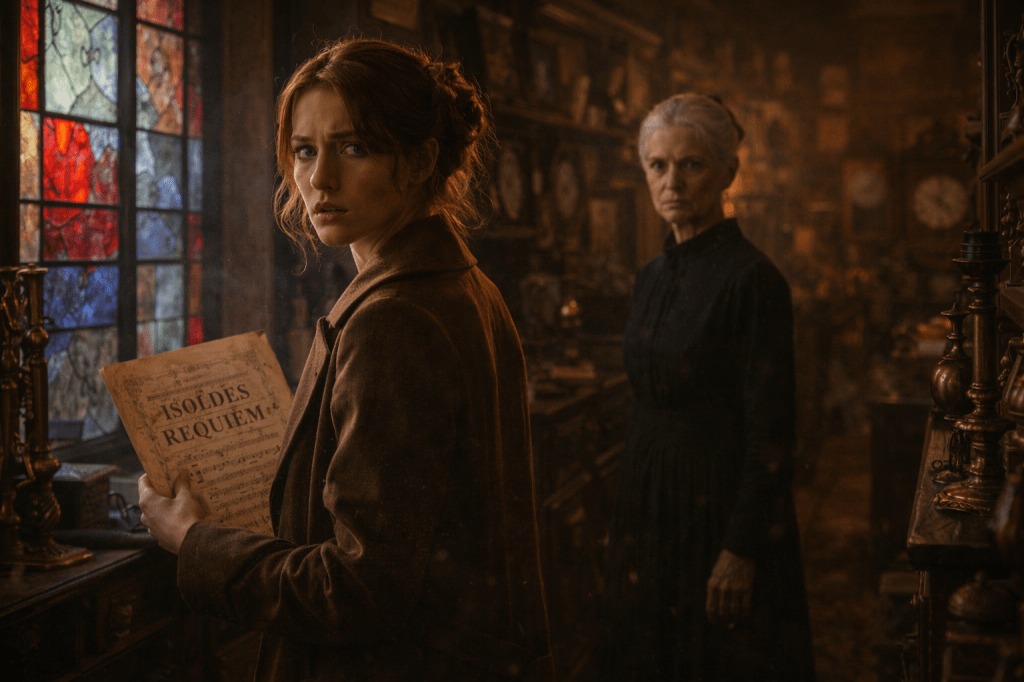
As I browsed, I felt eyes on me—sharp and watchful. Looking up, I saw the shopkeeper, Gertrud Hartmann. Petite and composed, her silver hair was swept into a tidy bun. Her gaze, piercing and cautious, seemed to size me up. She wasn’t unfriendly, but there was something about her that set me on edge.
It was in a dusty corner, beneath a stack of old books, that I found it. The cover of the sheet music, once embossed with gold leaf, was faded, its edges frayed with time.
But the title remained legible: Isoldes Requiem.
The moment my fingers brushed the paper, the room seemed to shift. A heaviness settled in the air, pressing against my chest—just for a second, just long enough to make my breath hitch. The notes seemed to pulse faintly under my fingertips, like something alive, like something waiting.
Before I could process what I had found, Mrs. Hartmann’s voice broke the silence.
“Ach, Isoldes Requiem,” she murmured, her gaze lingering on the pages. “That one… it’s stayed here longer than most.”
I glanced up, sensing the weight in her tone.
“Why?”
She didn’t answer right away. Her fingers brushed the brittle cover, and she sighed.
“Let’s just say… some music remembers. And not always kindly.”
A silence stretched between us, thick with unspoken things.
“Be careful, Emilia,” she added softly, her eyes suddenly too knowing.
“How do you know my name?”
She didn’t answer that either.
A shiver ran through me, but I forced my voice to remain steady.
“Then why keep it?”
Her expression softened, a shadow of weariness crossing her face.
“Some things aren’t meant to be destroyed. It’s beautiful, yes, but also dangerous.”
Her voice dipped lower, like she was about to add something else—something final. But instead, she just sighed, shaking her head slightly before whispering:
“Be careful, Emilia.”
She said my name with unsettling familiarity. My pulse quickened.
“How do you know me?”
Mrs. Hartmann ignored the question, her gaze shifting to the sheet music.
“This has been here for as long as I can remember. The woman who brought it—Isolde Krüger—was terrified. She said it needed to be hidden. She claimed a rival composer, consumed by envy, had cursed it, embedding his hatred in the notes. Those who play it are changed. Consumed by their own ambition or tormented by their failures.”
Her words hung heavy in the air, but I clung to my resolve. I couldn’t walk away.
“And you think it’s meant for me?” I asked, gripping the sheet music tighter.
“Ich weiß es nicht,” I don’t know, she admitted, her voice low, her gaze sharp. “But the music calls to those who can hear it. I’ve seen others take it. They always return—zerbrochen, gequält.” broken, haunted. “Yet they could never truly leave it behind. It latches onto something in you, feeding on your deepest fears and desires. Sei sicher, Emilia. Das ist nicht nur Musik.” Be sure, Emilia. This is not just music.
Another shiver coursed through me, colder this time, but I couldn’t turn back.
“I understand the risks,” I said, my voice steadier than I felt. “But I need this.”
Mrs. Hartmann held my gaze, her expression unreadable, before nodding. She wrapped the sheet music carefully, her movements deliberate, as if the fragile pages carried more than just notes.
As she handed it to me, her voice softened.
“Sei vorsichtig, Emilia,” Be careful, Emilia, she said. “Some masterpieces come with a price.”
She hesitated just a moment too long, her fingers lingering on the sheet music before letting go.
Outside, the crisp autumn air was a sharp contrast to the shop’s oppressive atmosphere. But the moment the door shut behind me, a strange weight settled in my chest—like something had shifted. Like something had already changed.
Closer Examination
The moment I left the antique shop, I knew I couldn’t keep this discovery to myself. If anyone could help me make sense of what I’d found, it was her. Ella Steiner had been my best friend since we were kids, and now she worked as a librarian at the Austrian National Library. Her knack for unearthing hidden truths was unmatched. If there was more to Isoldes Requiem, Ella would find it.
I called her as soon as I could, my excitement barely masking the unease tightening in my chest.
“Ella, du glaubst nicht, was ich gefunden habe,” Ella, you won’t believe what I found, I said, my voice pitching higher than I intended.
“What is it?” she asked, her tone curious but calm, steadying me as always. I pictured her in the library, surrounded by towering shelves of books, her hands busy with some fragile manuscript. It was her domain—a place where stories waited to be rediscovered.
The next morning, I met her there. Without a word, I handed her the sheet music.
“It’s by a composer named Isolde Krüger,” I began, the words spilling out faster than I could organize them. “She was murdered, and her spirit is trapped in this music.”
The moment I said it, doubt flickered in my mind. Did I truly believe this? Or was I grasping at an explanation for the strange pull of the music—the way it already felt like it owned me?
Ella frowned as she examined the sheet music, her expression thoughtful. The musty smell of old books mixed with the faint scent of polished wood—a familiar comfort in the vast library halls.
“Es muss gehört werden,” It must be heard, I whispered suddenly, the words surprising even myself. The conviction in my voice felt foreign, as if it came from somewhere deeper, somewhere I hadn’t yet dared to explore.
Ella looked up at me, her brow furrowing.
“Isolde Krüger. Der Name kommt mir bekannt vor.” The name sounds familiar. She flipped the sheet music over as if it might hold a hidden clue.
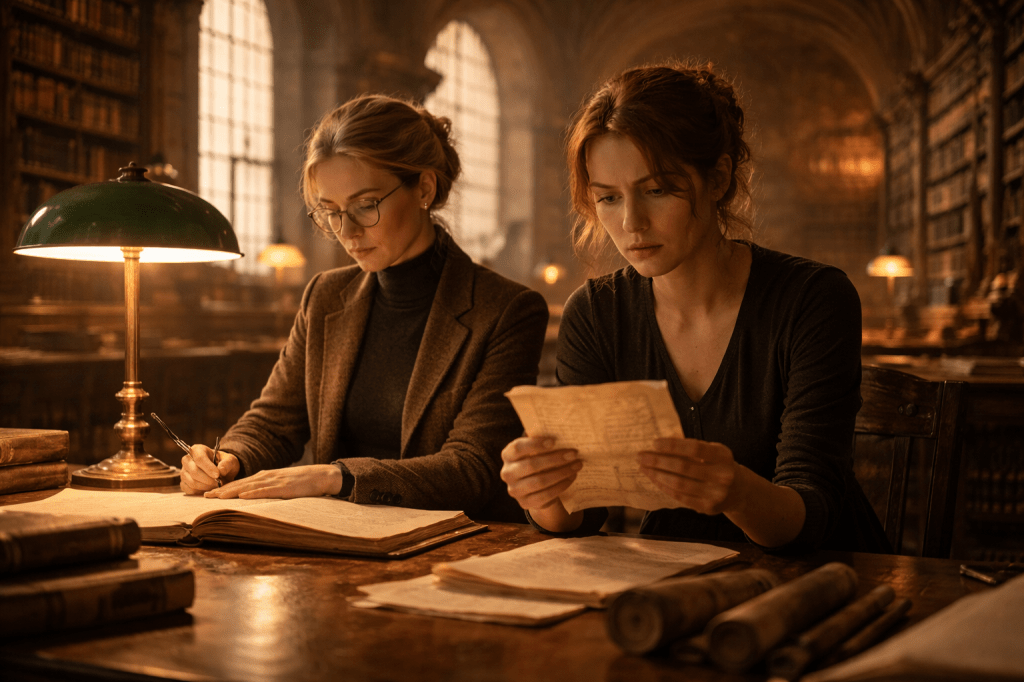
We delved into the archives, the dim light casting long shadows as we combed through fragile pages. The whispers of other patrons faded into the background as I worked, my fingers skimming over worn papers. My mind drifted to my grandmother’s hands, so steady, so sure as they played the piano.
She never struggled the way I did.
“Warum kann ich das nicht?” Why can’t I do this? I muttered under my breath.
The thought gnawed at me, twisting tighter with every irrelevant page I turned. Was it the music holding me back? Or was it something within me, something I couldn’t overcome?
The question lingered as I rifled through another stack of documents, frustration mounting. And then Ella’s voice broke the silence.
“Krüger, Isolde… ah, here’s something,” Ella murmured, flipping through a concert registry.
“Any mention of the Requiem?”
“Not yet, but… hmm.” Her finger traced a line on the page. “She shared several programs with a Leopold von Drachmann. His name’s everywhere in the early 1890s.”
“Was he a friend?”
“Hard to say. Here—there’s a review. He performed one of her pieces in ‘91, but the write-up dismisses her contribution entirely. Only praises his interpretation.”
I frowned. The name stuck with me, like a wrong note I couldn’t shake.
“Warte,” Wait, she said, her tone hushed but urgent. She held up a torn fragment of a letter.
My breath hitched as I leaned closer. The paper was yellowed, the ink faded, but the words were clear enough. Isolde had written about a composition so personal she feared it would expose her deepest shame. The vulnerability in her words struck something deep within me, mirroring a fear I hadn’t fully admitted to myself.
“She was terrified,” I whispered, my throat dry.
“Wovor?” Of what? Ella asked, her eyes scanning the letter with a sharp focus that I envied. She had a way of cutting through the noise, of seeing things I couldn’t.
I stared at the letter, my chest tightening. The fear wasn’t just Isolde’s anymore—it was mine. The music wasn’t just cursed; it was a mirror, reflecting everything I was afraid to face. What if my ambition, my desperation, was consuming me the same way it had consumed her?
The thought crept up my spine like cold fingers, and suddenly, the library felt too small, the air too thick.
“I need to know more,” I said, my voice trembling with a mix of determination and fear. “I have to understand what this music is trying to tell me.”
Ella’s concern deepened. As I flipped through another document, I caught her watching me, her brow furrowed, her lips pressed into a thin line. She wasn’t just focused on the research—she was worried about me.
“Du verlierst dich,” You’re slipping, Ella thought, gripping the edge of the book she held. This isn’t the Emilia I know.
She had seen friends unravel before, retreat into themselves, but this felt darker. And if she couldn’t reach me soon, she feared she might lose me entirely.
But I couldn’t stop. I couldn’t look away from the words on the page or the questions clawing at my mind. Was the music truly cursed? Or was it simply revealing a truth I wasn’t ready to confront?
The fear, the ambition, the doubt—it wasn’t just Isolde’s anymore. It was mine.
Supernatural Occurrences
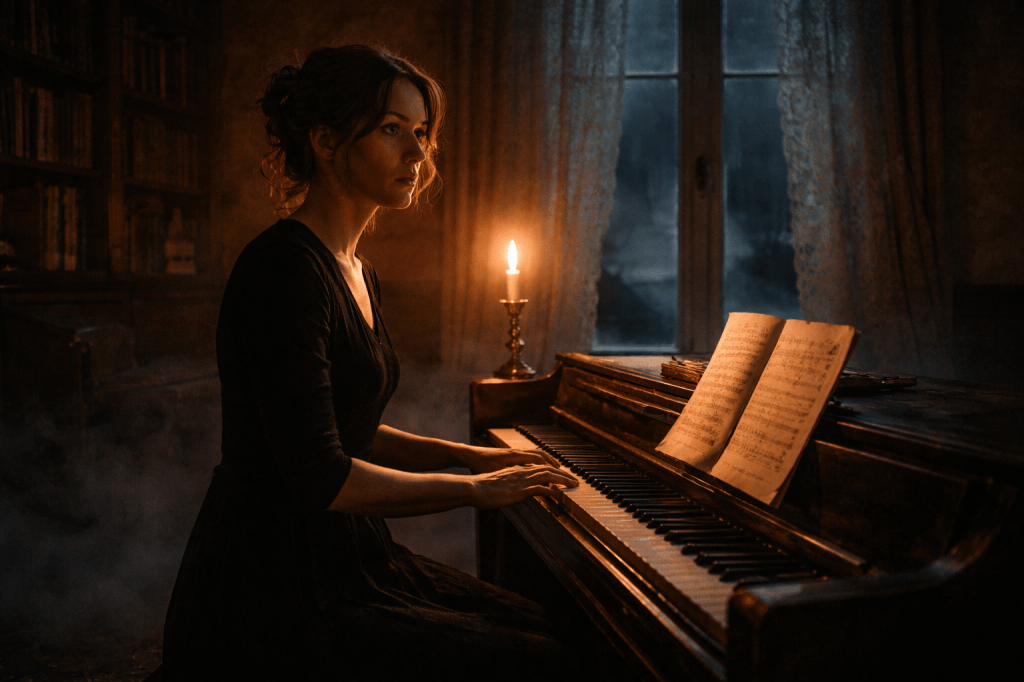
That night, the quiet of the city felt unnatural, as if Vienna itself was holding its breath. The stillness wrapped around my apartment like a heavy cloak, suffocating in its intensity. I couldn’t shake the feeling that something was waiting, lurking in the corners, watching me. The silence pressed down on me, thick and oppressive, as though the very air was warning me not to proceed.
I sat at the piano, my fingers trembling slightly as they hovered over the keys. Isoldes Requiem lay before me, taunting me—a challenge I could no longer avoid. The room seemed to hum with tension, the air almost electric, charged with something unseen. My breath came shallow, my heart pounding louder than I wanted it to. I closed my eyes, exhaled slowly, and began to play.
The melody that poured from my fingers was haunting, hypnotic, more than just music. It gripped me, each note resonating deep inside my chest, pulling at something I couldn’t name. But the cold hit me first. It wasn’t just the chill of the autumn night creeping in through the windows—it was deeper, bone-chilling, as if the very air around me had turned to ice. I paused, rubbing my hands together, but the cold clung to me, seeping into my skin.
The shadows in the corners of the room seemed restless from the start, like faint whispers of movement caught in the edges of my vision. At first, I dismissed it as fatigue—too many late nights spent at the piano, too few hours of rest.
But as the days passed, the unease grew. Objects would be slightly out of place when I returned to the room.
The scent of lavender would linger for just a moment before fading, like a memory I couldn’t quite grasp. And the shadows—they pulsed faintly in time with the music, their presence growing with each note, as though alive. They didn’t just watch—they waited.
A chill ran down my spine, and my breath caught in my throat. I realized then—the music wasn’t confined to this room. The strangeness, this unsettling presence, had begun to follow me beyond these walls.
Then came the bruises. They appeared without warning—dark purple marks forming on my wrists and fingers, as if I’d been gripping the piano keys too tightly. But I hadn’t.
The music seeped into every part of my life, haunting me even in the quietest moments. My relationships—once a source of support—began to fray under the weight of my obsession. I canceled rehearsals without explanation, my colleagues’ worried glances following me. I was unraveling, but the music had its claws in me, and I couldn’t stop.
Something shifted after my latest performance. That evening, as I stepped off the stage, Ella was waiting for me, her face a mix of relief and determination.
“Let’s grab a coffee,” she said, her tone leaving no room for refusal.
For the first time in months, I didn’t hesitate. We sat at our favorite café, its warm light and cozy corners a welcome contrast to the cold tension that had been my constant companion.
Ella didn’t press me for details. She listened as I spoke—haltingly at first, then with more confidence—about everything. The music, the doubts, the fears. The way it had begun to consume me.
She didn’t offer solutions, only understanding. But in her presence, I felt something I hadn’t in a long time: connected. For a brief moment, the whispers faded, the shadows receded, and I remembered what it felt like to be seen.
“Lass uns ins Kaffeehaus gehen,” Let’s go to the café, Ella suggested, her tone light but with a touch of insistence.
I managed a small smile. The idea of stepping out into the world, into Vienna’s heartbeat, felt overwhelming but oddly comforting. It wasn’t a cure, but it was a start.
Isolde Krüger’s Ghost
Late into one of my solitary practice sessions, the air in the room grew thick, pressing down on my chest. The temperature plummeted so suddenly that I gasped, my breath becoming visible in the cold. I shivered, wrapping my arms around myself as the candlelight flickered, casting long, wavering shadows across the walls.
This time, something was different. The oppressive silence didn’t just surround me—it felt alive, aware, as though the room itself was holding its breath. My heart pounded in my chest as I lifted my gaze from the piano. And that’s when I saw her.
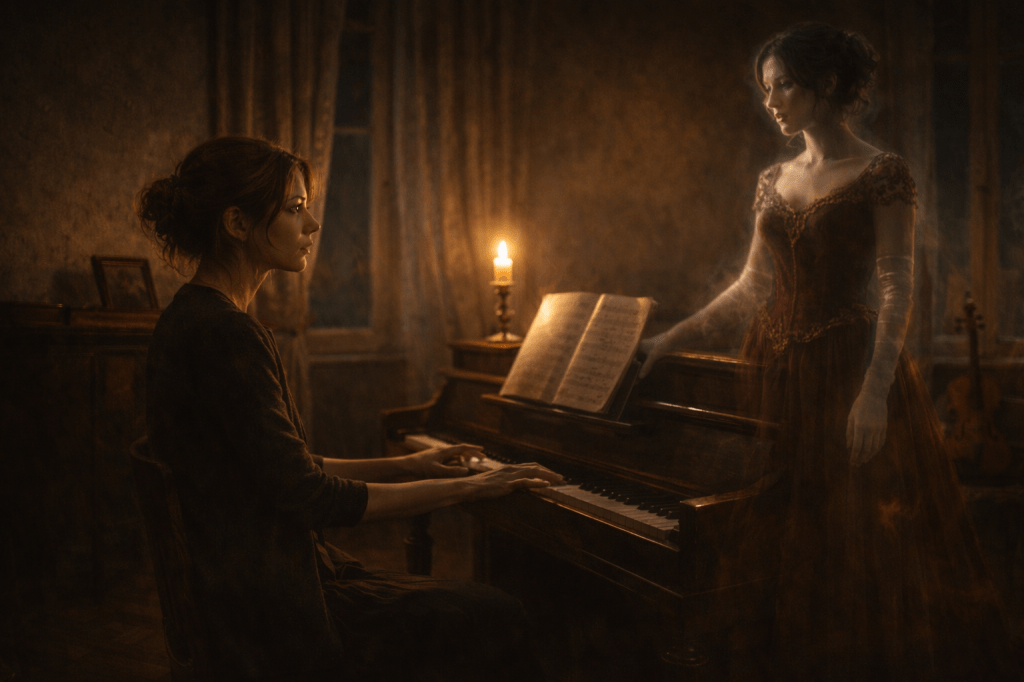
She stood by the piano, her figure ethereal yet commanding. Her crimson gown shimmered faintly, and her sorrowful eyes met mine with a plea I couldn’t ignore. The air around her felt heavy, her presence filling the room with a blend of grief and urgency.
“You play with such passion,” she said, her voice soft and echoing, like a melody carried on a distant wind. “Ich bin Isolde Krüger,” (“I am Isolde Krüger,”) she continued, her gaze piercing through me. “I was a composer, just like you. This melody is my final work, but I was murdered before I could finish it. My spirit has been trapped in these notes, waiting for someone to help me.”
My breath caught in my throat. This was her—the composer whose music had consumed me, whose tragic history I had tried to unravel. But here she was, standing before me, not just a name in an old story but a presence as real as the piano beneath my hands.
My voice trembled as I spoke. “What do you need from me?”
Isolde’s eyes softened, but the sorrow in them deepened.
“Help me finish my work,” she said. “And uncover the truth of my murder. Only then can my soul find peace.”
The weight of her words settled over me, but it wasn’t just her story that called to me—it was something deeper. Her struggles felt like my own. The failures, the doubts, the relentless pressure to prove myself—it all mirrored my life. And in that moment, I felt a connection to her that went beyond music.
“I’ll help you,” I said firmly, despite the tremor in my voice. “Together, we’ll finish what you started.”
I returned to the piano, my fingers trembling as they found their place on the keys. As I began to play Isoldes Requiem again, the music took hold of me in a way it never had before. Each note seemed to weave through my thoughts, pulling me deeper into something beyond my control. The lines between my mind and the music blurred, and soon, I wasn’t just playing—I was living it.
Visions of Isolde’s Life
Visions unfolded with a vivid clarity that gripped me entirely. My own failures played out like fleeting shadows—concerts where my fingers stumbled, the harsh critiques that echoed in my mind long after the applause had faded. But before I could dwell on those moments, the music shifted, pulling me into Isolde’s life.
Her triumphs glimmered like scattered jewels—compositions bursting with brilliance, only to be dimmed by envious whispers. The bitterness of a rival composer, the cruel dismissals from those in power—each moment rushed past like scenes in a dream. But it wasn’t just her story—it was a reflection of mine. The lines blurred, each note weaving our struggles together in a way that left me breathless and unnerved.
The bitterness, the rivalry, the eventual betrayal—it was all too familiar, too close to the struggles I faced daily in Vienna’s unforgiving music scene. The parallels were unsettling.
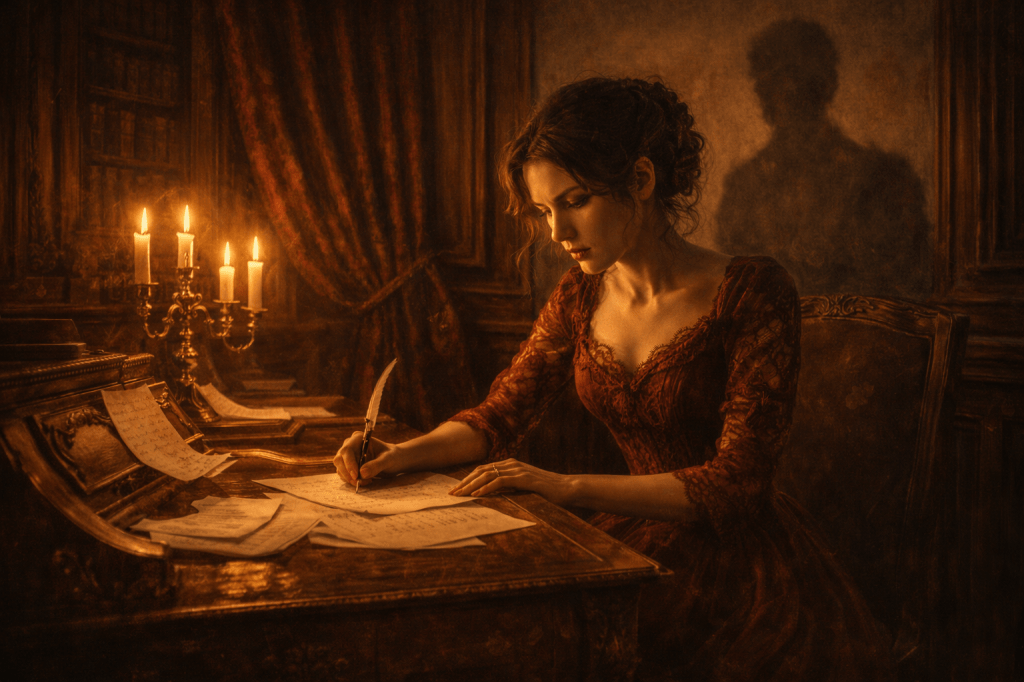
The vision sharpened, drawing me deeper. I saw Isolde at her desk, her hand trembling as she penned the final notes of her Requiem by candlelight. Shadows flickered around her, alive with an unnatural energy.
“They won’t take this from me,” she whispered, her voice tight with defiance and fear. Her words rang with desperation:
“Es ist meines,” It is mine, as her trembling hand added the final notes to the page.
The candle flame wavered, the shadows closing in around her. A larger shadow fell across the page, and I knew it was Leopold. His presence was suffocating, his anger a storm Isolde braced herself against even as she finished the notes that would become her final masterpiece.
Her determination was fierce, her hands steady, but there was a vibrancy in her that I hadn’t seen before—a quiet rebellion in the way she refused to be diminished. She loved deeply, not just her music but the world around her, even as it turned against her.
The glow of the candle faded, replaced by the cold of a Vienna winter. Isolde, with all her courage and brilliance, walked toward her fate. I felt the crushing isolation she carried. But now, I understood the fullness of her life—the way her passion had burned brightly, even in the shadows of jealousy and cruelty.
Then, another scene unfolded—a marriage proposal.
A handsome man stood before her, his expression a mix of disbelief and hurt as she turned him down. Isolde’s face was resolute. She had chosen her music over the traditional path laid out for her.
Her resolute refusal still echoed in the vision:
“Ich wähle meine Musik,” I choose my music.
She knew greatness demanded sacrifice. She couldn’t afford distractions—not love, not companionship. Her art demanded everything, and she gave it willingly.
I felt the same fierce determination that must have driven her, the same drive that pushed me every day. But the scene shifted, and the isolation that followed her choices became painfully clear.
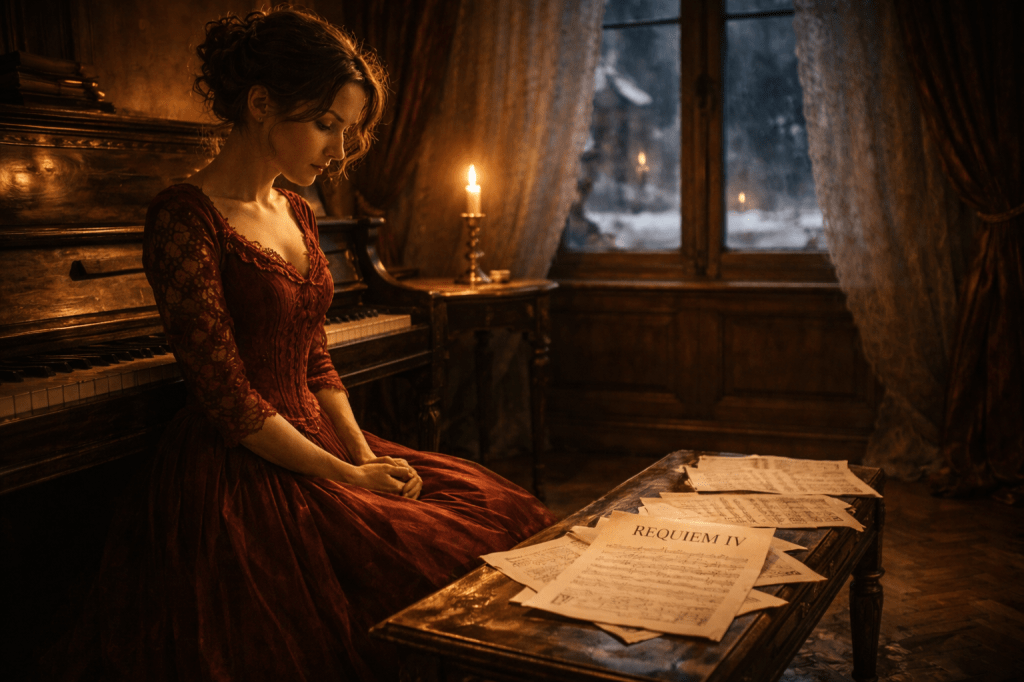
Isolde was alone—working late into the night, perfecting her compositions, surrounded by nothing but sheet music and the echo of her own ambition. The world outside her window seemed distant, unreachable, as if she had locked herself away in pursuit of something that might never be enough.
And then I felt it—that unmistakable tug of recognition. The choices Isolde had made were disturbingly familiar. They echoed my own sacrifices, decisions I had convinced myself were necessary for my career. The friendships I had let fade away because I was too focused on the next concert, the next composition. The nights I spent alone, consumed by my music while life moved on without me.
How many times had I turned down invitations from friends? How many times had I told myself that I didn’t have time for anything but my art? The memory of those missed moments, those lost connections, hit me hard, their weight settling in my chest. I had done the same thing—chosen my music over everything else.
But as I watched Isolde, sitting alone at her piano, the glow of candlelight casting shadows over her weary face, I realized something. The music wasn’t just telling her story—it was showing me my own potential fate.
Her brilliance hadn’t saved her from the crushing loneliness that came with her choices. Her ambition, her talent, had been undeniable, but it had come at a cost—a cost I was all too familiar with. It was as if the music was warning me, showing me that I was walking the same dangerous path she had. That if I wasn’t careful, my fate could mirror hers.
The realization gnawed at me, whispering that the sacrifices I had made might not lead to the success I craved, but instead to the same tragic end that had claimed Isolde’s life. Was this what it meant to chase greatness? To be consumed by it until there was nothing left?
The weight of the question lingered in the air, suffocating me, as the music wrapped around my thoughts like a warning I couldn’t ignore.
Visions of a Grand Ball
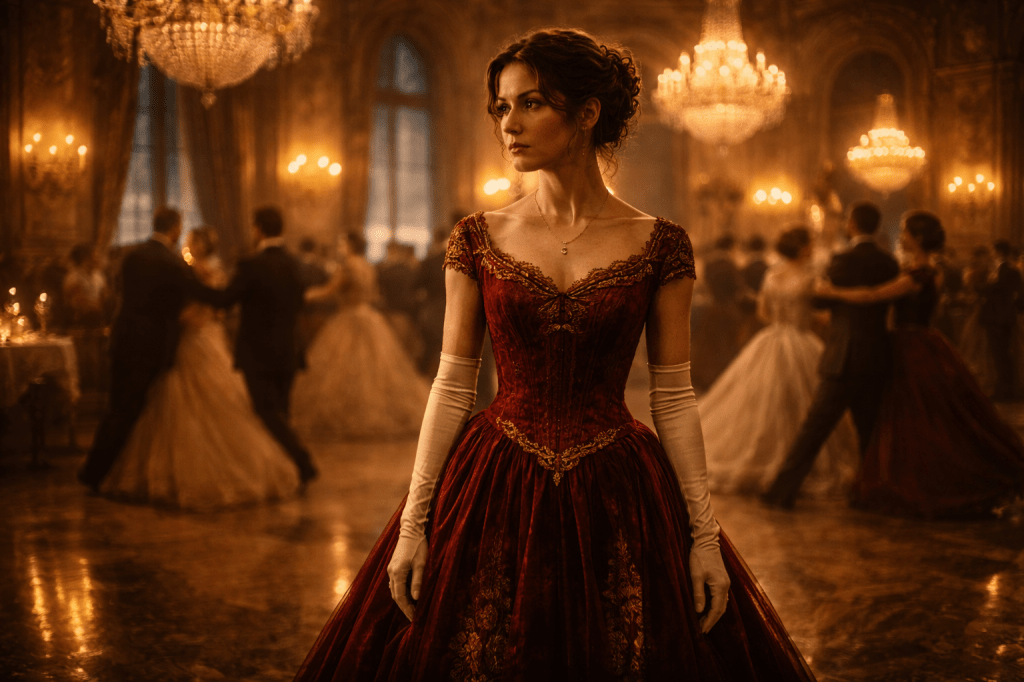
The music pulled me deeper, and the vision unfolded before me with sharp, vivid clarity. I found myself standing in a grand ballroom, a hall that shimmered with 19th-century opulence. Unlike the previous visions, this one was more intense, as though the music itself was dragging me into Isolde’s world, refusing to let me escape.
Above me, chandeliers sparkled like captured stars, their golden light dancing across polished marble floors. The room buzzed with the soft murmur of conversation, the clinking of crystal glasses, and the faint scent of floral perfumes mingling with candle wax. On the surface, it was breathtaking—a celebration of wealth and status wrapped in elegance.
But something felt wrong. A subtle suffocation crept into the air, wrapping itself around me like an invisible vice. It wasn’t the grandeur of the scene that unsettled me—it was the crushing weight of expectation. The whispers, the glances, the subtle but relentless pressure to conform to their narrow views of worth. I felt Isolde’s anxiety as though it were my own, her dread coiling tightly in my chest. Her brilliance wasn’t enough—not here. Her value was measured by how well she played their game, not by her talent or her passion.
Her fingers danced across the piano keys in front of the crowd, her music weaving a spell that held their attention.
And then, a memory flashed before me—a conversation between Isolde and her father. The scene shifted to the dim light of their family’s grand drawing room. Her father sat stiffly in a leather chair, his expression cold and unyielding.
“Deine Pflicht ist nicht die Musik,” Your duty is not to music, his voice cut through the vision like ice.
“Es ist deine Familie. Du wirst gut heiraten. Das ist, wie du deinen Platz sicherst, nicht durch törichte Ambitionen.” It is to your family. You will marry well. That is how you will secure your place, not through foolish ambitions.
The pain in Isolde’s heart mirrored my own, her frustration and despair rising like a tide. The suffocating weight of being misunderstood, dismissed by those who should have supported her, was palpable. Her father’s words hung in the air like a noose, threatening to choke the life from her dreams.
My hands trembled on the piano. The music poured out of me—Isolde’s story intertwined with my own. Each note defied the voices that told me I wasn’t good enough, pushing back against the expectations that had haunted me for so long.
And then, the vision shifted again.
Leopold von Drachmann
At first, the details were fractured—shifting glimpses of Isolde’s life woven through my visions. A name whispered in hushed tones at lavish gatherings. A shadow at the edges of candlelit parlors. A hand brushing too familiarly against hers, lingering just a moment too long.
Leopold von Drachmann.
The name surfaced over time, each appearance deepening the unease curling in my chest. He was always there—watching, listening, calculating. When Isolde performed, his gaze never left her. In conversation, his voice was warm, but something lurked beneath, something possessive.
Next the small sabotages came.
A misplaced score.
A review laced with veiled insults.
A patron who suddenly withdrew their support.
And finally—the invitation to the grand ball, where he handed her the glass of wine.
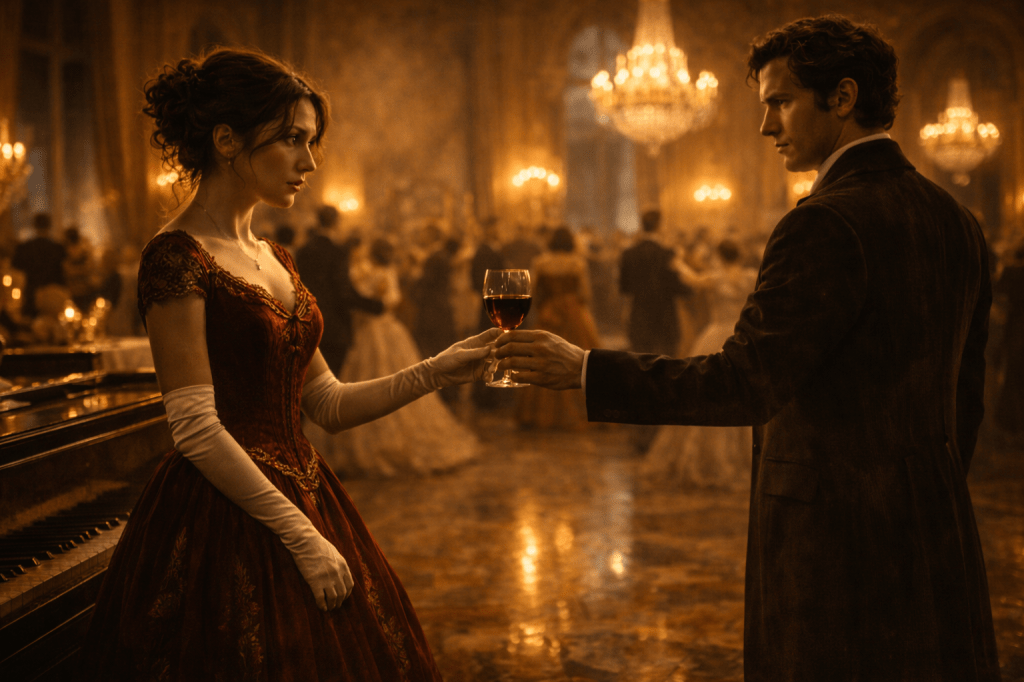
My heart pounded. I wanted to scream at her, to make her see the danger. But she accepted it, her expression weary but polite, as though she had no choice.
And as the visions bled into one another, I realized—I had been missing the signs all along.
The curse wasn’t just in the music. It had been written in her fate from the moment she met him.
The scene unraveled, and I was powerless to stop it.
Isolde’s body crumpled to the floor, her crimson gown pooling around her like spilled blood. The guests froze, their horrified faces illuminated by flickering candlelight. Gasps and whispers spread through the room like wildfire. And there, amidst the chaos, stood von Drachmann, his charming smile replaced with a cold, triumphant sneer.
The air around me turned icy, the scent of perfume dissolving into something darker—despair and decay. Isolde’s pain coursed through me, her fear and heartbreak flooding my senses. Her life, her potential, had been stolen. The music had stopped, but the vision held me captive. The shadows in the corners of the room seemed to grow larger, looming over me like a reminder of my own isolation, my own fear that my sacrifices would lead to nothing.
Was this my fate too? To be consumed by ambition, only to find it hollow? To realize too late that everything I had worked for would be undone by forces beyond my control?
The vision shifted once more. I saw Leopold hunched over Isolde’s original manuscript, his fingers trembling with rage as he scrawled over her notes, altering the music with deliberate malice. His voice, low and venomous, echoed in the still air.
“Sie denkt, sie kann mich übertreffen,” She thinks she can surpass me, he spat, his words dripping with contempt.
“Aber ich werde dafür sorgen, dass niemand ihr Werk spielt, ohne ihr Versagen zu fühlen.” But I’ll make sure no one plays her work without feeling her failure.
The scene sharpened, showing him poring over an alchemical text, its pages lined with strange, arcane symbols. His face was illuminated by flickering candlelight as he dipped his pen into a vial of shimmering ink, muttering incantations under his breath. The ink pulsed unnaturally as it seeped into the notes, twisting the music with a malevolent energy.
His face, twisted with jealousy and triumph, sent a shiver down my spine. The darkness he had infused into the music wasn’t just symbolic—it was alive, feeding on his bitterness and hatred. I could feel it, growing stronger with each stroke of his pen.
Still, it was too late for Leopold.
Isolde’s life had been cut short, her music left unfinished—a testament to her unrealized potential. The tragedy that befell her was more than a personal loss; it was a symbol of everything she could have been, stolen away by envy and cruelty.
I felt a surge of determination rise within me. I couldn’t let her story end this way. I couldn’t let her brilliance remain buried in the shadows of history. Isoldes Requiem deserved to be heard, and I would ensure it was. I would bring peace to her restless spirit and honor the legacy of a woman whose genius had been overshadowed by injustice.
As I played the final notes of the vision, something shifted inside me. A sense of closure, of triumph, filled the air. I had given voice to Isolde’s story, to her passion. But somewhere in the silence that followed, a question lingered.
Was it truly her story I was finishing?
Or was it mine?
End of Part 1
 Scott Bryant
You must be logged in to post a comment.