
Isoldes Requiem – Part II
Story Written & Told by
Emilia Müller, Ella Steiner,
& Isolde Krüger
Story Told by
Emilia Müller
Visuals & Imagery Created by
Emilia Müller, Ella Steiner,
Katharina Schmid, Eva Berger,
Birgit Schwarz, & Scott Bryant
Their story is shared by
Scott Bryant at the request of
Emilia Müller, Ella Steiner, & Isolde Krüger
Ella Confronts Emilia
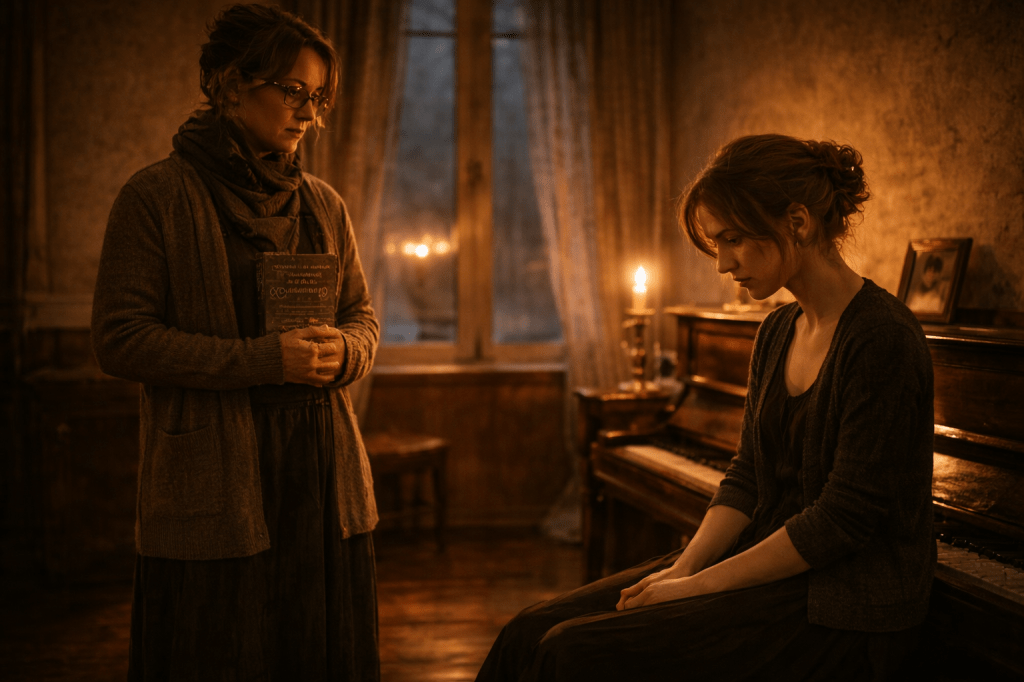
Ella’s voice pulled me out of the fog of my spiraling thoughts. She stood in front of me, her expression equal parts frustration and fear, holding a book as if it were a lifeline. The title, Forgotten Women of Music, glinted faintly in the dim light of the room.
“You didn’t tell me everything about Isolde Krüger, did you?” she asked, her voice sharp and demanding.
I stared at her, guilt twisting in my chest.
“You went digging?” I asked, caught between relief and annoyance.
“Natürlich habe ich das getan!” Of course I did! she snapped, her tone softening only slightly.
“You’ve been slipping away from everyone, Emilia. I had to do something.” She stepped closer, gripping the book tightly. “This isn’t just about the music anymore, is it? What did you find?”
I lowered my gaze, tracing the frayed edges of the sheet music in my lap. “It’s complicated,” I murmured. “I’m not even sure how to explain it.”
Ella exhaled sharply.
“Do you even hear yourself? You’ve stopped rehearsing with the orchestra, you cancel plans without warning, and now you’re talking about curses and ghosts like they’re real.” Her voice wavered slightly, frustration laced with something deeper—fear.
“It is real, Ella,” I shot back, the words spilling out before I could stop them. “You just don’t understand.”
Silence stretched between us, thick and suffocating. Ella’s expression darkened—not with anger, but something worse.
Disappointment.
She shook her head, setting the book down between us with a decisive thud. “I don’t understand,” she admitted, her voice quieter now. “But I also don’t know if I can keep doing this—watching you unravel and pretending I don’t see it.”
For a moment, I thought she might leave. She turned slightly, her fingers tightening at her sides. But instead of walking out, she exhaled sharply and sat down across from me.
“Tell me everything,” she said, her voice softer but firm. “Because whatever’s happening, Emilia, it’s scaring me. You’re not just consumed by this music—you’re disappearing into it.”
I swallowed hard, my throat dry.
“I didn’t mean to push you away,” I admitted. “I just… I didn’t know how to ask for help.”
Her hand reached across the table, covering mine with warmth.
“Lass mich dir jetzt helfen.” Let me help you now. “Whatever this is, we’ll figure it out. Together.”
I hesitated, then reached into my bag and pulled out my journal—the one I had been too afraid to show anyone. Scribbled notes, erratic sketches of shadows, and fragmented phrases filled the pages, evidence of the unraveling I couldn’t deny. I handed it to her, watching as her eyes scanned the entries, her expression shifting from confusion to alarm.
“The whispers…” she muttered, flipping through the pages. “And the shadows. Emilia, this isn’t normal.”
“I know,” I whispered, my voice breaking. “But it feels real, Ella. It feels like it’s all connected—to the music, to Isolde. And now it’s everywhere. I can’t escape it.”
Ella set the journal down and leaned back, arms crossed tightly.
“We need to dig deeper. If Leopold von Drachmann really did curse this music, there has to be a record of it. Something we can use to stop this.”
Her determination was grounding, a lifeline in the storm. I nodded, relief flooding through me.
“Danke.” Thank you.
Her expression softened, but her concern didn’t waver. “You’re not alone, Emilia. But we need to talk about you, too. You’re not sleeping, you’re not eating—this isn’t just stress. I think you need to talk to someone.”
I flinched at the suggestion, my stomach twisting with resistance. “I don’t need help,” I snapped. “I just need to finish this piece. That’s all.”
Ella didn’t back down.
“Und was passiert danach?” And what happens after? Her voice was edged with frustration. “What happens if you lose yourself completely in the process? Because that’s what it looks like, Emilia. You’re spiraling, and if you don’t pull back, I’m afraid I’m going to lose you.”
Her words settled like a stone in my chest. I wanted to argue, to insist that she didn’t understand, but deep down, I knew she was right.
I had let the music consume me.
But I couldn’t stop. Not now. Not when I was so close.

In the days that followed, Ella threw herself into research, diving into archives and historical records with a fervor that mirrored my own obsession. She brought me old letters, journal fragments, anything that might unravel the truth of Leopold’s curse and Isoldes Requiem. But with every discovery, the weight of the music seemed to grow heavier, its hold on me tightening with each note I played.
I knew Ella was right. The music wasn’t just a masterpiece—it was a trap, a labyrinth of grief and rage that was pulling me in deeper with every passing day.
The question lingered in the back of my mind, a constant, unrelenting whisper.
Would I finish the Requiem?
Or would it finish me?
Isolde Visits Emilia Again

The figure stood beside me, her translucent form shimmering faintly in the dim light of the room. Her dark hair framed her sorrowful face, and her eyes—deep, expressive, and piercing—locked onto mine with an intensity that froze me in place. I couldn’t move, couldn’t breathe. My fingers hovered over the keys, trembling, as if they too were caught in her ghostly grip.
“Isolde?” I whispered, my voice barely audible over the deafening silence that filled the room.
She didn’t respond, not with words, but her gaze spoke volumes. There was pain there, a profound sorrow that seemed to bleed into the very air around us. And beneath that sorrow, there was urgency—an unspoken plea that I felt deep in my chest. She needed something from me, something only I could give.
The air grew colder, the faint scent of lavender wrapping around me like a memory. My pulse thundered in my ears, and I realized I was holding my breath. Slowly, as if compelled by an unseen force, I placed my hands back on the piano keys. The warmth of the instrument’s smooth surface felt foreign under my fingertips, as though it no longer belonged to me.
Her presence grew stronger, her translucent form solidifying ever so slightly as the first notes of Isoldes Requiem filled the room. The music poured out of me, unbidden, each note pulling at something deep within. I wasn’t playing anymore—not really. It was as if my hands were guided by her will, her story flowing through the melody.
Visions flickered in my mind, unbidden and vivid. I saw Isolde sitting at her piano, her elegant fingers racing over the keys as the melody took shape. Her face was alight with determination, her eyes gleaming with the passion of creation. But that joy was fleeting, swallowed by the darkness that crept into her life. The whispers of her rivals, the betrayal of Leopold von Drachmann, and the crushing weight of her isolation—all of it unfolded before me like a tragic opera.
“Why are you showing me this?” I murmured, my voice cracking under the weight of the emotions flooding through me.
This time, she spoke, her voice soft but resonant, as if it were carried on the notes of the music itself. “Because you understand,” she said, her words echoing in the stillness. “You know what it is to give everything to your art, to feel it consume you. And you know the cost.”
Tears welled in my eyes as her words pierced through me. She was right. I had sacrificed so much—friendships, love, even my own sense of self—in my relentless pursuit of perfection. And for what? To prove myself to a world that seemed determined to dismiss me, just as they had dismissed her?
“But the music,” I began, my voice trembling. “It’s cursed. It’s destroying me.”
Isolde’s gaze softened, and for the first time, I saw something else in her eyes: compassion.
“It was meant to destroy him,” she said, her voice laced with regret. “Leopold poured his hatred and envy into this melody, thinking he could corrupt it, twist it into something dark. But he didn’t understand. Music has its own will, its own power. It carries the truth, no matter how hard you try to bury it.”
Her words lingered, sinking into the corners of my mind. The truth. That was what the music had been trying to show me all along—not just Isolde’s truth, but my own. It wasn’t just a cursed composition. It was a reflection, a mirror held up to my deepest fears, my darkest doubts.
“I don’t know if I’m strong enough,” I admitted, the confession tearing itself from my chest. “To finish it. To face it.”
Isolde stepped closer, her ghostly presence emanating a warmth that defied the cold of the room. “You are,” she said simply. “Because you see me. You hear me. And because you know that the greatest music—the kind that truly matters—comes from facing the parts of ourselves we’re most afraid of.”
Her words ignited something in me, a spark of determination that had been buried under the weight of my fear. Slowly, I nodded, my hands returning to the keys. The melody rose once more, but this time it was different. It wasn’t just hers—it was ours. The music swelled with emotion, blending my voice with hers in a harmony that felt both raw and transcendent.
The shadows that had lingered in the corners of the room seemed to retreat, their grip on me loosening with each note. The whispers faded, replaced by a clarity I hadn’t felt in weeks.
The final chords rang out, dissolving into silence. The room seemed to hold its breath, as if the walls themselves bore witness to something sacred.
When I looked up, Isolde was gone. Yet, she wasn’t. She lingered in the resonance of the notes, in the quiet between the chords—a part of the music, a part of me. The Requiem wasn’t just a curse or a tragedy—it was a testament to resilience, to the power of creating something beautiful even in the face of darkness.
I sat there for a long time, the weight of the moment settling over me. My voice broke the stillness, soft but resolute:
“Das ist meine Geschichte.” (“This is my story.”)
The words hung in the air, a declaration as much to myself as to the empty room. The music had taken so much from me, but it had also given me something in return—a truth I couldn’t ignore, and a choice I could no longer avoid.
I had to finish the Requiem. Not for Isolde. Not for Vienna. For me.
The Final Performance

The applause thundered through the grand opera hall, a tidal wave of sound that washed over me with a mix of relief and disbelief. I stood, the weight of the moment pressing into my chest, and faced the audience. Their faces blurred in the dazzling light, but the emotion radiating from them was unmistakable.
Each note carried Isolde’s struggles, her defiance, and ultimately, her triumph—not as a flawless masterpiece, but as an honest testament to her courage. In playing it, I felt my own fears dissolving, replaced by a quiet, unshakable strength. Isoldes Requiem wasn’t just music anymore; it was a bridge, spanning the years between her life and mine, showing me that imperfection could be a source of power, not weakness.
Some clapped with wild enthusiasm, others stood still, their eyes glistening as if the music had spoken to something deep within them.
I bowed, my movements mechanical, my mind still trapped in the echoes of the final note. The altered chord reverberated in my soul, a lingering reminder that I had dared to take control—not just of the music, but of my own story.
As I straightened, I caught sight of Ella in the crowd. She wasn’t clapping. Instead, she stood there, her expression unreadable, her hands pressed together as if she were praying. But her eyes—they held something I hadn’t seen in a long time. Not fear, not worry, but pride. It was enough to anchor me in the moment, to remind me that I hadn’t done this alone.
The curtains closed slowly, cutting me off from the audience’s roaring approval, and for the first time that night, the hall fell silent. The stagehands congratulated me in hushed tones as I walked past them, their smiles genuine but fleeting. I nodded absently, the weight of the performance still heavy on my shoulders. The corridors behind the stage felt colder, quieter, as though the energy of the performance had drained the very air around me.
After the Performance
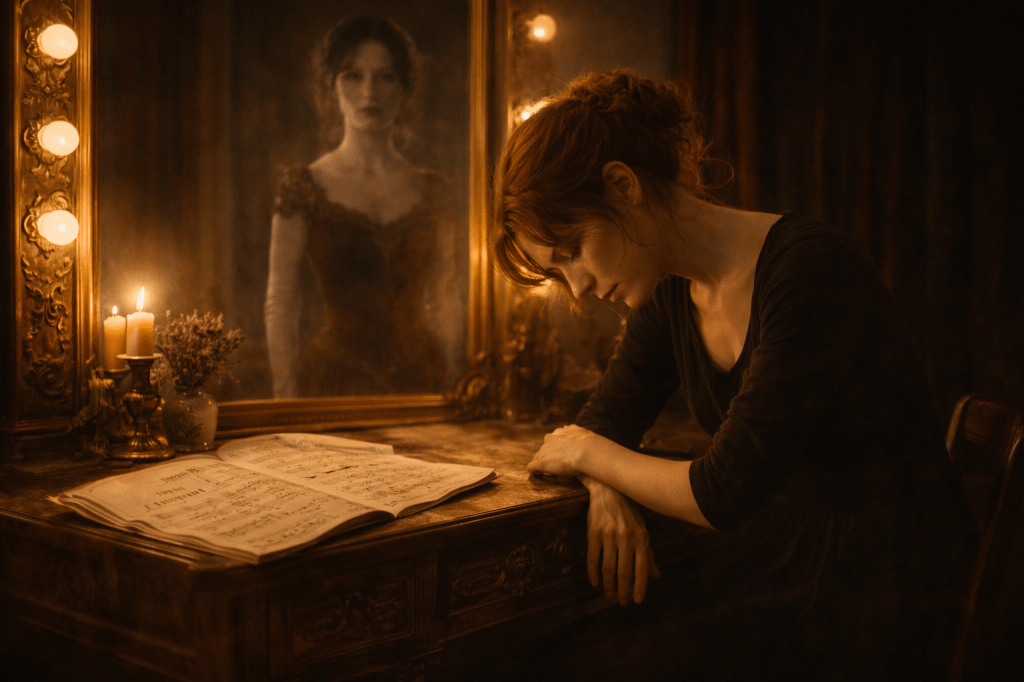
Back in the dressing room, I collapsed into the chair before the mirror. My reflection stared back at me, the dark circles under my eyes a stark contrast to the flush of triumph on my cheeks. The weight I had carried for so long seemed lighter, as if the music had finally released its grip on me.
The sheet music lay open on the vanity, its edges frayed and marked with notes, both Isolde’s and mine. I traced a finger over the final measures, the altered note standing out like a beacon.
“Es ist meins,” It’s mine, I whispered, the words grounding me in a way I hadn’t expected.
A breeze stirred the edges of the paper—soft, almost imperceptible. The scent of lavender lingered, faint but unmistakable.
My breath caught. I glanced at the mirror. For a fleeting moment, the reflection showed not just me—but us. Isolde stood just behind me, her expression unreadable, her dark eyes filled with something I couldn’t name. Gratitude? Farewell?
I blinked, and she was gone.
The German felt right—natural in a way English never could in moments like this. It was the language of my grandmother’s wisdom, of Isolde’s story, and now, of my triumph.
“Emilia.”
Ella’s voice pulled me from my thoughts. She stood in the doorway, her coat still on, her eyes scanning the room before settling on me. For a moment, we just looked at each other, the weight of the past weeks hanging unspoken between us.
“Du hast es nicht nur gespielt, Emilia,” (“You didn’t just play it, Emilia,”) Ella said, her voice trembling as though she were still grasping the depth of what she had witnessed. “You owned it. That was more than music. It was…”
“Freiheit,” (“Freedom,”) I finished for her, the word tasting foreign yet undeniably true.
She hesitated, her gaze searching mine as though trying to comprehend the enormity of what she had just seen.
“You weren’t just performing—you were telling a story. Hers, and yours.”
I exhaled deeply, the tension in my shoulders finally beginning to ease.
“It wasn’t just Isoldes Requiem,” I said, my voice steadier now. “Es war auch mein Requiem.” (“It wasn’t just Isoldes Requiem. It was my Requiem too.”) My way of saying goodbye to the fear, the doubt, the isolation.
Ella sat across from me, her hands resting on the vanity, but her eyes carried a flicker of uncertainty.
“Do you even know what’s next?” she asked, her voice gentle but edged with concern.
I hesitated, her question cutting through the post-performance high.
“I think it’s time to start something new,” I began, but her silence pressed me to continue.
“Etwas, das nur mir gehört.” (“Something that belongs to me alone.”)
And as I closed the final pages of Isoldes Requiem, I swore I heard the faintest whisper of a violin’s last note—one that hadn’t come from my own hands.
Her gaze softened, though the tension in her jaw remained.
“Gut,” (“Good,”) she said quietly. “But promise me, Emilia—promise me you’ll take care of yourself this time. I can’t keep watching you disappear.”
Her words stung, but I nodded. She wasn’t just my ally—she was the anchor that kept me from slipping into the shadows Isolde had left behind.
The warmth of her approval steadied me, and for the first time in months, I felt a spark of excitement for what lay ahead. The journey with Isoldes Requiem had changed me—humbled me, haunted me, but ultimately, it had taught me what it meant to create something meaningful.
As I slipped my coat over my shoulders, Ella reached into her satchel and handed me a folded envelope.
“I found this in the archives last week. A letter from Isolde to her sister. She never sent it.”
I unfolded the brittle paper. The words were fading, but legible: Don’t let them bury me. My voice lives in the notes.
Ella met my eyes. “Now they won’t.”
I pressed the letter to my chest, the final weight of the Requiem settling into something gentler. Something complete.
As we left the dressing room together, the faint hum of applause still echoed through the hall, a distant reminder of what had just been accomplished. The cold Vienna night greeted us as we stepped outside, but this time, the chill didn’t seep into my bones. It felt crisp, invigorating, a sign that the worst was behind me.
I glanced at Ella, her presence a quiet reassurance beside me. And for the first time in what felt like forever, I smiled—not the fleeting, uncertain smiles I had forced over the past weeks, but a real one.
The music had ended, but my story was just beginning.
Final Closure
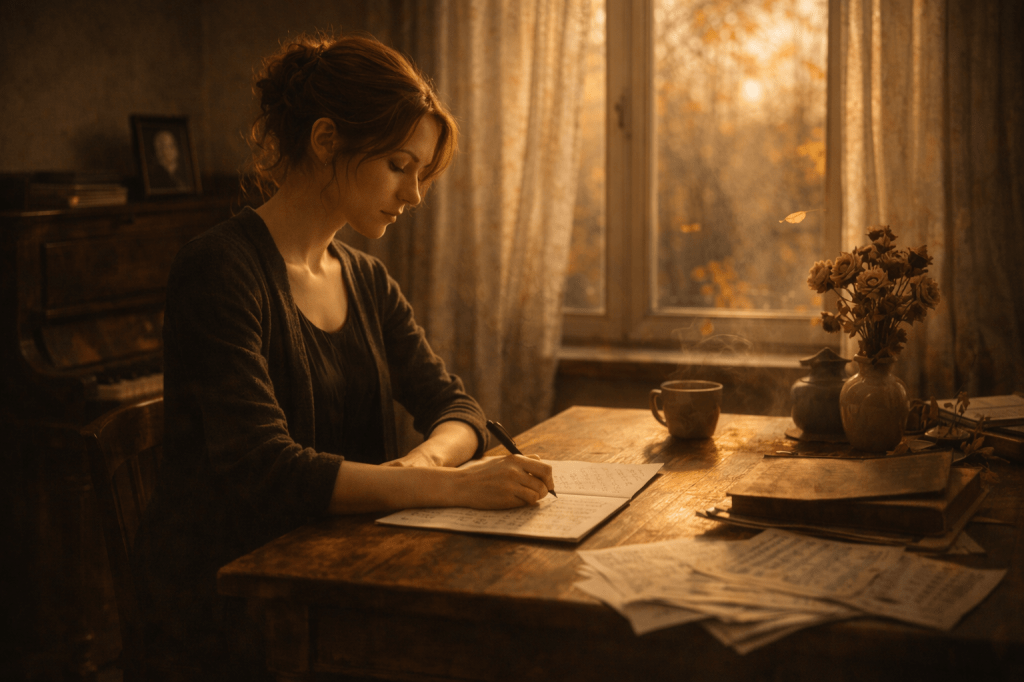
The morning light filtered through my apartment windows, bathing the room in a soft, golden glow. For the first time in months, I felt like I could breathe again. The heavy weight of Isoldes Requiem, with all its haunting beauty and devastating darkness, had finally lifted. It wasn’t gone—it would always be a part of me—but it no longer consumed me.
I sat at my desk, a steaming cup of tea warming my hands, and opened the journal Ella had helped me uncover. The delicate pages crinkled softly as I flipped through them, each one a testament to Isolde’s genius. Her notes, her unfinished compositions, her raw, unfiltered thoughts—they spoke of a woman who had given everything to her art, even as the world tried to silence her.
I wouldn’t let her be forgotten.
Pulling out a blank sheet of paper, I began drafting a letter to the Viennese Historical Society. The first few words came haltingly, my pen hovering as I searched for the right tone.
“An den geschätzten Ausschuss,” To the Esteemed Committee, I wrote, pausing to steady my thoughts. The act of addressing the committee in my grandmother’s language felt like an homage—not just to Isolde, but to the roots of my love for music itself. It was a way of connecting the past to the present, of honoring both Isolde’s memory and the legacy of my family.
How do you ask history to remember what it chose to forget? Each sentence felt like peeling away a layer of grief, each word a step closer to closure. I described Isolde’s brilliance, her tragedy, and why her work deserved to stand beside the greats. But as the letter unfolded, I realized I wasn’t just writing for her—I was writing for myself.
This act felt cathartic, like lifting a weight from my chest. By reviving her legacy, I was claiming my own, and with each word, I felt the lingering shadows of doubt begin to dissolve.
But this wasn’t just about Isolde. It was about me, too. Somewhere along this journey, in the darkness of her story, I had found a light of my own. It wasn’t just about the music anymore—it was about the courage to face my fears, to embrace imperfection, and to tell my own story, no matter how messy or uncertain it might be.
The thought brought a small, genuine smile to my lips. I glanced over at my piano, its familiar silhouette no longer intimidating but inviting. My fingers itched to play, not out of obligation or desperation, but out of love—the kind of love that had driven me to music in the first place.
I knew the journey ahead wouldn’t be easy. There would be critics, doubts, and days when I’d question everything. But for the first time in a long while, I wasn’t afraid of what lay ahead. I had faced the shadows, both Isolde’s and my own, and I had come out on the other side stronger, more certain of who I was and what I wanted.
As I finished the letter and set it aside, I returned to the piano. My fingers hovered over the keys for a moment, and then I began to play—not Isoldes Requiem, but something new. Something of my own.
The melody was simple, hesitant at first, but it grew with each note, unfolding like a story I had been waiting to tell. It wasn’t perfect, and it didn’t need to be. It was mine.
And as the music filled the room, the scent of roses lingered softly in the air, like a whisper of something both beautiful and bittersweet. A reminder of where I had been, and of where I was going.
Fulfilling Isoldes Requiem
By Emilia Müller
The story you’ve just read is not merely mine. It is ours.
It is the story of Isolde, a woman whose spirit refused to be confined to the past, a woman whose legacy has haunted more than just the pages of history. It is the story of Ella, of Gertrud, of the women who helped carry this burden with me—even when they didn’t know the full weight of what we were carrying.
At first, I didn’t see it. I thought the music was mine to finish, my task to take on. But I see now how little of it was mine to begin with. This requiem was never just Isolde’s—it was hers, yes, but it was also Leopold’s curse, woven into every note. And somehow, it was also mine.
Or maybe I was always hers.
I didn’t realize it at first, but Isolde was guiding me. Not in a way I expected, not as a quiet whisper in the night, but as something far more present—more alive. Her presence was in the music, in the shadows that followed me, in the whispered warnings that filled my mind.
She wasn’t haunting me. She was becoming me.
His spirit was embedded in the music, in the curse he left behind—a curse that wasn’t just about revenge. It was about erasing her.
But he failed.
Some stories refuse to be forgotten.
We weren’t just playing Isolde’s requiem. We were living it.
I thought I was fighting for myself. But as I played, as I listened, as the music took hold, I realized:
I wasn’t just playing Isolde’s requiem.
I was playing my own.
And maybe that’s what this whole journey has been about. Not just finishing her music, but becoming a part of it.
I don’t know where this will take me, or if it’s even over yet. But I’ve come to realize something: the music never ends. It doesn’t belong to one person. It’s never just one story. It’s a living, breathing thing, and it will continue to live through us, through the stories we share, through the voices that are never silenced.
The requiem is Isolde’s, yes.
But it is also mine.
And it is yours.
— Emilia Müller, Ella Steiner, & Isolde Krüger
 Scott Bryant
You must be logged in to post a comment.