
Célie’s Game
Written & Told By
Célie Baptiste, “Mama” Mercy Baptiste,
Odette Baptiste, & Clara Baptiste
Visuals & Imagery by
Célie Baptiste, Odette Baptiste,
Clara Baptiste—who know how the game is played. Hattie Vincent & Magnolia Landry —who know when to watch and when to speak. And Scott Bryant, who listened when he was meant to listen.
With care and reverence, their story is shared by
Scott Bryant at the direct request of Célie Baptiste,
“Mama” Mercy Baptiste, Odette Baptiste, & Clara Baptiste
A Note from Célie Baptiste, “Mama” Mercy Baptiste, Odette Baptiste, & Clara Baptiste
We are Baptiste women—storytellers, keepers of names, daughters of tricksters, guardians of what is ours.
This ain’t just a story about land. It’s about what gets stolen, what gets forgotten, and who has the nerve to take it back. It’s about knowing when to let a man think he’s winning, knowing when to let him play himself, and knowing when to lay down the last card.
Célie Baptiste knew that better than anyone. She set the pieces in place long before we got here, left a game behind, waiting to see if we could play it right. Her story don’t rest in paper or deeds. It lives in the hands that hold it next. That’s us. That’s you, if you listening right.
Mr. Scott Bryant? He didn’t try to make this story his. Didn’t try to tell it for us, didn’t try to rewrite the rules. He knew his place at the table and never once reached for the deck. He figured his name didn’t belong beside ours. We told him otherwise.
You don’t play a game alone. And you don’t let a story like this go untold.
This ain’t history laid down in a book to gather dust. This is a story still breathing, still whispering through the bayou, still waiting on the next move.
We remember. So you best remember, too.
— Célie Baptiste, “Mama” Mercy Baptiste, Odette Baptiste, & Clara Baptiste
Archival Note
Célie’s Game is a foundational story within the Her Stories / Her World archive. It is not preserved as a closed narrative, but as a living inheritance—one that establishes how power, land-memory, and women’s names are passed, tested, and protected.
The events recorded here are not meant to be resolved, explained, or universalized. They are meant to be remembered correctly.
Célie Baptiste does not belong to a single telling. She persists wherever women are asked to prove what was never meant to be surrendered. Future stories may echo her presence, invoke her name, or feel her pressure—but this account remains the point of origin.
This story is shared with care, and held with boundaries.
“Ain’t about what’s real, baby. It’s about what they believe.”
— Célie Baptiste
Célie Baptiste
Look at ‘em.
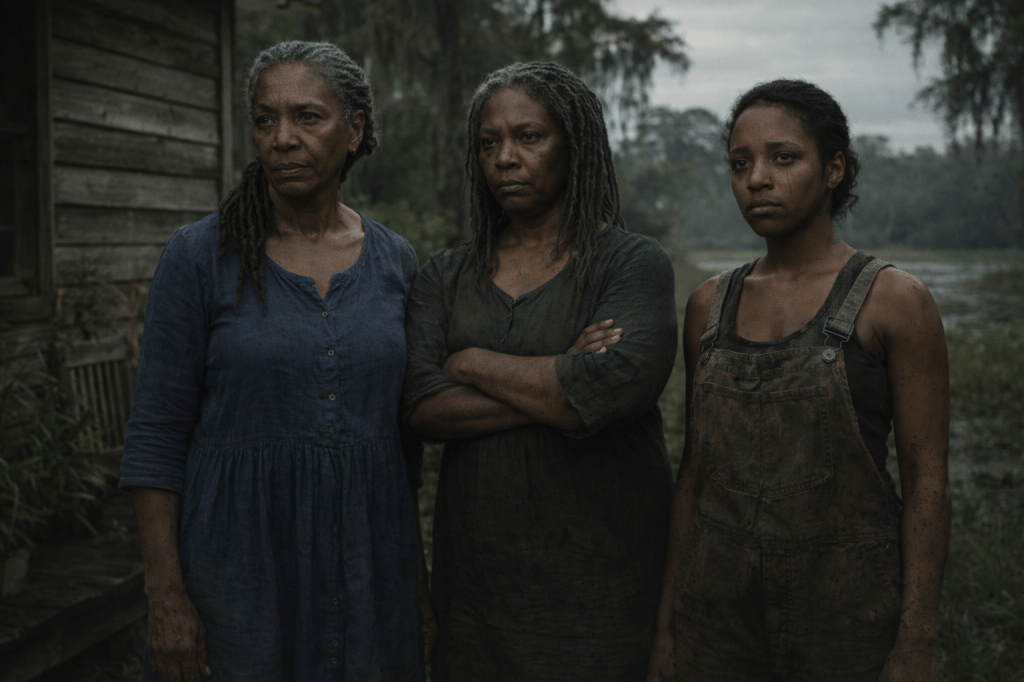
Three Baptiste women, standin’ on land soaked with more than rain—St. Landry Parish soil, bayou clay and blood beneath it—land that don’t belong to nobody but them.
I been watchin’ a long time, waitin’ to see if they remember who they are. Where I come from—L’Anse Noire, out by the bend where the cypress roots breathe above the water—you don’t forget what’s yours. The land remembers, even when folks pretend not to.
Down here by Bayou Têche, names last longer than fences.
Mercy—they call her Mama Mercy now. She got a voice like an old hymn and a stare that make a man rethink his whole life. Ain’t much she don’t know, and ain’t nothin’ she won’t say if the moment’s right.
Odette—sharp as a blade, quick as a card cuttin’ the air. She’s the one who left, thought she was done with this place. Went north for a while—New Orleans, then Baton Rouge—but the bayou calls louder than traffic ever could. But she came back, ‘cause she know a good con when she see one.
Clara—quiet, but she listen too well. She got that look in her eye, the one that say she don’t just hear stories—she believes ‘em. And belief? That’s the most dangerous trick of all.
They don’t know it yet, but this ain’t just a fight over land. This is about who they are.
Who they been.
Who they gonna be.
And if they don’t play it right?
Well.
Ain’t no room in this world for a Baptiste who don’t know how to keep what’s hers.
The Setup
“Mama” Mercy Baptiste
Baptiste blood been in this soil since cane first grew wild along the river. Folks say our great-grandmama worked the sugar fields near St. Martinville—knew every name of every spirit in the water, and maybe one or two that weren’t.
They been tryin’ to take this land since before I was born. Men with soft hands and hard voices, holdin’ paper like it mean somethin’.
They come drivin’ from Lafayette or Baton Rouge, wearin’ city shoes that sink in our St. Martin Parish mud. They don’t know this dirt’s been claimin’ men longer than they’ve been signin’ contracts. Always the same. They figure if they say “contract” and “legal” enough times, you’ll forget who put their blood in the soil.
I watch this one—Everett Kane—step out of his car, smooth suit, smooth smile, all that money confidence on him like cheap cologne. I don’t gotta hear a word to know what he come for.
“You must be Mrs. Baptiste,” he says, like he already owns the place.
I don’t answer right away. Let him sit in it. Let him wonder if he got the wrong house, the wrong woman, the wrong damn game.
Then, real slow, I say, “It’s Miss Baptiste. Never took to nobody’s name but my own.”
He hesitates—just for a second—but I see it. That flicker in his eyes. That’s the first crack.
“I won’t waste your time,” he says, slipping into that calm businessman voice. “I’m making an offer on this land. A fair one.”
Fair.
That’s a word men like him love to use. Fair like the price of a soul.
“This land ain’t for sale,” I say.
His fingers twitch. I know the type. Men like Kane don’t hear ‘no’ often. They hear not yet.
“It’s already been sold,” he says, real patient-like, like I’m slow. He pulls out a folder, all nice and neat, like paper ever stopped a storm. “The previous deed holder defaulted. I’m the legal owner now.”
I tilt my head, tap my cane once against the porch rail. Let him think I’m thinking. Let him think he got me.
“You ever heard of Célie Baptiste?” I ask.
His face don’t change, but I feel the shift. He don’t like not knowing things.
And that? That’s the second crack.
Odette
This man think he got us cornered. That’s his first mistake.
His second mistake? He think we play fair.
With arms crossed I started studying him. I’ve met a hundred Everetts before. The ones who walk into a room thinking they already won. Thing about men like that? They don’t know what to do when the game changes.
“Célie was our great-great-grandmother,” I say. “She left somethin’ behind in this land. You sure you wanna go diggin’?”
Kane scoffs, but I see the way his jaw tightens. “I don’t believe in ghost stories.”
That’s fine. He don’t gotta believe.
He just gotta run when the ghosts start talkin’.
Clara
I saw her before I ever heard her.
Célie Baptiste.
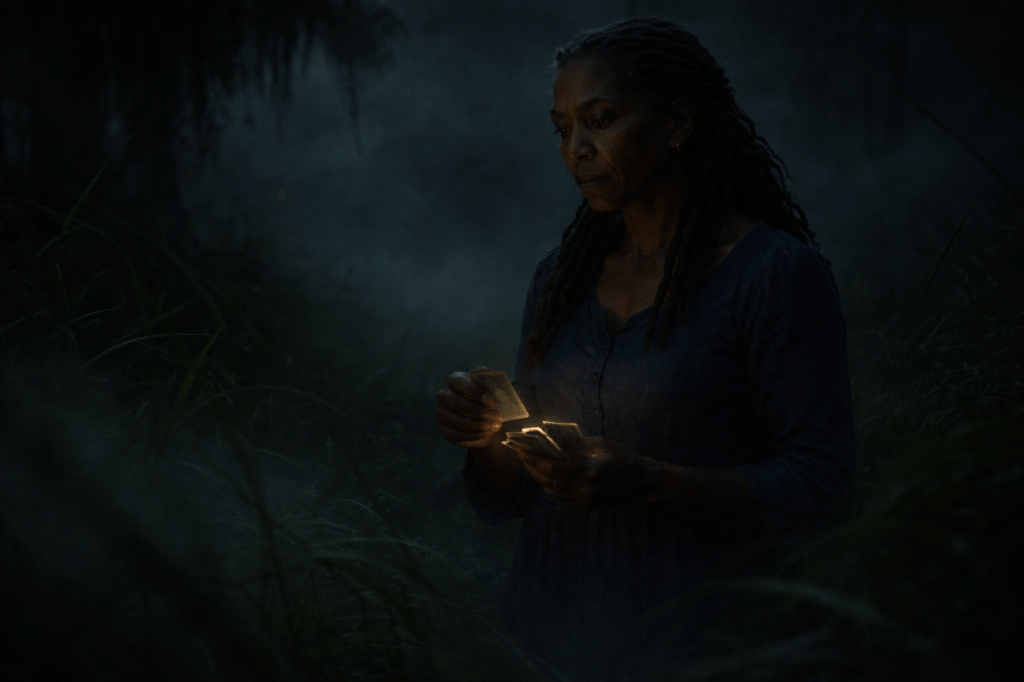
She was standin’ in the tall grass last night, shuffling cards slow, her hands barely touchin’ them. The mist rolled off the water from Bayou Têche, the same one Mama say run straight to where the spirits sleep. Her eyes caught the moonlight—dark, deep, knowing.
I ain’t never seen a ghost before. But I knew what she was.
“You got a test coming,” she said, her voice smooth as the river at night. “You gonna pass it?”
I swallowed hard. “What kind of test?”
She smiled—sharp, like the edge of a knife. “The kind that decide if you worthy.”
The wind picked up, rustlin’ through the trees, and when I blinked, she was gone.
Now, standin’ here with Mama and Odette, watchin’ Kane smirk like he already got us, I hear Célie’s voice in my head.
Make him play the game, but don’t let him see the rules.
I glance at Mama. She gives the smallest nod.
I glance at Odette. She smirks.
Alright then.
Let’s play.
The Game Begins
Odette
If there’s one thing I know, it’s that rich men hate feeling stupid.
Everett Kane walk onto our land acting like he got every card in the deck. What he don’t know is, we already stacked that deck before he even sat at the table.
“You sure you wanna go diggin’?” I ask him.
Kane scoffs, but there’s tension in his jaw now. He’s listening. That’s all we need.
Mama and Clara slip inside the house while I keep him busy, running my mouth the way I always do when I need a man to underestimate me.
“You ever play poker, Mr. Kane?” I ask, real easy, like we’re just chatting.
He adjusts his cufflinks. “I prefer games of skill.”
I laugh, shaking my head. “Ain’t no game of skill when the dealer got a stacked hand.”
That gets him. His nostrils flare just a little. He don’t like not knowing what I mean by that. Good. Keep him unsteady.
Behind me, I hear the house shift. Mama and Clara are setting the first trick.
Clara
We don’t need much.
A few small changes, a few whispers in the walls, and a man like Kane will do the rest himself.
Mama lights the first candle. “You remember what I told you?” she asks.
I nod. “Make it feel real before it is.”
She hands me the little pouch she made—dried moss, a pinch of bone dust, and a piece of old iron.
“Put this under his car. Make sure he don’t see you.”
I take it and slip out the back, quiet as the wind through the grass.
“Mama” Mercy Baptiste
Some folks need to see a ghost to believe in one. Others just need to think they did.
By the time I walk back outside, Kane’s got that look in his eye—the one men get when they think they shouldn’t be nervous, but they are.
“What’s wrong, Mr. Kane?” I ask, sweet as honey.
He clears his throat, glancing over his shoulder toward his car. “Thought I heard something back there.”
“Did you now?” I keep my face steady. “Bayou got a way of talkin’ at night. Always has.”
He don’t like that. He tugs at his collar, muttering something under his breath before shaking his head.
“I’ll be back tomorrow with my surveyor,” he says. “I don’t have time for stories.”
I nod, watching as he heads to his car. And that’s when the first trick takes hold.
Kane stops. Goes still.
His hands clench. He looks at the ground. Looks at his car.
He don’t say a word, but I see it plain as day—he feels it now.
The air, just a little too thick. The ground, just a little too soft. Like something’s watching.
He swallows hard, then gets in his car.
The engine stutters.
Then stalls.
He curses, trying again. The ignition clicks, clicks, but don’t catch.
Clara don’t move from the porch. Just watches. I see the way her fingers twitch, the way her shoulders tighten.
She don’t say nothin’, but I know.
This ain’t just our trick no more.
Kane finally gets the car started and pulls out so fast the tires kick up dust. I let him go. Let him think he’s in control.
I turn to Clara. “What happened?”
She licks her lips, eyes still locked on the spot where Kane was standing.
“She was there,” Clara says, voice low.
Mama and I share a look.
Célie’s playin’ now.
And that? That’s when the real game begins.
Odette
I expect Kane to stay gone a little longer. Maybe a week, maybe two. Give himself time to shake off the feeling he left with.
Instead, he come back next day.
That tell me two things:
- He think he too smart to be played.
- He too proud to admit he already doubtin’ himself.
Bad combination. For him, anyway.
His car pulls up slow this time, like he don’t trust the road anymore. Good. Let that unease settle in his bones.
Mama Mercy don’t move from her chair on the porch, just watches him like she got all the time in the world. Clara, quiet as ever, stands near the steps, eyes dark, lips pressed tight like she already know what’s comin’.
Me? I step down to meet him, smiling like I got no secrets at all.
“You sure got back quick, Mr. Kane,” I say, arms crossed.
He adjusts his cufflinks. “I don’t scare easy.”
That a lie. I hear it in his voice. Feel it in the way he won’t meet my eye for too long.
Good. Let’s see how much longer that hold up.
Clara
The air feel different today. Heavy.
Kane’s standing in the same place he was yesterday, but the land don’t want him here. I feel it.
And I ain’t the only one.
“She’s close,” I whisper.
Mama hears me but don’t look over. “I know.”
Kane don’t hear nothin’. He too busy talkin’, throwin’ out legal terms and threats like they gonna scare us more than this land scares him.
He don’t feel it yet.
But he will.
“Mama” Mercy Baptiste
I let him talk. Let him list his rights and ownership and all them little words he think mean somethin’.
Then I say, real easy, “Ever dream about drowning, Mr. Kane?”
That get him.
His mouth stops mid-word.
For a second, he just looks at me. “What?”
I nod toward the bayou.
“Ain’t uncommon ‘round here. Water creeps in your bones. In your mind. Folks hear things when they sleep. Wake up swearin’ they were sinkin’, but they bed still dry.” I pause, let my fingers tap against my cane.
“You sleep alright last night?”
The muscle in his jaw jumps. His fingers curl at his sides.
“I don’t believe in that superstitious bullshit.”
Oh, honey. He already halfway gone.
Odette
He don’t know it yet, but we got him on a string now.
Mama got in his head. That’s the first step. I see it in the way he rolls his shoulders, the way he glances toward the water, like it got closer since he got here.
He tryna shake it off, tryna act like he still in control.
So I help him lose a little more of it.
“Oh, shit,” I whisper, turning real sharp toward the trees behind him. “Did y’all see that?”
Kane spin around so fast I almost laugh.
“Ain’t nothin’ there,” Mama says behind me, all calm. “You scarin’ yourself.”
I hear how quick Kane breathes now. The way his fingers twitch, like he fightin’ the urge to check over his shoulder again.
He’s cracking.
One more push, and he’ll start seeing things we ain’t even gotta put there.
Clara
The moment he turns back to us, I see her.
Célie.
She standin’ in the grass behind Kane, just far enough that he don’t notice. She got her arms crossed, head tilted, eyes locked on me.
Watching.
She raises one hand, real slow, and points to the water.
Kane shift his weight like he uncomfortable, but he don’t move his feet.
I swallow. “Mama.”
Her gaze flicks to me. She knows I see somethin’.
Kane runs a hand down his face, muttering under his breath. “I don’t have time for this.”
Then he turns too fast, like he tryna prove somethin’, and his foot catches the root beneath him.
It happen so quick.
He stumbles.
The earth gives a little.
And for one second, I swear I hear water pullin’ him in.
His hands dig into the dirt. He grunts, pushes himself up, shaking his head like he dizzy. His shoes soaked through.
But the ground? It’s dry.
His face goes pale.
I don’t say nothin’. Just watch him.
So does Célie.
She smiles.
“Mama” Mercy Baptiste
He don’t say much after that.
Don’t look at the water. Don’t look at Clara.
Just wipes his hands, mutters somethin’ about “comin’ back tomorrow” and gets in his car.
We watch him go, wheels kickin’ up dust.
Odette lets out a slow whistle.
“Boy’s losin’ his grip.”
I nod. “Tomorrow, we end it.”
Clara don’t say nothin’.
Her eyes still on the bayou.
And when I follow her gaze, I see why.
Célie’s still standin’ there.
Smilin’.
Waitin’.
Odette
I wake up knowing today’s the day we finish this.
It ain’t just a feeling—it’s certainty. Like knowing a storm’s coming before you see the sky turn.
Mama’s already in the kitchen by the time I come in. Not making coffee. Not boiling water. Just standing at the table, rolling that old silver ring of hers between her fingers. A glass of tea, dark as river water, sits beside her, ice half-melted.
“He’ll be here soon,” she says.
I don’t ask how she knows. We all know.
Clara’s outside, sittin’ on the porch rail, eyes on the water. Ain’t touched her breakfast. Ain’t said much since yesterday, either.
She’s still with Célie, even when she ain’t lookin’ at her. I see it in the way her fingers drum against her thigh, slow and steady, like she’s countin’ seconds between lightning and thunder.
Mama slides a second glass toward me, condensation beading on the sides. “You ready?”
I take a breath. Nod.
“Then let’s end this.”
The Final Trick
Mama Mercy
I heard Kane’s car before I saw it.
That engine rattlin’ down the dirt road, wheels kickin’ up dust like the land itself was tryin’ to shake him off. House still standin’ same as always, but somethin’ felt different.
Like the land done been waitin’ on him.
I was already on the porch, rockin’ slow in my chair, glass of sweet tea restin’ easy in my hand. Ice long melted, but I weren’t in no hurry. Odette stood beside me, arms crossed tight, expression smooth as glass. Clara perched on the rail, quiet, watchin’. That child sees things before they happen.
And Kane? He ain’t like the way we lookin’ at him.
He steps out his car, straightens his jacket like that gonna help him. “This ends today,” he says.
I take a slow sip, let the glass clink against my teeth. The lemon’s sharp on my tongue, but my voice stays smooth. “It surely does.”
He squares his shoulders, tryin’ to sound important.
“I’m done with the games. If you don’t clear off this land, I’ll have it leveled by next week.”
Odette exhales, shakin’ her head like he a fool—which he is. She don’t even lift her bourbon, just lets it sit there, sweatin’ in the heat.
“You just don’t know when to quit, huh?”
Kane clenches his jaw.
“I don’t quit. I win.”
I let out a low chuckle, deep in my chest.
“Boy, you ain’t been winning since the day you set foot on this land.”
He don’t like that. I see the muscle in his jaw twitch. But instead of talkin’, he takes a step forward.
The ground sinks beneath his heel.
He stops.
Frowns.
Looks down.
That dirt too soft. Too soft. Like it don’t belong to him. Like somethin’ underneath is waitin’.
I swirl what’s left in my glass, watch the amber-colored tea catch the last of the daylight. Take a slow sip.
Then I tilt my head, voice real easy, like I’m talkin’ ‘bout the weather.
“Ever dream ‘bout drownin’, Mr. Kane?”
His mouth goes dry.
Oh, he feel it now.
Good.
Clara
I hear her before I see her.
The shuffle of cards, slow and steady. The hum of a song long forgotten.
Célie’s here. Right behind him.
She flicks a card up between her fingers. The Queen of Spades. Smiles.
“This is it,” she says.
The wind picks up. The bayou hums. The land shifts beneath Kane’s feet.
He sways. Takes a step back. The ground gives a little more.
“Stop,” he mutters, shaking his head. “I’m not falling for this.”
Mama Mercy leans forward. “Baby, you already fell.”
And then?
The ground caves.
Not fast. Not violent.
Just enough.
Enough to make Kane’s stomach drop. Enough to make him feel the earth pulling at him, dirt curling around his shoes, sucking him down.
His breath stutters. He stumbles back, heart pounding.
He looks at us, really looks this time, and I see it in his face.
He finally believes.
Odette
He’s shakin’.
Not just his hands—his whole body. He stumbles back like he expect the land to reach for him again.
And maybe it will.
“You—you can’t stop me from taking this land,” he stammers. But there ain’t no confidence in it anymore.
Mama Mercy just sighs. “Ain’t nobody taking nothin’, Mr. Kane. This land? It ain’t yours to have.”
His breath comes short and fast. He wipes a hand across his face, eyes darting between us, to the bayou, to the ground like he can’t tell what’s real anymore.
And that’s the moment he breaks.
“Fine,” he chokes out. “Fine. Keep the damn land.”
Then he turns and runs.
Don’t look back. Don’t slow down. Just peels out so fast his tires damn near kick the dust into next week.
And just like that, it’s over.
Mama lets out a slow breath. “There it is.”
I exhale too. “Damn. Thought he’d be harder to break.”
Mama shakes her head. “Baby, that man was never hard. Just loud.”
I laugh. She ain’t wrong.
But Clara? Clara’s still watching. Still listening.
And that’s when I realize—
It ain’t over.
Not yet.

Clara
The wind shifts.
I turn slow.
Célie’s standing in the field, cards flicking between her fingers, but she ain’t smilin’ no more.
She looks at me, only me, and I feel it before she says it.
The test ain’t just about him.
She tilts her head. Raises an eyebrow.
And waits.
My throat tightens.
This was never about just running Kane off.
This was about us.
About whether we understand what it means to keep what’s ours.
I swallow hard, straighten my shoulders, and step forward.
“Alright then,” I murmur. “What’s next?”
Célie smiles.
And the Queen of Spades vanishes between her fingers.
Clara’s Acceptance
Clara
The land is quiet.
Not peaceful—waiting.
Mama and Odette think it’s over. That Kane’s gone, and that’s the end of it.
But I know better.
Célie’s still here.
She stands in the grass, arms crossed, watching. Not smug, not proud. Just waiting.
Because we ain’t done.
I take a slow breath and step off the porch. Mama and Odette don’t stop me, but I feel their eyes on my back.
Célie tilts her head as I approach. Flicks a card between her fingers.
The Queen of Spades.
The trickster’s card.
“What now?” I ask.
Célie smiles. “Now,” she says, “you decide what kind of woman you wanna be.”
“Mama” Mercy Baptiste
I don’t like this.
Ain’t a thing in the world more dangerous than an unfinished trick.
And right now, Célie got my grandbaby standing dead center in one.
I step forward, cane tapping against the dirt.
“Célie.”
She don’t look at me. Just keeps her eyes on Clara.
“You always had a soft spot for the quiet ones,” I say.
That gets a reaction. Célie laughs, real low.
“The quiet ones listen,” she says.
“And I been waitin’ a long time for someone to listen right.”
Odette
This don’t feel like a lesson no more.
Feels like a claim.
Like Célie ain’t just testing Clara. She’s choosing her.
And I don’t like that. Not one bit.
“What’s the trick, Célie?” I ask, crossing my arms. “You don’t do nothin’ without an angle.”
Célie hums. “Ain’t a trick,” she says. “Ain’t a lie. Just a question.”
She flicks the card in the air, and it hangs there longer than it should before landing at Clara’s feet.
“What’s the question?” Clara asks.
Célie smiles. Slow. Sharp. Knowing.
“The land’s yours,” she says. “But the name? That, you gotta earn.”
Clara
My mouth goes dry.
I feel the weight of it—the choice.
It ain’t about the land. Not really.
It’s about the name.
Baptiste.
A trickster’s name. A name that means somethin’. A name that carries more than just history—it carries debt, power, a weight you gotta be strong enough to hold.
Célie kneels, picking up the card, holding it between her fingers.
“You take this,” she says, “and you ain’t just Clara Baptiste no more. You a Baptiste woman the way I was. The way your mama was. The way her mama was.”
She turns the card over. It’s different now.
Not the Queen of Spades.
The Joker.
“You carry the weight of every trick that came before you. You see what needs seein’. You move how we move. You make the world play by our rules.”
She leans in close.
“But you don’t get to walk away. Not ever.”
I exhale, slow.
I know what she’s saying.
You take the name, or you leave it.
“Mama” Mercy Baptiste
I feel my breath catch.
Célie done pulled the last card, and I ain’t sure how it’s gonna fall.
I want to stop it. Want to tell Clara she don’t gotta do nothin’ for no ghost, not even for family.
But that ain’t my call to make.
This? This gotta be her choice.
Odette
I don’t like this.
I don’t like how still Clara is. I don’t like the way Célie watches her, like she already knows how this ends.
I don’t like that I ain’t sure I do.
Clara
I reach out.
Brush my fingers over the card.
I could leave it. Could walk away and still own the land, still keep what’s ours.
But I know, deep in my bones, that ain’t the point.
The land ain’t the inheritance.
The name is.
And the name ain’t just a gift. It’s a responsibility.
I pick up the card.
The moment my fingers close around it, I feel everything shift.
The wind goes still. The bayou exhales.
Célie grins. “That’s my girl.”
And just like that—
She’s gone.
“Mama” Mercy Baptiste
Clara’s still holdin’ the card when I reach her.
It’s blank now.
I swallow hard. “You alright, baby?”
She nods, but her eyes are distant. Different. Older.
Odette lets out a slow breath. “What now?”
Clara looks out at the land. Our land.
She smiles.
“We make sure nobody ever tries this again.”
And just like that—
The legacy lives on.
Epilogue – The Next Night
Clara
I hold the card between my fingers, turning it over, feeling the weight of something that shouldn’t have weight.
The edges are smooth, the surface blank. It ain’t the Queen of Spades no more. Ain’t even the Joker.
It’s whatever I need it to be.
Célie’s gone now, but she ain’t gone. She lingers in the hush of the wind, in the shift of the water, in the way the trees lean just a little toward me when I pass.
She don’t need to stay.
I know what to do now.
I walk to the edge of the bayou, toes sinking into the soft earth, the smell of moss and water wrapping around me like a whisper. The land watches me, the way it’s watched every Baptiste woman before me. Out here in L’Anse Noire, stories don’t die; they just go quiet till someone listens right.
Mama and Odette stand back, letting me have this moment.
I lift the card one last time.
Then, slow and sure, I let it go.
It flutters once, twice, before the wind carries it out over the water. It lands without a sound, floating for just a second before the bayou takes it under.
I exhale.
The night exhales with me.
It’s done.
But it ain’t over.
Not really.
Months Later
Clara
The first time someone tries to take what’s mine after Kane, I don’t even have to try.
The man at the bank smiles at me the same way Kane did. The kind of smile that don’t reach his eyes. The kind of smile that say he think I don’t know the game.
“You have a beautiful property, Miss Baptiste,” he says, flipping through his paperwork. “We’d love to help you turn it into something… profitable.”
I tilt my head, let him talk, let him say all the words he thinks will make me lean forward, interested.
Then, when he’s done, I set my hands real gentle on the table between us and say, “You ever heard of Célie Baptiste?”
His brows pull together. “Should I have?”
I smile. Slow. Sharp. Knowing.
“Oh, sugar,” I say.
“You will.”
The End
Reflecting on Célie’s Game
By “Mama” Mercy, Odette, & Clara Baptiste
“Mama” Mercy Baptiste
“Folks always ask me if the stories ‘bout Célie Baptiste are real.
I tell ‘em, depends who’s askin’.
Truth is, ain’t never been about what’s real and what ain’t. It’s about who walk away holdin’ the power when the tale is done.
Now, if you listen close, real close, you might hear her name whispered through the bayou. Might feel a shift in the air when you stand on land that wasn’t meant for you.
But I reckon, if you gotta ask if Célie was real, then you ain’t never played the game right.”
Odette
“Ain’t no lesson here ‘cept this—you either play the game, or the game plays you.
Everett Kane thought money meant control. He thought power was somethin’ you could sign your name on and own.
But what I learned from Célie, what I learned from all the Baptiste women before me, is this—power don’t live in paper. It don’t live in land.
It live in who tells the story.
And this story? It’s ours. Always has been.”
Clara
I used to think stories were just words. Just tales Mama used to tell me at night, just a way to remember the past.
I know better now.
Stories ain’t just what happened. They’re what you make happen.
That’s why we still talk about Célie. That’s why we still say her name.
Because long as the story’s still bein’ told, she ain’t never really gone.
And neither are we. Game’s only over when I say it is.
-“Mama” Mercy Baptiste, Odette Baptiste, and Clara Baptiste
 Scott Bryant
You must be logged in to post a comment.