
The Tangier Cipher
(الشفرة الطنجيرية – Al-Shifra Al-Tanjiriyya)
Story Written & Told by
Leila Ben Youssef
& Karima Hamdani
Visuals & Imagery Created by
Leila Ben Youssef, Karima Hamdani,
Yasmina El Khatib, Khadija Bouazza,
Meryem Chafik, & Scott Bryant
With care and reverence, their story is shared by
Scott Bryant at the request of Leila Ben Youssef
& Karima Hamdani.
The Tangier Cipher is a regional account within Her Stories, Her World—a story of women protecting cultural memory, civic infrastructure, and human trust at the intersection of technology and place.
A Note from Leila Ben Youssef & Karima Hamdani:
The Tangier Cipher is more than just a story about cyber-attacks and the battle for control. It’s a reflection of the resilient, ever-changing nature of Tangier and the women who have shaped it. Through Karima, we’ve sought to give voice to women navigating the intersection of tradition and modernity, who fight for their country in ways big and small, often without recognition. Tangier is a city of crossroads, where the ancient and the new intertwine, and its women are the heartbeat of this dynamic.
This story is also a tribute to collaboration, to the unspoken bonds that allow us to confront the darkness. Scott Bryant has been an unwavering ally in this journey. While he insisted on not taking credit, we felt it was essential to acknowledge his contributions. His quiet dedication to bringing this story to life helped amplify our voices, and for that, we’re forever grateful. His work behind the scenes was a reminder that stories are never created in isolation—our strength lies in the support and trust we offer one another.
– Leila Ben Youssef & Karima Hamdani
Tangier, Morocco
Thursday, 4:42 PM
Leila Ben Youssef
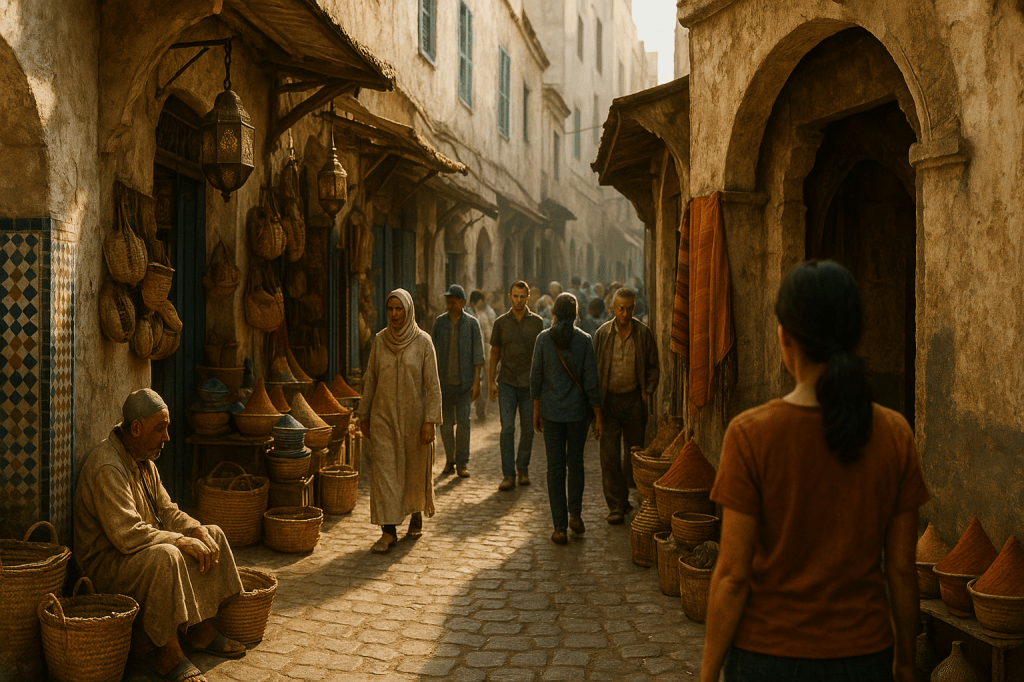
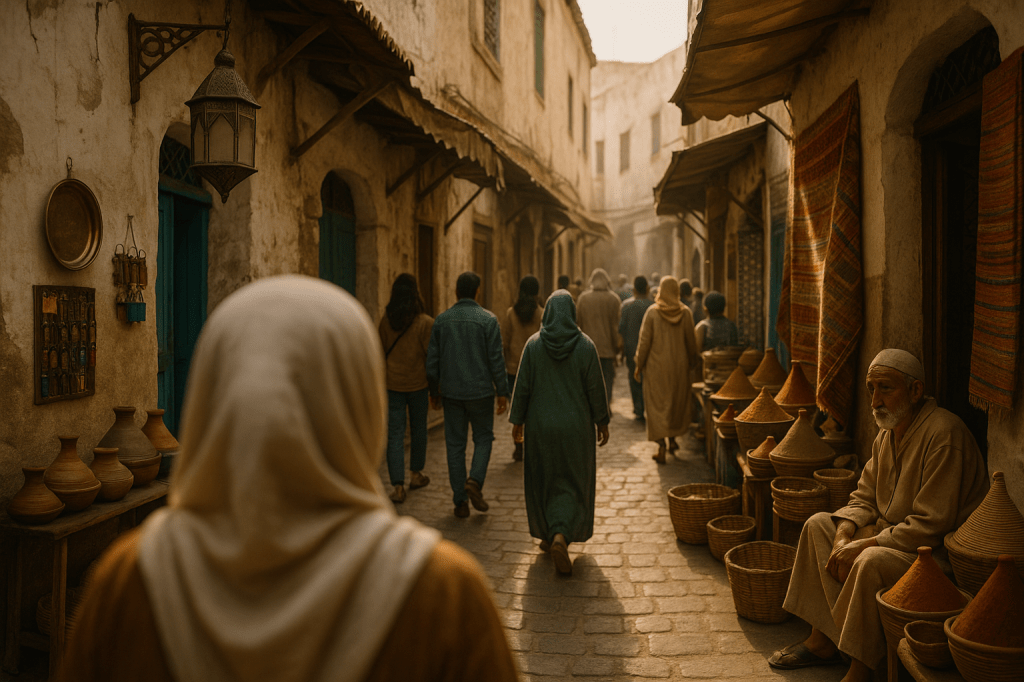
The call to prayer floated through the ancient streets, its echo weaving between the narrow alleys of the medina, blending with the chatter of the crowd. I passed a vendor calling out about b’steeya and ataya. These were the moments I cherished—simple, beautiful, and fleeting. But now, it felt like the city was hiding something darker.
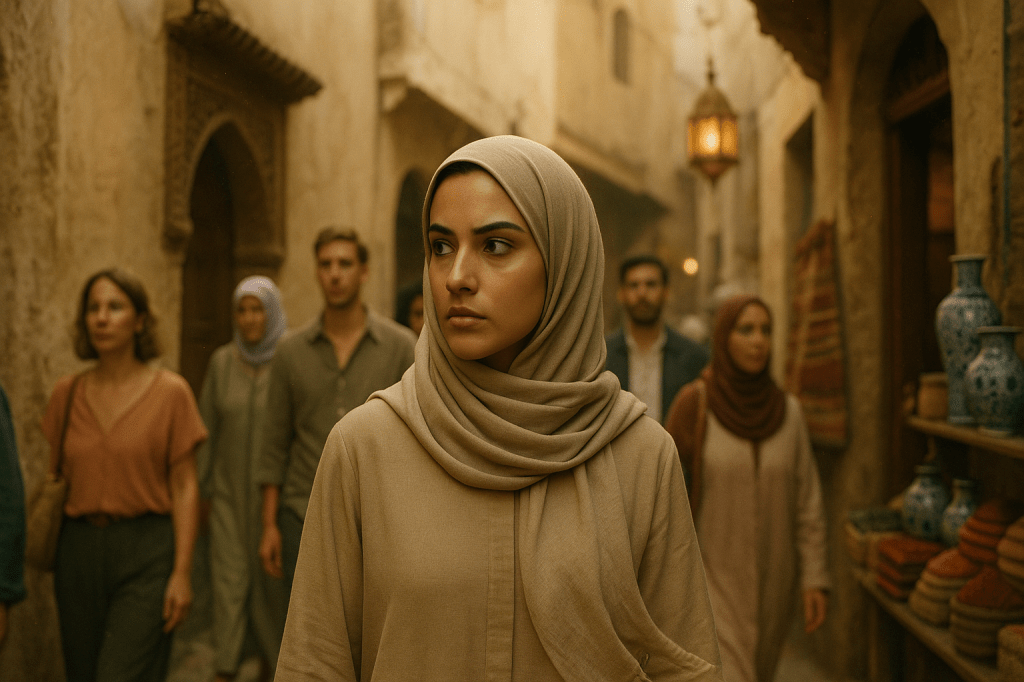
I, Leila Ben Youssef, adjusted my shayla, weaving through the throng of shoppers and tourists. The scent of cumin and saffron filled the air, mingling with the sweetness of fresh mint.
A familiar face in the crowd waved.
“As-salaam alaykum, Leila,” the vendor called, smiling warmly from behind a stall piled high with vibrant scarves.
“Wa alaykum as-salaam,” I replied automatically, my voice carrying the rhythm of the city. The greeting felt like a thread tying me back to the city’s heart, and I couldn’t help but smile, even though my mind was already elsewhere. Tangier, with all its layers, would always be home.
My eyes scanned the stalls automatically, cataloging the vibrant rugs and intricate pottery, but my mind was elsewhere.
My phone buzzed in my pocket, a sharp reminder of why I was here.
Pulling it out, I glanced at the notification:
“Cyber-Attacks Cripple Major Banks, Panic Spreads Across Morocco.”
My stomach churned.
Banks collapsing, people losing their savings, chaos spreading through cities like wildfire. This wasn’t just a story to chase; it was a disaster unfolding in real time. My job was to find out who was behind it—and stop them.
I thought of my grandfather, who always said, “A story isn’t worth telling if it doesn’t shake the ground beneath you.” This one felt like an earthquake.
Karima Hamdani was my best lead. She was the kind of hacker you didn’t just find; you earned the right to know her.
I pushed through the medina, past vendors calling out their wares, until I reached a small, tucked-away café overlooking the port. I’d suggested this spot for its view of the sea, though I doubted Leila cared about the scenery. I was early, so I ordered coffee and waited. The café’s warm wooden tables and clinking cups contrasted with the urgency simmering in my chest.
Just as I was about to leave, she appeared, her dark eyes scanning the room before locking onto mine. Karima’s casual appearance—jeans, a loose sweater—belied her sharp, calculating presence. She slid into the chair across from me, pulling out her laptop without preamble.
Tangier – Café Marhaba, 6:17 PM
Karima Hamdani
I glanced up from my laptop screen and met Leila’s eyes. She was already sitting, looking over at me expectantly. I could see the tension in her shoulders, the way she fidgeted with her scarf—nerves or impatience, I wasn’t sure.
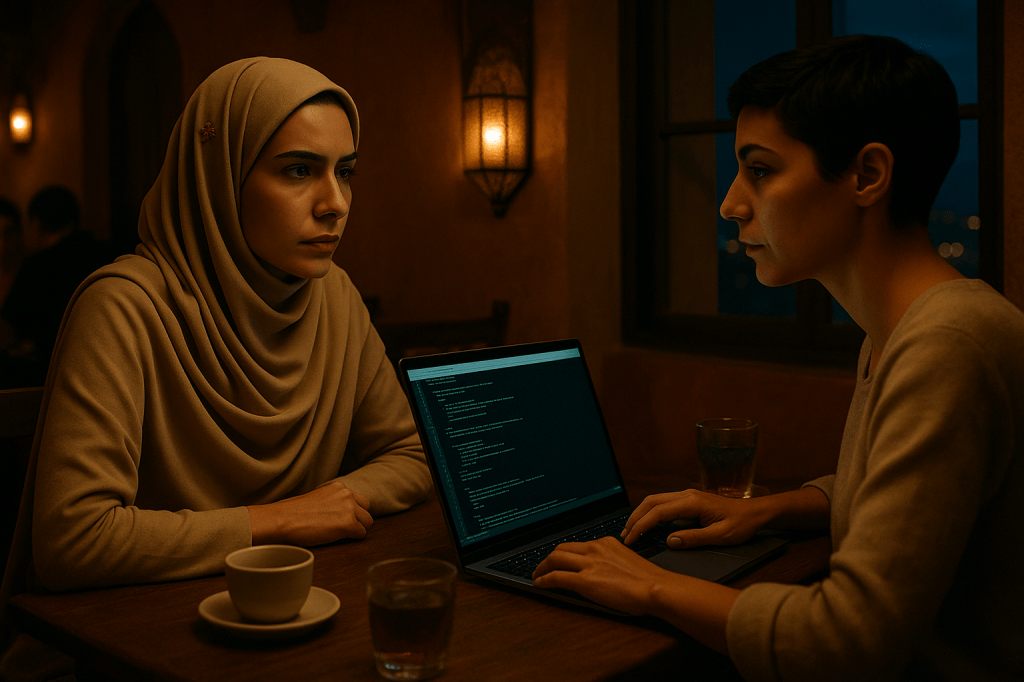
“Leila,” I said, keeping my tone brisk. “This isn’t random.”
She leaned forward, eager. “I figured as much,” she said, her voice low and steady. “Who’s behind it?”
I opened my laptop, and the lines of code flickered across the screen, each string more troubling than the last.
“I’ve been tracking the patterns. They’re targeting specific institutions, and the encryption they’re using? It’s advanced. Beyond anything I’ve seen before. They’re not just after money. They’re after control.”
I could feel her eyes on me, assessing, her mind already working as fast as mine.
“Control?” she asked, her voice taut with unease. “What else could they do?”
I didn’t answer right away. I let the weight of it hang in the air between us.
“If they can control the banks…” I said slowly, “they can control anything.”
Leila Ben Youssef
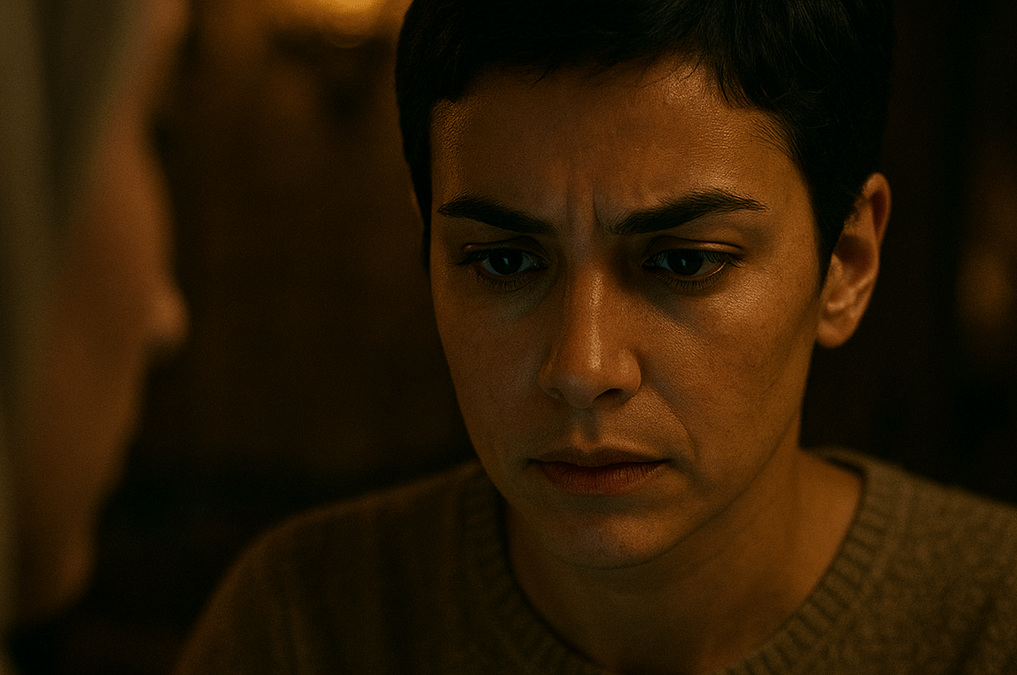
Karima’s words hit me like a punch to the gut. I had heard of cyber-attacks, but this?
This was bigger than anything I’d imagined.
If they could cripple Morocco’s infrastructure, the ripple effect would go far beyond financial ruin. I thought of my mother—if the power grid failed, or the water system went down, it would hit her first. She lived just outside the city, in a quiet neighborhood where a moment’s disruption could spiral out of control.
I snapped myself out of my thoughts and met Karima’s gaze.
“What’s the plan?” I asked, my pulse quickening.
The weight of the situation settled in my chest. This wasn’t just about uncovering the story anymore; it was about stopping a catastrophe.
Her lips curved into a thin smile, the kind that didn’t reach her eyes.
“We dig deeper. I have leads, but I need boots on the ground—your expertise. I can’t do this alone.”
Tangier – Leila’s Apartment, 9:42 PM
Karima
I could see the fire in Leila’s eyes. She wasn’t someone to back down from a challenge. Her sharp mind was exactly what we needed, even if it meant I had to rely on her in ways I hadn’t intended. It was a risk, but one we had to take.
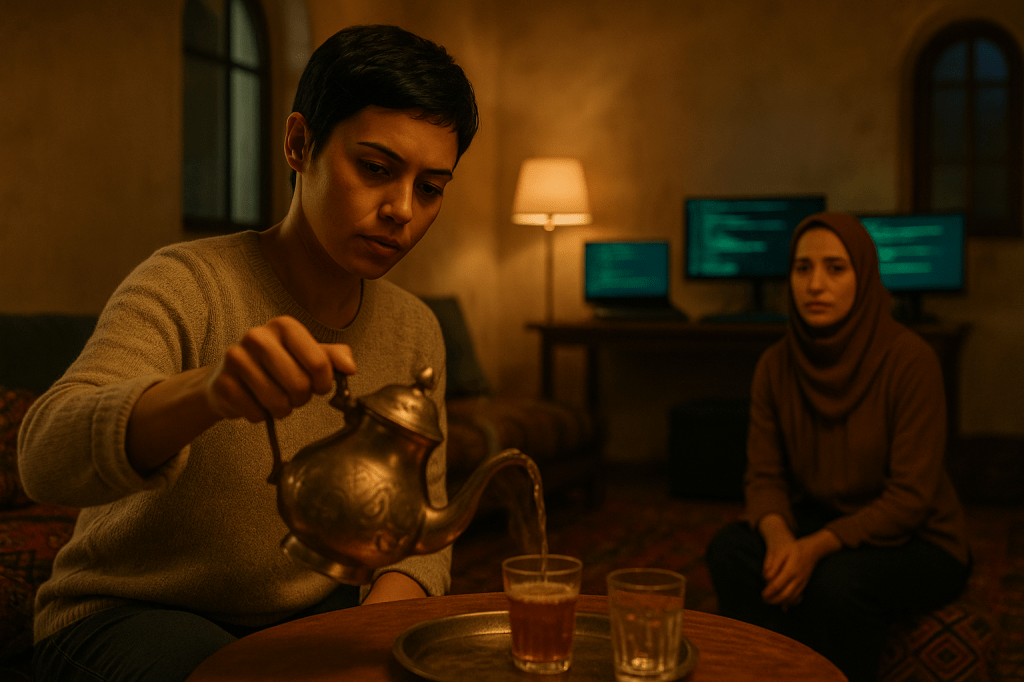
Later that evening, we found ourselves in my apartment. The space was an odd mix of old and new—traditional Berber rugs on the floor, but the walls were lined with glowing monitors, a blend of cultures and technology that felt oddly fitting. I poured mint tea with practiced hands, the steam rising in graceful arcs. I could feel Leila’s gaze on me as I worked, as if she was waiting for me to say something more. But we both knew the weight of the situation. Words wouldn’t change the reality. Action would.
“They’re called The Sable Network,” I said, breaking the silence.
“Every breach they leave behind the same marker—one line of dead code. No signature. Just silence where something used to live.”
Her breath caught. “How big?”
I didn’t sugarcoat it.
“Power grids. Water systems. Transportation networks.”
She met my eyes. “They’re not looking to disrupt. They’re looking to make us stop functioning.”
Leila
I could feel the blood drain from my face as Karima laid it all out. It was bigger than I’d thought—bigger than any threat I’d ever faced. The implications were devastating, and my mind raced to keep up. I thought of the families in Tangier, the bustling streets, the power outages that could plunge entire neighborhoods into darkness. My hand brushed against the old notebook in my bag, the one I’d used to write my first big story. I thought then that uncovering corruption was the most dangerous thing I’d ever do. But now? Now, this was something else entirely.
“We need evidence,” I said, my voice firm, trying to steady my pulse. “Something concrete.”
“I’ve got a lead,” Karima replied, her fingers flying over the keyboard. “An informant. She’s ex-Sable Network. Goes by ‘Shadow.’ She’s willing to talk, but we’ll have to move carefully.”
Tangier – Medina Cyber Café, 9:02 PM
Karima
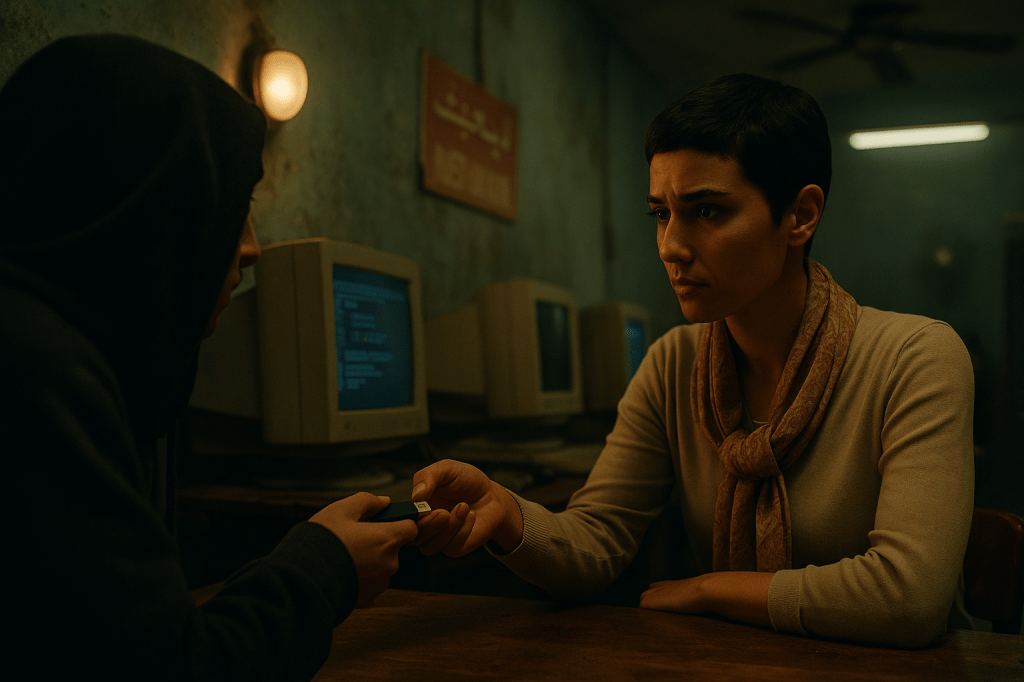
The next night, we met in a cyber café, deep within the medina. The place was cloaked in shadows, old monitors casting eerie glows across the room.
I leaned back in my chair at the café, a laptop in front of me, my fingers dancing across the keys. The ataya was still warm in my hand, its sweetness lingering as the sea breeze rustled the papers on my desk.
A man passing by nodded at me, a small, respectful smile tugging at his lips.
“Kif halek, Karima?”
“Bikhir, alhamdulillah,” I answered, my voice steady, not missing a beat. “I’m fine, thank God.” It was a routine greeting, one I could give without thinking. But in this city, even these small exchanges made me feel grounded, reminded me that Tangier was a place of connection, a place where stories lived in every corner.
Leila was all business as we slipped into the corner, the tension between us palpable. We weren’t just talking to an informant; we were talking to someone who had once been part of a network capable of toppling entire nations.
Shadow was nervous. Her hands trembled as she slid the USB drive across the table.
When she spoke, her voice caught halfway through each sentence, as if she was afraid of being heard even now.
“They’re after more than just money,” she said, her voice shaking with emotion. “They’re after chaos.”
Leila leaned forward, her fingers hovering over the drive.
“Do you have proof?”
Shadow nodded.
“Encrypted communications. Names. Locations. It’s not everything, but it’s a start. Be careful—they’re watching everyone.”
Leila

As I sat at the small café by the port, watching the sunlight flicker on the waves, I thought about the city I called home. Tangier had always held its stories close, revealing only what it wanted those who listened carefully to hear.
My mother used to say, “Lazim tadhakar”—“You must remember.”
Remember the way the streets speak, the way the medina whispers its secrets through the cracks. It felt like everything here was always just beneath the surface, waiting for the right person to listen. And right now, I was listening, every part of me attuned to the hum of the city, and the storm that was brewing.
I took the drive, the weight of it in my hand heavier than I expected. Shadow’s words haunted me. She wasn’t just giving us information—she was risking her life to do it. I met her gaze, the urgency of the situation sinking in.
“Why are you helping us?” I asked, though I already knew the answer. Her betrayal wasn’t for us. It was for the people who would suffer if this went unchecked.
Her voice was quiet. “I believed in change,” she whispered. “But change built on destruction is no change at all.”
Karima’s Apartment – 11:38 PM
Karima
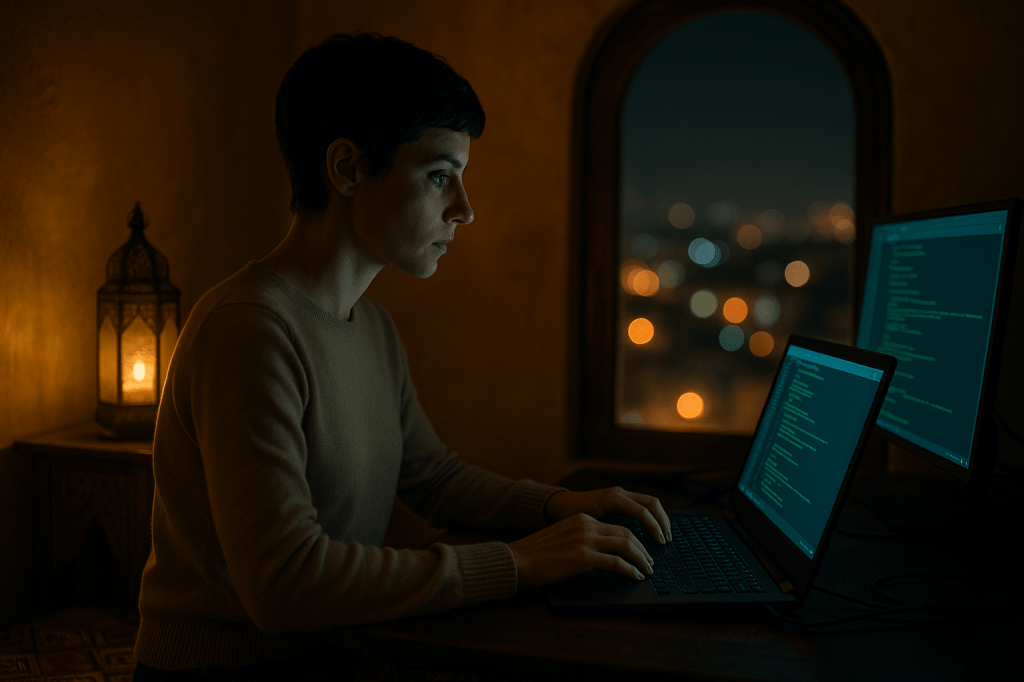
The lights of the city flickered softly through my apartment window as I worked. There was always something alive about Tangier—its unpredictability, its duality of modernity and tradition.
I remembered a saying my grandmother used to tell me, “Ma kanch mouchkil”—“It’s no problem.”
It had always been her way of shrugging off obstacles, no matter how difficult. I’d learned to carry that mindset with me, but tonight, it felt different. There was something heavier in the air. Tangier was always a place of crossroads, but this time, it felt like it was teetering on the edge.
At this moment, Leila and I decrypted the files. The evidence was damning. The names, the plans—everything pointed to The Sable Network being more dangerous than we could have imagined. The attack wasn’t just on the banks. It was a blueprint for the collapse of an entire country.
As Leila pointed to the screen, her voice was tight. “There it is. A server in Casablanca. That’s where they’ve been hiding.”
Just as we finished decrypting the last file, the alert flashed on Leila’s screen: They know we’re onto them.
“We’re out of time,” I said, my fingers flying across the keyboard to block the incoming breach.
Leila
The urgency in Karima’s voice matched the panic rising in my chest. The stakes had just been raised, and there was no turning back. As I disconnected my hardware, I could hear the distant hum of the city, still unaware of the chaos brewing beneath its surface.
“We need to publish—now,” I said, determination in my voice. The truth had to come out, and we were the ones to do it.
The End
Unraveling The Tangier Cipher
By Leila Ben Youssef & Karima Hamdani
Leila: For me, this wasn’t just another story. It was about defending the Morocco I grew up loving—the bustling medinas, the sea breeze, the stories my grandfather shared. As a journalist, I’ve always believed in the power of truth. But this investigation showed me that truth alone isn’t enough. We need to give people the tools to fight for what matters. Journalism isn’t just about uncovering secrets; it’s about preserving the stories that make us who we are.
Morocco is a tapestry of resilience, woven from the threads of our past and present. But like any tapestry, it can fray. This story was my small way of helping stitch it back together, one thread at a time. My grandfather always said, “A story that doesn’t shake the ground isn’t worth telling.” This one shook me to my core, and I hope it stirs others to action. Tangier has a way of holding its stories close, only revealing them to those who listen carefully. This time, it trusted me with one worth telling.
Karima: Technology is like a blade: its edge depends on the hand wielding it. This investigation reminded me how powerful and dangerous it can be. The same code that protects us can also tear us apart. But it also showed me the strength of collaboration. When we combine skills, when we trust each other, we can wield that blade to protect, not harm.
As a technologist, I often see the world in binary—ones and zeroes. This case, though, reminded me of the gray areas—the human stories behind the code. Protecting Morocco’s infrastructure wasn’t just about lines of code; it was about ensuring families had water, lights, and safety. Tangier is a city of whispers, where old paths meet modern chaos. Stories—like code—can bridge divides and create something lasting.
Leila & Karima: This wasn’t just about stopping The Sable Network; it was about showing what’s possible when we come together to protect what we hold dear. Morocco, with its rich culture and resilient spirit, deserves nothing less. Tangier has always been a city of crossroads—of cultures, trade, and intrigue. Tonight, its lights seemed brighter, as if the city itself had reclaimed its place as a beacon of resilience.
The Tangier Cipher (“الشفرة الطنجيرية” – Al-Shifra Al-Tanjiriyya) is one story among many, but it reminds us that with courage and collaboration, even the most intricate puzzles can be solved. And as we look forward, we hope this story serves as a reminder that truth, trust, and technology must go hand in hand in shaping a better future. Tangier’s whispers carry stories of resistance and renewal, a reminder that even in chaos, there is always hope.
 Scott Bryant
You must be logged in to post a comment.