
Waltz of Forgotten Bonds
Story Written by
Alessia Bruni & Lucia Rinaldi
Story Told by
Alessia Bruni
Artistic Vision & Imagery Created by
Alessia Bruni, Lucia Rinaldi,
Giada Benedetti, Vittoria De Luca,
Filomena Russo, & Scott Bryant
Scott Bryant shares this story with care and reverence, at the insistence of Alessia Bruni & Lucia Rinaldi, who refused to let his contributions go unacknowledged.
Separate Beds
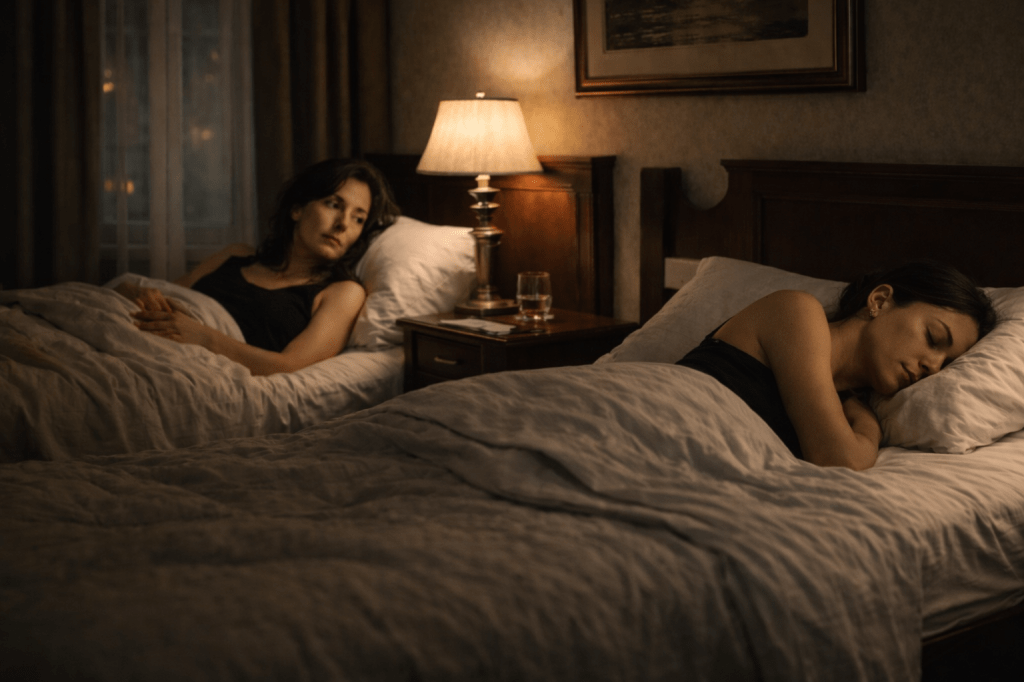
We slept in separate beds.
Not because we had decided to. It was simply how hotel rooms arranged themselves around us now—two narrow beds, parallel, a polite distance maintained without discussion. Lucia always took the one nearer the window. I took the other, closer to the door. It had been like that for years, long enough that it no longer felt symbolic. Just practical. Familiar.
That night, I lay awake longer than I expected to.
Lucia had fallen asleep quickly, or at least she had gone still. In the dim light from the street below, her face looked softer, less guarded than it did during the day. I watched the steady rise and fall of her breathing until it felt intrusive to keep looking. I turned onto my side and faced the wall.
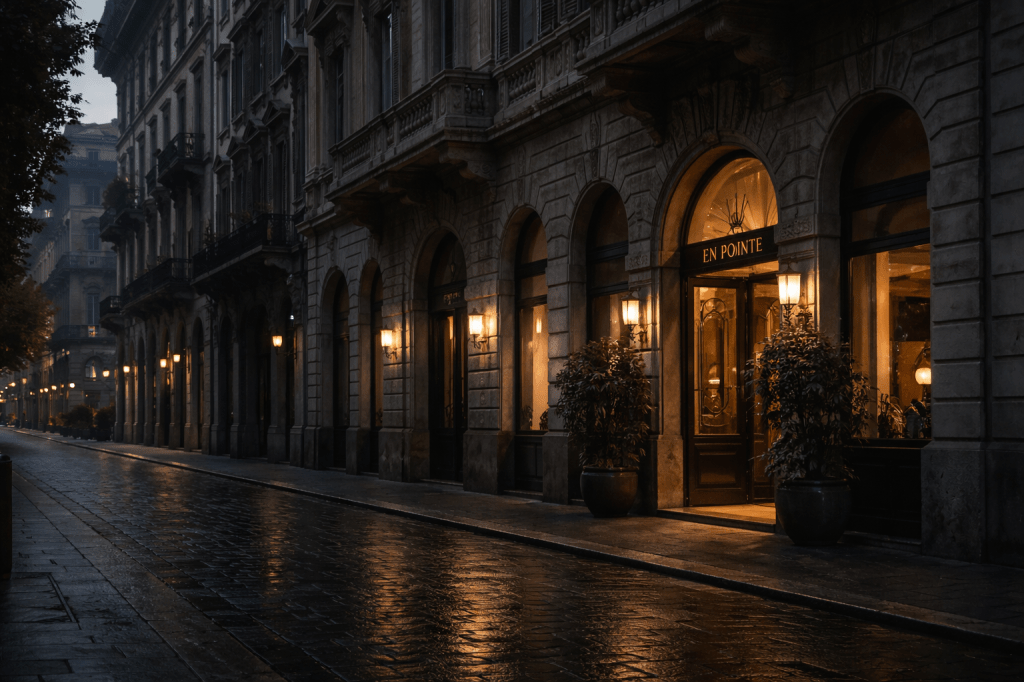
The En Pointe Hotel was quiet in the way older buildings are—never fully silent, but attentive. Pipes whispered behind the walls. Somewhere below us, a door closed. Milan at night did not sleep so much as pause, as if the city were holding itself in reserve.
Earlier, nothing had been wrong. That was what troubled me most.
Dinner had been easy. We talked about work—fabric delays, a fitting that would need reworking, a runway show Lucia wanted to attend next season. She laughed when I teased her about overcommitting. I laughed back. We moved through the evening with the practiced rhythm of people who had shared a life for a long time.
Still, there were small moments that did not settle.
Lucia’s attention drifted, not toward her phone or the room, but somewhere just beyond it. She nodded before I finished speaking. Once or twice, I found myself repeating a sentence, not because she hadn’t heard me, but because she seemed to have already moved on from it.
I told myself this was nothing. Fatigue. Travel. The usual disorientation that came with being away from home. Long bonds taught you not to panic at the first sign of quiet. Silence did not always mean absence.
At the café that afternoon, Lucia had stood by the window longer than necessary, her posture composed, almost still. Focused. I followed her gaze, expecting to see someone she recognized.
There was no one there.
“Do you see someone?” I asked.
She blinked, as if returning from a distance I hadn’t been aware of. “No,” she said easily. “I was just thinking.”
I believed her. Or rather, I accepted the answer. The difference mattered.
Now, in the dark, the memory surfaced again without invitation.
Lucia shifted in her sleep, turning onto her side. Her hand slid across the sheet, stopping short of the narrow space between our beds. The gesture was unintentional, unguarded. I felt a quiet tightening in my chest—not longing, exactly, but recognition. Of how close we were. Of how careful we had become.
This was what it meant, I thought, to share a life with someone for so long. Not constant closeness. Not constant knowing. But the ongoing negotiation of space. The willingness to move forward together even when you could no longer tell exactly where the other was looking.
There would be time to talk tomorrow. There always was. Mornings softened things. Coffee made questions feel less dangerous. I told myself this the way one repeats something already believed.
The Hotel Corridor
Eventually, sleep took me—not gradually, but all at once, like a curtain dropping.
I was standing in the hotel corridor.
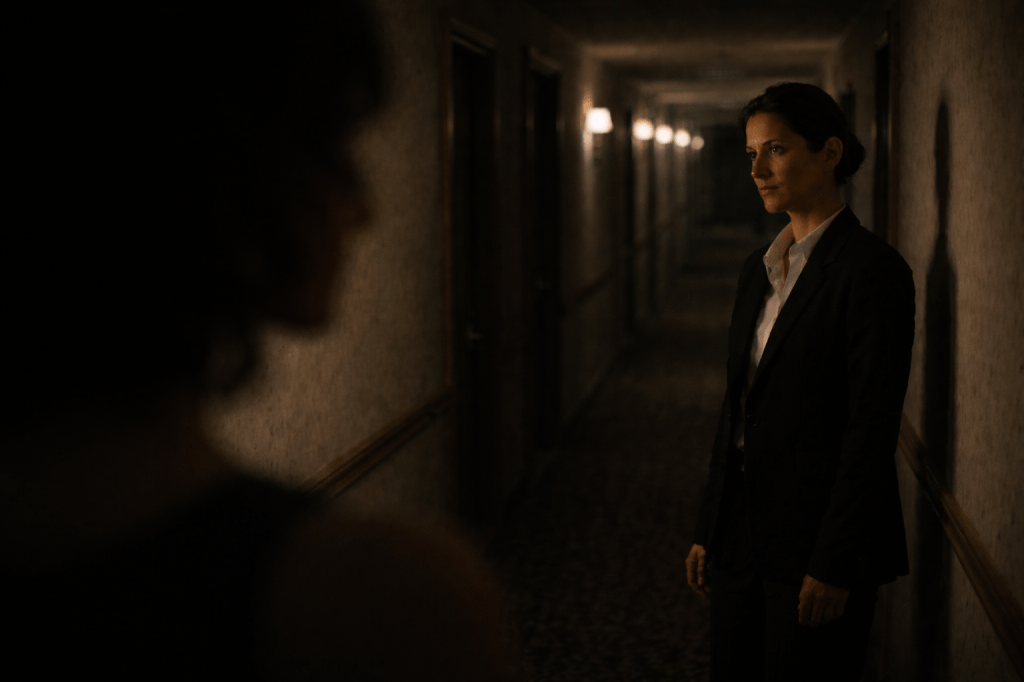
It was longer than it should have been, the walls stretching beyond their familiar proportions. Mirrors lined one side at uneven intervals. My reflection appeared and disappeared as I moved, never quite matching my pace.
At the far end, beneath one of the lamps, Lucia stood waiting.
Relief came instinctively, immediate and physical. I stepped toward her without thinking.
“Lucia,” I said.
She turned and smiled politely, the way one smiles at someone who has spoken first. Not unkind. Not surprised.
“Yes?” she said.
The word landed gently, placed with care.
“It’s me,” I said, though even as I spoke, the certainty of it wavered.
Her expression softened, as if she were trying to be gracious. “I’m waiting for someone,” she said. “She should be here soon.”
I glanced past her, following the direction of her attention. The corridor was empty. No footsteps. No movement. Only the sense of a presence I could not see.
“I won’t keep you,” Lucia added, already turning away.
And before fear or grief could gather into language, understanding settled into my body like weight:
Whatever she was waiting for, it was not me.
Waking

I woke before the light changed.
For a moment, I didn’t know where I was. The ceiling was unfamiliar, the air cooler than it should have been. The hotel held its breath in that hour just before morning, when the city hasn’t yet decided to resume itself.
Then I became aware of warmth.
Lucia was beside me.
Not in the other bed. Not across the narrow space we usually maintained. She was close enough that I could feel the steady heat of her body through the sheets, close enough that our knees touched, our calves aligned without friction. Her back was to me, her breathing slow and even, the rhythm unmistakable.
I did not move.
The realization settled slowly, carefully, as if startled too abruptly it might vanish. My hand rested near her shoulder, not touching, but close enough that the smallest shift would change everything. I could see the faint rise of her breath, the soft hollow at the base of her neck where her hair fell loose.
I searched my memory for the moment this had happened.
There was nothing.
No waking. No sound of footsteps. No half-conscious decision. The night offered me no explanation, only this outcome.
Lucia stirred, adjusting slightly, her arm drifting backward until her hand brushed my wrist. The contact was brief, unconscious, but it sent a sharp awareness through me. I held my breath, waiting to see if she would wake.
She didn’t.
Her hand relaxed where it had landed, fingers loose, trusting. I stayed very still, as if movement might break whatever fragile permission had brought us here.
The dream lingered at the edges of my mind — not as images, but as sensation. The weight of being unseen. The quiet certainty of standing in the wrong place. It faded slowly, dissolving into the present in ways I couldn’t separate.
Lucia shifted again, closer this time. Her knee pressed against mine. Her shoulder leaned back until it rested lightly against my chest.
I felt it then — the instinct to wrap my arm around her, to pull her nearer, to let my body answer the question my mind didn’t dare ask. The impulse was immediate and familiar, like muscle memory returning without warning.
I didn’t act on it.
Instead, I lay there, awake, listening to her breathe, trying to understand how two things could be true at once: the distance I felt so clearly, and the undeniable fact of her body seeking mine in sleep.
Outside, a delivery truck passed, tires hissing on wet pavement. Somewhere below, a door opened, then closed. Milan beginning again.
Lucia stirred more fully now, her breath changing, her body tensing briefly before relaxing. She made a soft sound — not a word, just the faintest exhale — and then she turned.
Her eyes opened.
For a second, she looked at me without recognition, the way people do when they surface slowly from sleep. Then awareness settled in, her gaze sharpening as she took in the room, the light, the position of our bodies.
She didn’t pull away.
“Oh,” she said quietly.
“Hi,” I replied, my voice lower than usual.
She glanced around, registering the single bed, the rumpled sheets, the other bed across the room untouched. A crease appeared briefly between her brows, not alarmed, just uncertain.
“I must have…” She stopped. The sentence didn’t finish itself.
“Yes,” I said, though I wasn’t sure what I was agreeing to.
She lay there for another moment, her hand still near mine. Neither of us moved to correct the situation. Neither of us named it.
“Did you sleep?” she asked.
“A little,” I said.
Lucia nodded, as if that made sense. She withdrew her hand slowly, carefully, then sat up, swinging her legs over the side of the bed. The space she left behind cooled almost immediately.
“I don’t remember getting up,” she said, not quite to me.
“I know,” I replied.
She looked at me then, really looked — not guarded, not distant, but searching. Something passed between us, subtle and unfinished.
“We should get ready,” she said after a moment. “We have that meeting this afternoon.”
“Yes,” I said again.
She stood and crossed the room, her movements efficient, familiar. She didn’t look back.
I stayed where I was, watching the light shift across the ceiling, my body still holding the shape of hers.
I did not know what it meant.
I only knew that, for reasons neither of us had chosen, we had found our way to each other in the dark.
Mid-Morning
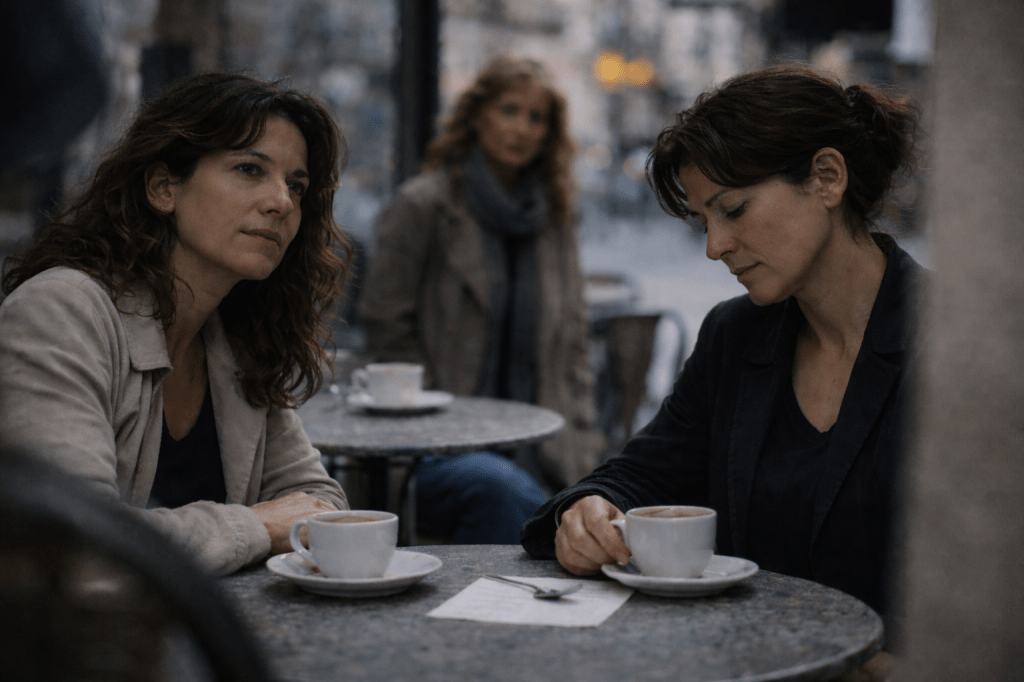
By mid-morning, the hotel had fully woken.
The En Pointe’s café opened onto the street through tall windows, light spilling in at an angle that softened everything it touched. The city moved past at a measured pace—footsteps, bicycles, the occasional delivery van idling too long before pulling away. Milan did not perform for anyone. It simply existed.
Lucia sat across from me, her coffee untouched.
She had changed since morning—tailored trousers, a crisp blouse, hair pulled back with efficient care. Composed again. The version of herself the world knew. She scrolled through her phone absently, pausing now and then to reread something I couldn’t see.
I watched her without meaning to.
The imprint of the night hadn’t left my body yet. The memory of waking beside her lingered in small, physical ways—in the awareness of space, in the way my shoulder still felt the echo of her weight. Lucia, for her part, seemed entirely present and entirely elsewhere at once.
“Do you want to walk after this?” I asked, keeping my tone light.
She looked up, smiled briefly. “Maybe. Let me see how long this call takes.”
“Of course,” I said.
She returned to her screen. The conversation closed as neatly as it had opened.
I took a sip of my coffee and turned slightly toward the window, letting the street hold my attention. The glass reflected faint outlines of the café behind me—tables, light fixtures, passing figures layered over the city beyond. For a moment, it was difficult to tell what belonged to which side of the glass.
“Excuse me.”
The voice was close. Not intrusive. Simply present.
I turned.
The woman stood beside our table, not waiting to be acknowledged, not apologetic either. She was older than us, perhaps in her late fifties or early sixties, dressed simply but with unmistakable care. A long coat draped over her arm, as if she hadn’t decided whether to stay or leave.
Her eyes met mine directly.
“I hope you don’t mind,” she said. “I just wanted to say—”
She paused, as though reconsidering the sentence.
“I recognize that look.”
I felt my breath catch, sharply enough that it surprised me.
Lucia didn’t look up.
“I’ve seen it many times,” the woman continued, her tone neither gentle nor severe. Observational. “From women who pass through here thinking they’re on solid ground.”
“I’m sorry,” I said automatically. “Do I—”
She shook her head once, a small, precise motion. “No. There’s nothing to explain.”
Her gaze flicked briefly—not to Lucia, but past her, as if noting the shape of the space Lucia occupied rather than the woman herself.
“You’re not lost,” she said. “But you are waiting.”
The words landed without force. Without accusation.
“I didn’t mean to intrude,” she added. “Sometimes it’s enough just to be seen.”
She straightened, already stepping back.
“My name is Odelle,” she said, as if it were incidental. “I’ve spent a long time in places like this.”
With that, she turned and walked toward the counter. The barista greeted her by name. She ordered, paid, and took her coffee to go.
A minute later, she was gone.
Lucia looked up then, finally, her brow faintly furrowed. “Did someone need something?”
“No,” I said.
She nodded, accepting the answer without question, and returned to her phone.
I stared at the space Odelle had occupied, the air there already settling back into anonymity. The café resumed its quiet rhythm. Cups clinked. A chair scraped softly across the floor.
Lucia reached for her coffee at last, took a sip, and sighed.
“Sorry,” she said. “That call’s going to take longer than I thought.”
“It’s fine,” I replied.
And it was. Or at least, it was manageable.
Still, Odelle’s words stayed with me—not as a warning, not as a revelation, but as confirmation of something I had been circling without language.
I was not lost.
But I was waiting.
Afternoon
By afternoon, the city had settled into itself.
The heat rose gently from the pavement, not oppressive, just present. Milan moved with its usual confidence—measured, unhurried, unconcerned with being observed. We walked side by side along Via Manzoni, our pace instinctively matched, the way it always had been. Years of moving together had taught our bodies how to align even when our thoughts did not.
Lucia talked about the meeting as we walked.
“The fabric house confirmed,” she said. “They can rush the samples, but it’ll cost more.”
“We’ll make it work,” I replied. “We always do.”
She nodded, satisfied. Problem solved. Another small success added to the long list of things we handled well together.
Inside the atelier, the air smelled faintly of starch and fabric dye. Bolts of cloth lined the walls in careful gradients—ivory to bone to cream, blacks deep enough to swallow light. The space calmed me in the way familiar rituals always had. This was where we were most fluent. This was where language returned.
Lucia moved through the room with quiet authority, greeting the assistant, reviewing sketches laid out on the central table. She was fully present now, focused, decisive. Watching her work still filled me with a kind of pride I hadn’t learned how to relinquish.
“Look at this,” she said, sliding a sketch toward me. “I’m thinking softer lines here. Less structure.”
I leaned in, studied it. “It changes the whole movement.”
“Exactly.”
Our shoulders brushed briefly as we stood over the table. The contact was incidental, but it registered all the same. Lucia didn’t react. Neither did I. We continued talking, adjusting proportions, discussing seams and drape.
From the outside, we must have looked seamless.
At one point, Lucia laughed—an unguarded sound, quick and genuine. It startled me. I looked up, instinctively searching her face for whatever had sparked it.
“What?” she asked.
“Nothing,” I said. “I just—forgot that one.”
She smiled, a little crooked. “I still have it.”
I wanted to ask where. Or for whom.
I didn’t.
The afternoon unfolded efficiently. Decisions were made. Notes were taken. Time moved forward whether we noticed it or not. When we finally stepped back out into the street, the light had shifted, softening at the edges.
“Do you want to stop somewhere?” Lucia asked. “Before we head back?”
“Sure,” I said.
We found a small bar tucked just off the main road. Nothing remarkable. A place you could disappear into for an hour without being asked to explain yourself. We sat at the counter, ordered mineral water and something small to eat.
Lucia checked her phone again, then set it face down this time. A small gesture. Deliberate, maybe. Or not.
She glanced at me. “You’ve been quiet.”
“I’m thinking,” I said.
“About work?”
“Yes,” I said. It wasn’t untrue.
She accepted that easily. That, too, was familiar.
We ate in comfortable silence, the kind that didn’t demand performance. Still, beneath it, I felt the low hum of something unresolved, like a question that hadn’t yet decided to take shape.
Outside, the city continued. A woman laughed somewhere behind us. A tram bell rang. Ordinary sounds. Ordinary lives.
Lucia finished her drink and stood. “Ready?”
“Yes.”
As we stepped back onto the street, she fell into stride beside me without thinking, close enough that our arms nearly touched. For a moment, the alignment felt effortless again, as if nothing had shifted at all.
And yet, Odelle’s words returned to me without invitation.
You’re not lost. But you are waiting.
I walked on anyway.
Fin.
 Scott Bryant
You must be logged in to post a comment.