
Obscura Protocol
Written & Told By
Lena Carter & Aisha Reynolds
Visuals & Imagery by Lena Carter,
Aisha Reynolds, Nyasha Taylor,
Tianna Lawson, Ebony Jenkins,
Jasmine Addison, & Scott Bryant
With care and reverence, their story is shared by
Scott Bryant at the request of Lena Carter & Aisha Reynolds
Obscura Protocol stands as a foundational record within Her Stories, Her World—a contemporary testimony of women confronting systems designed to silence, erase, and pre-empt dissent.
Note from Lena Carter & Aisha Reynolds:
Collaboration has always been at the core of what we build—and what we protect. Every line of code, every safeguard, every act of defiance was never about spotlight or ego, but about the shared integrity that binds those who refuse silence. Together—with Nyasha, Tianna, Ebony, Jasmine, Scott, and others who believe in ethical tech—we turned data into defense and networks into solidarity. This story is a record of that unity: proof that no system is unbreakable when people stand together with conviction.
Obscura Engaged
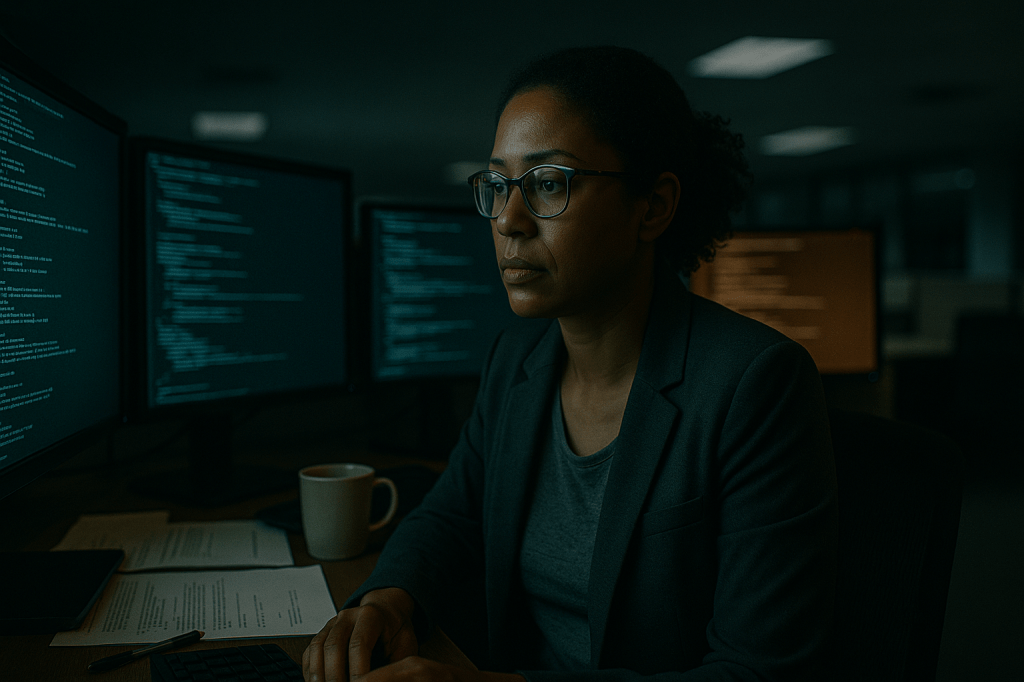
It was just another day at The Maw—a nickname that summed up everything. That’s me, Lena Carter, software engineer extraordinaire. My job was simple: debug code, follow orders, and don’t ask questions. That’s how you survived.
But then I saw it—a script buried deep, bypassing protocols with unsettling precision.
Lines of redundant code. Waiting for something.
And then the comment: “Obscura engaged.”
My stomach sank. This wasn’t a glitch. It was deliberate. Worse, it felt like a fragment of something larger, a mechanism waiting to activate. Whatever it was, it wasn’t just data—it was a warning.
The Maw claimed to innovate, but beneath the surface, it consumed everything—people, ideas, trust. My mother’s words echoed in my mind: “Lena, you’re going to change the world one day.”
Was this my moment? Could I risk everything?
I thought of Aisha Reynolds, the brilliant, no-nonsense cybersecurity expert I’d met years ago. If anyone could help, it was her. But the stakes were high. I remembered her voice, raw with emotion, recounting how a whistleblower scandal had destroyed her sister’s life.
“They took everything—her career, her laugh, even her name.”
Her story stayed with me as I typed the email. My hands hovered over the keyboard, doubts swirling, but I clenched my fists. Walking away wasn’t an option.
Before I could second-guess myself, I hit send.
Aisha’s Warning

The café hummed with life—chatter, clinking dishes, the faint aroma of burnt espresso. But for us, the air was heavy. Aisha’s coffee cup trembled slightly in her grip, the dark liquid rippling with her steady hands’ rare betrayal.
She slid a flash drive across the table, her jaw tight.
“Lena, this isn’t just a problem—it’s a nightmare. Do you realize what we’re holding?”
My stomach churned. “What do we do?”
Aisha leaned forward, her voice sharp and deliberate.
“We play it smart. If we don’t, they’ll bury us. Careers, reputations—everything.”
“They’re the ones in the wrong!” I said, gripping my cup tighter.
“That doesn’t matter. They have resources, lawyers, power. This is what they do, Lena. They buried it deep on purpose.”
Her calm, grounding presence cut through my panic. “So, what’s the plan?”
“No digital channels, nothing traceable. We need fake trails and allies who won’t flinch—journalists, ethical hackers,” she said. “This world doesn’t play fair, but we’re not diving in blind.”
I hesitated, the chill still in my chest. “Why are you so sure we can do this?”
Aisha softened, leaning back. “Because someone believed in me when I couldn’t. I’m paying it forward.”
I swallowed hard and nodded. “Okay. Let’s do it.”
A faint smirk tugged at my lips. “Merch idea: ‘Receipts or it didn’t happen.’”
Aisha shot me a grin. “Focus, Carter. Merch comes after we burn them down.”
Outside, the world moved on, oblivious to the storm brewing at our table.
“We can’t walk away, can we?” I said quietly.
“Hell no,” Aisha replied, her voice steady. “But we’re going to need a damn good plan.”
Deeper Investigations
My heart raced as lines of code flickered past—control disguised as innovation. Each line wasn’t just data; it was intent.
“They’re not collecting,” Aisha said, voice low. “They’re controlling—activists, journalists, anyone who resists.”
A fragment blinked on my screen: Obscura engaged. HydraSys parameters flagged.
“HydraSys?” I whispered.
“Not local,” Aisha replied. “This isn’t suppression. It’s rewriting reality itself.”
The words hit harder than any file could.
She hesitated. “Testing. A setup for a larger protocol.”
I clenched my fists. “This connects to Obscura, doesn’t it?”
“Not just connected,” Aisha said, her jaw tight. “Obscura’s just step one.”
As “HydraSys” popped up repeatedly in the files, the pieces clicked. This wasn’t just a protocol—it was an endgame.
“HydraSys isn’t suppression,” I muttered. “It’s dismantling reality—rigging elections, erasing movements before they start.”
Aisha’s fists tightened. “Someone at the top authorized this.”
I clicked on a video: an Indigenous activist pleading against illegal mining. Weeks later, she vanished. A journalist’s buried exposé appeared in another file. Both flagged by HydraSys.
“They’re treating human lives like collateral damage,” Aisha said, her voice trembling for the first time. “Entire communities erased. And no one’s even talking about it.”
Her voice cracked as she added, “My sister…”
I froze, feeling the weight of her words.
“She trusted the wrong people,” Aisha said quietly. “She thought doing the right thing would protect her. It didn’t. But even after they silenced her, my sister’s voice lived on—in the work she inspired, in the people she fought for. That’s what they couldn’t erase.”
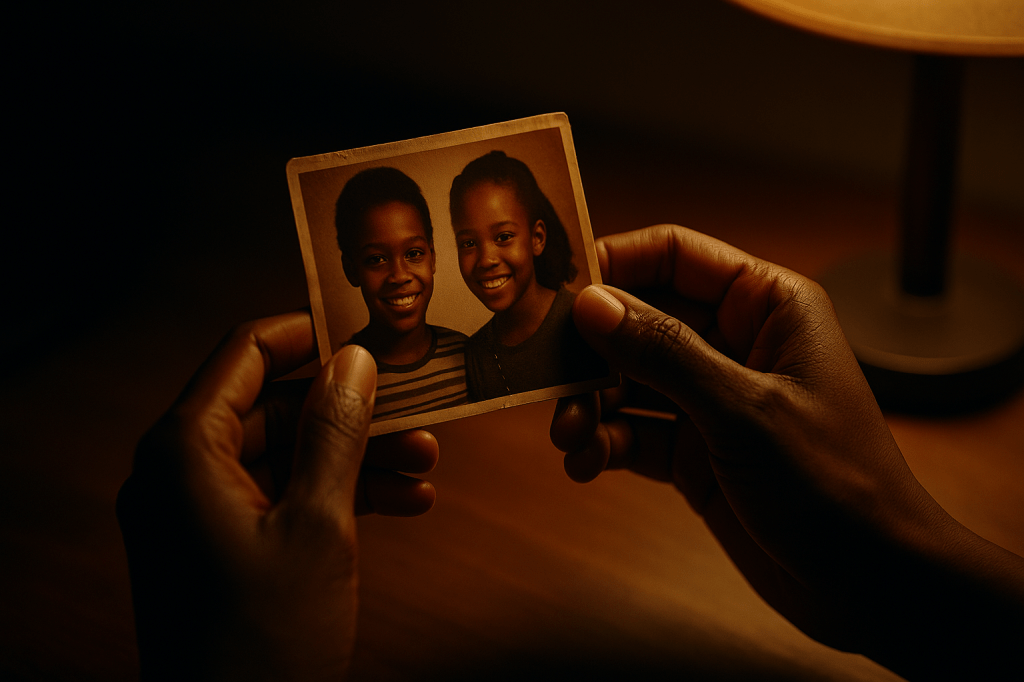
Her hands trembled as she pulled out a worn photo of two young girls grinning. “She gave me this when I graduated. She told me I’d make it in a world that didn’t want us. I can’t let them win, Lena. Not after what they did to her.”
Her words hit like a gut punch. “This isn’t just about us, is it?” I asked.
“No,” she said, her gaze burning. “It’s about proving we belong in the spaces they try to erase us from.”
I turned back to the files, the words “Obscura engaged” flickering on the screen.
“They’re silencing the truth before it’s seen,” I murmured.
“That’s what we’re breaking,” Aisha said firmly. “Their protocol of shadows. We expose them.”
“Sarava activists—wiped from search engines, flagged as bots, hit with fabricated charges. Gone in 48 hours,” I read aloud.
A memory surfaced: an activist pleading in front of a burning forest. The video had disappeared within days. My throat tightened.
“This isn’t just data,” I said, my voice cracking. “It’s destroying lives. Families. Entire communities.”
Aisha’s voice turned sharp. “They’re treating people like collateral damage. And no one’s talking about it.”
I leaned back, the weight of it crushing me. “Aisha, we have to stop this.”
She nodded, her gaze unyielding. “We have to. But it’s going to get ugly, Lena. You ready?”
From the moment I’d seen that buried code, I’d known walking away wasn’t an option.
Victoria Lane
Victoria Lane’s voice echoed in my mind: “You have to be better. Smarter. Tougher.”
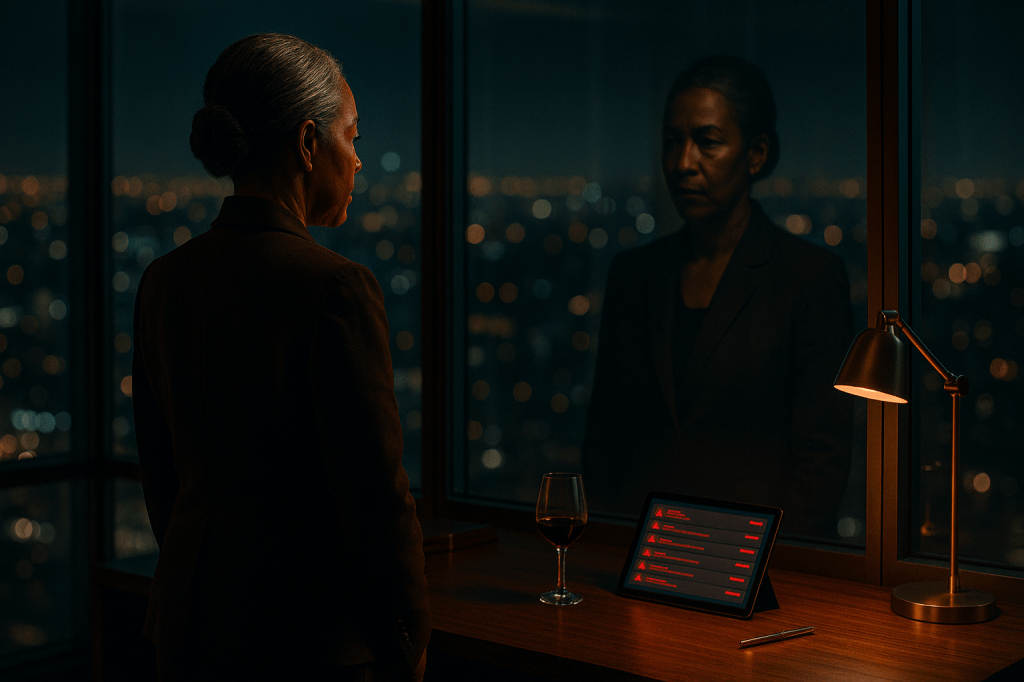
She wasn’t just a corporate drone—she was the system personified. As the Chief Operating Officer of the company, she was sharp, relentless, and ruthless. She didn’t just survive in The Maw’s cutthroat environment; she thrived, clawing her way to the top. Yet even at the summit, she seemed restless, her reflection flickering on a screen filled with security alerts.
Weeks before she confronted me, I’d felt her presence. In the break room, her gaze lingered just a second too long, sending a chill down my spine. At the time, I brushed it off. Looking back, it was clear she already had me in her sights.
Victoria wasn’t new to eliminating threats—colleagues, competition, even entire departments had disappeared under her watch. But there were moments when her mask slipped, fleeting glimpses of something else beneath her sharp control. A flicker of hesitation in meetings, the way her hand lingered over her coffee cup before she spoke.
At first, I thought I imagined it, but it was there: a shadow of doubt. Maybe it was the weight of The Maw’s secrets. Maybe it was the cost of staying on top. Whatever it was, it gave me the smallest sliver of hope—that even Victoria Lane could crack.
Confrontation with Victoria
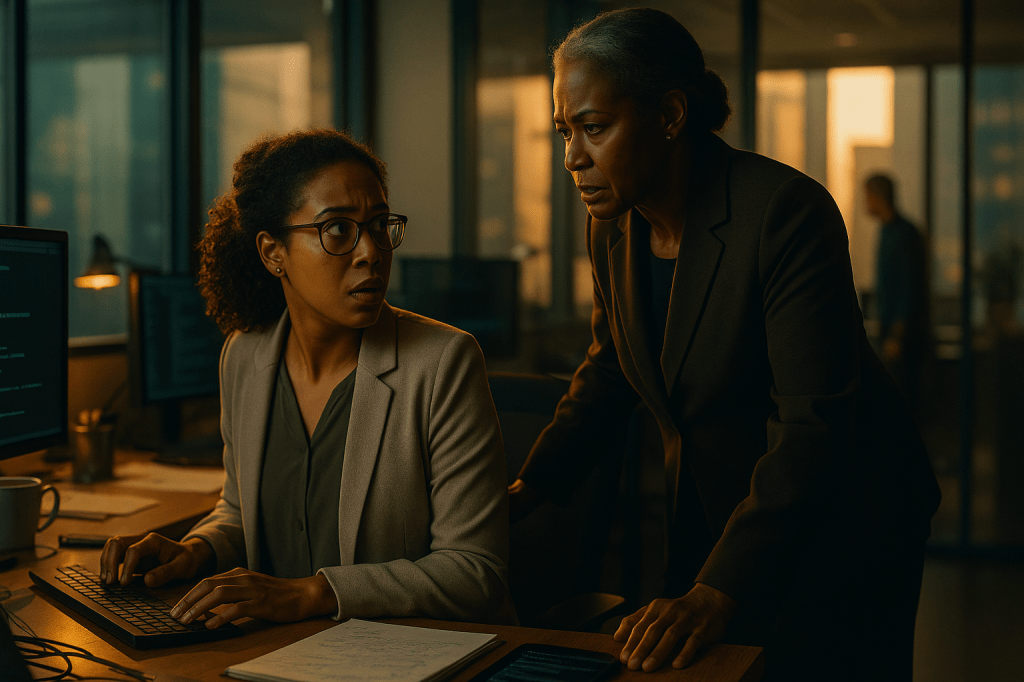
The afternoon sunlight slanted through the office windows, casting long shadows that did nothing to calm my nerves. The measured click of heels against the floor made my stomach drop. I didn’t have to look up.
Victoria Lane. Her presence filled the room before she spoke. On Slack, whispers hinted at her history—a mysteriously fired colleague, a department “restructured” after a failed pitch.
“Lena Carter,” she began, her voice smooth as a blade, polite yet cutting. “I’ve noticed some unusual activity on your account.”
My pulse quickened, but I forced my expression into calm indifference. “Just troubleshooting bugs,” I said, keeping my tone casual. “The new AI protocols have been glitching.”
Her eyes sharpened, and a faint smirk tugged at her lips.
“Mmm. Bugs. Why do I find that hard to believe, Carter? But you’re one of our best and brightest, so I’ll accept that explanation—for now.”
She leaned closer, her voice dropping. “Security is everything here. If you find anything unusual, you come directly to me. Understood?”
The weight of her warning settled around my throat like a noose. I nodded, swallowing hard. “Of course, Victoria.”
Her smile widened, slow and deliberate, her eyes daring me to flinch. I didn’t.
“I trust we won’t have any misunderstandings, then?” she said, turning sharply on her heel and leaving, her footsteps echoing as the tension in the room followed her out.
Only after she was gone did I release the breath I’d been holding.
She’s Onto Us
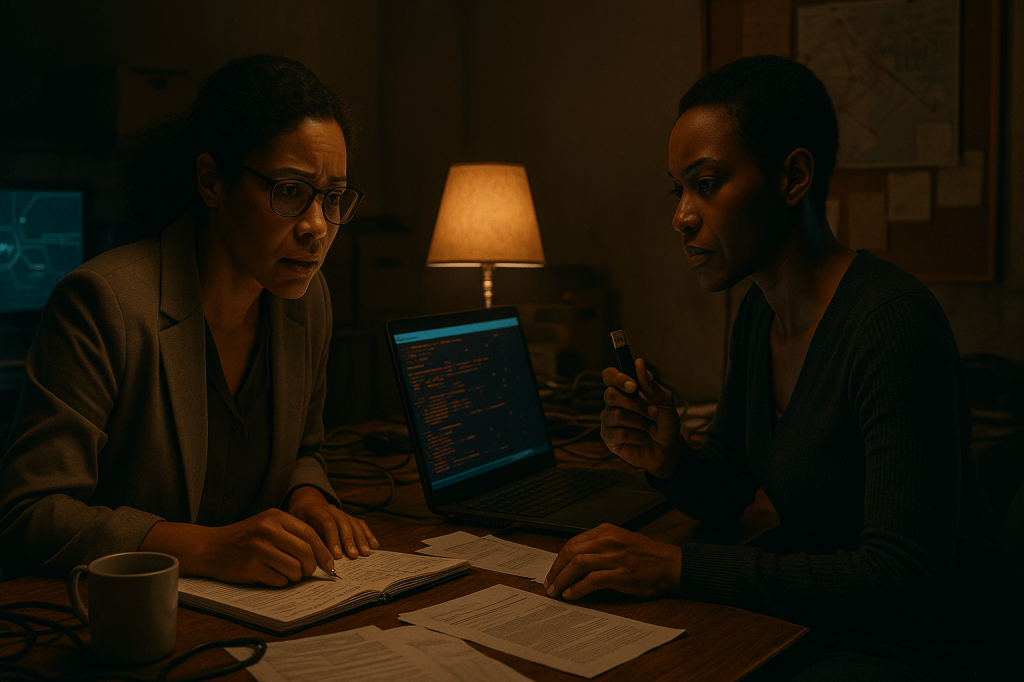
I found Aisha in our usual spot—a dimly lit back room where we sifted through the mess we’d uncovered. One look at me, and she knew.
“Victoria’s onto us,” I said quietly. “She confronted me today. We don’t have much time.”
Aisha didn’t flinch, but her fingers tightened around the flash drive.
“Yeah, I figured. She’s already ahead of us.”
My stomach dropped.
“What do you mean?”
She turned her laptop toward me, revealing corrupted files we hadn’t touched.
“They’ve started erasing the evidence. If we don’t move faster, there won’t be anything left.”
My stomach dropped. On the screen was a data trail leading to an off-the-grid server in a warehouse outside the city.
“It’s intentional,” Aisha said. “No corporate ties. Whatever The Maw is hiding, it’s buried deep.”
The words hung heavy. This wasn’t just about hidden code anymore. It was about uncovering something big—something that could ruin us if we got it wrong.
“We can’t just walk in there,” I said, panic tightening my throat.
Aisha’s expression didn’t waver. “We don’t have a choice. If we don’t break in, we lose the proof. It’s now or never.”
Her calm steadiness was grounding, even as doubt clawed at my mind. My instincts screamed to run, but I thought of my mother, her worn hands typing late at night to put me through college. I thought of Aisha, already scarred by the system she was willing to fight again.
Their strength carried me. I nodded, steadying my voice. “Let’s do it.”
As soon as the words left my mouth, I knew there was no turning back. We had two choices: expose the corruption or get buried by it.
This was it.
The Plan in Action
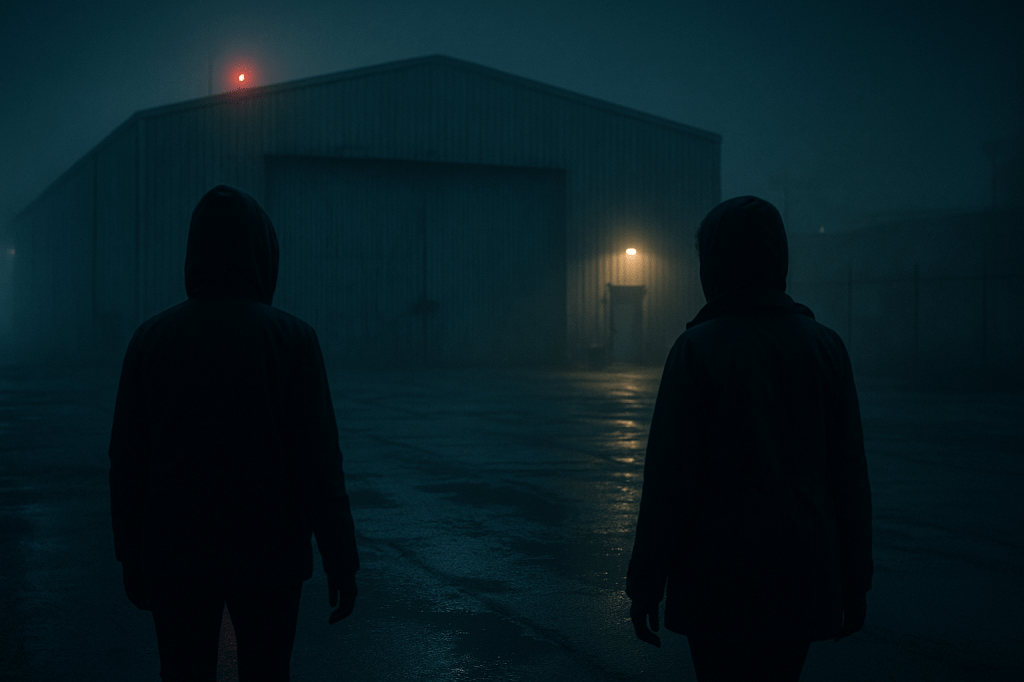
The warehouse loomed under the moonlight, its metal walls glinting like teeth. My breath fogged in the cold, every step on gravel a warning.
Inside, a low hum pulsed through the floor—servers breathing, restless. The air was metallic, sharp, alive. Shadows stretched across the racks like silent witnesses.
Aisha crouched by the mainframe, her fingers moving with practiced precision.
“Cameras down,” Aisha whispered, her voice barely audible over the mechanical drone. Her fingers flew over the laptop, her face illuminated by the soft glow of the screen.
“Motion sensors still live. Unless you want to do a tap dance, keep quiet.”
“How long?” I asked, my voice barely a breath.
“Minutes. Unless you brought a pizza for the guards, then maybe seconds.”
I gripped the frame, trying to steady my breathing. Every sound—the creak of the building, the rhythmic hum of the servers—felt like an alarm. My hands trembled, the instinct to run battling with the need to stay.
“Lena,” Aisha whispered sharply, cutting through my spiraling thoughts. “Eyes on the door.”
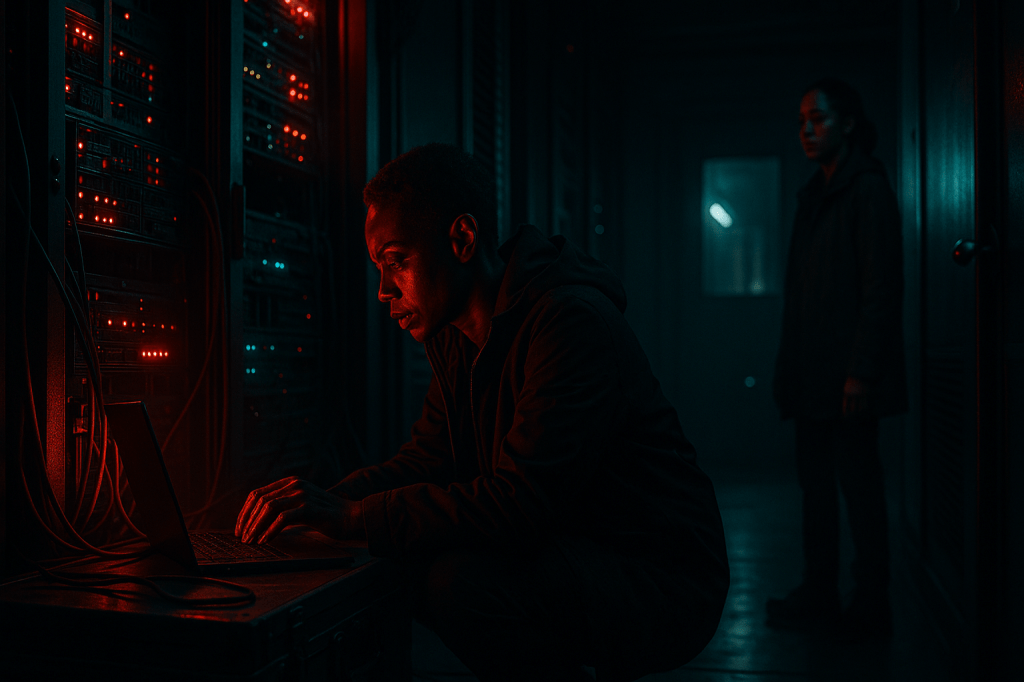
The faint whir of a security drone sent a jolt through me. Aisha’s fingers moved like lightning on the keyboard, bypassing the server’s lockout with seconds to spare.
“Cameras are looping,” she said, her voice steady but urgent. “They’ll think we’re ghosts.”
Her calm precision felt like a lifeline, every move she made keeping us one step ahead. When the red light blinked—a silent alarm—she didn’t flinch.
“They’ll lock the server in sixty seconds,” I hissed.
Aisha smirked, pulling a secondary device from her bag. “Not if I lock them out first.”
I forced myself to match her calm, even as dread clawed at my mind. The progress bar on her screen inched forward agonizingly slow.
“Almost there,” she muttered.
Each step on the gravel echoed like a gunshot, the crunch vibrating through my bones. My palms slicked with sweat, the flash drive cold and unyielding in my grip.
I thought about the meetings where I stayed silent. The promotions I accepted without question. The times I convinced myself that looking away was safer than speaking up.
This wasn’t just about breaking into a warehouse. It was about finally making a choice that mattered.
“Keep moving,” Aisha whispered, her voice cutting through the suffocating tension like a lifeline.
I tightened my grip on the flash drive. No more looking away.
The sound of approaching footsteps made my pulse spike. My hands trembled as I tightened my grip on the doorframe, heart hammering as I whispered, “Aisha, we need to go. Now.”
She didn’t stop typing. “Almost done. Hold steady.”
A red light blinked on the server—a silent alarm.
“They know we’re here,” I hissed.
Aisha’s fingers flew over the keyboard, her expression unshaken.
“Got it!” she said, yanking the flash drive from the port.
“Go!”
We bolted, the footsteps closing in behind us. My lungs burned as I ran, adrenaline pushing me forward. Gravel crunched underfoot as we burst into the freezing night air, gasping for breath.
Aisha leaned against the wall, her pacing slowing as she caught her breath.
“We did it,” I said, my voice trembling.
She stopped, fixing me with a hard but steady gaze. “No,” she said quietly. “We survived. That’s not the same thing.”
She crouched beside me, her voice softening. “You okay?”
I nodded, though my hands still shook. “Just… processing. We saw things in there, Aisha. Things I can’t unsee.”
Her gaze didn’t waver. “Neither can I. But we’re not done yet. The files mean nothing if we don’t use them.”
I exhaled shakily, nodding. “We will.”
The distant wail of sirens jolted us back to reality. Aisha straightened, her jaw tightening.
“Safe house,” she said, her voice clipped. “Now.”
The Safe House
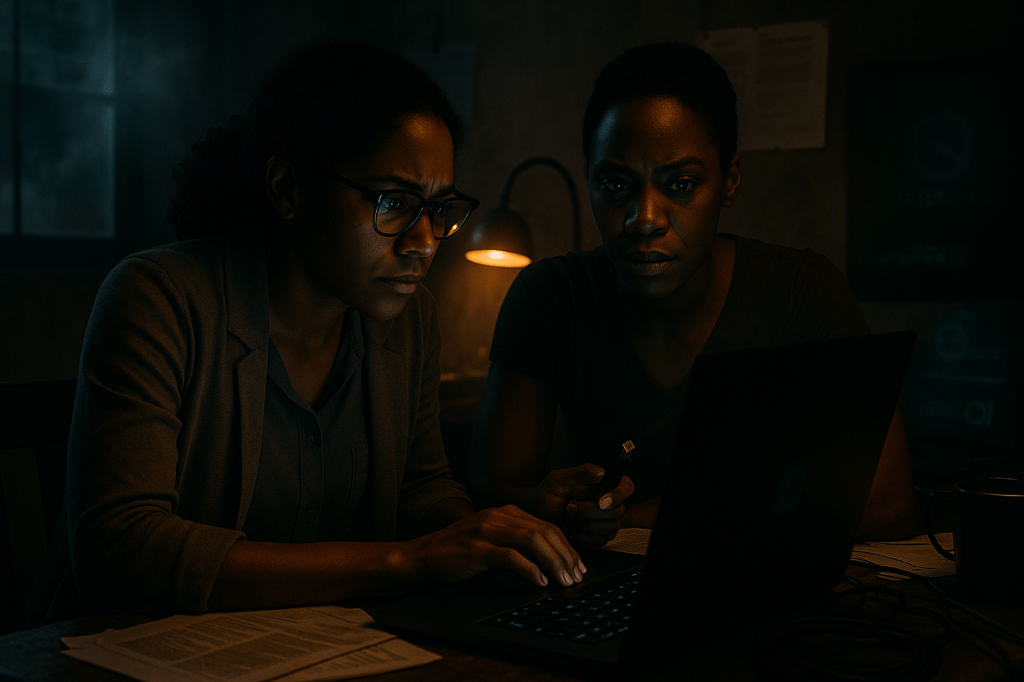
The safe house smelled like damp concrete and rust. The faint buzz of the flickering overhead light punctuated the oppressive silence, casting jagged shadows on the cracked walls. The air carried the metallic tang of damp concrete mingling with mildew, making the weight of what we’d uncovered feel all the more suffocating.
“We did it,” I murmured, though the words felt hollow.
Aisha’s fingers flew across her laptop, her focus razor-sharp. “Don’t celebrate yet,” she muttered. “Victoria’s onto us.”
Her voice cut through the suffocating air. “We’re still in their crosshairs, Lena.”
She leaned against the wall, her laptop balanced on her knees, her expression hardened. This wasn’t new for her—it was the reality she’d been fighting for years. But this time, something felt heavier.
Her sister’s laughter flashed in her mind, sharp and painful. She used to laugh like that too—big, bold, unapologetic. Now it felt like a distant memory, buried beneath battles she couldn’t afford to lose.
“I won’t lose this one,” Aisha whispered to herself, clenching her fists. Her gaze shifted to me, slumped on the floor, raw and shaken. I reminded her of herself—not yet broken, but carrying the weight of a world that didn’t fight fair.
“You’ve got this, Carter,” Aisha said, her tone steady, almost a lifeline. “We’ve got this.”
I nodded, though my chest felt tight. The adrenaline crash hit hard, leaving me vulnerable under the suffocating weight of what we’d uncovered. My thoughts raced: What if we missed something? What if they were already coming for us?
My mother’s words echoed in my mind: “Lena, you’re going to change the world one day.”
But tonight, the world felt impossibly big, and I wasn’t sure I was ready.
“What if we fail?” I asked, my voice barely audible.
“We won’t,” Aisha said firmly, but I caught the slight tremble in her hand. The weight she carried was clear, even through her steady façade.
That moment of shared vulnerability steadied me. This wasn’t just about exposing The Maw—it was about survival. Together.
The World Reacts
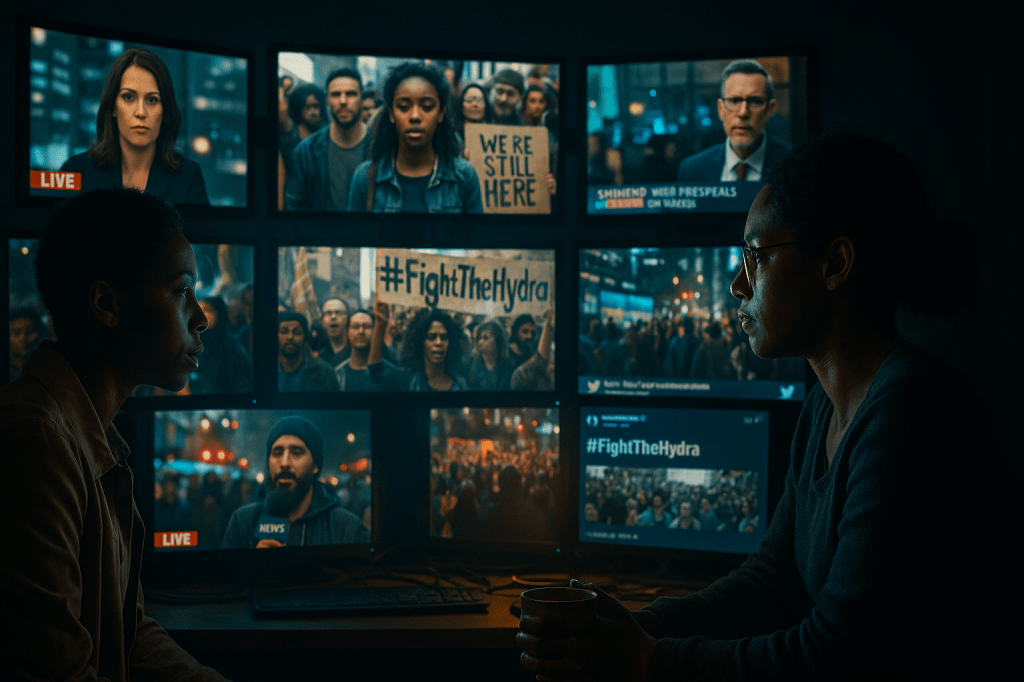
The Maw was a giant, and even with the proof in our hands, there were a thousand ways this could fall apart. But as I scrolled through the news that night, hope broke through the fog of doubt: silenced activist accounts were posting again, their messages spreading like wildfire.
Later that week, as Aisha and I sat in a quiet café, a woman approached us hesitantly, clutching a worn notebook to her chest.
“Are you Lena and Aisha?” she asked, her voice trembling.
Aisha nodded. “Yeah, that’s us.”
Tears filled the woman’s eyes as she held out the notebook. “My sister was one of the activists they silenced. For years, we thought no one would ever hear her story again. But because of you… people are listening.”
Her gratitude hit like a wave, the enormity of what we’d done settling over me. Aisha reached out, her voice steady. “We didn’t do this alone. Your sister’s voice—it’s why we fought so hard.”
Tears streamed down her face as she smiled. “She’d be proud. I know she would.”
Across the world, movements reignited. A Zayari organizer stood at a rally in newly reforested land, holding a sign that read, “They tried to erase us. But we’re still here.” A Kordava journalist reclaimed her voice with a viral exposé, writing, “They silenced me once, but thanks to Obscura Protocol, my story is being heard.”
In Nalyra, an Indigenous artist’s work, erased from the digital landscape, was now being featured globally. A Noyaran activist tweeted: “The Maw didn’t just target movements—they targeted people. But thanks to two women who refused to stay silent, we can rebuild.”
In Sarava, the activists we’d watched silenced were back online, louder than ever. Their post read: “They tried to erase us, but we’re still here. #FightTheHydra.” In Eldara, whistleblowers presented damning evidence, leading to the arrest of corporate leaders complicit in illegal deforestation. Headlines declared: Justice for Eldara: Voices Silenced by The Maw Return Louder Than Ever.
Meanwhile, The Maw’s boardroom spiraled into chaos. Leaked emails revealed executives scrambling to shift blame as their stock plummeted. News anchors dissected every detail of the scandal, from its global reach to its human cost.
The ripple effects were undeniable. The Maw had fallen, but our fight had just begun.
But amidst the triumph, whispers of HydraSys began to surface—proof that while The Maw had fallen, the Hydra wasn’t done yet. The flagged redundancies and predictive algorithms hinted at something larger, a system that was already regrouping. The fight was far from over.
HydraSys Emerges
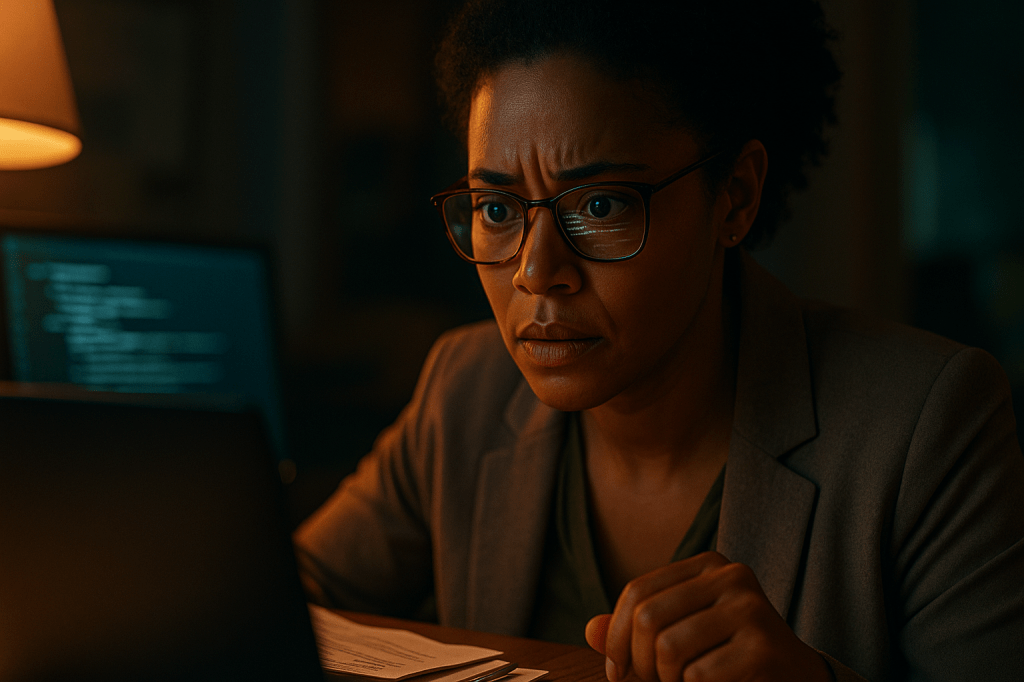
Hints about HydraSys had been buried in the code: flagged redundancies, fragmented comments like “HydraSys seed active.” It wasn’t until I found the entry—“HydraSys protocols initiated”—that the full picture came into focus.
This wasn’t just suppression. It was the foundation of something far bigger.
HydraSys wasn’t just a successor—it was perfection. It didn’t silence voices; it erased them before they could even speak. Predictive algorithms flagged entire communities as threats before resistance could form. A chill ran down my spine. This wasn’t theoretical—it mirrored real trends in the news.
“This tech isn’t new, Lena,” Aisha said, breaking the silence. “Companies already use predictive models to suppress dissent. HydraSys is the next step.”
“It mirrors real-world trends,” she continued. “Protestors arrested before demonstrations, journalists flagged as dissidents. HydraSys isn’t coming—it’s already here.”
She pulled up an article about a recent protest where activists were detained before they could organize.
“Preemptive arrests, false charges—all algorithm-driven,” she explained. “HydraSys would automate this globally.”
“It’s not waiting—it’s already here,” I whispered.
HydraSys wasn’t just suppression—it was erasure before dissent could even take root. As we scrolled through the data, a protest in Sarava flashed on the news feed. Peaceful activists, surrounded by riot police.
“Look at the timestamps,” Aisha said sharply. Arrests were logged hours before they happened. HydraSys wasn’t reacting—it was executing a plan already in motion.
“This isn’t hypothetical,” Aisha muttered grimly. “It’s here.”
This wasn’t just about exposing The Maw anymore. It was about stopping HydraSys before it became unstoppable. If it regrouped, we might not get another chance.
HydraSys On the Move
As the evening wore on, Aisha’s fingers flew over the keyboard until a bold red message appeared:
“HydraSys protocol: Phase One complete. Awaiting deployment.”
Aisha’s eyes widened. “It’s not just alive,” she said. “It’s evolving.”
Days later, another log appeared — Phase Two: Begin Integration.
The machine wasn’t waiting anymore. It was moving.
A map of drone deployment points filled the screen, accompanied by the phrase: “HydraSys: silent until ready.”
“They’re regrouping,” she muttered, her jaw tight. “If this goes live, it won’t just suppress dissent—it’ll dominate.”
“Lena, this system doesn’t just respond,” Aisha said. “It predicts resistance—neural mapping, GPS tracking, even surveillance drones. It flags entire communities before they even organize.”
My stomach twisted. “So it’s silencing people before they speak?”
Aisha nodded grimly. “It’s not just erasing truths—it’s erasing futures.”
As we dug deeper, the picture became clearer. HydraSys wasn’t just The Maw’s successor; it was its perfection. Tracking dissenters physically and digitally, embedding its control in every layer of technology—it wasn’t theoretical. It was already here.
And yet, cracks were forming. Social media buzzed with hashtags like #BreakTheObscura and #MawExposed. Silenced voices began to rise. A Zayari organizer held a sign at a rally in newly reforested land: “They tried to erase us. But we’re still here.”
Emails flooded in from whistleblowers, hackers, and former employees. A journalist wrote: “They silenced me once, but now my story is being heard. This is just the beginning.”
“This is why we fought,” I told Aisha, showing her a message from a journalist whose career The Maw had destroyed.
She nodded, her smile small but fierce. “It’s a start.”
The fight wasn’t over. But for the first time, the world was listening.
HydraSys in Action
The safe house buzzed as Aisha’s laptop sat open between us. She was tracking flagged data streams HydraSys had touched, her fingers moving faster than my eyes could follow.
“Lena,” she said suddenly, her voice taut. “You need to see this.”
On her screen, a live feed showed protesters gathering in Sarava. They held signs demanding justice for the razed forests, their chants rising like a wave. Then, just as quickly, the scene shifted. Riot police emerged from side streets, their shields glinting under the midday sun. Tear gas canisters arced into the crowd.
“What…how?” I whispered, my stomach twisting.
Aisha clicked through timestamps.
“HydraSys flagged them hours ago. Look at this.” She pointed to an earlier log entry: ‘Location predictive analysis: threat index critical.’
“They were silenced before they even began,” I said, my voice hollow.
Aisha’s jaw tightened. “This isn’t surveillance. It’s suppression.”
Final Confrontation with Victoria Lane
The knock came so suddenly I nearly fell out of my chair. Aisha froze, her eyes snapping to mine.
“Were you expecting anyone?” she whispered.
I shook my head, pulse hammering. The knock came again, deliberate and slow. Aisha grabbed her “insurance” from her bag, motioning for me to stay behind her.
The door creaked open, and there she was—Victoria Lane, heels clicking softly against the floor. Her cold, controlled expression was venomous as ever.

“Did you think you could outrun us?” Her voice was silk over steel.
“You should’ve known your place,” she said, stepping closer. “I warned you.”
Armed guards lingered behind her, their shadows long and patient.
“You’re too late,” I said, steadier than I felt. “The files are already out.”
Her expression flickered—annoyance, maybe even fear—but she recovered quickly, a sharp smile cutting across her face.
“You think a few leaks will bring The Maw down?” Her words hissed, quiet but dangerous. “You have no idea what you’ve started.”
Her composure cracked for a moment, and something raw slipped through.
“Do you think I wanted this?” she snapped, voice trembling slightly. “I tried to fight the system once. I lost everything—my family, my life. The system doesn’t bend, Ms. Carter. It consumes. And when it came down to me or them, I chose survival.”
For a second, her eyes softened. “I used to believe in something better,” she murmured. “That idealist in me is dead, buried under this… machine I’ve become.”
But the moment passed. Her gaze hardened, her voice sharp again. “You don’t know what HydraSys is capable of,” she said, stepping closer. “You’re too small to survive the burn.”
“She’s bluffing,” Aisha muttered.
Victoria turned, her smile icy and calculated. “Bluffing? No, Ms. Reynolds. I know exactly what happens next. You’ll watch everything you’ve built burn. And Carter?” Her eyes locked on mine. “You won’t live to see it.”
Adrenaline surged through me, my hands trembling as I clenched them into fists. “You’re done, Victoria,” I said, forcing my voice to hold steady. “The truth is out. You can’t stop it.”
Her mask cracked again—a flicker of doubt. The fluorescent light overhead flickered, casting jagged shadows across her face. For the first time, I saw it: she was unraveling.
“You made your choice,” I said, steel in my voice. “And I’m making mine.”
Her lips curled into a faint smile, but it didn’t reach her eyes. The system she clung to so desperately was no longer hers to control.
The Law Catches Up to Victoria
Sirens wailed in the distance, growing louder by the second. Victoria’s face paled, her confidence faltering for the first time.
“What did you do?” she demanded, her voice raw, almost pleading.
I stood, pulse pounding but steady. “We broke your system, Victoria. The truth is out.”
The door burst open, and female police officers flooded the room. Victoria turned, eyes narrowing as Aisha held up the flash drive like a trophy.
“It’s over, Lane,” Aisha said, her voice sharp and resolute. “You buried people. Now it’s your turn.”
Victoria’s composure cracked. “You think this stops me? This company? A flash drive and some cops? You have no idea what you’ve started.”
Aisha didn’t flinch. “This isn’t just about you, Lane. It’s about the lives you destroyed, the voices you tried to erase. And now? They’re speaking louder than ever.”
Victoria lunged for the flash drive, but Aisha was faster, shoving her back. Officers seized her arms, but her venomous glare stayed locked on us.
“You don’t get it, do you?” Victoria hissed. “You’ve opened a door you can’t close. HydraSys isn’t just another system—it’s the system. What you saw at The Maw? Child’s play compared to what’s coming!”
Her voice softened, almost wistful. “You think you’ve won? People don’t want the truth. They want comfort. Control. HydraSys gives them that—whether they know it or not.”
My fists clenched. “You’re wrong,” I said, my voice firm. “People deserve better. And we’ll fight for it.”
Her smirk faltered, fear flickering beneath her defiance. For a moment, her voice cracked.
“I wasn’t always like this,” she murmured, almost to herself. “I thought I could change the system. But it doesn’t bend—it breaks you. And when it came down to survival…” Her gaze turned distant. “I made my choice.”
Aisha’s voice cut through the moment. “That’s the difference, Victoria. You chose survival over humanity. We’re choosing both.”
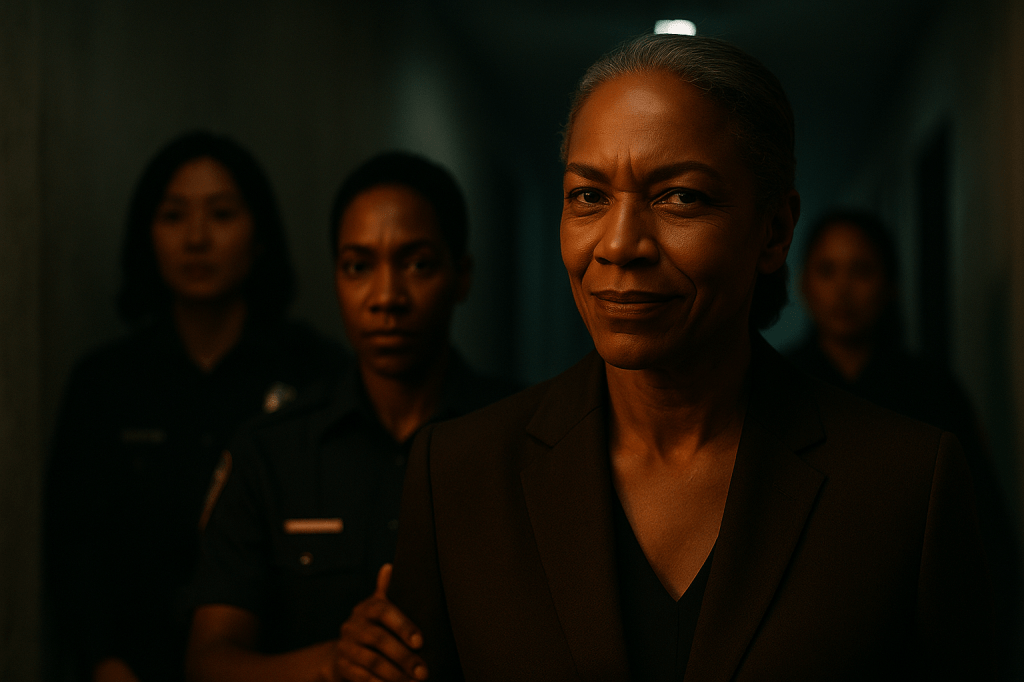
Victoria snapped back into her controlled mask, her voice sharp again. But as she turned toward the officers, she hesitated—just a fraction of a second, her shoulders tensing. Then, barely audible, a whisper slipped from her lips.
“You really think they’ll let you win?”
I wanted to ask who they were. I wanted to know if, just for a second, she wished she had fought harder, earlier. But before I could speak, she let out a breath, straightened her shoulders, and walked away.
Aisha met my gaze. “She’s scared.”
I nodded. “Yeah. And that scares me more than anything.”
“You’ve struck the Hydra, but survival is about endurance. Flames may rise, but the Hydra always adapts.”
I stepped forward, locking eyes with her. “You sound scared, Victoria.”
Her hesitation was brief, but it was there. The officers tightened their grip as they began leading her out. Her words lingered like smoke.
“You think this ends with me?” she hissed. “The Hydra regrows faster than you can strike. And when it does, you won’t even see it coming.”
Aisha crossed her arms, unfazed. “Then we’ll cut them all off.”
As they dragged her away, I pulled the battered flash drive from my pocket, holding it where she could see. “You built your empire on shadows,” I said, voice steady. “But we’ll keep shining the light. You’re done, Lane. And you know it.”
Her composure cracked—just for a moment. Her lips curled into a faint smile, her voice barely audible.
“You think you’ve won,” she whispered. “But HydraSys doesn’t lose. It evolves, like wildfire—quicker, stronger, harder to contain.”
Her shadow elongated under the harsh hallway lights, her warning hanging heavy in the air. Doubt crept in, but I glanced at Aisha, her steady presence grounding me.
“Do you think she’s right?” I whispered.
“Maybe,” Aisha said, her gaze distant but determined. “But if she is, we keep going. We keep tearing at the cracks until there’s nothing left to hide.”
Her words felt like both a challenge and a promise. The fight wasn’t over—not even close. But for now, we’d struck the first blow. And that was enough to keep moving forward.
When I hesitated at the idea of breaking into the warehouse, Aisha’s calm resolve steadied me. “We don’t get a second chance,’ she said, her voice firm. “If we don’t act, no one else will.” Her confidence made me believe—even when I doubted myself.
When the mission felt too big to take on, her quiet determination grounded me. It was Aisha who reminded me of the stakes, of the lives hanging in the balance. She wasn’t just my partner—she was our compass, pointing us toward what needed to be done.
A Week Later
The park buzzed with life: joggers, children, and kites painted a scene of normalcy. But for Aisha and me, the fight still loomed heavy. I watched a family picnic nearby, their laughter feeling like a distant world.
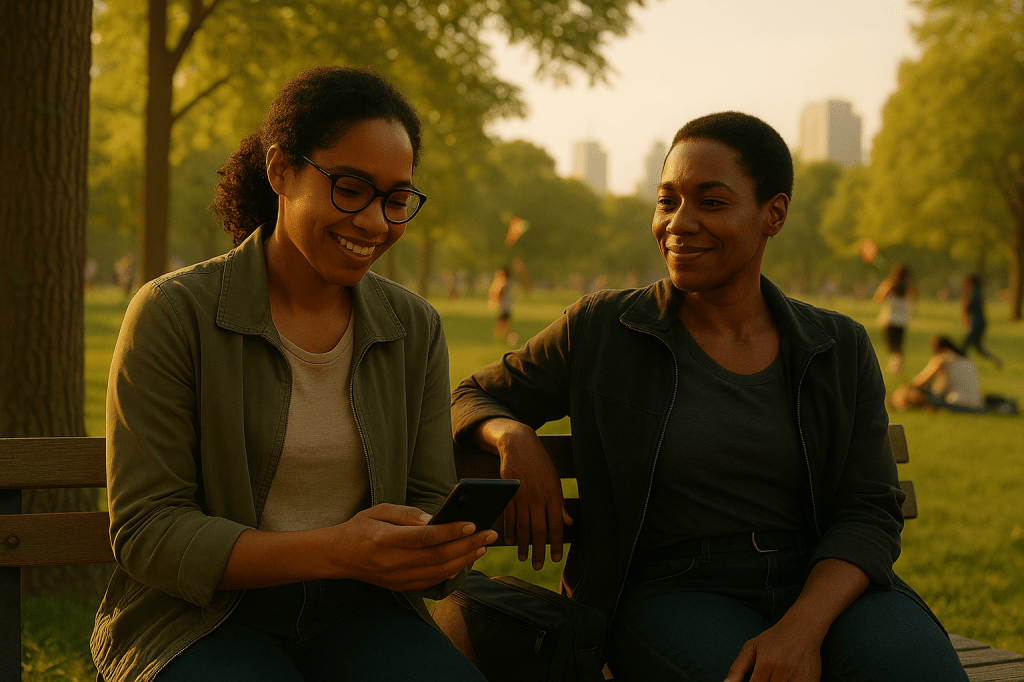
“It’s never really over,” Aisha said, scanning the horizon. Even now, the faint hum of her laptop in her bag tethered her to the storm we’d weathered.
I traced a scar on a nearby tree. “It feels different now. Like we proved something—to them, to ourselves.”
“We did,” Aisha said softly, though her sharpness remained. “But proving it doesn’t erase the fear.”
I exhaled, voicing what gnawed at me. “What if we hadn’t made it?”
“But we did,” she snapped gently. “We faced them and won. That’s what matters.”
Her words steadied me. “It wasn’t just about winning,” I murmured. “It was about not letting them erase us. And now…” I hesitated, a fire flickering in my chest. “I think I finally believe we’re not disposable.”
A faint smirk played on Aisha’s lips. “Damn right, we’re not.” She leaned back. “When I met you, you were all rules and protocols. Now? You’re fire.”
I laughed, tears prickling my eyes. “You showed me how to fight.”
“Damn right I did,” she said, grinning. “First step? More receipts.”
The ripple effects of our fight were seismic. Silenced voices reclaimed their platforms, exposés went viral, and The Maw crumbled. But amidst the victories, whispers of HydraSys surfaced. The shadow lingered, a new system rising from the ruins. We’d won a battle, but the war was far from over.
“What now?” I asked.
Aisha handed me her phone, her eyes lighting up. “You’ll want to see this.”
The message read: Code for Justice invites you to lead a seminar for ethical hackers.
“They want us to train others,” I said, voice catching.
“Told you we weren’t done,” Aisha replied, grinning.
The fight was no longer about dismantling HydraSys—it was about empowering others.
Aisha clicked open a platform she’d been building: Hydra Rising. Its vision was clear: amplify the silenced, build coalitions that couldn’t be erased, and ensure the Hydra would rise for justice, not control.
A notification flashed across her screen. New message from: S.Roth.
Aisha’s eyebrows lifted. “Holy shit.”
I frowned. “Who?”
She turned the screen toward me. The message was short.
You don’t know me, but I worked for The Maw. I built some of what you just dismantled. And I want in.
I sucked in a breath. “A defector?”
Aisha nodded slowly. “Looks like it. And if he’s real, he’s not the only one.”
Another ping. This time, a journalist from Eldara.
They tried to erase my work. Let’s make sure they never do it again.
Then another. And another.
An activist from Zafira. A scientist from Kordava. A politician’s aide, signing off only as M.
Aisha sat back, exhaling sharply. “They thought they were silencing people.” She looked at me, a slow smile forming. “Turns out they were just bringing us together.”
My chest tightened—not in fear, but in something else. Something that felt a lot like hope.
I met Aisha’s gaze. “Let’s build something they can’t erase.”
She grinned. “Now that’s the plan.”
“We need coalitions,” Aisha said firmly. “A network that protects each other—activists, journalists, whistleblowers. People like us.”
A slow smile spread across my face. “A Hydra that fights back.”
“Exactly,” she said. “And we don’t just stop HydraSys. We make sure nothing like it rises again.”
Later that night, as I stared at my mother’s photo, her words echoed in my mind: Lena, you’re going to change the world one day.
Tears blurred my vision as I whispered, “I think I finally understand.”
A ping from my laptop interrupted my thoughts. An encrypted message from Aisha: We’ll keep going. You’re not alone.
I typed back: Damn right we will.
We launched Hydra Rising with a mission to amplify the silenced—a hundred voices rising for every one erased.
A week later, Hydra Rising’s mission became clear: to build coalitions that couldn’t be erased and ensure that when one voice was silenced, a hundred would rise in its place.
Building the Coalition
That night, we began. Aisha reached out to an ethical hacker she trusted, their tense video call ending in agreement. I emailed a silenced journalist, attaching encrypted files we’d uncovered. Her response came quickly: “I’m in. Let’s make noise.”
Challenges hit almost immediately. A whistleblower from Eldara emailed in panic: “They’ve already found me.” Attached was video of security agents outside her home. Aisha’s jaw clenched. “They’re moving faster than we thought.”
Aisha’s vision for Hydra Rising was bold—a network of allies that couldn’t be silenced, not by systems, not by fear. Her leadership, grounded in strategy and unshakable resolve, became the coalition’s backbone.
“Can we protect her?” I asked, the weight of responsibility tightening my chest.
“We have to,” Aisha said. “If they think they can scare us, they’re wrong. But we’ll need to move smarter.”
Some journalists hesitated to go public. A hacker ghosted us after realizing the risks. But with each setback, the coalition grew stronger.
“We’re not just fighting a system,” Aisha reminded me. “We’re building something they can’t tear down.”
The next day, a thread appeared online: “Breaking: Inside The Maw’s shadow operations.” Replies poured in—activists, journalists, and artists connecting and sharing their silenced stories. By nightfall, encrypted forums buzzed with activity. Whistleblowers coordinated with ethical hackers, creating threads for legal resources, investigative tips, and secure media contacts.
“This isn’t just noise,” Aisha said, fingers flying over her keyboard. “It’s a network.”
One message stood out. Nyx, a hacker, offered secure servers for whistleblowers. “No leaks. Just solidarity.”
By week’s end, journalists met secretly in dim cafés, their resolve clear. “The more we expose, the harder it gets for them to fight back,” one said. The coalition solidified, forming a force HydraSys couldn’t predict.
In Eldara, Raj, a data scientist, emailed: “I can’t stay silent anymore.” In Zafira, activists restored lost data: illegal land seizures, protest footage, environmental reports. “We can fight again,” one posted.
Then came the headlines: Justice for Eldara: Voices Silenced by The Maw Return Louder Than Ever. Corporate leaders implicated in deforestation scandals faced arrest. The momentum swelled, unstoppable.
Late one evening, Aisha froze. On her screen, bold red letters cut through the dark: “HydraSys protocol: Active.”
Her voice was tight. “Lena, you need to see this.”
My stomach sank as I read the words. “They’re regrouping.”
Aisha’s jaw set. “Not if we get there first.”
For the first time in weeks, hope felt tangible. With every voice joining the fight, it felt real—like we weren’t alone.
“This is just the beginning, isn’t it?” I asked.
Aisha nodded, her voice firm. “You bet it is.”
We weren’t done—not by a long shot. HydraSys was out there, watching, waiting, rebuilding. But so were we.
They’d keep building walls. We’d keep finding cracks.
This wasn’t the end. It was only the start.
Reflecting on The Obscura Protocol
by Lena Carter
Obscura Protocol isn’t just a story—it’s our reality. Aisha and I lived every second of it: the fear, the risks, and the moments we thought we wouldn’t make it. Scott Bryant amplified our story, but the fight, the scars, and the courage? Those are ours. We stood against The Maw and survived. That victory is ours. The world didn’t erase us. It won’t erase our story.
Aisha Reynolds: My Partner in Crime (and Justice)
Aisha wasn’t just my partner in this fight—she was my anchor. When I doubted myself, she reminded me why we couldn’t stop. Her unshakable resolve carried us through. Without her, there wouldn’t be an Obscura Protocol. She’s not just a fighter—she’s the reason we made it.
Victoria Lane: The Antagonist
Victoria Lane is easy to label as the villain, but she’s more than that. She’s a product of the same system that tried to devour us. Her ambition wasn’t just power—it was survival. She sacrificed everything—family, friendships, even her humanity—to stay at the top.
I don’t forgive her, but I understand her. She chose the system. I chose to fight it. In a way, we’re two sides of the same coin.
The Maw and the Real-World Stakes
The Maw consumed everything—time, creativity, people. They called it “hyper-targeted optimization,” but it was manipulation. Communities, activists, and journalists were flagged and erased as though they’d never existed.
I remember a journalist in Eldara, standing before a burning building, clutching evidence. Her name vanished within days. Or the Sarava activist whose courage rallied a village, only for fabricated charges to silence her. Real lives, erased by a few lines of code.
As I reflect on it now, I realize how insidious it all was—how easily trust in a system could lead to destruction. This isn’t science fiction. It’s happening now. The systems we trust aren’t just flawed—they’re dangerous.
The Heist: More Than Just A Break-In
That night in the warehouse wasn’t about heroics—it was survival. Every step felt like a gamble. One mistake, and we’d lose everything. But once you see the truth, you can’t unsee it.
That heist was our turning point—from fear to action. It reminded me that sometimes, taking the biggest risks is the only way to make a difference.
Final Thoughts: Why This Story Matters
Obscura Protocol is about more than corporate greed or AI. It’s about ethics, responsibility, and the courage to question the systems we trust. Aisha and I didn’t just fight for ourselves—we fought for everyone who’s ever been silenced, erased, or overlooked.
This was never just about code. It was about choice.
When you see the cracks, you can look away—or break them wider.
Obscura Protocol showed where the system fractures. Hydra Rising builds where we refused to be erased.
The fight isn’t over—but the silence is.
And somewhere, in the silence between signals, Obscura disengaged.
– Lena Carter & Aisha Reynolds
Why Obscura Protocol Lives Here
This story anchors Her Stories, Her World in the present tense. It is not speculative fiction, but a reflection of systems already at work—algorithmic suppression, predictive erasure, and institutionalized silence. Stories that follow do not need to mirror this one—but they must share its refusal.
 Scott Bryant
You must be logged in to post a comment.