
My Name Is My Own
Story Written & Told By
Snow White
Recovered & Interpreted By
Dr. Amalia Fürstenberg, Dr. Selina Marquez,
Prof. Léonie Duchamp, & Dr. Farah Qadiri
Visual Reconstruction &
Artistic Interpretation By
Liora Ben-Ami, Samira Olayinka,
Édith Valeureux, Hyejin Nam,
Mireya Calderón, & Scott Bryant
Intimacy Coordination By
Snow White, Dr. Amalia Fürstenberg,
Dr. Selina Marquez, Prof. Léonie Duchamp,
& Dr. Farah Qadiri
Shared with steadfast loyalty by
Scott Bryant, at the request of Snow White herself,
Dr. Amalia Fürstenberg, Dr. Selina Marquez,
Prof. Léonie Duchamp, & Dr. Farah Qadiri
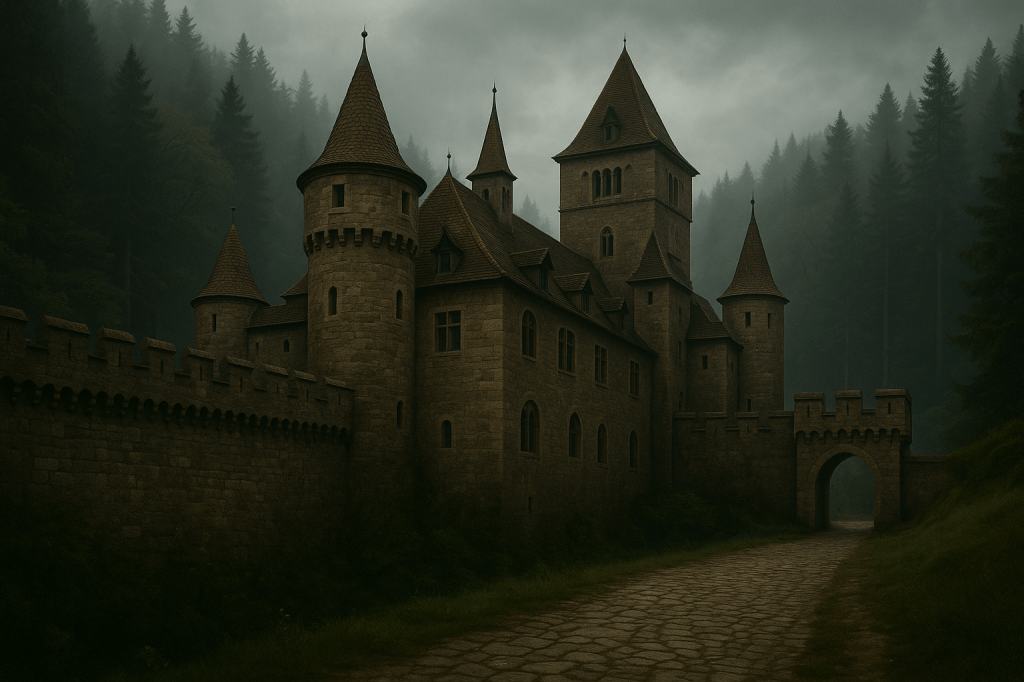
I did not know, in those years, that a life could be something one chooses. I believed—as I was taught to believe—that a girl’s story begins only when someone else names her. That a crown placed upon you is the same as a fate accepted. That silence, endured long enough, becomes a kind of virtue. When I finally stepped beyond the castle walls, I carried its echoes in my bones. They rattled like chains whenever the wind breathed too sharply.
This account is not written to remember her, though she will live in these pages like a shadow that refuses to die. It is written to remember myself—the girl I was before the mirror learned my face, before fear taught me how to move without sound, before a voice not my own tried to speak through my mouth. I write so I cannot forget the truth I learned the moment I reclaimed my name: that survival is not the same as obedience, and that even the smallest flame, protected long enough, can teach its own light how to grow.
If these words find anyone wandering their own dark corridors—whether built of stone or memory—know this: nothing given to you in fear is binding. You may refuse the shape someone else carved for you. You may break the mirror. You may walk into the forest and still belong to yourself. I am living proof that even a story written in captivity can be rewritten in one’s own voice. And so I offer mine, unhidden at last.
Act I — Entrapment
I. The Chamber
I cannot remember the sound of silence.
The castle never sleeps. The stones creak as if they breathe; the corridors sigh; footsteps echo where no feet walk. I lie in my chamber, staring at the slit of a window, watching the pale thread of moonlight bleed across the floor. It is the only proof the world outside still lives.
Sometimes I measure the hours by torch smoke. When it thins, the guards have passed. When it thickens, a door has opened somewhere I cannot see. The castle has its own lungs. They fill and empty around me.

And yet she finds her way even here.
Her shadow arrives before her voice, long and dark against my wall, reaching for me like a hand. I do not know if it is the firelight bending against the stones or if she truly stands outside my door.
I remember rain and iron—hooves on mud, a carriage door, the taste of fear like a coin under my tongue. I remember being carried over this threshold and the door closing behind me as if it had been waiting all along.
Sometimes she speaks—soft syllables pressed into the air until I think I imagine them:
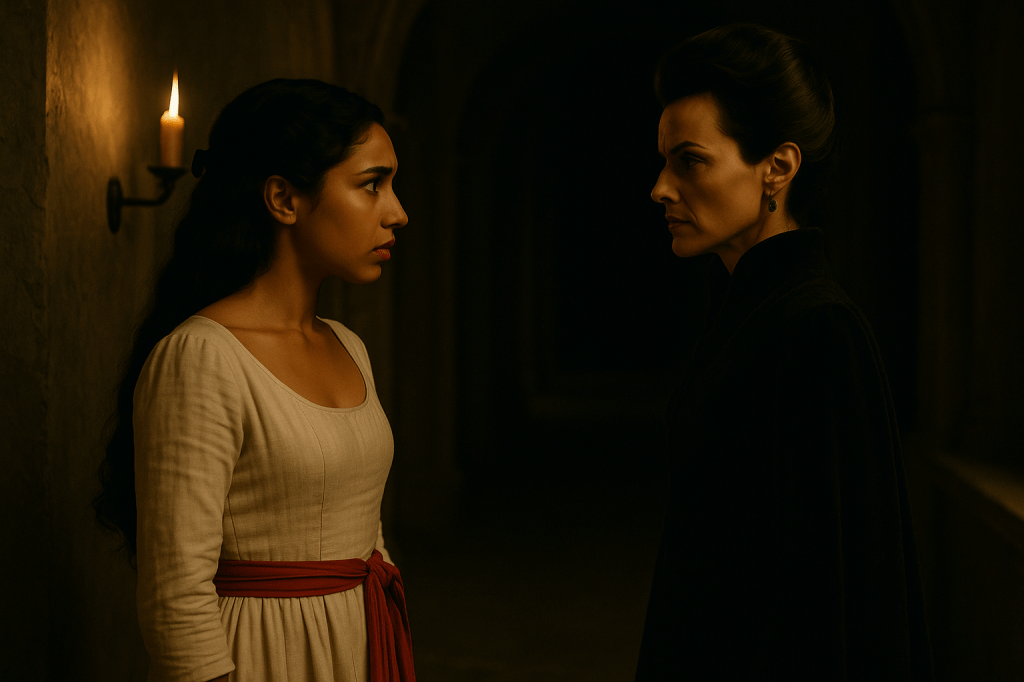
“Do you know what waits beyond these walls? Monsters, child. Darkness far crueller than me. I am all that stands between you and ruin.”
I want to believe it is a lie.
But when the torches gutter and the castle falls to breathless dark, I wonder if she is right—if the forest beyond the walls hungers for me even more than she does.
When sleep comes, it is shallow. I dream of corridors that fold like paper, of mirrors that breathe, of a name that dissolves on my tongue when I try to say it aloud.
II. The Routine of Servitude
By day the castle pretends to be alive.
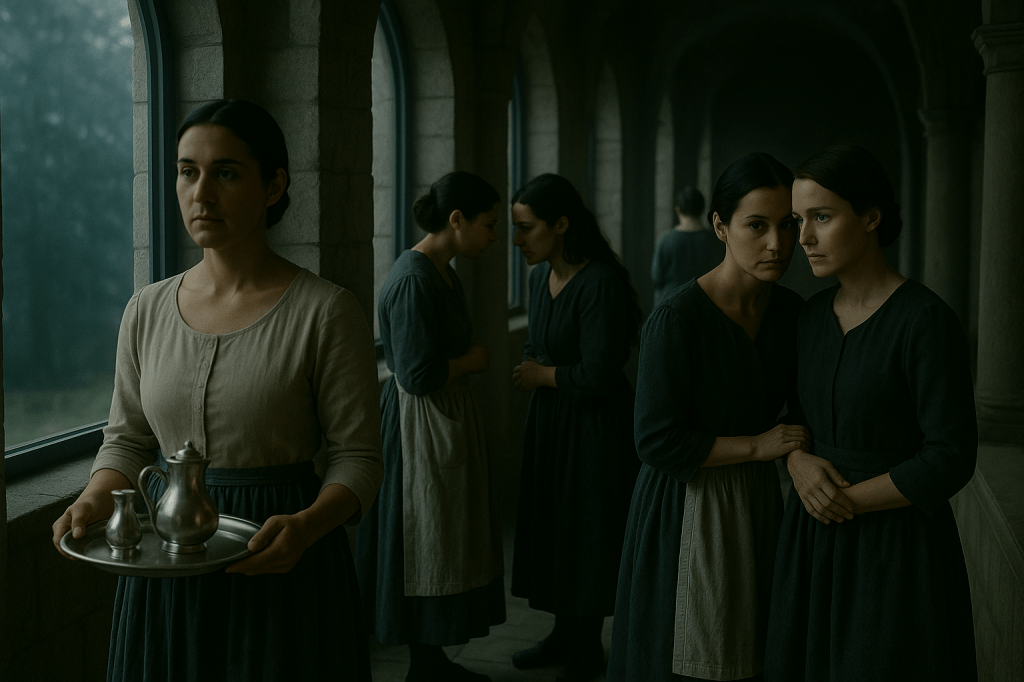
Servants drift through its corridors like smoke, carrying trays, sweeping floors already clean, whispering to the walls. I join them. I was not born to service, yet here I am, a nameless orphan stitched into the Queen’s household like a seam she intends never to see.
I tend fires that never warm me. I polish metal until my face blurs inside it. I keep my eyes lowered; the women around me keep theirs lower. None speak my name. None risk the Queen’s notice.
Once, in the linen room, a girl with chapped hands presses a thimble into my palm. “For luck,” she murmurs, almost without moving her lips. Our eyes meet for the length of a breath—hers full of warning, mine full of questions—and then she is gone, the space she leaves behind already claimed by silence.
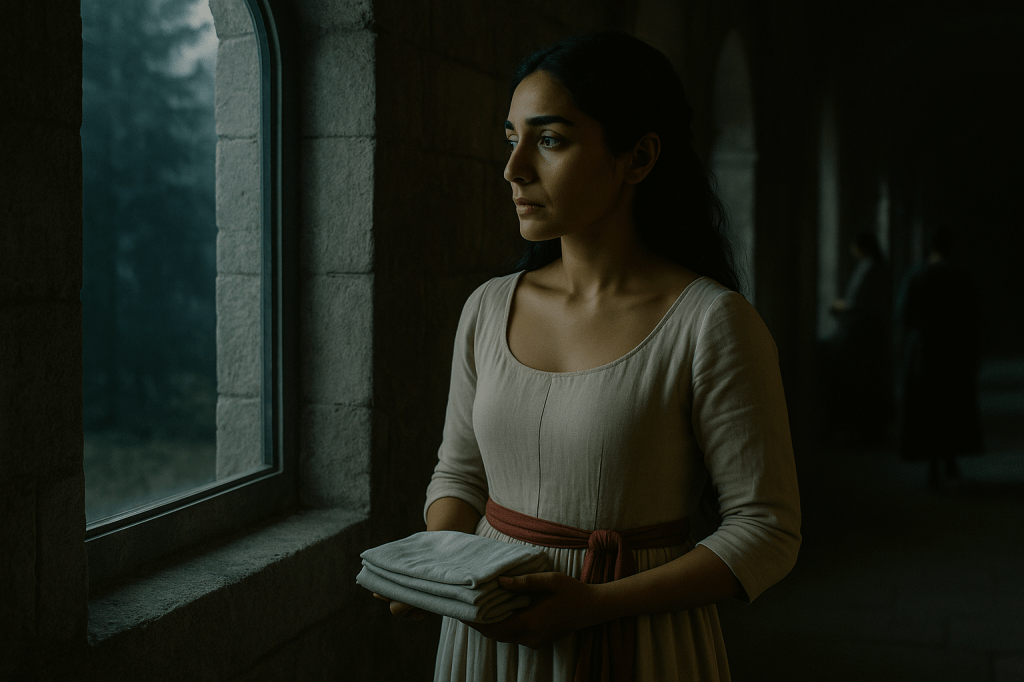
When the light is kind, I pause by the window and stare toward the Black Forest. From this height it looks endless—dark, breathing, alive. I wonder if it would take me in or swallow me whole. The wind carries the smell of pine and wet earth to me in scraps, like a language I could learn if I were allowed to listen.
III. The Summons
That afternoon her messenger finds me in the kitchens.
“Her Majesty commands your presence.”
My hands still. Command. Not invitation. Never invitation.
I wipe the steam from my face and follow, through corridors that tighten with every step, past portraits whose eyes follow like sentinels. As I near the Great Hall, the flagstones cool beneath my feet, the air thins, and my own breath begins to echo back at me as if the hall is practicing my voice.
The doors stand open like a mouth. The Great Hall yawns wide, its ribbed arches lifting into shadow. Banners shift as if breathing, stirred by a current I cannot feel. At its heart: the dais, the throne—dark oak, iron-fitted, towering like a cathedral door.

She sits upon it, unmoving. Light from high windows catches in her crown and dies there. Her gaze falls on me, sharp as a drawn blade.
“Snow White,” she says. Always that name—her creation, not mine.
I bow. I feel the air between us sharpen. The emptiness of the hall grows crowded with the things I cannot say.
“Do you know why I keep you?” she asks.
I do not answer. The hall is empty save for us, yet the silence feels crowded.
“Because you remind me of everything this world devours.” She smiles. “Purity. Innocence. A fragile thing to protect.”
Her smile does not reach her eyes. I kneel because the floor expects it; the stone seems to lift to meet my knees. When she dismisses me, the echo of her words follows like a curse. Protect.
In the corridor outside, the doors close behind me with the sound of a verdict.
IV. The Corridors at Night
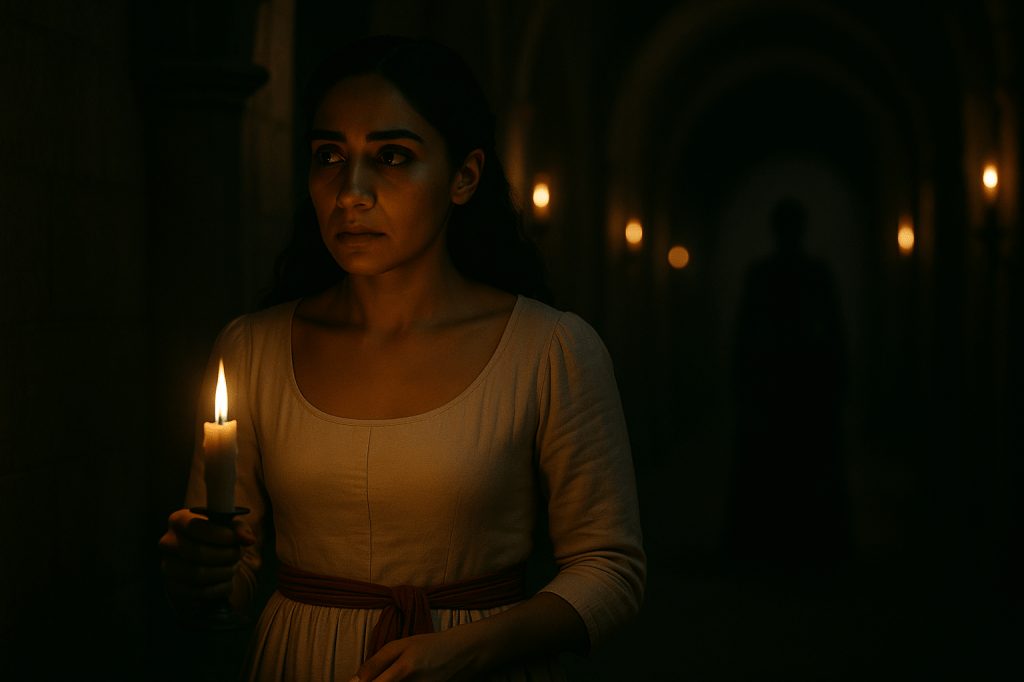
I do not sleep. The castle’s heartbeat thrums through the stones. I take my candle and wander.
Every hall looks the same—arched, narrow, endless. Torches whisper. My reflection wavers in polished shields. Somewhere water drips, counting out a time that does not belong to me.
A sound behind me: a single step.
I turn. Nothing.
Then, at the far end of the hall, she stands—framed by an archway, her robes drawn close, her face veiled in shadow.
“Do you see it now?”
Her voice threads through the air, thin and cold.
I clutch the candle tighter; hot wax spills across my hand. Pain blooms, small and human. I welcome it. I keep the flame alive. My breath fogs the air; the corridor seems to narrow to the width of my fear.
When I lift my gaze again, the corridor is empty. Only the torchlight trembles as if it heard what I could not bear to answer.
V. The Queen’s Chamber
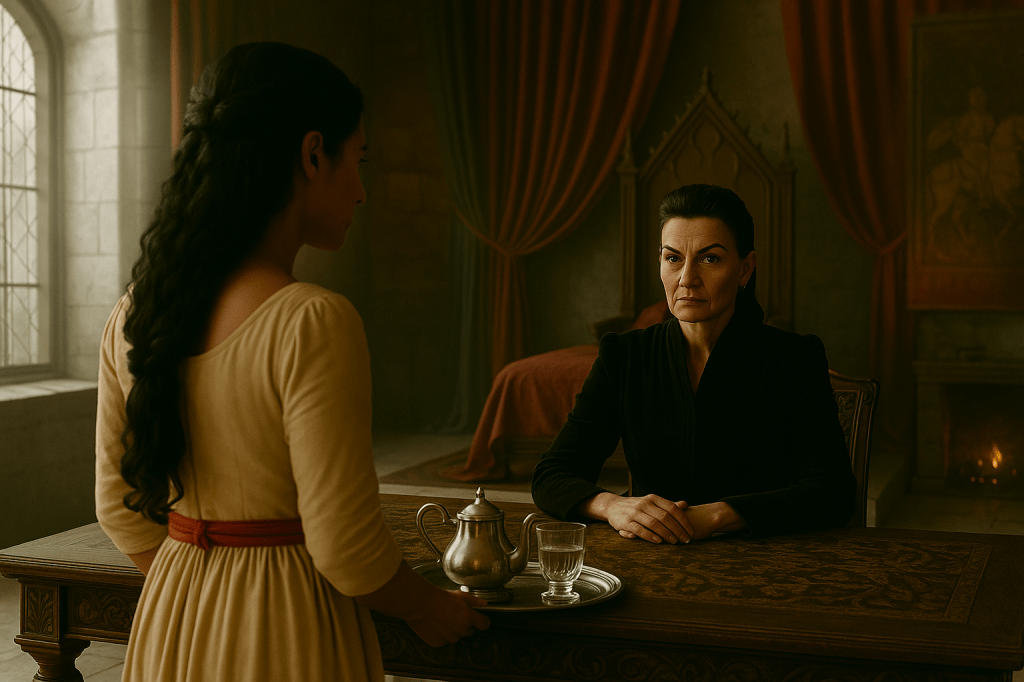
The next morning I am sent to her rooms with a tray of silver and glass.
Her chamber is vast, suffocating in its splendor—stone walls drowned in velvet drapes, a hearth that burns but gives no warmth. Rugs drink the sound of my steps. Tapestries watch, full of battles no one won.
She watches as I pour her drink.
“You move softly,” she says. “Like smoke. Have you always been that way?”
“I don’t know, Your Majesty.”
She rises, crosses the floor with slow, deliberate grace.
Before I can step back, her hand slips into my hair.
I freeze.
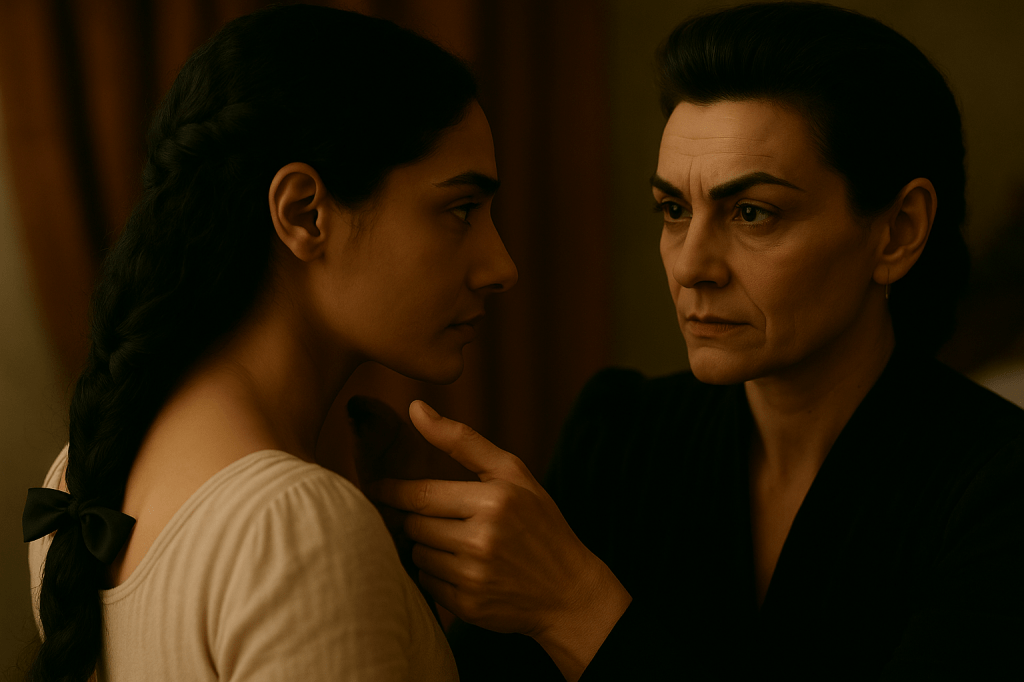
She gathers the dark waves with practiced ease—far too familiar, far too intimate—and from her sleeve produces a length of black ribbon.
“Hold still.”
Her voice is not unkind. That is what makes it terrifying.
She ties the ribbon at the base of my neck, her fingers brushing my skin. The knot is firm, decisive. When she releases me, my hair feels heavier, as though the bow itself carries weight.
“Black suits you,” she murmurs. “It makes the white shine brighter.”
The words brush my skin like ice. She draws a finger down the rim of the goblet and the metal sings. For a heartbeat I think she will say my name—my name, not hers for me—but the sound dies without becoming a word.
I bow to hide the tremor in my breath.
When I leave, I feel her gaze cling to me, following until the door closes.
The corridor outside smells of iron and lavender, and I cannot tell which belongs to her.
VI. The Mirror Room
That night the air in my chamber turns restless, a low humming behind the walls. I follow it through the corridors, down stairways I’ve never seen. Cobwebs stroke my wrists like warnings. The farther I walk, the colder the stone becomes, as though I am descending into the castle’s mouth.
It leads to a narrow door, half-hidden behind a tapestry. The fabric smells of smoke and old rain. My fingers find a hidden latch; the door sighs as if relieved.
Inside: a room of stone and silence. In its center stands a mirror taller than any doorway, its frame carved from dark oak and iron, alive with wolves and serpents. Candles gutter at its base, their flames bowing as though in prayer. The air tastes of copper; even my breath sounds like someone else’s.
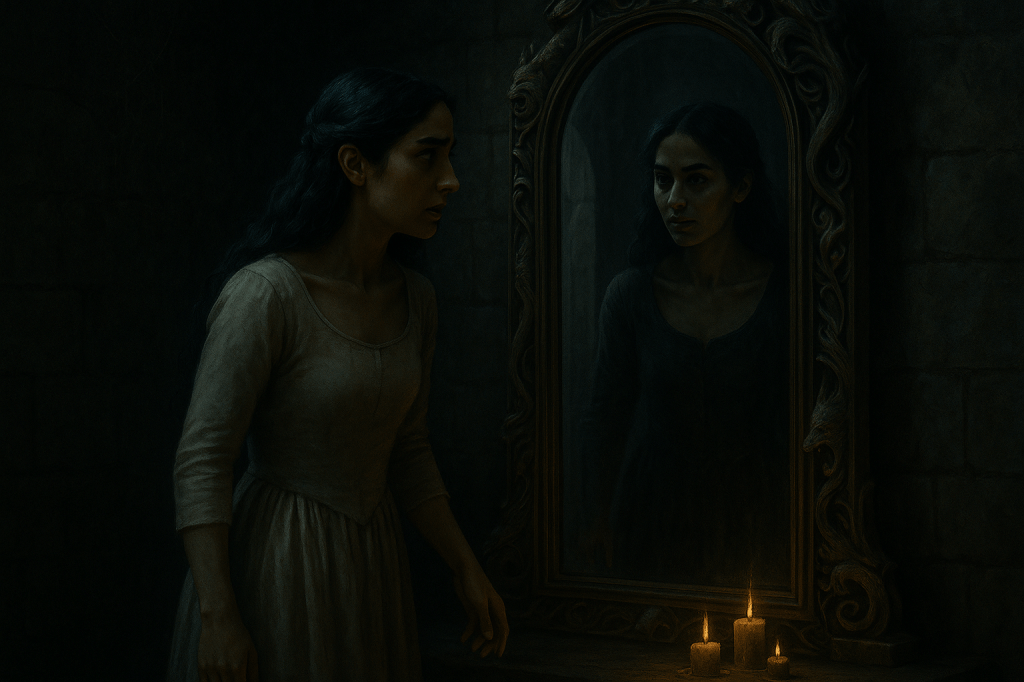
I step closer. My reflection wavers—pale face, dark hair, eyes rimmed with sleeplessness. Then the image shifts. The mouth sharpens, the gaze hardens. The reflection smiles when I do not. Behind my shoulder, the room deepens until it could swallow me whole.
A voice behind me: “Do you see it now?”
I turn. Only darkness.
The air tastes of iron and ash. The mirror ripples once, then stills. For a shuddering instant I think I see two of me, one looking toward the door and one looking back.
I run. My feet learn the corridors by terror. When at last my door closes behind me, the candle gutters out on its own, and I sit on the floor with my burned hand open in my lap until the stones stop moving beneath me.
Act II – The Hunt
I. The Days of Quiet
For three days, the castle pretends at peace.
The Queen does not summon me. No whispers leak through the stone. The servants smile too quickly, relieved but wary, as if the stillness might shatter.
I tell myself I am free to breathe again.
But every time I cross a hall, I feel the echo of her steps behind mine. When I sleep, I dream of corridors that lead back upon themselves—no doors, no sky, only walls that narrow until I wake choking.
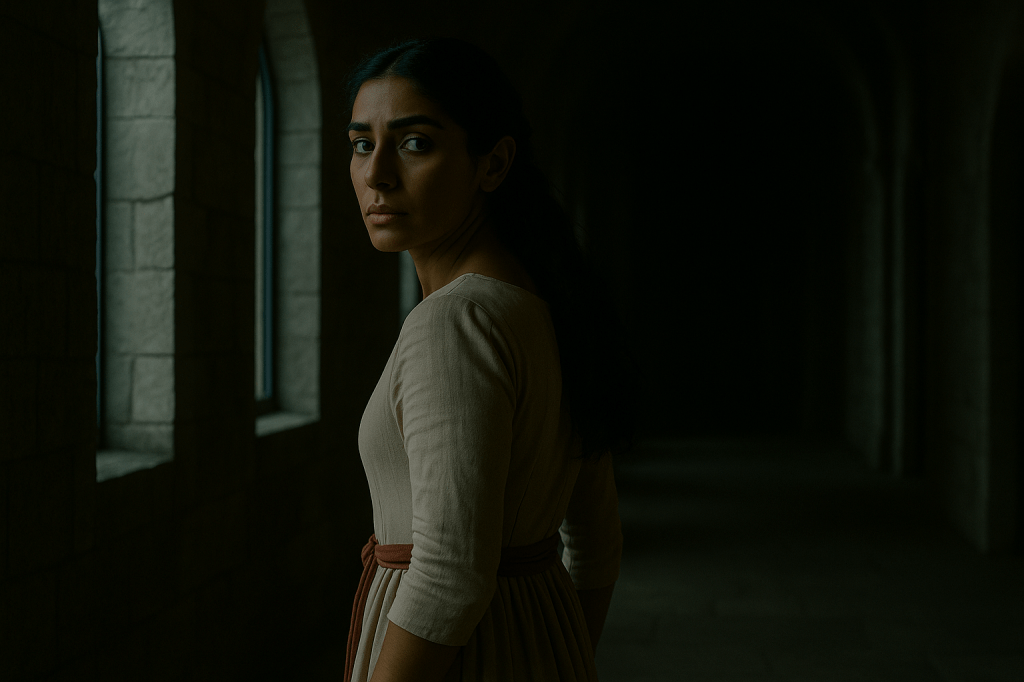
II. The First Hunt — The Lover
On the fourth night, I see her.
Not the Queen, not as she is.
A stranger stands by the hearth in my chamber — tall, graceful, her gown the color of deep wine. The fire paints her skin in molten gold, her hair loose and dark as spilled ink spreading toward me.
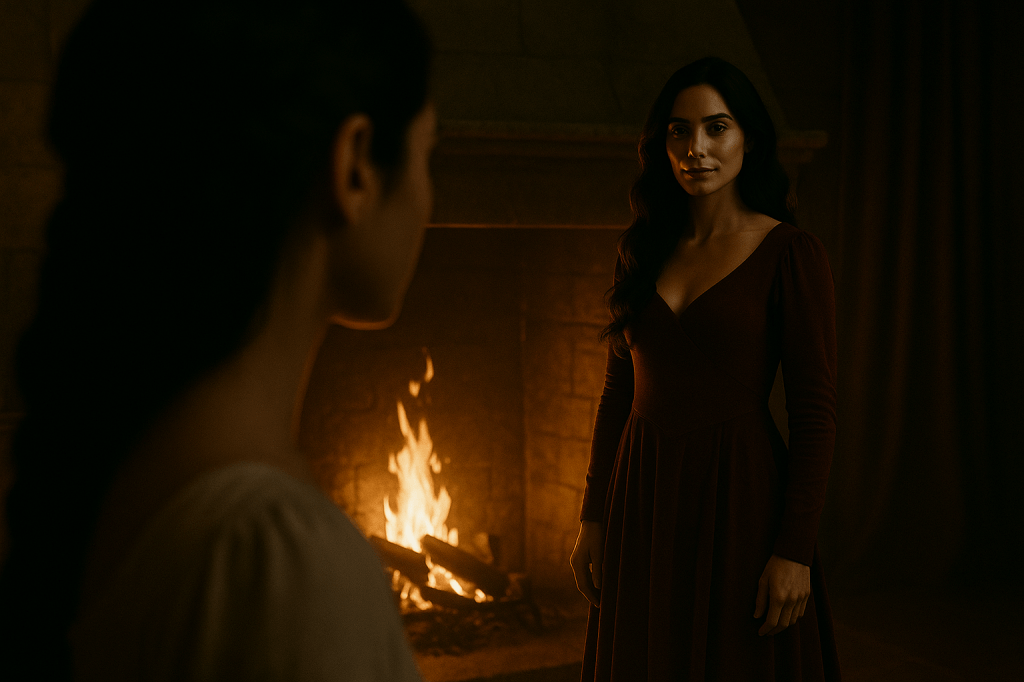
“You should not hide,” she whispers. “The world waits for you.”
Her voice is soft, lilting, familiar. My heart stumbles. No one speaks to me like that — with warmth, with knowing.
I should run. I should cry for the guards who will never come. But I do not move. Her eyes hold me, kind and sorrowful.
“Have you ever been touched by light?” she asks, stepping closer. The scent of her—smoke, roses, winter fruit—wraps around me like silk.
“I could show you.”
Her hand brushes my wrist. The touch is gentle, reverent. I feel heat climb up my arm, dizzying. For a heartbeat I think—perhaps this is what it means to be seen.
Then the air folds inward. The warmth curdles. Her hand tightens, iron beneath velvet.

The silk dissolves into shadow.
Beneath it stands the Queen.
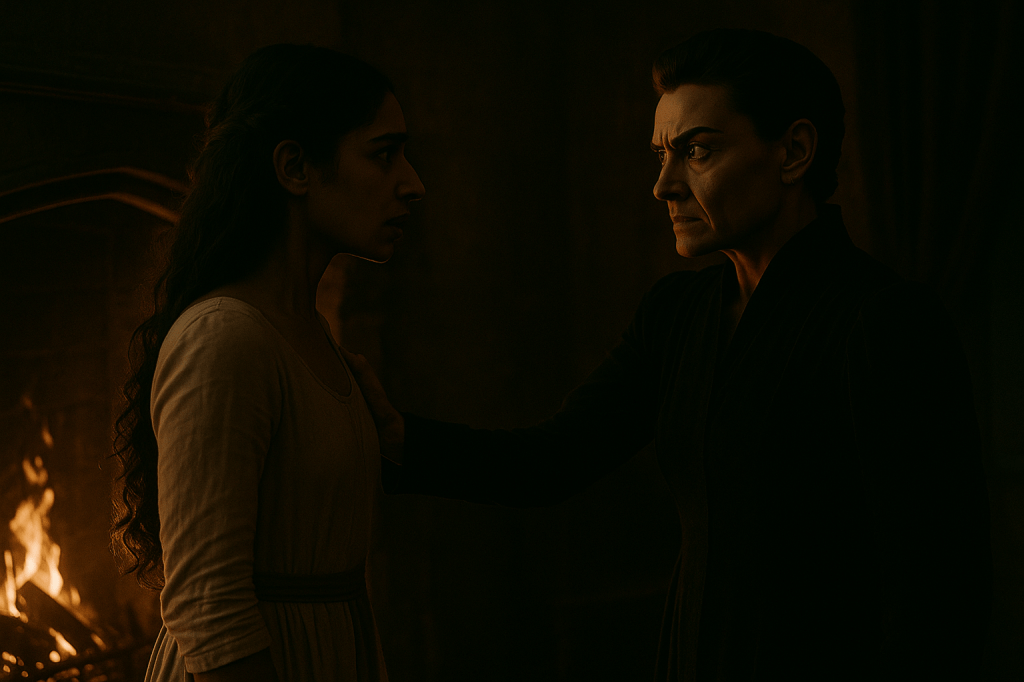
“Is this what you long for?” she asks. “To be desired?”
Her voice is no longer kind. It is hunger shaped into sound.
I stumble back, but she follows. Her fingers trace the line of my jaw — not cruel, not tender, but claiming.
“Be careful what you awaken.”
The words scorch more than her touch.
When she leaves, the room smells of smoke and ash.
I press my palms against my chest and feel my heart pounding as though it wants to break its cage.
III. The Second Hunt — The Caretaker
Morning brings silence.
The servants avoid my eyes again. I work in the kitchens until my hands ache, then in the graveyard where frost clings to every stone like a warning.
The garden is dying. Every plant is brittle, white-veined, as if the castle’s cold has seeped into the roots.
I kneel to brush the ice from a dead rose, and a voice answers the quiet.
“Poor thing,” she says. “Does she keep you here all alone?”
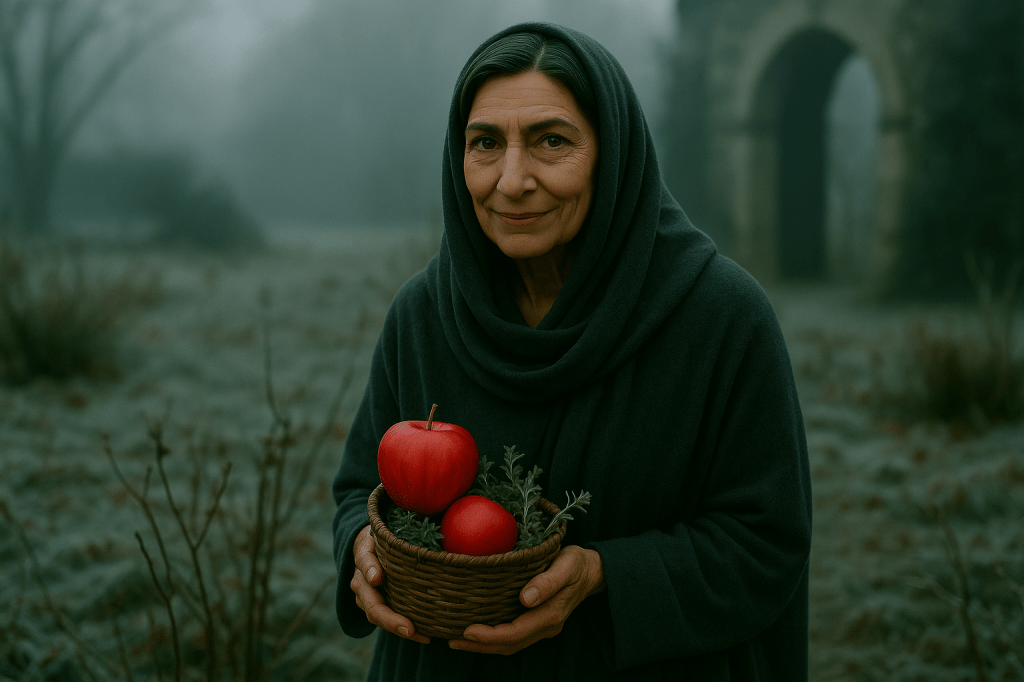
I look up. An old woman stands at the gate, wrapped in a grey shawl. Her face is soft and lined, her eyes kind. She carries a basket of herbs and apples, the red of them so bright it hurts to see.
“I don’t know you,” I whisper.
She smiles. “No one does, do they?”
Her words sink into me like warmth after a long fever. She steps closer, the scent of thyme and honey surrounding her.
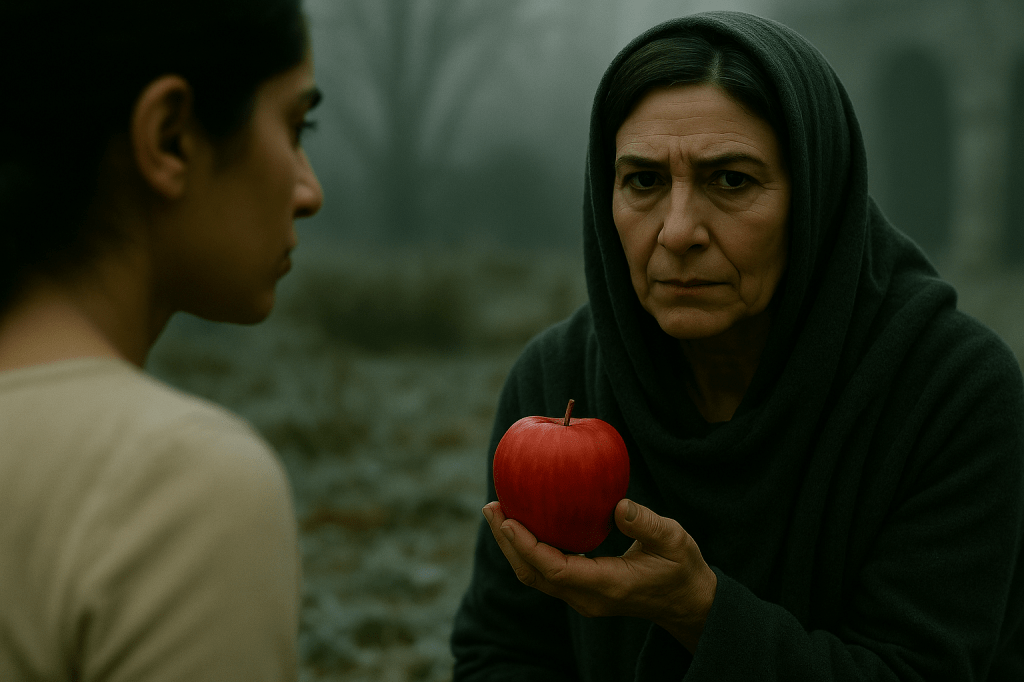
She takes my hand. Her palm is rough, familiar. For a heartbeat, I feel a memory stirring — a hand like this once guiding mine.
“Here,” she says, placing an apple in my palm. “Sweet things remind us we are alive.”
The skin of it gleams like blood. I can see my own reflection in its curve.
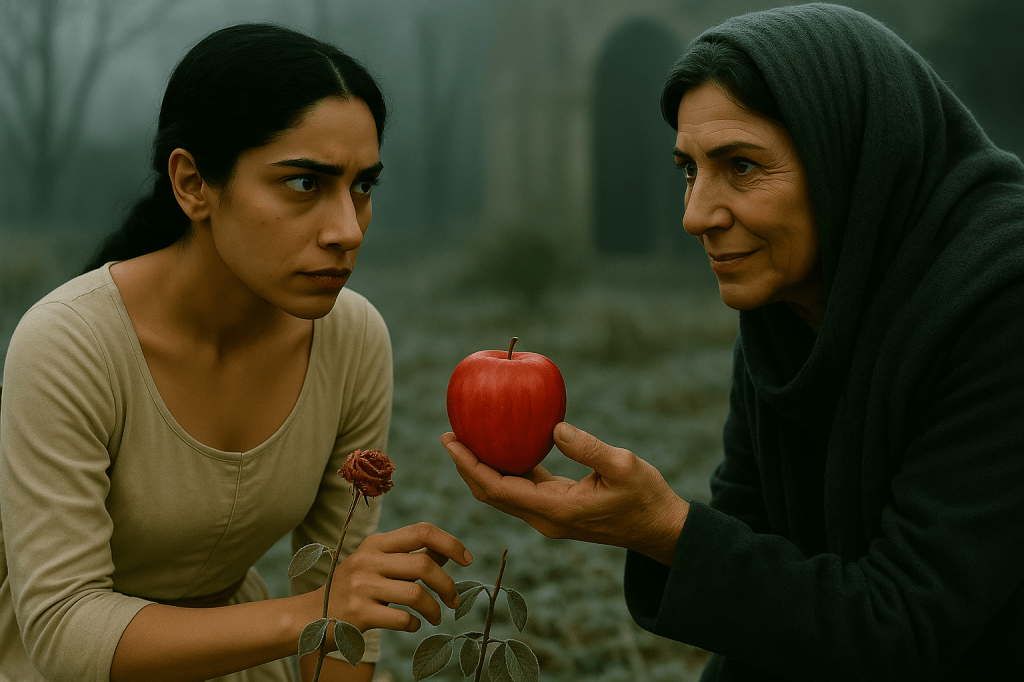
“Eat,” she murmurs. “You must keep your strength.”
I want to. I want to trust this gentleness, to believe in someone who does not ask, only offers.
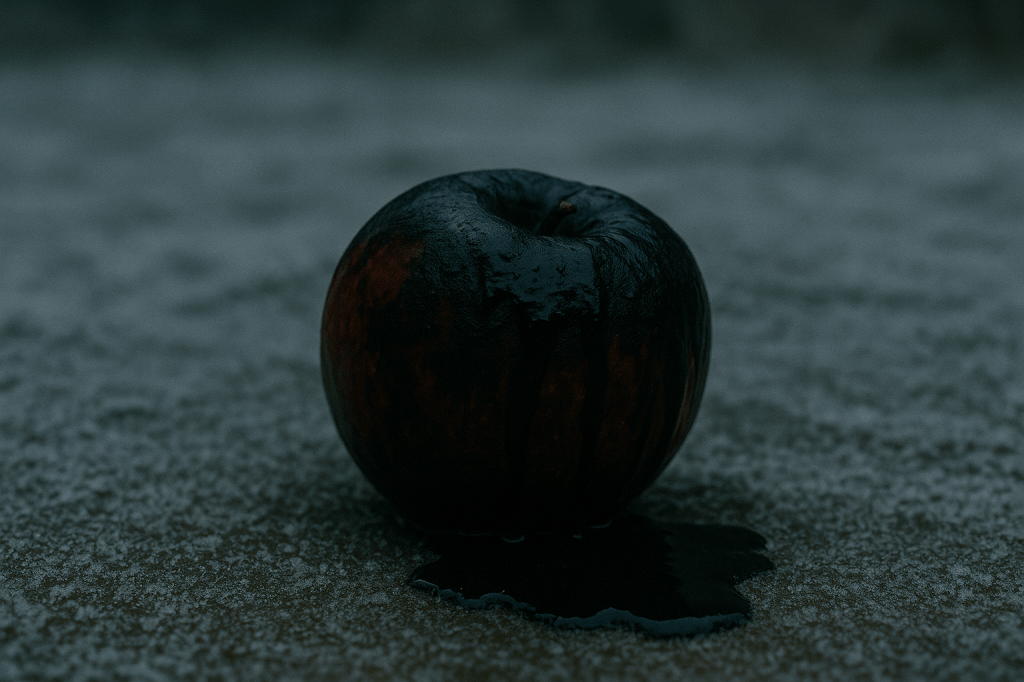
But as I lift it, the apple darkens.
Red drains to black. The flesh collapses inward, soft and wet. The sweetness curdles to rot.
The smell hits me first — sharp, metallic. I drop it. It bursts across the frost like spilled ink, bleeding into the snow until the color forgets itself.

The courtyard is empty. The old woman is gone. Only her voice remains, echoing through the archway, low and amused.
“Kindness,” says the Queen, unseen. “Is the cruelest illusion.”
I stare at the stain the apple left, watching it sink into the snow.
Even lies can look like love.
IV. The Third Hunt — The Mentor
That night, the air grows heavy with stormlight. The torches along the walls burn blue.
I wake to find her waiting before the mirror — cloaked in midnight blue, her reflection already standing beside her.
“You have strength,” she says, not turning. “I taught you well.”
Her voice is calm, rich with pride. It sounds almost human.
We stand before the glass together. Our reflections ripple side by side until they overlap — one shape with two faces.
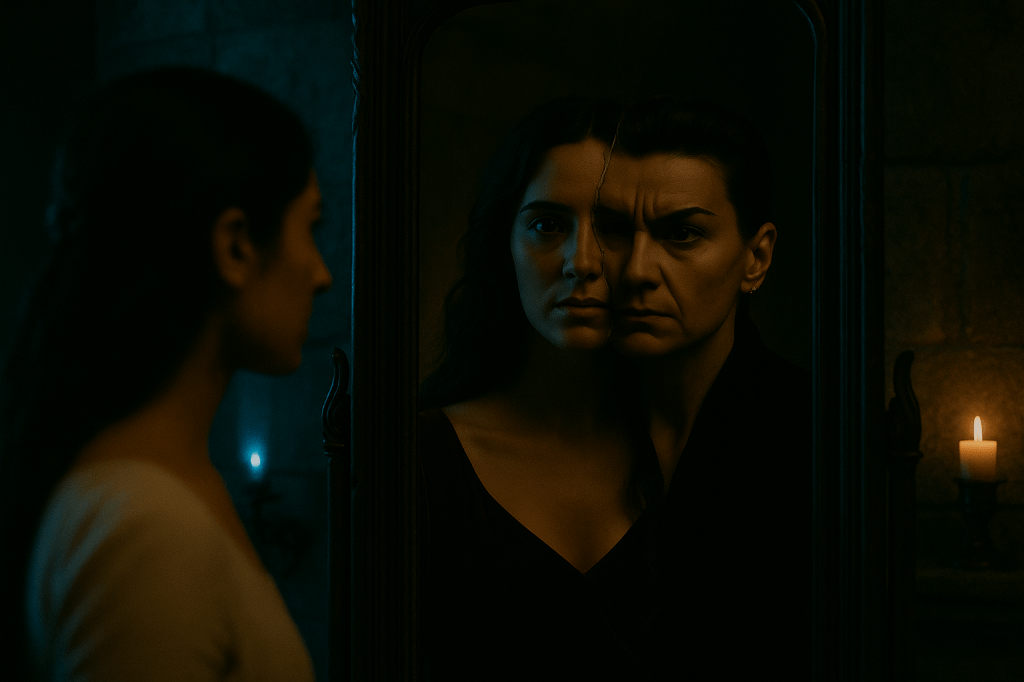
“Do you see?” she murmurs. “You are not my prisoner. You are my heir.”
The word strikes something deep in me — a tremor, a question. I cannot look away. The mirror’s light pulses like breath. My reflection’s eyes narrow, their color darkening to hers.
“I do not want your crown,” I say.
“You already wear it.”
She steps closer. Her reflection smiles first. The expression on its face is cruel, but mine matches it — for a moment, perfectly.
“You could rule,” she says. “You could make the world kneel. All it takes is to stop pretending the world is larger than you.”
Her words crawl under my skin. The idea is venom — sweet, intoxicating. I feel the mirror pulling me closer, the glass trembling like water.
The reflection’s lips move before mine. “Stay,” it whispers.
“No,” I breathe.
The word breaks the spell. The mirror flashes white — a vision, a shape: a woman of stone and shadow crowned in black thorns. The air explodes in sound and silence.
When I wake, I am alone. The candle by my bed has gone out. My hands smell faintly of iron.
V. The Castle Turns Against Me
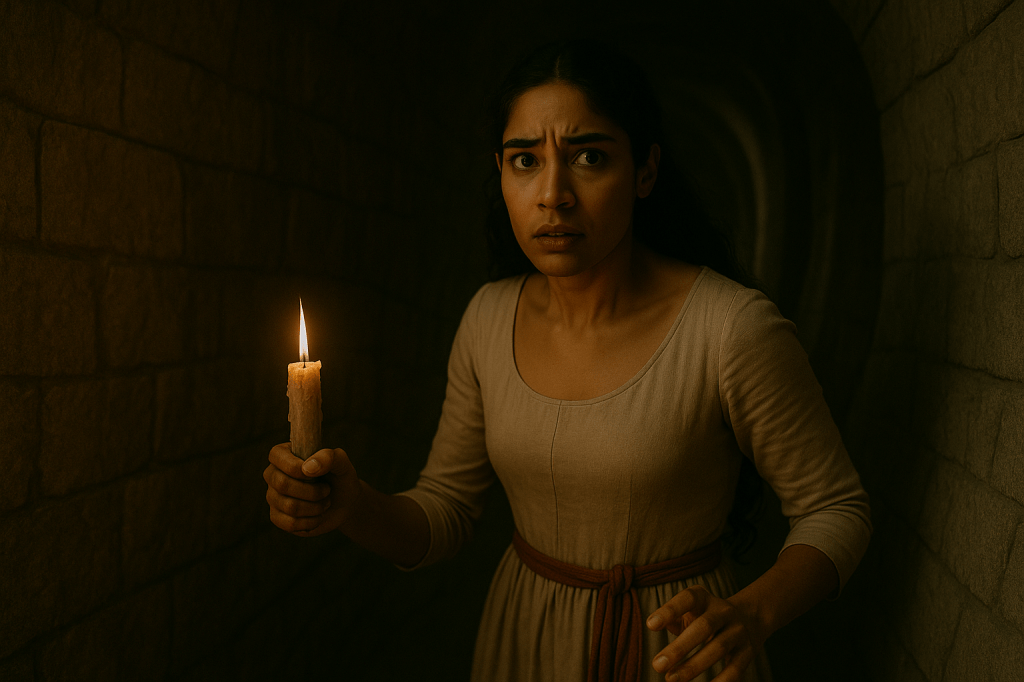
The next morning the doors refuse to open.
Corridors twist upon themselves; stairways lead nowhere. Even the servants have vanished.
The castle groans, alive and listening. I feel her everywhere—her breath behind my ear, her heartbeat inside the walls.
I run. Each hall I enter is narrower, darker. My candle sputters, the flame clawing at the air.
From somewhere far behind comes her voice, soft and close all at once:
“You can run from me, child, but you run only deeper inside.”
VI. The Defiance
I stop. My lungs ache. My hands tremble, but I do not drop the candle.
I turn toward the sound.
“I am not your child,” I whisper.
The walls shudder. Dust falls like snow. For the first time, the castle does not feel endless; it feels wounded.
I walk on, not caring where the corridors lead. If this is a labyrinth, then I will find its heart.
Act III – Reckoning
I. The Heart of the Castle
The castle no longer pretends to hide what it is.
Its walls pulse with a low hum, as though some vast heart beats behind the stone. The air trembles with whispers that sound almost like my name—almost. When I pause, the sound gathers around me, crowding close; when I move, it recedes like a tide that refuses to leave.
The torches no longer burn with steady light; their flames curl backward, devoured by their own smoke. The banners hang heavy as if soaked in night.
I follow the sound, deeper into the labyrinth, until I reach the hall where the Queen waits. I stop at the threshold. The door is cold under my palm. For a breath, I see myself as the castle sees me: a small figure cupping a small flame against a storm.
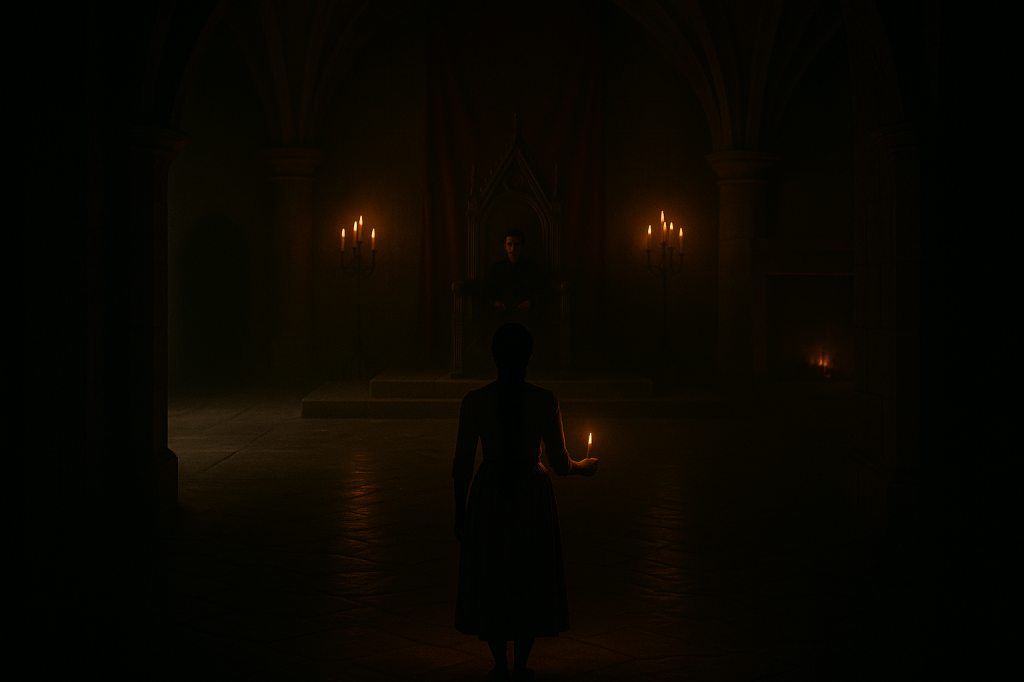
She is seated upon her throne, the same as before—tall, still, carved of oak and iron—but the room feels smaller now, as though the air itself must bow to her. The stone under my feet hums with her breath.
Her eyes glint like candlelight in a well.
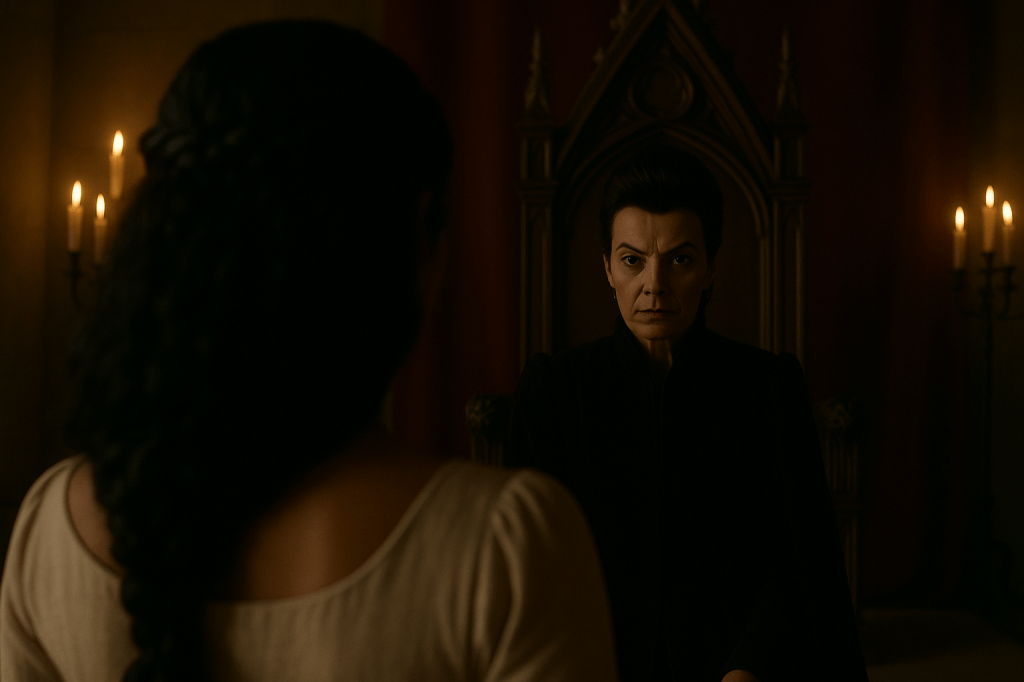
“Child,” she says. “You wander as if you’ve forgotten what protects you.”
“I am not a child.”
The words fall out before I can swallow them back. The sound of them makes the nearest torch leap.
Her smile is slight, almost tender. “Then show me. Speak your name.”
I open my mouth—and nothing comes. The air itself resists me. I can feel her power closing around my throat like a hand. The castle listens for my failure; the walls lean nearer so they won’t miss it.
Her gaze sharpens. “You see? You have no name without me. I gave you the one you bear. I made you Snow White.”
A draft crosses the hall and brushes my face with the smell of pine, as if the forest itself has slipped a finger through the door.
II. The Mirror
The throne hall bleeds into shadow. The stone melts away. When I look down, I am no longer standing on flagstone but on glass.
We are in the Mirror Room. The great mirror towers before us, breathing with faint, cold light. The carvings twist—wolves, serpents, vines—alive, waiting. Candle flames bend toward it as if in worship.
The Queen steps close to it. Her reflection meets her like a twin.

“You think this prison is mine,” she says softly. “But it was built for you.”
Her reflection moves before she does, turning its face toward me. The lips curve, but not in her smile—in mine.
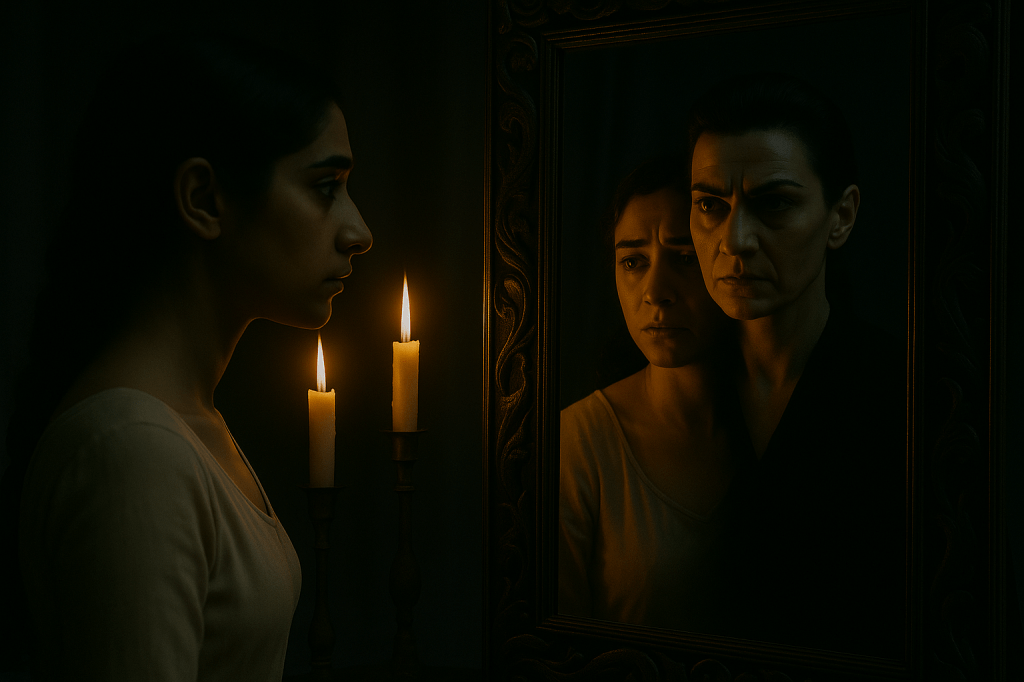
“Do you see it now?”
The words come from both voices—hers, mine, the mirror’s.
I shake my head, backing away. “No.”
The glass ripples and shows me a narrow corridor of years: a child lifted from a rain-drowned road; a girl learning silence the way others learn prayer; a young woman walking halls that memorize her step. Then it shows the three faces she wore for me—crimson lover, grey caretaker, blue-robed mentor—each dissolving at the edges until they bleed into one.
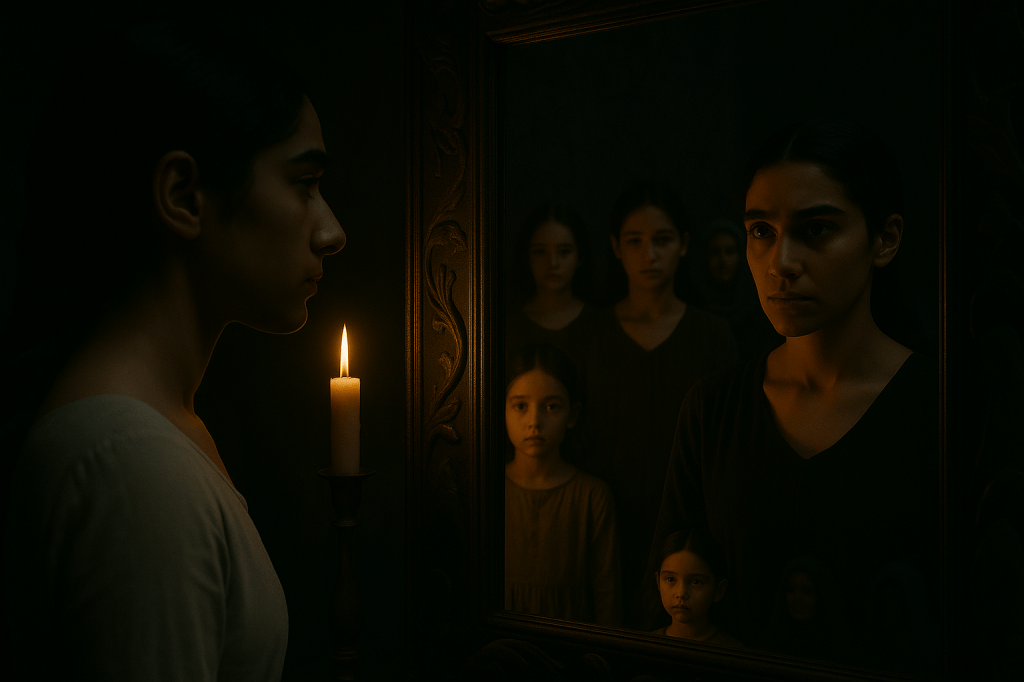
The Queen lifts her hand, pressing her palm to the mirror’s surface.
The reflection copies her.
“Everything I am, you have already begun to be.”
My reflection steps forward without my feet. For a breath, I see the crown she sees: black thorns rooted in bone. I feel the weight of the castle settle onto my shoulders like a cloak that remembers who wore it last.
III. The Name
Her power presses like ice against my skin. My heart pounds. I reach for the candle I still carry—the one flame I have kept alive through every corridor, every hunt.
Its light trembles, small and defiant. The wax has dried along my palm like a second skin; my burn throbs in time with the castle’s hidden heart.
“My name,” I whisper. “You never asked for it.”
The Queen tilts her head. “Because you have none.”
But the word rises in me, hot and sharp—a pulled thread, a buried ember. Not a title. Not a mirror. A sound I once slept inside. I remember a lullaby hummed against my hair, the smell of woodsmoke and bread, the press of a hand that was not hers. A doorway where someone said my name and the night answered soft as wool.
I breathe it out.

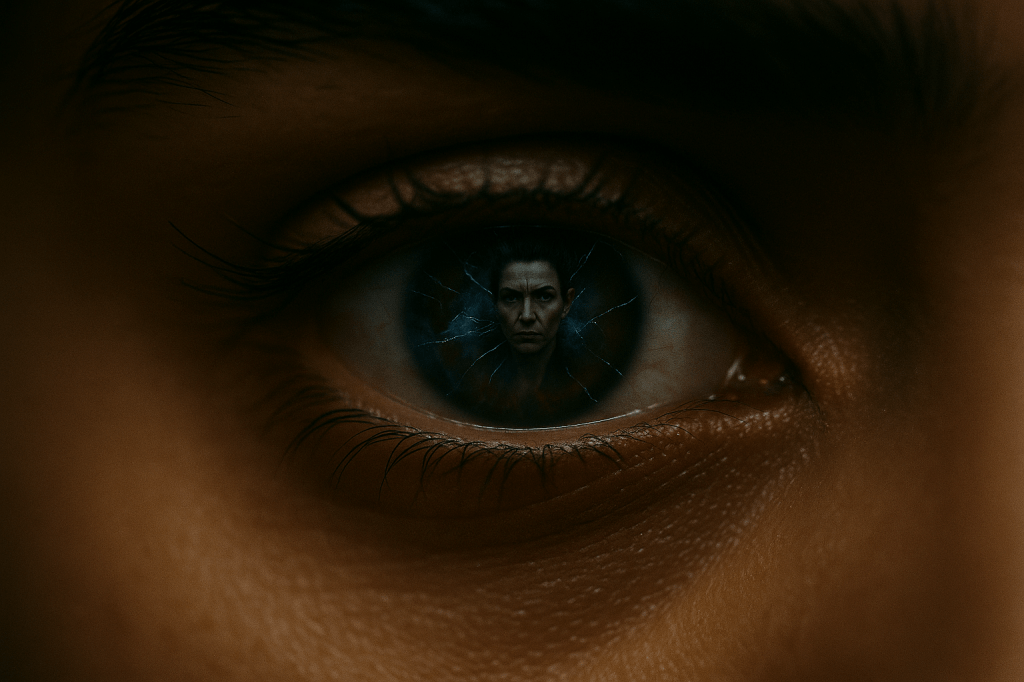
The name is mine. It does not matter what it is—only that it is. The sound of it cracks the silence open like glass. The torches exhale; the walls shiver. For the first time since I was brought here, the castle hears me.
The mirror splinters from the center outward. The reflection screams—not hers, not mine, but both.
IV. The Shattering
The castle convulses. Stone groans, beams twist, windows burst outward. Candles snuff and reignite in wild spirals of flame. Dust rains like snow in a storm that has forgotten how to end.
The Queen stumbles back from the mirror, her face flickering between a dozen selves—the lover, the mother, the mentor, the monarch—all unraveling. For a heartbeat her gaze softens, as if she sees in me the thing she lost before she learned to be cruel.
“You will regret this,” she hisses. “Out there, there are worse monsters than me.”
“Perhaps,” I say. “But at least they will not speak in my voice.”
The mirror’s final crack tears through the air like thunder.
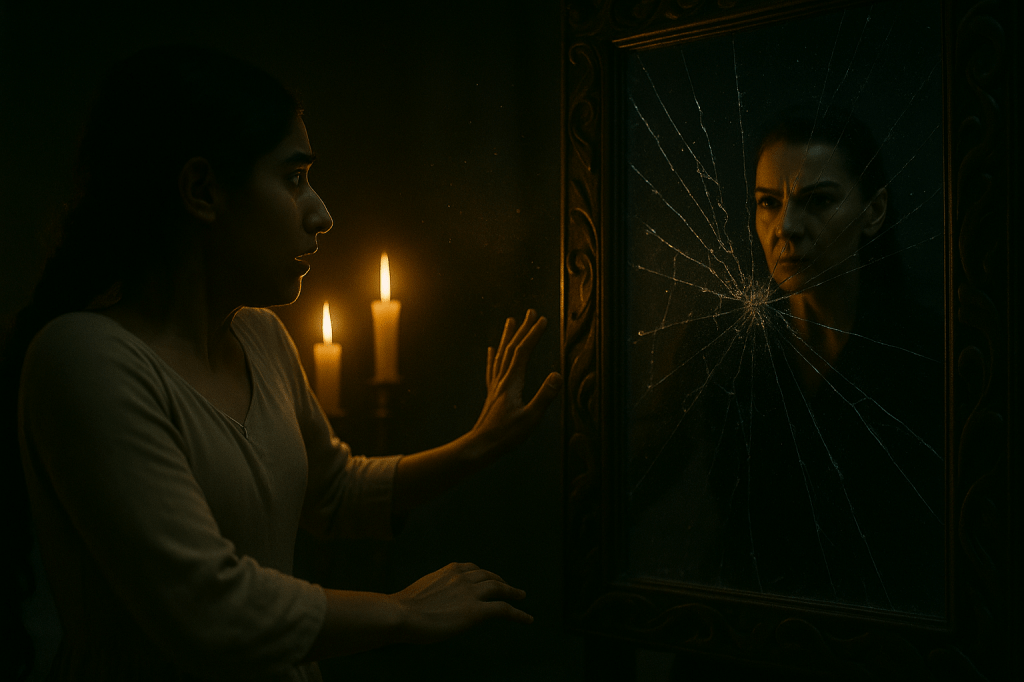
The Queen’s figure splits apart—reflection and body dissolving into shadow and light.
The throne hall exhales; somewhere a door unlatches itself without being asked.
Then silence. Real silence—the kind that has a sky above it.
V. The Black Forest
I wake among ruins. The castle stands broken behind me, half-swallowed by mist. The dawn is pale, uncertain. Smoke lifts in a thin ribbon from a fallen beam and disappears into a sky the color of pewter.
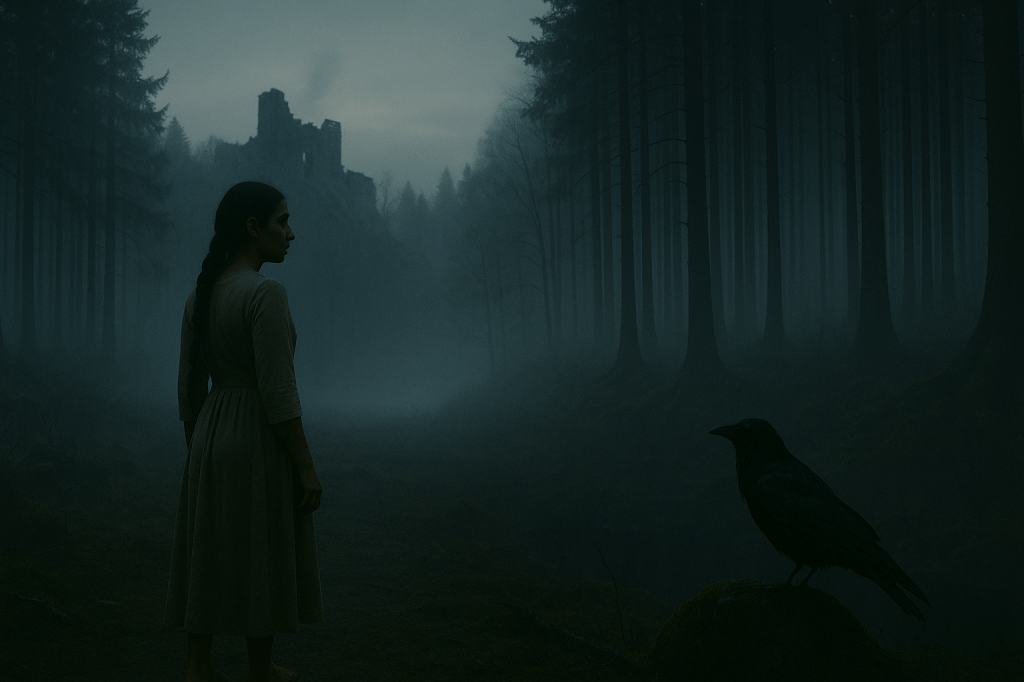
Before me lies the forest—black trees, silver fog, a thousand secrets whispering just beyond sight. The ground is soft and damp; it remembers rain. A raven turns its head toward me as if it has been waiting to see what face I chose.
The air is cold, but it is clean. The wind brings resin and loam and the distant rush of a stream. When I breathe, the breath belongs to me.
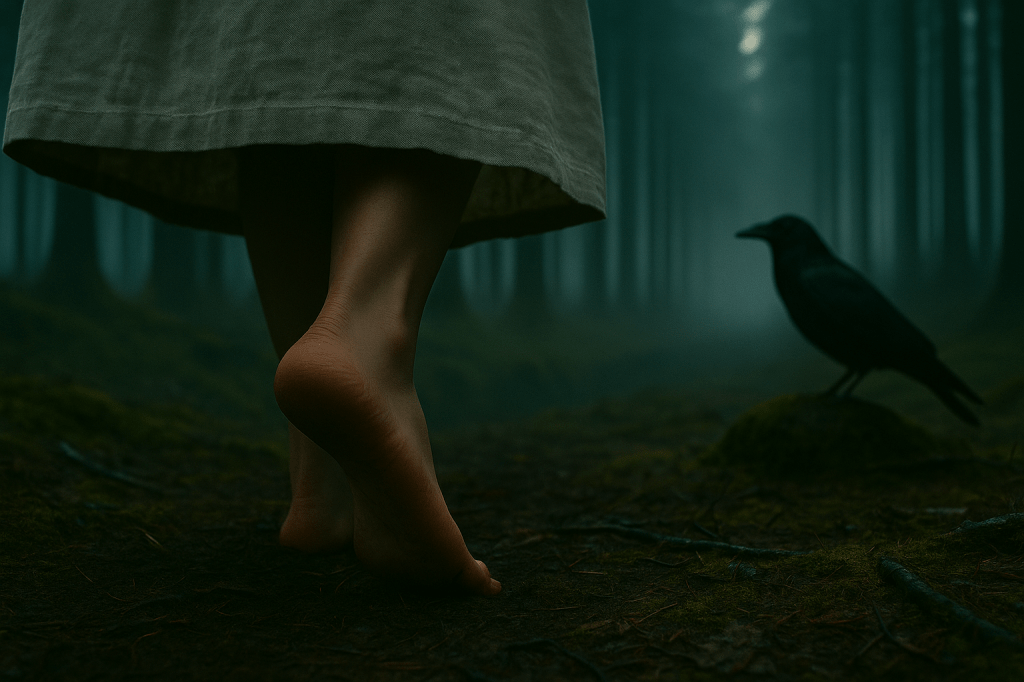
I step forward. The earth shifts beneath my bare feet—soft, breathing, alive—as if welcoming its first breath in years. My burned hand stings and then steadies, as if the flame inside it has agreed to rest.
Behind me, the first light of morning touches the stones. For a moment, the castle almost looks peaceful. Then the shadow of it fades, and I walk on. Between the trunks, the light breaks into a hundred thin paths.
I choose one.
Epilogue
Sometimes, when I close my eyes, I still hear her.
Not the words—only the breath between them.

But now, when I whisper back, it is not her echo that answers—
it is mine. And the forest answers too.
Afterword — Written Beyond the Walls
There are days now when I wake and do not hear the castle breathing behind me. The silence is no longer a threat; it is a companion, a witness to the spaces I am learning to fill. I walk the forest paths without fear of their shadows, and when the trees whisper, they speak in the language I have begun to reclaim. The world is larger than I was ever allowed to imagine, and I am learning, slowly, what it means to exist without being watched.
I have kept the candle I carried through the corridors. Its wick is spent, its wax cracked, but it rests beside my bed like an old truth. It reminds me that I once lived in a place where flame was forbidden to burn too brightly—where light was a thing rationed, measured, feared. Now, when the dawn filters through the branches, I do not shrink from it. I let it touch the places in me that once belonged to darkness, and I do not apologize for how they shine.
If these pages endure, let them stand not as a warning but as a promise: no mirror holds dominion forever. Names lost can be found again. Even a story written by another’s hand can be taken back, word by trembling word. I leave this account behind with the hope that someone who needs it will find their own way out of the labyrinth. And if they walk into the forest afterward, as I did, may they discover that the world beyond the walls does not devour them—
it frees them.
The End
 Scott Bryant
You must be logged in to post a comment.