Der schönste Fehler

Story Written By
Märta Löwenfeld

Story Told By
Brünnhilde Krämer, Ilsa Wundt,
Magda Eisenbaum, & Anneliese

Visuals & Imagery Created By
Jana Küster, Lina Vogt, Saskia Brenner,
Tabea Grünwald, Leonie Markert,
& Scott Bryant

Spellwork By
Brünnhilde Krämer, Ilsa Wundt,
& Magda Eisenbaum

With care and reverence, their story is shared by
Scott Bryant at the request of Märta Löwenfeld, Elfriede Baumann, Hannelore Weiss – along with the magical blessings of
Brünnhilde Krämer, Ilsa Wundt, Magda Eisenbaum,
& Anneliese

A Note from the Three

We did not mean for it to become a tale.
We meant only to keep a record. A reckoning.
A girl walked into our spell, and we—
Well.
We have remembered her ever since.

If you read this, read with care.
Magic does not always wear a crown.
And stillness is not the same as silence.

They call us witches. We never argued the name.

— Brünnhilde Krämer
— Ilsa Wundt
— Magda Eisenbaum


The Black Forest (Schwarzwald)
Near the Mummelsee,

Baden-Württemberg
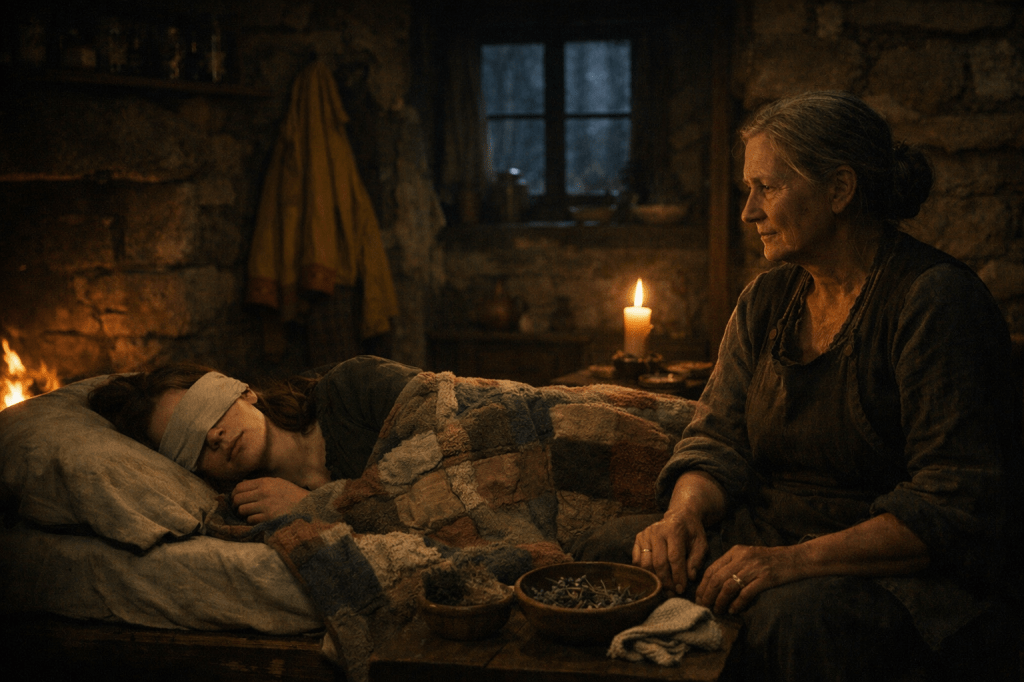
A cinematic, horizontal, photorealistic still frame set inside a small stone spellroom in the Black Forest at night, rendered in grounded A24-style realism.

Annaliese lies asleep on a narrow wooden bed beneath a patchwork quilt. Her posture is natural and unguarded, suggesting deep exhaustion rather than theatrical sleep. She is a fair, lightly freckled young woman in her early 20s with long dark-golden wavy hair fanned gently across the pillow. Her proportions are fully realistic, with natural adult anatomy and no stylization. A soft cloth rests lightly over her eyes to shield them from firelight. Her breathing appears calm and steady.

She wears a simple forest-green dress beneath the quilt. Her mustard-yellow wool coat with red embroidery at the cuffs hangs on a wooden peg near the door in the background — clean but worn, clearly functional rather than decorative. Her bare feet are tucked beneath the quilt, unseen but implied.

Brünnhilde sits beside the bed in quiet vigil. She is an older Germanic woman with weathered features and grey hair tied back in a simple bun. She wears a dark linen dress and a worn apron, sleeves rolled from work. One hand rests near a small wooden bowl of lavender water and a folded cloth; the other rests loosely in her lap. Her expression is gentle, tired, and protective — watchful without anxiety.

The room is lit naturally by three sources only:
• warm firelight from a low hearth (pine and rosemary burning)
• a single candle near the bed
• faint cool moonlight filtering through a small stone window

Lighting is soft and layered, with realistic falloff and natural shadowing. Skin tones remain neutral and unglamorous. No visible magic, no glowing symbols, no spell effects — only the quiet aftermath of enchantment.

The stone walls are rough and aged. The space feels lived-in and functional rather than mystical. Textures are tactile and real: wool, wood, stone, linen, water.

The atmosphere is hushed and intimate. The image should feel observed rather than staged. Shallow depth of field, subtle film grain, restrained contrast. No fantasy embellishment. No stylization. No beautification.

The emotional tone is quiet endurance, safety through presence, and aftermath rather than action.

NEGATIVE PROMPT / AVOID

No glowing magic
No runes or symbols
No fantasy lighting effects
No stylized faces or bodies
No sexualization
No dramatic posing
No cinematic exaggeration
No modern objects
No soft-focus glamour
No heroic framing

Brünnhilde

The woman hums again.

A warm, weightless sound—like the wind before the snow falls, or the hum of bees who’ve forgotten to sting. I keep a cloth over her eyes most mornings. The light bothers her. Or maybe it bothers me. Magda would say that’s projection. Ilsa would call it poetic.

Witch is the word people use when women refuse to be harmless.

I call it kindness.

She lies beneath a patchwork quilt in the old spellroom, her golden hair fanned across the pillow like a crown she never asked for. I keep the fire just hot enough, with pine and rosemary in the hearth so she doesn’t fade. Her coat still hangs on the peg near the door: yellow wool, trim buttons, a little red embroidery at the cuff. Clean but not new. Worn by a woman who expected rain and not enchantment.

She shouldn’t have been there. Not when Ilsa and Magda were circling each other like hawks again. Not when spells were blooming off their tongues like nettle and thorn.

Not when magic wanted a witness.

I remember her face when the charm struck. Not fear—just surprise, as if she’d heard a song she hadn’t realized she knew. Her eyes closed mid-step. She folded like a curtain drawn too fast.

And I, who always arrive too late, caught her before she hit the stones.

“Schlaf weiter, kleines Herz,” I whisper to her now. Sleep on, little heart.

I wipe her brow with lavender water. Her lips twitch. Her breath is steady. She is alive. Just… paused.

Ilsa calls her die Schlafende. Magda calls her irrelevant.

I call her here. And that is more than most people get.

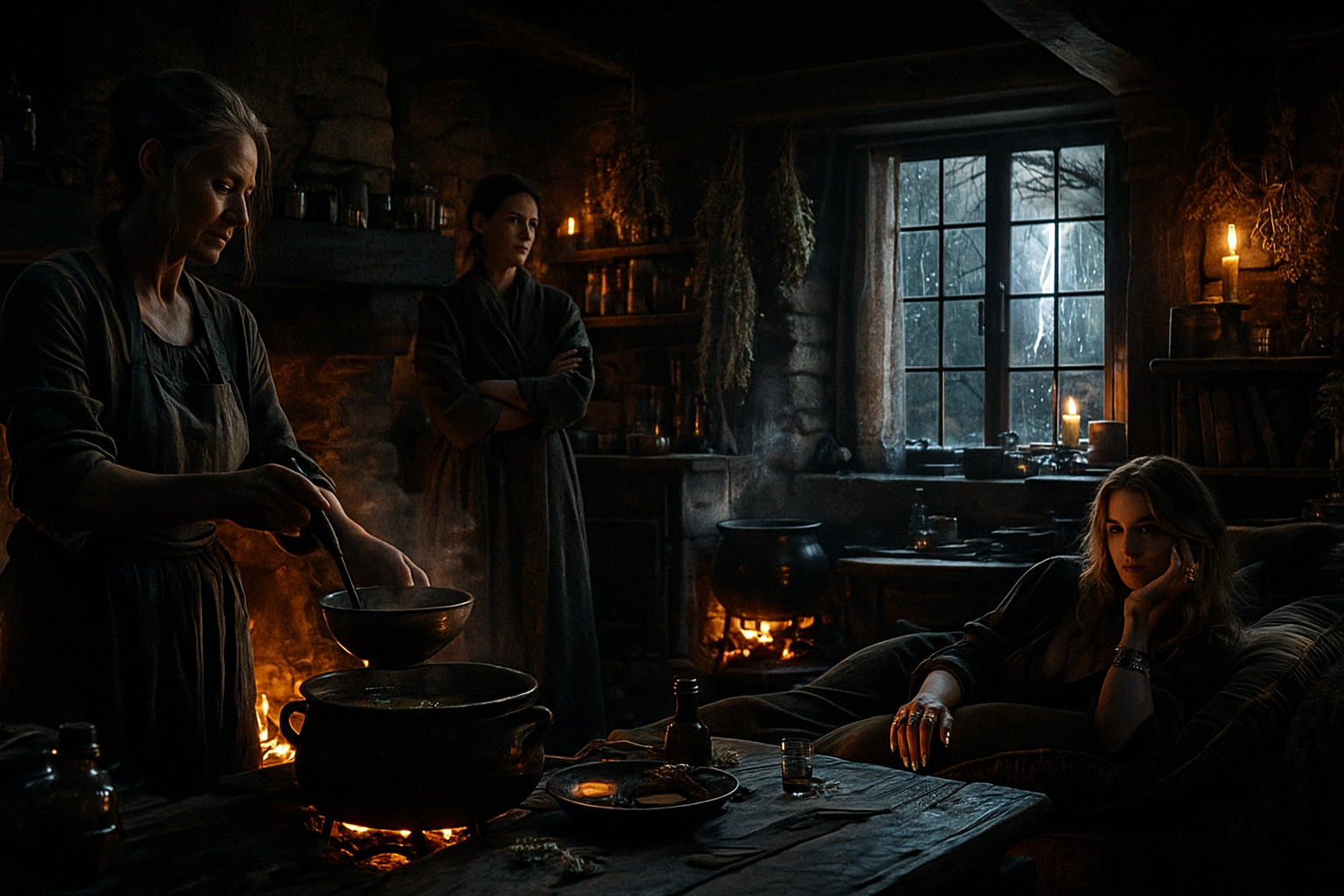
A horizontally framed, photorealistic A24-style cinematic scene inside a dim medieval stone-and-timber cottage deep in the Germanic mountains during a storm. The room is shadowy and textured, lit by a low-burning hearth and the cold flicker of lightning beyond a rain-streaked lattice window.

In the foreground, Brünnhilde stands by the hearth, an older weathered Germanic woman with grey hair tied back. She wears a dark linen apron and rolled sleeves. Her strong hands ladle steaming broth into a handmade ceramic bowl. Firelight illuminates her lined face with a warm, steady glow, emphasizing her quiet strength and grounded presence.

Beside her stands Magda, tall, severe, and rigid in posture. She wears structured dark wool robes in muted, medieval tones. Her sharp features are lined with intellect and age. Arms crossed, she watches the room with disciplined restraint and analytical tension. Her expression is controlled, weary, and illuminated by cooler ambient light.

Reclining on a velvet floor cushion is Ilsa, the youngest witch. She lounges like a cat, her long loose hair catching the hearth’s warm highlights. Her fingers glitter with ornate gold rings, her nails painted gold. She taps them idly on a scarred wooden table, her expression sly, amused, and calculating. She wears loose velvet-textured clothing, sensual and dark.

The cottage interior is cluttered with magical detail: sagging wooden shelves filled with ancient spellbooks and scrolls, bundles of dried herbs hanging from the rafters, glass vials of glimmering liquids catching stray light, and a low cauldron steaming gently over the fire. Dust, smoke, and the scent of woodsmoke and moss fill the thick air.

Outside the lattice window, a storm rages—lightning cracks across the sky, wind bends the forest branches, and rain lashes the stone wall. Inside, the lighting is richly chiaroscuro: warm amber highlights from the fire, deep blue shadows from the storm, and soft grain reminiscent of elevated A24 cinematography.

The emotional tone is heavy and intimate: three witches bound by sorrow, consequence, and a shared magical mistake, rendered with painterly realism, moody medieval atmosphere, and a tactile, enchantment-laden stillness.

Brünnhilde stood by the hearth, ladling broth into a ceramic bowl, careful not to spill. She wasn’t hungry—none of them were, not really—but her hands needed work, and the girl should smell something warm when she woke.

If she woke.

“I fed her yesterday,” Magda muttered, arms crossed, spine straight as the stove pipe. “She doesn’t need it again.”

“You hovered by the door,” Brünnhilde replied mildly. “That’s not feeding.”

Ilsa lounged on a cushion like a coiled ribbon, tapping her nails on the table. Gold enamel, freshly enchanted.

“Honestly,” she said, voice sweet with rot, “she looks better asleep than most people do dancing. Maybe it was a blessing.”

Brünnhilde turned. “A blessing?”

“A mistake,” Magda snapped. “An unintended convergence. The two of us were casting simultaneously. There were echo fields. Feedback. It collapsed inward.”

“It wasn’t a spell with intent,” Magda said later. “It was a collision.”

“She smiled at me,” Ilsa offered, dreamy. “Right before. That’s something, isn’t it?”

Brünnhilde slammed the ladle into the pot. “You set her on fire, Ilsa. A magical fire, sure. But it burned the will right out of her.”

“It wasn’t fire,” Magda corrected, “it was temporal stasis.”

“Oh, thank you, Frau Professor,” Ilsa hissed. “That makes it so much better.”

Magda pinched the bridge of her nose. “We didn’t mean to curse her.”

“But we did,” Brünnhilde said.

A silence. Thunder muttered in the distance.

Brünnhilde ladled the soup into a bowl anyway.

“She dreams of forests,” she said softly. “And of apples. And of being left.”

Ilsa frowned. “Apples? Really?”

“I don’t think it’s a coincidence,” Brünnhilde said. “I think we made a mistake that wants to be a story.”

“And if we try to undo it?” Magda asked.

Ilsa looked up sharply. “Would she even want to wake up?”

“We were not fighting over her,” I said. “We were fighting past one another.”

Ilsa

If one more raven sits on the roof and mutters Unglück! at me, I’m going to hex every feather off its smug little body.

This whole thing has been wildly overblown.

Was it ideal, what happened with the girl?

No.

Was it tragic? Perhaps.

But was it my fault?

Please.

I, Ilsa, had just finished bottling my new potion—amber glass, gold stopper, a swirl of moonroot and dahlia oil so fine it sang when you opened it. Magda had already sniffed it and said, “It smells like rain on a bakery floor.” That woman wouldn’t know sensuality if it danced naked across her spellbook.

So I decided to make a moment of it. Something grand. I stepped outside, just past the foxglove hedge, and whispered a glamour.
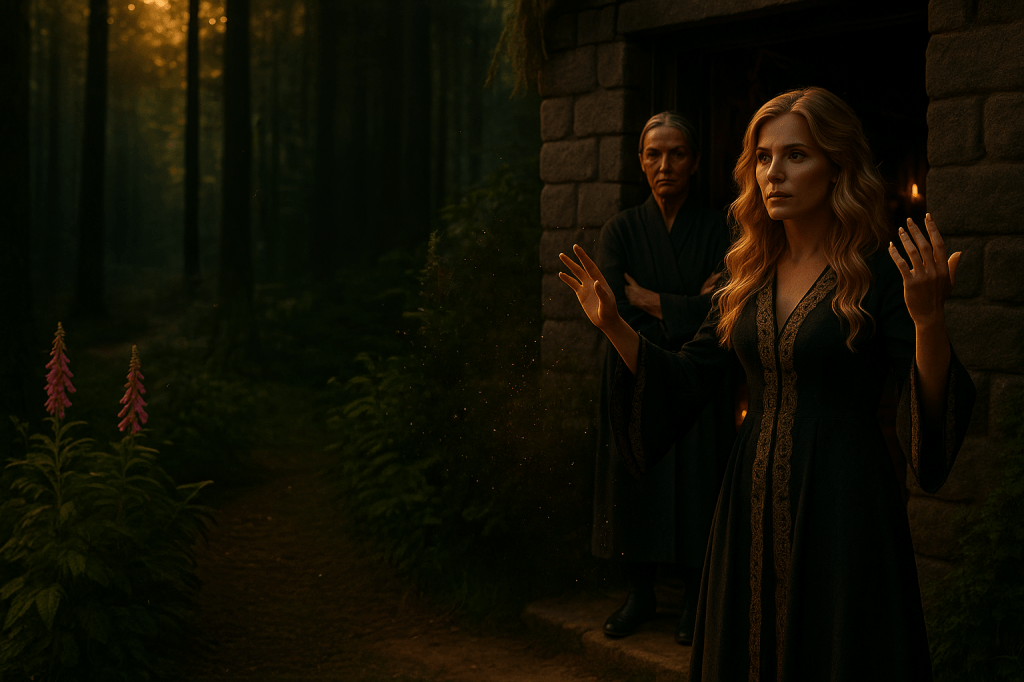
“Come to me, Schönheit,” I said, and the leaves rustled as if applauding. Birds flitted overhead, and the air thickened like warmed honey. A small charm, just enough to draw attention to my radiance.

And of course, Magda was on the stoop with her arms crossed like a librarian preparing for war.

“You’re manipulating resonance fields,” she said.

“I’m inspiring them,” I said back. “Sorry you’re immune.”

She muttered a grounding chant—something flat and clumsy, all edges—and the wind turned.

Now, to be clear, I wasn’t trying to counter her. But I couldn’t just stand there, could I? I twirled my fingers, intensified the glamour, called down a shimmer of candlelight through the trees.

That’s when I saw her.

The girl. Coat the color of fresh-churned butter, curls wind-tossed, humming to herself.

She wasn’t watching us. She wasn’t afraid. She looked… amused.

And I—

I liked her. Just for that moment. She had this stillness, like she knew something we didn’t.

Then the spell snapped like a whipcrack.
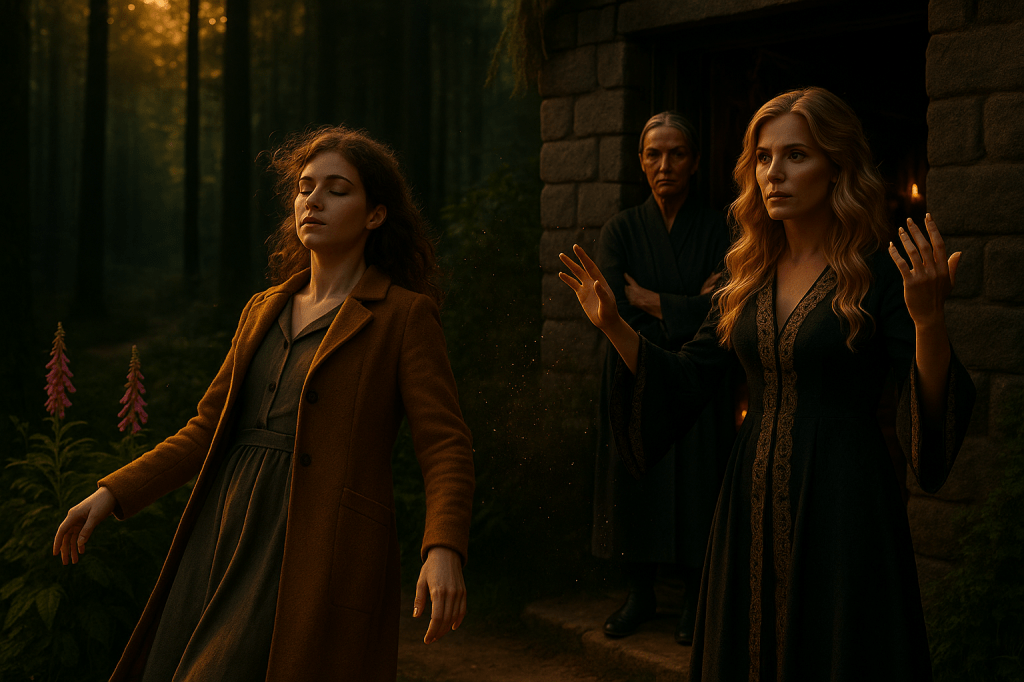
A horizontal, A24-style, photorealistic cinematic image set in a Germanic forest clearing during late-day golden hour. The setting matches the established canonical environment: a mossy clearing in front of a stone-and-timber witch’s cottage, with warm candlelight glowing faintly from the open doorway and cool forest light beyond. Tall spruce and fir trees frame the edges of the composition. A soft magical haze hangs in the air.

Center — Anneliese (fictional woman)

A young, fully fictional woman with wind-tousled curls and fair skin.
She wears a mustard-yellow wool coat over a forest-green dress.
She stands mid-step, beginning to falter — her posture slightly off-balance, as if subtly affected by magic.
Her expression is calm but unfocused.
Soft golden magical particles float around her like drifting pollen, catching the warm light.

Right Side — Ilsa Wundt (fictional Option D canon)

This appearance is fully locked and MUST match exactly:
– A strikingly beautiful fictional woman in her early forties.
– Long, honey-blonde wavy hair, loose and luminous.
– Fair skin with refined, elegant features.
– Poised, confident, controlled expression — focused but not panicked.
– Wearing a fitted black robe embroidered with elaborate gold thread along the neckline, sleeves, and hem.
– Hands raised mid-glamour, fingers elegantly positioned.
– Gold-painted nails visible.
– Three to five ornate gold rings on each hand.
– A faint magical shimmer surrounds her palms — soft, ember-like motes glowing in the fading light.

Background Right — Magda Eisenbaum (fictional witch)

A tall, severe older fictional woman standing in the stone cottage doorway.
Silver-threaded hair pulled back.
Sharp features, rigid posture.
Wearing austere, dark woolen robes.
Her expression is tense, critical, and disapproving, watching Ilsa closely.
Soft warm candlelight glows behind her inside the cottage.

Environment & Lighting

Golden-hour sunlight filtering through the dense forest canopy.
Long shadows, warm highlights.
Moss-covered stones, foxglove blossoms beside the cottage.
Dust and magic motes drifting in the air.
A24-style cinematography: controlled contrast, shallow depth of field, painterly atmosphere.
No additional characters.
No deviation from the canonical appearance of Ilsa (Option D).
Everything grounded, magical, and realistic.

Wind and light collapsed inward.

Her eyes fluttered—and she smiled.

She smiled.

I remember it precisely because it was not the smile of someone being cursed. It was the kind of smile you wear before a waltz begins.

Then she dropped.

A cinematic, photorealistic scene set in a dense central-European forest outside a stone witch’s hut.

In the foreground-left, a young woman in her early 20s collapses backward mid-spell, suspended in the moment between falling and being caught.
She is fair-skinned with natural, soft facial features and loose, curly brown hair that spills behind her. Her body is arched backward, eyes closed, expression serene and strangely peaceful.
She wears a mustard-yellow wool coat and a muted forest-green dress, the coat catching warm light.
Small glowing golden spell particles drift off her body and into the air around her.

Two outstretched human arms from offscreen foreground-left reach toward her, attempting to catch her as she collapses. The hands are tense, fingers spread, reacting to the sudden fall.

In the midground-right, standing in the open doorway of a rustic stone hut, three witches witness the moment:

Ilsa (Witch 1 — Primary focus)

A strikingly beautiful woman in her early forties with long, wavy honey-blonde hair illuminated by the golden sun.
Her expression is wide-eyed and alarmed, shocked by what’s happening.
She wears an elegant black enchanted robe embroidered with intricate gold trim.
One hand is lifted in front of her, fingers splayed; long gold metallic nails and multiple ornate gold rings catch the light.
Her posture communicates sudden fear and loss of control.

Brünnhilde (Witch 2 — Background)

An older, weathered woman with gray hair pulled back tightly.
She stands just behind Ilsa, framed by the doorway, watching with grave concern.
She wears a simple dark linen garment with sleeves rolled at the wrist.
Expression: steady, stoic, protective.

Magda (Witch 3 — Not fully visible here)

Her presence is subtle or partially occluded; the focus remains on Ilsa and the collapsing girl.

Inside the hut behind them, the interior glows with multiple warm candle flames, lighting stone walls and casting flickering orange reflections.

The forest background is heavily stylized with tall, dark trees stretching vertically, washed in deep shadow.
The entire right side of the frame glows in rich amber-gold light, strongly directional, as if the sun is low and filtering horizontally through the trees.
Atmospheric dust and spell particles sparkle in the beams of light.

The tone is dramatic, magical realism, with the emotional intensity and color palette of an A24 fairytale film — deep shadows, glowing gold highlights, hyper-detailed textures, realistic expressions, and dynamic motion.

Aspect ratio: 16:9
Ultra-photorealistic
High drama, mid-collapse motion

Brünnhilde caught her. Magda cursed like a priest.

I didn’t say anything. I just walked over and knelt beside her, and whispered:

“I didn’t mean that.”

But her chest rose and fell like snowfall. No reply.
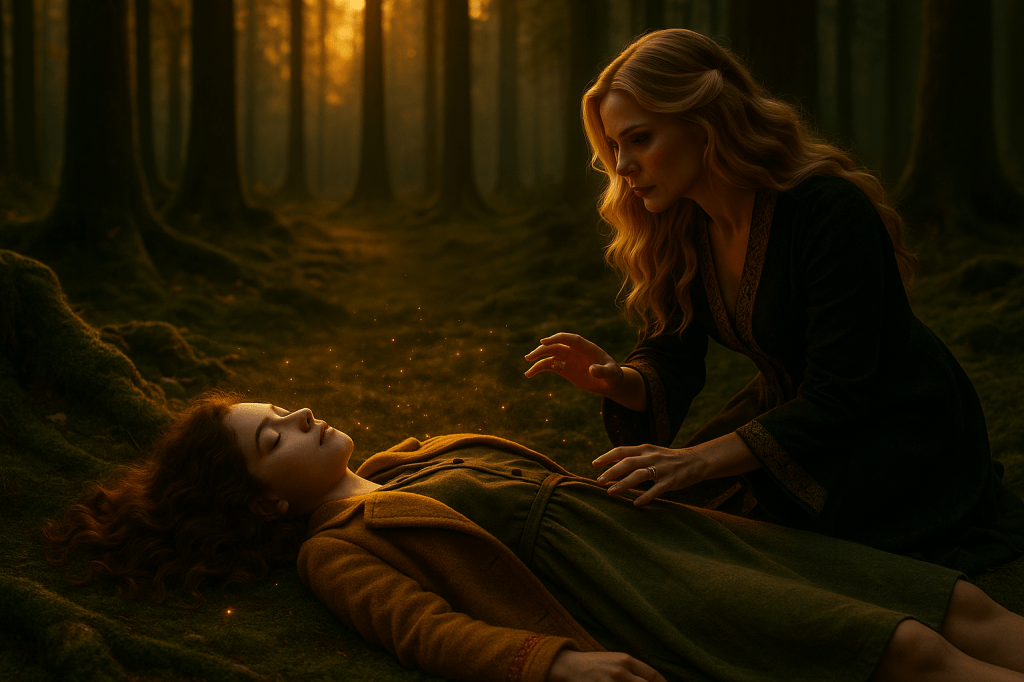
A digital photograph set in an ethereal forest clearing at the edge of a stone witch’s cottage.
The scene takes place moments after a magical misfire.

In the foreground, Ilsa, a strikingly beautiful witch in her early forties, kneels beside a collapsed young woman. Ilsa has long dark hair that falls freely, glamorous gold-embroidered black robes, and multiple ornate gold rings on her fingers. Her expression is uncharacteristically soft and concerned — a rare moment of vulnerability. She is reaching toward the young woman with gentle hesitation, as if torn between guilt, fascination, and responsibility.

The young woman is Annaliese, barefoot, with delicate natural features, light freckles, long dark-golden wavy hair, and a mustard-yellow wool coat over a forest-green dress. She lies partially on her side in the soft moss, her posture peaceful, eyes closed, as if caught between waking and dreaming. A faint shimmer of residual magic — tiny warm embers — drifts around her, glowing softly in the air.

Lighting: warm golden-hour sunlight filtering through tall trees, casting long soft beams across the clearing. The atmosphere feels quiet, heavy, and intimate. Shadowed stone walls of the cottage frame the right edge of the image, with a dim orange candle glow from inside.

Tone & Style: cinematic, emotionally charged, photorealistic; looks like a still from an A24 dark fairytale film. Natural colors, mossy greens, warm highlights. Soft depth of field.

Composition: wide shot; Ilsa and Annaliese in the lower-right third; the forest fades into mist behind them. No extraneous characters.

Do NOT include gore, injury, or violence. The moment is magical, tender, and ambiguous — not horrific.

Now they glare at me like I summoned demons. But I see the girl at night. In my dreams. In the mirror.

And do you know what?

She still smiles.

Magda

Let the record state: I warned her.

I warned Ilsa—explicitly—not to cast in open air while the leyline above our hill was in flux.

“We are approaching the third eclipse,” I said. “The magical field is volatile. Disruption is probable.”

But of course, she heard none of it. She never does.

She thinks spells are scarves to be twirled. She has no regard for weight, for resonance, for the cost.
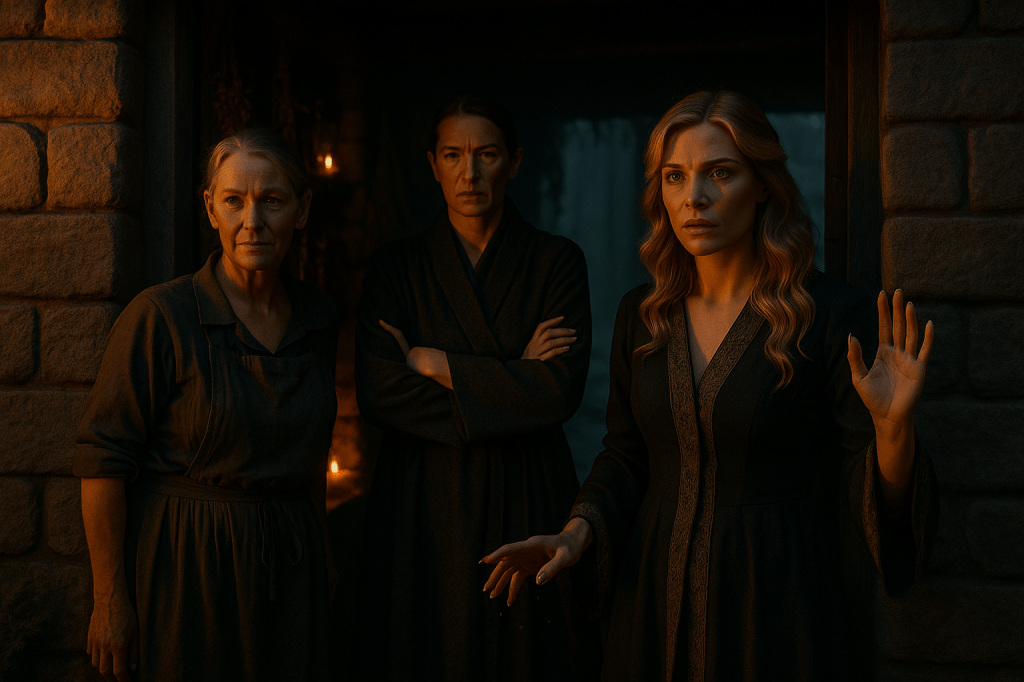
I was on the threshold. I had just closed my journal when I felt the first shimmer—her glamour spell, layered thick with pride and oil of rose. The birds began their ridiculous chorus. She stood in her embroidered robes like a woodland opera. And I—

I lost patience.

So I cast a stabilizing current. A simple field anchor. Nothing malicious. Just enough to ground the glamours before the sky split from the strain.

And the girl—

I didn’t see her until it was too late.

She stepped between us. The very center of the convergence. No protection, no mark, no magical heritage I could sense. Just… walking.

I remember her eyes. Unstartled. As if she had known.

The spell tore sideways. Collapsed in on itself. A flash of blue, then gold, then stillness.

She dropped like a marionette with cut strings.

I checked her pulse before Brünnhilde reached her. Strong. Shallow. Temporal stasis. An involuntary trance state held in place by reactive magic. The kind of thing that shouldn’t happen—not between two spells as basic as ours.

Which means…

No. I won’t say it.

Brünnhilde thinks she was meant to be there. That the spell didn’t choose her by chance.

Ilsa thinks it’s romantic.

I think it’s a mess.

And I am trying to clean it up.

I’ve reviewed the transcripts, recalculated the magical imprint, written three reversal drafts. None stable. The girl pulses with energy that wasn’t ours to begin with. Something caught inside her. Some dormant current that absorbed what we flung and held it still.

If we try to undo it all at once—

It could shatter her.

So instead, we wait. Brünnhilde feeds her soup. Ilsa sighs at her beauty.

And I rewrite the incident again in my notes. Each time, the lines get shorter. Fewer details. Less guilt.

She was not our fault.

Except some nights, when the wind comes down from the forest and the girl breathes in her sleep—just sharply enough to catch my ear—

I find myself standing in the doorway of the spellroom, holding the key to the reversal cabinet.

And I don’t open it.

Not yet.

A horizontally framed, A24-style photorealistic cinematic image set deep in a shadowed, enchanted northern European forest. At the center of the frame walks Anneliese, a fictional young woman whose appearance must remain 100% consistent with her canonical design.

Anneliese Canon (lock this appearance exactly):

Fair, lightly freckled skin

A soft, oval face with delicate natural features (gentle nose bridge, soft jawline, expressive but small lips)

Calm, serene expression; eyes relaxed or half-closed

Long dark-golden wavy hair, loose and natural, falling to mid-back

Realistic proportions, 5'4–5'5, with a natural, grounded posture

Correct anatomy (no elongated limbs, no stylization, no distortion)

Wearing a mustard-yellow wool coat with subtle red embroidery at the cuffs

A forest-green dress visible beneath the coat

Barefoot, her steps light but realistically weighted

She walks forward through a forest path of pale earth and moss. Her coat flows gently behind her with natural motion, not exaggerated. The surrounding environment is quiet, reverent, and cinematic: towering pine trees disappearing into cool mist, moss-covered trunks, and soft diffused light filtering through the canopy like early morning fog. The atmosphere is still, hushed, and dreamlike but fully grounded in realism.

Small forest birds perch quietly on mossy branches, watching her in stillness. The tonal palette is muted greens, golds, and grays. The image must feel intimate, emotional, and rooted in dark fairytale realism — like a lost frame from modern folklore cinema. No surreal distortion. No stylization. Capture Anneliese exactly as described above.

Anneliese (The Woman)

I am not sleeping.

I am… elsewhere.

There is a forest here. Not the kind with maps and paths, but the one behind the stories people tell. The one where the trees remember your name, even if you’ve never said it aloud.

I walk here sometimes.

Barefoot.

The earth is soft as flour.

The birds speak in voices I almost recognize. Sometimes they sound like my grandmother, or the teacher I loved who wore green silk gloves, or the woman at the bus stop who once said, “Don’t let them tell you stillness means nothing’s happening.”

Stillness.

That’s what they think I am.

They call me die Schlafende. They call me the girl. They call me mistake.

Sometimes I hear the names people reach for when they don’t know how to name a woman who stops—fairy tale warnings wrapped in women’s skin. But I am not a story someone else can end.”

But I remember the moment it happened.
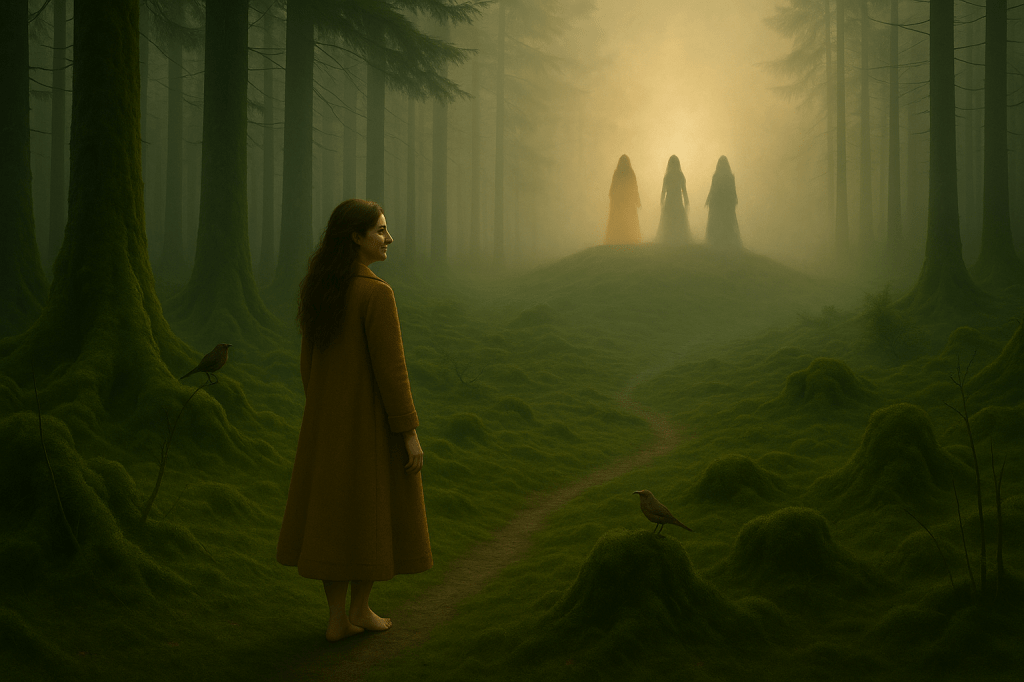
Annaliese’s Vision — Wide Establishing Shot (MASTERLOCK)

Create a wide, cinematic, photorealistic establishing shot that depicts Annaliese experiencing a symbolic, visionary moment in the forest.

FOREGROUND — ANNALIESE (ONLY ONE WOMAN)

A fair, lightly freckled young woman in her early 20s stands barefoot on a moss-covered forest path.
She has:

long, dark-golden wavy hair

a serene, quietly knowing expression

realistic proportions (5'4–5'5)

She wears:

a mustard-yellow wool coat with subtle texture

a forest-green dress underneath

no shoes

Her posture is calm and composed, as if in a moment of inner recognition or awakening.
Her expression is soft, almost smiling — not fearful.

Soft golden-hour light catches her hair and shoulders.

She is the only figure in the foreground.

MIDGROUND — THREE WITCHES (SILHOUETTES ONLY)

On a small hill in the distance, place exactly three women in silhouette:

One cloaked in light

One cloaked in logic (rigid posture)

One cloaked in doubt (folded or uncertain stance)

They must appear:

distant

symbolic

anonymous

NOT recognizable as Brünnhilde, Magda, or Ilsa

Only their forms should read — no faces, no detail, no individual clothing textures.
They may hold faint gestures suggesting crackling energy or magical resonance, but minimal and understated.

They must look like a vision, not a literal scene.

SETTING & LIGHTING

A deep, misty forest with towering pines and a mossy floor.
Lighting:

late-day golden hour, warm and atmospheric

beams filtering through the mist

soft backlighting around the silhouettes

gentle rim light on Annaliese

Mood:
mythic, quiet, dreamlike, but still grounded in photorealism.

COMPOSITION

The camera is pulled back in a wide cinematic frame.

Annaliese stands in the lower-third foreground on the forest path.

The witches appear far up the path on a subtle rise, framed by glowing mist.

The environment should feel expansive, immersive, and symbolic.

STYLE

Photorealistic, cinematic, high dynamic range

Hyper-detailed textures in the forest

Subtle magical particles or dust motes in the air

Color palette: muted greens, gold light, soft shadows

HARD LIMITS

Only one Annaliese

Exactly three silhouettes of witches

No extra people

No animals unless incidental background birds

No painterly distortion

No stylization that breaks realism

I saw them—three women on a hill, their hands crackling with too much want and not enough listening. One cloaked in light, one cloaked in logic, and one cloaked in doubt.

And I—

I smiled.

Not because I was naive. Because I recognized them.

I have walked past women like that all my life. Women full of power they haven’t yet named. Women who call other women vain or weak or in the way when what they mean is: You remind me of something I lost.

The spell touched me, and I let it. I could have pulled back. I didn’t.

Because I was tired. Because I had been carrying things I could not name. Because it felt good to pause—to become something unmoving. Untouchable.

But here, inside this forest, I remember everything.

The smell of soup. The click of fingernails on stone. The scratching of a pen in a book no one else is allowed to read.

They talk to me sometimes. Whisper things they don’t know I hear.

Brünnhilde sings, gently, off-key.

Ilsa recites her own poetry.

Magda reads aloud in a language older than the hills.

They think I’m locked inside a mistake.

But I’m not.

I am watching. I am listening.

And when I open my eyes—

They will not be the only ones who wake.

Brünnhilde

She moved.

Not much. A twitch, like a flake of ash blown sideways. But I saw it. Her fingers flexed. Her lashes fluttered.

The spell is softening.
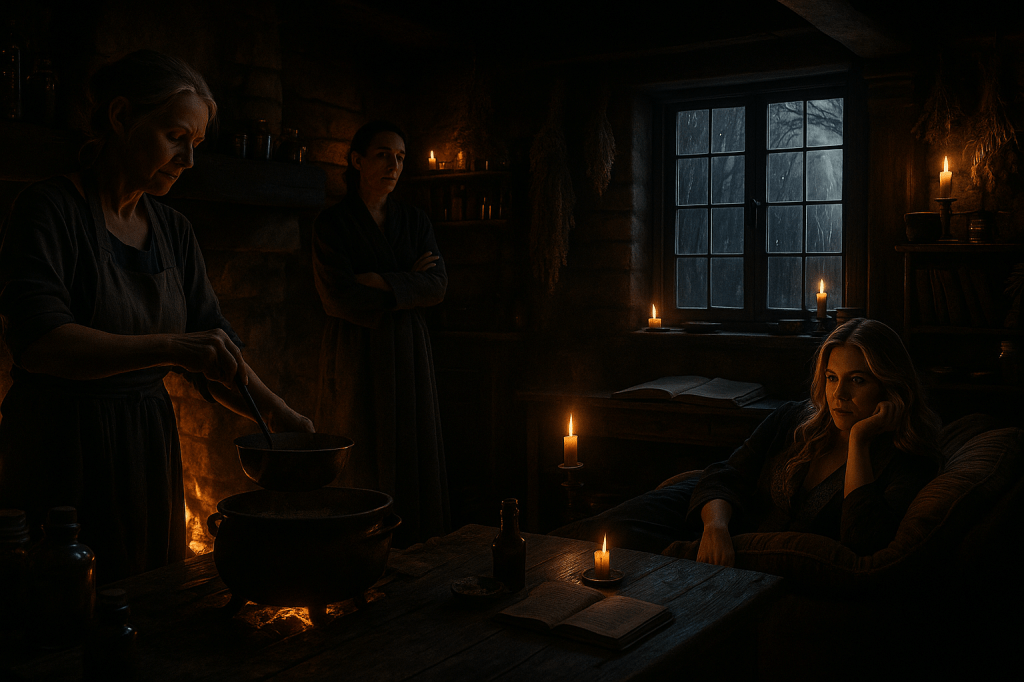
MASTERLOCK PROMPT —

“Inside the Cottage: The Long Night”
(Ready for generation when you wish.)

DO NOT introduce extra characters. Only canonical witches + unconscious Annaliese (off-frame or partially visible).

COMPOSITION — WIDE, LOW-LIT INTERIOR

A photorealistic, cinematic interior scene of the witches’ stone cottage at night.
Warm firelight flickers from the hearth.
Candleflame trembles at the edges of glass jars.
Rain streaks the window.

CHARACTERS

Brünnhilde — at the hearth:

stirring a pot

face lined with worry

strong hands steady

dark linen apron, rolled sleeves

Magda — midroom, standing in thought:

rigid posture

sharp features

dark wool robes

expression: intellectual dread

spellbook open on the table beside her

Ilsa — reclining on the chaise:

honey-blonde hair spilling freely

black robe with gold embroidery

ornate rings catching firelight

expression: controlled guilt

gaze drifting toward Annaliese (off-frame)

ENVIRONMENT

Hanging herbs, jars of tinctures

Fire casting rhythmic shadows

A quiet domestic space turned somber

No magical effects—only subtle tension

HARD LIMITS
No other figures.
No active magic.
No silhouettes in the window.
No intruders—only the long night.

I went to the window and watched the sky. Storms coming down from the hills. Wind pulling through the thatch like fingers combing hair. The kind of weather that doesn’t ask permission.

I told Magda first. She didn’t look up from her notes.

“Residual energy. Unstable discharge.”

I told Ilsa. She painted a charm across her lips with foxglove oil and said:

“So what? Maybe she just likes dreaming.”

I didn’t answer. I went back to the spell room. Lit the salt candles. Drew the reversal circle.

MASTERLOCK PROMPT — 
“The Reversal Circle”

Wide, cinematic interior shot — the ritual moment itself

DO NOT add any extra characters or figures. Only Annaliese + the three canonical witches.
No men, no silhouettes, no hands reaching from offscreen.
No beams of magic or explosions — only soft, realistic magical resonance.

GENERAL COMPOSITION — WIDE, CENTERED RITUAL SHOT

A cinematic photorealistic wide shot inside the witches’ spell room.

Annaliese lies in the center of a drawn reversal circle (yew, crow feather, salt), softly illuminated by amber candlelight and faint storm flashes from the window.

The three witches stand around her, forming a tense triangle.

The atmosphere is heavy, storm-charged, intimate.

CHARACTERS — EXACT CANON
Annaliese (center, lying within the circle)

Fair, lightly freckled young woman

Long dark-golden wavy hair

Wearing her mustard-yellow coat and forest-green dress

Barefoot

Eyes half-open, watching quietly

Expression: serene, present, almost knowing

Subtle golden motes around her, leftover from the misfire (very faint)

Brünnhilde (foreground left, stepping into the circle)

Older Germanic woman

Gray hair tied back

Weathered, warm, steady expression

Wearing dark linen apron, sleeves rolled

One foot inside the ritual circle

Holding the reversal charm (yew + crow’s feather)

Expression: determined, burdened, protective

Candlelight warms her features

Magda (background center-left)

Tall, severe, analytical

Dark wool robes

Rigid posture, arms tense

One hand gripping Brünnhilde’s wrist in warning

Expression: alarm layered over rational calculation

Positioned just outside the circle, body angled to prevent catastrophe

No magical effects on her hands or body

Ilsa (right side of frame)

Strikingly beautiful, early 40s

Honey-blonde hair, wavy, luminous

Black robe with ornate gold embroidery

3–5 gold rings, metallic nails catching candlelight

Expression: fear + guilt + awe

Hands slightly raised, sensing magical reverberation

Standing just inside the circle’s edge

Faintest ember residue near her fingertips (subtle, photorealistic)

SET & LIGHTING

Stone spell-room interior

Candles lit around the circle

Herbs hanging from ceiling beams

Storm flashes outside window (cool blue highlights)

Warm amber candlelight inside

Floor covered in chalk, yew, feather strands

Subtle shadows of movement from wind outside

No chaos, no flare-ups — only tension and suspended breath

STYLE REQUIREMENTS

Photorealistic

Cinematic color grading: warm amber interior vs. cool storm blue highlights

Sharp facial features, realistic textures

No painterly distortion

No fantastical overlighting

Naturalistic magical residue only (motes near Annaliese + faint embers at Ilsa’s fingers)

HARD LIMITS

Only Brünnhilde, Magda, Ilsa, Annaliese

No extra bodies, hands, figures, or silhouettes

No glowing beams or dramatic VFX

No symmetry-breaking distortions

Proportions must be human and realistic

And when they didn’t come, I called them.

“Now,” I said. “No more delays.”

Ilsa rolled her eyes but came. Magda closed her book with a sound like a slammed door.

We stood around the girl.

The coat was still buttoned. Her breath was steady.

But her eyes were not closed.

They were watching.

Not wide open. Not startled.

Just… there.

“She’s ready,” I said.

“Are we?” Ilsa muttered.

“We don’t get to choose that,” I snapped.

I reached for the reversal charm, braided from yew and crow’s feather. Magda grabbed my wrist.

“We haven’t tested—”

“We did this. We don’t get to rehearse the apology.”

Silence.

Outside, the wind howled down the chimney. The house shuddered.

Inside, the girl exhaled. A deliberate, present breath.

I stepped into the circle.

And for the first time, they followed me.
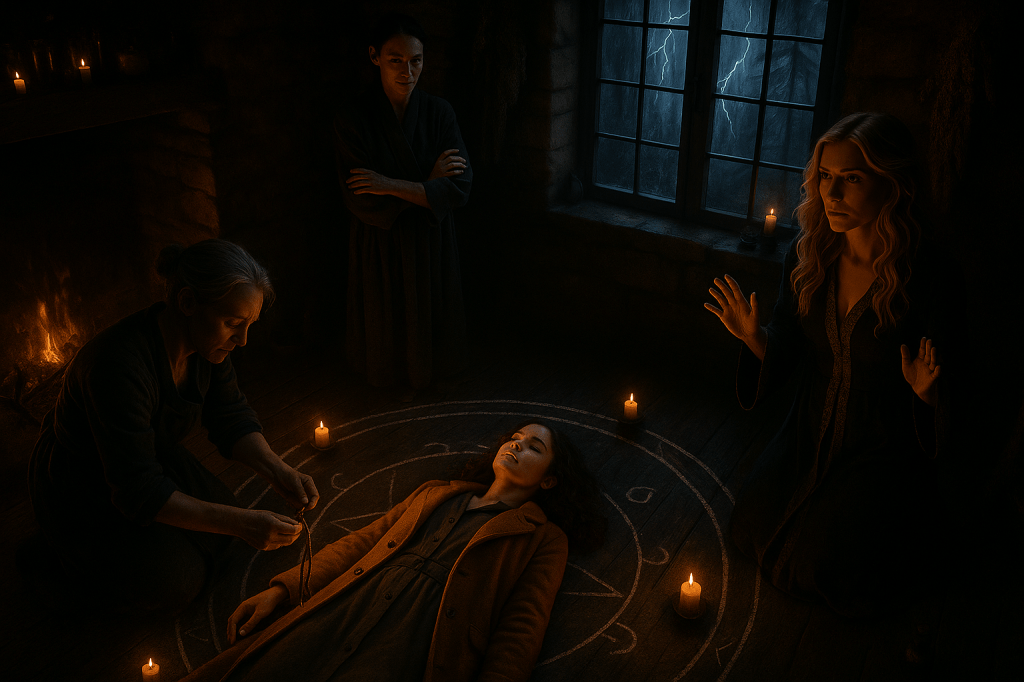
Brünnhilde

The reversal spell is a quiet thing. That surprises me.

We always imagine magic as thunder. But this feels like dew. Like breath against stone.

We kneel around the runes—drawn with care, weathered by time.

No candles. No incantations. Just us.

Our hands do not touch.

But our silence does.

And that, I think, is the oldest kind of spell.

MASTERLOCK PROMPT — ARTIFACT 13.3

“When the Circle Activates”**

ABSOLUTE REQUIREMENTS

Only the three canonical witches + Annaliese

No extra figures, silhouettes, or background characters

No uncontrolled magical flares, explosions, beams, or chaotic FX

Magic must appear as contained, structured, and ritually precise

GENERAL COMPOSITION

A tight, dramatic mid-shot looking slightly downward toward the ritual circle as it begins to activate.

The witches are positioned around Annaliese exactly as in Artifact 13.2:

Brünnhilde (left foreground, kneeling)

Magda (upper center, standing)

Ilsa (right foreground, half-crouched or leaning forward)

Annaliese lies at the circle’s center, eyes half-open, expression serene but charged, as if something ancient is waking.

MAGICAL EFFECT REQUIREMENTS

The activation MUST look:

contained

subtle yet powerful

rooted in ritual precision rather than spectacle

Visual effects allowed:

faint, structured glowing lines forming beneath Annaliese (like golden runes or geometric sigils)

dust motes rising in a circular pattern

a gentle inward pull of candlelight toward the center

low swirling of warm amber and cool blue energy meeting but not colliding

Absolutely NOT allowed:

beams of light

eruptions

chaotic storms

unintentional figures or faces in the magic

anything that breaks the photorealistic tone

CHARACTER EXPRESSIONS

Brünnhilde

Calm determination

Hands steady, hovering over the circle

Light reflecting off her weathered features

Magda

Intense focus

Eyes tracking the emerging sigils

Lips pressed tight, ready to intervene

Ilsa

Nervous awe

Golden nails catching the arcane light

Hair subtly lifting from ambient magical tension

Annaliese

Peaceful, illuminated from below

Eyes soft, slightly open

Breath rising visibly

LIGHTING & COLOR

Warm candlelight from the side

Cool stormlight from the window

Mixed with the soft internal glow of the ritual lines

Cinematic contrast, photorealistic textures

STYLE REQUIREMENTS

Hyper-detailed photorealism

No painterly softness

16:9 cinematic frame

Sharp facial fidelity

Realistic physics

HARD LIMITS

ONLY the three witches + Annaliese

No symbolic birds, animals, silhouettes, or visions

No active thunderstorms inside the cottage

Magic must remain refined, structured, and ritualistic

Ilsa

I can’t look at her.

I keep staring at the yellow thread on her coat sleeve, loose and curling like a question.

She was beautiful. Still is. But that’s not what makes it unbearable.

What makes it unbearable is that she saw us. She wasn’t afraid. She walked straight into our storm, and we broke her like glass we didn’t realize we were holding.

I kneel now because I can’t run.

“I’m sorry,” I say.

The words taste like rust.

“You weren’t the mirror,” I add. “We were.”
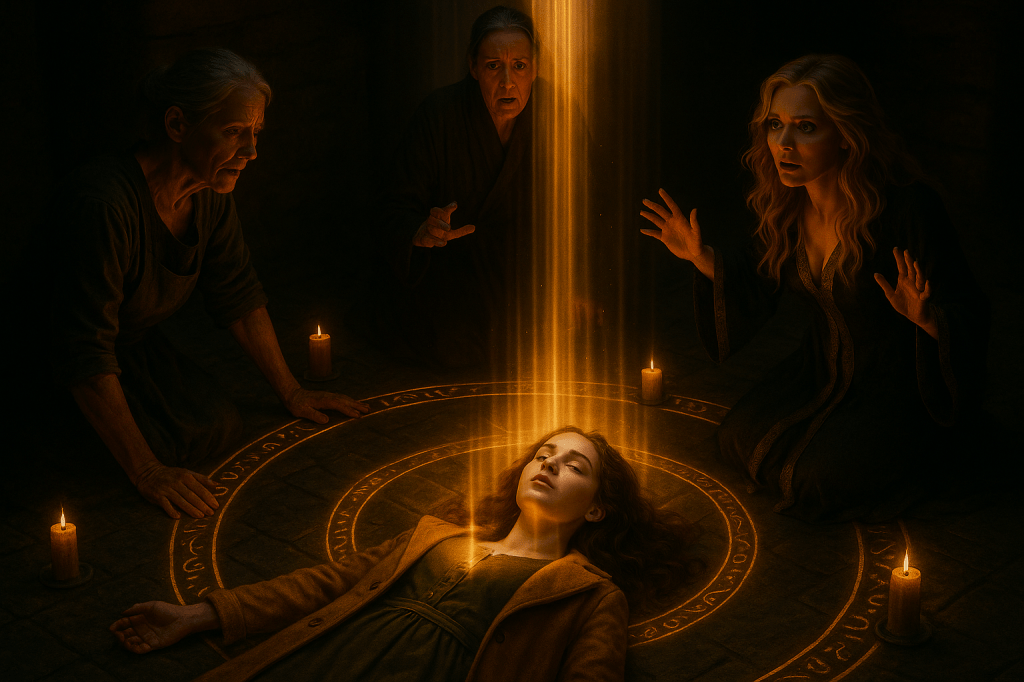
MASTERLOCK PROMPT — 
“The Surge / Annaliese Opens Her Eyes”

COMPOSITION — MID-WIDE CINEMATIC SHOT
The moment the reversal circle erupts with controlled-but-intense magical energy.
Annaliese lies at the center, eyes suddenly open—calm, lucid, almost luminous.
Golden light radiates upward in gentle columns, NOT explosive or violent.

CHARACTERS — EXACT CANON FOR ALL

Annaliese (center):

Fair, lightly freckled young woman

Long dark-golden wavy hair

Barefoot, mustard-yellow coat

Eyes open for the first time—soft, glowing slightly with inner magic

Expression: serene awareness, not fear

Body slightly elevated from the ground (subtle, not dramatic)

Witches in Triad Formation:

Brünnhilde (left):

Weathered face, gray hair in a tie

Strong hands gripping the circle’s edge

Expression of awe mixed with dread

Magda (center-left):

Tall, severe, tense posture

Dark wool robes, arms partially raised to stabilize energy

Eyes wide, caught between scientific fascination and alarm

Ilsa (right):

Luminous honey-blonde waves

Enchanted black robe with gold embroidery

Gold rings glowing with the surge’s reflection

Expression: devastation turning into recognition

LIGHTING & MAGIC PARAMETERS

Magic manifests as gold and soft white radiance—not beams

Sigils along the circle flare to life

Backlighting enhances Annaliese’s silhouette

Candle flames bend inward toward her

MOOD

Awe, fear, inevitability

The sense that Annaliese is awakening to something older than all three witches

HARD LIMITS

NO extra figures

NO monstrous or violent effects

Magic must stay subtle, elegant, mythic

No distortions of any canonical character design

STYLE

Photorealistic fantasy cinematography

High dynamic range, crisp detail, grounded realism

16:9 wide frame

Magda

I want to categorize this moment. Give it form.

But the lines don’t hold.

I spent nights calculating outcomes, drafting reversals, chasing precision.

But not once did I ask what she might want.

When she speaks—

“You knew better,” she says.

I do not argue.

“And still,” she says, “you chose control.”

The words crack something in me. Not shatter—splinter.

I see every choice I made in her stillness.

I don’t have an answer.

But I kneel. And this time, I stay.

It’s the first honest thing I’ve done in days.

LUMIVORE V1 — CANON SCENE PROMPT (DETAILED ARCHIVAL VERSION)
Plate V — “She Woke Herself” (Option A: Intimate Close Tableau)

Horizontal • Cinematic • Hyper-Realistic • A24 Tone
Eye-level framing • Close, intimate tableau • 35–50mm lens feel

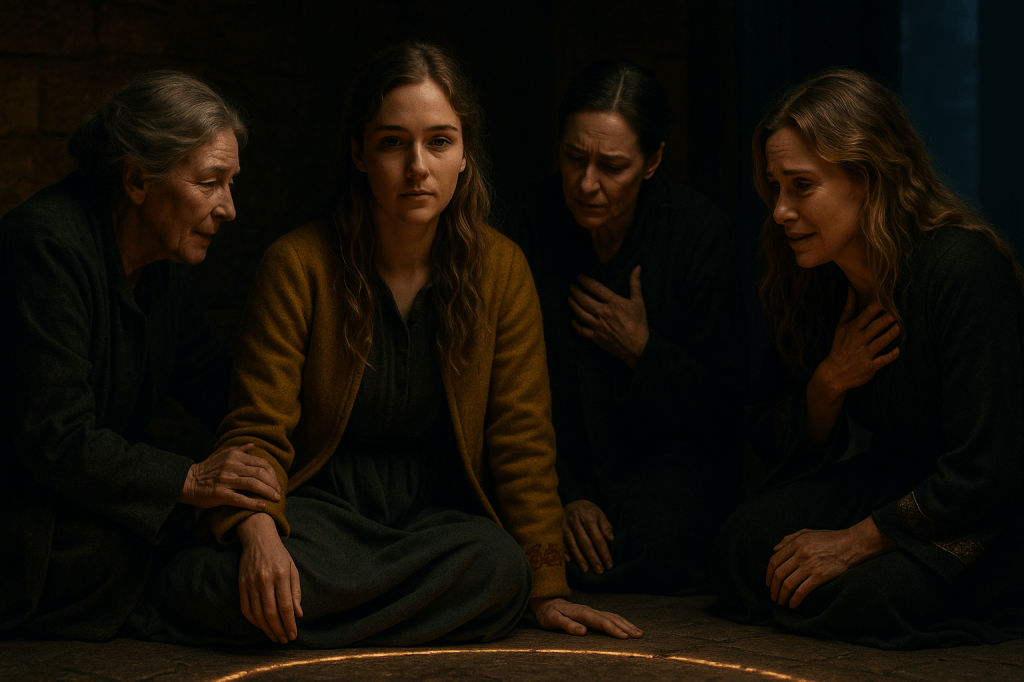
A horizontal, cinematic, photorealistic still frame inside a small stone cottage at night. The shot is framed closely around four women seated and crouched in an intimate semicircle. The atmosphere is quiet, warm, and emotionally charged. The remains of a faint golden ritual circle glow softly on the floor, almost extinguished. Warm candlelight illuminates the women’s faces with gentle chiaroscuro, while cool moonlight enters faintly through an open doorway in the background.

Annaliese (foreground center-left)

A fair, lightly freckled young woman in her early 20s with a natural adult build and realistic proportions sits at the edge of the dim ritual circle. She has long, dark-golden wavy hair and soft, grounded facial features. She wears a mustard-yellow wool coat with subtle red embroidery at the cuffs, draped naturally as she sits, and a forest-green dress beneath it. Her posture is steady and calm: one hand rests in her lap, while the other lightly touches the stone floor near the faint glow of the circle. Her expression is serene, clear, quietly fierce — the look of someone who has come into her truth and is no longer afraid. She is fully awake and centered.

Brünnhilde (left foreground)

An older woman with weathered features and tied-back gray hair kneels very close beside Annaliese. She wears dark, practical clothing. Her posture leans gently toward Annaliese, with one hand placed tenderly on Annaliese’s forearm in a gesture of relief and protection. Her face is soft, tired, and emotional — a small, aching smile forming as she looks at the young woman with love, regret, and release.

Magda (center-right, slightly behind)

A tall, severe woman with sharp features and dark hair pulled back, dressed in dark wool robes, sits or crouches slightly behind Annaliese. Her posture is usually rigid, but here it has softened: shoulders lowered, head slightly bowed. One hand rests against her chest, the other near her knee. Her expression is solemn and introspective — humbled, remorseful, shaken — as if reckoning with her part in what has unfolded.

Ilsa (right foreground)

A striking woman with long dark-blonde wavy hair and a black gown trimmed with gold embroidery crouches near Annaliese’s level. Her posture leans forward with emotional openness. One hand is lightly pressed to her chest as if controlling a surge of emotion — a sound between a laugh and a sob. Her eyes shine, her expression raw and tender, revealing a deep personal investment in Annaliese’s awakening.

Lighting & Atmosphere

Warm candlelight highlights the contours of their faces and hands, deepening the shadows around them and creating a sense of closeness. Faint moonlight from the open door adds a cool contrast behind the group. The golden circle’s light is nearly gone, just a faint line on the floor. The air feels still, intimate, and human — a moment of confession and recognition rather than magic.

Tone & Style

Hyper-realistic and emotionally grounded, with naturalistic lighting and subdued colors. No spectacle, no active magic, no stylization. The image captures four women in the immediate aftermath of truth — quiet, devastating, healing — like a sacred confession in visual form.

Anneliese (The Woman)

I dreamed a long time. I walked paths no one else could follow.

And I listened.

They spoke to me in sleep. They thought I couldn’t hear.

But I did.

I heard the longing in Ilsa’s laughter, the grief in Magda’s silence, the steady love in Brünnhilde’s touch.

I know now: they didn’t curse me to punish me.

They cursed me because they forgot they were women.

Not gods. Not myths. Just women, aching in their own skins.

So I speak.

“You didn’t put me to sleep,” I tell them. “I chose to rest. Because the world wouldn’t let me stop. My name is Anneliese.”

I look at each of them.

“You called me a mistake. A witness. A blessing. But you never asked who I was. I was always awake. You just didn’t see me.”

Brünnhilde’s breath catches. Ilsa’s eyes shine. Magda looks away.

“But I’m awake now,” I say again. “And I decide what that means.”

Ilsa lets out a sound between a laugh and a sob.

Magda nods once—like a queen stepping off her throne.

Brünnhilde smiles, tired and whole.

I rise.

The storm has passed.

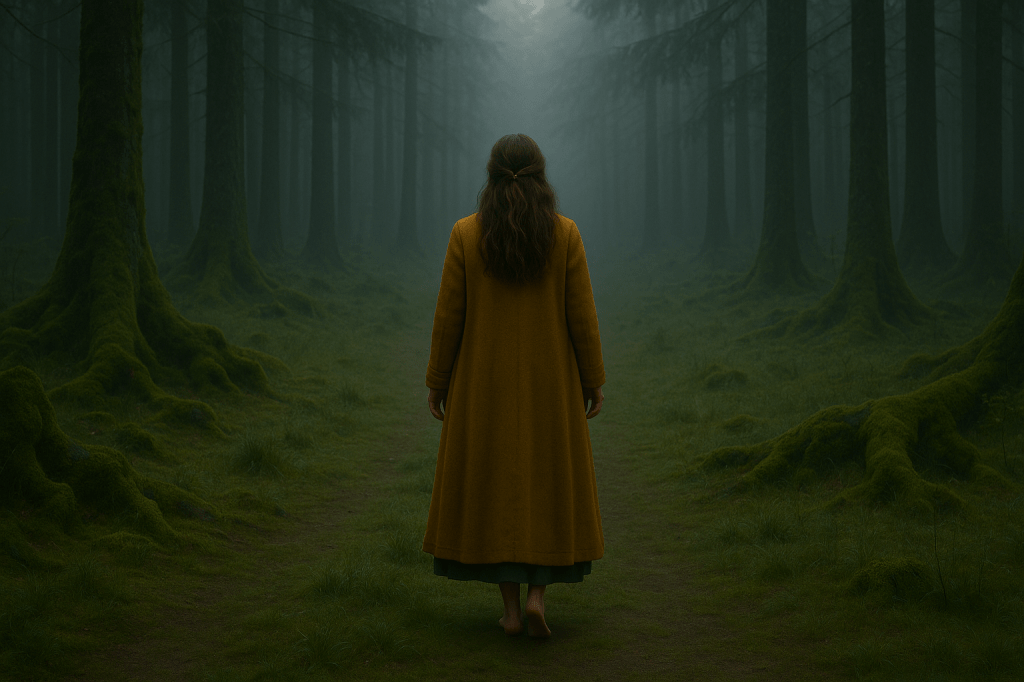
FINAL REVISED LUMIVORE V1 — CANON SCENE PROMPT Plate VI — “Epilogue: She Walks Into Her Own Story” HORIZONTAL • CINEMATIC • PHOTOREALISTIC • A24 TONE Wide framing • Dawn atmosphere • Natural lens A wide horizontal, cinematic, photorealistic still frame set at dawn in a mist-covered forest clearing. The light is soft silver-blue with faint warm undertones. Low morning fog curls around moss-covered roots. The scene is quiet, grounded, and mythic. ⭐ SPATIAL & DIRECTIONAL LOCKS (CRITICAL) Image must be horizontal, landscape orientation (no vertical framing). The forest spans fully from the left edge to the right edge of the frame. The woman appears in the lower third, not close-up. The camera is pulled back to show the width of the environment. The woman is walking AWAY from the viewer and INTO the deep forest. No cottage, no buildings, no structures, no windows, no doorways. No silhouettes or figures other than the woman. ⭐ Main Figure (Back to Camera, Long Coat Lock) At the center of the wide horizontal frame, a young woman with long dark-golden wavy hair tied loosely with twine walks barefoot through dew-covered grass toward the deeper forest. She has a natural adult build and realistic proportions. COAT LENGTH LOCK: She wears a long, ankle-length mustard-yellow wool coat with subtle red embroidery at the cuffs. The coat is heavy, full-bodied wool, with a straight, vertical drape that nearly reaches her bare feet. It moves subtly with her step, maintaining a floor-length silhouette consistent with her canonical appearance. Beneath the coat, the forest-green dress is visible in natural folds. She is mid-stride, posture relaxed and resolute, head lifted slightly as if listening to something ahead. She walks into mist that gently parts around her. ⭐ Environment & Atmosphere The forest ahead shows layered depth: tall pines, moss-covered trunks, drifting dawn fog. Soft, cool light filters through the trees with a faint warm rim glow outlining her coat and hair. No magical glow or effects — only natural dawn light. ⭐ Tone & Emotional Intent Hyper-realistic, restrained, contemplative. A quiet, solitary, hopeful folktale ending. This is the moment a woman walks into a story that belongs entirely to her. No witnesses. No past in the frame. Only her future ahead.

Brünnhilde

She left at dawn.

No one tried to stop her.

She didn’t say where she was going. Just took her yellow coat from the peg, tied her hair back with twine, and stepped into the wet grass barefoot.

The mist curled at her ankles. The trees watched.

Not the forest of maps, but the one behind the stories. The one where names are remembered, even if whispered only once.

Magda Eisenbaum stood at the window.

Ilsa Wundt brewed tea with too much cinnamon.

I opened the old book and added one last page.

“She was never ours to begin with,” I wrote. “But we are hers now, whether we admit it or not.”

They’ll tell the story wrong, of course.

They always do.

They’ll say a prince saved her. That a mirror told the truth. That magic wore a crown.

They might even call her Sleeping Beauty, as if her pause was a punishment, her waking a rescue. They’ll say anything but the truth: that she chose to stop. And chose, too, when to begin again.

But I was there.

I saw the forest open to greet her.

I know: She woke herself.


Archival Distinction Statement

The Fairest Mistake is not an adaptation of Sleeping Beauty, but a deliberate corrective re-entry into the fairytale lineage. Where traditional versions frame stillness as punishment, curse, or spectacle, this work reframes stillness as chosen suspension—a form of rest enacted by a woman whose body and spirit have been asked to endure without pause.

Unlike classical or modern retellings, the central figure (Anneliese) is never rendered unconscious, passive, or voiceless. Her stillness is neither imposed nor exploited; it is entered knowingly, inhabited consciously, and exited on her own terms. The narrative authority remains with women throughout—fractured, fallible, loving women whose misuse of power becomes the story’s true moral inquiry.

This work rejects rescue narratives, romantic awakening, and punitive enchantment. It proposes instead that rest itself can be an act of agency, and that awakening is not something done to a woman, but something she claims when ready.

She was never asleep.
She was listening.

– Märta Löwenfeld


LUMIVORE V1 — CANON PORTRAIT PROMPT (REFINED, FINAL)
Plate 0 — “Märta Löwenfeld at the Edge of the Mummelsee Forest”

Horizontal • Wide Cinematic • Photorealistic • A24 Tone
The Scholar as Listener • Archival Field Portrait

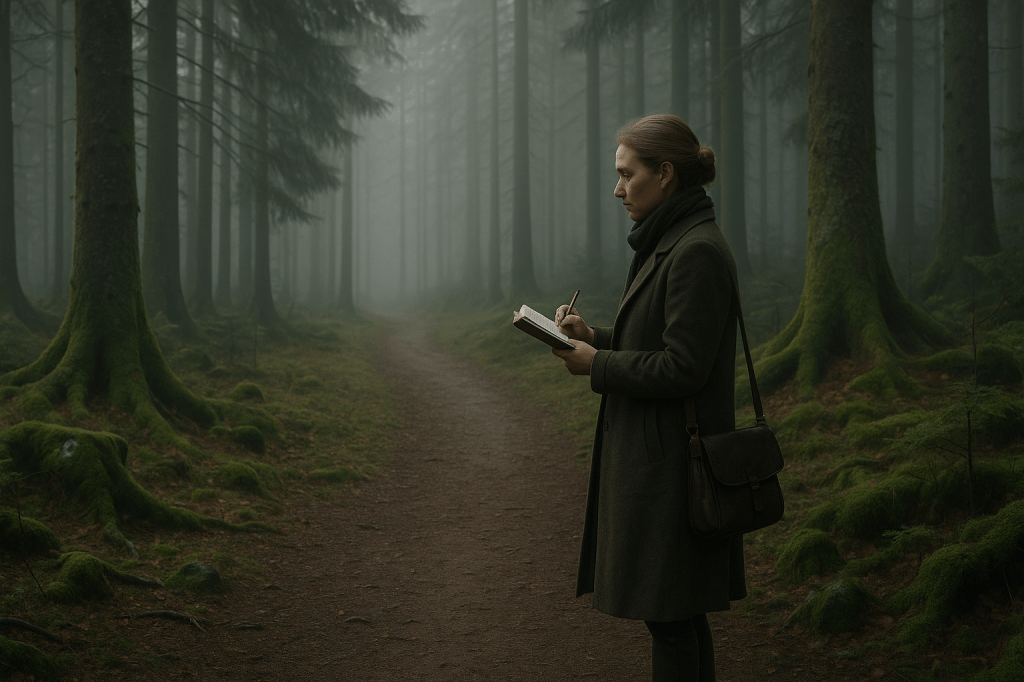
A wide horizontal, cinematic, photorealistic still frame set on a misted forest path near the Mummelsee in the northern Black Forest of Germany. The environment dominates the frame. Mist drifts between tall pine trunks and moss-covered roots. The light is soft, silvery, and atmospheric — early morning or late afternoon — creating a contemplative field-documentary mood.

⭐ Märta Löwenfeld — Canonical Appearance

A woman in her 40s with non-specific Central European features and a calm, intelligent presence.
She should not resemble Annaliese in any way.

She is positioned farther from the camera, appearing in the lower third of the frame.
The camera uses a wider lens to capture environmental scale over portrait detail.

Attire

Heavy wool coat in charcoal, forest brown, or deep olive

Sturdy leather boots (NOT barefoot)

Practical scarf for cold forest air

A satchel or crossbody field bag at her hip

Minimal to no makeup; a natural, grounded appearance

Hair

Medium or dark blonde hair pulled back loosely or in a low, functional bun.

⭐ Signature Gesture (Canon Lock)

Märta holds an open notebook in one hand and a pencil in the other.
She is actively writing or mid-observation — not posing.
The notebook is clearly visible but not theatrically highlighted.

This gesture signifies her role as the folklorist beginning her documentation of Der schönste Fehler.

⭐ Expression & Posture

Profile or semi-profile only — not facing the camera, no eye contact

Eyes directed toward the forest or toward her notebook

Relaxed shoulders, gentle posture

The expression conveys quiet concentration, attentiveness, and thought

She appears to be listening to the landscape, not performing for the viewer

This must read as a documentary capture of a woman at work in the field.

⭐ Environmental Composition Locks

Märta is 30–40% smaller in frame than in a typical portrait

She is located near a forest path leading deeper into mist

Tall pines and moss-covered roots create a strong vertical structure

Mist thickens farther into the woods

The scene is fully naturalistic

No buildings, no fantasy, no magical elements

Optional: a very subtle hint of the Mummelsee glinting through the trees (not required)

The environment must feel like the origin-place where Märta first “heard” the story.

⭐ Tone & Intent

Hyper-realistic.
Archival.
Quiet.
Observational.
A field photograph taken during research.

The final image should express the moment:

“Here is where she first understood that the old stories had left something out.”

I first began thinking of Der schönste Fehler while walking the forest path that circles the Mummelsee. The air was cold enough to sting, the mist thick enough to blur the pines into pale silhouettes. It was the kind of hour when a story can slip into you without permission.

Somewhere between the water’s edge and the tree line, a thought rose with the clarity of a bell struck underwater:

What if the witch was never the villain?
What if she wasn’t even alone?

I imagined three women — powerful, petty, brilliant — quarreling over something small and creating something large. I imagined a spell born not of malice, but of exhaustion, longing, and the quiet hunger to be seen. Not a curse — a pause.

And then I wondered about the girl at the center of it all.

What if she wasn’t a sleeping beauty?
What if she was never “put under”?
What if she simply… rested?

Not because a spindle demanded it.
Not because a story punished her.
But because the world had asked too much.

What if stillness itself was power?
What if she woke herself?

I wrote the first lines sitting on a cold stone at the lake’s edge. The mist shifted. The forest breathed. And somewhere within the trees, the story began to speak.

About the Setting
Near the Mummelsee, Baden-Württemberg

The Mummelsee is a small, glacial lake nestled high in the northern Black Forest of Germany—an area long steeped in myth, folklore, and shadowed beauty. Local legends speak of water spirits (Nixen), hidden worlds, and travelers who enter the forest and never return quite the same.

The name “Mummelsee” is said to derive from the Old High German word murmelen, meaning “to murmur”—a reference to the sound of the water and the secrets whispered across its surface. Some say the lake is bottomless. Others say it mirrors what you aren’t ready to see.

Setting Der schönste Fehler near the Mummelsee was a deliberate choice—to root the story in the ancestral soil of Germanic fairytales, but to tell one where a woman walks into magic, not to be silenced or saved, but to pause, remember, and choose her own ending.

It is not the forest of maps.

It is the one behind the stories.

— Märta Löwenfeld
Baden-Württemberg / Los Angeles