
If You Stop, You Miss Me
Story Written By
Livia Sartori & Camilla De Rossi
Visuals & Imagery Created By
Isotta Marin, Marta Rizzi,
Nina Callegari, Arianna Valeri, & Scott Bryant
With care and reverence, their story is shared by
Scott Bryant at the request of Livia Sartori & Camilla De Rossi
This story was conceived during Carnival, in the early hours, while walking without destination.
Scene I — Cannaregio | Just After Midnight
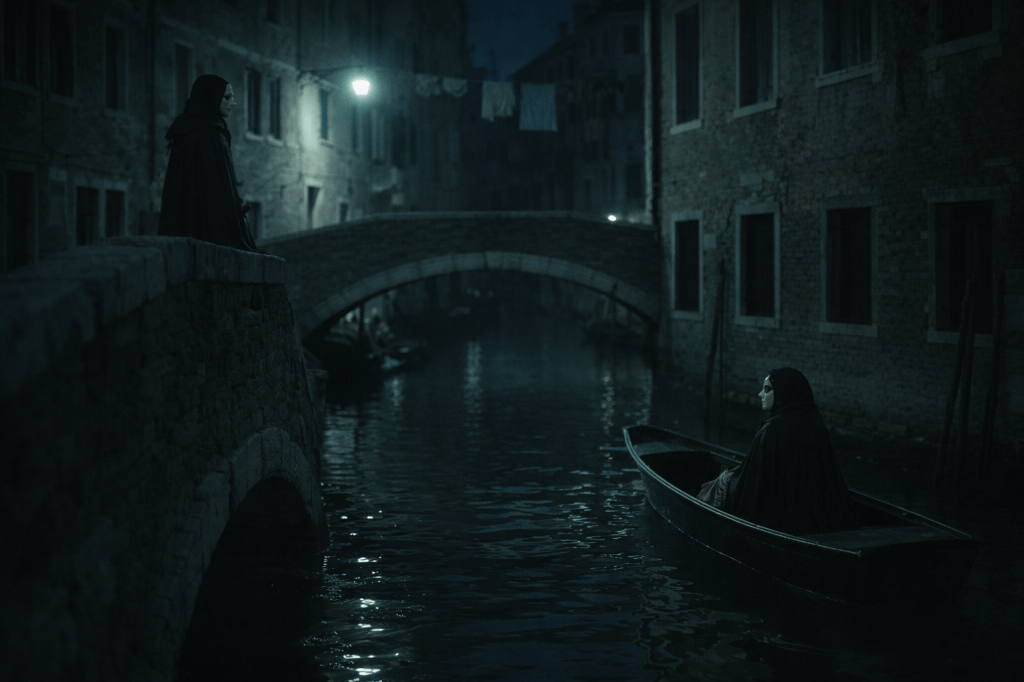
The canal was narrow enough that the sound of the water arrived before the boat did. Not a splash, not a wake — just the low, steady movement that belongs to someone who knows where they’re going and isn’t announcing it.
I was already on the bridge when she passed beneath me, moving in the opposite direction. For a moment I watched the reflection instead of the body — the lamp trembling on the water, the pale oval of a mask broken into fragments by the ripples — and only then did I look down.
She was seated low, her posture unhurried, the dark of her cloak absorbing what little light there was. The Moretta gave nothing away except the eyes. Even those did not search. They lifted briefly, as if checking the height of the bridge — and met mine by accident, or by something close enough to accident that it felt the same.
It was not a long look.
It did not need to be.
The boat continued. The canal carried her forward. The moment passed before I understood that it had happened at all.
I stayed where I was, my hands resting on the stone, the smell of damp masonry and old water rising faintly as if the night had exhaled. The surface below smoothed itself. The lamp steadied. There was nothing there to follow anymore.
Only then did it arrive — not urgency, not desire, but clarity.
I could stop now.
She would never know I had been here.
The thought did not feel like loss.
It felt like permission.
I stepped down from the bridge and turned, not quickly, not to catch her, but because my body had already chosen the direction before I asked it why. The calle opened and narrowed the way it always does — laundry lines overhead, windows dark, the city pared back to what remains when it is no longer being watched.
I did not see her again right away. That felt important too.
When I did, it was not because she had waited. It was because our pace had found the same measure. We took the same narrow turn without looking at one another, as if the city itself had decided there was only one reasonable way forward.
Her mask caught the light once, then did not again.
I kept enough distance to leave room for doubt. She did not hurry. I did not either.
There were fewer masks here, fewer reasons to explain oneself. The night had thinned to those who understood it without instruction. Every corner held the possibility of disappearance — not as threat, but as fact.
I followed without calling it that.
When she turned her head slightly — not back, never back, only enough that I could see the line of her jaw beneath the velvet — I understood the rule without being told.
Keep up, or miss it.
I did not feel tested.
I felt invited.
Scene II — Castello | Deep Night
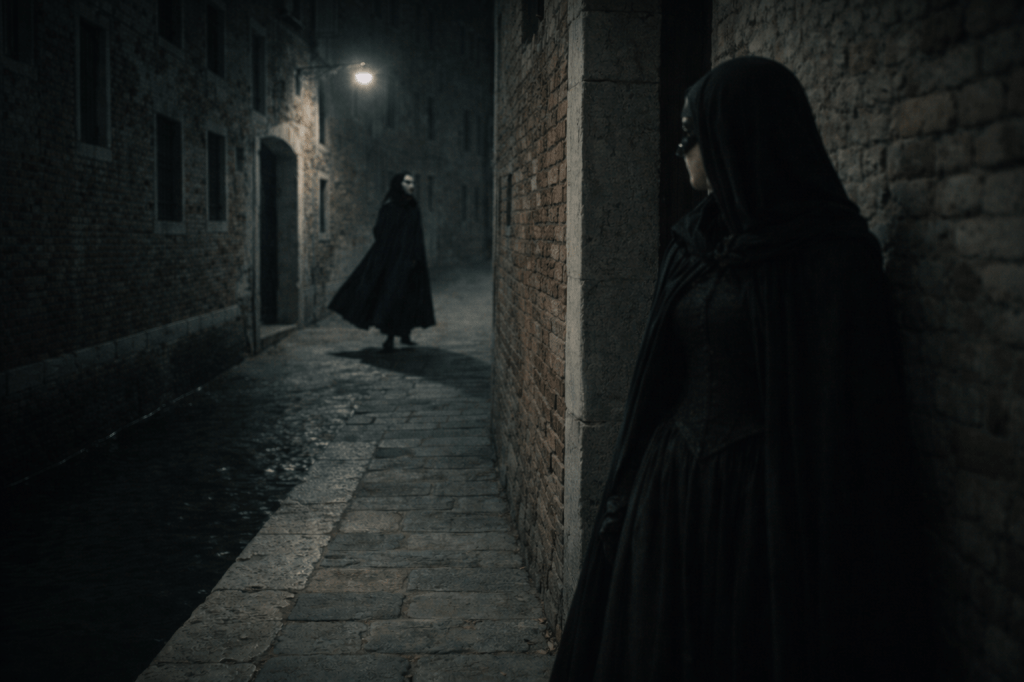
The streets changed without announcing themselves. The lamps thinned. The walls drew closer. The night learned how to hold its breath.
Here, the city felt less like a place and more like a sequence — one turn leading cleanly to the next, as if hesitation had already been accounted for and removed. She moved through it with the confidence of someone who did not need to remember where she was going. I understood then that this was not wandering. It was selection.
She took a corner first.
I followed — not quickly, not to catch her, only to remain.
The distance between us widened, then narrowed again, never by accident. When it stretched, the night stretched with it. When it closed, the space adjusted as if it had been waiting. She did not look back. She did not need to.
At one point she slowed, just enough that I noticed it before I understood why. A breath. A half-step. I matched it without thinking. The pace resumed.
That was when the game revealed itself.
Not pursuit.
Not invitation.
Alignment.
We passed through a covered passage where sound vanished completely, the stone swallowing it whole. Her cloak brushed the wall once, then did not again. I became aware of my own movement — the way fabric responds, the way attention sharpens when nothing interrupts it.
She turned her head slightly as we crossed a small square emptied of everything but shadow. This time her eyes met mine directly, openly, as if confirming something already agreed upon.
The look did not linger.
It didn’t have to.
When she moved on, she did not wait to see if I would follow. That mattered. The choice remained mine, intact and unobserved.
I stayed with her rhythm, letting the city fall away in sections. Each glance felt different from the last. Each one altered the shape of what was possible without ever fixing it in place.
The masks did their work.
Nothing was exchanged.
Nothing was asked.
Only the shared understanding that if I faltered — if I stopped to name what this was — it would vanish. Not as punishment. As consequence.
So I didn’t.
I let the night hold us in parallel, the movement itself becoming the agreement.
Scene III — Dorsoduro | Pre-Dawn

The dark did not end.
It thinned.
The lamps no longer held the street by themselves. Stone began to show its color again — not fully, not honestly, but enough to change how distance behaved. Shadows softened. Edges lost their urgency. Carnival loosened its grip without apology.
She slowed first.
Not a stop.
Not an invitation.
A yielding.
I came alongside her without marking the moment it happened. One step, then another, until the space between us was no longer something I measured. We walked together now, neither leading nor following, our pace held by the same quiet understanding that had carried us this far.
I became aware of her differently. Not through direction or distance, but through proximity — the way air changes when someone occupies it beside you. The mask still hid her face. The cloak still kept its shape. But the effort of maintaining separation had fallen away.
We did not look at each other often.
We didn’t need to.
The city opened slightly here. Water brightened at the edges. Somewhere beyond sight, the day waited — patient, inevitable. Carnival did not vanish. It simply stepped back.
I thought, briefly, that this was where it might end. That one of us would turn, or slow, or allow the light to decide for us.
Neither of us did.
We continued forward, side by side, our reflections joining where the pavement darkened, separating again where it dried. The rhythm had changed, but it remained shared. No more testing. No more measuring.
The night had already given us everything it meant to.
When the street widened enough that direction mattered again, she angled away — not abruptly, not with regret. Just enough to reclaim her own line. I did not follow this time. I did not feel the need to.
We did not remove our masks.
There was no moment that required it.
She went on.
So did I.
And when the light finally reached my face, I understood that nothing had been left unfinished — only unclaimed.
Which felt, unexpectedly, like freedom.
 Scott Bryant
You must be logged in to post a comment.