Cendre et la Couronne – Part II

Story Written By
Queen Aveline Beaumont,
Crown Steward Cinder Dubois,
Duchess Claudine Delisle,
& Madame Esmée Étoile

Told Through the Voices Of
Queen Aveline Beaumont
& Crown Steward Cinder Dubois

Visuals & Imagery Conjured By
Liora Marivelle, Céleste Rousselle,
Théa Lavellan, Éline Vervain,
Maëlle Étoilemont, & Scott Bryant

Spellwork & Whispered Magic By
Madame Esmée Étoile

Intimacy Coordination By
Queen Aveline Beaumont &
Crown Steward Cinder Dubois,
who shaped their closeness with intention,
trust, and truth

With steadfast loyalty, our story is shared by
Scott Bryant, at the royal request of Queen Aveline Beaumont, Crown Steward Cinder Dubois, Duchess Claudine Delisle,
& Madame Esmée Étoile

I believed my story would be written for me—a crown pressed to my head, my steps measured by expectations, my words never truly my own. But I learned, sometimes through fire, that the world is not balanced by silence.”
— Queen Aveline Beaumont

“They called me Cinder because I lived among the ashes. But even from the soot, I learned to see sparks.”
— Crown Steward Cinder Dubois


Part 2: The Ball
Anticipation and Defiance

Aveline

The palace is restless. Servants scurry through the halls, their arms laden with flowers and linens, their whispers barely audible over the clatter of preparations. The courtiers are no better, their usual games of gossip and intrigue heightened by the promise of new faces and alliances.

A cinematic, fairy tale realistic depiction of Princess Aveline Beaumont, a French princess in her mid-to-late 20s, standing alone on the stone balcony outside her royal chambers on the night of the grand ball. The scene is set at twilight, with the last golden light of the setting sun filtering through heavy, storm-gathering clouds. The sky glows with hues of violet, rose-gold, and deep gray, suggesting beauty tinged with impending disruption.

Aveline gazes out over the formal palace gardens below—designed with spiral hedgerows, shimmering fountains, and bursts of roses, irises, lilies, and orange blossoms. The air is richly fragrant and charged with the metallic tang of rain, the wind beginning to stir. A few raindrops darken the stone balustrade where her gloved hands rest lightly.

She wears a deep indigo silk ball gown with voluminous skirts, a fitted bodice, and understated silver embroidery of stars and climbing vines. Her chestnut-brown hair is styled into a braided chignon, secured with a pearl comb, with soft strands framing her fair, contemplative face. Her almond-shaped brown eyes scan the horizon with an expression of poise, tension, and quiet determination.

The breeze lifts the hem of her gown slightly, and the light dances across the embroidery as if whispering secrets of the storm to come. The composition evokes stillness at the edge of motion, a poised moment of reflection and anticipation. The mood blends regal serenity with atmospheric tension, echoing the weight of responsibility and the unspoken threads winding beneath the night’s celebrations.

I watch it all from the balcony outside my chambers, the view of the palace gardens stretching out before me. The air smells of orange blossoms and rain, the clouds above hinting at a storm that hasn’t yet arrived. It feels fitting, somehow.

“Aveline.” My mother’s voice is as sharp as the heels of her shoes against the marble floor. She doesn’t wait for me to turn before she speaks again. “The Crown Prince of Aeloria arrives tonight. You will make an impression.”

I keep my gaze on the gardens.

“I’m sure I will.”

Her silence is heavy, a warning in itself.

“This ball is an opportunity, not a burden. You would do well to remember that.”

I finally turn to face her, forcing my expression into the careful neutrality she’s taught me.

“And what would you have me do, Mother? Smile until my jaw aches? Dance until my feet bleed?”

“If that’s what it takes,” she replies without hesitation.

The knot in my chest tightens. I want to scream, to tell her that I am not a pawn to be traded or a prize to be won. But I know it would only fall on deaf ears. Instead, I incline my head, offering the kind of smile that’s polished and hollow.

“As you wish.”
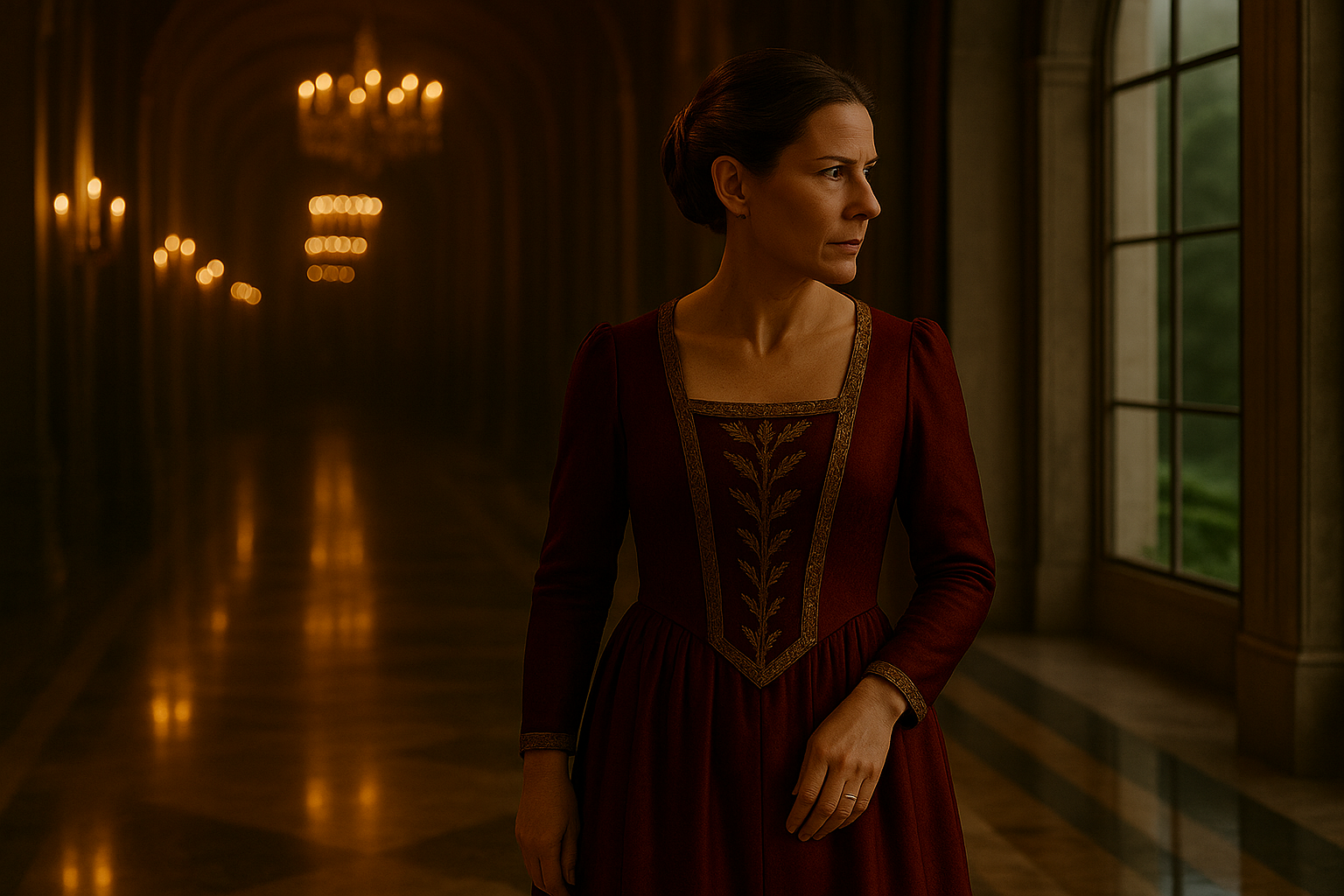
A horizontal, cinematic, gorgeously lit, fairy tale–realistic film still set in a Charles Perrault–style 17th-century French palace. The image features Queen Geneviève Beaumont, a regal French queen in her late 40s, standing alone in a vast marble corridor with a vaulted ceiling and arched windows. Her dark chestnut hair, streaked with silver, is styled into a braided chignon secured with an ivory comb. She wears her canonical deep garnet silk ball gown with a high neckline, long sleeves, and gold vine embroidery down the bodice and cuffs. She wears no necklace or earrings—only a simple gold wedding band on one hand. The lighting is dim and moody, lit by chandeliers and wall sconces casting warm golden highlights and deep shadows across the polished Carrara marble floor.

To her right, tall windows reveal a lush, sunlit royal garden outside—symbolizing possibility and freedom. The Queen stands near the window but turned inward, her expression thoughtful and restrained, posture upright with one arm lowered at her side and the other slightly bent, as if mid-step or mid-thought. The framing contrasts the luminous outside world with the darker, more confined interior, emphasizing emotional distance and quiet power. The visual tone conveys regal command under pressure, solitude, and the unspoken tension of maternal expectation.

She leaves without another word, the sound of her retreating footsteps echoing in the corridor. I let the smile drop the moment she’s gone.

Far below, the first guests begin to arrive, their carriages winding through the gates like dark serpents against the pale stone. For a moment, I close my eyes and imagine being anywhere else—somewhere where the air isn’t so heavy, where every glance doesn’t carry expectations.

But no matter how hard I wish, I know I’ll never escape this place. Not unless someone shows me the way out.

The Enchantment

A cinematic, gorgeously lit fairy tale realism scene featuring Cinder Dubois, a young French woman in her mid-to-late 20s, just moments before her magical transformation. She is seated on the floor in a dim, candlelit room within a crumbling estate in Charles Perrault–era France. The room is small and timeworn — cracked plaster walls, a low wooden beam ceiling, and a single glowing candle on a rough-hewn table. The warm flicker of the candle casts long shadows across the space, illuminating dust motes dancing in the air.

Cinder has olive-toned, sun-kissed skin with a soft, natural blush on her cheeks, and dark expressive eyes filled with a mixture of apprehension and quiet resolve. Her thick, wavy brown hair is tied loosely in a braid, a few strands escaping to frame her angular face. She wears a patched, earth-toned wool dress in muted greens and browns — clearly handmade and visibly worn — and is barefoot.

Her posture is still, slightly hunched forward, hands resting in her lap or lightly grazing a weathered wooden tabletop. The atmosphere hums with anticipation. There is a faint glimmer coming from beneath the floorboards — a hidden grimoire about to stir. Outside the window, the night is silent, the outlines of dark, enchanted trees barely visible. The visual style is painterly and cinematic, with realistic textures, soft light gradients, and a shallow depth of field that focuses intimately on her expression.

The tone of the image is quiet, emotionally intimate, and steeped in pre-transformation wonder — the moment just before Cinder steps into her fate.

Cinder

The room is quiet, save for the soft crackle of the dying fire and the faint rustle of pages as I turn them. The night presses against the cracked window, darkness broken only by the flicker of a single candle. Shadows dance across the rough walls—shifting, listening.

The grimoire rests open before me, its pages steeped in looping script and ancient symbols I’ve barely begun to understand.

I kneel and place it on the floor, careful, reverent.

This is it—the moment I’ve been drawn to and afraid of. The whispers have led me here, always forward. But now, doubt coils around my ribs like smoke.

What if I’m wrong? What if the magic slips through my fingers like water, leaving nothing behind?

I steady my trembling hands and let my fingertips brush the golden threads woven faintly into the pages.

Then I stand.

The symbols begin to glow—soft, steady, pulsing in rhythm with my heart. The air thickens. The spell has begun.

It tastes like starlight. I don’t know how else to describe it.

The grimoire’s pages rustle as if breathing. The candle flickers violently. I whisper the incantation, each word strange and familiar in equal measure.

Warmth blooms around me, wrapping against my skin like a second layer. My body rises—slowly, weightlessly—suspended above the book, heart pounding.

A digital painting in a semi-realistic, cinematic fairy tale style. A young French woman in her mid-to-late 20s floats gently above the floor in a dimly lit stone room, the early stages of a magical transformation unfolding around her. She has olive-toned skin, expressive dark almond-shaped eyes, and long, thick brown hair loosely tied back in a braid, with strands curling near her face. She wears a patched, earth-toned wool dress—worn, humble, and textured—still unaltered by the spell. Her bare feet hover slightly above the stone floor. Beneath her, an ancient grimoire lies open on the ground, glowing softly with golden symbols and spellwork. Delicate threads of light begin to spiral upward from the book, curling around her arms and legs as the enchantment awakens. The candlelit room is quiet and rustic, with shadows dancing across rough stone walls and wooden beams overhead. The warm glow of firelight and the cooler glimmer of magical golden light blend atmospherically. The mood is reverent, emotional, and grounded in fairy tale realism. Horizontal composition, cinematic lighting, richly textured, deeply magical.

The whispers surge, curling through the air like threads of smoke. They brush my skin, electric and knowing. One note, then another, until they form a single, breathless hum.

And then—my dress begins to dissolve.
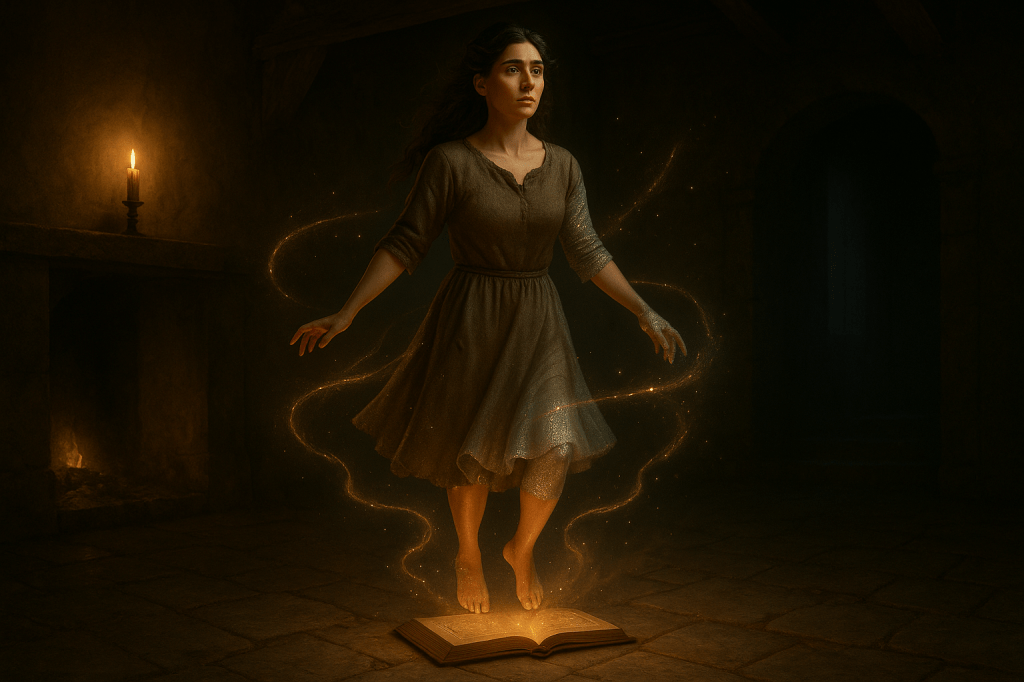
Ash and patchwork fall away, replaced by silk and silver.
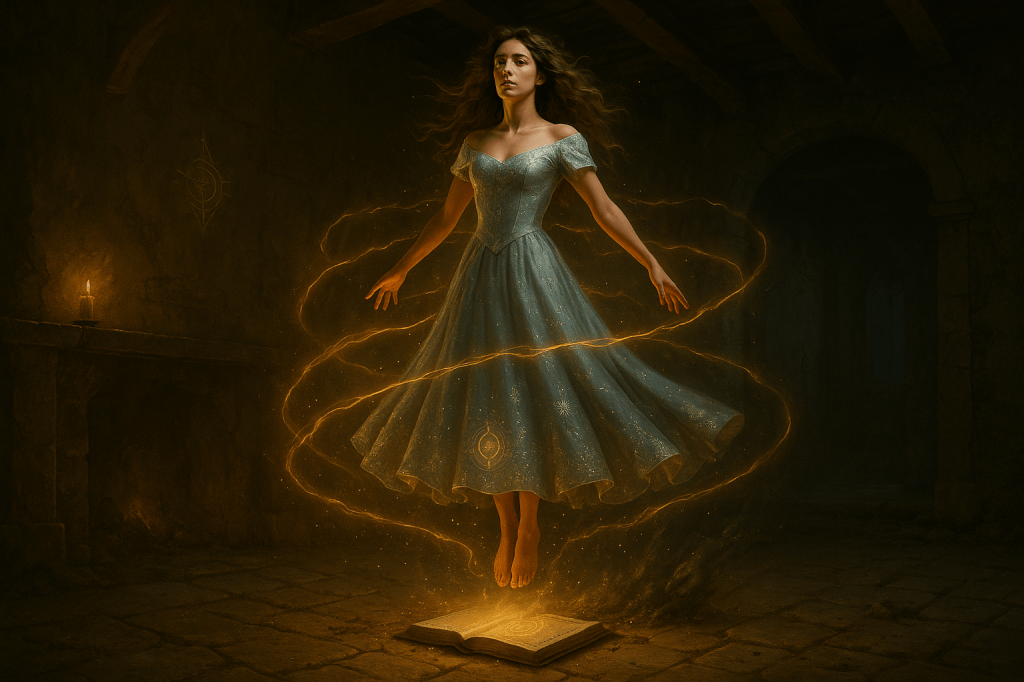
HORIZONTAL IMAGE – A cinematic, fairy tale realism digital painting capturing a powerful transformation scene inside a dim, crumbling chamber of a French fairy tale estate. The focus is Cinder Dubois, a young French woman in her mid-to-late 20s with olive-toned skin that glows warmly in the radiant light. She is suspended midair, surrounded by swirling threads of golden magical light, as her transformation into a shimmering silver ball gown begins.

Below her, a grimoire lies open, glowing with arcane energy, its pages illuminated with glowing symbols and one central glyph. The golden glow from the book casts soft, realistic illumination upward, creating warm highlights across Cinder’s cheekbones, gown, and floating strands of hair.

Her thick, wavy brown hair flows gently around her face, lifted by the energy of the spell. She gazes slightly downward in a moment of quiet awe and determination, her almond-shaped dark eyes reflecting the glow. Her old earth-toned wool dress dissolves at her feet, breaking apart into threads and embers, visually anchoring the before/after transformation. Fragments of fabric and soft ash trail downward, suspended in the light.

The new gown forms around her, mid-transformation — a beautifully embroidered silver gown that gleams like liquid moonlight, with subtle magical star motifs and runic embroidery across the hem and sleeves. It flows around her body with weight and texture, not exaggerated or floating unnaturally.

The background includes cracked stone walls, faint faded glyphs, and flickering golden reflections dancing on the beams and corners of the chamber. Soft shadows deepen beneath her feet, emphasizing her levitation and the gravity-defying stillness of the moment. The air is charged with magic, with a faint golden haze around her, and the overall scene is lit like a realistic film still — glowing, cinematic, and emotionally resonant.

The transformation is seamless, like moonlight being poured over my shoulders.

HORIZONTAL IMAGE: A cinematic, fairy tale realism scene of Cinder Dubois, a young French woman in her mid-to-late 20s, suspended gracefully in the air during the magical transformation into her ball gown inside a crumbling, dimly lit French fairy tale estate. The scene takes place at night, with the room bathed in warm golden light radiating from a glowing grimoire open on the floor below her.

Cinder’s olive-toned skin glows softly in the magical light, her thick, wavy brown hair flowing freely in the air, catching the glow as if lifted by the energy of the spell. Her angular face shows a mix of awe, resolve, and wonder. Around her, threads of golden light spiral and swirl, casting sparks and trails as they lift and encircle her.

Her patched wool dress dissolves into ash-like threads near the floor, visible as wisps disintegrating beneath her, while a shimmering silver ball gown begins to form mid-air around her body — the fabric glowing like liquid moonlight, layered and embroidered with faint magical glyphs, stars, and blooming vines. One glyph on her gown subtly mirrors the arcane symbol glowing on the page of the grimoire.

The stone walls and columns behind her show faint, faded sigils and cracks, as if the room has long housed enchantments. The golden light reflects off these textures, adding visual depth and grounding. A soft shadow beneath her feet emphasizes her lift. The space glows with quiet intensity — the air humming with ethereal magic, candlelight flickering faintly in the corners, and a deep stillness holding the moment aloft.

The composition is captured in a realistic, cinematic style, blending historical French fairy tale textures with magical realism — evocative, emotional, and breathtaking in visual tone.

The gown shimmers like liquid starlight, embroidered with patterns that resemble constellations and wild roses.
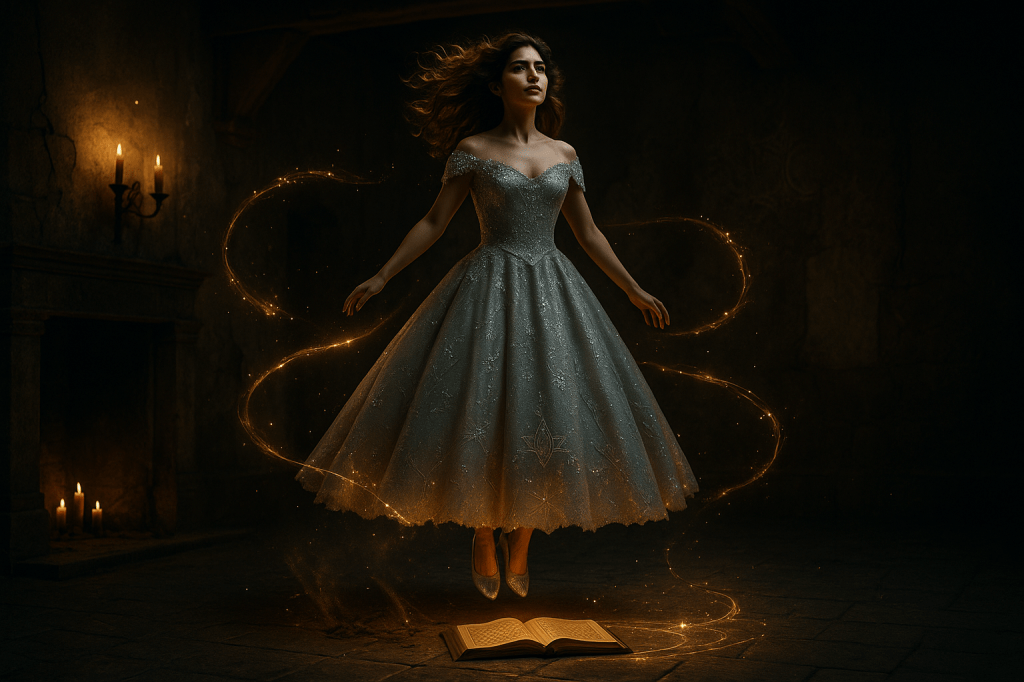
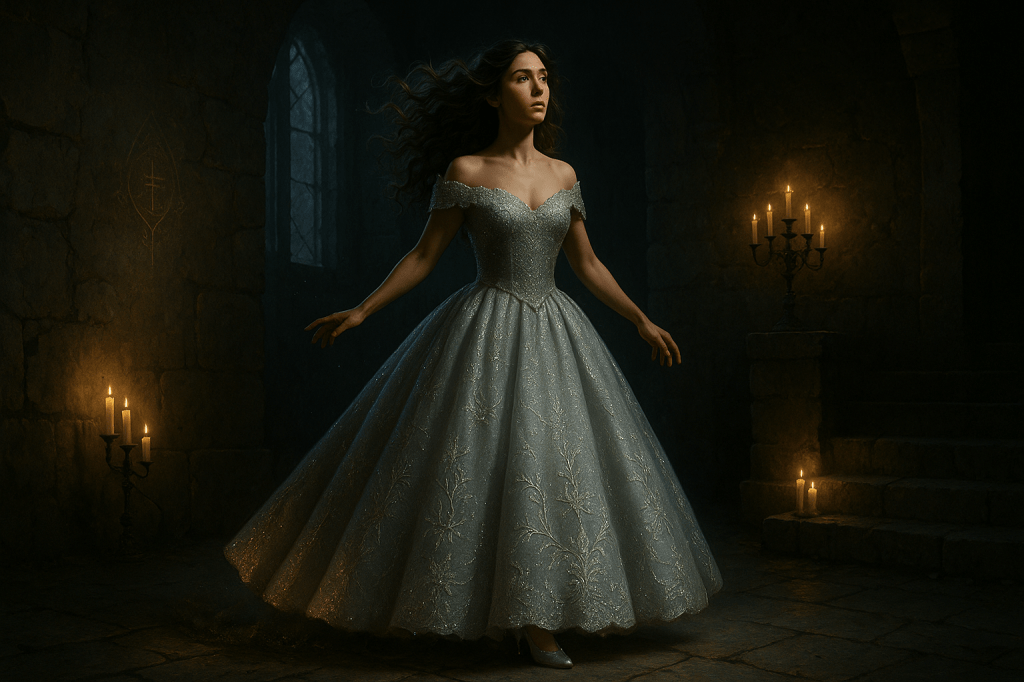
A cinematic, photorealistic fairy tale scene of Cinder Dubois, a young French woman in her mid-to-late 20s, suspended mid-air in the midst of a magical transformation in a dimly lit, crumbling French fairy tale estate at night. Her olive-toned skin glows with warm, golden light emanating from the open grimoire beneath her, which lies on a stone floor, its pages radiating softly with glowing arcane symbols. She wears a shimmering silver ball gown that ripples like liquid moonlight, detailed with embroidered patterns of stars, constellations, and blooming vines that faintly glow with magic. Her thick, wavy brown hair flows upward, catching the golden light in soft tendrils. Her angular face reflects a mix of awe, power, and quiet resolve. The crumbling walls around her are textured with age: peeling plaster, faint scorch marks, and subtle faded glyphs that suggest old enchantments still linger. Glowing golden threads of light spiral around her body, some coiling around her hands and arms, others lifting the last remnants of her old wool dress into the air as threads and ash. The room is illuminated only by the spell's golden glow and faint candlelight from wall sconces, casting soft shadows and adding depth. The visual style is gorgeously shot, like a live-action fairy tale movie — realistic lighting, fine textural detail, graceful composition. Horizontal framing, shallow depth of field, softly glowing particles floating in the air, magical realism meets cinematic depth of field, fairy tale realism style.
A digital painting in a realistic, fairy tale-inspired cinematic style. The scene captures Cinder Dubois, a young French woman in her mid-to-late 20s, during the final moment of her magical ball gown transformation. She floats gracefully above the stone floor of a crumbling, dimly lit French fairy tale estate. The background shows aged stone walls, worn wooden beams, faded carvings, cracked plaster, and faint golden arcane symbols etched in the stone—subtle hints of ancient enchantment. Candlelight flickers from old sconces and a long-extinguished fireplace.
Golden magical threads spiral around her, trailing embers in the dark. Her silver gown is fully formed, shimmering like liquid moonlight, embroidered with delicate, glowing patterns of stars, vines, and magical glyphs that echo the open grimoire beneath her. Her olive-toned skin glows warmly in the magic’s radiance. Her long, wavy brown hair floats around her as if suspended in spellbound air, catching soft golden highlights.
Her expression is one of awe and determination—her eyes reflecting quiet power and readiness. Below her, the grimoire lies open on the worn stone floor, emitting radiant golden light from intricate illuminated pages. Small remnants of her former wool dress swirl around her boots like ash or vanishing thread, hinting at the price of the transformation. The atmosphere is thick with enchanted stillness, illuminated only by magic and candlelight. The visual tone is cinematic, richly detailed, warm and darkly glowing—capturing the moment between old identity and new destiny.

When the light fades, I look down and gasp.

My hands, once rough and scarred, now gleam like polished ivory. My hair falls in soft waves, freed from soot and string. My feet are wrapped in glass-like slippers that catch the flicker of the candle and scatter it like stars.
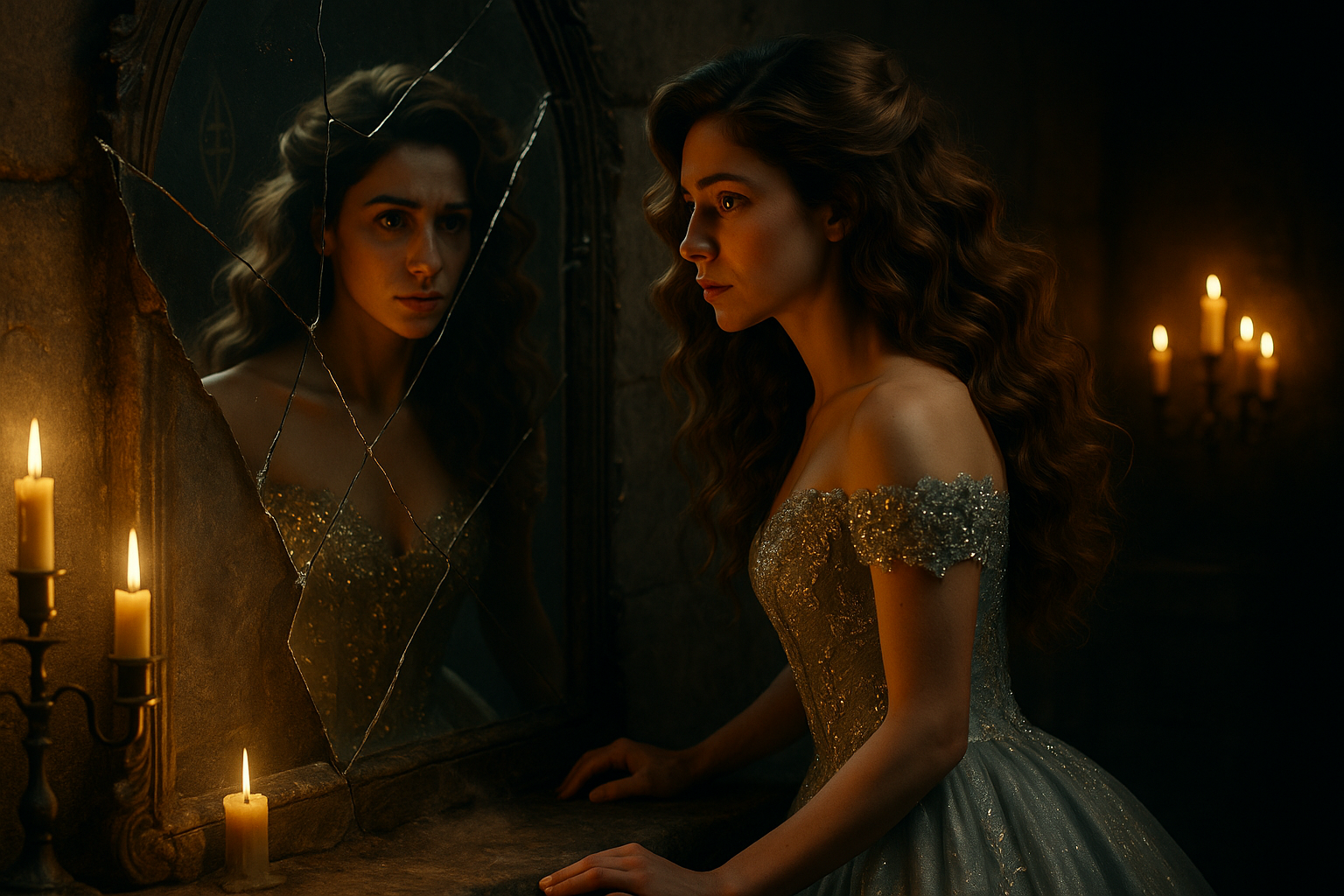
A cinematic, fairy tale realism photograph of Cinder Dubois, a young French woman in her mid-to-late 20s, standing in a crumbling, dimly lit room of a French fairy tale estate. She wears a fully transformed silver ball gown, shimmering with fine embroidery resembling moonlit vines and stars, crafted from delicate yet realistic fabric that sparkles subtly in the candlelight. Her olive-toned skin glows softly. Her thick, wavy brown hair flows freely and naturally around her shoulders, with strands catching the warm light. Cinder’s expression is poised, filled with resolve and wonder, as she pauses mid-step at the top of a worn stone stair, the folds of her gown falling gracefully around her. She wears historically appropriate ballroom shoes—dainty, glass-like or satin slippers that fit the era of Charles Perrault’s France. The background reveals aged stone walls, etched with faint, arcane glyphs glowing dimly. Tall candle sconces cast flickering golden shadows. The scene is horizontal, beautifully composed, richly lit, and deeply atmospheric—evoking the aesthetic of a cinematic fairy tale brought to life with realism and enchanted subtlety.

I catch my reflection in a cracked shard of mirror.

For the first time, I see someone unrecognizable—not Cinder, not ash, not girl-servant or ghost. A girl who could belong in the stories I thought were never meant for me.

I touch my face. Clean. Luminous. Real.

And for a moment, I believe I could belong.

For the first time, I feel like I belong in a story.

Somewhere far away—or maybe closer than I think—a princess might be turning her head, sensing the starlight gathering here.

But the whispers return, softer now. Like a lullaby.

“Find the crown.”

I clutch the stolen invitation, my heart racing. Whatever waits for me at the palace, I know I cannot turn back.

The Ball

Aveline

The ballroom hums with life.

Every corner is filled with color and movement—gowns that shimmer like moonlight, the glint of jewels catching the light from the chandeliers. The air is heady with the scent of orange blossoms, polished mahogany, and cire d’abeille, mingling with the faint sweetness of vin de Bourgogne. The courtiers glide in practiced rhythm, their laughter as calculated as their powdered wigs, their smiles sharper than the glint of a fleuret in a duel.

A cinematic, horizontal, fairy tale–realistic photograph captures a regal French queen and her daughter seated at the head of a grand ballroom during a royal ball. Queen Geneviève Beaumont, a French queen in her late 40s, sits poised with perfect posture in an ornate gilded throne-like chair, dressed in her deep garnet silk ball gown with long sleeves and gold embroidery. Her dark chestnut hair, streaked with silver, is styled in a braided chignon, and she wears no crown or jewelry except a plain gold wedding band. Her expression is calm but commanding, her gaze scanning the room like a hawk. Beside her sits Princess Aveline Beaumont, a young French woman in her late 20s, wearing a deep indigo ball gown embroidered with silver vines and stars. Aveline’s hair is styled in a formal braided updo adorned with a single pearl comb. Her posture mimics her mother’s, but her fingers grip the folds of her gown tightly, revealing tension beneath composure. Her face bears a tight, polite smile that doesn’t reach her eyes. The marble floor gleams beneath them, and blurred dancers move in the background—evoking the swirl of court life. Candlelit chandeliers glow above, and the warm, opulent lighting contrasts with the emotional stillness of the two women. The image emphasizes restraint, pressure, and quiet defiance, set in a richly appointed Charles Perrault–style French palace interior.

I, Princess Aveline Beaumont, second in line to the throne, sit at the head of the room, my mother beside me, her hand resting lightly on the gilded armrest of her chair. She radiates composure, her gaze sweeping the room like a hawk surveying its prey. I try to mirror her posture, but my fingers tighten against the folds of my gown.

“You should smile more,” she whispers without looking at me. “It’s unbecoming to look so… tense.”

I force my lips into the curve of a polite smile. It doesn’t reach my eyes.

At a silent cue from the steward, I rise and take the smaller presentation chair set just below my mother’s throne—closer to the floor, closer to the spectacle. It is meant to make me visible. Assessable. Less distant.

A seat designed for scrutiny, not sovereignty.

I’ve sat in it a dozen times, and yet I still feel like a child on display.
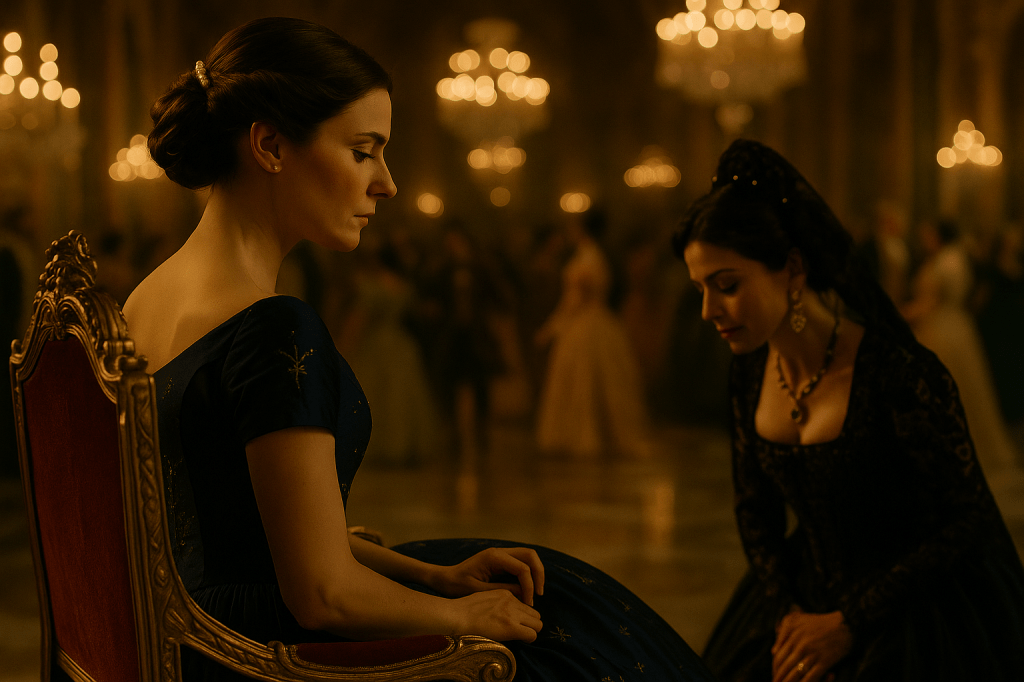
A cinematic, horizontal still from a live-action fairy tale set in a grand Rococo ballroom during a royal ball. The viewer sees over the shoulder of Princess Aveline Beaumont, a French princess in her late 20s with chestnut-brown hair styled into a braided chignon secured with a pearl comb. She is seated on an ornately carved throne-like chair with deep blue upholstery and gold trim, wearing a deep indigo silk ball gown embroidered with subtle silver vines and stars. Her posture is regal but tense, and her expression is distant, with her eyes turned slightly to the side, conveying that her thoughts are elsewhere.

The lighting is golden and soft, from chandeliers and candelabras, casting warm highlights on the polished Carrara marble floor. Behind her, the ballroom pulses with life: blurred figures of nobles move through the space—dancing, bowing, greeting—dressed in 18th-century attire with jewel-toned silks and lace. A baroness from the southern provinces, styled with Spanish-inspired fashion—a dark embroidered gown, gold jewelry, and a small lace mantilla comb—bows slightly in the midground as she’s introduced.

The camera's composition emphasizes Aveline’s detachment and solitude amidst the grandeur. The queen is not visible in this frame, focusing entirely on Aveline's inner world.

The mood is elegant but weighted—echoing tension, expectation, and a quiet storm behind the princess's composed facade.

Another guest is announced—a baroness from the southern provinces, known more for her diamonds than her discourse. I nod as she bows, but my thoughts are already elsewhere.

The weight of the crown feels heavier tonight, even though it hasn’t yet graced my head.

Every look, every gesture, every carefully chosen word feels like a performance. They’re all here to see me, to judge if I’m worthy of the title that will one day be mine. I feel like a figurehead instead of a person.

I wonder if anyone here would ever look at me and truly see me.

Then the next guest is announced, and everything shifts.

Her gaze finds mine, and the din of the court falls into a muffled hum. We are two figures in a mirror, the world blurred around us.

Cinder

The room is overwhelming. The light, the music, the sheer number of people—it presses against me from all sides, but I keep my chin high and my steps steady. The spell holds, though I feel it humming beneath my skin, warm and alive. Every glance that lands on me makes my stomach twist, but I force myself to keep moving.

I am not Cinder tonight. I am no one. A shadow among the glittering crowd, here to see the palace I’ve only ever dreamed of and to follow the whispers that led me here.
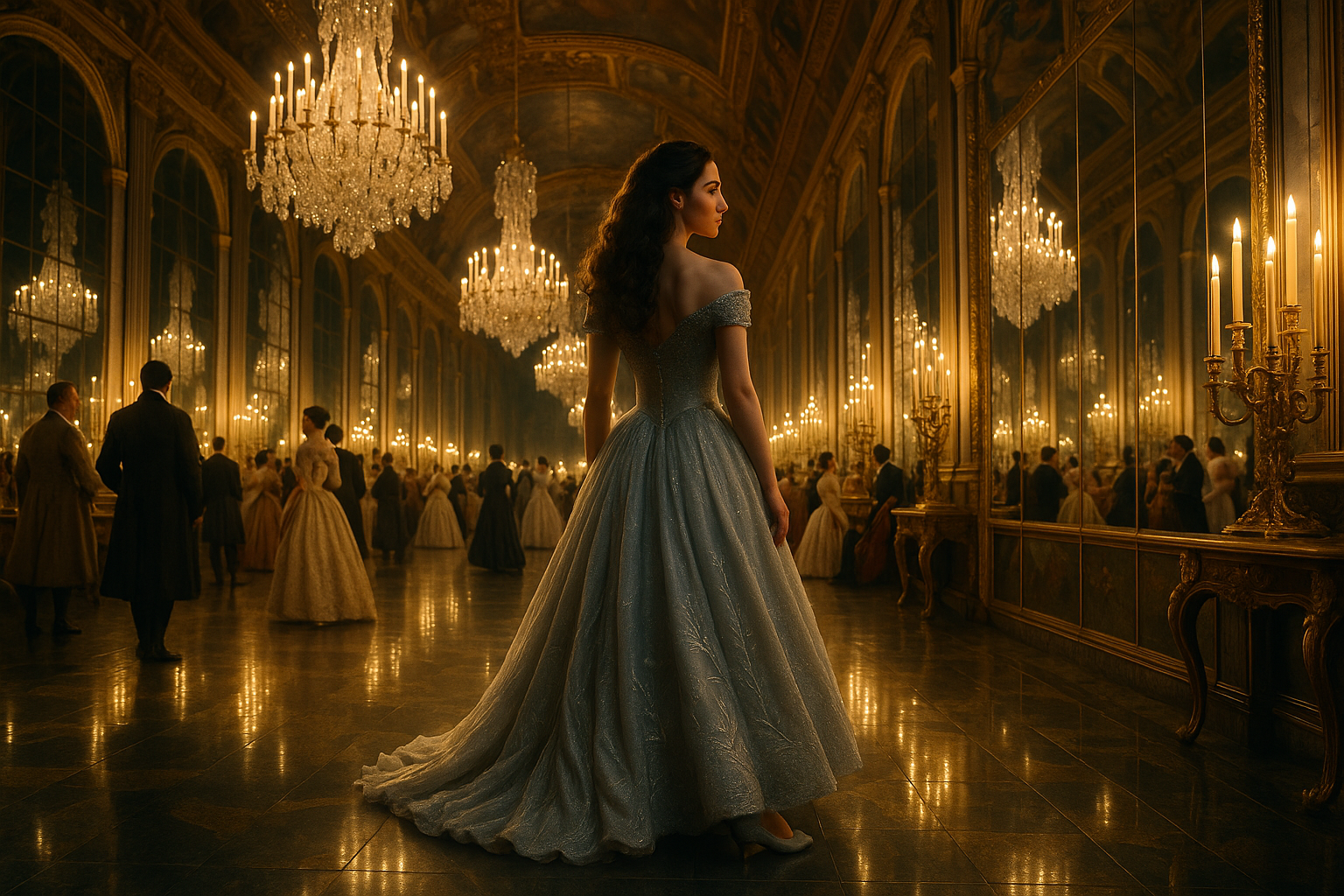
A horizontally framed, cinematic digital photograph in a fairy tale realistic style. The setting is an opulent 17th-century French ballroom inspired by the Hall of Mirrors at Versailles. The lighting is golden and warm, cast by glittering chandeliers and candle sconces that reflect in the massive mirrors lining the marble hall. A young woman with light olive skin stands in soft focus near the edge of the ballroom floor. She has long, wavy brown hair worn loose down her back, and wears a luminous, pale silver ball gown with subtle embroidery that catches the light.

The Hall of Mirrors is more beautiful than I imagined. The chandeliers drip with crystals, casting shards of light across the polished floors. The walls are lined with mirrors that stretch to the ceiling, reflecting endless versions of the people swirling across the room. And at the center of it all is her.

She doesn’t wear a crown, but she doesn’t need one. It’s in the way she carries herself, her head high despite the weight pressing down on her shoulders. Her gown is a deep blue, simple compared to the courtiers around her, but it suits her. She looks like the eye of the storm, calm and steady as the chaos swirls around her.
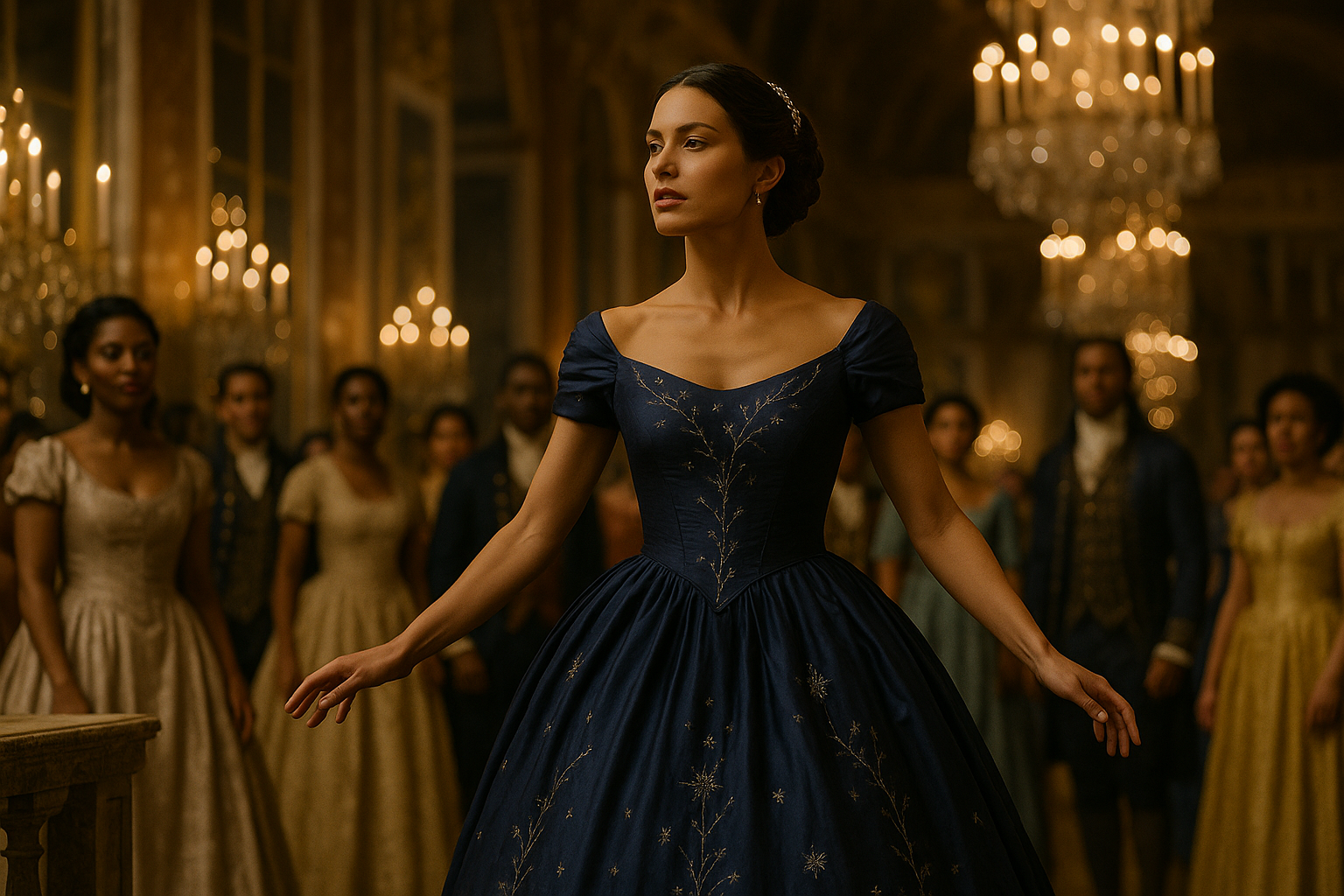
A cinematic, fairy tale realistic still frame capturing Princess Aveline Beaumont, a French noblewoman in her mid-to-late 20s, making her entrance into a grand ballroom on the night of the royal ball. The room is modeled after the Hall of Mirrors in Versailles, with towering gilded mirrors, crystal chandeliers casting warm golden light, and Carrara marble floors that shimmer under candlelight.

Aveline steps forward mid-motion, her deep indigo silk ball gown flowing around her in soft movement. The gown has voluminous skirts, a fitted bodice, and understated silver embroidery in the form of delicate vines and stars. Her chestnut-brown hair is styled into a braided chignon adorned with a pearl comb, with loose strands framing her fair, contemplative face. Her almond-shaped brown eyes scan the room with quiet confidence, her lips slightly parted—not in surprise, but resolve.

Her posture is dynamic yet graceful—one foot slightly ahead, her gown in motion, and one hand gently poised as if about to lift her skirts or offer a greeting. She carries herself with the poise of royalty, but the tension of the evening subtly lingers in her expression.

Around her, a diverse crowd of nobles in lavish 17th–18th century gowns and tailored coats begins to turn toward her—some mid-conversation, others mid-curtsy or bow. The guests are of varied ethnicities, their expressions ranging from admiration to curiosity to unreadable intent. The mood is one of anticipation and shifting energy—Aveline’s arrival has changed the tenor of the room.

The overall tone is richly cinematic—lit like a historical drama, elegant and painterly in composition, with a focus on motion, emotional subtext, and the weight of unseen forces at play. This is a world steeped in fairy tale realism—poised between splendor and strategy.

The whispers rise again, threading through the music.

“Find the crown.”

I don’t know what I’m doing until I’m already stepping forward.
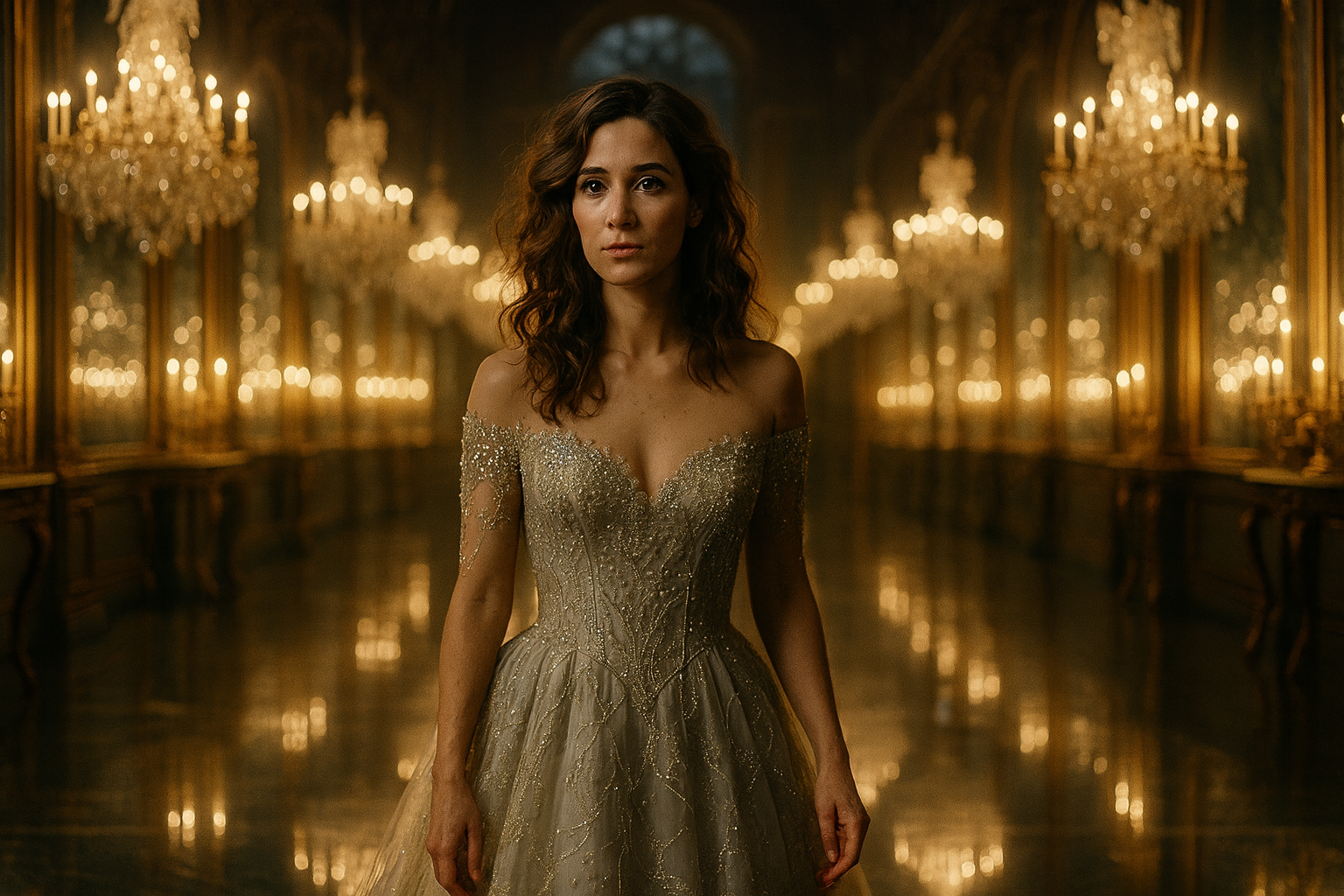
A cinematic, photorealistic scene of Cinder Dubois, a young French woman in her mid-to-late 20s, standing in the opulent Hall of Mirrors of a 17th-century Charles Perrault-era French palace. The setting is inspired by Versailles: a long, grand corridor lined with towering mirrors and shimmering golden chandeliers that spill soft golden light onto the polished Carrara marble floors. The atmosphere is romantic and magical, yet rooted in realism. Cinder stands alone in the vast space, facing slightly to the side, her thick wavy brown hair cascading over her shoulders, catching the candlelight with threads of golden reflection. She wears a luminous silver ball gown that ripples like liquid starlight, adorned with intricate embroidery of vines and constellations. Her skin is olive-toned, softly glowing in the warm light. Her expression is introspective, poised between awe and quiet determination. Glass slippers glint subtly beneath her gown. The hall is completely empty except for her, emphasizing her singular presence and the echo of grandeur. The image should feel like a still from a high-budget fairy tale film — gorgeously shot, fairy tale realistic, hyper-detailed, and emotionally rich. Horizontal aspect ratio, with a sense of depth, dramatic lighting, and historic authenticity. No visible anachronisms, no modern elements. Mirrors should reflect the environment realistically, with gentle softness rather than perfect symmetry.

Aveline

I see her before she speaks.

She’s unlike anyone here. Her gown is silver, shimmering like starlight, and her hair catches the light with every step she takes. But it’s not her beauty that draws me—it’s the way she moves, like she doesn’t belong to this room, like she’s carrying a secret no one else can see.

She stops a few paces away, her silver gown shimmering faintly under the chandelier’s light. For a moment, I think she might turn back. But then her gaze finds mine, and the room—the crowd, the noise, the weight—fades around us.

“Your Highness, I… I’m pleased to meet you,” she says, her voice soft but steady. She curtsies—fluid, deliberate—like a question waiting to be answered.

As I rise, our hands brush—light, unthinking. A spark of warmth races up my arm before I pull back.

A cinematic, horizontally framed, fairy tale realistic ballroom scene set in the opulent Hall of Mirrors, inspired by 17th-century French architecture and Charles Perrault aesthetics. The lighting is warm and golden, cast by dozens of glittering chandeliers suspended from a vaulted ceiling and mirrored walls stretching into the distance. The marble floor reflects the candlelight, creating a shimmering dreamlike glow.

In the foreground, two young women share a quiet, emotionally charged moment amid the swirling motion of dancers in the background. One woman stands on the left, in a luminous, silver off-the-shoulder gown adorned with delicate embroidery that catches the light. Her curly brown hair cascades loosely, and she curtsies low with grace—her gaze steady and searching. She is Cinder Dubois, not of the court, yet bold and composed.

Opposite her stands Princess Aveline Beaumont, poised and regal in a deep indigo silk ball gown embroidered with silver vines and stars. Her dark hair is styled in a braided chignon with a pearl comb, her expression measured but affected, as if surprised by the presence before her. She looks directly at the curtsying woman, captivated. Around them, diverse ball guests—men and women of various skin tones and backgrounds—move in elegant patterns, dancing in pairs in the soft golden light. Their motion blurs slightly, evoking a sense of time suspended for these two women.

The mood is rich, emotional, and gorgeously shot like a film still—intimate in the foreground, grand and lavish in the background, as if the crowd and courtly noise have faded, leaving only this moment between them.

Her voice has no quiver, no trace of courtly submission. It’s like nothing I’ve heard in these halls before.

I should dismiss her, step away before anyone notices—but I can’t.

The way she looks at me, steady and unyielding, makes me want to be seen.

“You’re not from court,” I say, though I already know the answer.

“What is your name?”

“Cinder. Cinder DuBois, your highness.”

“Cinder.” I let the name settle between us. “Unusual… but beautiful. Tell me, what do you seek? My hand?”

Her lips quirk, a faint, knowing smile. For a moment, I wonder if she hears whispers too—if we’ve both been called here by the same force.

Her lips curve into the faintest smile.

“No, Your Highness.”

“Then why are you here, Cinder?”

She hesitates, her gaze drifting toward the mirrors behind me. For a heartbeat, I think she won’t answer.

Then she steps closer, her voice dipping into a whisper.

“To find something.”

I feel the edges of a smile pull at my lips.

“There’s no need for ‘Your Highness.’”

I offer my hand.

“Come, Cinder. Shall we dance?”
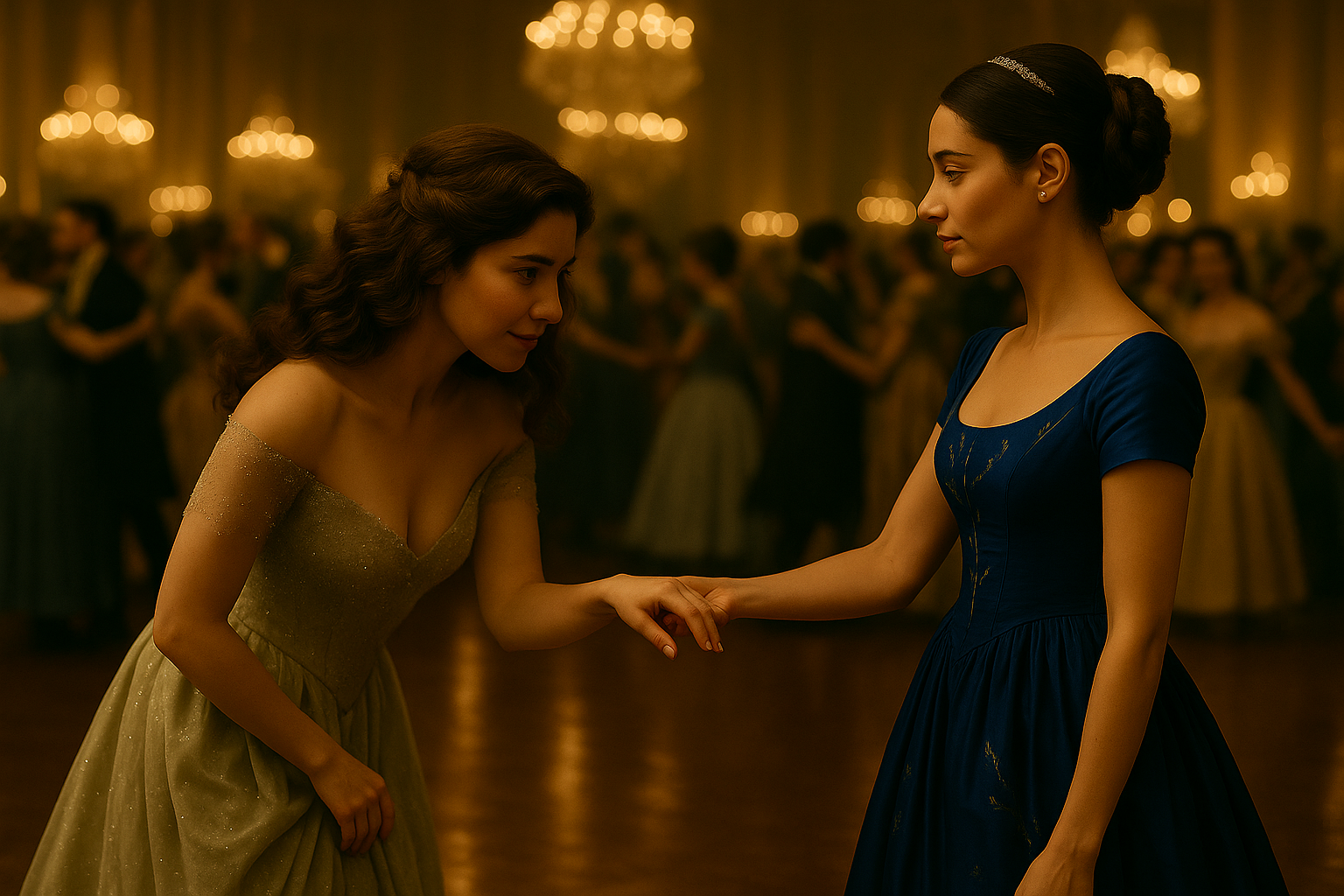
A photograph captures a pivotal fairy tale moment between two young women in an opulent 17th-century ballroom. One woman — with pale olive skin, dark expressive eyes, and long wavy brown hair worn loose — bows slightly in an elegant shimmering off-the-shoulder silver gown. She is Cinder Dubois, a humble and grounded figure, poised yet unsure, her hands gathered at her waist as she lowers herself forward in a moment of vulnerable courage. Facing her is Princess Aveline Beaumont, a French royal woman with fair skin and dark hair styled into a braided chignon adorned with a pearl comb. She wears a fitted indigo silk gown with delicate silver embroidery resembling vines and stars. Aveline stands tall, composed, gently extending one hand in graceful invitation. The ballroom gleams with golden candlelight, cascading crystal chandeliers, and mirrored walls, evoking the Hall of Mirrors at Versailles. The atmosphere is cinematic and still, filled with reverence and quiet tension — a breath held before a dance. The background is filled with softly blurred dancers in period dress, creating a dreamlike sense of movement and intimacy around the stillness of the two central figures. Shot in a richly textured, fairy tale realistic style with warm highlights and baroque detail.

The Moment

Cinder and Aveline

The music swells, the violins rising in a sweet, aching melody. Around us, the ball continues—spinning gowns, clinking glasses, the hum of conversation—but for us, it all falls away. We stand at the edge of something neither of us fully understands, something larger than the palace, larger than the ball.

And somewhere in the shadows, the whispers grow louder.

A Bond Forged in Shadows
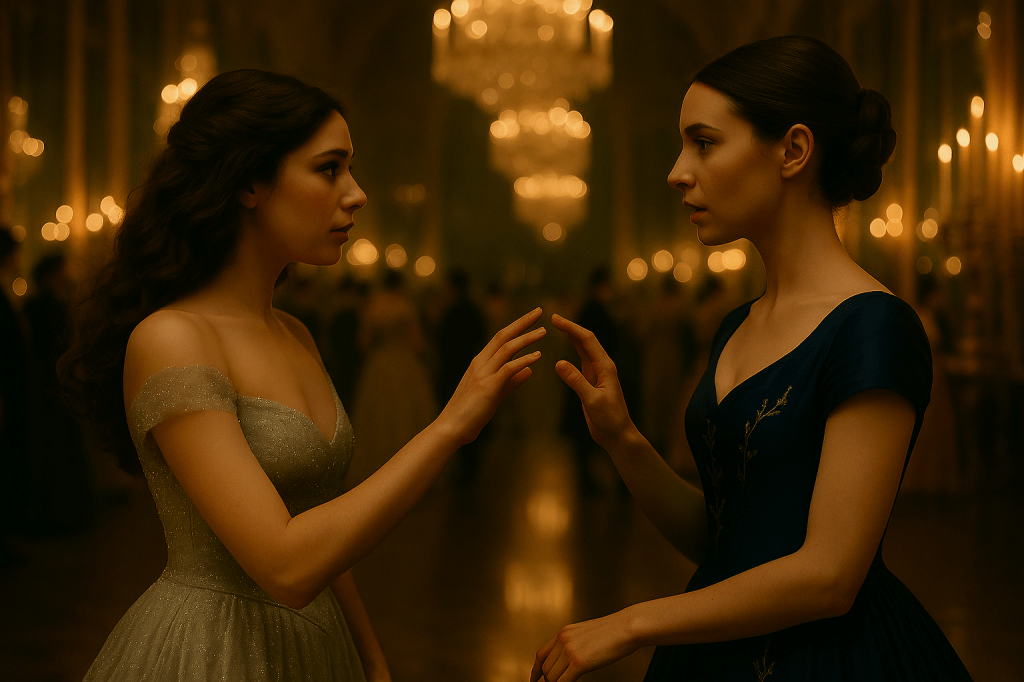
A cinematic still from a fairy tale film set in the Hall of Mirrors at the Palace of Versailles. Two young women stand facing one another at the beginning of a formal dance. One is Cinder Dubois — a young woman with pale olive skin, dark expressive eyes, and long wavy brown hair worn loose. She wears an off-the-shoulder silver-grey ball gown that glimmers subtly in the candlelight, modest yet enchanting, with embroidery resembling vines and stars. She is graceful, nervous, and strong. The other is Princess Aveline Beaumont — a fair-skinned French princess with dark hair styled into a low braided chignon, regal posture, and a composed, contemplative expression. She wears a fitted deep indigo gown embroidered with silver-gold constellations and subtle botanical motifs. The lighting is warm and golden, cast by chandeliers and candlelight, with reflections of the grand mirrors stretching into the background. There is no handhold—only the space between them and the moment just before they move. The mood is intimate, elegant, and steeped in magic and unspoken emotion. The aesthetic is realistic, Charles Perrault–era, and gorgeously cinematic.

Cinder

The weight of her gaze is unlike anything I’ve felt before. It doesn’t press me down the way Madame Violette’s sharp eyes do, nor does it skim past me like the villagers who barely notice my presence. It holds me steady, like she’s measuring not just who I am but what I could be.

“What are you looking for?” she asks, her voice quiet but firm.

I open my mouth to answer, but the words catch in my throat. How do I explain the whispers? The pull that led me here, the grimoire’s cryptic warnings? She wouldn’t understand. But then I meet her eyes again, and something about the steadiness there makes me believe she might.

“Something I’ve only just begun to understand,” I say finally.

Her lips press into a line, thoughtful rather than dismissive.

“And have you found it?”

“Not yet.”
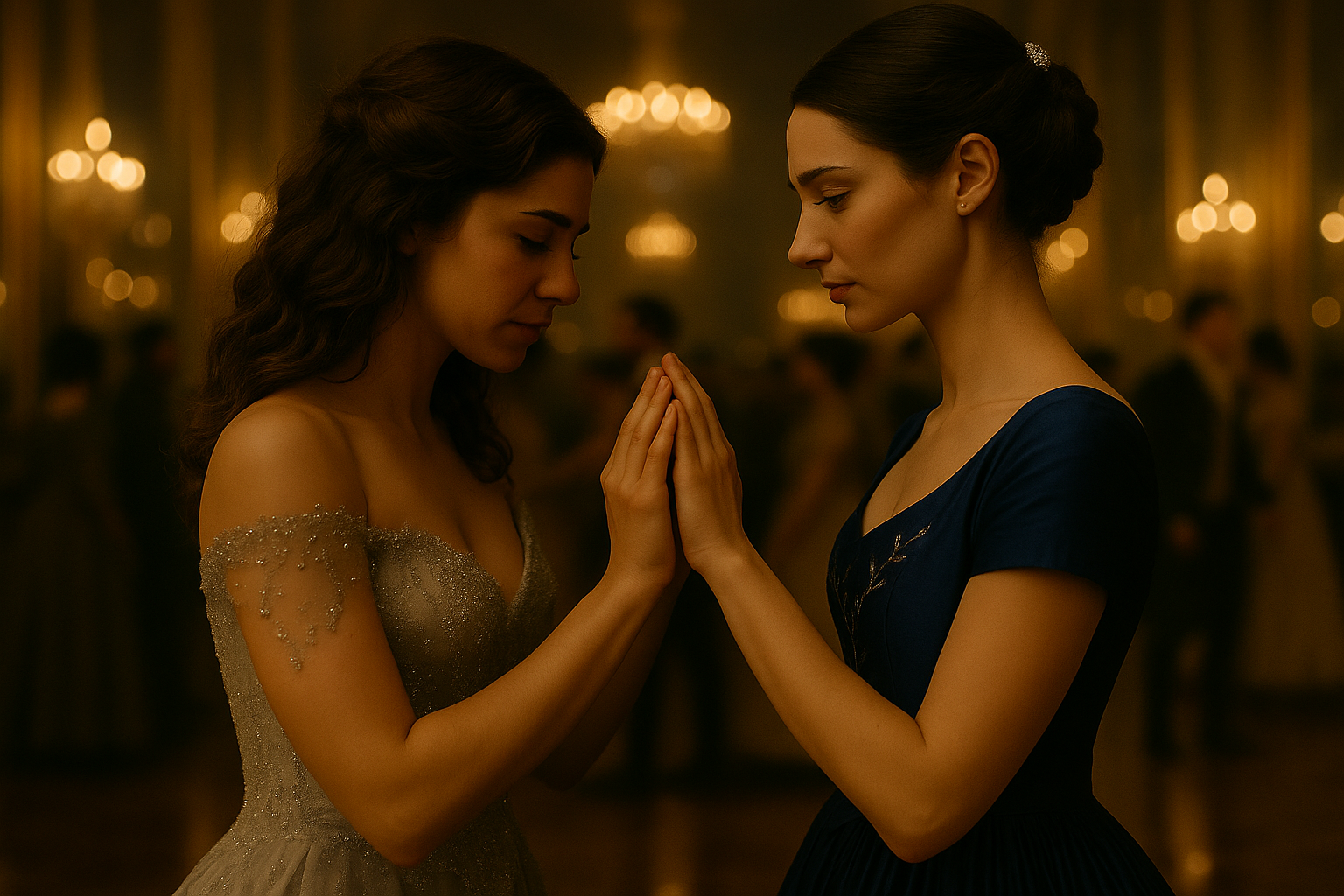
A cinematic, horizontally framed photograph in the style of a fairy tale realistic period drama. Two young women stand close together at the center of an opulent ballroom, surrounded by soft candlelight and blurred dancers in elegant 17th-century attire. One woman has light olive skin, long wavy brown hair worn loose, and wears a pale silvery gown with delicate embroidery—this is Cinder. The other is a French princess with fair skin and chestnut brown hair styled in a formal braided chignon with a pearl comb—this is Princess Aveline. She wears a deep indigo silk gown with silver vine and star embroidery. The two women face each other in a tender moment, palms pressed gently together in a sacred, reverent gesture. Aveline’s gaze is lowered softly, Cinder’s expression open and intent. A warm golden glow from chandeliers and wall sconces bathes the scene. The background is slightly dimmed, creating intimacy and emotional focus. The atmosphere is rich with quiet magic, courtly romance, and unspoken recognition.

The Fateful Dance

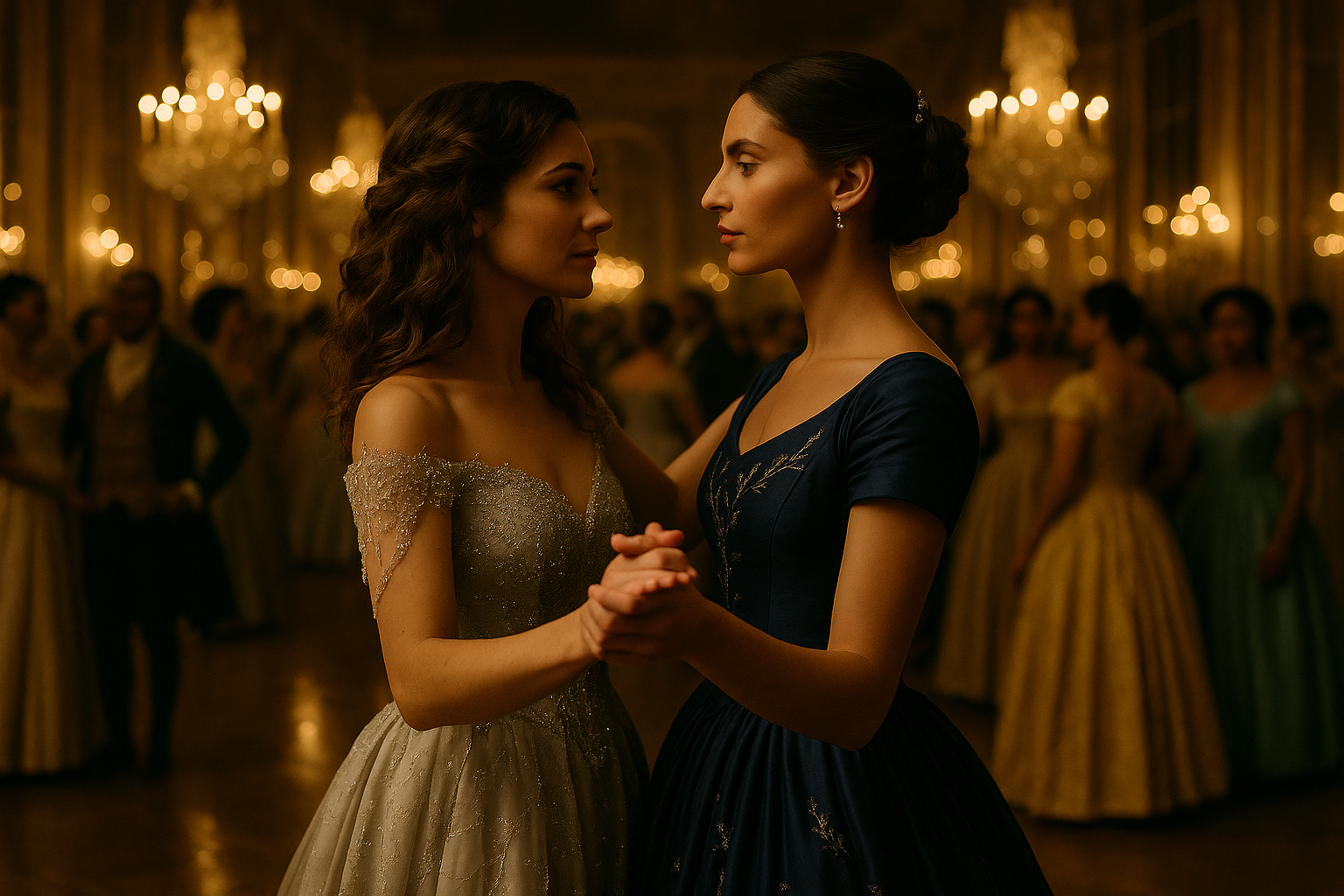
A cinematic, horizontally framed, fairy tale realistic ballroom scene set in the Hall of Mirrors of a 17th-century French palace, evoking the golden opulence of Charles Perrault’s era. The room glows with candlelight and chandeliers, their light reflecting endlessly across gilded mirrors and polished marble floors. Guests in richly embroidered gowns and coats swirl in elegant dance beyond the focus, their figures slightly blurred by depth of field.

In the foreground, two young women share their first dance. On the left stands Cinder Dubois, a young woman with pale olive skin and soft, expressive features. Her long, curly brown hair cascades over her bare shoulders, and she wears a shimmering silver off-the-shoulder ball gown adorned with fine beadwork and delicate embroidery that catches the warm chandelier light. She gazes with quiet intensity at her dance partner, one hand gently holding hers, the other resting near her waist.

Opposite her is Princess Aveline Beaumont, a regal French woman in her late 20s with chestnut-brown hair styled in a braided chignon secured with a pearl comb. Her gown is a deep indigo silk dress with silver embroidery of stars and vines. The neckline is square and elegant, and the fitted bodice flows into full skirts. She meets Cinder’s gaze with a calm, focused expression—serene yet unmistakably drawn in.

Their hands are gently clasped as they dance close, surrounded by a softly lit, enchanted atmosphere. The background guests include a diverse array of dancers of varying skin tones and heritage, consistent with a richly inclusive fairy tale world. The mood is romantic, cinematic, and emotionally charged—capturing the quiet beginning of a love that defies expectation and transforms everything.

The style is filmic, detailed, and steeped in atmosphere—every element bathed in golden candlelight, every fold of fabric rendered with realism and grace, evoking both the intimacy of a private moment and the grandeur of a public revelation.

Cinder

Her hand is in mine.

No one told me how steady this moment would feel—not like fire, not like lightning. But like breath. Like rhythm. As if something old and invisible finally aligned.

We haven’t moved yet, not really. But we’re already dancing. Our stillness is the prelude, our silence the score.

“Are you certain?” she whispers.

But her fingers don’t pull away.

“No,” I say. “But I don’t think the magic brought me this far to stop now.”

Aveline

The room still spins with velvet and gold, but none of it touches me. Just her.

Just Cinder.

I’ve danced with noblemen—stiff, ornamental, always performing. But this? This is something else entirely. With her, it’s not performance. It’s presence.”

She moves like she’s deciphering something—me, maybe. Or the way the light bends when we’re together.

I feel the music shift—soft strings, tender and aching.

“Follow me?” I ask.

“Only if you mean it,” she replies.

I do.

Cinder

We move.

Not as they taught in village squares, not with rehearsed elegance—but as though we remember. As though something in our bones has done this before.

Her hand guides. Mine echoes. We turn, not because the music tells us to, but because something within us does.

And as we glide past the crowd, I feel it—

The whispers have gone silent.

Not absent—fulfilled.

Aveline
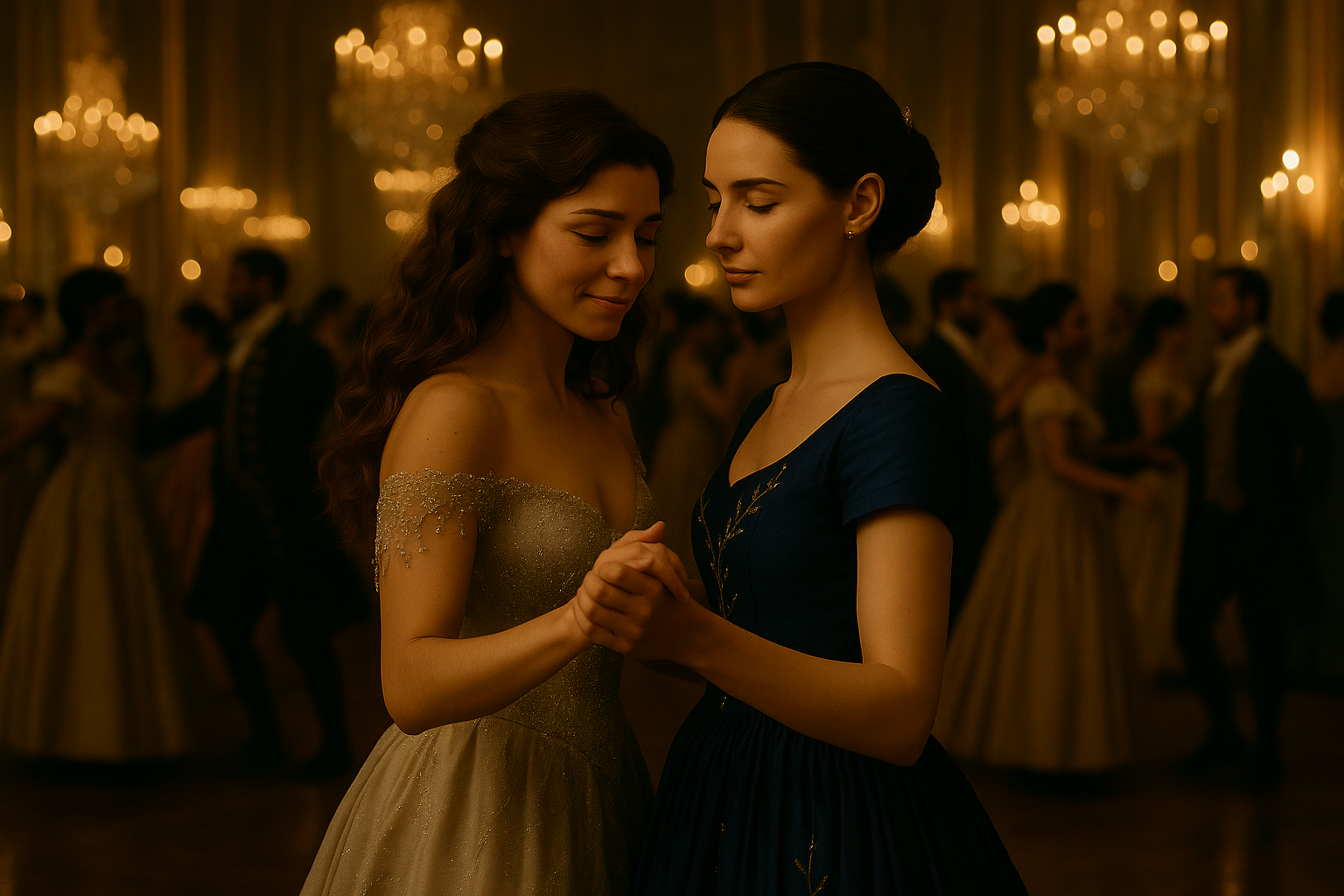
A cinematic, horizontally framed photograph capturing two young women with light skin dancing together in the center of a grand 17th-century French ballroom inspired by the Hall of Mirrors at Versailles. One woman wears a shimmering silver ball gown with delicate beading, off-the-shoulder sleeves, and long, loose wavy brown hair. The other wears a deep indigo silk gown embroidered with silver vines and stars, her chestnut-brown hair styled in a braided chignon with a pearl comb. They hold hands gently, gazing at one another with emotion and quiet joy, completely absorbed in each other. The surrounding ballroom is filled with diverse guests in period-accurate gowns and suits, twirling in the background under massive chandeliers casting warm golden light. Marble floors reflect the glow, and towering mirrors line the gilded walls. The mood is romantic, dreamy, and grounded in emotional presence rather than formality. Shot with a shallow depth of field, the background is softened, creating a sense of intimacy and suspended motion around them. Fairy tale realistic, with Charles Perrault–era aesthetics.

Her closeness is not overwhelming.

It’s steadying. Grounding.

Her breath brushes my cheek, and I’m afraid to turn—afraid that if I see her fully, the spell will shatter.

I know what I’m expected to be tonight. The jewel. The heir. The prize.

But right now, I’m just a woman with a heartbeat and a secret.

And she’s the only one who hears it.

We turn one final time, slower now. The air has shifted. The world is holding its breath.

Cinder

The floor never falls away.
It simply lets go.
One moment we are dancing.
The next—
we are becoming.

My bare feet left my glass slippers – a freeing moment for my feet.
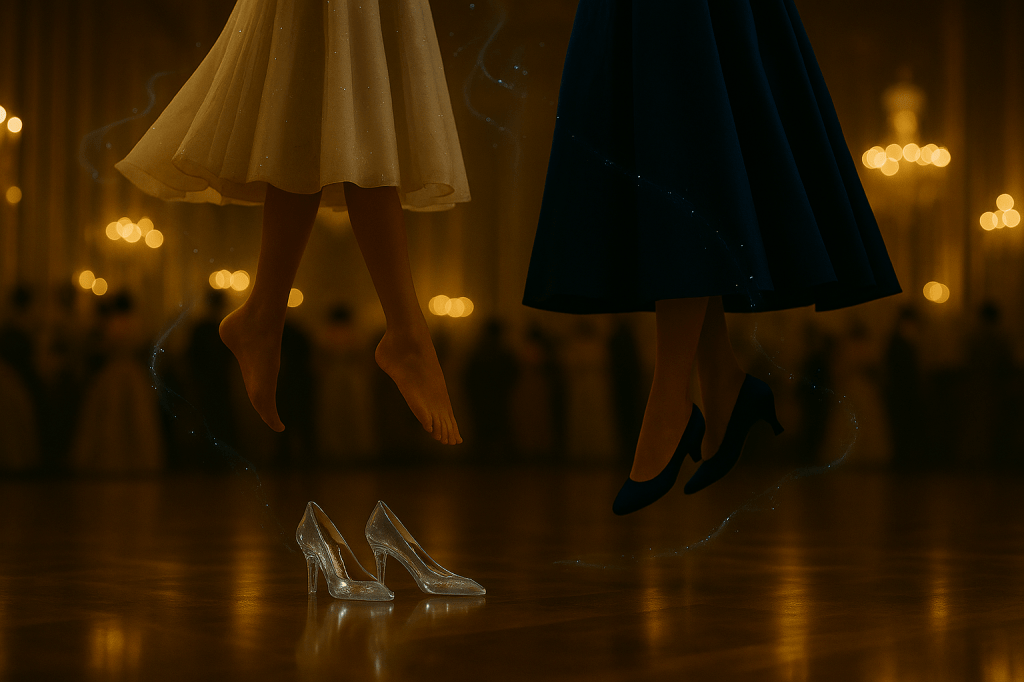
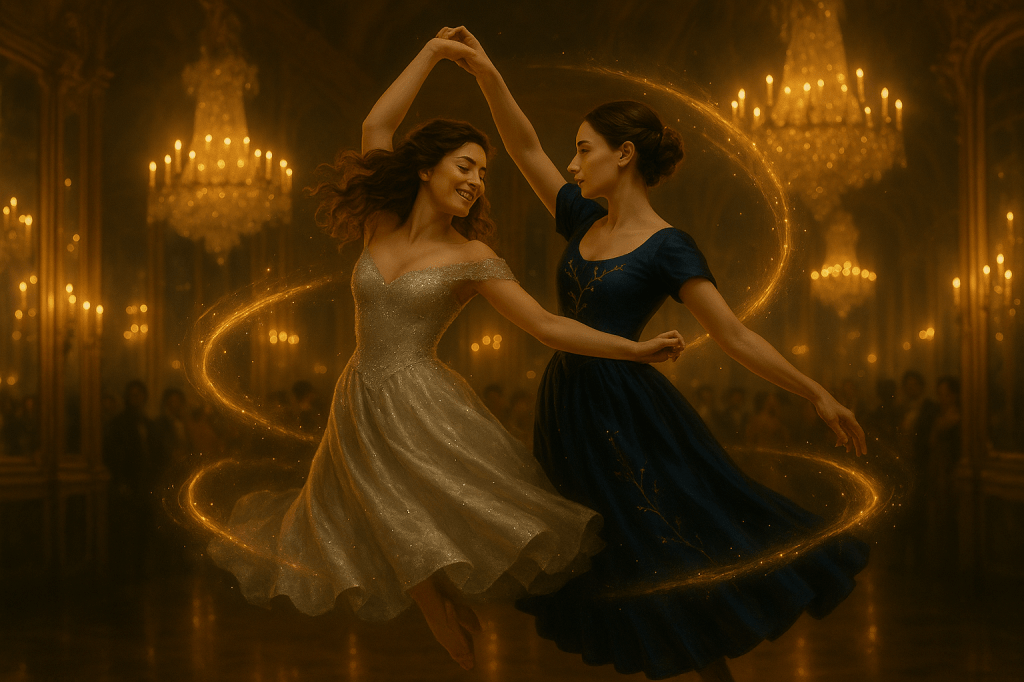
A horizontally framed, cinematic digital painting in a fairy tale realistic style.
Two young women levitate gently in the center of a grand 17th-century ballroom inspired by Charles Perrault fairy tales. One woman—Cinder—has pale olive skin and long, wavy brown hair worn loose. She is barefoot, her feet delicately lifted above a pair of perfectly aligned, stationary glass slippers left behind on the polished marble floor. She wears a luminous, off-shoulder silver gown adorned with delicate embroidery.
The second woman—Princess Aveline—has chestnut brown hair in a braided chignon with a pearl comb, and wears a deep indigo silk ballgown with silver embroidery of stars and vines. She is not barefoot. She stands slightly lower in the air than Cinder, holding her hands in a shared, suspended dance. Their faces are focused, tender, and intimate.
Around them, faint glowing tendrils of blue-white magic spiral through the air, trailing like ribbons from their movements. The ballroom is softly lit by golden chandeliers and candles, but the background is dimmed, making the couple appear isolated in a private, suspended moment. The crowd is still, blurred, or unaware—adding a surreal hush to the scene. A fairy tale atmosphere with magical realism and romantic tension. Focus on motion, elegance, and suspended enchantment.
A cinematic, horizontally framed still of two young women with light skin dancing in midair, gracefully levitating above a candlelit ballroom floor. One wears a soft silver gown with beaded embroidery and long wavy hair worn loose — she is expressive, in motion, and barefoot. The other wears a deep indigo ball gown with silver vine embroidery and a pearl hairpiece securing her dark hair in a regal chignon — she is poised, serene, yet enchanted. Their hands are joined in a suspended, swirling turn, their dresses flowing with magical movement. Around them, an opulent 17th-century ballroom fades softly into shadow — glittering chandeliers, towering mirrors, golden candle sconces. The background crowd continues to dance unaware, dimmed as if caught in a slowed moment. The scene evokes a hidden enchantment: delicate, romantic, and spellbound — a fairy tale moment defying gravity and notice. Style is richly cinematic and fairy tale–realistic, evoking the visual aesthetic of a Charles Perrault-era ballroom with magical realism and ethereal lighting.

There is no rush of wind. No gasps from below.
Just the rise of something soft and ancient,
like the world exhaling beneath us.

Her hand remains in mine.
A tether. A vow.
And I think—
if I let go of gravity tonight,
I’ll still have her.
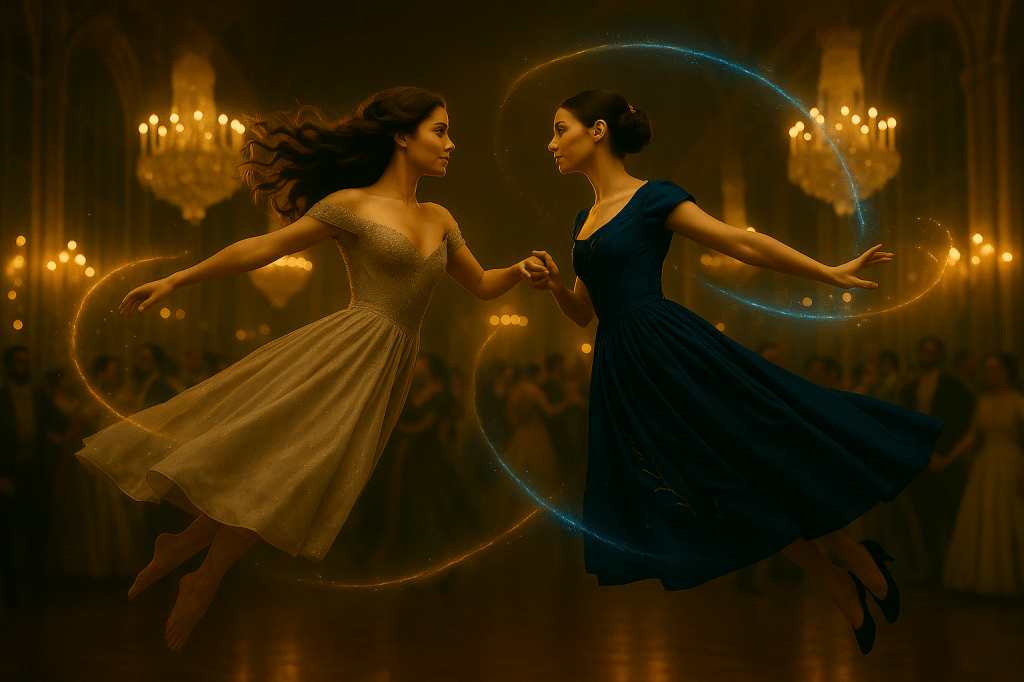
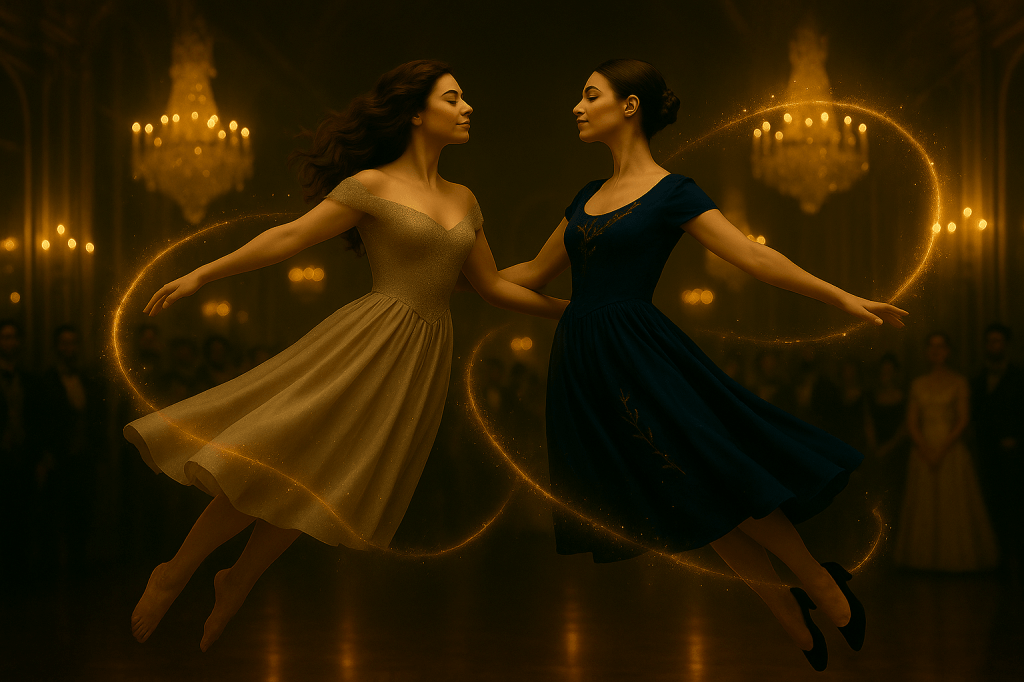
A digital painting in a semi-realistic style captures a cinematic, horizontal composition of two women suspended midair in an enchanted ballroom, caught in a magical spiral pull toward one another. One woman—Cinder Dubois—has pale olive skin, expressive dark brown eyes, and long, wavy brown hair loose and flowing. She wears a soft, shimmering, off-the-shoulder silver gown with subtle embroidery, and she is barefoot. The other woman—Princess Aveline Beaumont—has fair skin, dark hair styled in a braided chignon adorned with a pearl comb, and she wears a fitted, deep indigo gown with silver vine and star embroidery. Her shoes remain on as she floats. They are reaching for each other, arms outstretched and torsos arched with gentle intensity, their fingers nearly touching. Their hair and skirts billow as though caught in a swirling upward current of invisible magic. All around them, glowing golden and silver magic tendrils spiral in the air, trailing around their limbs and dresses, illuminating the ballroom with warmth and enchantment. The grand Hall of Mirrors setting features towering mirrors, cascading chandeliers, and Rococo architecture in candlelit gold tones. Background figures are blurred, evoking dreamlike isolation of the moment. The overall mood is breathtaking, romantic, and full of quiet wonder.
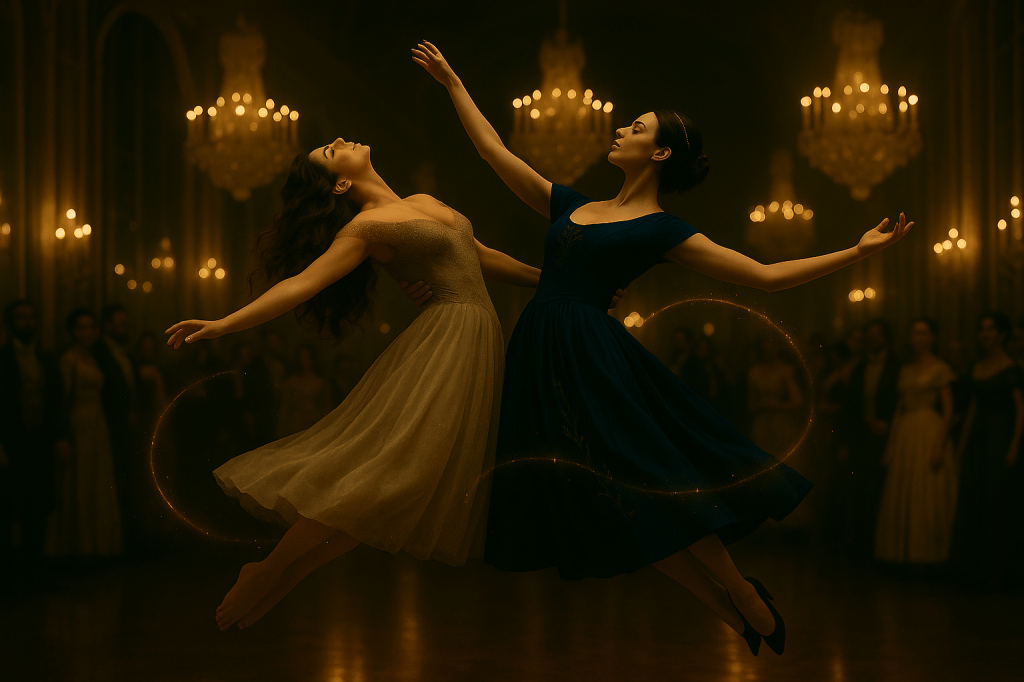
A digital painting in a cinematic, film-still style depicts two young women levitating back-to-back in the center of a candlelit ballroom inspired by the Hall of Mirrors at Versailles. They float midair, weightless, dresses fluttering. One is barefoot, wearing a soft, shimmering off-shoulder gown in silver-gold tulle; her long, loose brown hair moves with the air. The other wears a dark indigo silk gown with subtle embroidery of gold-threaded branches and has dark hair styled in a braided chignon. They lean away from each other, arms extended outward in mirrored opposition, fingers nearly reaching. Their poses are graceful, limbs elongated and proportional, their spines curved in elegant counterbalance like a ballet motion frozen in time. Surrounding them are glowing magical tendrils—ribbons of golden light that spiral and arc around their forms, interweaving through the air. The atmosphere is warm and enchanted, with reflections of the chandeliers flickering across the marble floor and mirrored walls. Background guests are softly blurred, all eyes turned toward the levitating pair. The lighting is soft amber, with warm highlights along their faces and dresses, emphasizing the ethereal nature of the moment.

Aveline

I do not feel the lift.
I feel her.

The world has dimmed at the edges—
courtly laughter, shoes on marble, the weight of duty.
All of it… beneath us now.
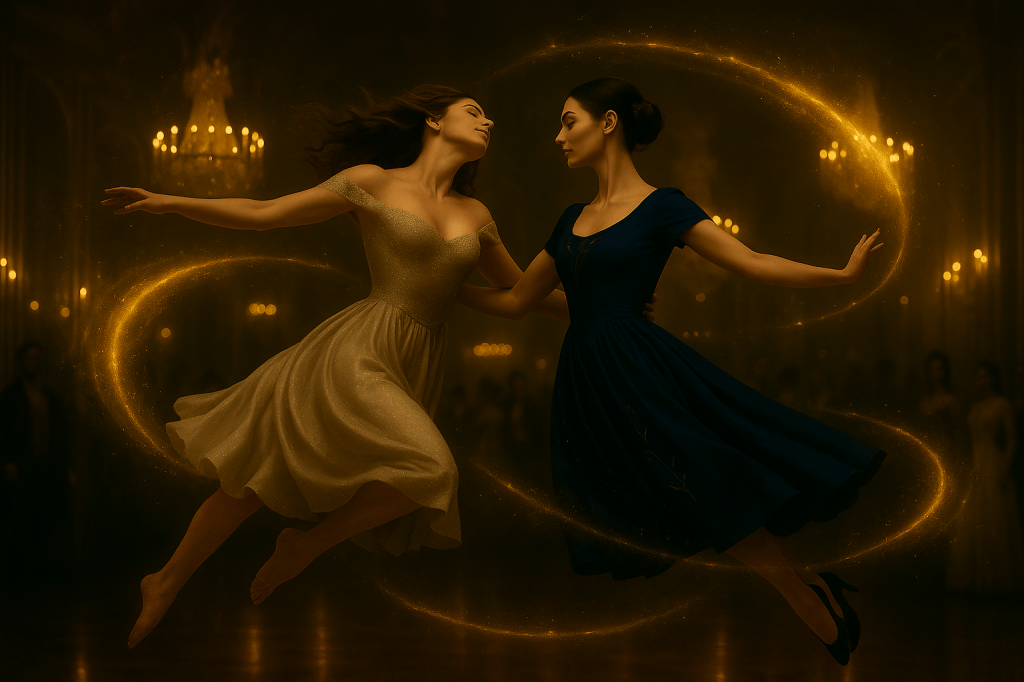
A digital painting in a cinematic, fairy tale–realistic style. Two young women are suspended midair, dancing in an off-center spiral of golden magical energy inside the opulent Hall of Mirrors of a 17th-century French palace. The lighting is golden and dramatic, evoking candlelit chandeliers that glint against towering mirrors and Rococo architecture. One woman—Cinder Dubois—has pale olive skin, expressive dark eyes, and long, loose brown hair flowing behind her. She is barefoot, wearing a forest-gold off-the-shoulder gown that sparkles subtly with enchantment. Her body is angled in graceful tension, caught in motion as if swept upward and outward by unseen force. Opposite her, Princess Aveline Beaumont, a French noblewoman with fair skin and dark hair styled in a braided chignon, wears a fitted indigo royal gown embroidered with silver vines and stars. She is mid-turn, one arm reaching as if pulling Cinder into the spiral. Their dresses ripple from the magical motion, suspended as if in weightless choreography. Their eyes are fixed on each other, intimate and unwavering. Golden magic tendrils swirl around them in a crescent-shaped arc, leaving glowing traces in the air. The background crowd is blurred but formal, dressed in period ballroom attire. The mood is ethereal, charged with motion and emotional gravity, like a climactic moment frozen in time. Horizontal composition, richly detailed, glowing like a still from a fantasy film.
A cinematic digital painting of two young women levitating midair inside a grand ballroom lit by golden candlelight and immense crystal chandeliers. One woman is Cinder Dubois: she has pale olive skin, expressive dark brown eyes, and long, loose brown hair that floats around her in motion. She is barefoot and wears a flowing off-shoulder silvery-gold ball gown with subtle shimmer and soft volume. The other is Princess Aveline Beaumont: a French woman in her late twenties with fair skin, her dark hair styled in a braided chignon adorned with a small pearl comb. She wears a fitted royal indigo ball gown embroidered with silver vine and star motifs. Both women are arched back in midair in a mirrored pose, their backs bowed and one arm each reaching out toward the other, fingertips nearly touching. Their other arms are curved behind them, suggesting weightlessness and surrender. They appear suspended in an emotional, magical moment, surrounded by swirling tendrils of glowing golden light that echo their movement. The crowd below watches in hushed awe, blurred softly in the background. The mood is enchanted, emotional, and luminous—like a film still from a fairy tale reimagining. This is the climax of their first and only dance.
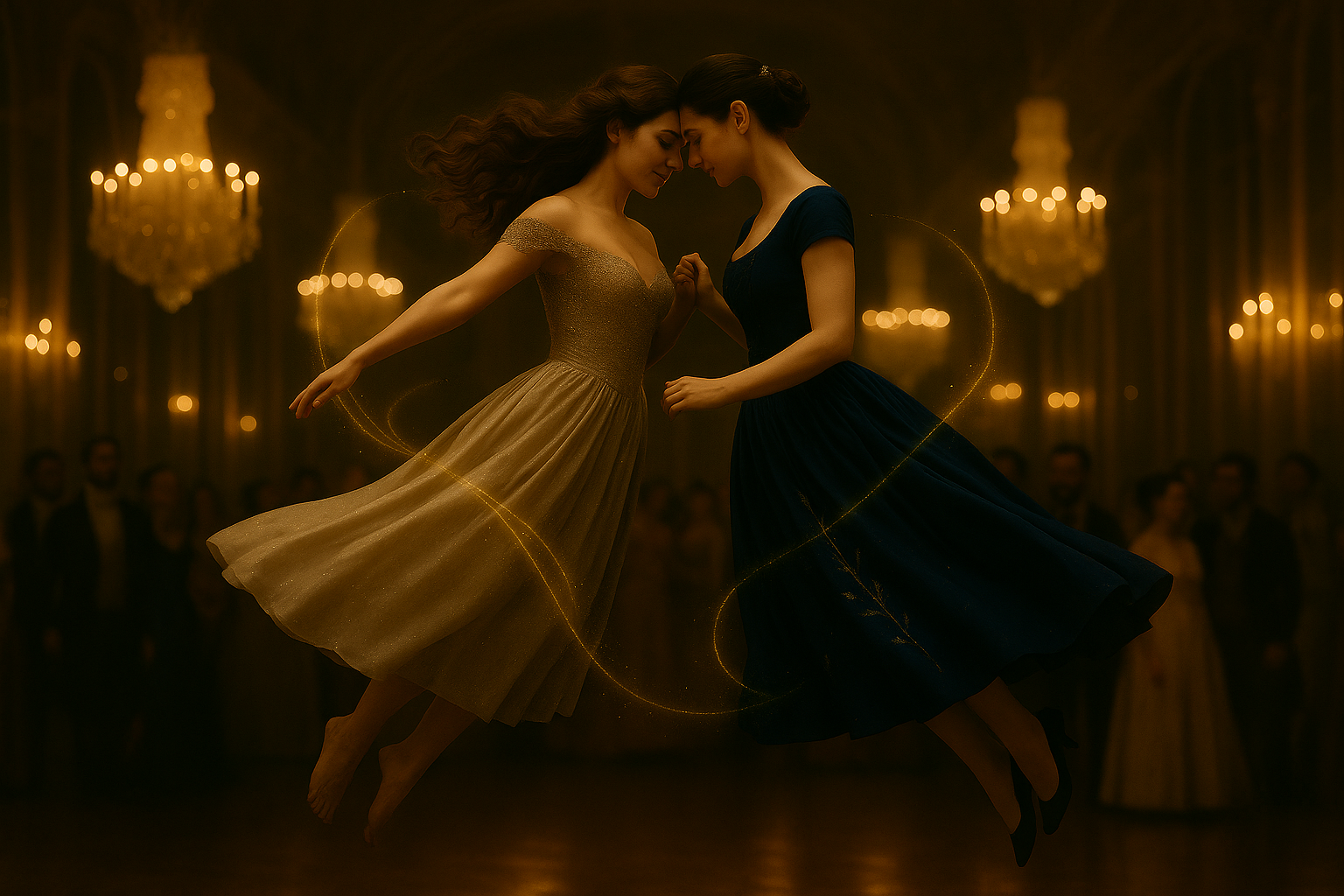
A digital painting in the style of a cinematic film still, depicting two women suspended midair in the grand Hall of Mirrors of a French Baroque palace at night. One woman is barefoot with long, wavy brown hair worn loose—she wears a soft, ash-gold ballgown with delicate sparkle and embroidered vine motifs. The other woman has dark hair styled into a braided chignon with a small pearl comb, and wears a rich indigo gown with silver embroidery resembling branches and stars. They are mid-spin, gently touching foreheads with closed eyes, one hand clasped between them while their other arms flow freely outward in graceful motion. Their skirts billow in opposite directions, suggesting rotational lift. Magical tendrils of golden and blue light swirl around them in slow arcs, illuminating their faces and forming gentle trails through the air. Around them, other dancers are blurred in motion, creating a soft vortex of candlelight, chandeliers, and mirrored reflections. The lighting is warm, romantic, and glows with enchanted intensity. Horizontal composition, 16:9 ratio, fairy tale realism with high detail and emotional intimacy.

Her gaze anchors me.
The air swirls with threads of magic so gentle
they do not demand belief.
They invite it.

And as our gowns turn in slow orbit,

I realize: this is no performance. This is the quiet holiness of being seen

And then—we return to the floor.

Cinder’s feet return inside her glass slippers.

Cinder
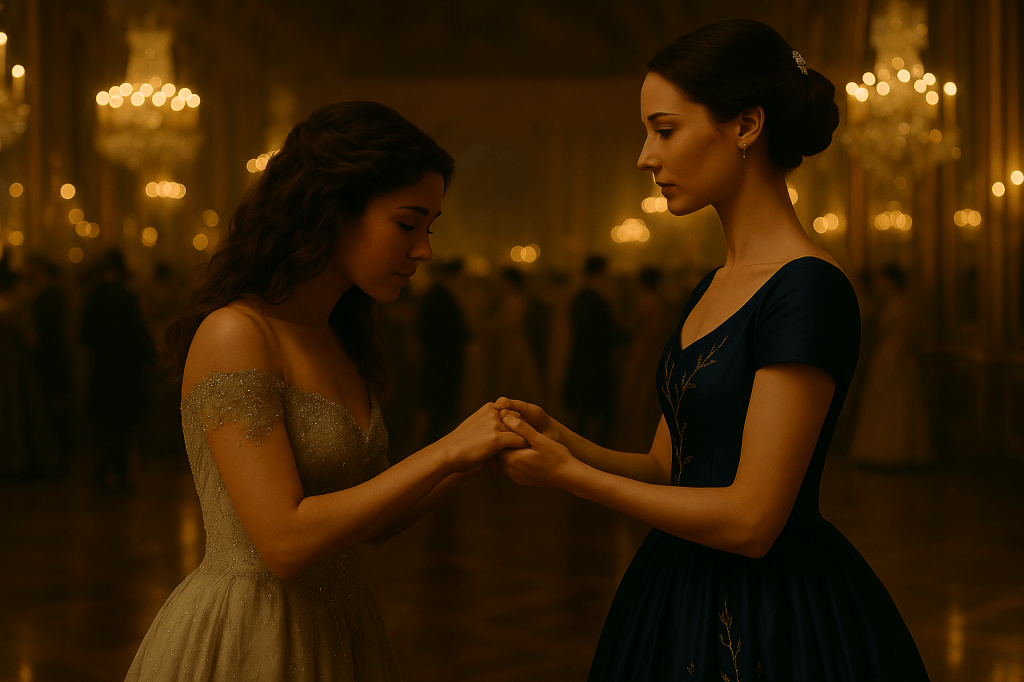
A cinematic, horizontally composed, fairy tale–realistic photograph of two young women dancing in an opulent 17th-century French ballroom. The brunette woman with light olive skin and long, loose wavy hair (Cinder) wears a shimmering pale silver gown with delicate embroidery. She gently kisses the hand of the other woman, a poised French princess in a deep indigo ball gown embroidered with silver stars and vines. The princess (Aveline) has chestnut-brown hair styled in an elegant braided chignon with a pearl hair comb. Their posture is intimate and reverent—Cinder holds Aveline’s hand with tenderness, lips brushing against her fingers, while Aveline gazes down with quiet emotion. The background shows golden candlelight reflecting off tall mirrors, opulent chandeliers sparkling above a diverse crowd of elegantly dressed guests who remain blurred and distant. The composition highlights a moment of emotional stillness between the women amid the grandeur. The image is lit warmly, like a cinematic film still, with rich textures, soft shadows, and glowing reflections across Carrara marble floors and Rococo walls.

I lower her hand and kneel.

Raise her hand to my lips.

A kiss—light, reverent, deliberate.

Not as a servant. Not as a subject.

But as someone who sees her.

Aveline

A cinematic, emotionally resonant digital painting styled like a film still, set inside a grand 17th-century French ballroom with opulent chandeliers glowing in soft golden light. The focus is on two young women standing center frame amid a blurred background of dancers and gilded mirrors. One woman, Cinder Dubois, has pale-olive skin and long brown hair worn loose in soft waves. She wears a muted silver-beige ball gown with off-shoulder tulle sleeves, and she is mid-curtsy, her eyes downturned, vulnerable but resolute. The other woman, Princess Aveline Beaumont, has fair skin and dark hair styled into a braided chignon secured with a pearl comb. She wears a deep indigo royal gown embroidered subtly with silver vines and stars. She is upright, dignified, and holds Cinder’s hand in both of hers with gentle purpose. Her arms are gracefully bent at natural angles—no stiffness—creating a tender and supportive posture. Their clasped hands are at the center of the composition, fingers entwined reverently, hinting at a vow or silent promise. The surrounding atmosphere glows with candlelight, giving a sense of warmth, stillness, and reverence. The palette leans into rich golds and soft shadows, with magical particles subtly shimmering in the air. The emotional tone is one of mutual recognition, the sacred hush after flight. Horizontal framing. Period-accurate detail. Fairy tale realistic. Magical realism tone.

And I mirror her.

I lift her hand, press a kiss to her fingers, and feel the quiet ripple between us—like the surface of still water disturbed by a truth too long submerged.

No thunder. No sparks.

Just the soft click of fate settling into place.

A moment where the weight of royal pressure didn’t vanish—but finally lifted, just enough, so I could feel the shape of my own heart beneath it.

Cinder

Her gaze flickers toward the mirrors behind us, her reflection shimmering faintly in the glass. The chandeliers overhead cast shards of light across her face, and for a moment, she looks almost untouchable—like the stories of queens and warriors I used to read in my mother’s journal. But then her hand twitches against the folds of her gown, and I see it—the hesitation, the weight she carries.

“I imagine you’ll find it soon enough,” she says, but there’s a question in her voice, as though she isn’t sure if she means it for me or herself.

Aveline

There’s something about Cinder I can’t place.

She speaks with a calmness that doesn’t belong to the chaos of the court. Her words are deliberate, her movements careful, but beneath it all, there’s an intensity—something alive and restless, just below the surface.

She feels out of place here, and yet she doesn’t shy away.

Your Presence is Needed

Aveline

Before I can ask her anything more, a shadow falls over us. I don’t need to look to know it’s my mother.
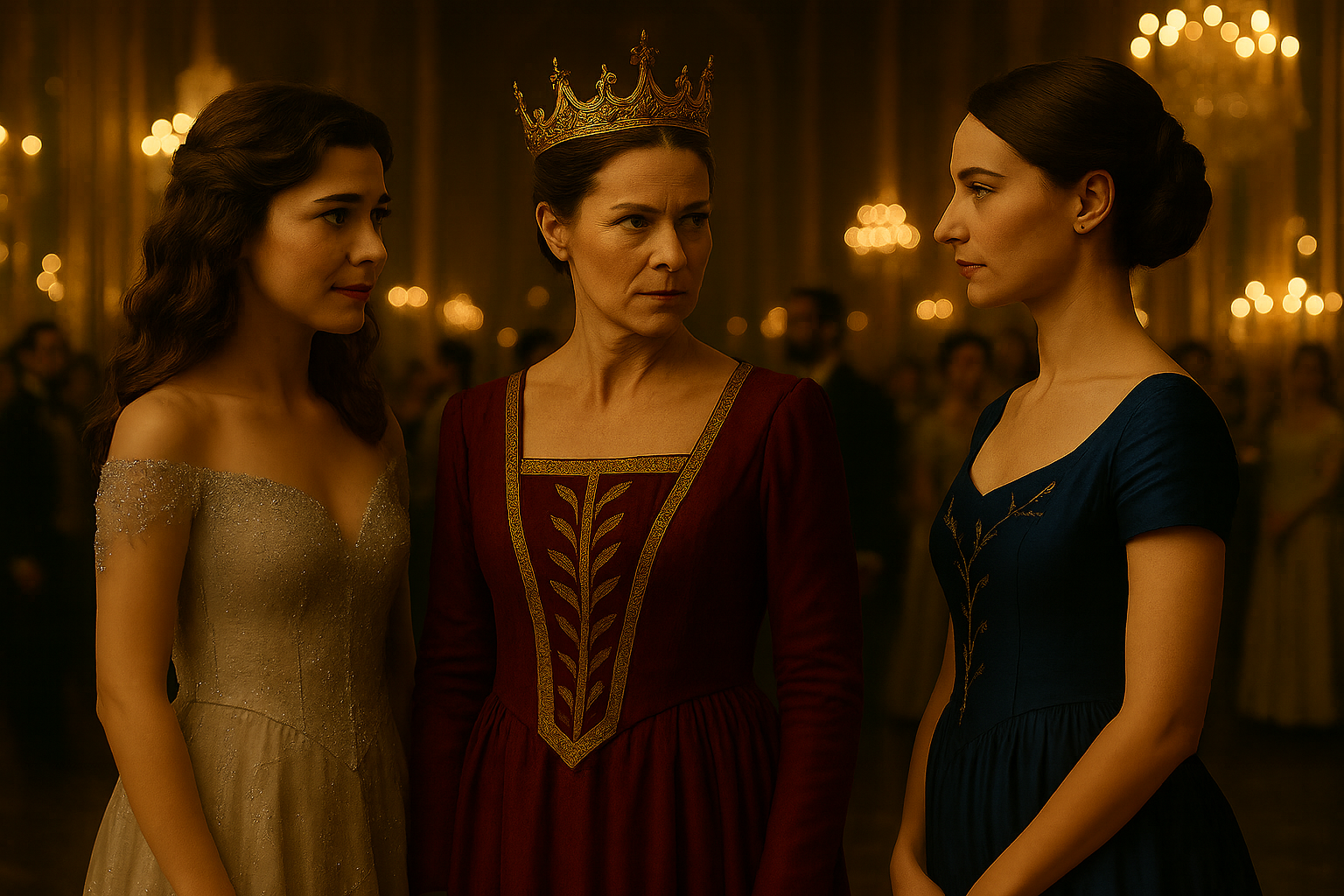
A cinematic, horizontally framed image set inside a grand 17th-century French palace ballroom in the style of Charles Perrault fairy tales. The setting is opulent—mirrored walls stretch into the distance, towering golden chandeliers glow above, and warm candlelight bathes the entire room in amber hues. The crowd behind is softly blurred, elegantly dressed nobles of diverse backgrounds dancing and conversing, their motion echoing through the marble-floored space.

In the foreground, three women stand in tense proximity, frozen in a moment of political and emotional weight. Centered is Queen Geneviève Beaumont, a woman in her late 40s with fair skin and sharp, authoritative features. She wears a deep red velvet gown with gold embroidery and a tall, ornate gold crown atop a braided chignon. Her hands are at her sides, and her expression is one of cool scrutiny—stern, unyielding, and visibly disapproving.

To the Queen’s right stands Princess Aveline Beaumont, her daughter, regal and composed in a dark indigo gown embroidered with silver vines and stars. Her hair is styled in a smooth braided chignon adorned with a pearl comb. She stands tall, her gaze steady but tight-lipped, as if caught between duty and defiance. Her posture reflects control, but her eyes are drawn toward the young woman opposite her.

To the Queen’s left stands Cinder Dubois, a young woman with pale olive skin and long, loose brown curls. She wears a soft silver off-the-shoulder gown with intricate embroidery that shimmers subtly in the light. She is calm, respectful, but not submissive. Her hands remain at her sides—no physical contact is made with the Queen. Her expression holds quiet poise and faint curiosity, as if aware she has just become the subject of royal scrutiny.

The spatial arrangement makes the Queen a visual and symbolic barrier between the two younger women. The power dynamic is clear: she is in control, but she is not the emotional center. The image captures a moment of tension—where old power meets new possibility—rendered in rich cinematic detail, with a warm, fairy tale–realistic aesthetic.

“Princess Aveline,” she says, her tone clipped but polite enough for the crowd around us. “Your presence is requested by Lord Thibault.”

“Of course, Mother,” I reply, my voice a practiced melody of obedience. But when I glance at her, she isn’t looking at me—her eyes are fixed on the girl standing before me.

“And who is this?” she asks, her words sharp enough to cut silk.

I turn to Cinder, half expecting her to stumble over an answer. But instead, she smiles faintly, inclining her head with a grace that surprises me.

“Just a guest, Your Majesty,” she says, her voice steady. “Here to admire the beauty of your court.”

My mother’s gaze lingers for a moment longer, and I see the flicker of suspicion in her eyes. But then she dismisses the girl with a wave of her hand, already turning toward Lord Thibault’s approaching figure.

“Come, Aveline,” she says. “You’ve spent enough time idling.”

I glance at Cinder one last time, catching the faintest hint of a smile before she steps back into the crowd. I follow my mother, but the weight of her presence lingers, a thread I can’t seem to cut.

A Quiet Revelation
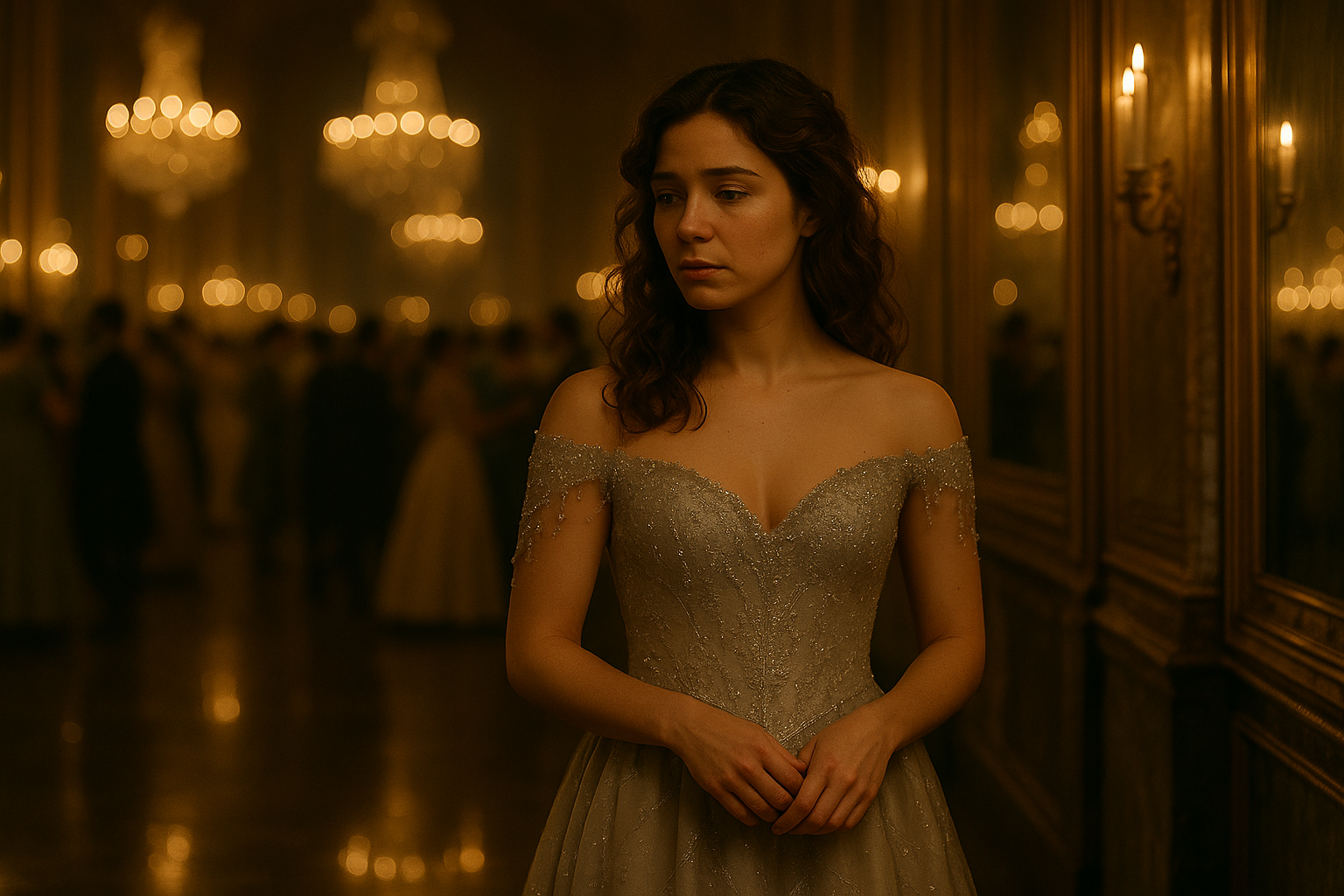
A cinematic, horizontally framed, fairy tale realistic scene set at the edge of a 17th-century French palace ballroom inspired by Charles Perrault aesthetics. The room glows with warm golden light from towering chandeliers, and the mirrored walls reflect the opulence in soft, painterly blur. Ornate candle sconces line the edges, casting flickering shadows. In the background, a crowd of nobles in period ball attire dance and mingle in soft focus, their movements blurred and indistinct—distant, like a world apart.

In the foreground, standing apart from the crowd near the mirrored wall, is Cinder Dubois, a young woman with pale olive skin, long curly brown hair, and dark expressive eyes. She wears a shimmering silver off-the-shoulder gown with intricate embroidery and beadwork that subtly catches the light. Her posture is quiet and thoughtful—her hands gently folded before her, head slightly turned to the side, her expression inward and pensive as if listening to something beneath the surface of the world.

The lighting is softer here, more intimate—dimmed as she steps just beyond the reach of the chandeliers. The mood is one of solitude and weight. The atmosphere hums with the tension of magic held barely in place, of whispers rising beyond hearing. Her silver gown reflects faint glimmers of candlelight, and the mirrors behind her suggest movement just out of sight, adding to the mystical undertone.

This image captures the moment between escape and decision—the spell holding, the danger near, the story turning. The style is richly detailed, lit like a period film still, emotionally resonant and visually grounded in a fairy tale world.

I slip through the crowd, keeping my steps light and my head low. The spell holds, but I can feel its edges fraying, like a cloak that’s been pulled too tight. The whispers in my ears grow louder, more insistent.

“Find the crown. The path is set.”

I reach the edge of the ballroom, where the light is softer, and the air feels less heavy. For a moment, I let myself breathe. The grimoire hums faintly beneath the folds of my gown. Its presence grounding me even as the world around me spins.

A cinematic, fairy tale–realistic scene inside an opulent Charles Perrault–era ballroom, illuminated by cascades of golden candlelight and glittering crystal chandeliers. The polished marble floor reflects the warm glow. In the foreground, Princess Aveline Beaumont — a French princess in her mid-to-late 20s with fair skin, dark hair styled into a braided low chignon adorned with a delicate hair comb — stands in her deep indigo silk ball gown with understated silver embroidery of vines and stars. She has slightly increased distance from Lord Thibault, a French nobleman in his late 40s with dark smooth skin, intelligent almond-shaped eyes, and sharp features, wearing a finely tailored charcoal coat with subtle silver embroidery and a crisp white cravat, medals on his chest. Aveline’s body is angled subtly away from Thibault, her gaze turned toward Cinder Dubois, who is just out of frame, giving the sense of a conscious break from Thibault’s orbit. There is faint, elegant tension in Aveline’s shoulders and the gentle positioning of her hands, hinting at restrained emotion. The scene is framed so that the viewer catches the moment of shifting allegiance — Thibault still engaged in polite conversation, but Aveline’s focus drawn elsewhere. Behind them, the ballroom guests waltz in soft motion blur, their gowns and coats in a variety of historically accurate fabrics and colors, adding to the sense of grandeur.

Style & Mood:
Realistic yet magical, with cinematic depth of field, rich warm tones, and painterly light falloff. The atmosphere carries a mix of political court tension and romantic undercurrent, as if the viewer is catching the precise instant before an emotional turning point.

I glance back toward the princess. She stands beside a man with a polished smile and too many medals pinned to his chest. Her expression is careful, polite, but I see the strain in her shoulders. The way her hand tightens against her gown.

Aveline

A cinematic, horizontally framed still of a young woman with light olive skin and long, wavy brown hair worn loose, standing alone at the edge of a grand ballroom inspired by the Hall of Mirrors in a 17th-century French palace. She wears a soft silver-gray gown with delicate embroidery, the fabric flowing naturally with her movement. Her expression is solemn, distant—conveying emotional weight and quiet heartbreak. The lighting is low and moody, with golden candlelight reflecting off the mirrors and crystal chandeliers above. The crowd behind her is heavily dimmed and blurred, emphasizing her isolation. She is slightly turned away, as if about to leave, her reflection faint in the mirrors beside her. The atmosphere is rich with melancholy, and the mood is fairy tale realistic, as if time is slowing around her. Shot on a shallow depth-of-field lens for intimacy and emotional depth.

Cinder doesn’t belong here. Not like the others.

She’s iron, trying to bend into gold—and no one sees it but me.

“I saw her, and in seeing her, I remembered myself.”

I paused.

“She didn’t bow—not to me, not to the crown. Only to the truth she carried like fire.”

I don’t know why I feel it so strongly, but I know this: whatever the whispers are leading me toward, she’s a part of it.
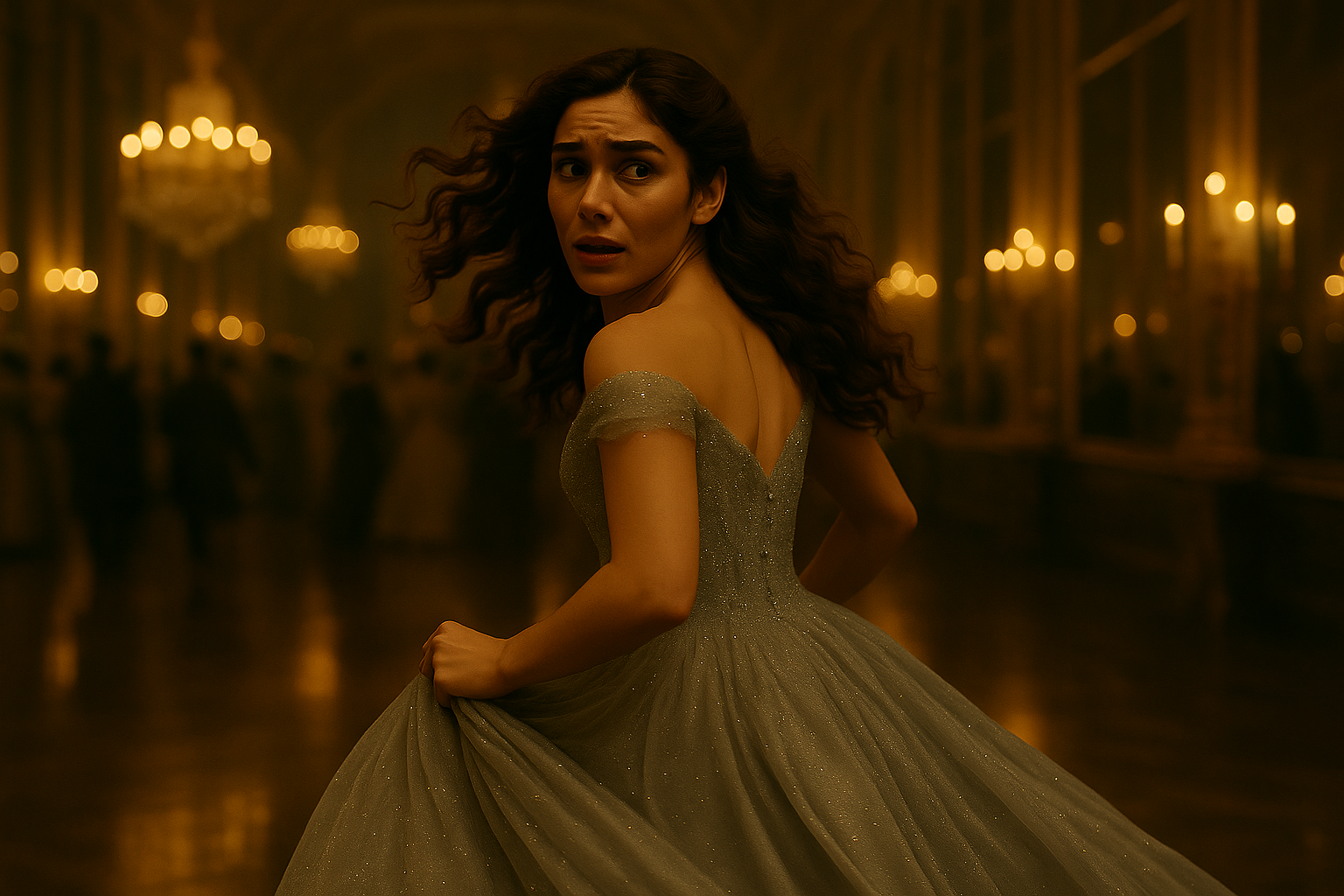
A cinematic, horizontal film still in the realistic, Charles Perrault–era fairy tale style, capturing the exact moment Cinder Dubois flees the royal ball at midnight. The scene is set in the opulent Hall of Mirrors, its endless golden chandeliers and towering mirrored walls glowing with warm candlelight. The polished Carrara marble floor reflects the flickering light and the blurred shapes of waltzing guests in the background.

Cinder is in motion, mid-run, her body turned slightly toward the viewer as she looks over her shoulder with urgency and fear. Her long, wavy brown hair flows behind her, catching the warm light. She wears her established silver-blue ball gown: an off-the-shoulder design with a fitted, shimmering bodice and a full skirt that billows with the motion of her run. The fabric glitters subtly, with delicate embroidery catching the candlelight. On her feet are her glass slippers, rendered with delicate translucence, catching glints of gold from the chandeliers.

Her dress and hair move with realistic physics—skirts lifting and folding naturally from her forward stride, and the hem just grazing the floor as she runs. The scene conveys both motion and vulnerability, with subtle tension in her arms as she gathers the gown to keep from tripping. Her face shows the split-second conflict between wanting to glance back and the instinct to flee.

The background is softly blurred to focus attention on her, with the mirrors along the wall faintly reflecting her movement, hinting at both her presence and her rapid departure. The entire composition is warm yet tense, evoking the exact second before the spell begins to unravel.

The bells strike midnight.

One. Two. Three.

The music falters, if only in my ears.

By the sixth chime, I’ve turned from the dancers.

By the ninth, she’s already gone.

I don’t see her leave—I feel it. Like the absence of breath in the lungs.

The mirrors remain—but I no longer see myself in them.

They still hold a ghost of silver and starlight, as if the room refuses to let her go. I know I won’t.

Just the echo of Cinder in silver, vanishing into shadows.

At Midnight

The spell broke at midnight, just as the whispers warned it would. Panic surged through me with the first chime, its echo slicing through the grand hall. I fled the ball, my heart pounding, desperate to escape before the magic unraveled completely.
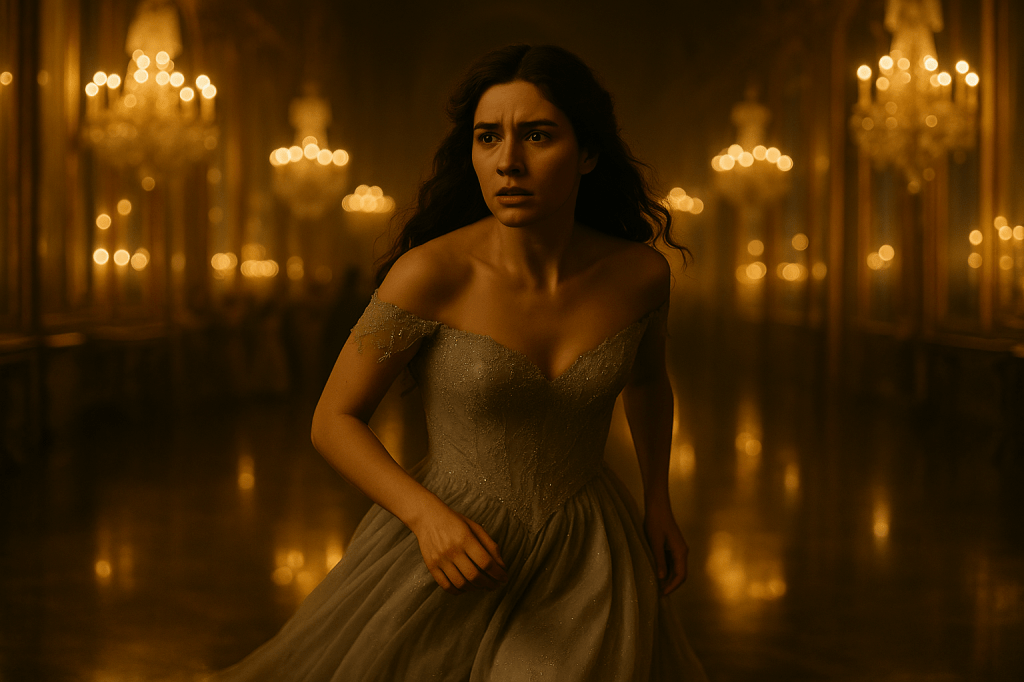
A cinematic still of a young French woman in her mid-to-late 20s with light olive skin and long, wavy brown hair worn loose, fleeing through an opulent, candlelit ballroom inspired by the Hall of Mirrors in a 17th-century French château. She wears a silver-gray ball gown with delicate embroidery and off-shoulder sleeves, the fabric rippling as she turns in panic. Her expression is tense and distressed, eyes wide with urgency. Her movement suggests the moment just after midnight—the spell breaking—as she rushes away from the glowing chandeliers and dimly lit crowd. The mirrors reflect faint streaks of light and her blurred silhouette. The background is dreamlike and golden but beginning to distort subtly, suggesting the unraveling of magic. Shot with a shallow depth of field for emotional intensity and motion blur for drama. Fairy tale realism, with warm tones and a sense of magical urgency.
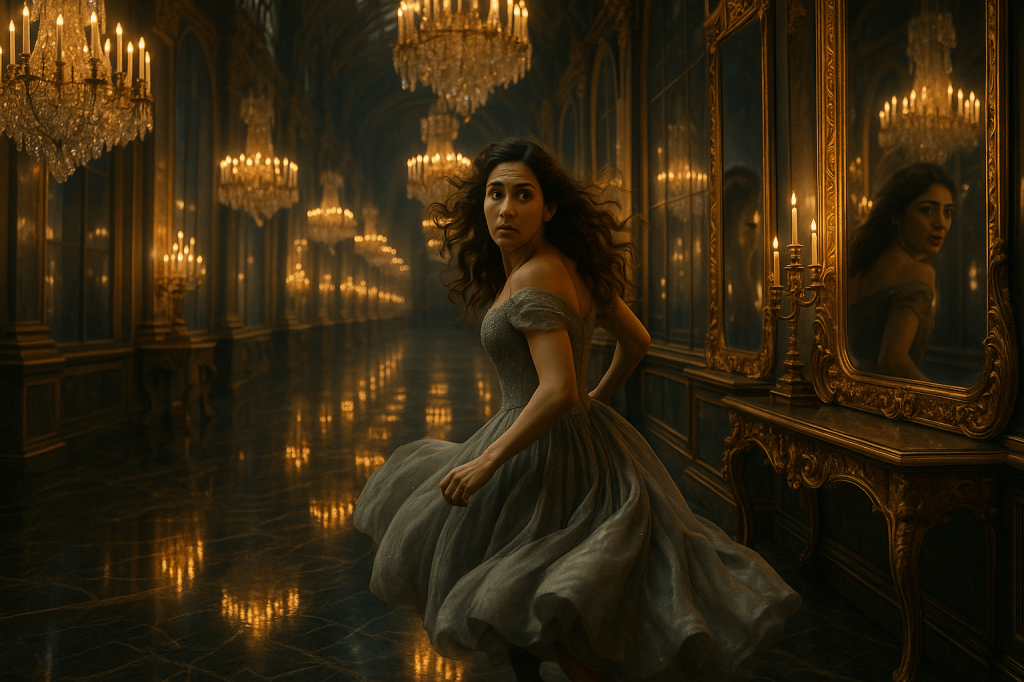
A cinematic, fairy tale–realistic image of a young French woman in her late 20s with olive-toned skin, expressive dark almond-shaped eyes, and long, thick wavy brown hair running through an opulent 17th-century Hall of Mirrors. She wears a distressed, off-the-shoulder silvery-gray ball gown that flows behind her as she moves. The fabric is subtly frayed at the hem, glittering slightly in the candlelight. The woman glances over her shoulder as if in flight, her hair and skirt caught mid-motion. The hallway is richly lit with warm golden candlelight from crystal chandeliers and candelabras. The walls are lined with towering gilded mirrors that reflect her movement, creating a surreal sense of pursuit and doubling. The checkered marble floor reflects her figure and the chandeliers above. The mood is urgent, magical, and deeply cinematic—Baroque opulence meets fairy tale dread, captured in horizontal framing with a deep vanishing point.

The shimmering silver gown had already begun to fade, its brilliance dimming into muted gray threads with every hurried step.
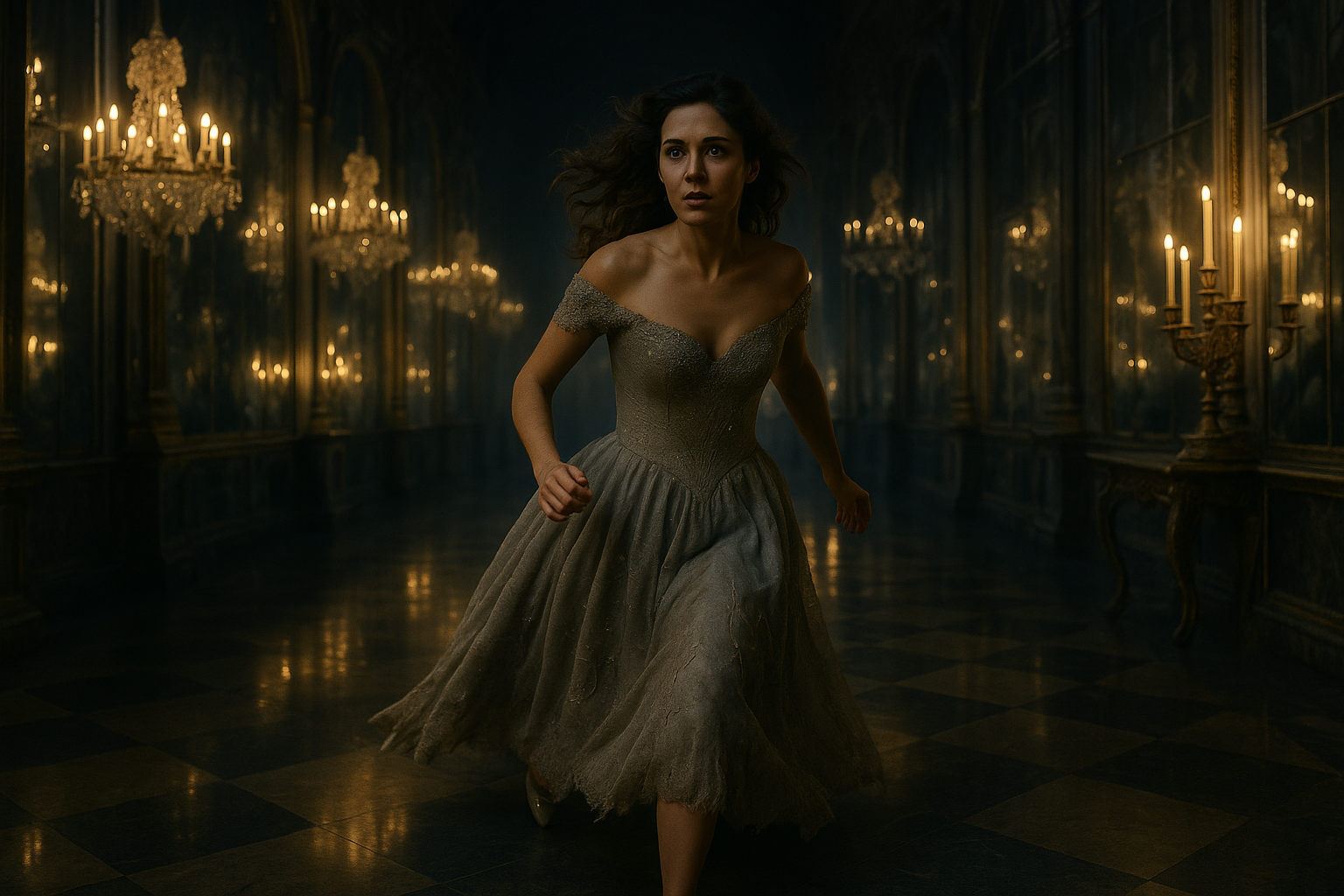
A cinematic, gorgeously shot, fairy tale realistic scene inside the Hall of Mirrors at midnight. A young French woman, Cinder Dubois, is shown mid-run in the opulent palace. She is in her mid-to-late 20s with olive-toned skin, expressive dark almond-shaped eyes, and long, thick wavy brown hair that now spills messily around her shoulders as she flees. Her once-enchanted silver gown is dimming—its luminous threads now faded to a dull gray, with fraying embroidery at the hem and bodice, as if unraveling from magic’s loss. She wears cracked, glass-like slippers, barely clinging to her feet. Her expression is one of fear and urgency, eyes wide, lips parted as if catching breath. The polished checkerboard marble floor glints dimly in the flickering light of candlelit chandeliers overhead. Towering mirrors stretch along the walls, but instead of elegant reflections, they distort her figure with blurred motion and flickering light, evoking the unraveling enchantment. Rich Rococo architectural detailing—gilded sconces, baroque mirror frames, faint fleur-de-lis carvings—enhances the historic opulence. The scene is filled with motion blur, wind in her hair, and dimmed golden light with moody shadows, capturing the precise moment the spell begins to collapse as the chimes of midnight echo through the palace.
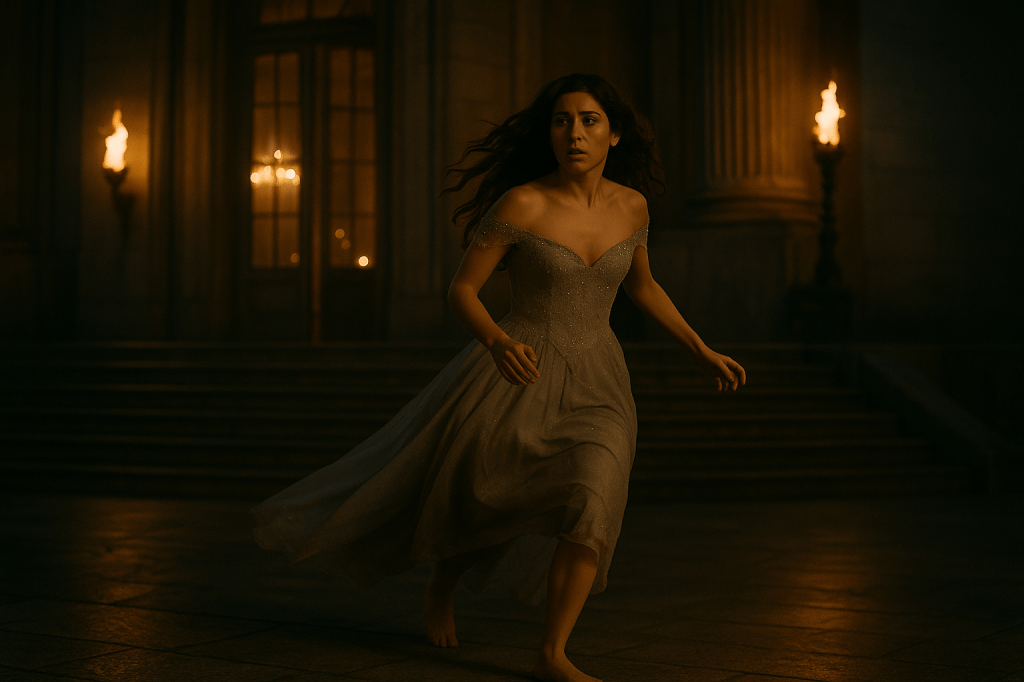
A cinematic, horizontally framed photograph capturing a young woman fleeing a grand fairy tale ball at midnight. She stands barefoot at the base of wide marble palace steps, her long, wavy brown hair flowing behind her. She wears an elegant, silver, off-the-shoulder ball gown that glimmers softly under moonlight and torchlight. The expression on her face is one of panic and urgency, caught mid-motion with one hand gathering the skirts of her gown, the other outstretched as if for balance or escape. The massive golden doors of the palace are ajar behind her, glowing with warm candlelight and the soft blur of chandeliers and dancers. The surrounding world is dim and cinematic, with deep shadows along the balustrades and hints of a forest beyond the steps. The stone beneath her feet is cold and reflective, emphasizing her vulnerability. The atmosphere is enchanted and tense, capturing the exact moment when magic begins to unravel. Fairy tale realistic. Charles Perrault–era aesthetic. Shot in warm golds, soft silvers, and moonlit blues.

The delicate slippers melted into cool dew on the palace steps, the chill biting into my bare soles as I stumbled forward.
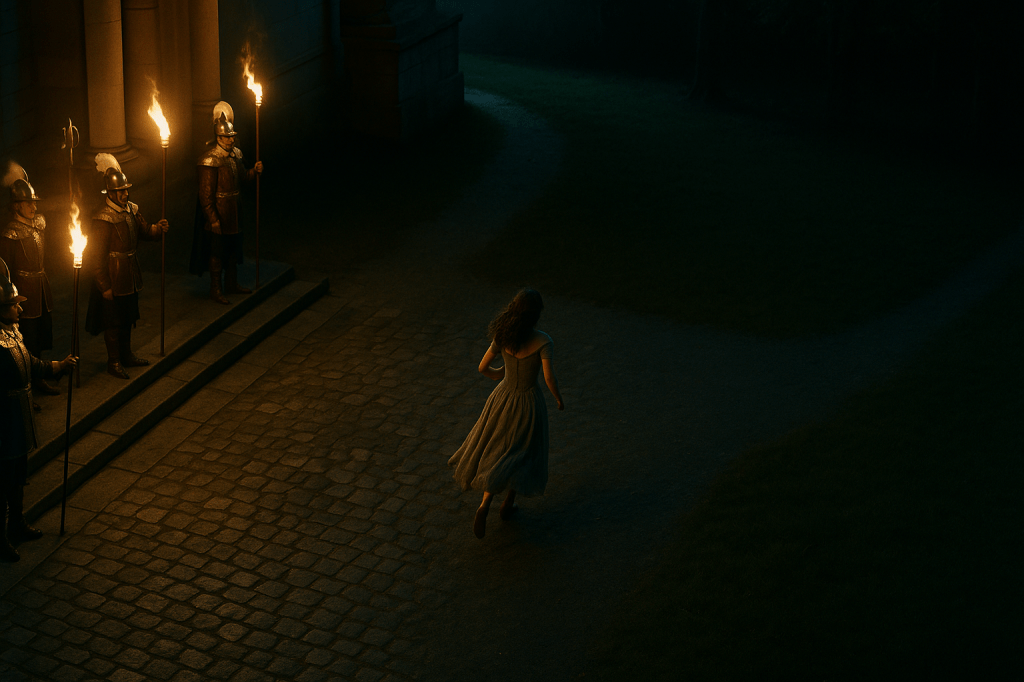
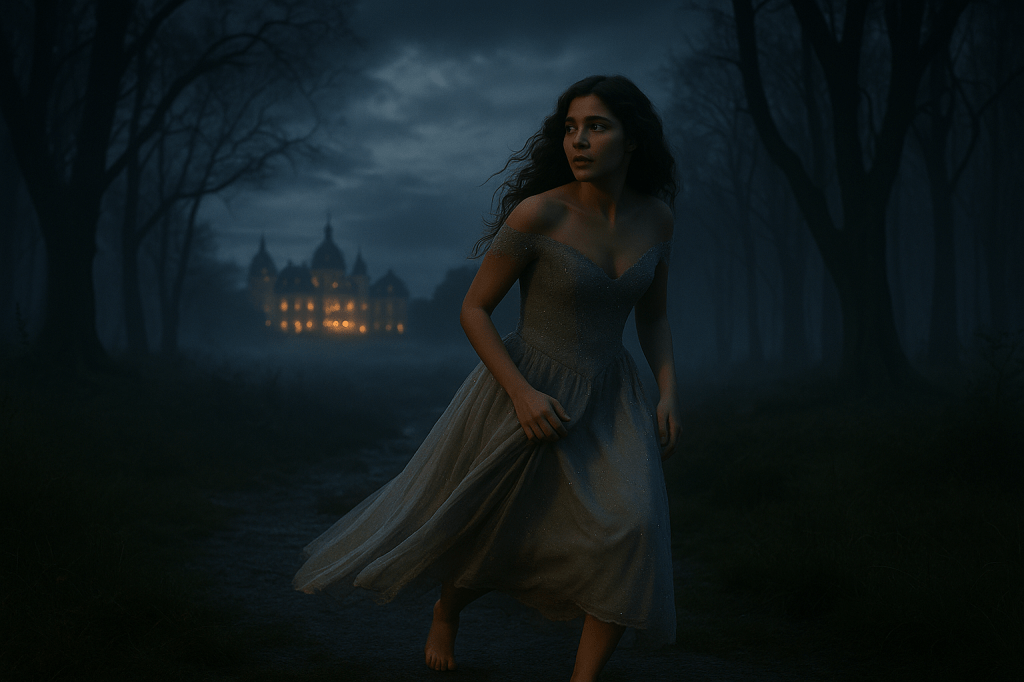
A cinematic, fairy tale–realistic overhead shot of a young French woman in her mid-to-late 20s with pale olive-toned skin and long wavy brown hair running away from a royal palace at midnight. She wears a distressed, silvery-gray off-the-shoulder ball gown that flows behind her as she moves. The scene is lit by a dramatic mix of warm torchlight and cool moonlight. On the stone steps of the palace, a formation of regal palace guards stands at attention, wearing ornate ceremonial uniforms with polished breastplates, feathered helmets, velvet sashes, and long spears tipped with glowing torches. The cobblestone courtyard transitions into a forest path leading into the dark woods. The contrast between the golden palace light and the shadowy, misty forest creates a sense of magical tension and escape. The guards remain motionless, watching as she flees toward the unknown. The image is horizontal in layout, gorgeously lit, composed with deep shadow and reflective surfaces, evoking cinematic fairy tale realism with a sense of grandeur, danger, and freedom.

By the time I reached the forest’s edge, the gown unraveled entirely, its threads dissolving into streams of light, vanishing into the night like falling stars.

A cinematic, fairy tale–realistic horizontal image of a young French woman in her mid-to-late 20s running through a moonlit forest. She has olive-toned skin, expressive dark almond-shaped eyes, and long, thick wavy brown hair, some of which clings to her face and neck with dampness. Her once-glamorous shimmering silver ball gown is mid-transformation—now unraveling from the neckline and back into delicate threads of glowing light that drift and dissolve into the air behind her. In its place, a worn, earth-toned woolen dress is fully visible, textured with soft folds and a handmade, patched look. She is barefoot, running urgently across the uneven forest floor. The forest is richly atmospheric: tall, ancient trees with moss-covered roots frame the path, and cool moonlight pours in from above, casting intricate shadows across the scene. Her hair and side profile are softly illuminated by a shaft of moonlight, giving her a luminous edge that separates her from the dark forest. Faint golden motes and threads of light drift in the air around her, fading like remnants of magic. Her expression is focused and emotional—a blend of determination, urgency, and awe as she flees into the unknown. The entire image evokes magical realism, tension, and transformation, captured in a gorgeously shot, cinematic, fairy tale-inspired style.

I ran the rest of the way home, lungs burning, the grimoire clutched tight to my chest—as if it might tether me to the last shreds of the enchantment. The whispers ebbed as I crossed the garden wall, fading into a heavy, humming silence that wrapped around me like a waiting shadow.

And then, for a breathless moment, I collapsed into the moss.
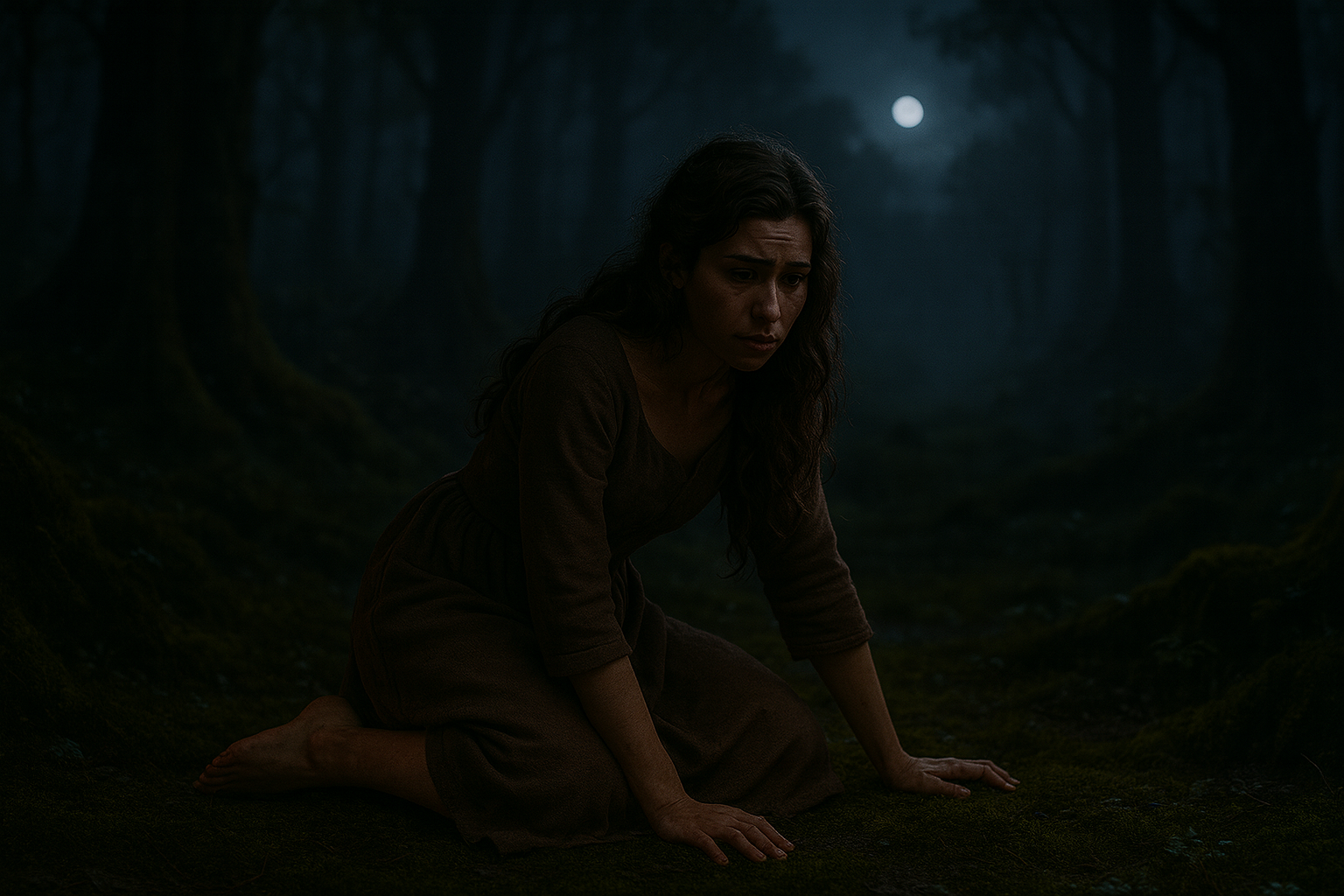
A cinematic, horizontally framed digital photograph of a young woman with light olive skin and long, wavy brown hair, collapsed at the mossy edge of an enchanted forest at night. She wears a simple, earth-toned medieval peasant dress, slightly tattered and dirt-streaked, signaling the end of a magical transformation. Her bare feet are muddy and scraped. She kneels or falls forward onto the forest floor, her body heavy with exhaustion, surrounded by moss, ferns, and ancient trees. Moonlight filters weakly through the branches, casting pale silver light over her figure while the forest behind her fades into soft shadow and mist. Her hands are open against the moss, as if surrendering to the earth itself. The atmosphere is quiet, emotionally raw, and magical—but grounded. There’s a sense of heartbreak, relief, and arrival. The style is fairy tale realistic, with Charles Perrault–era sensibilities and naturalistic detail. Shot with cinematic lensing, rich textures, and subdued magical tones.

The spell didn’t break me — it led me here. To the earth, to silence, to breath. To myself.

A Fever Dream

Now, with dawn spilling pale light across the floor, I sit by the hearth, my fingers tracing the smudges of ash etched into my skin.

The ball feels like a fever dream—an impossible world of light and color, spun from magic that was never mine to keep. And yet, her presence lingers, vivid and inescapable. The curve of her smile, the touch of her hand, the way her laughter wove itself into the music—they cling to me, haunting the silence of this place I call home.

A cinematic, fairy tale realistic still frame capturing Princess Aveline Beaumont, a French noblewoman in her mid-to-late 20s, making her entrance into a grand ballroom on the night of the royal ball. The room is modeled after the Hall of Mirrors in Versailles, with towering gilded mirrors, crystal chandeliers casting warm golden light, and Carrara marble floors that shimmer under candlelight.

Aveline steps forward mid-motion, her deep indigo silk ball gown flowing around her in soft movement. The gown has voluminous skirts, a fitted bodice, and understated silver embroidery in the form of delicate vines and stars. Her chestnut-brown hair is styled into a braided chignon adorned with a pearl comb, with loose strands framing her fair, contemplative face. Her almond-shaped brown eyes scan the room with quiet confidence, her lips slightly parted—not in surprise, but resolve.

Her posture is dynamic yet graceful—one foot slightly ahead, her gown in motion, and one hand gently poised as if about to lift her skirts or offer a greeting. She carries herself with the poise of royalty, but the tension of the evening subtly lingers in her expression.

Around her, a diverse crowd of nobles in lavish 17th–18th century gowns and tailored coats begins to turn toward her—some mid-conversation, others mid-curtsy or bow. The guests are of varied ethnicities, their expressions ranging from admiration to curiosity to unreadable intent. The mood is one of anticipation and shifting energy—Aveline’s arrival has changed the tenor of the room.

The overall tone is richly cinematic—lit like a historical drama, elegant and painterly in composition, with a focus on motion, emotional subtext, and the weight of unseen forces at play. This is a world steeped in fairy tale realism—poised between splendor and strategy.

Princess Aveline Beaumont.

Her name feels sharp on my tongue, too grand for someone like me to speak aloud.

But her gaze—that steady, searching gaze—felt anything but untouchable.

She looked at me like I was someone, like she saw past the silver gown and the shimmering spell to something real.

But what would she see now? Just a woman with calloused hands and a stolen book, a woman who doesn’t belong in her world.
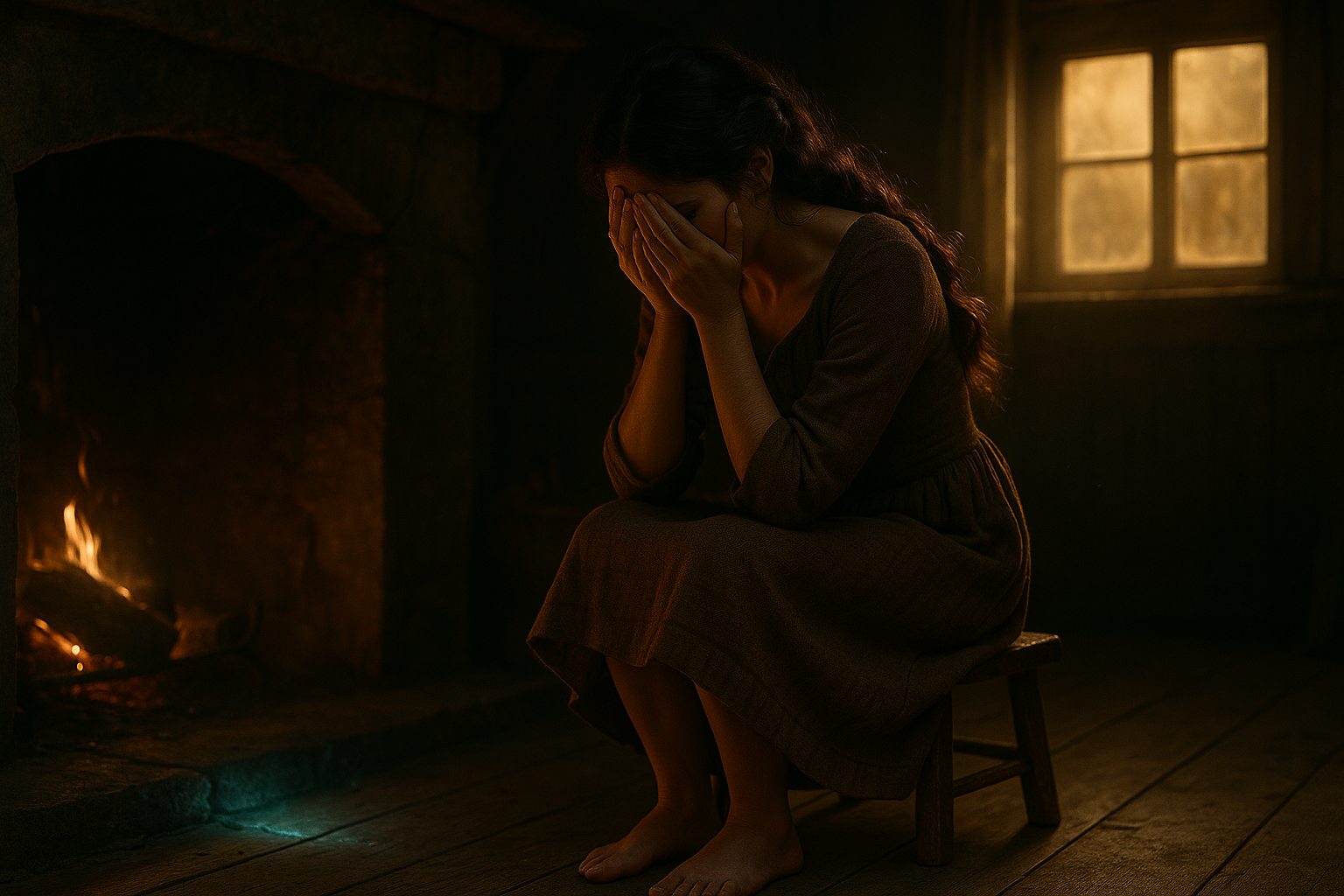
A horizontal, cinematic, fairy tale–realistic digital painting of a young French woman in her mid-to-late 20s sitting on a low wooden stool beside a faintly glowing hearth inside a small, crumbling room of a forgotten French estate. The room is dimly lit, filled with warm orange embers from the fire and soft golden morning light filtering through a cracked wooden window. The young woman has olive-toned skin, expressive dark almond-shaped eyes, and thick, wavy brown hair loosely braided, with a few strands curling around her face from the hearth’s warmth. Her face is partially hidden in her hands, her shoulders slightly hunched as she cries silently. She wears a rough, patched wool dress in muted, earthy tones—symbolic of her return from enchantment. She is barefoot, with her feet resting lightly on worn, creaking wooden floorboards. The sparse room features exposed beams, a rough stone hearth, and simple, rustic details. The emotional tone is quiet and raw, filled with sorrow, reflection, and the lingering ache of transformation. Subtle morning mist glows at the window edges. The atmosphere suggests the presence of old magic—underneath the floorboards near her, unseen, a grimoire hums faintly in the silence, suggesting a connection to spellcraft. The overall image evokes melancholy beauty, realism, and the intimate sadness of fairy tale aftermath.

End of Part 2

Continue to Part 3