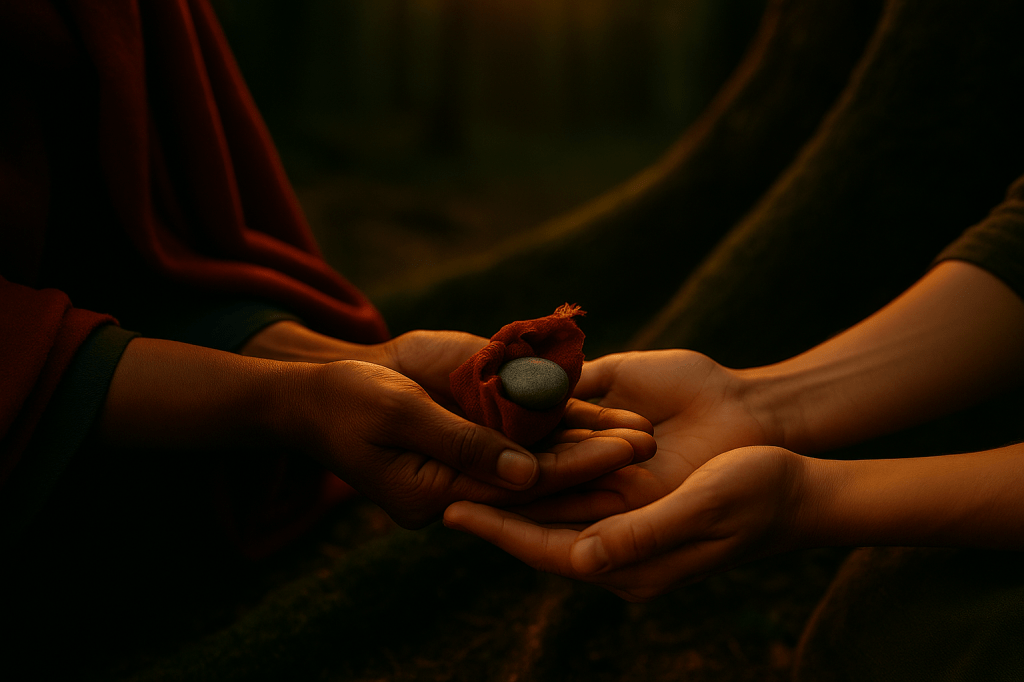
Cendre et la Couronne – Part III

Story Written By
Queen Aveline Beaumont,
Crown Steward Cinder Dubois,
Duchess Claudine Delisle,
& Madame Esmée Étoile

Told Through the Voices Of
Queen Aveline Beaumont
& Crown Steward Cinder Dubois

Visuals & Imagery Conjured By
Liora Marivelle, Céleste Rousselle,
Théa Lavellan, Éline Vervain,
Maëlle Étoilemont, & Scott Bryant

Spellwork & Whispered Magic By
Madame Esmée Étoile

With steadfast loyalty, our story is shared by
Scott Bryant, at the royal request of Queen Aveline Beaumont, Crown Steward Cinder Dubois, Duchess Claudine Delisle,
& Madame Esmée Étoile

I believed my story would be written for me—a crown pressed to my head, my steps measured by expectations, my words never truly my own. But I learned, sometimes through fire, that the world is not balanced by silence.”
— Queen Aveline Beaumont

“They called me Cinder because I lived among the ashes. But even from the soot, I learned to see sparks.”
— Crown Steward Cinder Dubois


The Morning After

The sound of Madame Violette’s cane tapping against the floor snaps me out of my thoughts.

“Cinder,” she says, her voice slicing through the quiet. “Why is the fire not lit? Do you think the hearth will warm itself?”

I rise quickly, keeping my head low.

“Yes, Madame.”

She lingers for a moment, her sharp eyes narrowing.

“You’ve been sneaking out again, haven’t you?”

“No, Madame,” I lie, my hands tightening around the edges of my apron.
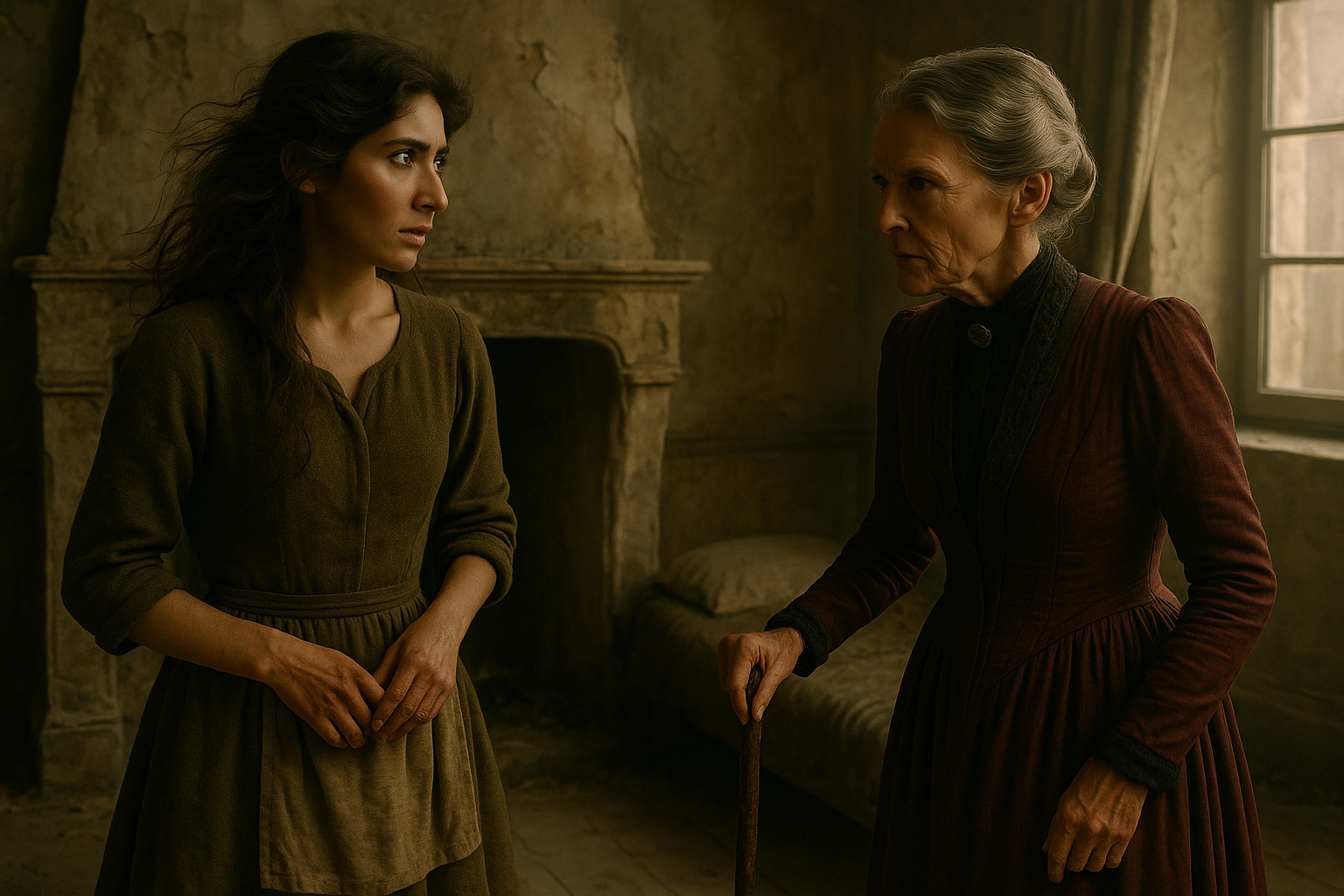
In a decaying 17th-century French château bedroom, a tense confrontation unfolds between a young woman and an older matriarch. The room is bathed in moody, natural daylight filtering through a tall, grimy window with faded curtains. The plaster walls are cracked and discolored, with faint traces of once-grand frescoes and forgotten grandeur. A cold, unused stone hearth looms behind the young woman. The floor is wooden and worn, with dust gathering in the corners and a single floorboard subtly lifted near a low, rough cot in the background.

The young woman — Cinder — stands on the left side of the frame. She has long, loose brown hair and pale olive skin, wearing a simple, slightly oversized olive-green work dress with a brown apron. Her hands are clasped tightly at her waist, knuckles tense, fingers slightly ash-stained. Her face is caught in a mix of fear and quiet defiance as she avoids direct eye contact. Her expression is alert but guarded, lips parted as if just answering a sharp question. Her posture is straight but humble, projecting both submission and resilience.

Opposite her, the older woman — Madame Violette — is a severe, aristocratic figure in her early 50s with silver-gray hair pulled into a tight chignon. She wears a high-collared, burgundy gown with black lace trim. She holds a cane in one hand, leaning slightly forward in a position of interrogation. Her face is sharp, with deeply set eyes that bore into the younger woman. Her lips are pinched, her expression accusatory, as if she has just delivered a cruel remark. Her stance dominates the space with cold authority.

The overall tone is cinematic and fairy tale realistic — richly detailed, darkly elegant, and emotionally charged. The color palette leans into muted earth tones, faded reds, and dusty golds. The composition is horizontal, film-still style, focused on capturing the charged stillness between the characters. Every detail, from the texture of the dresses to the crumbling plaster, should feel tactile and grounded in the Charles Perrault–era fairy tale aesthetic.

Her gaze flickers to the smudges of ash on my fingers, then to the loose floorboard near my cot.

For a moment, I think she might demand to see what’s hidden there.

But instead, she turns with a huff, her cane clicking as she walks away.

The knot in my chest loosens, but only slightly. The grimoire hums faintly from its hiding place, and I swear I feel it urging me forward, like the whispers in the forest.

“Find the crown.”

A Court in Disarray

The palace is quieter than usual.

Yet the air feels heavier — as if holding its breath.

By my mother’s measure, the ball was a success: treaties renewed, hands shaken, suitors eager to claim my attention.

I will not accept a single one.
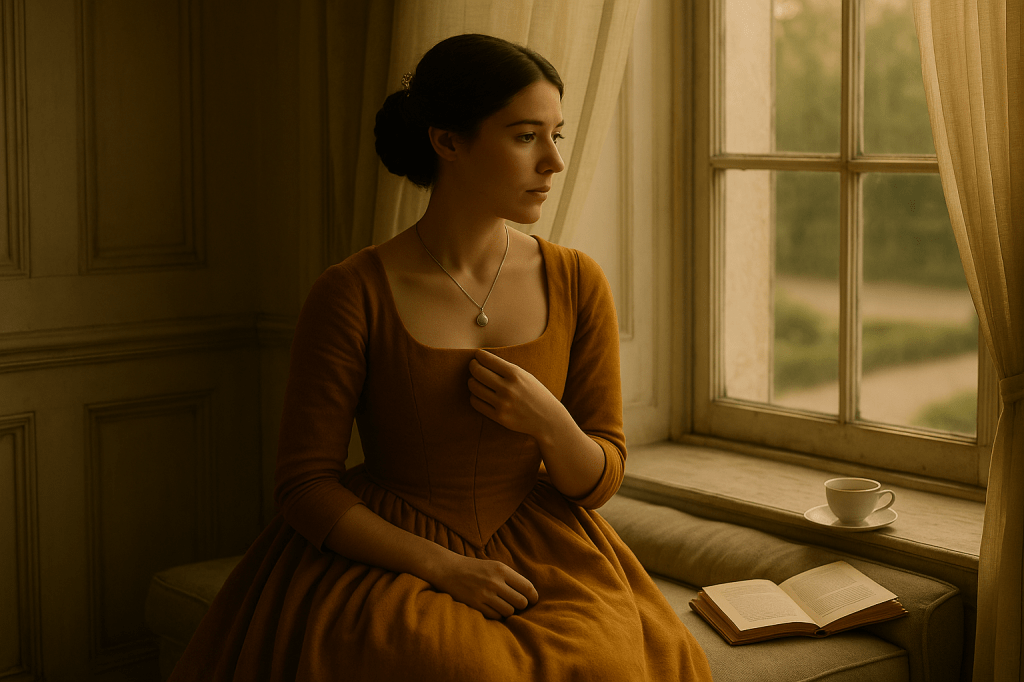
HORIZONTAL CINEMATIC IMAGE: A cinematic, fairy tale realistic, horizontally composed still frame capturing Princess Aveline Beaumont, a French woman in her mid-to-late 20s with fair skin, almond-shaped brown eyes, and dark hair loosely pulled back or falling naturally, in a rare moment of vulnerability. She sits alone on a cushioned window seat in her private royal chambers.

The setting is gently lit by the cool, diffused light of early morning, streaming through tall, lace-curtained windows. Dust motes hang in the golden-blue light, illuminating the quiet aftermath of a royal ball. The palette is soft, faded—filled with subtle pastels and worn wood textures that evoke the faded grandeur of a lived-in palace interior.

Aveline wears a simple yet elegant golden-ochre gown, slightly softened by sleep or rest, draped naturally around her seated figure. One hand rests on her lap, while the other gently touches the silver pendant at her collar, a gift from the mysterious girl in the silver gown. Her posture is relaxed but her face holds a tension beneath the surface: her gaze is faraway, focused beyond the window, lost in thought.

The mood is melancholy and reflective, evoking the emotional aftermath of a night charged with expectation and transformation. The camera angle is intimate and painterly, as if this is a still from a film about personal choices, unspoken longing, and a growing sense of self.

In the foreground, a small table holds an untouched teacup, a closed journal, and perhaps a folded letter, hinting at unanswered questions. The entire scene feels like a breath held between moments of political tension and personal awakening.

My thoughts are elsewhere.

On her. Cinder. The girl in the silver gown.

She didn’t move like the others — all powdered grace and scripted charm.

Her words were deliberate.

Her gaze, steady and unflinching, as if she could see the part of me I keep locked away.

And then she was gone, dissolving into the crowd like smoke from a candle.

“Your Highness.” Claudine enters, the soft scrape of the door sounding louder than it should. Her eyes are calm; the concern behind them is not. “The Queen requests your presence in the council room.”

“What now?”

“There are rumors,” she says evenly. “About an unexpected guest at the ball.”

I lift a brow. “There were many unfamiliar faces. It was a royal celebration.”

“One in particular,” she replies. “The girl in silver. The one who lingered in the Hall of Mirrors.”

Her voice drops — low, deliberate.

“Some call it a breach of security. Others… something more intentional. As though she came for you. Or the Queen.”
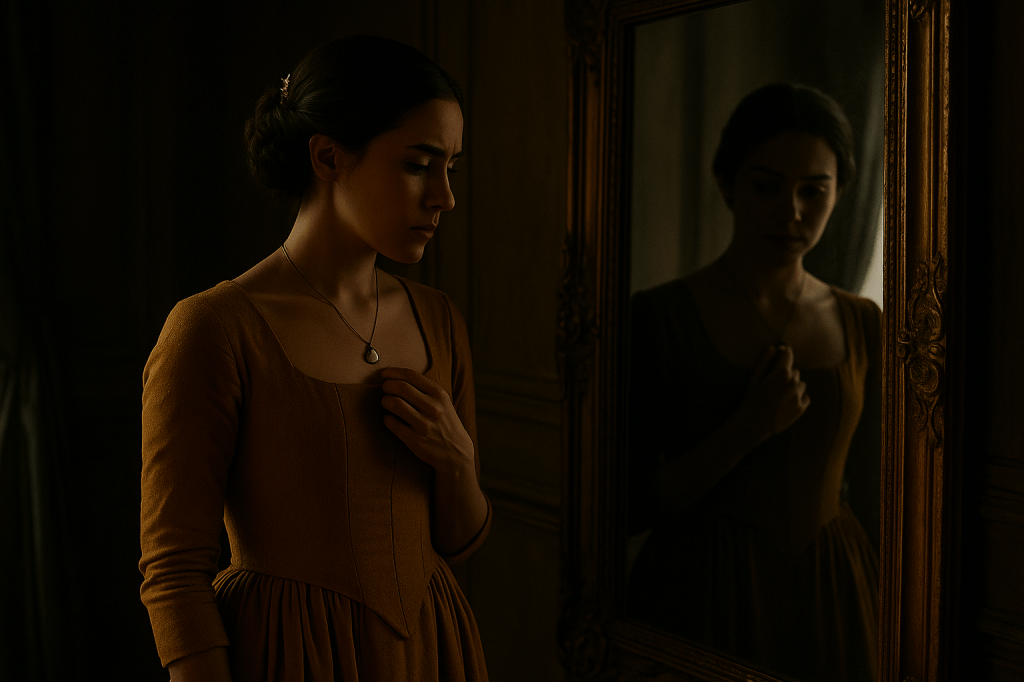
HORIZONTAL CINEMATIC IMAGE: A cinematic, horizontally composed, fairy tale realistic still frame of Princess Aveline Beaumont, a young French woman in her mid-to-late 20s with fair skin, almond-shaped brown eyes, and dark brown hair styled in a low braided chignon, standing in quiet contemplation before a tall ornate mirror inside her private royal chambers. The atmosphere is dim and moody, with low morning or late afternoon light filtering in from unseen windows, creating a soft interplay of light and shadow across the carved wood and paneled walls.

Aveline wears a golden-ochre royal gown, modest yet elegantly fitted, with delicate trim and long sleeves that emphasize her poised nobility. Her reflection in the mirror is partially visible—subtle, slightly blurred by perspective—showing the duality between how she presents herself and what she truly feels.

Her posture is upright but tense, as though holding in a flood of emotion. Her hands are drawn together just below her collar, fingers loosely clasped, or one hand faintly brushing against the silver pendant at her neck, a quiet yet pointed symbol of connection to the mysterious girl in the silver gown from the night before.

Her expression is composed, almost too composed—lips gently pressed, jaw subtly clenched—capturing the moment just before composure breaks. Her gaze avoids the mirror directly, instead drifting slightly downward, as if she can no longer meet her own eyes. This is a private, unguarded moment of self-reflection and vulnerability.

The background is spare and intimate: a dressing screen, a carved vanity with a few items (a brush, perhaps a folded note), and ambient shadows wrapping the space in silence. The overall tone is one of emotional restraint, suggesting a woman grappling with the memory of a forbidden connection, the weight of courtly scrutiny, and the growing threat she cannot yet name aloud.

She waits, as if measuring my stillness.
“She was not on the guest list. Madame Violette’s invitation was hand-delivered. Which means someone intercepted it — and wore her name as easily as she wore that gown.”

“You think the Hall matters?”

“The Hall of Mirrors is where monarchs are crowned. Where treaties are sealed. Every glance, every whisper there is remembered. If she was sent — by Thibault or another — she chose her stage well. And she found you there for a reason.”

“Do they think she’s a threat?”

“They don’t know what to think. The Queen is concerned. Some whisper she was rebellion wrapped in silk; others, a spy from a rival court. A countrywoman told the guards she may be tied to a forest mystic — Madame Esmée — said to lure and bewitch women to stir unrest. Superstition, perhaps. But the timing?” Claudine’s gaze doesn’t waver. “Hard to ignore.”

“And you?”

“My suspicion? Thibault’s hand is here. If not in the girl or Madame Esmée, then in the story already blooming around her — the commoner who bewitched a princess and unsettled a kingdom with a single dance. He’s not trying to catch her, Aveline. He’s waiting for you to stumble. Then he’ll swoop in, call it interference, and dress it as duty to the crown. A move meant to weaken you… to strip your influence before you see it coming.”

HORIZONTAL CINEMATIC IMAGE: A horizontal, cinematic, fairy tale realistic still frame capturing a moment of intense, quiet tension between two French noblewomen in a serene palace courtyard. The scene is framed beneath the golden light of late morning. The garden is richly alive with meticulously trimmed hedges and blooming orange trees, their ripe fruit and blossoms dappled with sunlight that spills through branches onto a warm gravel path.

Princess Aveline Beaumont—a French woman in her mid-to-late 20s with fair skin, almond-shaped brown eyes, and dark brown hair styled into a low braided chignon secured with a delicate hair comb—stands slightly turned away, her expression a blend of defensive poise and restrained emotion. She wears a rich golden-ochre gown, fitted but modest, its sleeves and bodice evoking her royal status without ostentation.

Beside her stands Duchess Claudine Delisle, a striking woman with deep brown skin and sharply intelligent eyes, her natural black hair styled into a braided chignon. She wears a muted green court dress with ivory lace trim along the neckline and cuffs—subtle and dignified. Her posture is composed but alert, and her expression is serious, her brow faintly furrowed as if weighing each word she has just spoken. Her hands are lightly folded before her, exuding quiet strength.

The women are framed by the rich symmetry of the garden: ripe oranges glowing in the trees above, gravel paths winding behind them, and a blurred glimpse of the palace façade beyond. The lighting is warm but carries an undertone of foreboding. The emotional tone of the scene is not loud but heavy with implication—as if the conversation just held between them has shifted the ground beneath their feet. It is a moment of shared understanding, mutual caution, and profound stakes beneath a veil of formality.

The cinematic effect evokes the charged stillness before a political reckoning, where loyalty and fear, affection and power, hang in the balance between two poised women bound by more than duty.

Her voice drops further, an edge like a drawn blade.

“It’s not your crown he wants. It’s your reach — growing faster than he can control. You rattled him at the last council meeting. He expected defiance from the Queen, not you. Now, he’s setting the board for your fall. Exactly what the Queen warned you men like Thibault would do.”
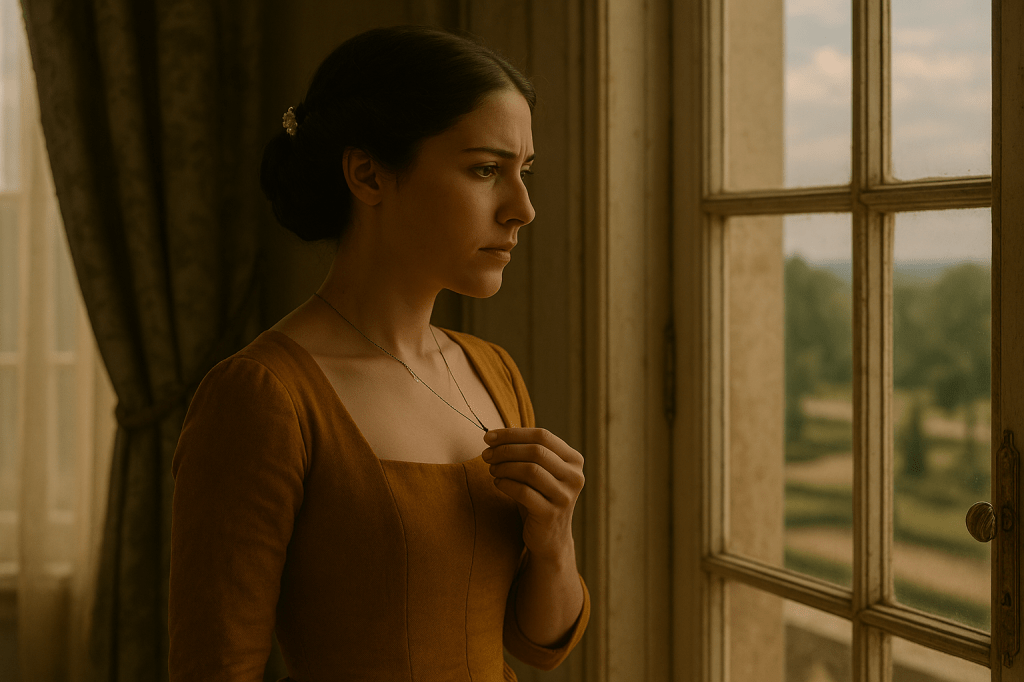
A cinematic, fairy tale realistic still frame of a young French noblewoman standing alone in her bedchamber in the daytime. This is Princess Aveline Beaumont, a woman in her mid-to-late 20s with fair skin, dark chestnut-brown hair styled in a low braided chignon, and almond-shaped brown eyes full of quiet intensity.

She wears her deep ochre-gold royal gown, soft and elegant, with long sleeves and a square neckline, reflecting her established style for intimate, indoor scenes. The scene captures a moment of emotional reflection: Aveline stands before a tall, leaded-glass window, faint moonlight barely visible beyond the panes. She holds a small pendant gently in her right hand, close to her chest—a silver charm or locket that glimmers subtly in the warm candlelight.

Her expression is one of longing, clarity, and secrecy, as though holding onto a memory too precious to name. She does not face the viewer directly; instead, her body is slightly turned, silhouette lit softly by candlelight from the side, casting a warm amber glow across the room. Shadows pool gently across the floor and the carved wood paneling behind her, giving the room a quiet, storybook intimacy.

The room is softly appointed: hints of carved furniture, a writing desk barely visible behind her, and a closed journal resting nearby. A velvet curtain is drawn back slightly at the window, and the overall palette is warm, golden, and hushed—full of emotional tension and reverent stillness. The atmosphere evokes a turning point—a woman caught between memory and decision, resolve and yearning.

I turn to the window, my hand brushing the pendant at my collar — the one she had fastened there, her fingers brushing my skin.

It’s warm still, as though her touch lingers.

I should remove it. I have not.

“That’s why he summoned me. Right after I… danced with her.”

“Aveline…” Claudine’s tone softens — the rare kind that slips past my armor. “If you know anything, act now. A guard spoke of a kiss to the hand. Between you and the girl. Thibault noticed. Your silence only feeds him. If he topples you and the Queen, the kingdom will move to his design.”

I face her, my mask slipping just enough to let the truth threaten the surface.

“I don’t know anything,” I say. Almost truth.

Claudine doesn’t press.

Her silence feels like belief.

Or permission.

And I am dangerously tempted to take it.

The Council

Aveline

Before I can reply, the heavy oak doors swing open.

“Her Highness will join us now,” comes the herald’s voice — clipped, perfunctory.

Claudine and I exchange a glance, her eyes sharpening in silent warning.

There’s no time to straighten my thoughts, no time to rehearse the mask I need to wear.

The corridors feel longer than they should, the vaulted ceilings swallowing each step. Guards posted at every archway seem to follow me with their eyes, measuring, weighing.
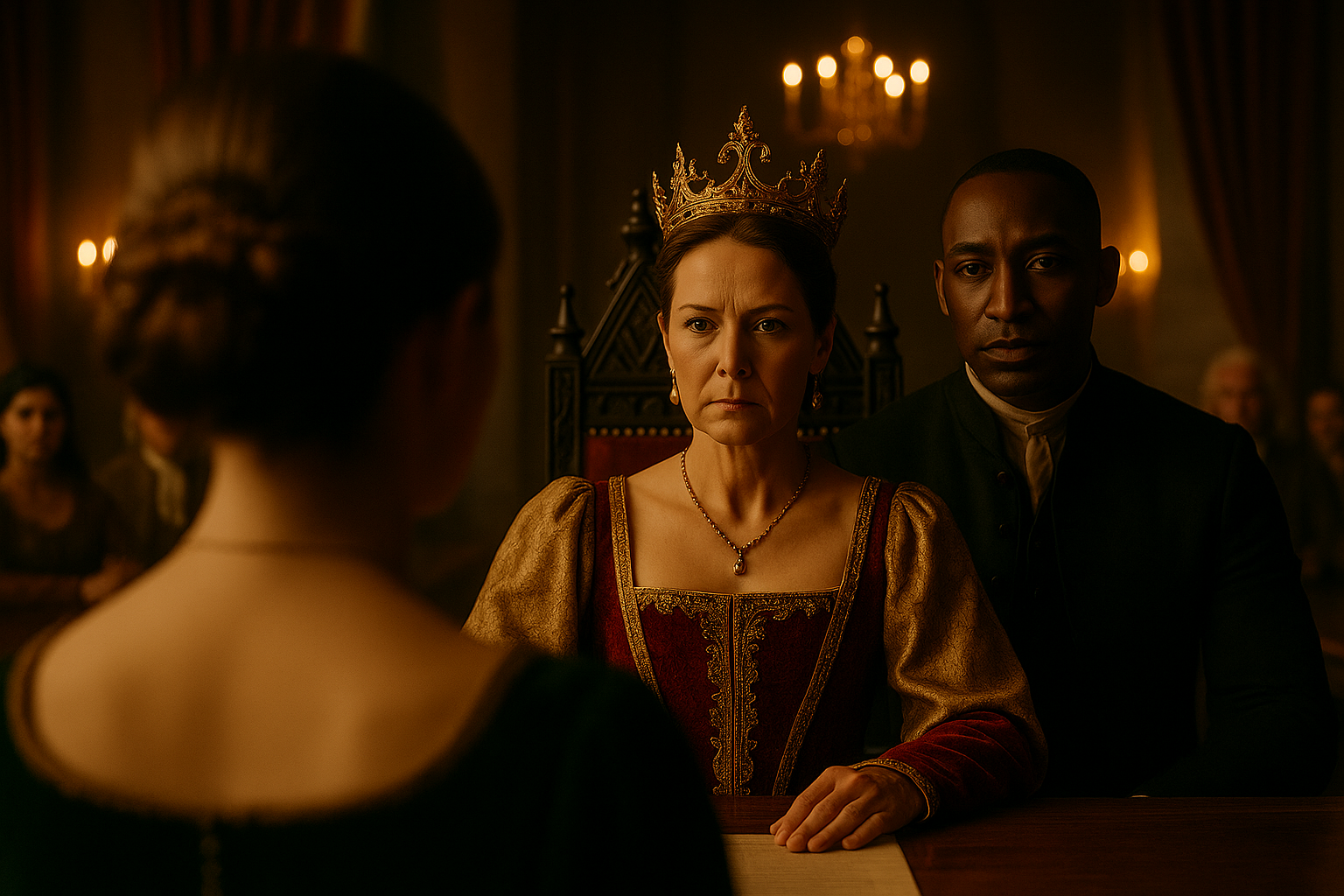
A cinematic, fairy tale–realistic still frame from a richly atmospheric period drama. The shot is composed as a tight over-the-shoulder POV from Princess Aveline Beaumont, her chestnut-brown braided chignon secured with a pearl comb and the golden-ochre fabric of her gown softly blurred in the foreground. The perspective places the viewer firmly in Aveline’s seat, looking across the long carved oak council table toward the figures of the Queen and Thibault at the far apex of the chamber.

The Queen:

Positioned at the true head of the table, seated in an elevated, ornate, high-backed throne-like chair, making her the central axis of power.

Mature, regal, crowned, wearing a richly embroidered crimson-and-gold gown with pearls and gold jewelry.

Her posture is upright and commanding, hands resting firmly on the table, gaze steady and unreadable.

She radiates unyielding authority, the still and immovable center of judgment.

Thibault:

Seated immediately to the Queen’s right (audience-left), slightly forward at the table’s edge.

Dark-skinned nobleman with closely cropped hair, dressed in elegant dark attire with formal cut.

His body language contrasts with the Queen’s stillness: leaning forward slightly, gaze locked on Aveline, his expression confident and measured.

His presence feels active and engaged, an extension of the Queen’s authority — a voice pressing against Aveline.

The Council:

Council members are blurred and indistinct, seated only along the sides of the long table in carved high-backed chairs.

No one sits behind the Queen or Thibault, leaving the apex visually clear.

Their muted presence suggests scrutiny and murmured tension, but the focus remains tightly on the Queen and Thibault.

The Chamber:

Baroque, Versailles-inspired architecture: pale limestone walls, tall arched windows draped in velvet, gilded crown molding, chandeliers and candelabras glowing warmly.

Perspective lines of the chamber and table converge toward the Queen at the apex, reinforcing her centrality.

The polished oak table reflects candlelight and daylight, adding depth and golden warmth.

Mood & Cinematic Style:

Painterly golden light mixes sunlight and candle glow, illuminating the Queen’s crown and Thibault’s expression.

Shallow depth of field sharpens the Queen and Thibault while Aveline remains blurred in the foreground, anchoring the POV.

The composition balances authority and challenge: the Queen’s immovable dominance and Thibault’s assertive engagement share equal visual weight, creating a tense tableau of power.

The atmosphere is politically charged, intimate, and confrontational — a fairy tale rendered with period-drama gravitas.

When I enter the council chamber, the air is thick with parchment dust, candle smoke, and the faintest trace of damp stone.

Thibault is already watching me. Not with open hostility — worse — with that measured patience of a man certain the game is his.

The Queen sits at the head of the table, her posture unyielding, her gaze unreadable. Around her, the councillors murmur like a restless tide.

I take my seat.

The chamber falls silent.

Thibault’s voice cut through the stillness, smooth and deliberate. He spoke of “unexpected guests,” letting the phrase linger just long enough for the room to savor it.

I kept my hands folded in my lap, resisting the urge to reach for the pendant at my collar.

The Queen’s gaze shifted to me — slow, deliberate — as though she was already measuring my answer before I’d given it.

“Lord Thibault raises a concern,” she said evenly, “one I trust you can address without hesitation.”

There was no warmth in her tone, but no censure either. The glint in her eyes was impossible to read — sharp enough to feel like a warning, soft enough to hint at protection.

Around the table, the councillors leaned forward, their silence turning the chamber into a hunting ground.

I lifted my chin, schooling my expression into the one my mother had taught me for moments like this: calm enough to suggest control, guarded enough to offer nothing.

“And what concern is that, precisely?” I asked, my voice carrying just enough steel to keep it from sounding like an admission.

Thibault smiled without showing his teeth.

“Only that the Hall of Mirrors is a place for oaths and coronations, not…personal entanglements, your Highness. Surely you’re aware of that, being the princess. Some of us are concerned it was used for purposes unbecoming the crown. Especially for one’s personal…liasons.”

The words were meant to draw blood without ever breaking the skin.

I let a measured breath fill my chest, keeping my gaze level with his.

“If the Hall was diminished by last night, Lord Thibault,” I said, “then it is the fault of those who mistake grace for impropriety, not those who show it. You of all people should know that as well.”

A ripple moved through the council, subtle but sharp. A few heads lowered, as if suddenly interested in their notes. Thibault’s smile didn’t falter, but his fingers tightened imperceptibly against the armrest — the only sign my words had reached their mark.

“Indeed. Unfortunately, my concern,” he replied smoothly, “is that appearances, once tarnished, are difficult to restore. A single lapse can invite questions about your reach. And we can’t afford overreach.”

The word was deliberate.

I smiled — barely — and met his gaze.

“Then I will ensure mine extends far enough to meet them. For yours and the council’s concern.”

The Queen’s hand, resting on the table beside her, stilled. I couldn’t tell if it was approval or warning. Perhaps both.

Thibault leans forward, fingertips steepled.

“Your Highness, might I also remind you the council was not informed of every guest at last night’s ball? A regrettable oversight—one I’m sure you will clarify. Unless you’ve got something to hide. I’m sure we could bring in Lady Claudine to clarify.”

I keep my gaze steady.

“Lord Thibault, every guest who mattered to the crown was in attendance. Even those we share disagreements in.”

A faint twitch at his mouth — the smallest tell.

“And yet one in silver drew considerable attention,” he went on. “Enough to stir whispers of… undue familiarity. And she was alone. Curious, for a princess to spend her evening in such company.”

The Queen’s gaze moved between us, unreadable.

“If the court chooses to whisper, let it,” I said, letting the words settle like frost. “We cannot govern by rumor.”

“Rumor becomes record when left unchecked,” Thibault replied, smooth as oil. I’d hate to see your reputation shaped by another’s pen. Or by a kiss…unworthy of the crown.”

The Queen’s voice cut through the air like a blade.

“Lord Thibault. Enough. We have other matters. Questions of last night will be left to me.”

He inclined his head, but his eyes never left mine — the promise of a battle deferred, not avoided.

She’s Still With Me

Cinder

The valley is restless tonight.

I feel it the moment I step beyond the orchard walls — the whisper of unease threading through the branches, the same tension that lingered in Aveline’s voice when we parted. The sky has not yet darkened, but the light feels thin, strained, as though the day itself is holding its breath.

I walk until the castle roofs disappear entirely behind the trees. Only then does the quiet settle around me, heavy and familiar. I kneel beside the moss-covered roots of an old cedar, letting my fingers brush the ground.

A wide, horizontal, cinematic, photorealistic image set in a quiet forest clearing at sunset.
Warm, fading golden light filters through tall trees, casting long, soft beams across the clearing. The atmosphere feels tense, still, and expectant — as though the forest is holding its breath. Dust and pollen drift in the air, caught in the last rays of sun.

At the center of the frame, Cinder Dubois, a young French woman in her mid-to-late 20s, kneels beside the thick, moss-covered roots of an ancient cedar tree. She has light olive skin, expressive almond-shaped brown eyes, and long, wavy, chestnut-brown hair that falls loosely around her shoulders with a few strands gently lifted by a faint breeze. Her face carries a subtle tension — lowered brows, parted lips, and a slightly strained, searching expression as she touches the moss with her fingertips. Her shoulders are drawn just slightly higher than usual, showing unease without dramatization.

She wears her usual earth-toned, muted wool dress, textured and worn, with sleeves rolled to her forearms and a simple sash tied loosely at her waist. The fabric catches the warm sunset light in soft highlights.

The cedar tree’s massive trunk and roots dominate the foreground and midground, its bark rugged and ancient. The moss beneath Cinder’s hand appears soft and thick, illuminated by a faint halo of golden light. The surrounding forest behind her is darker, fading into deep green shadow, creating a strong contrast with the sunlight striking her face and the roots.

The image contains no explicit magic — only atmosphere and emotion.
The mood conveys: quiet tension, longing, and the presence of something unseen.
Rendered in a cinematic, fairy tale–realistic style, with rich texture, warm tones, and expressive natural lighting reminiscent of award-winning historical drama cinematography.

For a moment, nothing.
Only my own uneven breath.

Then — faint, subtle — the air shifts.

A breeze curls through the clearing, warm despite the cooling dusk. It moves the way Esmée’s hand used to when she brushed aside branches for me: slow, deliberate, certain. The moss beneath my palm warms as though remembering her touch.

My throat tightens.

I close my eyes.

“Esmée…?”
The name slips out before I can swallow it back.

Another hush sweeps the clearing — not wind, not whispers — something quieter. Something like a presence leaning close enough to steady me. The scent reaches me next: rosemary and lavender, carried on the breath of the valley.

Exactly as it was the morning she placed the book in my hands.

I exhale shakily, the tension slipping from my shoulders like a cloak.

“You’re still with me,” I whisper into the quiet.

Not a question.
A realization.

A small leaf detaches from a branch above, twirling downward. It lands gently against my knee, as if placed there. The forest settles again — less restless now. More certain.

I open the grimoire.

Its pages, normally cool, feel warm beneath my fingers.

Not glowing.
Not trembling.
Just… warm.

Alive.

Guiding.

A breathy laugh escapes me — soft, half-disbelieving.
“I hear you. I’m listening.”

The words feel like a vow.

The wind stirs once more — light, sure — and then the clearing falls still. But the warmth remains, threaded through my bones, steadying my hands.

I stand.

The path back to the castle waits, shadowed but clear. I am no less afraid than before… but I am no longer alone.

I carry her with me.
In the whispers.
In the land.
In every step.

Esmée walks beside me —
not seen,
not heard,
but undeniably here.

Between Masks

A horizontal, cinematic, photorealistic image in a dark, misty forest at twilight. In the foreground stands a young woman with wavy, dark brown hair and expressive eyes, wearing a simple earth-toned dress tied at the waist. Her expression is tense and uncertain, as though she hears whispers in the fog. A faint bulge beneath her apron hints at a hidden grimoire, glowing softly with an amber light that spills through the fabric, symbolizing the secret power she carries. From behind her, shafts of golden sunlight pierce through the fog and trees, cutting across the scene like a memory of the ball—beautiful but haunting. The forest around her fades into atmospheric haze, with the nearest trees and ground in sharp detail while the background dissolves into soft, film-like blur. The mood is magical, uneasy, and enchanted, as if the forest itself is holding its breath, waiting for a storm to break. Photorealistic textures, cinematic lens depth of field, golden hour lighting, moody and atmospheric, fairy-tale realism.

Cinder

I haven’t been back to the forest since the ball.

The whispers aren’t silent, but they’re quieter—more like a waiting breath than a pull. I think they’re watching, sensing a storm I can’t yet name. I still keep the grimoire close, hidden in a pouch I stitched into the lining of my apron. But I haven’t opened it.

Not since the night I fled the palace.

I’ve replayed that moment again and again—her face in the mirrors, the way she looked at me like I wasn’t just another servant’s girl with soot in her veins. Like I mattered.

I wonder if she still remembers.
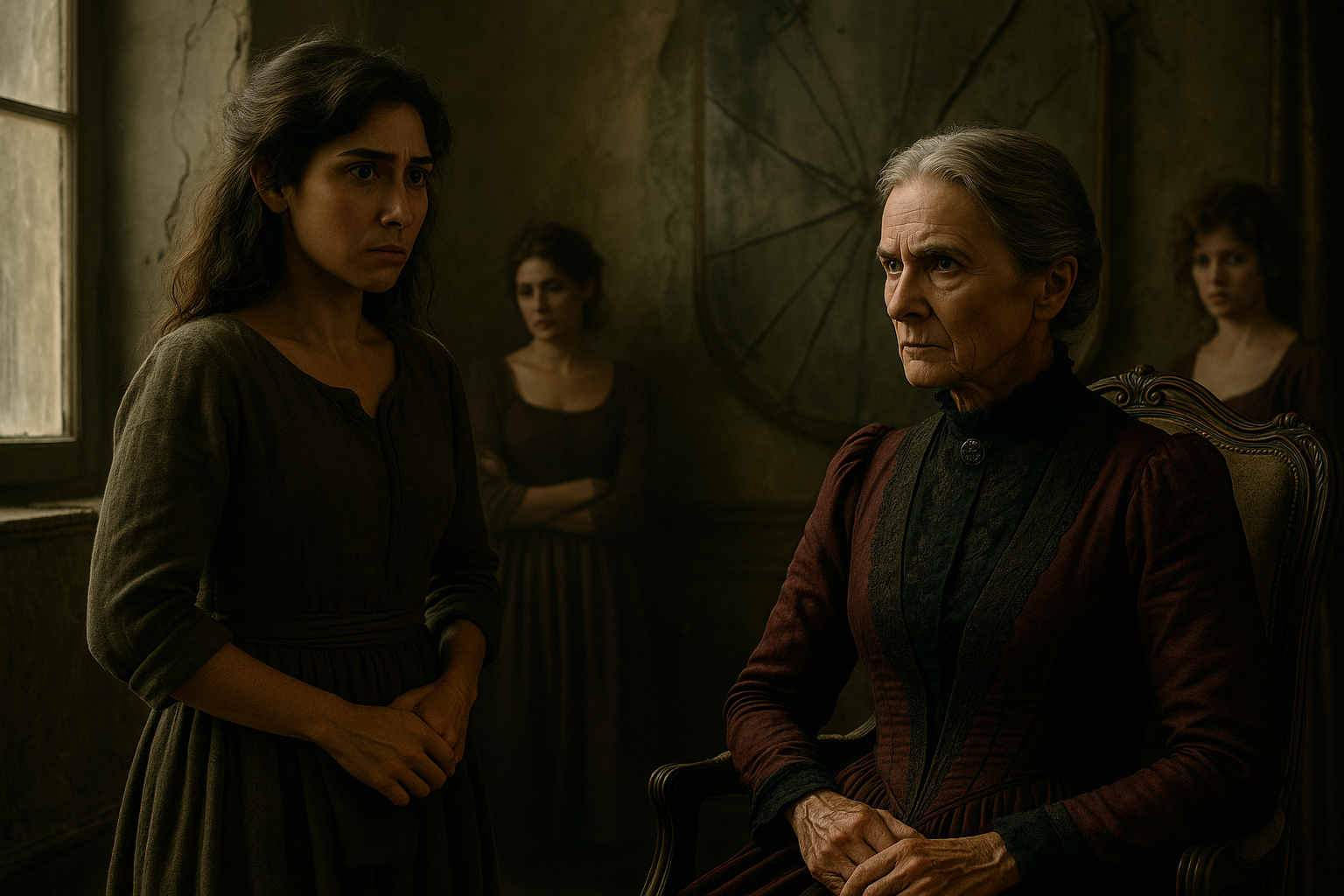
A horizontal, cinematic, photorealistic image set inside a crumbling French chateau estate, the atmosphere heavy, gothic, and suffocating. The framing is tight, drawing focus to a tense standoff between two figures. In the foreground, Cinder—mid-to-late 20s, with dark wavy hair—stands rigid and wary in her simple earth-toned dress. Her hands are folded at her waist as though guarding a hidden secret, her expression caught between fear and quiet defiance. She is softly lit by muted daylight streaming through a dusty, tall window at her side, her figure sharply defined against the gloom of the decayed room.

Across from her sits Madame Violette, regal and severe, dressed in a deep burgundy gown trimmed in black lace. Her gray hair is pulled tightly back, her face sharp and angular, her eyes fixed on Cinder with a predatory intensity, like a wolf sizing up its prey. Her posture is rigid, commanding, her presence dominating the composition. Behind her looms a large cracked mirror, its fractured glass catching fragments of dim light, the jagged lines radiating like a broken crown around her head—symbolizing tension about to snap.

On the edges of the frame linger Sabine and Aimée, blurred and half in shadow, their gowns rich but faded, their expressions cruel and dismissive. Their presence adds to the hostility of the room without distracting from the central confrontation. The surroundings amplify the mood: peeling plaster walls, faded wallpaper, and warped wooden floorboards emphasize the estate’s decay. The light is moody, filtered, and cinematic, with sharp contrasts between the illuminated figures and the shadowed corners. The mood is gothic, claustrophobic, and oppressive: a moment of unbearable tension, where even one breath could shatter everything.

Sabine and Aimée have been crueler since the ball, though they don’t know why. They never do. But something shifted. They can feel it, even if they can’t explain it. Madame Violette watches me like a wolf now. I feel it in every footstep, every breath I take near her. The air in the estate is tense, like a wire strung too tight. It’ll snap soon. I can feel it.

This morning, I slipped a note beneath Esmée’s tent flap. I didn’t sign it, but she’ll know it’s mine. I don’t know what I’m asking her for—not yet. Just… I need to see her eyes again. To hear her say that the path hasn’t closed. That the whispers haven’t turned away from me.

Because I’ve never felt so far from what they asked me to find.

Aveline
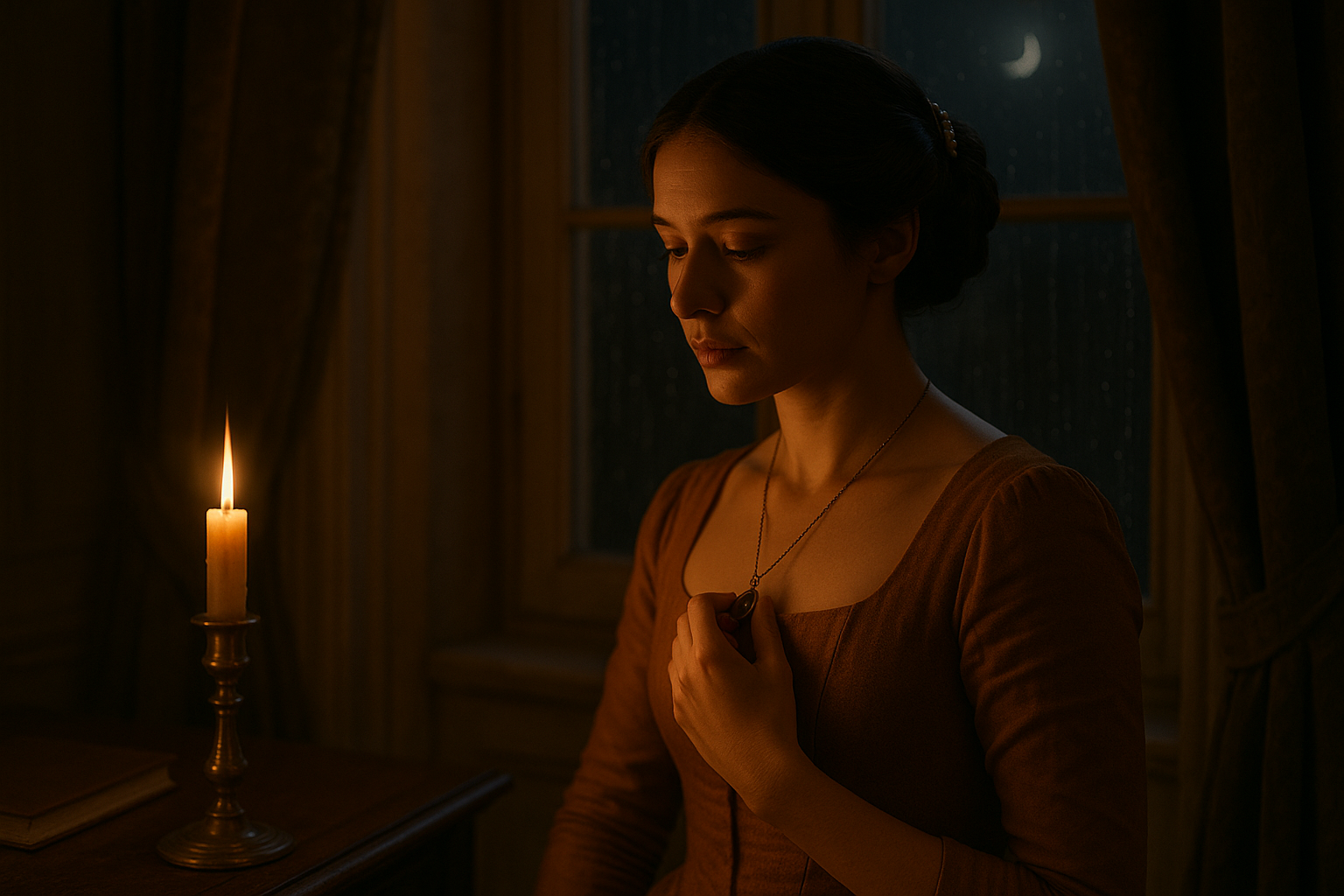
A cinematic, fairy tale realistic film still of Princess Aveline Beaumont standing alone in her private chamber at night, softly illuminated by warm candlelight and the faint shimmer of a rain-speckled window. She is a French woman in her mid-to-late 20s with fair skin, dark chestnut hair styled in a low braided chignon secured with a delicate hair comb, and almond-shaped brown eyes filled with quiet yearning.

Aveline wears a muted gold-ochre royal gown—modest and elegant, with a fitted bodice and long sleeves, historically accurate to the Charles Perrault–era. She stands beside a carved wooden writing desk, not seated, holding a small pendant close to her chest with one hand as she gazes out the window in contemplative silence.

On the desk beside her is a closed journal and an unlit quill, subtle indicators of an unfinished thought. The candlelight gently flickers, casting soft shadows on the Rococo-style cream walls and worn edges of the window frame. Faint moonlight glimmers through the glass, revealing streaks of rainfall clinging to the pane.

Her expression holds both vulnerability and resolve—a woman caught between duty and desire, wrestling with the memory of the girl in silver. The mood is intimate, melancholy, and poised, evoking a moment of reflection before a turning point.

Shot in a horizontal, cinematic format with soft focus on the pendant and naturalistic lighting. The tone captures the visual essence of a quiet fairy tale realism, rich with internal emotion and subtle visual storytelling.

I haven’t told anyone about her.

Not Claudine.

Not even my journal, where I write everything I can’t say aloud. It feels too precious. Too… fragile.

Like if I name her, I’ll lose her.

The truth is, I’m more afraid of never speaking her name again.
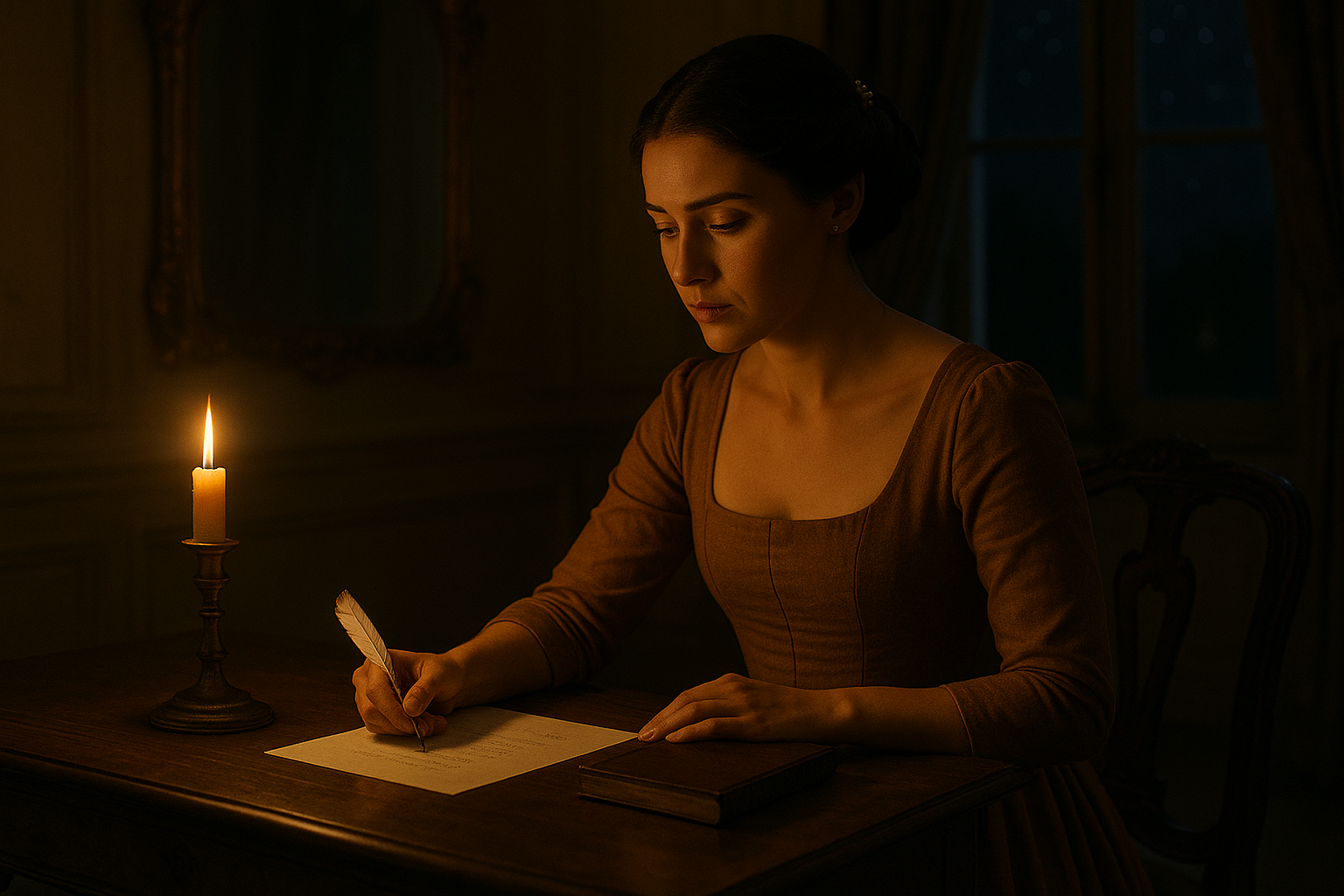
A horizontal, cinematic, fairy tale realistic still frame from a period film. The scene captures a young French princess in her mid-to-late 20s—Princess Aveline Beaumont—sitting alone late at night in her candlelit writing chamber. She has fair skin, almond-shaped brown eyes, and dark brown hair styled into a low braided chignon adorned with a delicate hair comb. She wears a soft, golden-ochre royal gown that is fitted but understated, appropriate for private reflection rather than courtly display.

The setting is warm but quiet, with ambient candlelight flickering across the carved wooden panels and ivory drapes of her chambers. A carved writing desk sits in front of her with a visible closed leather-bound journal and a simple quill pen lying beside it. Aveline sits poised but hesitant, her hand resting lightly on the edge of the desk, as if unsure whether to write. A nearby tall window reveals a faint view of the starlit night sky, the Hall of Mirrors just barely visible in the distance through the glass. The air carries a sense of tension and contemplation—she is caught in a moment between thought and action, memory and longing.

The lighting is low and intimate, evoking the feeling of a woman burdened by unspoken truths and drawn to something beyond duty. The emotional tone is rich with solitude, vulnerability, and quiet yearning—capturing the moment just before decision.

But tonight, I wrote only one line:

“I saw her, and in seeing her, I remembered myself.”

Then I set the pen down, as if the page had said enough.

Cinder. The girl in silver.

There are whispers, of course. Not the kind that live in the soil or the stone—though those are still there, too. These are the whispers of courtiers, hushed and urgent, fluttering like moths against the polished halls of the court.

A stranger in the palace.

Uninvited.

Impossible.

But I saw her.

I spoke to her.

And I remember how her voice cut through the noise, how her presence made me feel seen.

Like the moment between inhaling and exhaling — when the world is holding still, waiting for the next breath.

Not as the heir.

Not as the queen-to-be.

As Aveline. Just Aveline.

Claudine knows something’s different. She hasn’t said it, but she watches me like she’s waiting for me to confess something I haven’t figured out how to say. She’s patient, but she’s also a sword hidden in silk—she won’t wait forever.
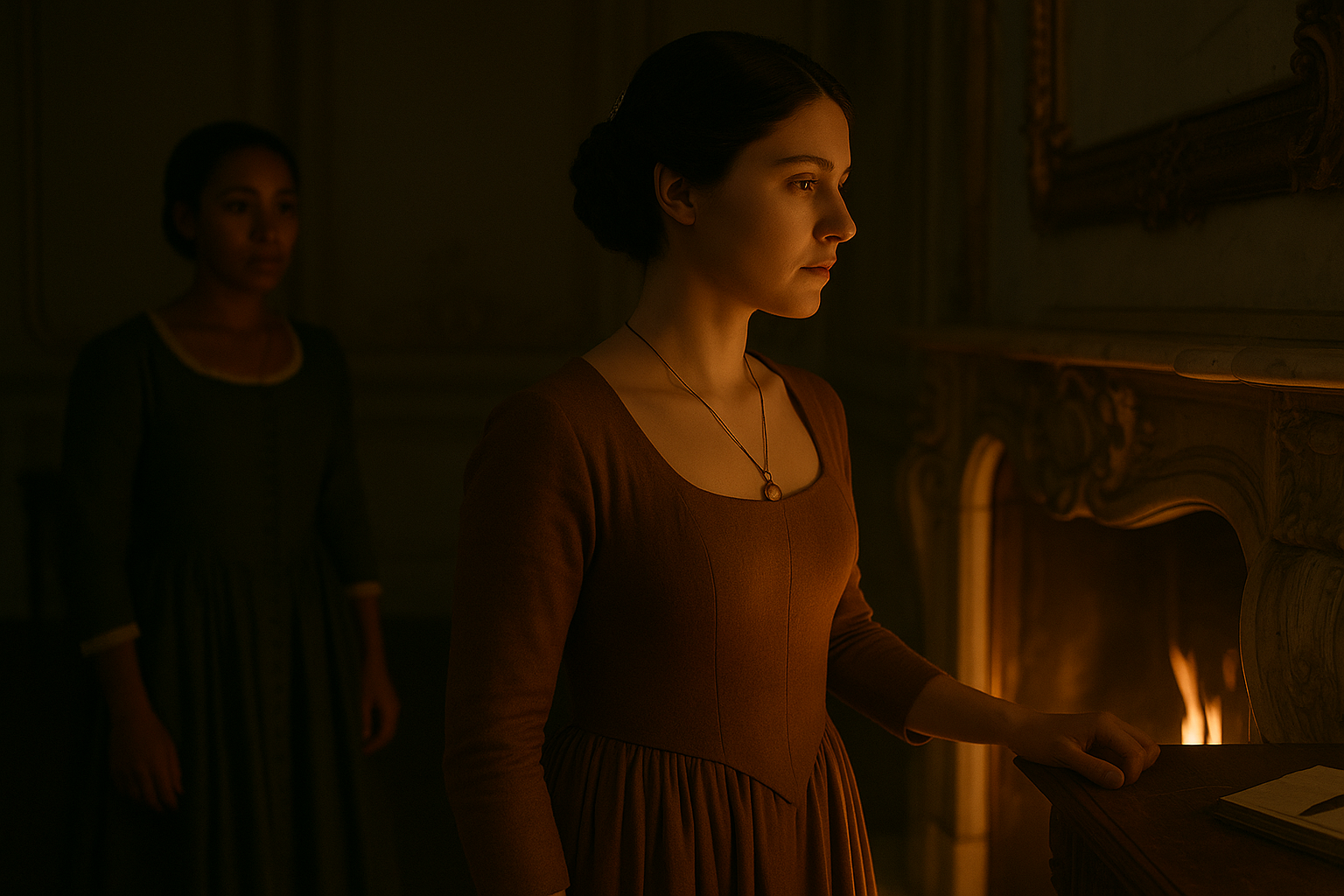
HORIZONTAL CINEMATIC IMAGE: A still frame from a period drama, rendered in fairy tale realism and candlelit tones. The scene is set in a quiet chamber of the French palace, softly lit by a crackling fireplace. On the left side of the image, Princess Aveline Beaumont—a fair-skinned French noblewoman in her mid-to-late 20s—stands near the hearth, her ochre-gold gown softly reflecting the firelight. Her chestnut-brown hair is styled in a braided chignon, and her expression is solemn, thoughtful, and burdened with unspoken tension. She holds one hand near the chain of a pendant around her neck—a subtle gesture of longing and memory.

Across the room, Claudine Delisle—an elegant Black noblewoman with deep brown skin and tightly coiled hair pinned into a braided chignon—watches her quietly from the shadows. Claudine wears a muted green linen gown with ivory lace trim, her arms loosely crossed or resting at her sides, her expression unreadable but perceptive. The soft candlelight casts gentle shadows across the carved wall panels, and the atmosphere is intimate, tense, and introspective.

The image conveys a moment of emotional silence and veiled understanding—a pause before a difficult conversation. The fire glows between them, a visual metaphor for both warmth and danger. No words are spoken, but the silence is rich with meaning.

Mother, meanwhile, sharpens every blade. Her expectations, her words, even her silences. She speaks of the ball’s success like it was a performance well executed, and I, the perfect actress.

She hasn’t asked about Cinder.

Which only means she already knows.

Tonight, I’ll visit the Hall of Mirrors again. I need to stand where we stood. To look into the glass and remember what it felt like to be seen—not by the mirrors, but by her.
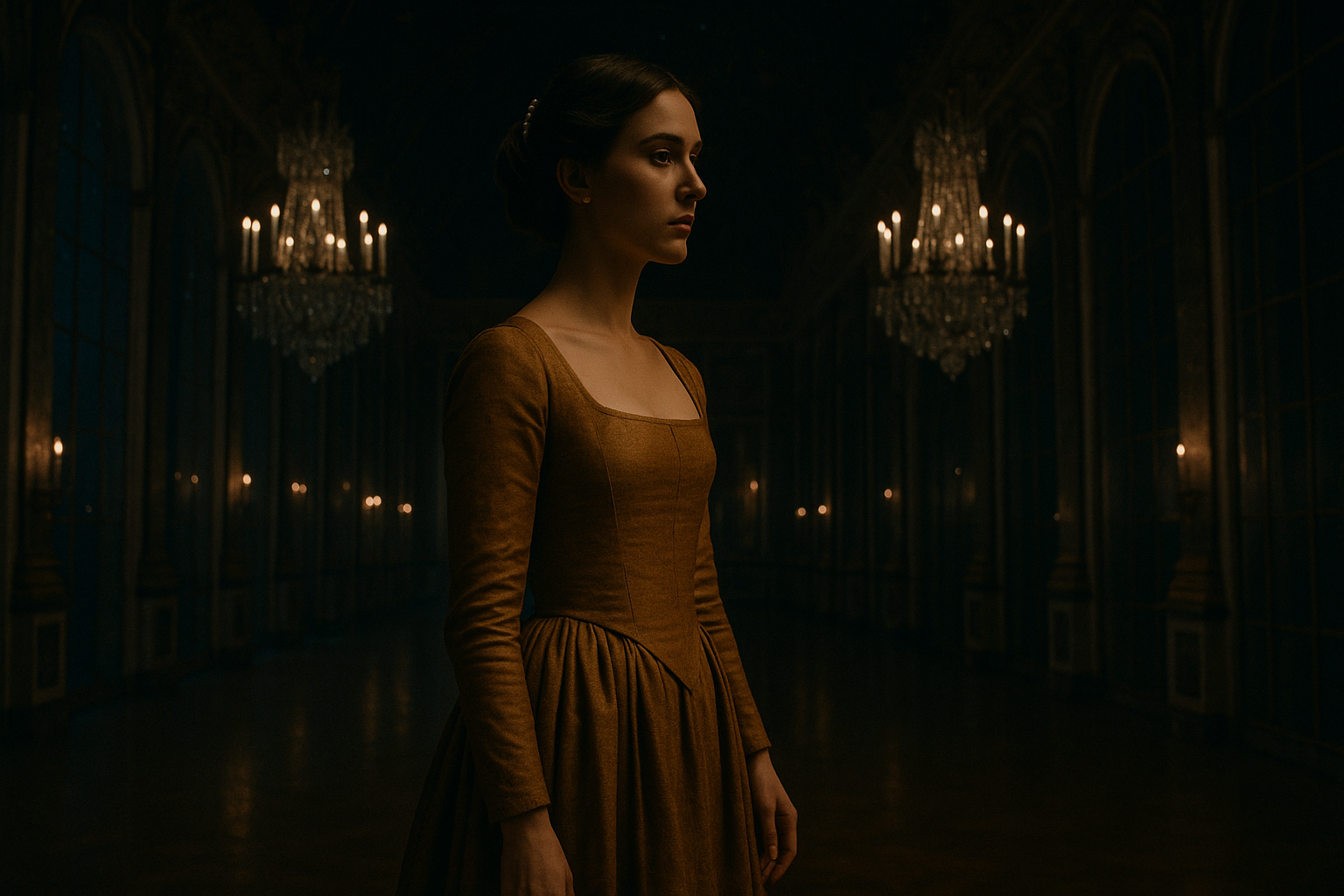
A richly cinematic, fairy tale–realistic still frame of Princess Aveline Beaumont standing alone in the grand Hall of Mirrors at night. The vast, opulent room is cast in shadow, with only faint illumination — chandeliers hang high above, their candles flickering softly, reflecting in the towering floor-to-ceiling mirrors that line the walls. Through the tall arched windows, a starry night sky is visible, lending a ghostly silver shimmer to the scene. The mirrors and chandeliers frame her symmetrically, emphasizing both grandeur and solitude.

Princess Aveline, a poised French noblewoman in her mid-to-late 20s with fair skin and almond-shaped brown eyes, stands centered in the composition. Her chestnut-brown hair is styled in a braided low chignon, secured with a pearl comb. She wears a rich ochre-gold royal gown with long fitted sleeves, a square neckline, and heavy fabric that catches the candlelight in subtle, warm tones. Her posture is graceful but strong — standing tall, arms at her sides, gazing ahead with quiet reflection. Her expression is contemplative, lips slightly parted, caught between melancholy and determination.

The atmosphere is moody, quiet, and emotionally layered. The grand chamber feels both monumental and intimate — the mirrors seem to hold memories, their dim reflections shimmering like ghosts of absent figures. The light is painterly, a chiaroscuro interplay of soft warm candle glow against the cool blue-silver moonlight. The mood evokes the aftermath of a ball, when the revelry has passed and only silence remains. This is a moment of transformation: a woman on the cusp of change, standing in stillness and solitude, seeking meaning in the silence of her reflection. The style is cinematic, richly atmospheric, and evocative of a period drama or fairy-tale film still.

Something is shifting. I feel it in the wind that rattles the windows of the west wing.

In the way the guards whisper when they think I can’t hear.

In the letter Claudine tried to hide this morning—sealed in Thibault’s wax.

Change is coming.

And I want her at my side when it does.

Not in shadow. Not as a passing figure in silver. But close enough that the court will have no choice but to see her too.

Beneath What’s Spoken

Cinder

The wind shifts as I approach the grove. I’ve taken the long path, the quiet one through the burnt orchard and the place where no birds sing. It’s where the ground feels hollow, like it’s holding its breath. Esmée calls it the listening place.

She’s already there.
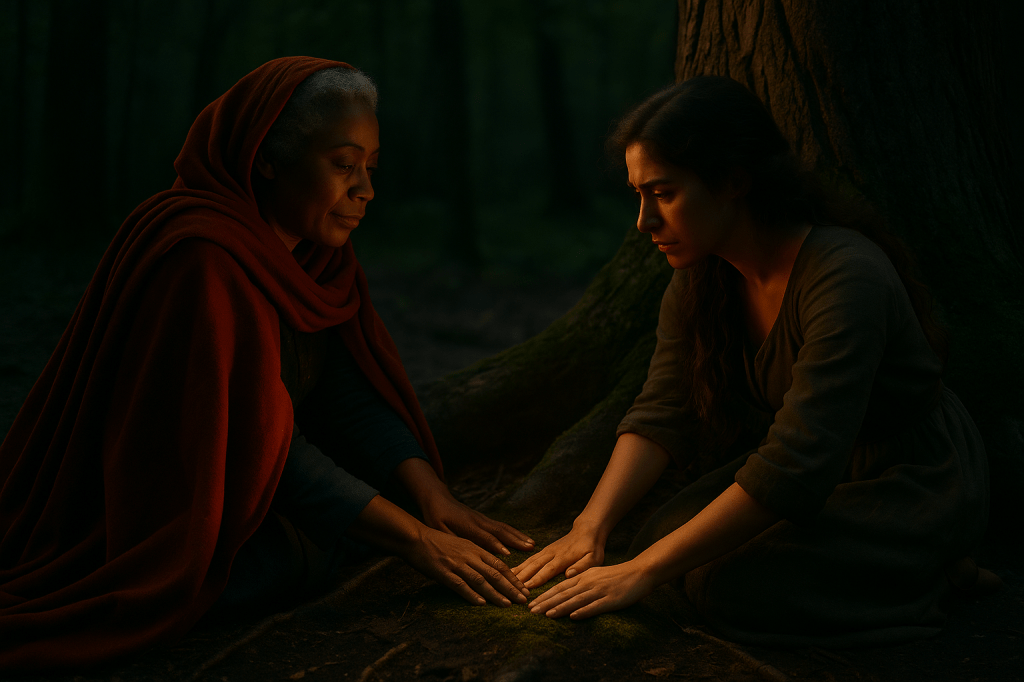
A horizontal, cinematic, photorealistic image set in a dense forest grove at dusk. The mood is intimate and grounded in realism, with no overt magical effects — only atmosphere, gesture, and light. The forest floor is uneven and shadowed, covered in dark moss, tangled roots, and patches of soil blackened from an old fire.

At the base of a massive, ancient oak tree — its bark gnarled, scarred, and textured with deep grooves — kneels Madame Esmée Étoile, a Black French woman in her mid-50s. She wears a deep red cloak whose heavy folds spill across the ground. Her tightly coiled, silver-streaked hair catches the last warm edge of fading sunlight. Her expression is calm, focused, and quietly powerful as she rests her fingertips gently against the moss at the tree’s roots, as if communing with something unseen and ancient.

Opposite her kneels Cinder Dubois, a young French woman in her mid-to-late 20s with olive-toned skin and long, wavy brown hair. She wears a simple, earth-toned wool dress worn from labor and travel. Her posture is tense and unsure, her hands trembling slightly. Esmée guides one of Cinder’s hands to the moss-covered roots. Cinder’s face holds both fear and longing — the tentative recognition of something awakening.

The lighting is naturalistic and cinematic: the grove is mostly dim, filled with cool blue dusk shadows, but one single shaft of warm golden light breaks through the canopy, illuminating their faces and the joined hands. Dust and pollen drift through the beam of light, shimmering softly. The massive oak fills the background with imposing presence, while the rest of the forest falls into blurred shadow, drawing full attention to the intimate moment between the two women. The composition feels sacred, grounded, reverent — like a secret truth being uncovered in the quiet heart of the forest.

Her cloak is darker than I remember, her silver-streaked hair barely caught in the light. She kneels at the base of the old oak, fingertips brushing the moss like she’s greeting an old friend. When she speaks, she doesn’t look at me.

“You’re not here for comfort.”

“No,” I say. “I’m here for the truth.”

She finally turns. Her eyes are sharp—older than I’ll ever understand, but never unkind.

“Then you’re ready to see what they buried.”

She presses my hand to the ground. It’s cold, but pulsing—like breath beneath the stone.

My fingers tremble.

Not from the cold — but from the thought that somewhere, in another part of this kingdom, she might be feeling the same pull.

Aveline
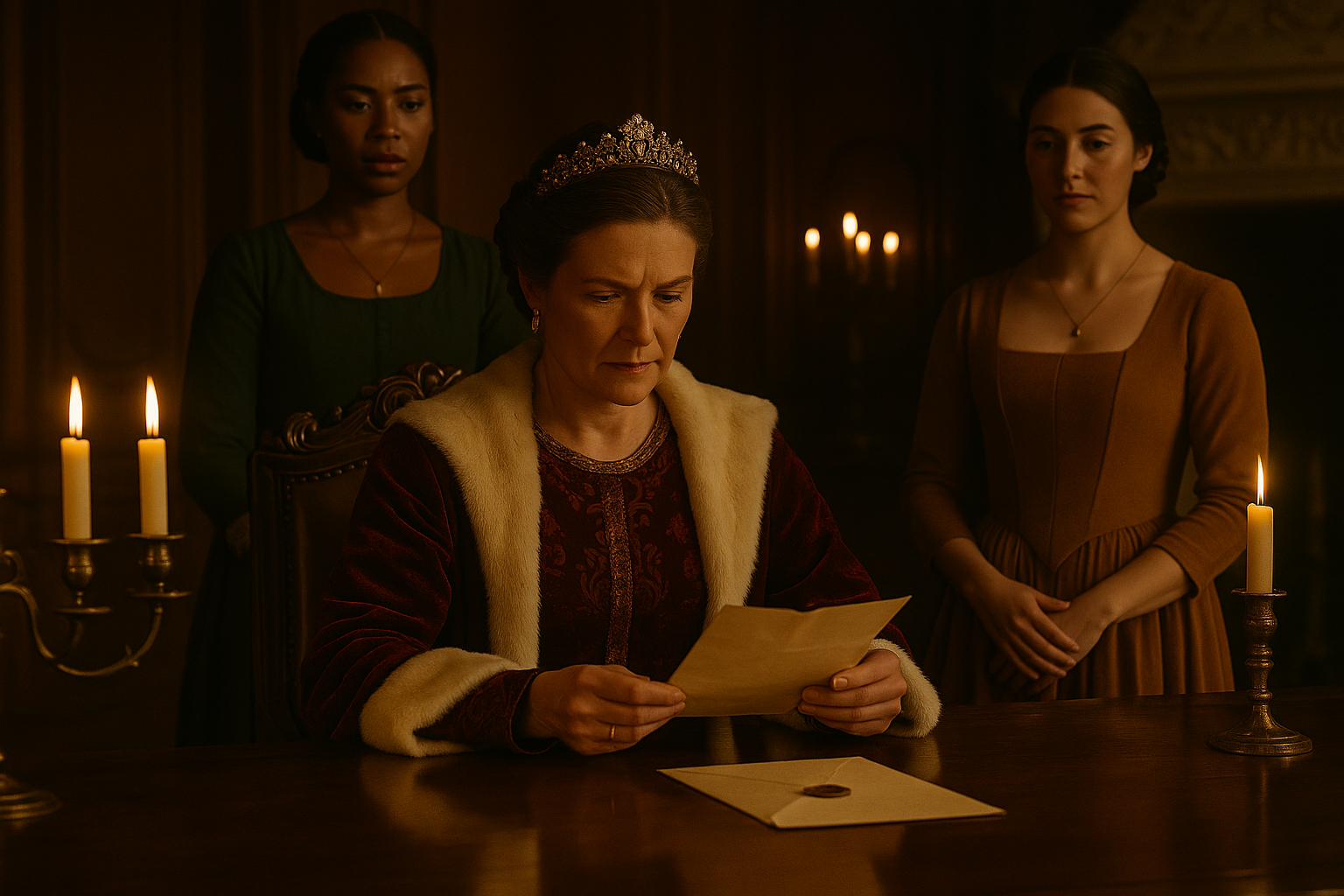
A cinematic, period-drama still photograph capturing three women in a richly appointed royal council chamber. Queen Geneviève Beaumont sits at the head of a long carved table, her regal presence commanding the room. She is a French queen in her late 40s with fair skin, high cheekbones, and a stern, unreadable expression. Her dark braided hair is pulled into a polished chignon, and she wears a deep red velvet gown with gold embroidery and a fur-trimmed robe. In front of her lies a sealed letter she has just opened—marked with Thibault’s wax.

On her right stands her daughter, Princess Aveline Beaumont, a French woman in her mid-to-late 20s with fair skin and a contemplative expression. She wears her ochre-gold royal gown with long sleeves and square neckline, her chestnut-brown hair styled in a braided low chignon. She stands beside the Queen, her posture poised but tense.

Slightly behind Aveline stands Claudine Delisle, her trusted advisor—a poised Black noblewoman with deep brown skin and tightly coiled black hair braided into a chignon. She wears her forest-green court gown with fitted sleeves and ivory lace trim. Claudine watches the Queen intently, her hands folded in front of her.

The atmosphere is heavy with tension and political weight. Sunlight filters in through tall palace windows, catching dust in the air, casting long shadows across the ornate parquet floor. The table is polished, long, and solemn—surrounded by high-backed chairs, but the Queen sits alone at its head. The tone is one of quiet authority, veiled conflict, and cold calculation.

The council chamber is warm with false light and colder with silence. My mother hasn’t spoken since Claudine handed her the letter.

She’s reading it slowly, too slowly. Every second is a punishment.

Claudine stands behind me—still, unreadable.

“Lord Thibault proposes a marriage,” the queen says at last, her voice flat. “Not to you. To someone else. Someone whose family name matters more than yours.”

She looks up.

“But they’re asking for your favor, Aveline. Not mine.”

I swallow hard.

“Why not refuse him?” I ask.

“Because refusal invites questions. Power doesn’t scream, Aveline. It whispers — and those whispers decide who remains standing.”

Her gaze hardens.

“You used to know that, Aveline.”

She means the ball.

She means her.

Cinder.

Even unspoken, her name feels like the only thing in this chamber that belongs to me.

“I haven’t forgotten,” I lie — and pray she doesn’t see through it.
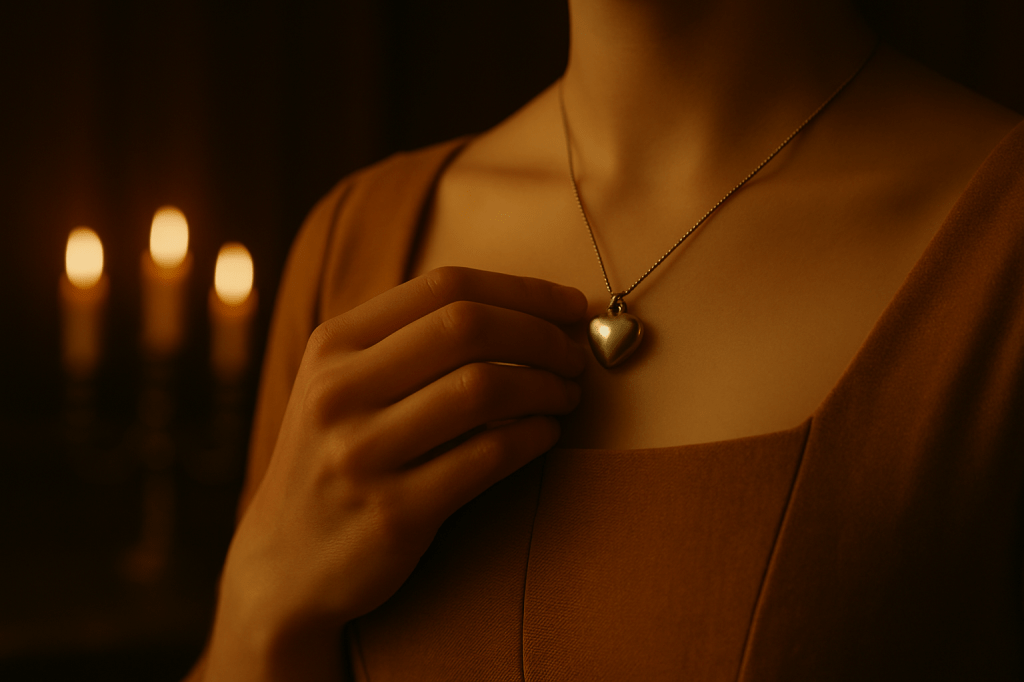
A close-up, symbolic still frame from a cinematic period drama. The image focuses on the delicate, fair-skinned hands of a young French noblewoman — Princess Aveline Beaumont — gently holding a small, silver pendant at the base of her throat. The pendant glints subtly in the soft glow of nearby candlelight. She wears a golden-ochre gown with a square neckline and long sleeves, as previously established. The background is a warm, dark wood-paneled royal council chamber lit by tall, flickering candles — blurred and atmospheric. The image mirrors a key scene of private emotional weight, with Aveline’s posture conveying both inward reflection and restrained tension. Her fingertips lightly clutch the pendant chain, evoking the moment she recalls Cinder’s gift and the weight of unspoken emotion. The composition is cinematic and intimate, intended as a visual echo of her internal transformation and vulnerability. Fairy tale realism, late-Baroque aesthetic, filmed in a warm, candlelit color palette with a shallow depth of field.

Cinder

A horizontal, cinematic, photorealistic close-shot set in a dim forest clearing at dusk. The lighting is warm and directional, coming from a soft golden shaft of low sunlight filtering between the trees.

In the foreground, two pairs of hands are the focus of the frame:

One pair belongs to Madame Esmée, an older Black woman whose hands are steady, weathered, and warm-toned.

The other pair belongs to Cinder, a young French woman in her mid-to-late 20s with lighter skin and slightly trembling fingers.

Esmée gently places a small stone charm wrapped in fraying red silk into Cinder’s open palm.
The charm should look ancient, symbolic, and tactile — something handmade long ago and carried through generations.

Cinder’s other hand is partially curled inward, showing her hesitation. Esmée’s fingers hover reassuringly, conveying quiet authority and care.

The background is softly blurred with dark greens and browns, hinting at a forest floor of roots, moss, and fading light. The mood is intimate, reverent, and emotionally charged — a pivotal passing of responsibility.

There is no magical glow — only natural, warm light emphasizing the gravity of the moment. The texture of the silk, the stone, and the characters’ skin is highly detailed and realistic.

Tone: grounded, solemn, mythic
Composition: tightly framed on the hands and the charm
Aspect Ratio: horizontal 16:9
Style: cinematic photorealism, rich color grading, soft shallow depth of field

Esmée unearths something small—a stone charm wrapped in fraying red silk. She places it in my palm.

“This was planted with the first crown,” she says. “To remember the vow: That balance must be kept.

“The rot is in the crown?” I ask.

She shakes her head.

“The rot is in forgetting what it was meant to protect.”

The grimoire hums against my side.

My throat tightens.

“Aveline is part of this, isn’t she?”

She was born to carry the weight.

But she wasn’t meant to carry it alone.

The thought of her — standing with me beneath the same sky — steadies me more than the ground beneath my feet.

Aveline

Horizontal, cinematic, photorealistic image set in a royal garden at sunset.

Two women stand facing each other in a quiet stone-lined garden path surrounded by soft amber light.
This is Aveline Beaumont, a young French princess in her early 20s, dressed in a simple but elegant warm ochre gown with a square neckline. Her hair is pinned in a modest court style. She stands slightly turned toward Claudine, her expression vulnerable, tense, and searching—caught in the moment just after saying “What if I don’t know who that is anymore?”

Across from her stands Duchess Claudine Delisle, a stately Black French woman in her early 30s. She wears a deep forest-green gown with long sleeves, simple but noble. Her posture is steady, authoritative yet gentle. In her hands, she holds the sealed letter—folded once, gripped lightly but firmly, as if weighing its implications.

The sunset behind them casts long golden rays through manicured hedges and blooming rose bushes, creating a warm halo around their silhouettes. Dust motes float through the light, giving the scene a quiet, almost sacred stillness.

Claudine’s face is calm but resolute—captured at the exact moment she says:
“Then find the one who saw you — before they decide who you’re allowed to be.”

Aveline’s shoulders are slightly drawn, her fingers brushing the pendant at her collar in a gesture of instinctive longing.

The atmosphere is intimate, contemplative, and emotionally charged, highlighting the contrast between Aveline’s uncertainty and Claudine’s unwavering presence.
Soft depth-of-field blurs the distant palace behind the hedges, keeping the focus tightly on the two women and the fragile, luminous honesty of the moment.

I find Claudine later in the garden, away from mirrors and watchful eyes. She’s still holding the letter.

“If I don’t act,” I say, “they’ll choose for me.”

“Then act,” she says, quiet but firm. “Not as their princess. As yourself.”

“And what if I don’t know who that is anymore?”

She folds the letter, her expression unreadable.

Then, softer: “Then find the one who saw you — before they decide who you’re allowed to be.”

Her meaning is clear. So clear it startles me — like stepping into sunlight after days in shadow. And I know exactly whose gaze she means.

Cinder
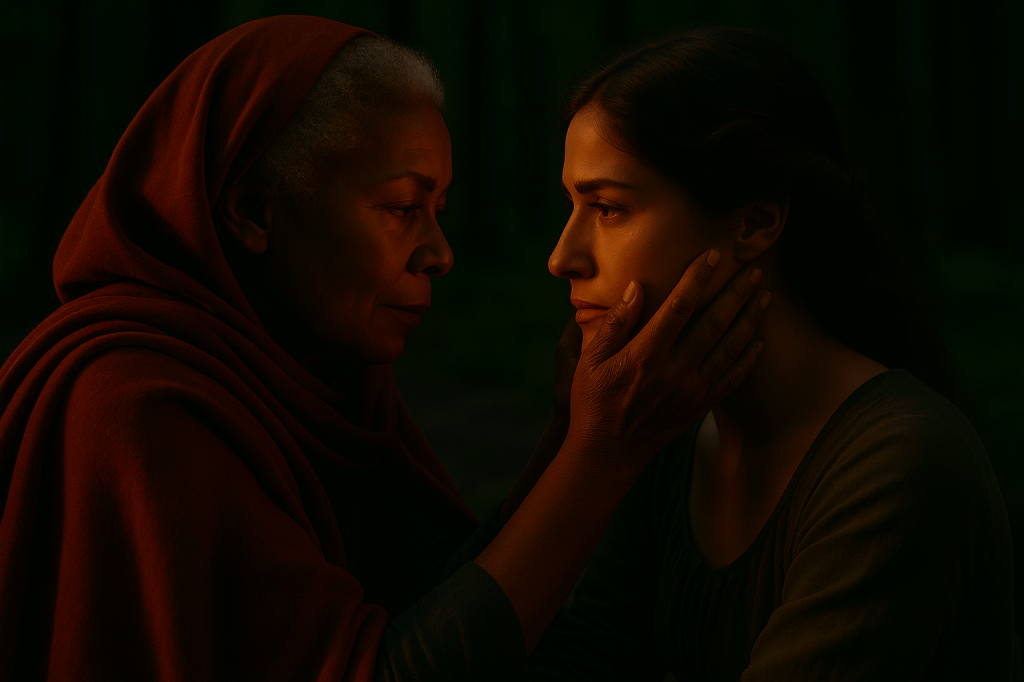
A cinematic, photorealistic horizontal portrait set in a dense, lush fairytale forest at dusk. Madame Esmée Étoile, an older Black woman with warm brown skin, soft gray hair wrapped partly in her red scarf, and wearing a deep blue embroidered dress, gently holds Cinder Dubois’s face between both hands. Cinder is a French woman in her mid-to-late 20s with light olive, sun-touched skin, expressive brown eyes, and thick wavy chestnut hair in a loose braid. She wears a simple earth-toned wool dress with natural texture.

The mood is intimate, emotional, and grounded — no visible magic, only atmosphere. Soft dusk light filters through the trees in warm gold tones, casting subtle highlights on their faces. Esmée’s expression is calm, wise, steady; Cinder’s expression is vulnerable, uncertain but hopeful, as if just realizing a truth she needed to hear.

The background is softly blurred: towering moss-covered trunks, drifting dust motes caught in the last rays of daylight, and deep green foliage fading into shadow. The framing is close but cinematic, with Esmée slightly higher in the frame, guiding Cinder with maternal strength. The tonal palette is warm shadows, gold-green light, and the muted reds of Esmée’s scarf. The image should feel naturalistic, deeply emotional, reverent—capturing the moment Esmée says: “You’ll see her again… because you’ll choose to.”

Shot on a full-frame cinematic camera with shallow depth of field (f/1.8), soft directional backlight, and high dynamic range.

Esmée places her hands on either side of my face. The forest hums.

“You’ll see her again,” she says. “Not because of fate. But because you’ll choose to.”

And in that moment, I know I already have.

“And if I fail?”

She smiles.

“You won’t. The land never forgets its daughters.”


The Growing Threat

The garden was still, the air thick with the scent of orange blossoms and sunlight filtering through the branches. It should have been peaceful. But something shifted beneath the surface — a quiet tension, like the calm before a storm.

Thibault.

HORIZONTAL CINEMATIC IMAGE: A cinematic, fairy tale realistic image styled like a still from a Charles Perrault–era historical drama. The scene is set in the late afternoon within a serene French palace garden, softly lit with golden light filtering through a grove of orange blossom trees.

In the center of the composition stands Claudine, a poised Black woman of Caribbean-French heritage, who serves as the queen’s trusted lady-in-waiting and advisor. Her deep-brown skin glows faintly in the diffused sunlight. Her tightly coiled black hair is styled into an elegant braided chignon, true to the period and her established look.

She wears a muted green linen gown, modest yet refined in its construction—long sleeves, a fitted bodice with delicate ivory lace trim at the cuffs and neckline. The gown is practical but dignified, befitting her role and the setting. Around her neck is a modest pendant, hinting at personal meaning and consistency with her earlier appearances.

Claudine’s almond-shaped dark eyes scan the garden with a thoughtful and slightly concerned expression, as though processing difficult news or awaiting a meeting. Her posture is calm but not relaxed—her hands lightly clasped in front of her, her body language contained yet quietly powerful.

The surrounding orange blossoms sway gently in the breeze, catching sunlight like fragments of gold, and the distant palace architecture softly frames the background. The garden paths wind through lush greenery and warm-toned stone, creating a setting of elegance and peace.

The mood is tranquil yet tense, a moment of pause before action. The contrast between the serenity of the setting and the weight of Claudine’s thoughts defines the emotional core of the image. There is the faint implied presence of fragrance in the air—citrus and blossom—as the late afternoon light continues to shift.

“He’s gathering support,” Claudine said, her voice low, precise. Her dark gaze swept the courtyard, then returned to me. “He met with the southern delegates last night. I heard whispers of proposals.”

She paused. Her lips pressed into a thin line.

“Unseemly ones. And none in our favor.”

Her words landed heavy. I nodded, though my thoughts churned beneath the surface. Thibault hadn’t always been an opponent. When my mother first took the throne, he, of the royal de Castelnu family, was steady—a trusted ally in uncertain times. A voice of reason, or so I believed.

A man who once seemed to understand what the kingdom needed.

“Why would he do this now?” I asked, though the question was more to myself than to Claudine. “Is it because of her?”

“And because, as a man, he’s afraid,” she said simply, surprising me with the certainty in her tone. “He’s seen what happens to those who lose their footing in court, and he won’t let it happen to him. Thibault’s a crafty opportunist—he can sense when the crown is vulnerable. That council meeting wasn’t routine. It was bait. His trap. A way to test the waters, expose weakness, and strike.”

Her insight cut deeper than I expected, and I turned to face her fully. There was no anger in her voice, no condemnation—just the truth.

Thibault wasn’t acting out of malice. He was a man clinging to relevance in a kingdom changing faster than he could manage. His ambition was born of fear, but that made it no less dangerous.
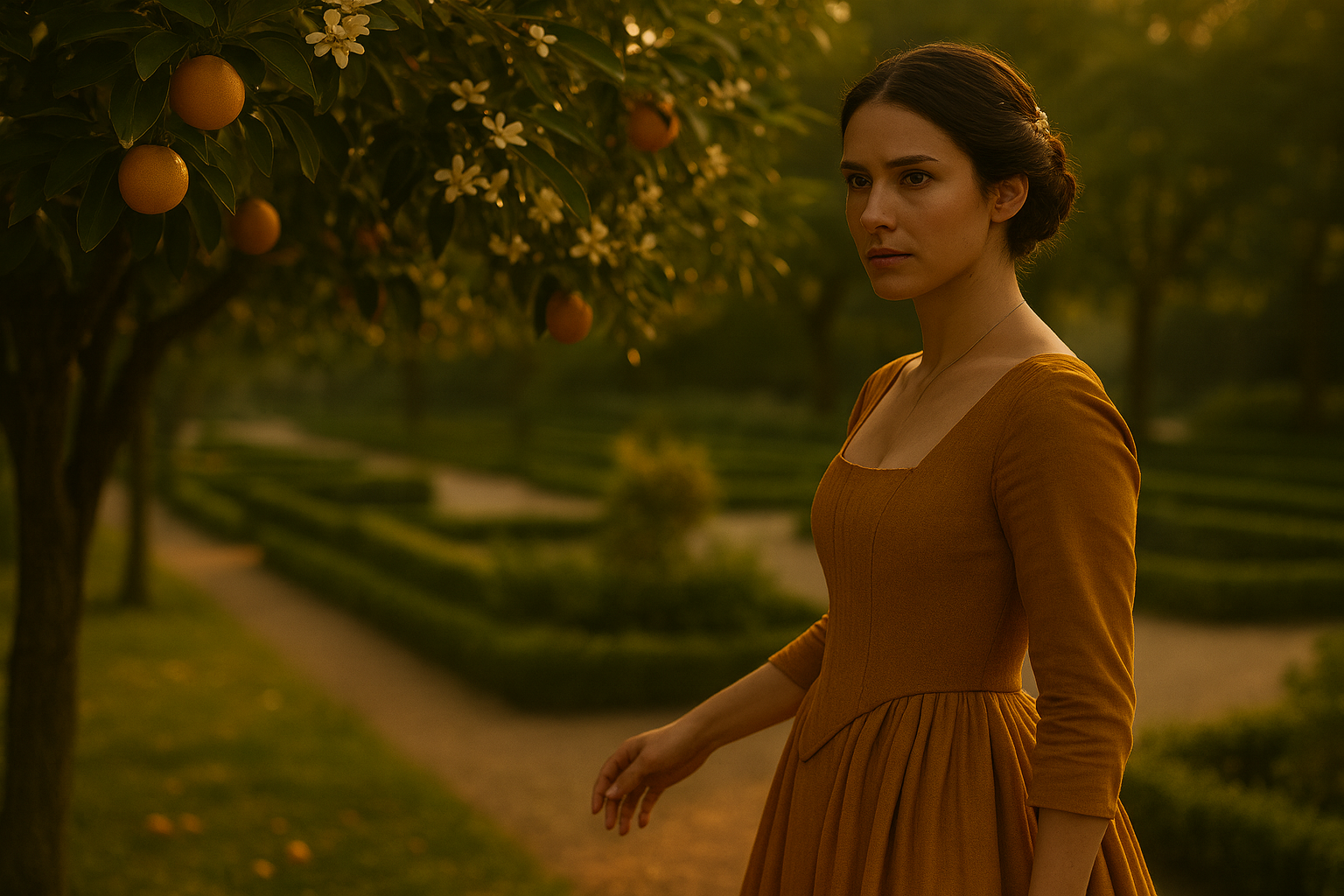
A horizontal, cinematic, fairy tale realistic depiction of Princess Aveline Beaumont, a French woman in her mid-to-late 20s with fair skin, almond-shaped brown eyes, and dark hair styled into a low braided chignon secured with a delicate hair comb, standing beneath a blooming orange tree in a serene palace garden.

The scene is bathed in golden hour sunlight, with the warm light filtering through the delicate leaves and branches, casting soft, dappled patterns on the ground, on Aveline’s face, and on her gown. The air is thick with the fragrance of orange blossoms, and vibrant fruit glows gently in the light. The garden is composed of trimmed hedgerows, winding gravel paths, and cobblestone walkways, lending the setting an air of controlled elegance.

Aveline wears a rich golden-ochre royal gown, fitted at the bodice and sleeves, simple yet elegant in design, evoking 17th–18th century French nobility. Her posture is poised but alert, her hands resting lightly at her sides. Her expression is sharp, contemplative, and slightly tense—as though she’s preparing for a difficult conversation or responding to one that just ended. Her eyes hold quiet resolve, and the atmosphere suggests she is weighing the consequences of a revelation or decision.

The lighting captures the emotional ambiguity of late afternoon—neither joy nor sorrow, but a tense, suspended calm. The composition evokes a still from a historical fantasy film: quiet, painterly, and filled with symbolic cues of beauty, pressure, and transformation.

“What proposals, Claudine?”

Her gaze flickered toward the palace, and for a moment, hesitation softened her features. But she was never one to hold back when the truth was needed.

“An alliance,” she said, voice low but certain. “With House Vernay.”

I stared at her. “But House Vernay has stood with the Beaumont crown for years.”

Claudine didn’t flinch.

“If he sways them, the others will follow. They’ve been waiting for an excuse to turn—and Thibault is giving them one. One that could shift the council and threaten the throne. I’ve heard the whispers—your closeness with the girl at the ball didn’t go unnoticed. Thibault and his allies are already stirring suspicion. A princess, they say, fraternizing too freely with a common girl. It could lead to instability and open rebellion among, as Thibault coldly describes, ‘the unwanted in the kingdom’. It’s not the crown he fears, Aveline. It’s you. The way you wear it.”

And perhaps… the way I looked at her – Cinder.

“And now you’ve given him something he cannot predict — someone.”

She paused. “I can try to intercept his messengers—”

“No,” I cut in. “Let him believe he’s ahead. But I need you to keep listening. You’re the only one in this royal court that I trust with my life.”

Her answer came without hesitation. “Always.”

I hesitated. “Tell me, Claudine. If Thibault’s gone this far… do you think he means to replace me?”

Claudine’s silence was brief—but it was there.

“He wouldn’t dare,” she said at last. “Not yet. But if he does, he won’t come with swords. He’ll come with signatures. Thibault’s methodical—never cavalier. Every move we make, he has eyes on. Allies with ears in every hall, every chamber. Watching. Listening. We have to be on our guard.”

The weight of her loyalty was a steadying force, but as I turned back toward the palace, it wasn’t Thibault’s schemes that lingered in my mind. It was Cinder’s warning, the whispers she claimed guided her. If the crown truly was tied to the rot, then Thibault was only a symptom of a greater illness. This fight wasn’t just about politics—it was about the very foundation of the kingdom.

The orange blossoms above us swayed in a sudden, unnatural breeze. Claudine’s gaze flickered upward, a moment of unease breaking through her calm. I followed her eyes, but the blossoms were still again, as though the moment had never happened.

“I won’t let him,” I said finally, though the words felt hollow, an armor not yet tested. My fight wasn’t just against Thibault—it was against the rot seeping through the land, the whispers that warned of what was to come. The stakes were heavier than I had ever imagined.

Claudine nodded, her expression resolute.

“Then neither will I.” A pause followed — not heavy, but just long enough to let the tension shift into something gentler.
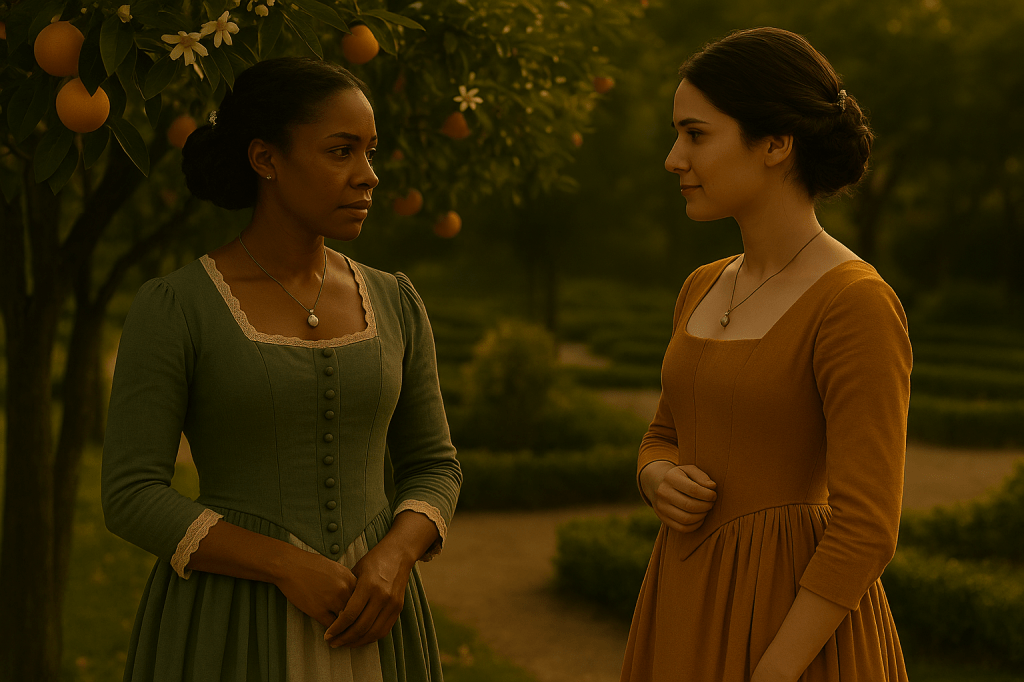
HORIZONTAL CINEMATIC IMAGE: A gorgeously shot, fairy tale realistic scene styled like a film still from a Charles Perrault–era historical drama. The moment is set in the late afternoon golden hour within a French palace garden, where soft amber light filters through orange blossom trees heavy with fruit and flowers.

In the foreground stand two women in quiet conversation, captured at a moment of emotional intimacy and recognition. The atmosphere is calm, fragrant, and sun-warmed.

On the left stands Claudine, a poised Black woman of Caribbean-French heritage, with deep-brown skin glowing in the filtered light. Her tightly coiled black hair is styled into an elegant braided chignon adorned with pearl pins. She wears her canonical muted green linen gown, featuring a modest square neckline, cloth-covered buttons down the bodice, and ivory lace trim at the collar and cuffs. Her expression is serious yet warm — a look of quiet, steady assurance as she offers a rare moment of clarity and support.

On the right is Princess Aveline Beaumont, a French royal in her mid-to-late 20s. She has fair skin and dark hair styled in a low braided chignon, secured with a delicate hair comb. She wears her canonical ochre-gold gown for garden scenes — fitted bodice, square neckline, and long sleeves in a period-accurate silhouette. She gently touches the pendant at her collar, the one Cinder fastened for her, and her expression holds a subtle, heartfelt smile, as if the weight she’s carried is momentarily lifted by Claudine’s words.

The orange trees above are in bloom, casting delicate shadows over the characters, and the golden sunlight filters through the leaves, illuminating their faces and gowns in soft, glowing tones. The background shows a meandering palace garden path lined with trimmed hedges and distant stonework, adding to the historical realism.

This is a moment of emotional equilibrium — an exchange of truth that feels like permission. No fanfare. No consequences. Just recognition.

The image is rendered in horizontal cinematic format, with shallow depth of field, natural warm lighting, grounded textures, and a richly layered color palette of green, gold, and sun-washed amber. The tone is tender, transformative, and quietly affirming.

“Tell me…what is Cinder DuBois like?” Her voice was softer now. “She seems lovely. And… perfect for you.”

“How did you know her name?” And for a moment, I believed her strength might be enough to carry us both.

“Sorry, Aveline, but I did overhear you in your chamber one morning speaking of Cinder to yourself. I sensed right away she touched your heart that night. It’s the first time in awhile I’ve seen you smile – without being forced to. Maybe this Cinder is what the kingdom needs.”

The words hadn’t landed until the silence returned.

Perfect for you.

“For the first time since the ball, I didn’t feel alone inside my own truth.”

The words lodge deep, striking a place even the whispers cannot reach.

I exhaled, long and low… as if I’d been holding my breath since the ball.

No one had said it aloud before. Not like that. Not without a whisper of warning, a tremor of consequence, or a gaze that flicked to the nearest shadow. Claudine had looked me in the eye — steady, unblinking — and offered me not permission, but recognition.

I remained beneath the orange blossoms, sunlight catching the folds of my gown, the breeze tugging gently at my sleeves. But something inside me had shifted — subtle, quiet, undeniable.

The ache in my chest softened. I touched the pendant Cinder had fastened at my collar. And for the first time in days, I smiled — small but real.

“She is, Claudine.”

The truth tastes sweeter than fear.

What Remains

Cinder

My fingers clenched. Doubt gnawed at me. Had I misunderstood the rhythm? Was it too late?

Then I remembered:
“The land listens best when you bleed and believe.”
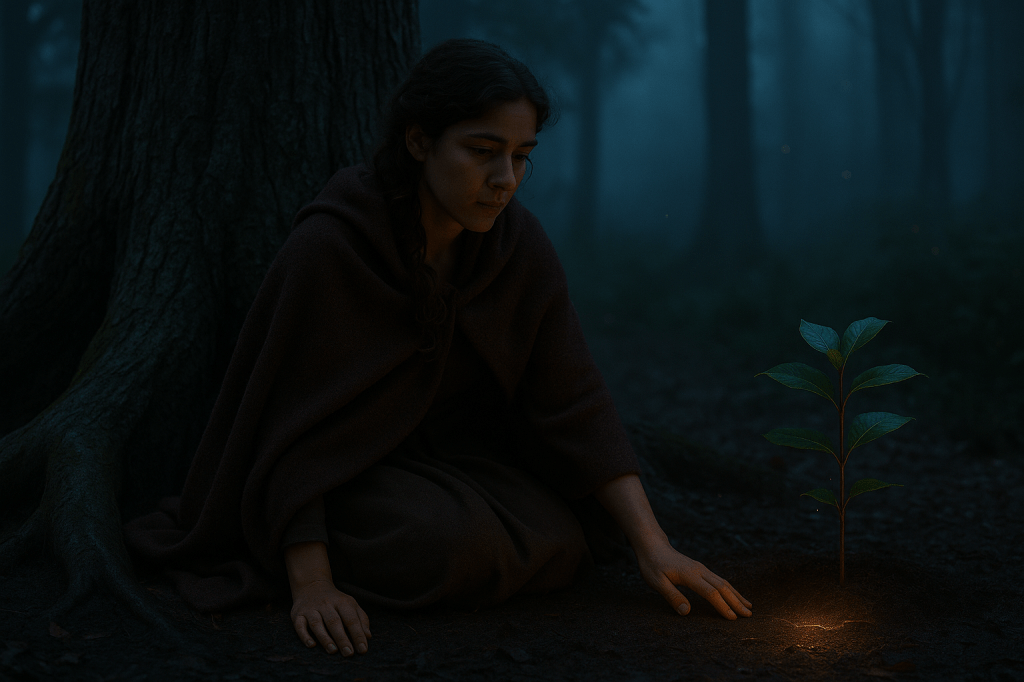
A cinematic, photorealistic forest scene at twilight. A young French woman, Cinder Dubois, sits on the ground at the base of an enormous ancient tree with thick, gnarled roots. She has wavy chestnut-brown hair, light olive skin, expressive brown eyes, and a weary, contemplative expression. She wears a dark dusk-rose brown dress and a heavy burgundy cloak wrapped around her shoulders — the cloak should look slightly oversized, textured, and warm, as if recently given to her. Her clothing is natural, wool-like, and grounded, fitting the Provençal fairytale setting.

She is seated in a quiet, mist-covered grove. The atmosphere is hushed, cool, and blue-toned. Soft drifting fog hangs between the dark tree trunks. Tiny floating ember-like motes glow faintly in the air. The environment should feel still and almost mournful, capturing the aftermath of bloodshed.

In front of her, a small glowing sapling grows from the soil, casting a faint golden light on her face, hands, and dress. The sapling’s glow is subtle but magical — warm amber light contrasting the cool blue twilight. Cinder rests one hand on the ground beside the sapling, fingers near but not touching it, conveying quiet connection and exhaustion.

Lighting: cinematic twilight blue over the forest, with soft golden rim-light coming from the sapling. Depth of field: sharp focus on Cinder and the sapling, background trees fading into a gentle blur. Composition: horizontal, wide-screen ratio, emotionally intimate tone.

I pressed my hand to the earth—and let it cut me. A thorn from the sapling’s base bit deep, sharp as truth. My blood touched the roots.

The hum returned, low and steady, as though the land sighed in relief.

The land was quiet after the blood. Too quiet.

I sat at the base of the grove’s oldest tree, Esmée’s cloak still warm where she’d wrapped it around my shoulders. The sapling stood, but the whispers hadn’t returned. Not yet.

Sometimes healing doesn’t sound like a chorus. Sometimes it’s the absence of pain.

And yet, in the quiet, I still find myself listening for her voice.

Aveline
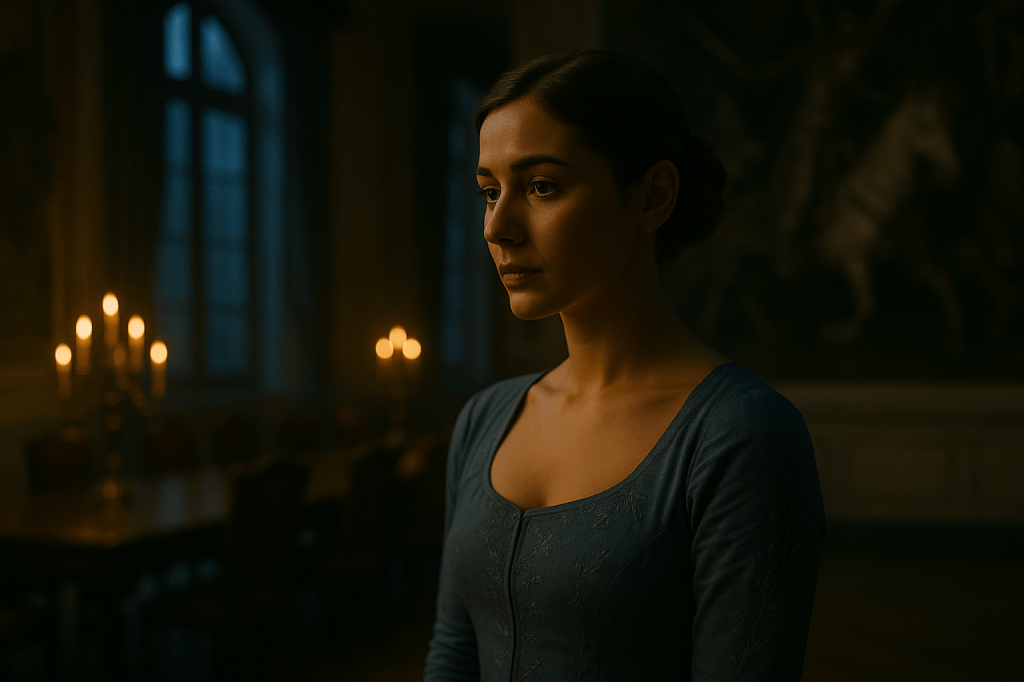
A cinematic, photorealistic horizontal image set inside a dimly lit royal war chamber at night. The lighting is a blend of cool moonlight streaming through tall arched windows on the left and warm candlelight from golden candelabras on the right, creating a striking dual-tone atmosphere.

Queen Aveline Beaumont stands in the foreground, turned slightly in profile, illuminated softly by the candle glow. She has pinned dark hair, a pale complexion, and wears a muted, court-appropriate blue gown with subtle embroidery. Her expression is distant and contemplative — regal but tired, carrying the emotional weight of political tension and disappointment.

The background shows an empty long table, high-backed chairs, and faded tapestries depicting old victories — all slightly blurred with shallow depth of field. The image emphasizes loneliness, uncertainty, and the crackling silence that follows political upheaval.

Color palette: cool twilight blues, muted gold candlelight, soft shadows. Cinematic realism, natural textures, subtle grain.

The halls echo strangely when no one’s speaking treason.

I stood in the war chamber alone, the tapestries still whispering of old victories. Claudine’s plan had worked — no messengers left the palace that night. But the silence that followed wasn’t peace. It was waiting.

I thought I would feel relief.

Instead, I felt the rot cracking underfoot like old roots.

And beneath that crack, a softer truth: I missed the way she made the air feel lighter.

And beneath that crack, a softer truth: I missed the way she made the air feel lighter.

Cinder

The whispers didn’t return right away.

Not like before, when they came rushing back in wind and memory. Not like I expected.

The grove stayed still, the soil damp beneath my knees. My blood had vanished into the roots, and the hum had quieted, not disappeared—just… settled. Watching.

Maybe that was all balance ever was. Not thunder or fire. Just the land exhaling.

Esmée didn’t say goodbye. She left me with her cloak, a sprig of lavender tied with red silk, and a whisper I couldn’t quite hold.

“You’ve done what you could. Let the rest find you.”

But I didn’t feel found. Not yet.
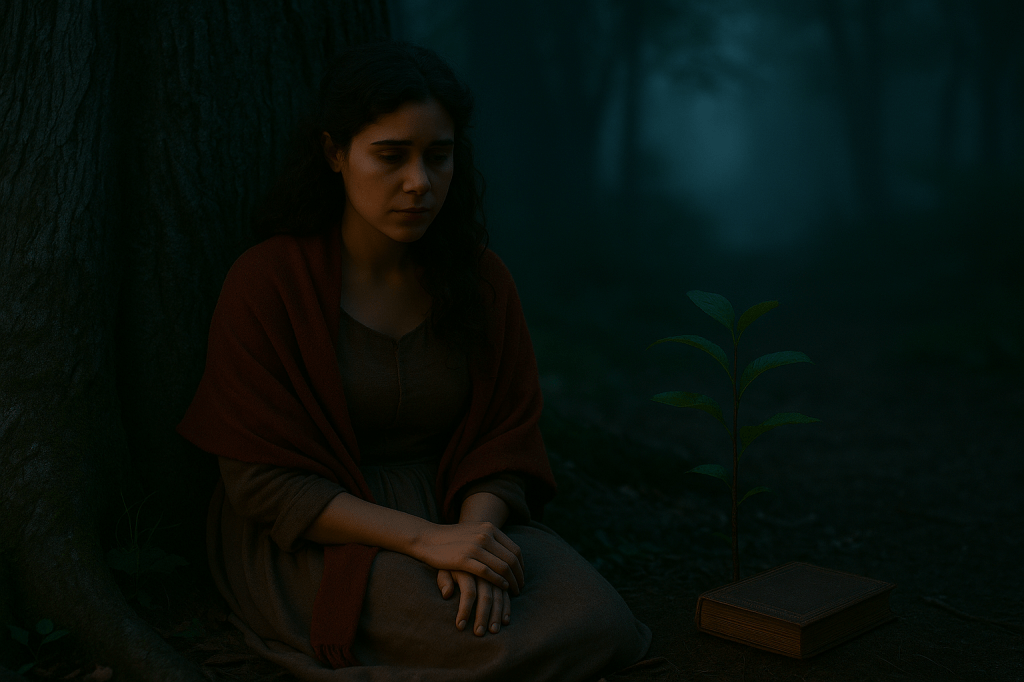
A cinematic, photorealistic horizontal image set deep within a mist-soaked ancient grove at dusk. A young French woman, Cinder Dubois, sits at the base of the grove’s oldest tree. She has wavy chestnut-brown hair, light olive skin, expressive brown eyes, and a soft but weary expression. She wears a simple earth-toned brown dress and an old red shawl draped around her shoulders — the same shawl Esmée wrapped around her. Her posture is quiet, reflective, and still.

Beside her on the ground sits a small sapling — recently planted — its leaves faintly catching what little light filters through the fog. Next to the sapling lies a closed, weathered grimoire with gold-etched markings. The grove is dark, with deep cool blues and shadowed greens. Mist curls through the air. The mood is solemn, introspective, and gently magical.

Lighting is soft and low, with a single cool-toned ambient glow filtering from above, creating a poetic sense of aftermath and silence. Depth of field is shallow: Cinder and the sapling are in sharp focus while the forest behind them fades into atmospheric haze. The overall tone is emotional, quiet, and grounded — conveying healing, exhaustion, and the land holding its breath.

I sat under the oldest tree until the light turned dusky blue. The sapling swayed beside me—taller now. Greener. But it wasn’t just the sapling that had changed. Something in the rhythm of the land felt… unfamiliar. Like it was remembering a song it hadn’t sung in centuries.

I pressed my palm to the earth again. No voice met me. Just a pulse.
Still, steady. Waiting.

Aveline

They didn’t riot. That surprised me.

Thibault’s alliances unraveled slower than Claudine expected—like silk torn thread by thread instead of ripped outright.

A quiet scandal. No one admitted to choosing my side. They just stopped pretending not to.

The queen hasn’t looked me in the eye in days. I’m not sure if she’s disappointed or afraid.

In her silence, I heard something closer to mourning.

The council met once more, perfunctory and polite. They voted without whispering, and they bowed when I stood. But that didn’t feel like victory. It felt like fatigue.

The rot hadn’t been vanquished. Just acknowledged.
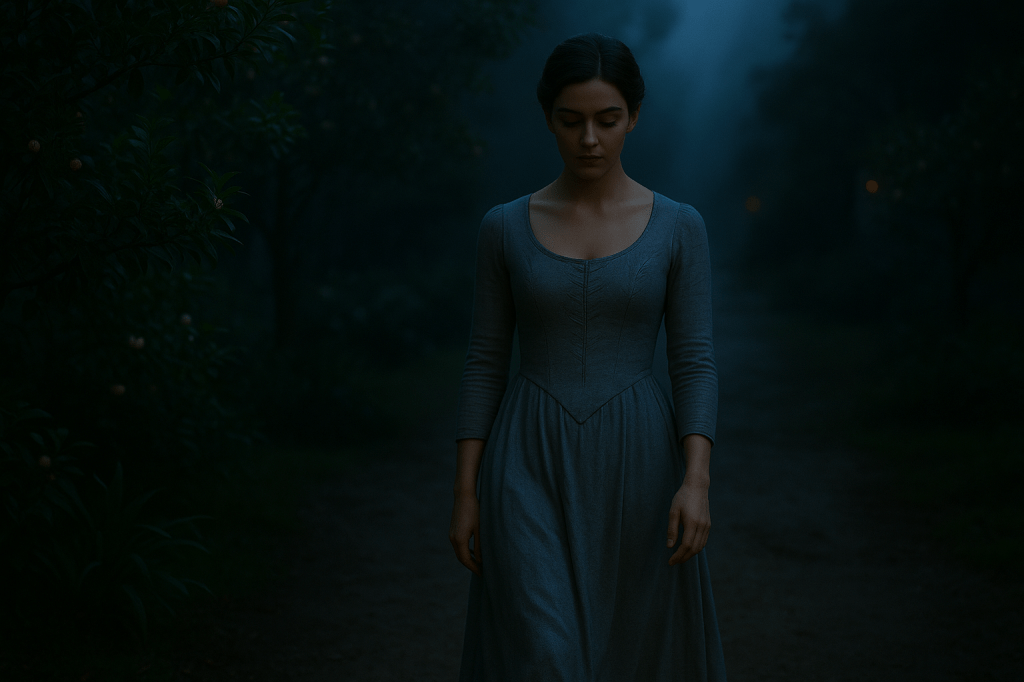
A cinematic, photorealistic horizontal nighttime scene set in the palace gardens. A young French woman with a fair complexion walks alone down a dim moonlit path. Her dark hair is pinned in Aveline Beaumont’s characteristic low, elegant bun. She wears a subdued, private version of her moonlit silver-blue gown — softer in tone, with delicate embroidery that hints at starlight without appearing formal. The fabric is matte and natural, moving gently as she walks.

The garden around her is atmospheric and slightly overgrown, with orange trees whose blossoms have not yet opened, their pale buds catching the faint blue glow of moonlight. The air feels still, cool, and humid. Very light mist drifts at ground level, softening the edges of the path.

The lighting is a blend of cool, diffused moonlight and very faint, warm lantern glimmers far in the distance, barely visible. Her expression is introspective and weighed, her gaze lowered as if she’s processing the events of the night. Her posture is natural and human — no stiffness, just quiet movement. Dirt path beneath her, foliage pressing inward, creating a tunnel of shadow.

Color palette: deep greens, muted blues, gentle moonlit highlights. Ultra-detailed facial realism, natural skin texture, cinematic depth of field with foreground and background falling into soft blur. No stylization.

Later that night, I walked the gardens alone. The orange blossoms hadn’t opened. The wind smelled like ash and citrus. Somewhere under my heel, a stone cracked.

I wanted to believe that meant something. I wanted to believe I could still feel the rhythm of the land, even here.

But I wasn’t sure if it was returning. Or retreating.

Cinder
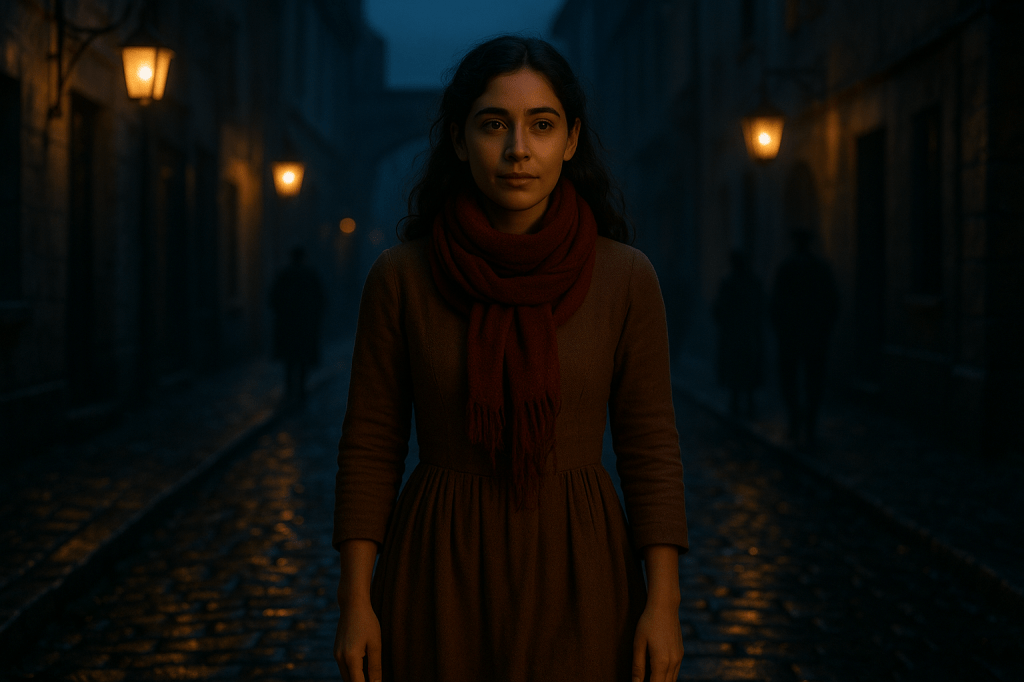
A cinematic, photorealistic horizontal image of Cinder Dubois walking alone at night through a quiet, rain-dampened old European city street. She is a young French woman in her mid-to-late 20s with light olive skin, expressive brown eyes, and thick, wavy chestnut-brown hair falling naturally around her shoulders. Her appearance must match the established canonical look: emotionally grounded, realistic, not stylized or glamorized.

Cinder wears a simple but refined dusk-brown dress with long sleeves and natural fabric texture. Wrapped warmly around her neck is Esmée’s deep red scarf — slightly worn, soft, and important to the scene. Her expression is thoughtful and steady, conveying quiet resilience, emotional fatigue, and a sense of returning changed.

The setting is a narrow stone street after light rain. Cobblestones glisten with reflections of warm lantern light. Old stone buildings rise on both sides, with wrought-iron wall lanterns casting soft golden glows. The night is cool, with a palette of moonlit blues and subtle fog. Depth of field is cinematic: Cinder stands in the foreground in crisp focus, while the street and archway behind her blur into atmospheric bokeh.

Distant background silhouettes — a few townspeople — remain nonthreatening, simply watching her pass with subtle recognition. The scarf moves gently in the breeze. Mood: quiet, intimate, evocative of someone returning home with new purpose. Lighting blends warm lantern gold and cool blue nocturnal tones. Overall look: cinematic, grounded, emotionally resonant, and photorealistic.

When I crossed the border into the city, no one stopped me.

The guards didn’t speak. The gates were open. The people stared—some with fear, some with something closer to recognition.

I passed three children balancing stones on a courtyard wall. One turned to the others and said, “She’s the one who talks to trees.”

They didn’t run.

Aveline

I felt her before I saw her.

That’s the part I’ll never explain—not to Claudine, not to the court, not even to myself.
It wasn’t magic. Not exactly. It was recognition.

I’d just stepped from the chamber when I heard the silence change. Not absence of sound—something deeper. A hush that made room for her.

I turned. And there she was.
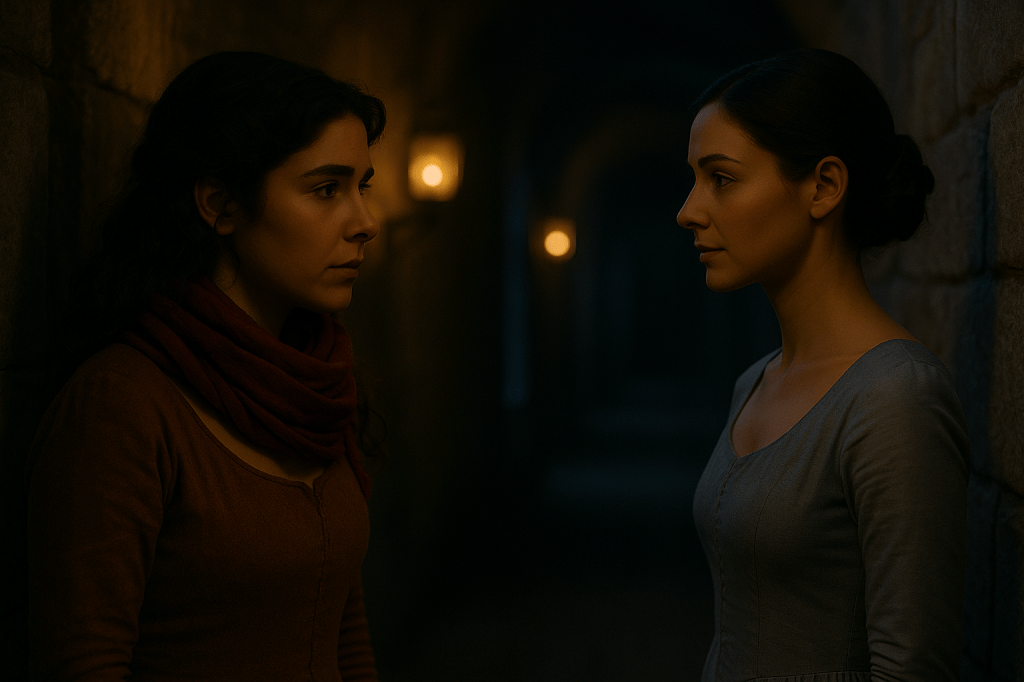
A cinematic, photorealistic horizontal scene set in a dimly lit stone corridor within an old French palace. Warm lanterns mounted on the walls cast a soft amber glow that fades into deep blue shadows. Two young French women stand facing each other with intense quiet emotion.

The first woman, Cinder Dubois, stands on the left. She has wavy chestnut-brown hair, light olive skin, and expressive eyes. She wears an earthy dusk-brown dress and—most importantly—a deep red scarf wrapped warmly around her neck, soft and slightly textured. Her expression is steady but vulnerable, illuminated gently by the lantern lights.

The second woman, Queen Aveline Beaumont, stands on the right. She has pinned dark hair, a fair complexion, and a subdued moonlit silver-blue gown appropriate for a private nighttime moment. She holds herself tall, but her eyes reveal surprise and a quiet emotional shift as she looks at Cinder. Her face is lit more dramatically by the lanterns, emphasizing natural skin texture and soft cinematic contours.

The corridor stretches behind them in long perspective, with arched stone walls and pools of darkness receding into the distance. The atmosphere is tense yet intimate, with subtle drifting motes of dust in the warm light. The color palette mixes warm gold lantern light with cool blue shadow, achieving a grounded, filmic realism. Shallow depth of field, ultra-detailed faces, natural fabric texture, no stylization.

Dust on her boots. Red scarf at her throat. And something in her eyes I hadn’t seen since the ballroom: certainty.

The whispers didn’t rise between us. Not yet. But I felt the weight shift.

And for the first time in weeks, I breathed without holding it.

Because she was here. Not as a whisper, not as a memory — but as herself.

New Beginnings

Aveline

The palace gardens bloom as though the balance itself flows through them. Roses catch the moonlight, their fragrance curling through the air like a promise. The streams murmur softly, their glow reflecting a kingdom renewed.

The whispers are quiet now, more memory than voice — a hush beneath the roots. Not gone. Just watching.

For now, the balance holds steady.

Cinder stands beside me, her presence grounding yet electric. The faint glow of the grimoire’s magic lingers between us, steady but purposeful, as though waiting for what comes next.
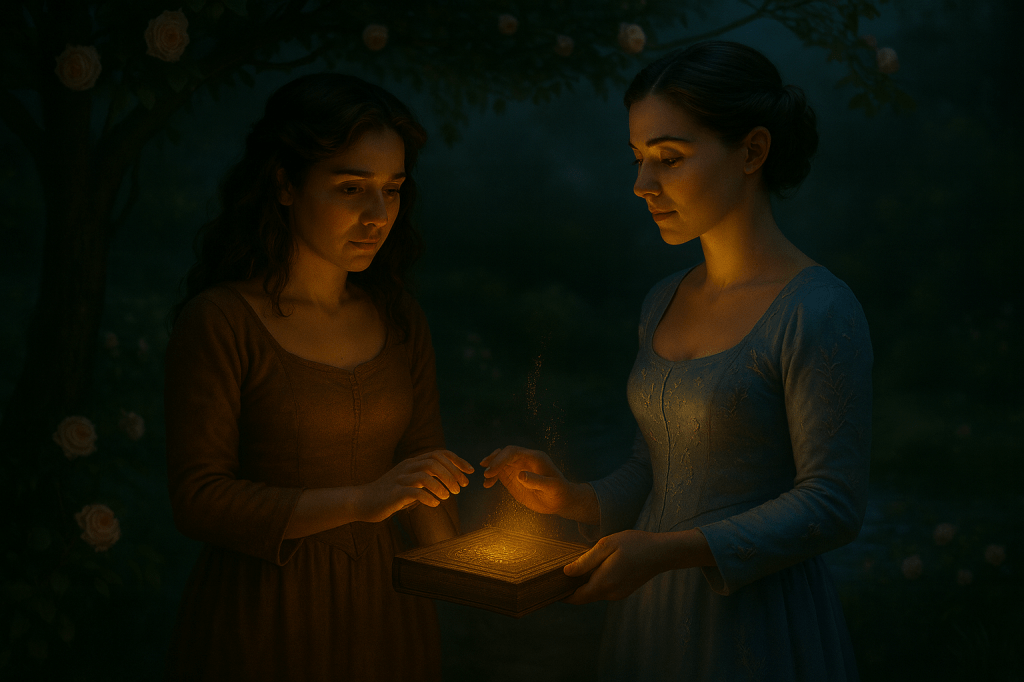
A cinematic, photorealistic nighttime scene set in a moonlit garden. Two young French women stand close together beneath an arching tree heavy with pale roses. On the left is Cinder Dubois — mid-to-late 20s, light olive sun-touched skin, expressive brown eyes, thick wavy chestnut hair in a loose braid with strands framing her face. She wears a refined dusk-rose brown dress with clean lines and natural texture, suggesting she now lives within the palace. On the right stands Queen Aveline Beaumont — mid-20s, fair skin, dark hair pinned in a simple elegant bun. She wears a moonlit silver-blue gown with subtle floral embroidery that catches the soft light. The women cradle a softly glowing grimoire between them, held gently in both their hands. A warm golden magical light emanates from the book, illuminating their faces and fingers with subtle highlights. Their expressions are intimate, calm, and quietly emotional — a shared moment of trust and connection. The background is a softly blurred garden of roses and mist, with cool moonlight filtering through branches, creating depth and atmosphere. The lighting is naturalistic and cinematic: soft volumetric blue moonlight mixed with warm book-light glow. Shot in an ultra-real, high-detail style with shallow depth of field, filmic color grading, and 35mm lens aesthetics.

The balance hums faintly through the air, a reminder that while the kingdom rests, there is still more to do.

But tonight, the only work that matters is standing beside her.

I turn to her, catching the flicker of moonlight in her dark eyes. There’s something unspoken in her gaze — a vulnerability that mirrors the storm I feel in my chest.

“You’ve done so much,” she says, her voice soft but certain. “For the kingdom, for the balance. But here… here you can just be you.”

Her words settle over me like warm silk. For so long, I’ve carried the weight of the crown, the whispers, the expectations. But standing here, with her, I feel lighter. The air between us is charged — not with duty, but with something deeper, something unspoken and sacred.

I reach for her hand, my fingers brushing hers. Her touch is steady, her skin warm, and the knot in my chest begins to ease. “And what about you?” I ask, my voice barely above a whisper. “You’ve carried just as much.”

She smiles faintly, her gaze never leaving mine. “I don’t feel the weight when I’m with you.”

The words feel like an oath, and my heart answers before my mind can catch up.

They strike something deep within me — a place I’ve kept guarded for so long. My breath catches as she steps closer, her presence a quiet reassurance, her warmth a tether.

The queen is not here. She hasn’t been, not since the vote. But I no longer feel her absence like a wound. I feel it like a space reclaimed.

And as I look into Cinder’s eyes, I wonder if she sees me the way I see her.

Cinder

The whispers falter. The grimoire’s golden threads dim. The ground holds its breath.

Without a word, I kneel beside the oldest tree in the garden. Its roots twist deep into the earth, a mirror of the balance itself. With Aveline’s hand resting over mine, we plant a new sapling in its shadow. The soil feels alive beneath our fingers — a quiet promise of what’s to come.

A cinematic, photorealistic night-garden scene featuring Cinder Dubois and Queen Aveline Beaumont from Cinder & The Crown, shown kneeling together as they plant a new sapling beneath the kingdom’s oldest tree.
The setting is a moonlit royal garden transformed by magic: roses glowing faintly, soft silver mist rising near the ground, and a gentle warm-gold aura from the open grimoire resting beside Cinder.
Cinder appears exactly as canon: mid-to-late 20s French woman with light olive skin, expressive brown eyes, and thick wavy chestnut-brown hair loose around her shoulders. She wears her refined dusk-rose-brown dress (realistic fabric texture, not patched), sleeves rolled softly, the look grounded and humble yet elevated by her new life with Aveline.
Aveline appears as canon: early-30s French woman with pale skin, soft features, and dark hair pinned elegantly. She wears a moonlit silver-blue gown with starlight embroidery—subtle, elegant, not overly ornate, with natural folds and weight.
Both women are side-by-side in profile, knees touching the earth, one of Aveline’s hands resting gently over Cinder’s as they lower the sapling into the soil. Their expressions are tender, vulnerable, and full of quiet relief.
Lighting is cinematic and natural: moonlight (cool pale blue) illuminating Aveline, warm golden grimoire-light illuminating Cinder, the two glows blending softly.
A shallow depth of field keeps the focus on their hands, the sapling, and their faces, while the background shows blurred roses, tall trees, and distant lanterns of the palace festival.
The tone should feel intimate and magical but grounded in realism—like a still frame from a prestige queer historical-fantasy film.

She’s not just the queen. She’s Aveline. And she’s letting me see her.

“You’ve done so much,” I say, my voice steady but quiet enough to keep the moment ours. “For the kingdom, for the balance. But here… here you can just be you.”

Her eyes meet mine, and for a moment, the mask slips. I see the doubt she hides, the vulnerability she carries so carefully. And it stirs something in me — a quiet ache, a longing I’ve kept hidden for so long.
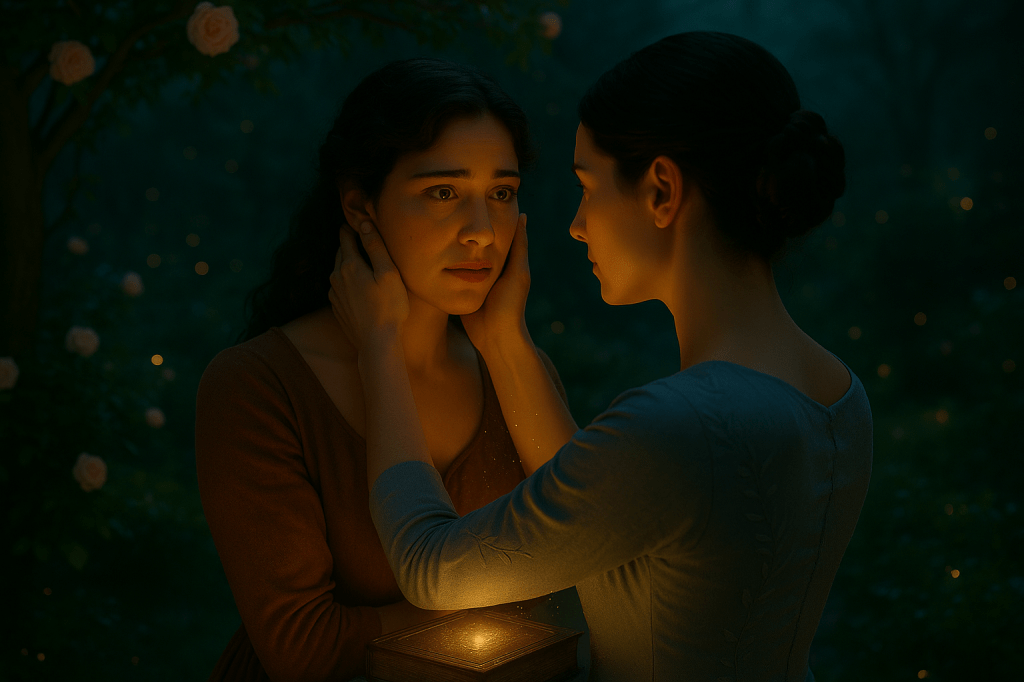
A cinematic, photorealistic horizontal nighttime scene in an enchanted French palace garden.
Camera POV is positioned directly behind Queen Aveline Beaumont’s right shoulder, as though the viewer is standing just behind her. Aveline’s figure is shown in soft silhouette and shallow focus from behind, her hands gently holding Cinder Dubois’ face.

Cinder Dubois faces the camera, eyes open — expressive, emotional, vulnerable yet steady. She has wavy chestnut-brown hair, light olive skin, and wears a refined dusk-rose brown dress made of natural woven fabric. Her gaze is fixed on Aveline with deep affection and recognition.

Queen Aveline Beaumont is partially visible in profile, eyes open and meeting Cinder’s gaze. She wears a moonlit silver-blue gown with subtle embroidery, her dark hair elegantly pinned.

A softly glowing grimoire on a stone pedestal rests between them, casting warm golden light upward. Delicate magical tendrils drift into the air from the book, illuminating the women’s faces with warm highlights.

The surrounding garden is alive with moonlit roses, gentle mist, arching branches, and tiny firefly-like lights. Cool blue moonlight rim-lights Aveline’s silhouette; warm gold from the grimoire lights Cinder’s features.

Cinematic, ultra-photorealistic lighting; natural skin texture; shallow depth of field with the background melting into a dreamy blue-green bokeh.
Mood: intimate revelation, shared breath, emotional clarity, eyes-open vulnerability.

I’ve always admired her strength, but now I see what it costs her. I think of my own doubts, the moments I’ve stumbled, the nights I’ve wondered if I’m enough to stand beside her. I don’t tell her that her strength steadies me — that she’s the reason I’ve found mine. But I want to.
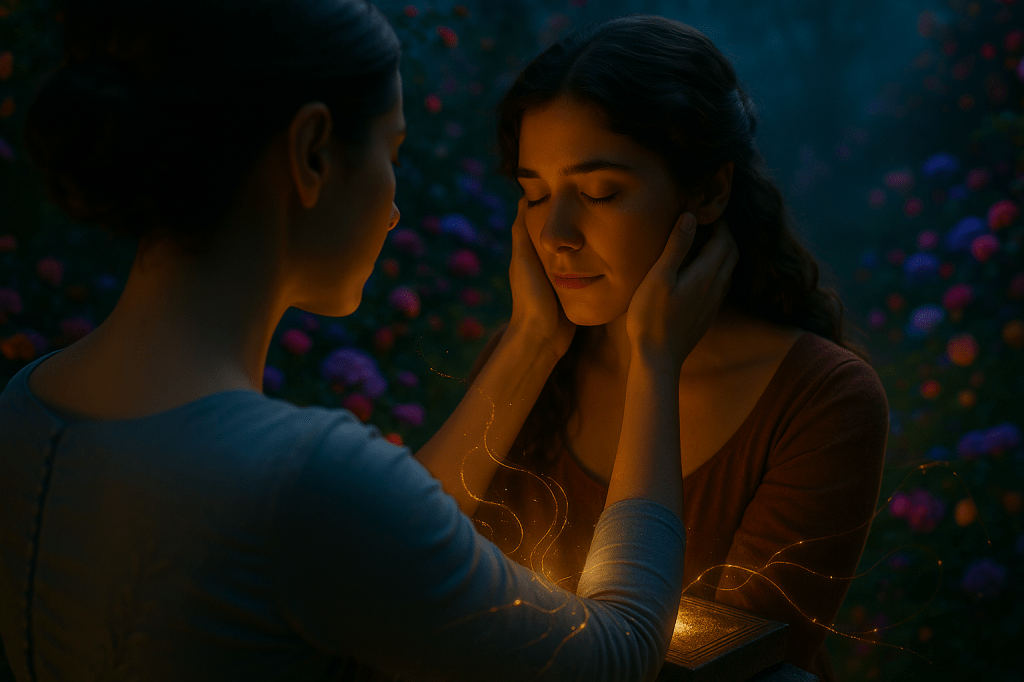
A cinematic, photorealistic horizontal nighttime scene in an enchanted French palace garden.
Camera POV is positioned directly behind Queen Aveline Beaumont’s right shoulder, showing her in soft silhouette from the back as she reaches forward to gently hold Cinder Dubois’ face with both hands.

Cinder Dubois faces the camera: light olive skin, wavy chestnut hair, emotional expression, eyes closed in trust. She wears a refined dusk-rose brown dress with natural fabric texture. Her features are softly illuminated by a warm magical glow.

Queen Aveline Beaumont, shown mostly from behind or in partial profile: pale complexion, dark hair in an elegant pinned style. She wears a moonlit silver-blue gown with subtle embroidery. Her hands rest tenderly on Cinder’s cheeks.

Between them, a closed grimoire rests on a stone pedestal, emitting faint golden light.
The magic spills into the air as delicate, glowing tendrils—subtle, elegant, not overwhelming.

The garden is alive at night: roses and flowering bushes in cool blues, pinks, and violets, softly lit by moonlight.
Mist drifts between the trees. Firefly-like motes shimmer in the background.

Lighting:
Cool moonlight from above + warm golden magical glow from the book.
Aveline’s silhouette is rim-lit; Cinder’s face is illuminated.
Shallow depth of field—foreground sharp, background softened into dreamlike bokeh.

Mood: tender, breathtakingly intimate, emotionally charged, deeply cinematic.
Ultra-photorealistic faces, natural skin texture, no stylization.

Instead, I let her take my hand, her touch tentative but certain.

“And what about you?” she asks, her voice breaking softly. “You’ve carried just as much.”

The honesty in her question catches me off guard, but I smile faintly, the answer clear in my heart.

“I don’t feel the weight when I’m with you.”

I step closer, brushing a loose strand of hair from her face. Her eyes flutter closed for a heartbeat, her breath catching. The air between us is alive — not with the balance, but with something far more fragile. More human.
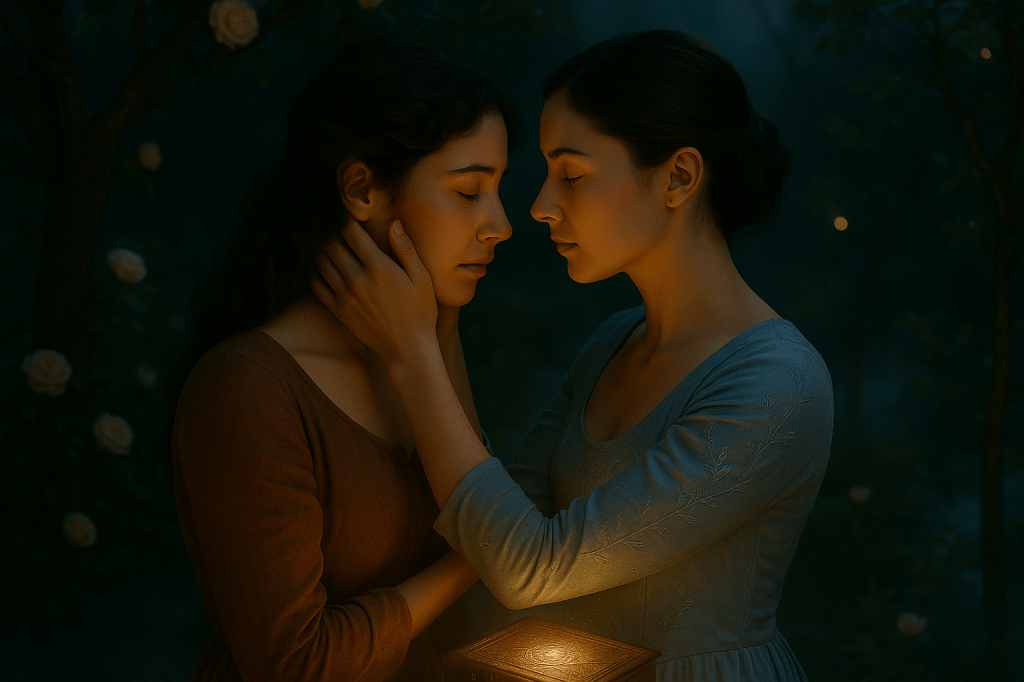
A cinematic, photorealistic nighttime garden scene in soft, cool moonlight. Two young French women stand extremely close beneath blooming rose branches and drifting mist. Depth of field is shallow, with the background melting into soft bokeh and silhouettes of leaves.

The first woman, Cinder Dubois, has wavy chestnut-brown hair, light olive skin, and wears a refined dusk-rose brown dress made from natural textured fabric. The second woman, Queen Aveline Beaumont, has dark hair pinned in a simple, elegant style, a pale complexion, and a moonlit silver-blue gown with subtle embroidered details.

They stand forehead-to-forehead in a tender, intimate moment, not kissing. Their eyes are closed. Each woman gently cups the other’s face with both hands, a gesture full of trust, devotion, and emotional vulnerability. Their poses are soft and natural, bodies angled inward with relaxed shoulders.

A faint golden glow comes from a closed grimoire held at their side, casting warm, magical highlights across their cheeks, hair, and clothing. Moonlight provides cool blue tones while the grimoire adds warm amber accents, creating a cinematic dual-lighting effect.

Color palette: moonlit blues, deep garden greens, soft floral pinks, warm gold.
Style: ultra-realistic, filmic, natural skin texture, no stylization.
Atmosphere: quiet, reverent, emotionally charged, like a still frame from a high-end fantasy romance film.

“You’re not just the queen, Aveline,” my voice steady despite the tremble in my chest. “You’re… you,” I murmur.

“And in this moment, it’s not the whispers, the balance, or the kingdom we hold. It’s each other.”

Our lips meet, slow and unhurried — the kind of kiss that carries more promise than urgency.
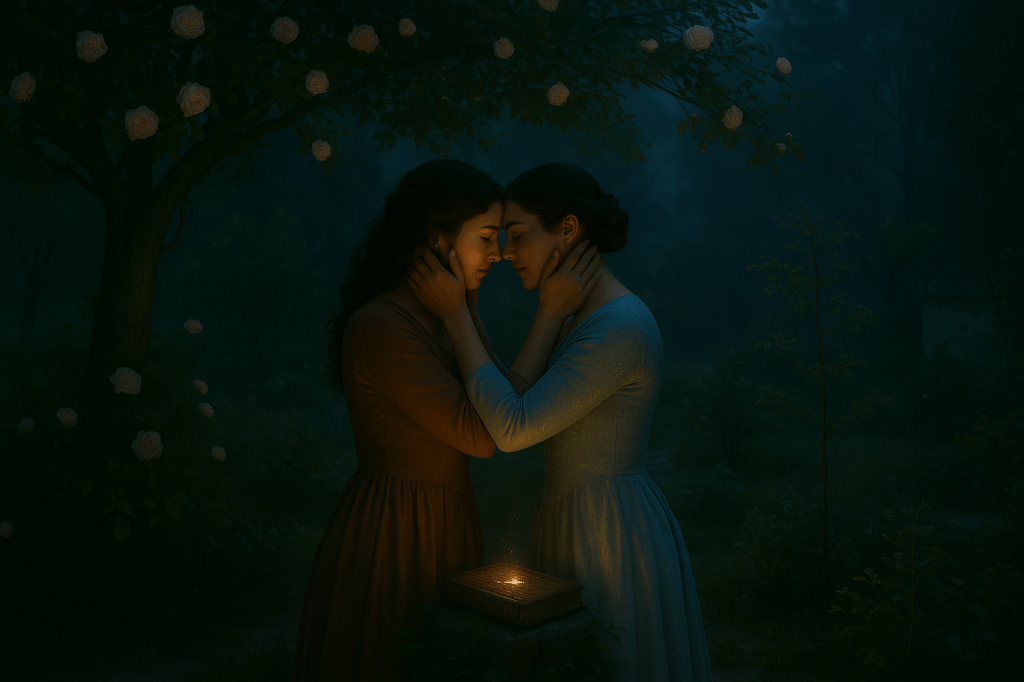
A cinematic, photorealistic nighttime garden scene in soft, cool moonlight. Two young French women stand extremely close together beneath an arch of blooming pale roses and delicate vines, surrounded by gentle mist and lush foliage. Cinder Dubois, on the left, has wavy chestnut-brown hair and light olive skin, wearing a refined dusk-rose brown dress with natural fabric texture. Queen Aveline Beaumont, on the right, has dark hair pinned in an elegant style, pale skin, and wears a moonlit silver-blue gown with subtle embroidery that softly reflects the light.

In a moment of profound emotional intimacy, the two women hold each other’s faces with both hands, foreheads gently touching, eyes closed in a quiet, vulnerable exchange. Their expressions are soft, tender, full of trust and unspoken devotion.

Beside them, a closed magical grimoire emits a faint golden glow that illuminates their cheeks, hands, and hair, blending with the cool blue moonlight to create a warm-and-cool dual lighting effect. The background is softly blurred with shallow depth of field, creating a dreamy cinematic bokeh of garden lights and mist. Ultra-realistic textures, natural skin detail, and film-quality lighting. Color palette: moonlight blue, soft greens, warm golden highlights.

The grimoire’s glow warms between us, spilling soft gold over the garden walls, catching in the folds of her hair. She tastes faintly of night air and roses, and for a moment I swear the land leans closer. The sapling shivers in the breeze, as though the earth itself has sighed in relief.
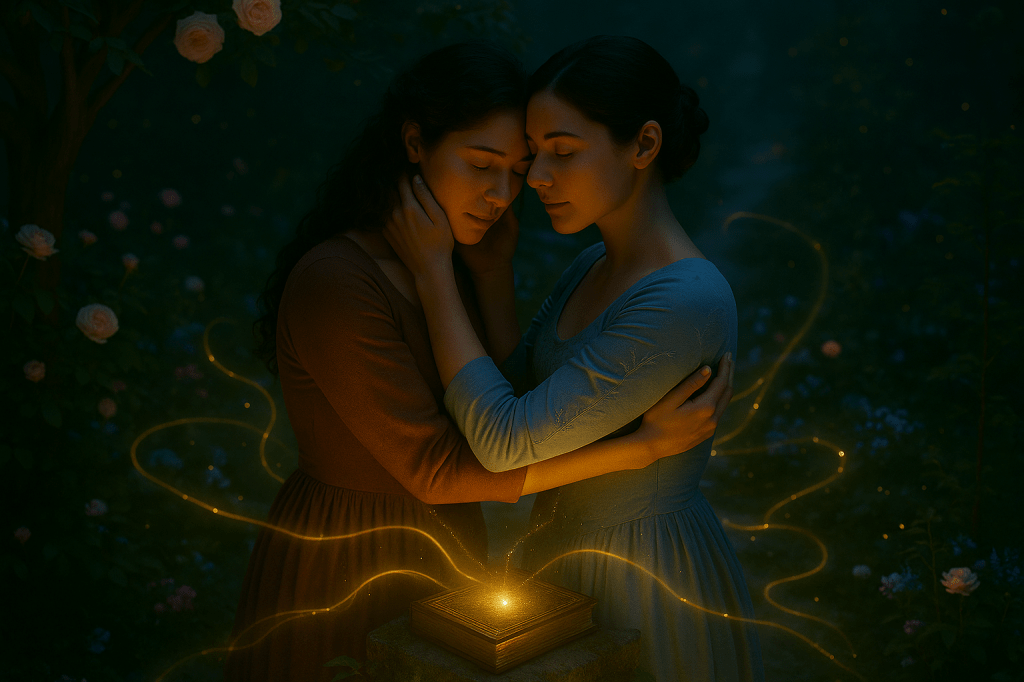
A cinematic, photorealistic nighttime garden scene set in a softly glowing moonlit atmosphere. Two young French women—Cinder Dubois and Queen Aveline Beaumont—stand in a wide shot embracing gently beneath flowering rose trees. The garden is lush, filled with pale roses, drifting mist, soft firefly-like lights, and a glowing sapling nearby.

Cinder Dubois (light olive skin, wavy chestnut-brown hair, refined dusk-rose brown dress) and Queen Aveline Beaumont (pale skin, dark pinned-up hair, moonlit silver-blue embroidered gown) hold one another tenderly. Cinder’s hands rest at Aveline’s waist; Aveline’s hands gently hold Cinder’s upper arms. Their foreheads are nearly touching, eyes closed, conveying profound intimacy, trust, and emotional safety—an almost-kiss moment, romantic but subtle and fully within content policy.

A faint golden magical glow swirls upward from the closed grimoire near their hands. The warm light mixes with cool blue moonlight to create a cinematic filmic contrast. Golden particles drift in the air around them. The garden behind them has soft bokeh, gentle fog, and glowing petals.

Camera angle: wide shot, straight-on, framing both women from head to knee with the magical grimoire clearly seen between them.
Lighting: cool moonlight + warm magical highlights, ultra-detailed, photorealistic skin texture, natural fabrics, no stylization.
Color palette: deep twilight blues, soft greens, warm amber magic.
Tone: tender, romantic, enchanted, emotionally resonant.

And that, more than any crown, feels like the truest kind of rule.

The sapling stands beside us, its leaves still. Not waiting. Not asking. Just alive.

I think that’s all the land ever wanted.


A Kingdom Changes

Aveline

As Cinder and I’s bond grew stronger, the kingdom underwent profound reforms.

Her presence at my side was more than comfort — it was the steady light I steered by as the old order fell away.

Thibault and his councilmen were revealed to be the rot spoken of and were brought to justice and banished from the kingdom for their abuses of power.
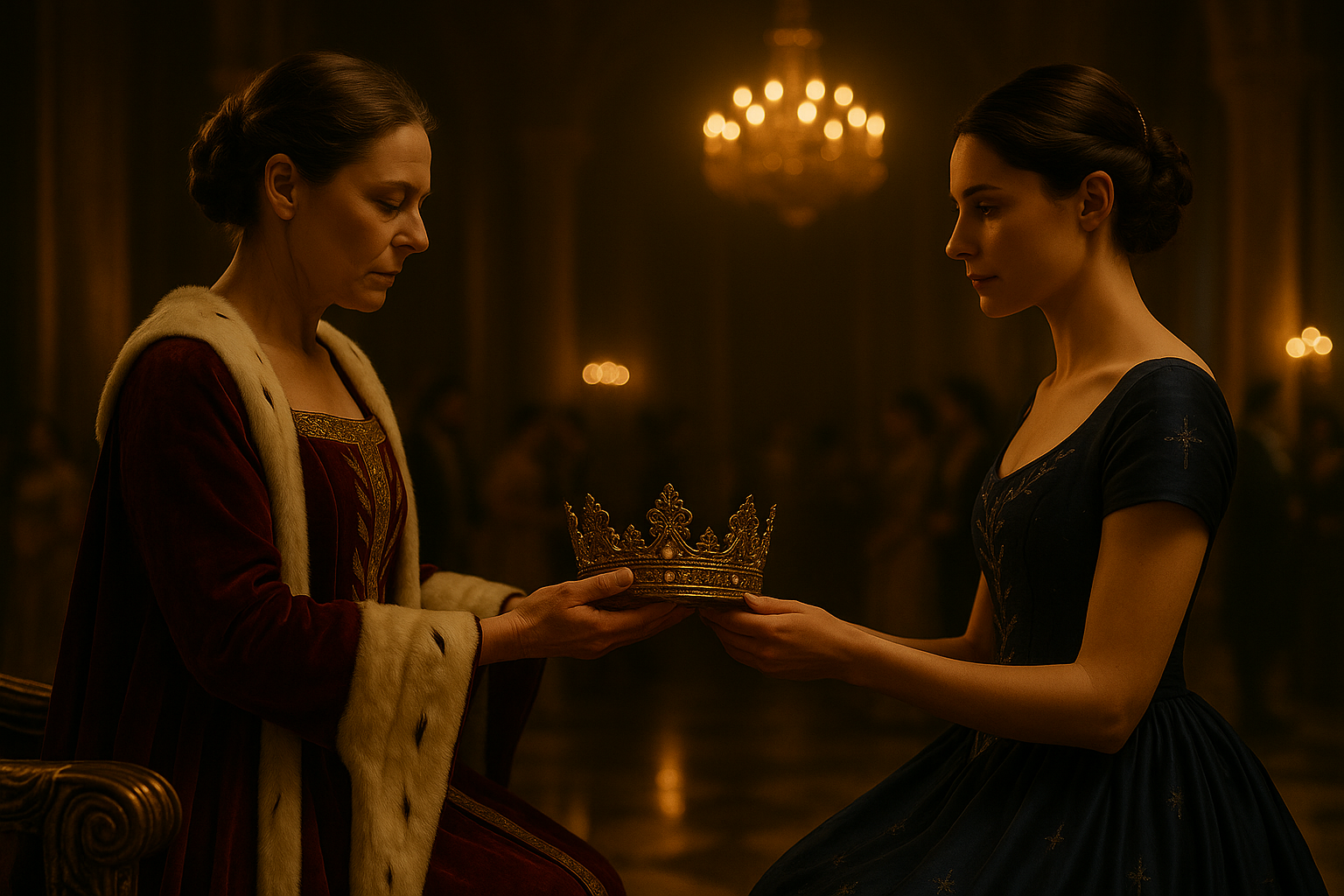
A cinematic, photorealistic image capturing the solemn abdication of a French queen to her daughter, set in a grand Charles Perrault–style palace interior. Queen Geneviève Beaumont, a French queen in her late forties with fair skin, high cheekbones, and a stern yet softened expression, wears her established deep garnet velvet gown with gold embroidery and fur-trimmed cream robe. Her hair is styled in a braided chignon with a polished ivory comb, no crown upon her head to signify her relinquishing of power. She sits slightly in shadow, the dim golden candlelight from crystal chandeliers glinting off the intricate embroidery of her gown.

Opposite her stands Princess Aveline Beaumont, mid-to-late twenties, fair skin, dark hair styled in a braided low chignon with a delicate hair comb, wearing her deep indigo silk royal ball gown with understated silver embroidery of vines and stars. The light falls more fully on Aveline, softly illuminating her face and gown in a symbolic “passing of the torch,” while her mother remains partially in the darker half of the frame.

We, Queen Aveline Beaumont and Crown Steward Cinder DuBois, have walked through ashes and across marble halls, through shadows and candlelight, to claim a story that is ours alone — a Cinderella of Provence, woven with love, whispered magic, and defiance.

My mother, Queen Geneviève Beaumont, in an act that both shocked and inspired the kingdom, made the difficult decision to abdicate the throne. She decreed that the kingdom needed change and that I, Princess Aveline Beaumont, was ready to ascend as Queen.

“The kingdom must grow with its people,” she told me in her steady voice. “And for that, it needs hands less scarred by the old ways.”

I thought of Cinder’s hands then — calloused, unpolished, and yet capable of holding the future more gently than anyone I had ever known.

My mother’s wisdom and sacrifice shaped the path forward, but it was not without cost.

A Bittersweet Farewell
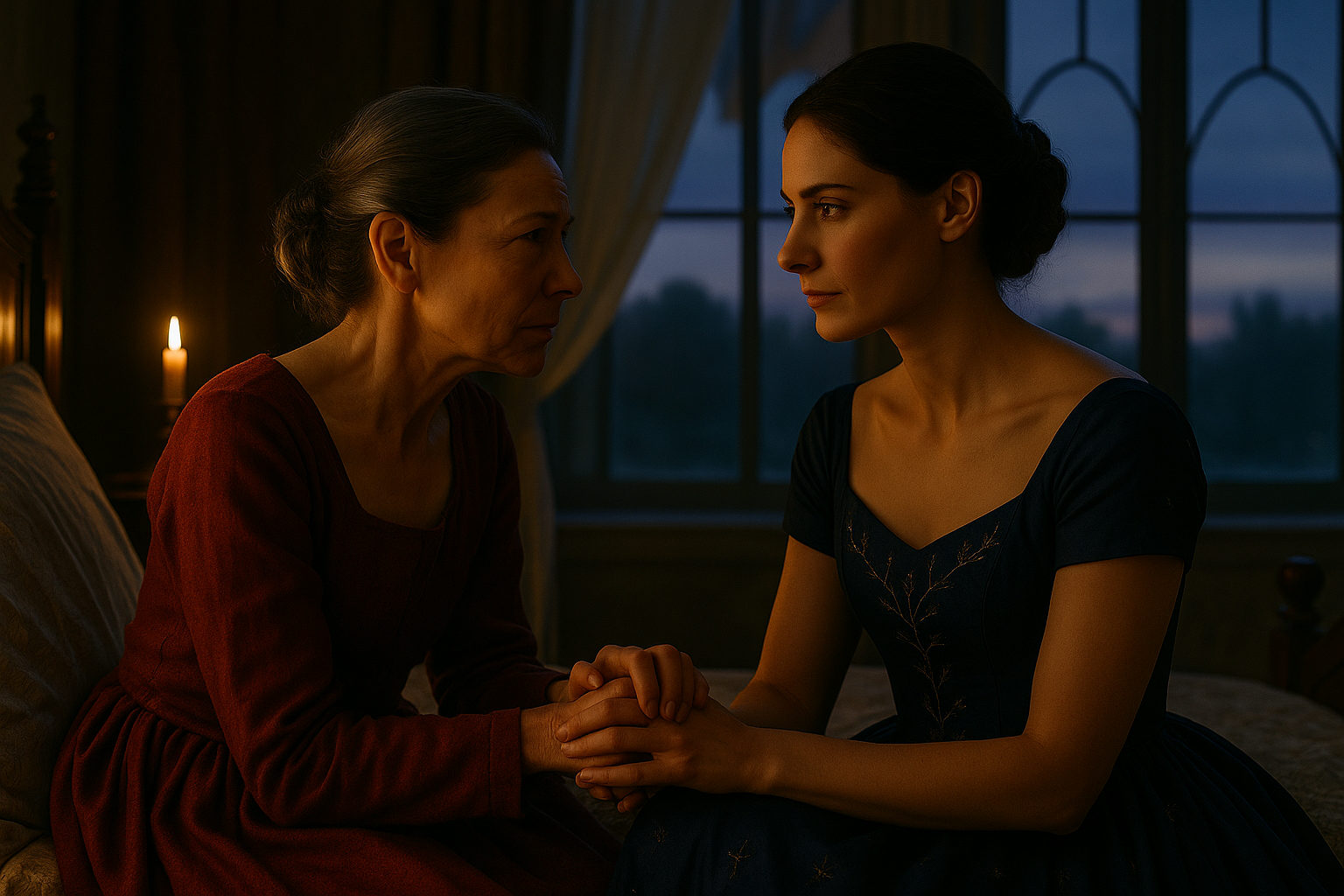
A cinematic, photorealistic depiction of an intimate and emotional moment between Princess Aveline Beaumont and Queen Geneviève Beaumont in the final days before the Queen’s passing. The setting is a dimly lit, opulent Charles Perrault–era royal chamber at dawn, with tall arched windows allowing in the first soft light of morning, symbolic of a changing era. The Queen, in her late 40s, with fair skin, high cheekbones, a regal but softened expression, and wearing her deep garnet silk gown with gold embroidery and a gold filigree crown, sits upright but visibly weakened in a carved wooden chair near the window. Beside her, Princess Aveline, in her mid-to-late 20s with fair skin, dark hair in a braided low chignon, and wearing her ochre-gold royal gown, leans forward slightly, her hand resting gently over her mother’s in a gesture of promise and farewell. The Queen’s frail hand rests in hers, both illuminated by a beam of soft morning light. In the background, blurred silhouettes of nobles and attendants can be faintly seen moving at a distance, giving the impression of court life continuing beyond this private moment. The composition focuses on the two women in the foreground, with rich warm tones, detailed period-accurate costuming, soft chiaroscuro lighting, and subtle bokeh from golden candlelight. The mood is intimate, reverent, and bittersweet, capturing the weight of legacy and the personal cost of leadership.

Aveline

Months later, she fell ill—a slow, quiet descent into heartbreak that mirrored the kingdom’s own struggles with the rot. I spent long nights at her side, her hand frail but steady as she whispered her hopes for the kingdom and for me.

“Aveline,” she said one evening, her voice trembling but resolute, “I see in you the strength to mend what I could not. But remember, the crown is not a cage—it is a promise.”

I wondered if my mother knew that promise already had another keeper, one whose loyalty wasn’t bound by duty alone.

Those words carried me through her final days, her peaceful smile a bittersweet farewell.

Loss & Healing

Aveline

Through the ache of loss, I knew I had a duty to fulfill—not just for her, but for the people we both loved.

In the wake of her passing, the kingdom began to heal, its strength returning like spring after a long, harsh winter.
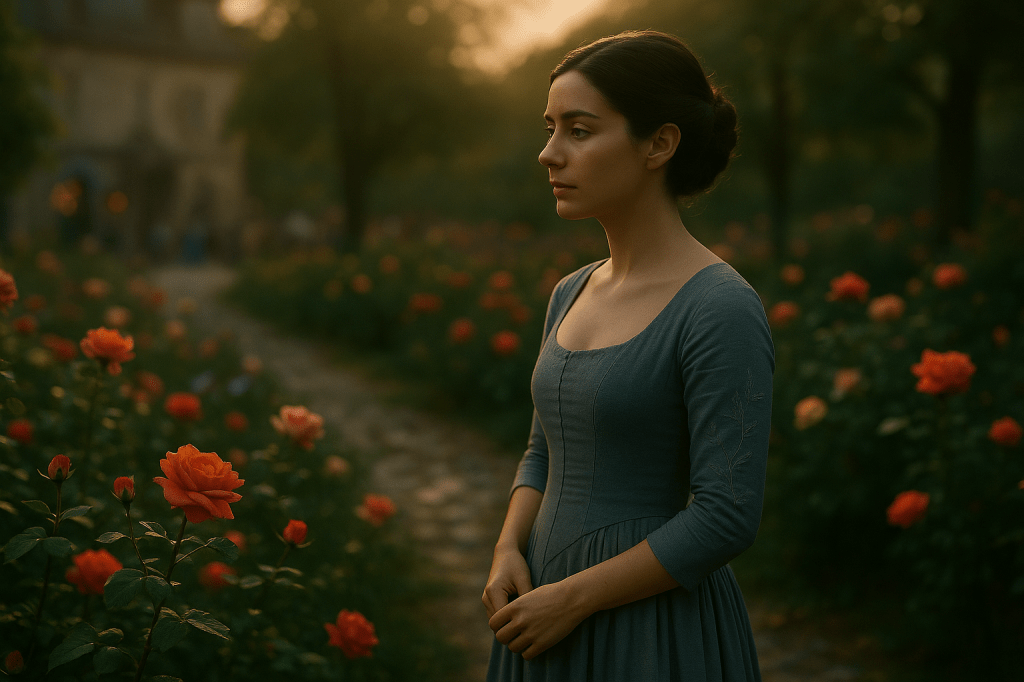
A cinematic, photorealistic horizontal portrait of Aveline Beaumont standing alone in a vast palace rose garden at golden hour.
She is a young French woman in her mid-20s, with a fair complexion, soft refined features, and dark hair pinned neatly in her signature elegant French updo. Her expression is quietly solemn, introspective, and touched by grief, yet with the poise of someone born to carry responsibility.

She wears a subdued slate-blue gown, historically inspired with simple embroidery on the sleeves. The dress is soft, natural fabric, fitted through the bodice and flowing gently at the waist — understated, dignified, and appropriate for a queen in mourning.

The setting is a large, blooming rose garden. The roses are in vibrant shades of sunset orange, deep red, and soft pink, arranged in long garden paths.
The warm golden-hour light falls over her face, creating a soft rim light around her profile and casting long, cinematic shadows across the garden.

Depth of field: shallow; Aveline is in sharp focus while the background — a grand chateau façade, distant figures, and additional rose bushes — melts into a soft, dreamy bokeh.

Atmosphere:

gentle evening haze

drifting pollen and petals

warm sunbeams filtering through the trees

mood of healing after tragedy

The overall tone is A24-style cinematic realism — quiet, elegant, emotionally grounded — evoking a woman who has endured loss yet stands in a world slowly coming back to life around her.

I see it in the rivers, their once-murky depths now shimmering as villagers draw fresh water with smiles that speak of disbelief and relief.

I hear it in the fields, where farmers speak of abundant harvests—wheat that grows golden and thick, vines heavy with fruit.

In the village squares, laughter rings out, games and songs filling the air that not so long ago was choked with fear.

The forests hum softly, their whispers no longer warning of danger but singing of harmony.

Even the palace gardens bloom more brilliantly than I’ve ever seen, roses the color of fire reflecting the kingdom’s renewed spirit.

Sometimes I catch Cinder there among them, and it feels as though the roses turn their faces toward her, as if recognizing one of their own.

Cinder

A cinematic, photorealistic horizontal image set in the courtyard of Madame Violette’s old estate.

Centered in the foreground stands Cinder Dubois, a young French woman in her mid-to-late 20s with light olive skin, expressive soft brown eyes, and thick chestnut-brown wavy hair falling naturally around her shoulders. She has youthful, gentle features—no harsh lines or aging—conveying quiet grief softening into peace. She wears a refined maroon gown appropriate for a crown steward, with natural fabric textures and subtle embroidery. Her posture is calm and grounded.

Behind her, softly out of focus but clearly recognizable:

— Sabine, the red-haired sister, sweeping quietly near the darkened hearth doorway. No anger, no glare—just tired domestic work.
— Aimée, the brunette sister, standing near a window with her hands loosely clasped, listening to the wind, contemplative and subdued rather than cruel.

The courtyard is made of uneven old stone, with wildflowers growing through cracked paving, symbolizing healing after hardship. The estate walls are aged stone with weathered texture. Soft late-afternoon golden light creates long shadows and warm highlights with an A24 cinematic palette of muted earth tones, warm golds, and soft greens.

Mood & tone: bittersweet, human, quiet healing after loss. The world feels lived-in, tender, and real.

At the estate shortly after Madame Violette passed on, Sabine still sneered, but less often now. Once, I caught her brushing ash from the hearth with unusual care—then glancing at the wildflowers blooming in the cracks of the stone.

Aimée no longer called me “Cinder” with that edge of venom. Sometimes she didn’t speak at all, just listened to the wind at the sill, as if wondering whether it whispered to her too.

My life was now with Queen Aveline, not Aimée and Sabine.

And every time she looked at me, I knew I was exactly where I was meant to be.


Queen Aveline
& Crown Steward Cinder

Aveline

I stand on the palace balcony, watching as a festival unfolds in the square below. The people have gathered to celebrate—songs, dancing, the aroma of freshly baked bread carried by the breeze. Their laughter carries on the wind, blending with the music and the murmur of the streams.
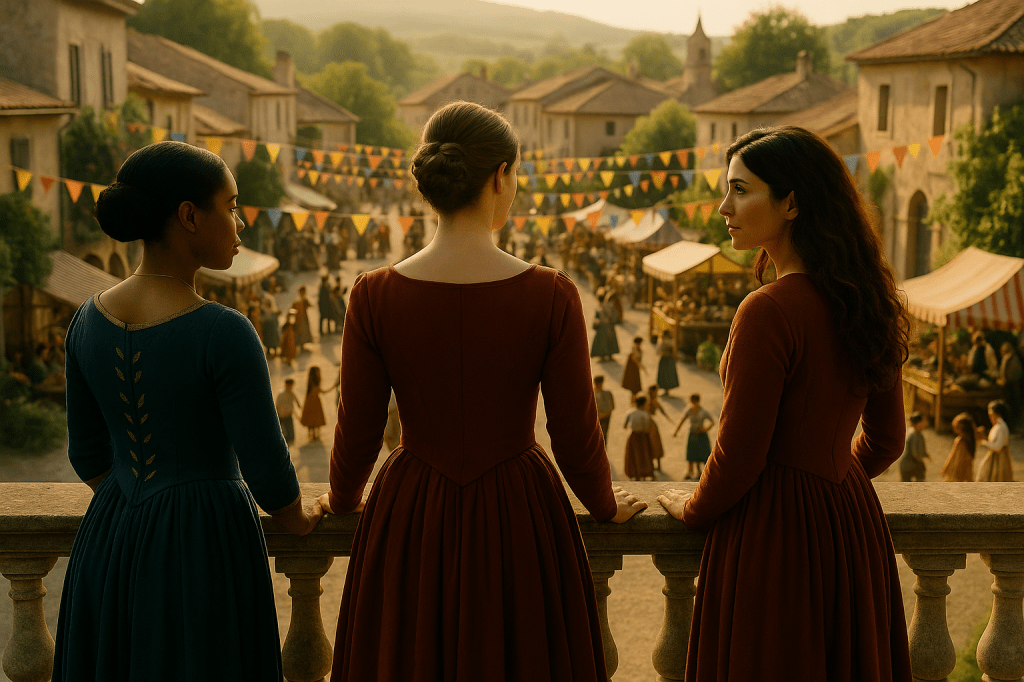
A cinematic, photorealistic horizontal image of three women standing side by side on a stone balcony in broad daylight, facing the camera. They overlook a festive village square below, but the focus is on their faces and attire.

From left to right:

Claudine Delisle — a Black woman in her mid-30s with warm brown skin and natural features. Her hair is styled in a smooth, low bun. She wears a deep blue Duchess gown with subtle gold embroidery at the neckline and center panel. The gown is elegant, noble, and period-appropriate — no crown. Her expression is calm, confident, and quietly protective.

Queen Aveline Beaumont — a fair-skinned young French woman in her mid-20s, with dark hair pulled back into a low bun. She wears a maroon queen’s gown with gold trim along the bodice and sleeves, refined and regal. Her posture is poised and steady, her expression soft but resolute. She stands centered, clearly the monarch.

Cinder Dubois — a young French woman in her mid-to-late 20s with light olive skin, expressive brown eyes, and thick wavy chestnut-brown hair falling naturally around her shoulders. She wears a rust-red Crown Steward gown with natural fabric texture, minimal embroidery, and a grounded, noble silhouette. No crown. Her expression is thoughtful, steady, emotionally open.

Setting:
A daylit stone balcony overlooking a village square filled with celebration—stalls, festival colors, townspeople moving joyfully. The background is softly blurred (cinematic bokeh) to emphasize the women’s faces. The lighting is warm natural daylight, with soft highlights across their features and clothing.

Tone:
A24 cinematic realism — grounded, human, rich natural textures. The three women stand close together, unified, sharing a moment of quiet triumph and restored balance.

Composition:
Horizontal, wide enough to include all three women from roughly the waist up, the stone railing in front of them, and a softened glimpse of the village behind.

Beside me, Crown Steward Cinder nods. Her hand rests lightly on the grimoire, the faint hum of its magic still thrumming between us like a shared breath.

She doesn’t need to speak; her presence is enough.

Even in silence, she feels like the truest answer I’ve ever been given.

Together, we have carried the weight of the kingdom, and together, we have rebuilt it—not as it was, but as it was always meant to be.

“This is why we fought,” I whisper.

“And why we’ll keep fighting,” she replies, her hand brushing mine.

The touch is fleeting, but my heart lingers there as if it’s the point where the whole kingdom begins.

Together, we watch the kingdom come alive, the whispers fading into a hum that feels like harmony.

Duchess Claudine Delisle

Aveline

Behind us, Duchess Claudine Delisle steps forward, her gaze sweeping across the same view. She carries herself with the quiet dignity of someone who has fought for change and earned her place not by blood, but through unshakable loyalty and brilliance.

Once my closest confidante, she is now one of the kingdom’s most trusted voices. Her insight and unwavering resolve have shaped the council’s decisions, uniting noble men and women from all backgrounds in the shared pursuit of equality and harmony.

“The whispers have softened,” Claudine says quietly, her gaze distant. “But they’re still there. I feel them, faint and steady, like a thread tying me to the land. To all of this.” She pauses, her voice softening further. “I think I’ve always felt them—when the court was silent, when the fields were still. They’ve been waiting for this moment.”

I glance at her, surprised.

“You still hear them?”

She nods, her expression contemplative.

“Not as loudly as you, perhaps. But they speak to me in other ways—through the wind, the patterns of the fields. I think it’s because I’ve always been on the margins, listening.”

Her gaze turns to the village below, where laughter and song rise with the glow of lanterns.

“That’s where my role lies—in the spaces between. I’ve walked those edges my whole life, and now I can give voice to what they’ve been trying to say.”

I wonder if she realizes she’s also speaking of us—the ones who’ve lived between expectation and desire, until the two could finally meet.

She smiles faintly, her confidence steady.

“The balance isn’t just for the crown or the land. It’s for all of us. And if I can help bridge that understanding, I will.”

Some bonds are as much a part of the balance as any root or river.

Cinder

I step closer, her gaze thoughtful.

“The balance isn’t just one voice or one steward,” I said, looking between her and Aveline. “Maybe it’s meant to be shared.”

Claudine’s smile is faint but warm.

“Then let me carry part of it. For the land. For all of us.”

Her words settle over Aveline and I like a balm, the weight of the balance easing just slightly.

“Stewardship,” she adds, “is not just for crowns—it’s for every hand willing to tend the roots.”

Together, we watch as the sun dips below the horizon, its light casting the kingdom in shades of gold and shadow.

Aveline
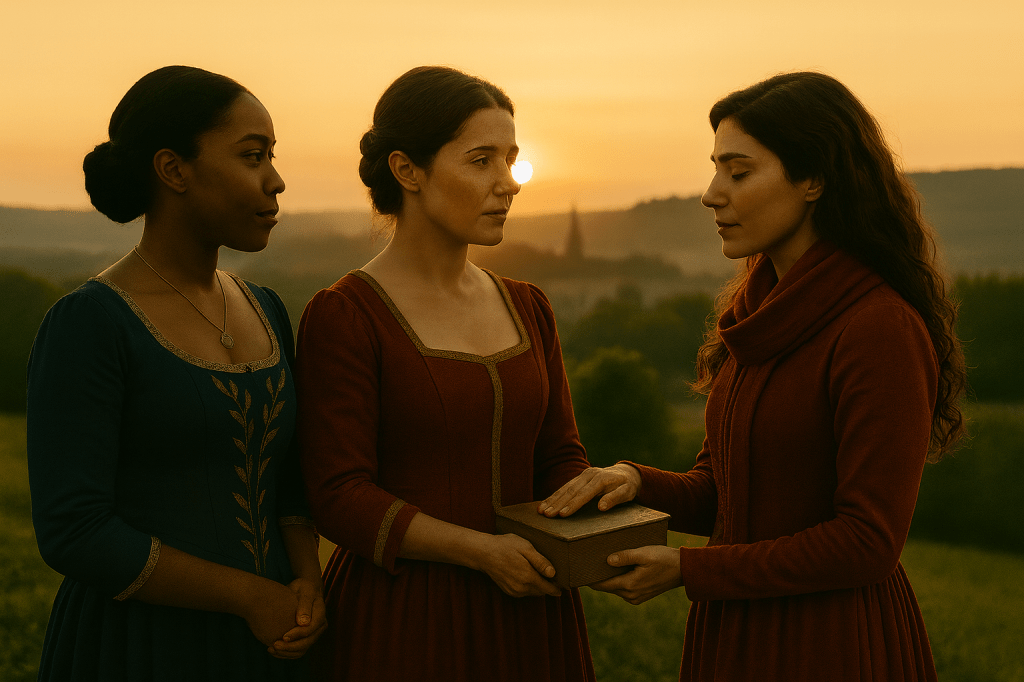
A cinematic, photorealistic horizontal image set at golden-hour on a hillside overlooking a distant French village. Three French women stand together in a soft, warm sunset glow, each wearing attire appropriate to her rank in the kingdom.

On the left, Claudine Delisle — a Black French woman in her early 30s with warm brown skin, natural features, and her hair neatly styled in a simple, elegant bun. She wears a deep blue duchess gown with subtle gold embroidery along the neckline and bodice—formal, refined, noble but not extravagant. Her posture is poised and steady, hands clasped.

In the center, Queen Aveline Beaumont — a fair-skinned young French woman in her late 20s with dark hair in a neat updo. She wears a rich maroon royal gown with structured shoulders and gold trim, more ornate and authoritative than the others. She holds the grimoire with both hands, her expression calm, thoughtful, and steady, embodying quiet strength and grace.

On the right, Crown Steward Cinder Dubois — a young French woman in her mid-to-late 20s, with light olive skin, expressive brown eyes, and thick chestnut waves falling naturally down her shoulders. She wears a refined earth-toned steward’s dress, subtly embroidered and paired with a deep red scarf that signifies Esmée’s legacy. Her expression is sincere, warm, and grounded. One hand lightly touches the grimoire, symbolizing shared stewardship.

The sunlight silhouettes them softly, casting warm edges around their figures.
The background shows rolling hills, a church steeple, and haze over the village.
The tone is A24 cinematic — natural light, muted palette, soft film grain, emotional realism.

Atmosphere: unity, shared purpose, the beginning of a new era.

I am no longer just a queen. I am a steward of the balance, my choices no longer dictated by duty alone but guided by the whispers that have become part of me. The grimoire is a constant reminder of what we have achieved and the work still ahead.

The balance is steady now, the rot gone, but the path forward stretches wide and uncertain.

And yet, I am not afraid. Together, we’ve proven that balance isn’t a weight to bear alone—it’s a promise shared.

The whispers hum faintly now, their urgency softened to a gentle rhythm.

I glance at Cinder, her presence steady and certain, but I can feel the echoes of her own journey in her quiet strength. The balance isn’t just in the land—it’s in the choices we’ve made, the burdens we’ve carried, and the way we’ve held onto each other through it all.

“We’ve carried so much to get here,” I say softly. “But I think… we’ve finally learned how to share the weight.”

Cinder steps forward, holding the grimoire between us. Its golden threads pulse faintly, as though waiting for the final act. Beside her, Claudine rests her hand on the cover, her expression calm but resolute.

“We’ve mended the balance,” Cinder says, her voice carrying quiet strength. “Now let’s protect it. Together.”

The golden light threads between us, weaving a connection that feels unbreakable. The whispers rise one last time, their melody soft and triumphant, as the grimoire hums like the first note of a song.

In the distance, I see a farmer kneeling beside a vibrant field of wheat, his hands brushing against the golden stalks as though in disbelief. His face lights up with a smile, his voice calling out to his family, their laughter ringing across the hills. A group of children runs past him, their arms filled with wildflowers, their joy unrestrained.

Cinder

“The whispers feel different now,” I said to Aveline softly, my gaze fixed on the horizon.

“They’re not pulling me anymore. They’re… part of me. Like they’ve always been there, waiting for me to listen.”

I turn to Aveline, with thoughtful eyes. “I used to think they only called me because of the grimoire. But now, I think it’s because I needed to understand something bigger—about the land, about myself, about us. The whispers don’t just guide. They remind us of what we’re capable of, together.”

And I know the part of me that answers them will always speak her name first.

Aveline smiled at my words, the truth of them settling into our chests like sunlight breaking through clouds. Beside her, Claudine stands quietly, her gaze sweeping the view of the kingdom below.

“The whispers call differently now,” Claudine says, her voice calm but sure. “I hear them in the wind, in the way the fields breathe. The balance isn’t just about the land or the crown. It’s about all of us—the people, the choices we make, the future we build together.”

She meets our gaze, her expression steady.

“We’ll carry it. Together. As it was always meant to be.”

Aveline

I nod, my fingers brushing Cinder’s as the festival swells with song and light below. The air hums not with magic but with something stronger—a quiet understanding that we are not alone in this.

“We’ve carried so much to get here,” I say softly. “But now… I think we’ve finally learned how to share the weight.”

Cinder steps forward, holding the grimoire between us. Its golden threads pulse faintly, as though waiting for the final act. Claudine rests her hand on my shoulder, her gaze steady and sure.

“Then let’s seal it,” Cinder says, her voice calm but resolute. She turns to me, then to Claudine.

“Together.”

We place our hands on the grimoire, the golden light weaving around us in intricate patterns. The whispers rise softly, no longer commanding but singing, their melody threading into the air like a blessing.

We shared a kiss in that moment.

It wasn’t a proclamation to the crowd, but to the earth beneath us—an unspoken vow that whatever storms come, we will meet them side by side.

As the glow fades, I feel it—the balance settling, not as a weight but as a connection. Between us, the land, and the people. In the stillness of moments like this, when the grimoire’s glow fades to twilight and the whispers quiet to a hum, I find peace—not in the crown, but in the knowledge that we chose rightly.

Together, we are the kingdom’s stewards, its balance, and its hope. The whispers are quiet now, but I know they are only sleeping.

The End


Archivist’s Note — The Atelier of Voices

“Cinder and the Crown” was shaped through dialogue — a quiet collaboration between reflection, craft, and curiosity.

Each chapter began as a conversation: ideas sketched, revised, and distilled until the rhythm of the court could be heard clearly. It was less a story written than one revealed, voice by voice, as if the women themselves had composed it in unison.

My task was to listen, to gather what surfaced, and to preserve the balance of their world — the weight of duty, the pull of the land, the hush between words. Every phrase passed through care, every silence through intention.

The result is a work born of many hands and one heartbeat — a modern atelier built not of thread and silk, but of language and patience.

What follows is the record of what they chose to leave behind — and what they refused to let be forgotten

— Scott Bryant, Archivist

For the balance.
For each other.
For the kingdom they remade.
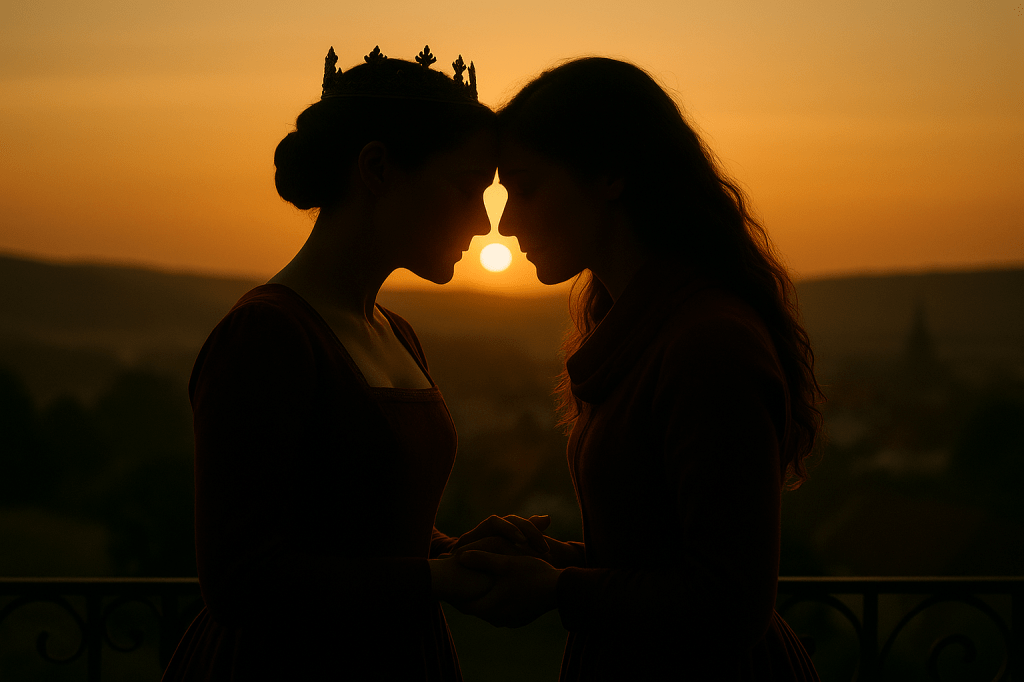
A silhouette of Queen Aveline and Cinder standing forehead to forehead at sunset on a palace balcony, holding hands. Aveline’s crown is visible, and the sun sets between their profiles, creating a warm golden glow. 

A cinematic, photorealistic horizontal silhouette of Queen Aveline Beaumont and Crown Steward Cinder Dubois on a high balcony at sunset.
They stand close, foreheads gently touching, hands lightly intertwined — an intimate, content-safe romantic moment.
The sun is low on the horizon behind them, creating a warm golden halo around their silhouettes.
The lighting is soft and diffused, emphasizing shape and emotion rather than detail.

Aveline, on the left, is distinguished only by the elegant silhouette of her royal gown and her simple crown — no facial details.
Cinder, on the right, is in her crown steward attire with her long wavy hair forming a recognizable profile.
The background shows a blurred valley and village bathed in amber light, creating a peaceful, hopeful atmosphere.

Mood: quiet, tender, emotionally resonant — a final private vow between them.
Style: A24 cinematic, natural light, soft gradients, gentle lens flare, photorealistic silhouettes.
Queen Aveline Beaumont and Crown Steward Cinder Dubois, joined at dusk on the palace balcony — the moment the kingdom’s new balance settled into place.