
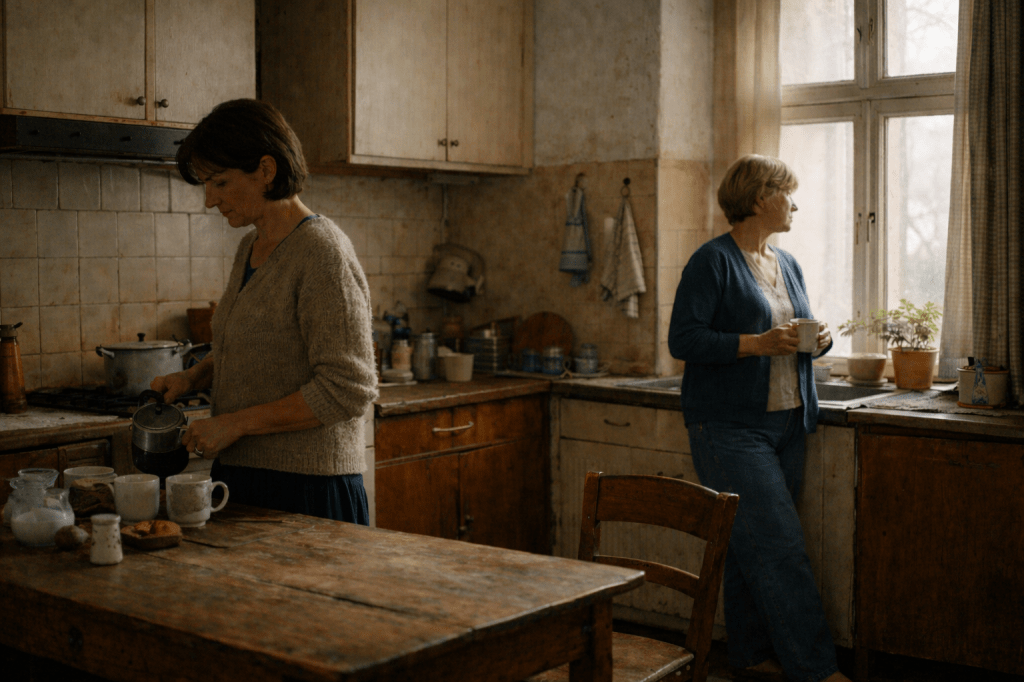
I had already turned the oven on when I noticed the tape.
It ran straight across the kitchen floor, pale blue, pressed flat and confident. It passed under the table, between two chair legs, and continued toward the sink as if it had been given instructions and followed them exactly. I stood there with the flour still in my hand, trying to remember whether we owned tape like that.
The oven hummed. I poured the flour into the bowl anyway.
I had decided to bake the night before, without ceremony. The butter was soft. The eggs were cracked cleanly. I reached for the sugar.
My hand stopped.
The sugar bowl was on the other side of the tape.
This took longer to understand than it should have. The bowl was where it had always been. The tape was new. That was the only difference.
“Well,” I said.
Behind me, she cleared her throat.
“I think,” she said carefully, “that’s not yours.”
“I only need it briefly.”
She nodded. “I know.”
There had been explanations earlier. Apologies. Careful phrases delivered twice, as if repetition might help. Someone had gestured at the floor with a pen and said something about clarity. None of it mentioned baking.
“I’ve already measured everything else,” I said.
“That’s unfortunate,” she said.
“I could substitute.”
She tilted her head. “You could.”
We both knew I wouldn’t.
She reached for the sugar bowl, then stopped, her hand hovering over the tape.
“I don’t know if I’m allowed,” she said.
“I don’t know if I’m allowed to receive it.”
We waited. Nothing happened.
I turned the oven off.
“That’s that, then,” I said.
I wiped the counter and stopped when the cloth crossed the line.
“Who cleans which side?” I asked.
“I suppose we clean what belongs to us.”
I wiped my half more carefully than necessary. She wiped hers. The faint dust between remained.
At the sink, the tape cut the basin in half. The faucet was hers. The drain was mine.
She turned the water on a little. It pooled uselessly and went nowhere.
“That won’t work,” she said.
“No.”
She turned it off.
“I’ll carry my mug around,” she said.
She took the long way through the hallway, passing the sink like furniture we had failed to assemble correctly.
In the bedroom, the tape was worse.
It ran under the bed at an angle, assigning her the pillows and me the foot. Whoever had measured it had not bothered to align it with anything meaningful.
“I was planning to change the sheets,” I said.
“We could rotate the bed.”
“And still be wrong.”
“Yes,” she said. “Just differently.”
She sat on her side and put on her slippers. I lifted the blanket and paused.
“Who folds?”
“I think we fold what’s ours.”
We did. The middle remained folded by no one.
The lamp was on her side. My book was on mine.
“That’s inconvenient,” she said.
“I’ll remember,” I said. “Eventually.”
There was another knock later. Another apology. Someone asked if we had questions.
“Yes,” I said. “Does dust cross the border?”
They wrote something down.
By afternoon, the village had noticed. Someone waved. Someone stood too long at the gate. Nothing else changed.
Back in the kitchen, I moved the sugar bowl two inches farther from the tape.
“That might not be permitted,” she said.
“I’m prepared to argue.”
She smiled. That small, practical smile that suggested we had argued about worse things.
We ate bread and butter. No cake. The crumbs stayed mostly on my side.
When it was time to clean up, she handed me the cloth without thinking, then stopped.
“Sorry.”
“It’s fine,” I said. “I’ll get another.”
We now owned two cloths.
That night, we slept carefully. I did not roll over. She did not steal the blanket. The border remained exactly where someone had decided it should be.
In the morning, the house creaked as it always had.
The tape lifted slightly near the doorway.
We stepped over it without speaking, then stepped back again, because it seemed polite.
Nothing had been ruined.
It was simply going to take longer to bake.
 Scott Bryant
You must be logged in to post a comment.