
Video released January 2016 · Blog post originally written February 6, 2016 · Updated February 9, 2024
Note: This essay was originally written in early 2016, shortly after the release of the New York Times Op-Doc. In 2024, I’ve lightly updated it with reflections on how the debate has shifted — and how much remains the same.
A man can take off his shirt in the park and no one blinks. A woman does the same, and suddenly it’s indecency, scandal, or even a crime. The line between freedom and shame is razor-thin, drawn not by nature but by culture.
That tension is at the heart of Free the Nipple?, a short New York Times Op-Doc released in January 2016. At the time, the video struck me as small but sharp — a glimpse into how something as ordinary as the human body could still be treated as a site of rebellion.
Nearly a decade on, its resonance has only deepened.
Watch the Op-Doc here:
Media Framing – Protest, Community,
& Street Voices
The Op-Doc begins not with spectacle, but with women themselves. Members of the Outdoor Co-Ed Topless Pulp Fiction Appreciation Society in New York City sit in a park, topless, reading books and talking together. Their presence is calm, grounded, unapologetic.
One member reminds viewers:
“Many New York citizens don’t realize that it’s actually legal for women to be topless. It’s been legal since the year 1992.”
Another adds:
“At one point in history it was also illegal for men to be topless as well. And only in the year 1937 did it become legal for men. The law should not be applied differently based on your gender.”
Their voices make clear that this isn’t about provocation. It’s about visibility and equality — about occupying public space with the same freedoms men take for granted.
Balanced against this are the street interviews in Times Square.
Reactions range from curiosity to moral panic.
One woman dismisses toplessness with the line:
“What is there about showing so much of your breast exposed, except for excitement, for a male!”
Others shake their heads and mutter about children.
These moments expose how far the culture lags behind the law.
The film highlights that tension — women calmly living their rights, the public still reacting as if those rights were outrageous.
A History of Visibility
The nipple debate may have surged in 2015, but the fight over women’s bodily autonomy stretches back much further.
Suffragists once marched through hostile crowds to make their presence undeniable. In the 1960s, feminists staged protests that challenged beauty standards and public modesty — the myth of bra-burning at the Miss America pageant endures precisely because it symbolized rebellion against control of women’s appearance.
Artists like Carolee Schneemann and Annie Sprinkle later pushed the boundaries of art and activism, using nudity to seize control of representation.
As the Op-Doc reminds us, even men’s toplessness was once banned — until 1937. Every gain, for men or women, came through resistance.
Free the Nipple? simply carries that lineage forward.
It asks: if men won the right nearly a century ago, why should women still be policed?
Bodies, Borders, and Cultural Contrasts
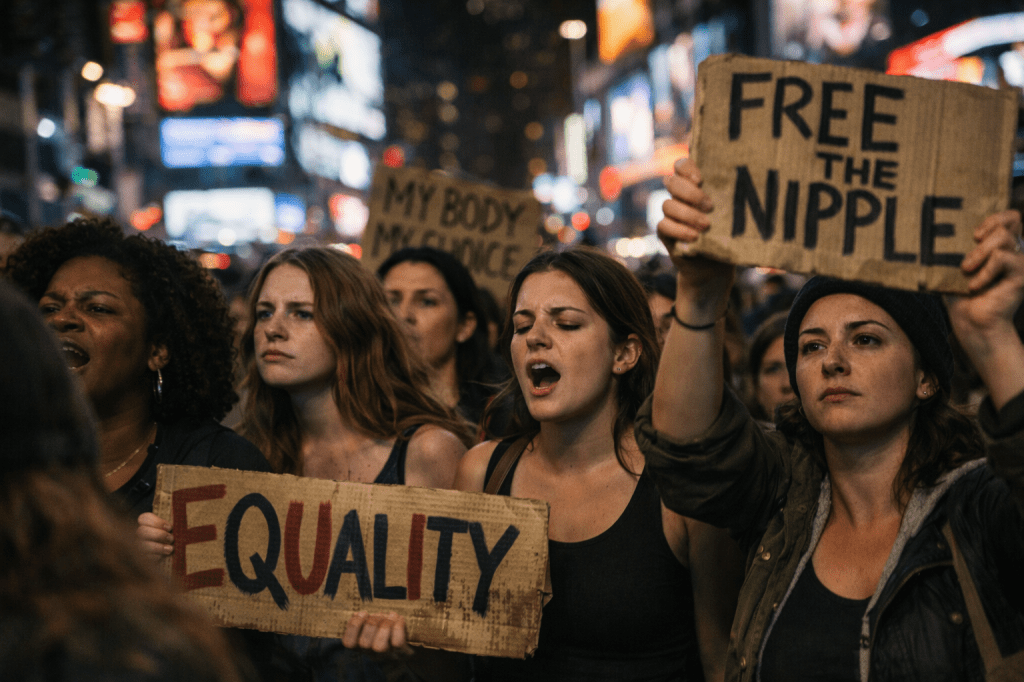
The film also makes clear how inconsistent “decency” really is.
In New York, toplessness has been legal since 1992 thanks to Ramona Santorelli’s case, which successfully argued that laws singling out female nipples were unconstitutional.
Yet even with that ruling, women still face wrongful arrests by officers unaware of the law.
Elsewhere in the U.S., statutes remain murky.
In New Hampshire, legislators even tried to push through a bill that would explicitly criminalize women exposing their nipples. The irony: in much of Europe — France, Spain, Germany, Scandinavia — toplessness is treated as unremarkable.
As one member of the Pulp Fiction Society put it:
“The law should just be the law.”
Instead, women’s rights shift depending on geography, interpretation, and whim.
If exposure is freedom in Paris but indecency in New York, then the nipple is not inherently controversial.
Control, not morality, is what’s really at stake.
The Digital Frontline
(2016 reflection)
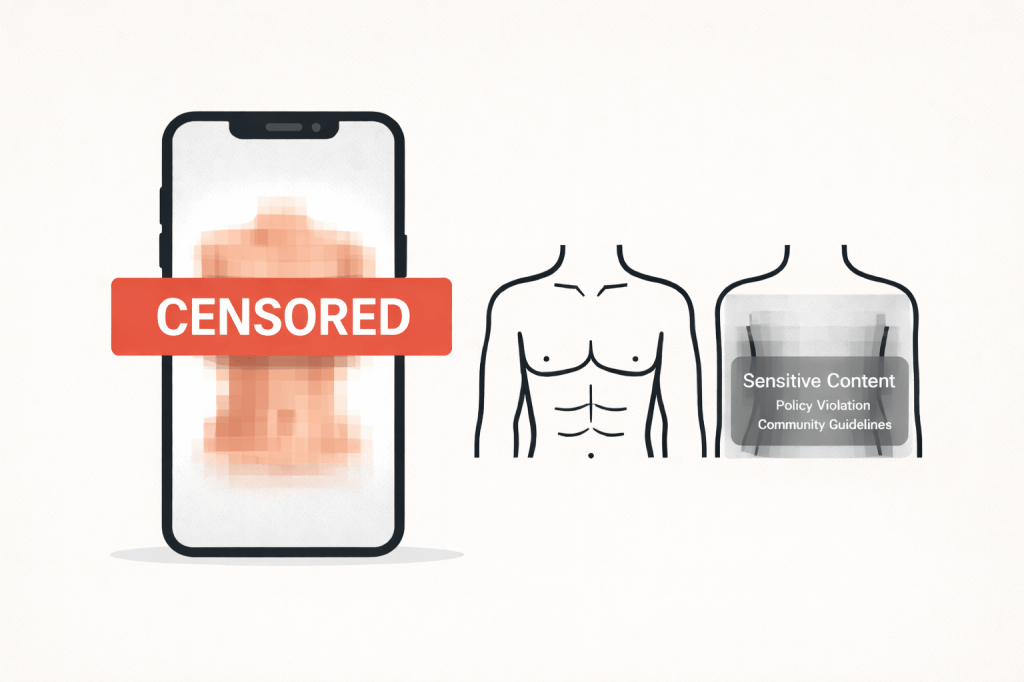
Even as New York women exercised their rights, platforms like Instagram and Facebook censored them. The film notes the absurd workaround: women photoshopping male nipples over their own to dodge bans.
“That is ridiculous,” one laughs. “How can you tell the difference? Why should one nipple be censored while the other one isn’t?”
(2024 update)
Nearly a decade later, the hypocrisy has hardened. Algorithms now automate these bans, deleting women’s images while leaving men’s untouched. Women still find themselves shadow-banned or erased for showing what is legal offline. The irony could not be sharper: in the so-called open space of the internet, women’s bodies are policed as aggressively as ever — only now by machines.
From a design and tech perspective, this isn’t accidental. Every interface, every content filter, every algorithm is a design decision. Image-recognition systems are trained to erase one kind of nipple and not the other, embedding bias into the code itself. Community guidelines may be written in neutral language, but their execution reveals a cultural choice: to mark women’s bodies as violations, while leaving men’s untouched.
This is why Free the Nipple? still matters. The battleground isn’t just law or culture anymore — it’s infrastructure. Platforms design the limits of visibility, and those choices ripple outward into women’s daily lives. The street may be a protest stage, but the screen is now equally contested territory.
Who Owns The Female Body?
When you step back, toplessness is only the surface. The deeper question is about ownership.
Who owns the right to say what a woman’s body can do, where it can appear, how it can be read?
In the film, one Desnuda in Times Square put it bluntly:
“The female body is definitely owned. It’s a commercial entity. When an independent woman wants to take control and decides she can make a little cash showing off her body, that’s when it becomes a problem.”
Governments legislate women’s bodies.
Courts arbitrate them.
Media frames them.
Tech companies censor them.
This is why the nipple matters — not because of its anatomy, but because of what it symbolizes. To show it freely is to claim autonomy; to ban it is to insist that the female body belongs to everyone but the woman herself.
If the body is always political, then every act of visibility is resistance.
Closing Reflection
When I revisit Free the Nipple?, I’m struck by how much and how little has changed. The women in the film — gathered in community, painted in Times Square, explaining calmly that their bodies are natural, not obscene — remain powerful to watch.
(2024 update)
And yet the same cultural battles continue. Abortion rights have been rolled back since 2022. Social media platforms remain stubborn in their double standards. The double standard has not faded. The only constant is women’s refusal to disappear.
The Op-Doc closes with a vision voiced by one of the Desnudas:
“The ultimate goal for us, for women’s equality and women’s rights, is that there’s no reaction.”
That simple statement still resonates — equality means normalcy, not spectacle.
That’s why a short video about toplessness still matters. Because when something as ordinary as a nipple becomes a battleground, the stakes are larger than skin.
Laws define rights, but platforms and design choices shape visibility — and those decisions, coded into everyday tools, continue to decide what women can and cannot show.
So maybe the question isn’t just Free the Nipple?
Maybe it’s what else might we free if we stopped being afraid of women’s bodies?
 Scott Bryant
You must be logged in to post a comment.