
Pompeii: The Exhibition
Oregon Museum of Science and Industry (OMSI)
Portland, Oregon
June 24, 2017 — 9:30 AM
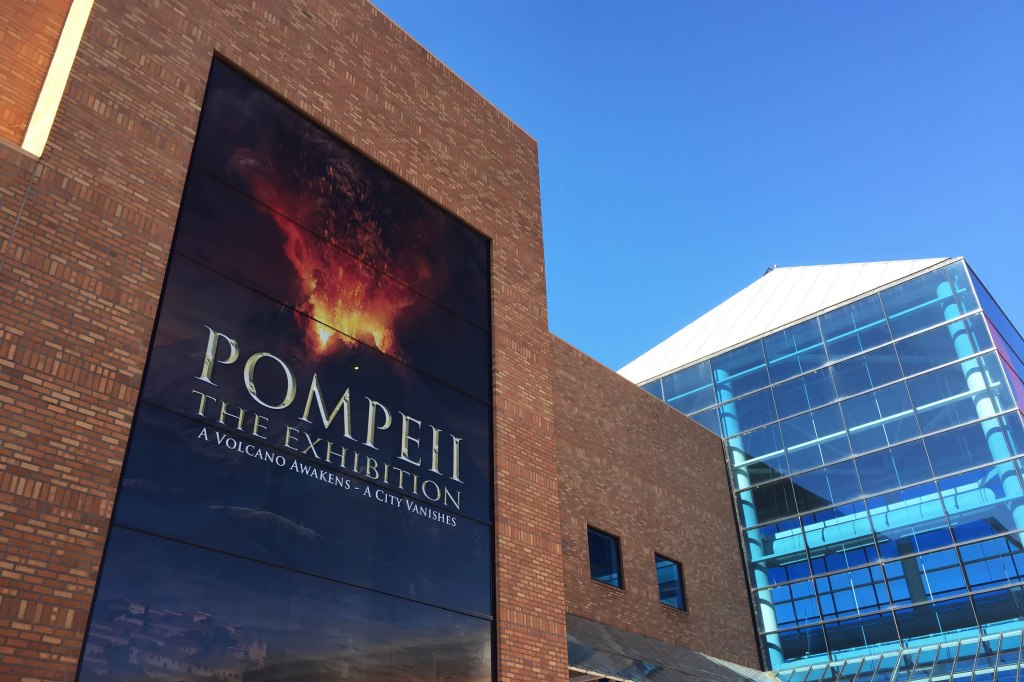
The Pompeii exhibition at the Oregon Museum of Science and Industry is structured to emphasize scale. Artifacts are grouped densely; vitrines follow one another in quick succession; preservation is presented through accumulation. A city becomes legible through volume—stone, plaster, casts, fragments—each contributing to a broader sense of loss and continuity.

Moving through the exhibition, I did not linger everywhere equally.
One object became the focus.
It was not the most dramatic piece on display. It was not a body cast or a collapsed wall or a domestic interior frozen mid-gesture.
It was a small marble theater mask from Pompeii, dated to the first century A.D., depicting a woman from Roman theatrical tradition.
The mask is carved with restraint. The hair is formal and abundant, indicating role rather than individuality. The mouth is open—not expressive, but functional. In Roman theater, this opening was shaped to project sound across space. The mask is an instrument designed for voice.
But the voice it carried was never hers.
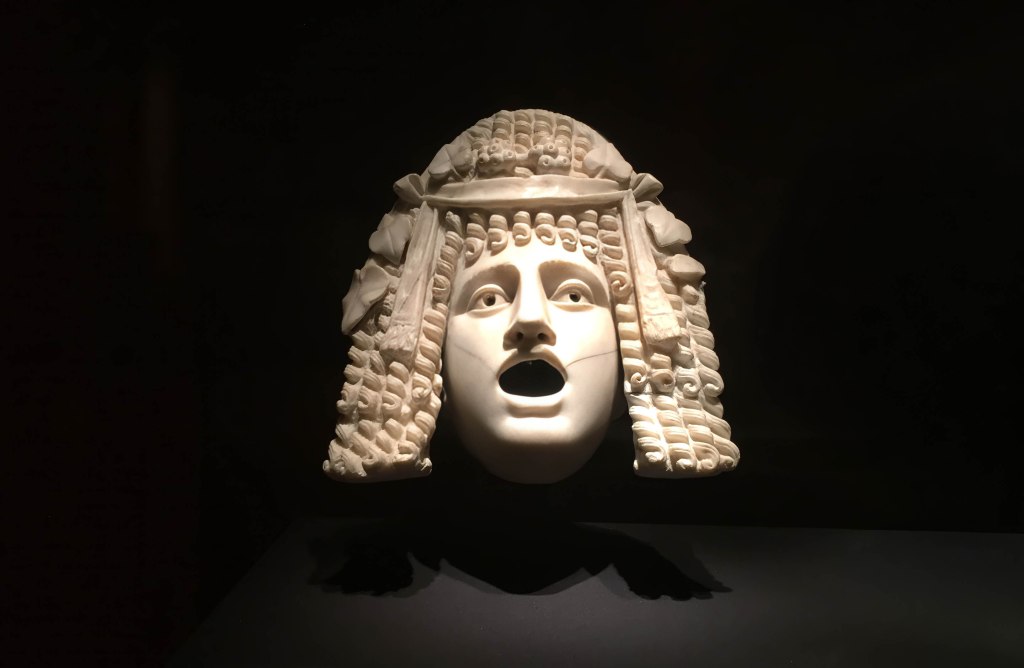
Although the character represented is a woman, theatrical roles in Roman performance were played by men. The object preserves the form of a woman whose speech was always delivered through another body. Her face remains. Her voice does not.
The significance is structural rather than dramatic.
Pompeii is often described as a city erased. Yet the eruption did not erase indiscriminately. It preserved homes, objects, and patterns of daily life—including exclusions. The volcano did not alter who was permitted to speak and who was spoken for. That arrangement was already in place. The mask endures as evidence of a system that did not require catastrophe to exist.
The exhibition included major works on loan from the Naples National Archaeological Museum, objects of considerable historical weight. Within that context, the mask is easy to pass by. It does not draw attention through scale or damage.
In a city often framed through images of silence—bodies fixed in place, mouths sealed by ash—this object documents a different absence: a figure constructed for speech, preserved in a form that never allowed her to speak in her own voice.
The eruption fixed Pompeii at a moment in time.
The mask reflects what was already in place.
 Scott Bryant
You must be logged in to post a comment.