
Cultural Notes — Religious Iconography / Built Environment
Shrine of the Four-Faced Brahma — Caesars Palace, Las Vegas, Nevada
May 2017
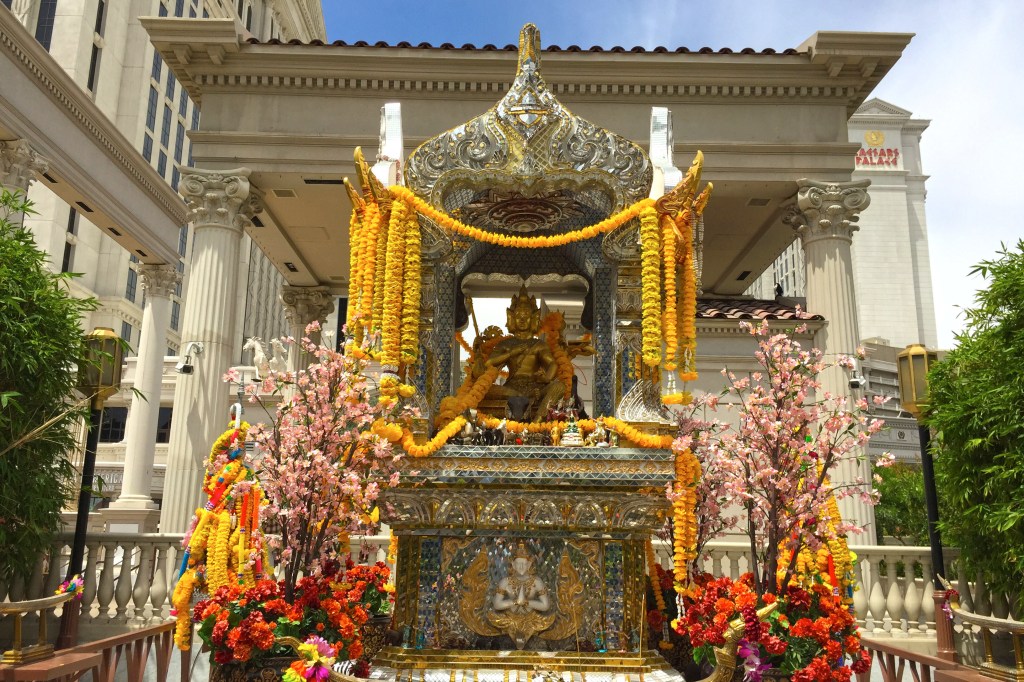
The shrine stands within the grounds of Caesars Palace, set among columns and architectural elements that draw on Roman forms. Positioned along a pedestrian walkway, it is fully integrated into the surrounding hotel environment while maintaining a distinct visual identity.
It is not a subject I typically document. The setting made it difficult to ignore.
At its center, a multi-faced figure sits beneath an ornate canopy. The structure is highly detailed—mirrored surfaces, gold ornamentation, and layered decorative elements that reflect light differently depending on position and time of day. Floral garlands and arrangements are placed around the figure, introducing color and texture that contrast with the pale stone of the surrounding architecture.
The shrine is not isolated; it exists within a space defined by movement—guests passing through, stopping briefly, or continuing along the path toward other parts of the property.
It introduces a form associated with Thai devotional practice into a setting otherwise defined by Roman architectural references.
There is no clear boundary separating it from the rest of the environment, yet its arrangement signals a different mode of attention. The placement of offerings suggests an intended function beyond decoration, even as the surrounding context remains commercial.
At the center of the property, the architectural language remains consistent, but the shrine operates alongside it rather than within it. The two systems are not merged; they are held in parallel.
It remains in place, defined by its structure, its ornamentation, and the objects placed around it. The environment continues to move; the arrangement of the shrine does not change.
 Scott Bryant
You must be logged in to post a comment.