
Some films shout; Carol whispers. It’s a story told as much in what isn’t said as in what is. Watching Cate Blanchett and Rooney Mara in Todd Haynes’ Carol (2015)—adapted by Phyllis Nagy from Patricia Highsmith’s The Price of Salt—feels like leaning into a private conversation, where the pauses and silences speak louder than words, conveying a world of longing and unspoken emotion. It’s in these quiet moments that the film’s true power lies, pulling us into its characters’ unspoken desires.
Department Store Glances
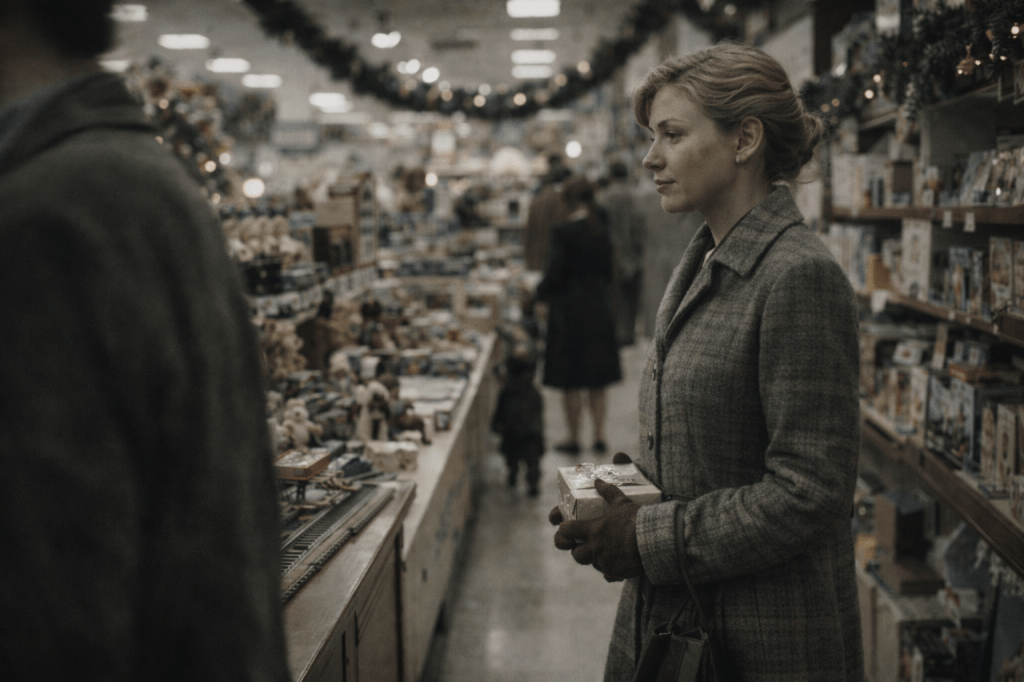
Take, for example, the way Carol (Blanchett) and Therese (Mara) first meet in the department store during the Christmas season. It’s the kind of scene most films would rush through: a quick exchange of dialogue to establish a connection. But here, every detail feels heightened.
In the “I Like the Hat” scene, Carol’s composed, deliberate presence contrasts beautifully with Therese’s nervous energy. As Carol engages Therese in a seemingly casual conversation—asking how she knows so much about train sets—the true power of the moment isn’t in the words exchanged. It’s in the pauses, the lingering gazes, and the subtle shifts in body language, capturing their connection in a quiet, unspoken intimacy.
The beauty of this scene is that it doesn’t need grand gestures or sweeping dialogue to convey its weight. It’s all there in the glances, the lingering quiet, and the charged space between them. You don’t just watch their connection unfold—you feel it.
Silence as Intimacy
Throughout Carol, the score mirrors its restraint. Carter Burwell’s hauntingly subtle music floats in and out, like a thought you can’t quite grasp, punctuating the silences with a bittersweet melody that lingers just as long as the quiet itself. It doesn’t dominate the scenes; instead, it amplifies the stillness and emotional weight of moments both large and small.
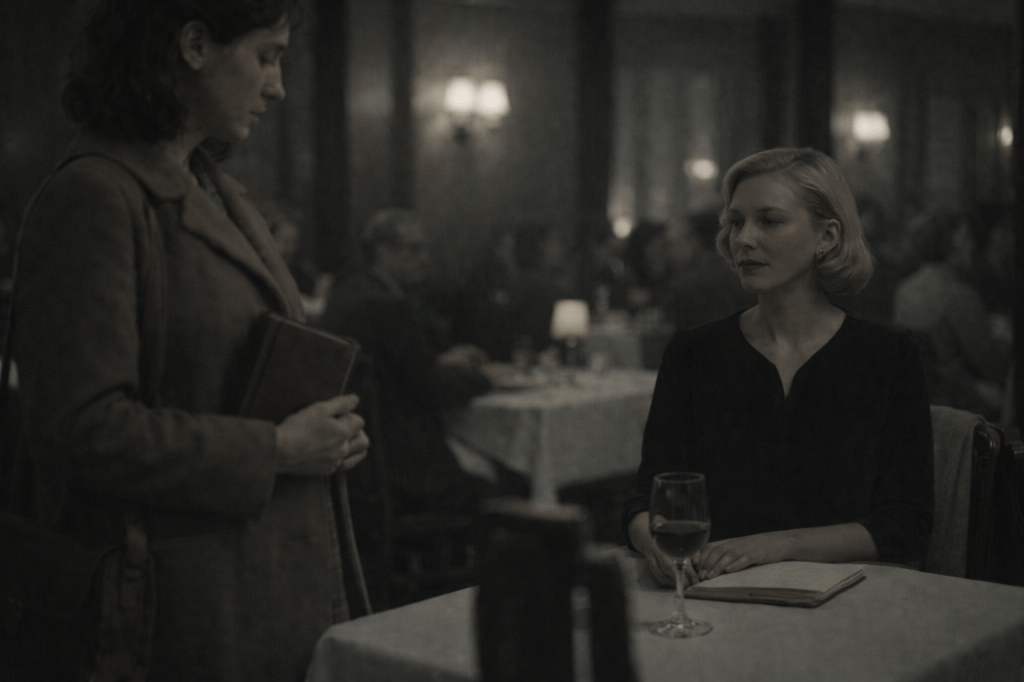
Perhaps the most poignant example of silence in Carol comes near the end of the film. Therese steps into an elegant restaurant, the lively clatter and conversation fading in significance as her gaze locks on Carol, seated at a table with others. No words pass between them. None are needed. In that single, charged moment, everything they’ve been through—heartbreak, risk, and love—culminates in an unspoken invitation, rich with possibility.
In our daily lives, silence can feel uncomfortable, something to fill or escape. But Carol reminds us that silence can also be profound, a space where meaning blooms. It challenges us to listen—not to words, but to what lingers unsaid.
That’s the brilliance of Carol. It trusts its audience to pay attention, to hear the quiet truths in the spaces between words. And maybe that’s why it lingers, like an unspoken promise or a memory that refuses to fade, long after the credits roll.
Final Thoughts
I remember seeing the film for the first time at a matinee showing in the Portland, Oregon metro area right after its release around Thanksgiving in 2015. For days afterward—during the chilly fall days—I couldn’t stop thinking about it: the silences, the glances, the unspoken emotions. Carol stayed with me, quietly echoing in the corners of my mind, just as it was meant to.
 Scott Bryant
You must be logged in to post a comment.