
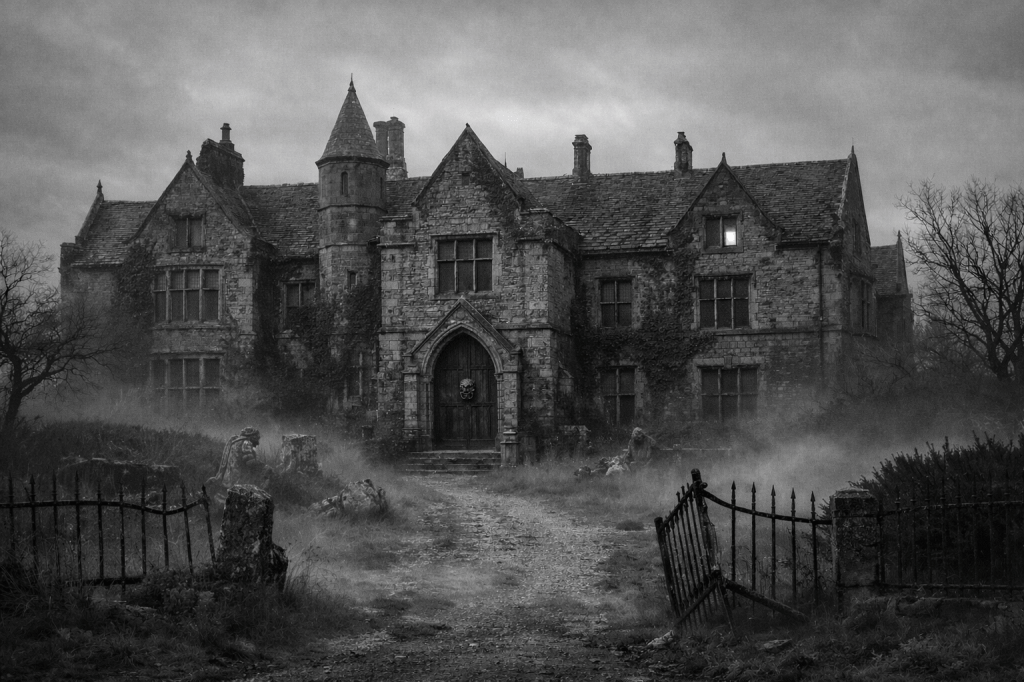
Few films have lingered in my mind like Robert Wise’s The Haunting (1963). Based on Shirley Jackson’s book, The Haunting of Hill House, the film is a masterpiece in creating fear through what it doesn’t show—a method reminiscent of Jacques Tourneur’s Cat People (1942), where the unseen and the psychological take center stage.
At its core lies a question that has perplexed and enthralled audiences for decades: what really happened in Hill House? Was it truly haunted, or were the events shaped by Eleanor’s emotional vulnerabilities? The beauty of The Haunting lies in the unknown, forcing viewers to confront the thin veil between the supernatural and the psychological.
Eleanor: A Vulnerable Soul
or a Supernatural Target?
Eleanor Lance, played brilliantly by the late Oscar-nominated Julie Harris, is a deeply layered character. From the start, it’s clear she is navigating profound feelings of loneliness and alienation, shaped by years of isolation while caring for her late mother. Her yearning to belong is poignant, making her a relatable yet complex protagonist.
The opening scene establishes Eleanor’s vulnerable state. Her tense relationship with her sister and brother-in-law, who dismiss her needs and take her car without permission, highlights the isolation and lack of control she has endured. This sense of powerlessness follows her to Hill House.
When Eleanor arrives, the unsettling events that follow seem deeply intertwined with her inner world. Ghostly, drum-like banging echoes through the halls, its relentless rhythm both ominous and captivating. In one of the film’s most memorable moments, Eleanor grips what she believes is Theo’s hand in terror during the night, only to discover that Theo is on the other side of the room. Is the house reaching out to her, or is this a projection of her desperate longing for comfort and connection? This scene epitomizes the film’s brilliance in leaving these questions unanswered. Eleanor becomes both a lens and a mirror, inviting the audience to interpret the tension between her internal world and the external forces at play.
Theodora: Rebellion in the Shadows
While Eleanor is defined by her vulnerability and yearning for connection, Theodora (“Theo”), masterfully played by Claire Bloom, clearly represents a starkly different approach to navigating the world. Confident, sharp-witted, and independent, Theo exudes a rebellious energy that challenges societal norms. Her coded queerness and refusal to conform to traditional gender roles make her an intriguing character, especially in the context of a 1960s horror film. Her refusal to conform stands in defiance not only of societal expectations but also of Hill House itself, as if she is the one force the house cannot fully claim. Theo’s sharp wit and teasing nature often push Eleanor to confront her insecurities, creating a dynamic that is both supportive and tension-filled.
Theo’s relationship with Eleanor is one of the film’s emotional cores. When they first meet, Theo’s confidence immediately contrasts with Eleanor’s timidity, setting the tone for their dynamic. Theo’s teasing dialogue—“My dear girl, I already know about you”—suggests a coded acknowledgment of her queerness and establishes her as a figure who defies norms.
This dynamic is further highlighted during the dinner scene. Theo’s charm and quick wit dominate the conversation, drawing attention to her magnetic personality, while Eleanor’s awkwardness underscores her insecurity and struggle to fit in. Theo’s ability to effortlessly navigate social situations makes her both an enviable figure and a foil to Eleanor, whose internalized fears and self-doubt often isolate her. Moments like this reinforce Theo’s role as both a confidant and a mirror, exposing Eleanor’s vulnerabilities while also pushing her to step outside her comfort zone.
Theo’s sharp tongue and teasing nature, such as in the bedroom scene where she comforts Eleanor after a frightening experience, could be considered cruel, but they also serve to highlight Eleanor’s vulnerable self-image. Their interactions are layered with both camaraderie and tension, creating a dynamic that reflects the broader themes of belonging and identity.
Though touched by the house’s horrors, Theo resists succumbing to them, her independence and self-assuredness standing as a counterpoint to Eleanor’s vulnerability. While Theo maintains a defiant distance from its grasp, Hill House looms as an oppressive force, its malevolence particularly potent in its connection to Eleanor.
Hill House: A Malevolent Force
or a Psychological Projection?
Hill House is more than just a haunted setting; it is an oppressive force that seems to mirror Eleanor’s inner world and embody the traumas of her past. For Eleanor, who has spent years trapped in the role of caregiver to her controlling mother, who required constant care, the house becomes a physical manifestation of the stifling and suffocating forces that have shaped her life.
The house’s labyrinthine design and disorienting architecture, described early in the film by Dr. John Markway (Richard Johnson), the scholarly investigator leading the study of Hill House, vividly evoke the emotional and psychological entrapment Eleanor has endured. Dr. Markway’s rational, scholarly approach to Hill House underscores the impossibility of reducing its chaotic and emotional pull to mere scientific explanation.
Much like her mother’s constant demands dictated her existence, Hill House looms over Eleanor, exerting a sinister, patriarchal, and unrelenting influence. The eerie, drum-like banging that echoes through its halls mirrors the sound of her mother’s cane knocking against the wall—a haunting reminder that the trauma of her past is inescapable, reverberating through her present.
Even the house’s empty, watching windows seem to echo Eleanor’s deepest fears: of being scrutinized, judged, and ultimately abandoned. These fears are rooted in her isolation and her yearning for connection, making her an easy target for Hill House’s malevolence. The house doesn’t just haunt Eleanor; it claims her, feeding on her vulnerabilities and amplifying her insecurities. In the end, the bond between Eleanor and Hill House reaches its inevitable, tragic conclusion.
The Unresolved Ending: A Study in Fear
The film’s conclusion mirrors its thematic ambiguity. Eleanor’s tragic death—driving her car into a tree outside Hill House—raises questions of agency and control. Was this the house’s final act of dominance, or did Eleanor, in her own way, choose to embrace its claim as a means of escaping her lifelong isolation? Her final words, “I am home,” reflect this duality, suggesting both surrender and liberation. Theo’s sharp grief at Eleanor’s death reflects her complex feelings of both protectiveness and frustration, leaving an emotional resonance that lingers beyond the film’s ambiguous final moments.
Why The Unknown Matters in Horror
In an era where many horror films rely on explicit jump scares and neatly resolved narratives, The Haunting stands as a testament to the power of ambiguity. Its refusal to provide easy answers deepens its psychological impact, making it a film that rewards multiple viewings and endless interpretation.
The true terror of The Haunting comes from the way it challenges us to question reality. Are we witnessing a haunting, or are we exploring the fragile and complex inner world of a woman yearning for connection? The answer, perhaps, is both—and that’s what makes the film so unforgettable. Whether you view it as a supernatural tale or a psychological study, The Haunting leaves its mark by forcing us to confront the shadows within our own minds—proving that its true terror resides not in its walls, but in us.
 Scott Bryant
You must be logged in to post a comment.