
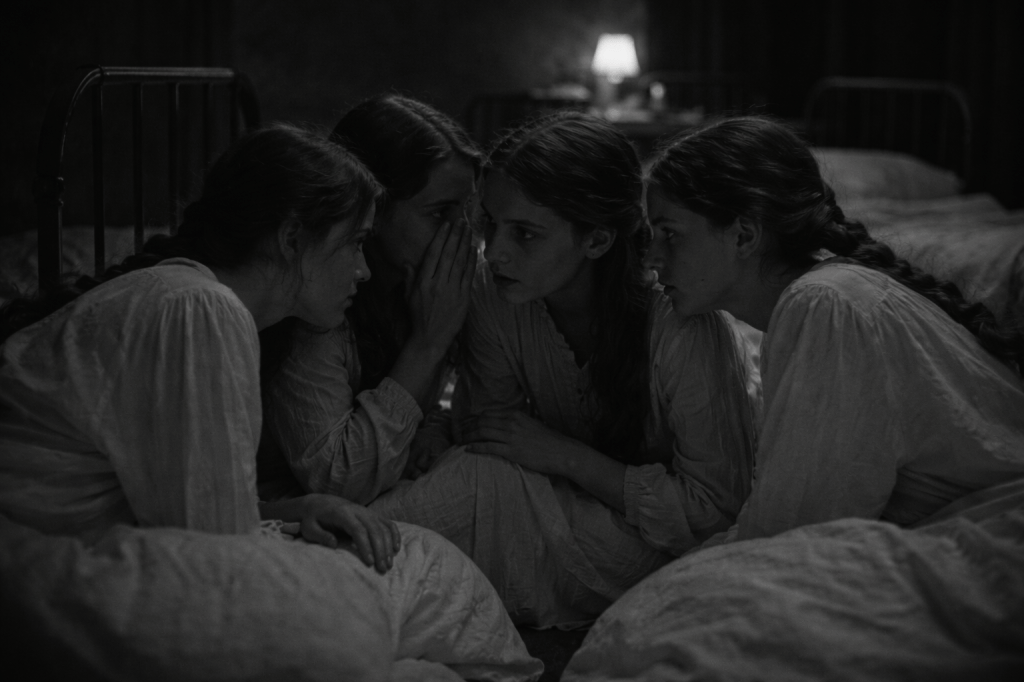
Leontine Sagan’s 1931 film Mädchen in Uniform, made during the final years of the Weimar Republic in Germany, was groundbreaking in its open critique of authority and its tender portrayal of queer desire. There is a remarkable quietness to the film that belies its revolutionary heart. Within the rigid walls of the Prussian boarding school, where discipline and conformity reign supreme, the relationships among the students form a sanctuary—a space where individuality, emotion, and resistance can quietly flourish.
The school itself looms large in the film, both physically and symbolically. Its imposing architecture, stark corridors, and regimented schedules are designed to suppress individuality and instill obedience. Yet, within this environment, the students carve out spaces of connection. These moments are not merely acts of camaraderie; they are acts of defiance. By forming bonds of care and solidarity, the girls resist the school’s attempts to reduce them to obedient cogs in the state’s machinery.
Manuela von Meinhardis (Hertha Thiele) and her infatuation with Fraulein von Bernburg (Dorothea Wieck) often take center stage in discussions of the film, but equally important are the interactions among the students themselves. Their shared laughter, whispered secrets, and small rebellions create a counterbalance to the oppressive atmosphere of the school. These moments of unity remind us that even in the harshest conditions, community can provide a refuge.
In one of the film’s most tender and memorable moments, shown below, Fraulein von Bernburg kisses each girl good night. This simple act, filled with compassion, offers the students a fleeting yet profound sense of care and validation in a world otherwise dominated by cold discipline. The gesture, though small, is a rebellion through love—an affirmation of their humanity that quietly challenges the institution’s oppressive control.
Fraulein von Bernburg’s quiet resistance inspires the girls, but the film’s strength lies in showing that no single individual carries the burden of defiance. Instead, it thrives through collective solidarity, where small acts of connection form the foundation of resistance.
One of the film’s most striking scenes occurs during the play rehearsal. The students perform Don Carlos, a story of defiance against tyranny, and their choice of material feels almost subversive. In this context, their performance becomes more than an academic exercise; it becomes a symbolic reflection of their own struggles. Through the collective act of storytelling, they express their yearning for freedom and their rejection of the oppressive rules that govern their lives.
At the heart of this sisterhood is a shared understanding of their circumstances. The girls’ laughter often feels tinged with the knowledge of their mutual vulnerability. They are not oblivious to the consequences of stepping out of line, but their small acts of rebellion—whether it’s sneaking forbidden food or expressing affection—carry an undeniable power. These acts remind them, and us, that even within a system designed to suppress individuality, the human spirit finds ways to endure and connect.
Fraulein von Bernburg’s kindness and quiet resistance to the school’s harsh rules inspire the girls, but she is not a savior. The real strength of Mädchen in Uniform lies in its refusal to place the burden of resistance on one individual. Instead, it celebrates the power of collective solidarity—among the students and even between them and von Bernburg—to create a web of quiet defiance far more powerful than any single act of rebellion.
By the film’s end, the cracks in the school’s oppressive system become visible. Manuela’s emotional breakdown is not just an individual cry for help; it is a catalyst that forces the entire community to confront the cruelty of their environment. The other students’ attempts to comfort and protect her underscore the strength of their bond. Even in their most vulnerable moments, their sisterhood offers a glimmer of hope.
Mädchen in Uniform reminds us that resistance does not always take the form of grand gestures or overt defiance. It’s a reminder that in systems built to suppress, collective action—even in its quietest forms—can erode even the most rigid structures of control. In a world that seeks to isolate and control, sisterhood becomes not just a sanctuary but the greatest rebellion of all.
 Scott Bryant
You must be logged in to post a comment.