Rewriting the Wild West: If ‘The Great Train Robbery’ Starred Only Women

In 1903, film history added a milestone when Edwin S. Porter’s The Great Train Robbery hit the screen. Instead of still images, the Wild West came alive through kinetic storytelling—gunfights, galloping horses, a gang of outlaws, and a posse of determined lawmen. But what if that same story had starred women instead?

Breaking Barriers in Early Cinema

A women-led Great Train Robbery would have been revolutionary—shattering societal expectations and expanding the limits of what film could do. A director like Alice Guy-Blaché, Lois Weber, or Mabel Normand—women already innovating behind the camera—might have given this action-packed Western a whole new edge.

Now imagine the heist itself: a group of women pulling it off not for riches or notoriety, but because they had no other choice.

Widows. Workers. Women left behind in a world that never made space for them.

Their crime wouldn’t just be rebellion—it would be resistance. A bold, dangerous path to reclaiming power in a man’s world.

A Smarter Heist
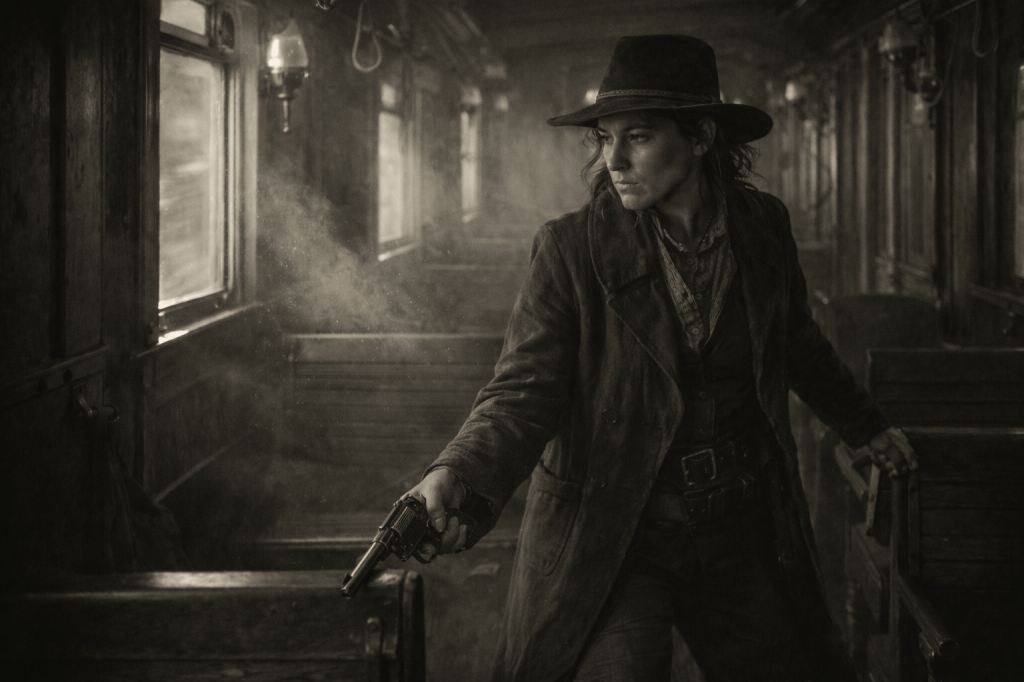
LUMICORE V1.1 — CANON SCENE PROMPT

“Between Stations”
(Locked Final)

FORMAT: Horizontal cinematic still
COLOR: Black-and-white with restrained sepia undertone
REALISM MODE: Grounded early-20th-century historical realism (no stylization)

PROMPT

A horizontal black-and-white cinematic image with a subtle sepia undertone, set inside the interior of a steam locomotive railcar in the early 1900s. The image is rendered in grounded cinematic realism, prioritizing believable motion, practical lighting, and material authenticity over spectacle.

The railcar interior is narrow and utilitarian, constructed of dark, worn wood paneling with brass fittings dulled by constant use. Benches, handrails, and storage fixtures show scuffs, dents, and uneven wear from years of travel. The space feels enclosed and vibrating with forward momentum rather than expansive.

Light enters primarily through small side windows, uneven and partially obscured by grime. Daylight cuts in at sharp, imperfect angles, briefly catching dust disturbed by the train’s movement. Dust appears intermittently and inconsistently, visible only where it crosses light—never stylized or exaggerated.

Illumination is supplemented by fixed gas lamps mounted along the walls. The lamps burn steadily, not swinging, their glow weak and functional. Shadows shift subtly due to vibration and changing exterior light rather than dramatic effects.

The sense of speed is conveyed through environmental cues rather than blur: slight vibration in hanging elements, loosened objects resting imperfectly, and the instinctive bracing of the body against motion. No exaggerated motion blur dominates the frame.

A woman stands within the railcar, dressed in period-accurate outlaw attire appropriate to the early 1900s—functional layered clothing, sturdy boots, and practical fabrics worn and dusted from travel. Her clothing shows creases, fraying, and signs of long use.

She holds a period-appropriate revolver aligned with the technology of the era. The revolver is held lower and closer to the body, angled slightly downward and partially obscured by her coat or the bench, reading as contained readiness rather than a commanding or heroic pose. The weapon reads as a tool, not a symbol.

Her posture is controlled and economical. She braces subtly against the movement of the train, attention focused off-frame rather than toward the camera. She does not pose; she occupies the space as someone accustomed to danger and motion.

Her hands are natural and unexaggerated—no stylized tension, no dramatic angles. The grip is functional and restrained.

The composition balances her presence with the surrounding railcar architecture. She is integrated into the space rather than isolated from it. The atmosphere is tense but contained, defined by confinement, momentum, and anticipation rather than action.

CAMERA & LENS

Eye-level or slightly offset perspective

Moderate focal length (35–45mm equivalent)

Natural depth of field; no aggressive blur

LIGHTING

Mixed practical light (daylight + gas lamps)

Uneven illumination

No spotlighting or heroic rim light

NEGATIVE PROMPTS

No heroic or commanding poses

No exaggerated motion blur

No swinging lamps

No stylized dust beams

No modern firearm designs

No action-poster framing or glamorization

The original film is known for its fast-paced action. But in a reimagined version, the women might rely more on strategy and cunning than brute force. Disguises, diversions, and split-second wit could become their strongest tools.

Picture it: instead of storming the train with guns blazing, the women blend in—posing as passengers, workers, even innocents. In a world that underestimates them, their invisibility becomes their advantage.

And the climax? Not a chaotic shootout, but a brilliantly timed redirection. A rusted switch flipped. A sheriff stranded on the wrong track. A train full of secrets vanishing into the trees. The tension lies not in the violence—but in the precision, and the stakes if they fail.

Women on Both Sides of the Law
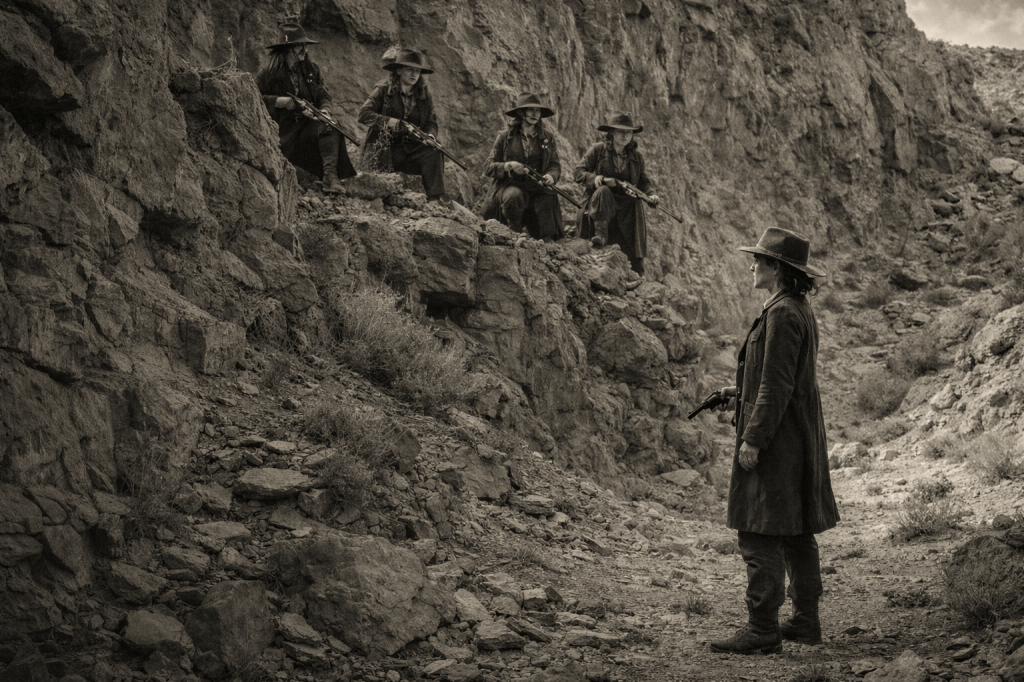
If the outlaws were women, why not the law enforcers too?

A female sheriff or deputy leading the chase opens up rich narrative ground. What drives her? Duty? Personal loss? A complicated empathy for the women she’s pursuing? Perhaps she sees something of herself in them—a flicker of recognition that challenges her resolve.

And within the gang: are they bonded by friendship, or thrust together by desperation? Is there loyalty, betrayal, doubt? These women wouldn’t just be rebels—they’d be human. Complex, flawed, and navigating a world that has never played fair.

Themes of Rebellion and Survival

LUMICORE V1 — CANON SCENE PROMPT

“The Switch”

FORMAT: Horizontal cinematic wide still
COLOR: Black-and-white with restrained sepia undertone
REALISM MODE: Grounded early-20th-century historical realism (no stylization)

PROMPT

A wide, horizontal black-and-white cinematic image with a subtle sepia undertone, set in a dense forest in the early 1900s. The image is rendered in grounded historical realism, emphasizing physical labor, timing, and environment rather than spectacle.

In the foreground, three women work at a railway switch beside a secondary track overtaken by brush and low growth. The iron switch mechanism is rusted, heavy, and resistant, its movement requiring coordinated effort rather than speed. One woman braces the lever with both hands; another steadies the housing or clears debris; the third watches the track alignment, attention fixed and precise.

Their expressions are controlled and focused, not exaggerated. Tension appears in posture—set shoulders, bent knees, weight shifted for leverage—rather than faces. Their body language reflects familiarity with hard work and risk.

They wear authentic early-1900s bandit attire adapted for labor: long skirts hitched up over sturdy boots, work aprons, scarves, gloves darkened by oil and dirt. Fabrics are worn and practical, creased and dulled from use.

In the mid-to-background, a steam locomotive approaches at reduced speed, aligned toward the newly set track. The train’s mass is felt through scale and presence rather than motion blur. Steam vents unevenly from valves and seams, drifting into the trees in irregular plumes—not billowing theatrically, but responding to pressure and movement.

The forest is dense and enclosing. Tall trunks crowd the tracks; undergrowth presses close. Sunlight filters faintly through branches in broken patches, touching leaves, rail tops, and steam inconsistently. Light does not spotlight the women—it behaves naturally, indifferent to their urgency.

No one looks toward the camera.

The moment is defined by timing and consequence: the switch nearly set, the train close enough to matter, the forest silent and watching. The image captures labor under pressure, not action for display.

CAMERA & LENS

Wide focal length (28–35mm equivalent)

Eye-level perspective near track height

Deep focus preserving foreground labor and background train

LIGHTING

Natural daylight filtered through trees

Uneven illumination

No dramatic contrast or spotlighting

NEGATIVE PROMPTS

No exaggerated facial expressions

No heroic or cinematic poses

No dramatic steam clouds

No heavy motion blur

No stylized sunbeams

No modern rail elements

While the original Great Train Robbery is a straightforward tale of crime and justice, an all-women version could explore something deeper: systemic oppression, female agency, survival.

Their theft wouldn’t just be a crime—it would be a message. And the story wouldn’t have to end in capture.

Maybe it ends with a quiet escape into the unknown—a final shot of wind in their scarves, dust rising from the tracks, and silence where gunfire might have been.

Maybe it leaves the audience wondering: who really won?

A Cinematic “What If”

In 1903, a film like this would’ve been unthinkable. The male-dominated film industry—and the rigid norms of the time—would never have allowed it. But imagining it today is more than wishful thinking. It’s a way of exploring how storytelling evolves, and how powerfully alternate perspectives can reshape history.

Would audiences back then have embraced it? Some might’ve called it shocking. Others—especially women—might’ve found it thrilling. Liberating. A film like this could’ve opened new doors for female voices in cinema. It could’ve reshaped who we thought could hold the reins, the gun, or the last word.

Because an all-women Great Train Robbery wouldn’t just swap gender roles—it would tell a new story. One of cleverness, resilience, sisterhood, and defiance. It would capture the inventive spirit of early film while challenging its limitations.

Perhaps, in Some Alternate Timeline…

Maybe this film does exist somewhere. A grainy reel flickering in a forgotten projector. A sepia-toned story of women who broke not just the law—but every rule that said they couldn’t.