
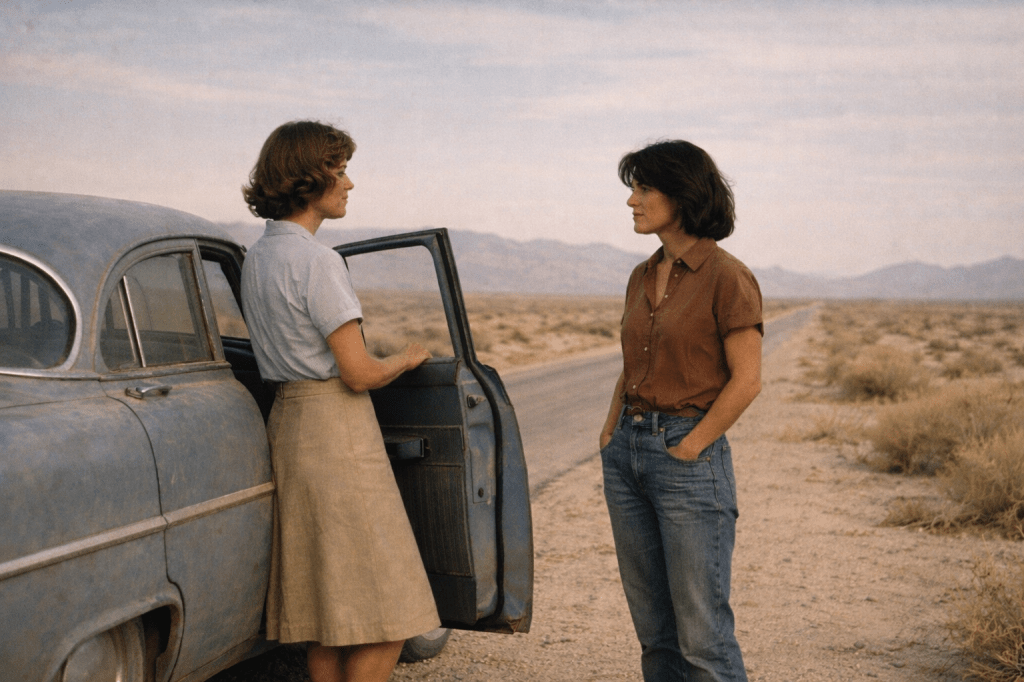
When you think about Donna Deitch’s Desert Hearts (1985), what comes to mind first? The undeniable chemistry between Cay Rivvers (Patricia Charbonneau) and Vivian Bell (Helen Shaver)? The boldness of its story? Or maybe the gentle, yet electric, pacing of their romance? For me, it’s the Nevada desert—a character in its own right, shaping the love story with its vastness, its beauty, and its quiet, unrelenting presence.
The desert isn’t just a backdrop in this film. It’s an emotional landscape, mirroring the characters’ inner journeys.
Vivian & Cay
When Vivian Bell arrives in Reno, she’s prim and contained, her East Coast academic world a far cry from the dusty, open expanse she steps into. The desert seems almost alien to her—too big, too wild, too uncontrollable.
Yet, that’s exactly what makes it the perfect setting for her transformation.
Cay Rivvers, on the other hand, fits seamlessly into the landscape. Her confidence, her ease, and her unapologetic sense of self all feel in harmony with the desert. She’s not afraid of its vastness; she thrives in it. The desert reflects her spirit—free, bold, and quietly powerful. It’s through Cay that Vivian starts to see the desert differently, not as a barren, intimidating space but as a place where she can shed her constraints and finally breathe.
There’s something poetic about love blooming in a desert. Deserts are often seen as inhospitable, harsh, and unforgiving. Yet life persists there. Flowers bloom, cacti thrive, and sunsets blaze with colors that seem otherworldly. Similarly, Vivian and Cay’s love takes root in a place where society might not nurture or protect it, but that doesn’t stop it from growing. In fact, the desert’s isolation seems to give them the space they need to explore their feelings without interference. It becomes their refuge, their sanctuary.
The Desert Becomes The Stage
The scenes where the desert truly takes center stage are some of the film’s most poignant. One unforgettable moment is Vivian and Cay’s first kiss, which takes place in the rain outside the car. Cay stands by the passenger window, drenched but resolute, while Vivian remains inside, hesitant but unable to look away. The rain feels almost surreal in the context of the desert, a rare and fleeting occurrence in such an arid environment. It parallels their love—something extraordinary and unexpected, yet delicate and vulnerable in a world that often feels hostile to it.
The kiss is tentative yet transformative—a storm breaking open their defenses and marking the beginning of something neither can fully control. Even as the rain dominates the moment, the desert looms in the background, reinforcing both the isolation and courage it takes to choose love in such an unforgiving world.
Another striking moment comes through the film’s subtle yet persistent portrayal of the Nevada landscape, whether in the dusty roads they travel or the open skies above them. The vastness of the desert reflects the emotional openness that grows between them, offering a space where they can explore their feelings free from societal constraints. The desert is more than a setting—it’s a silent participant in their love story, amplifying the rawness and vulnerability of their connection.
By the end of the film, as Vivian prepares to leave by train, the desert is once again a quiet but powerful presence. When she asks Cay to join her, the arid landscape around the train station emphasizes the magnitude of the moment. It’s not just a choice about love; it’s about stepping into the unknown, leaving behind the safety of the familiar. When Cay decides to take that step with her, it’s a testament to the courage and trust they’ve built together. In its openness, the desert not only shapes their love but also becomes a symbol of the freedom and resilience they carry forward.
Desert Hearts could have told this story anywhere, but it’s hard to imagine it being as impactful without the desert. The setting isn’t just a location; it’s a partner in the storytelling. Quiet and steadfast, the desert shapes the characters’ journey as much as their choices do. Its vastness mirrors the risks of love, its beauty reflects their growing connection, and its isolation grants them the freedom to truly see each other. In the end, the desert becomes a testament to resilience—a place where love, like life, dares to flourish against all odds.
 Scott Bryant
You must be logged in to post a comment.