
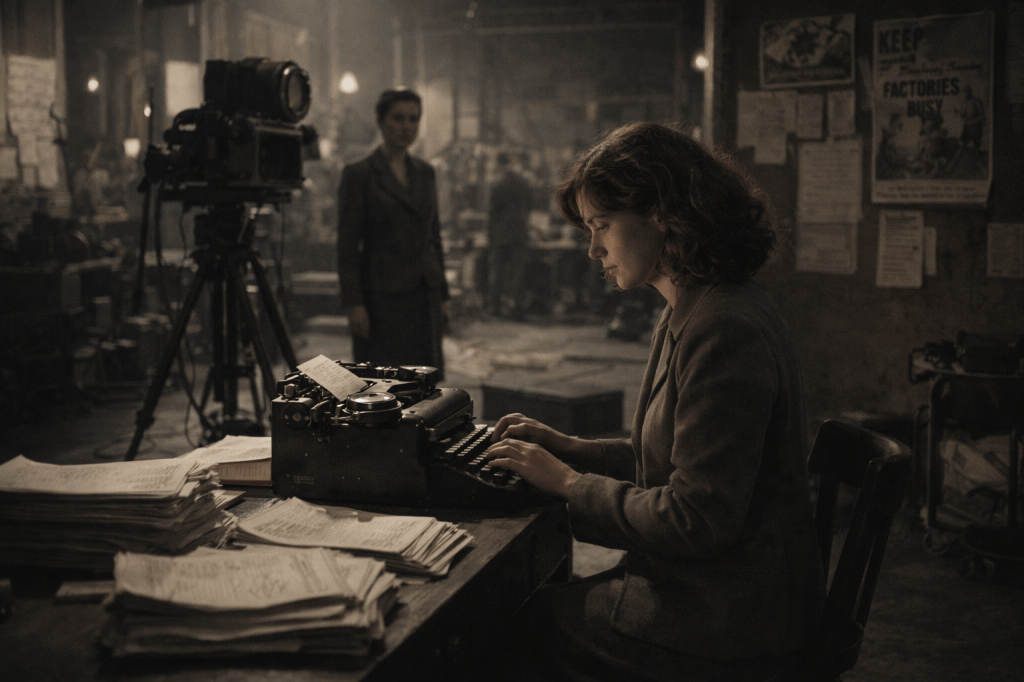
When one thinks about World War II films, stories of soldiers, battles, and heroism on the front lines often come to mind. But Their Finest (2016) takes a different approach—one that shines a light on the power of storytelling itself – directed and written by women.
Directed by Lone Scherfig and written by Gaby Chiappe, based on Lissa Evans’ book Their Finest Hour and a Half, the film follows Catrin Cole (played by Gemma Arterton), a young British woman who unexpectedly finds herself working as a screenwriter in Britain’s Ministry of Information. Catrin is tasked with helping craft morale-boosting films during the war, stepping into an industry where women’s contributions are often undervalued.
While Their Finest is charming and often humorous, it also highlights the struggles and triumphs of women working in a male-dominated industry. Through Catrin’s journey, the film offers a compelling look at gender roles in wartime filmmaking—how women were dismissed, underestimated, and yet instrumental in shaping the stories that kept nations hopeful.
Women’s Work as “Slop”
Early in the film, Catrin is hired not as a writer but as someone to “tidy up the slop”—a dismissive term used by her condescending colleague Tom Buckley (Sam Claflin) to describe dialogue written for women. This moment immediately establishes the gender divide in the industry. Women were expected to contribute in minor ways, while men handled the “real” work of storytelling.
Despite her talent, Catrin is treated as an afterthought, a recurring theme that mirrors the real-life struggles of women trying to break into the film industry at the time. She must prove herself over and over again, even when her contributions clearly strengthen the script.
Proving Herself in a
Male-Dominated Industry
As the film progresses, Catrin’s work speaks for itself. She reshapes a Dunkirk rescue story into something compelling and heartfelt, bringing an authenticity that the men around her had overlooked. Slowly, she earns the respect of some of her peers.
However, even as she gains recognition, gendered obstacles remain. She is paid significantly less than her male counterparts (only £2 a week), and her work is still seen as secondary. This reflects a larger historical reality—women were often allowed into creative spaces during wartime, but their contributions were undervalued, and their opportunities were temporary, often vanishing when men returned from war.
Women in the Propaganda Machine
One of the film’s most interesting elements is how it portrays the role of cinema in shaping public morale. The British government understood the power of film in keeping spirits high and reinforcing national unity.
But for Catrin, writing propaganda films isn’t just about boosting morale—it’s about giving women real representation on screen. The film-within-the-film, based on the Dunkirk evacuation, initially struggles to include meaningful female characters. Catrin’s involvement helps shift the focus, ensuring that women are portrayed not just as passive bystanders but as active participants in the war effort.
This reflects a broader shift in wartime filmmaking. Just as Rosie the Riveter symbolized American women stepping into roles traditionally held by men, British women also filled gaps left by soldiers, including in the film industry. As young men went off to fight, women took on positions they had previously been excluded from, including screenwriting and production. Though often still constrained by societal expectations, their influence began to grow, leading to more stories centered on women’s experiences.
Representation on Screen vs. Reality
One of the cleverest aspects of Their Finest is how it explores the gap between how women were perceived and how they actually lived.
The Dunkirk film Catrin is working on is based on a supposedly true story of twin sisters, Rose and Lilly Starling, who sailed out on their boat to rescue British soldiers. However, upon investigation, she finds that the real sisters never actually made it to Dunkirk. This moment highlights an interesting dilemma: should films tell the raw truth, or should they shape stories to inspire?
While the story is exaggerated for dramatic effect, Catrin’s insistence on keeping the Starling sisters present and important speaks to the ongoing struggle for representation. Even today, women’s roles in historical events are often minimized in film and television, making Their Finest feel surprisingly relevant.
The Contrast Between Catrin,
Phyl Moore, & Sophie Smith
“You know, a lot of men are scared we won’t go back into our boxes when this is all over. Makes them belligerent.” – Phyl Moore
Catrin isn’t the only woman navigating the challenges of wartime filmmaking. In my favorite scene, Phyl Moore (played by Rachael Stirling), a sharp-witted producer, reacts to Buckley’s use of “busts” for film title ideas (“Somewhere in this world there is a bullet with that man’s name on”) with biting humor.
Moore delivers a scathing yet hilarious commentary, suggesting that Buckley may not have had a mother and was instead discovered by his screenwriting colleague Raymond Parfitt (played by Paul Ritter), “spawning spontaneously in the sawdust” of a pub.
Unlike Catrin, Moore is experienced and confident in her role, yet she still has to operate within the constraints of a male-dominated industry—and contend with the sexist attitudes of men like Buckley.
Sophie Smith (played by Helen McCrory) is a pragmatic and business-savvy talent agent who understands that women in the film industry must fight twice as hard to be taken seriously. This becomes particularly evident as she takes over her late brother Sammy Smith’s agency, navigating a male-dominated profession while representing actors like the temperamental but aging star Ambrose Hillyard (played by Bill Nighy), who is cast as The Starling Sisters’ alcoholic Uncle Frank.
Despite Smith’s sharp instincts and ability to manage difficult personalities, Sophie’s role remains fraught with challenges, making her yet another compelling example of how Their Finest portrays the resilience of women in wartime filmmaking.
Romance vs. Independence
While Their Finest includes a romantic subplot between Catrin and Buckley, the film makes it clear that Catrin’s true love story is with her career. Unlike many period dramas where a woman’s story revolves around romance, Their Finest subtly subverts expectations by keeping the focus on Catrin’s personal and professional growth.
By the end of the film, she has evolved from a woman simply looking for a job to a writer with a distinct voice and purpose. In a way, Their Finest is about more than just women in wartime filmmaking—it’s about women finding their place in a world that often tells them they don’t belong.
Final Thoughts
Their Finest is more than just a charming period drama. It’s a tribute to the often-overlooked women who shaped wartime cinema, both on and off the screen. Through Catrin’s journey, the film highlights the struggles women faced in gaining recognition, the importance of authentic representation, and the resilience it took to carve out a space in a male-dominated industry.
Though set in the 1940s, its themes still resonate today, making Their Finest a powerful reminder that women’s voices in film have always mattered—even when they weren’t always heard.
 Scott Bryant
You must be logged in to post a comment.