
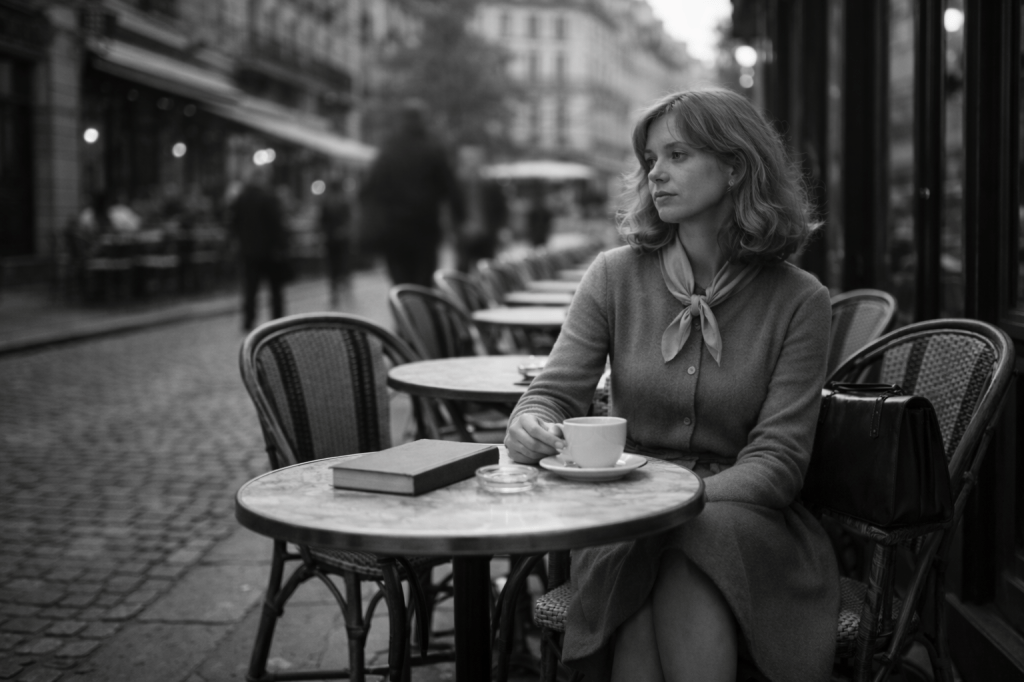
The array of films that poignantly and honestly brings the frailty of the human condition to the screen comes closest to the work of Agnès Varda, Cléo from 5 to 7 (Cléo de 5 à 7) of 1962, with Corinne Marchand as Florence “Cléo” Victoire.
Within a period of 90 minutes, the film conveys all imaginable types of emotions and isolates a specific situation of waiting, a case of the shared human condition. Cléo’s walk – or rather odyssey – through the streets of Paris waiting for the outcome of a potentially defining medical test – is as deceptively simple as it is deep-felt. It’s a cinematic masterpiece that transforms a mundane act into an existential odyssey.
Waiting as a
Universal Human Experience
From the result of a test, to a job interview, or even a text message, waiting is something we all do in our lives. Varda’s real-time storytelling makes this experience visceral. Concentering the story around Cléo’s two-hour arc puts us in the heart of her struggle. We all can imagine the clock counting, every moment weighed down by creeping fear and excitement.
In today’s world of instant gratification, the idea of waiting feels almost foreign. Nonetheless, the feelings associated with anticipation-vulnerability, amplification of self-doubt-etc.—these are as poignant as ever. Watching Cléo from 5 to 7 reminds us that these moments of uncertainty are not just interruptions to be endured; they’re part of the fabric of life.
The Emotional Duality of Time
It may be a present, which enables us to learn and develop, or a curse, which makes us aware of our destiny to die.
Varda’s use of real-time storytelling heightens this tension. The unbroken flow of time feels both relentless and intimate, forcing Cléo—and us—to confront the present moment. In this sense, the movie transcends the concept of waiting to be a contemplation on the experience of how we navigate the time box.
Anxiety and the Search for Meaning
Perhaps the most moving part of Cléo from 5 to 7 is the way it addresses the tension between anxiety and self-learning. Cléo begins the film as a woman defined by her beauty and societal roles. Her first few seconds are characterized by vanity and frivolity, as if such distractions can protect her from the sense of responsibility of her fear. But as the hours pass, her layers peel away. She starts looking for her identity, relationships, and what all in her life means.
This transformation is subtle yet profound. Cléo’s walk through Paris becomes a metaphor for her journey inward. Each encounter—with peers, by chance, and even with herself in the mirror—becomes another one of those looking glasses that forces her to look herself at something beyond the manifestations of an external, seemingly untouchable, life. By the film’s end, she’s not just waiting for her diagnosis; she’s actively reclaiming her agency and humanity.
The Relevance of Cleo Today
In an era where constant connectivity and distractions dominate, Cléo from 5 to 7 feels like an antidote. It calls us to slow down, take the time to sit with our discomfort and welcome the paradox of life. Waiting, as the movie depicts, is not an empty space to be filled, but one to be occupied. It is during moments of quietude that our authentic selves are frequently unearthed.
Life is not only measured by results but by the value of our experiences, including the weird and wonderful ones. Her work motivates us to see waiting as not a wasted day but as a time for learning and contemplation.
Final Thoughts
Moments of confusion, fear of the unknown and searching for meaning in the unknowable.
At the very least, Cléo’s story is an invitation that even in our greatest state of unease, we are alive—and, by that very token, a very beautiful thing. It’s this depth and resonance that make Cléo from 5 to 7 one of my all-time favorite films.
 Scott Bryant
You must be logged in to post a comment.