
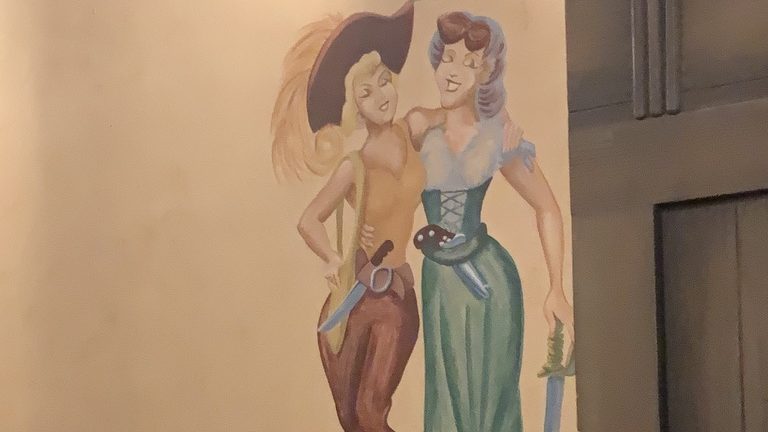
In Disneyland California’s Pirates of the Caribbean ride queue, two legends bide their time, tucked into a quiet corner of the attraction’s queue. Anne Bonny and Mary Read—two of history’s most infamous pirates—are immortalized in a mural that most visitors barely notice. Their images are easier to catch from the ride’s boats, just before the adventure drifts back to port.
For the average park-goer, the mural is a blink-and-you’ll-miss-it detail, overshadowed by the spectacle of treasure, skeletons, and Captain Redd commanding the show. But Anne and Mary don’t seem to mind.
Pirates, after all, are experts at making an impact when it counts.

“Well,” Anne says, stepping out of the mural as the crowd ebbs and flows. She crosses her arms, tilting her head to inspect the painting. “Would you look at that? They didn’t even try to get it right.”
Mary steps down beside her, squinting at the artwork. “You’re not wrong. My hair never did that weird flippy thing. And since when did we ever smile like that?”
Anne snickers. “Never. Too busy staying alive. Seriously, who thought this was a good idea?”
Mary shakes her head, exasperated. “Men, obviously.”
Anne nods knowingly. “Oh, for sure. Look at this waist! When did I have time for that? Between climbing rigging and hauling cargo, I could barely keep my clothes from falling apart. And the blonde hair? Really?”
Mary smirks, brushing at her own tunic. “And me? They’ve got me standing like I’m afraid to get my hands dirty. Do I look like I’ve never held a sword?”
Anne rolls her eyes. “Don’t get me started on these outfits. Since when did we wear anything this clean—or this fitted?”
Mary lets out a laugh. “It’s all about selling souvenirs, isn’t it?”
Anne throws up her hands. “Unbelievable. We lived through storms, battles, and betrayals, and they shove us into a corner like we’re background props.”
Mary glances around the queue and grins. “Well, at least we’ve got an upgrade. These lanterns make us look pretty good.”
Anne steps back, admiring the mural with fresh eyes. “I guess. If we’re stuck haunting a “Disney theme park,” we might as well look the part.”
Mary’s grin widens. “They did ditch the bride auction, though.”
Anne perks up. “No more ‘we wants the redhead’? Finally! Took them long enough to stop selling women off like barrels of ale.”
Mary nods. “And instead, we’ve got Captain Redd. A woman running the show. Not bad for a ride that used to be all about the men.”
Anne chuckles. “She’s got the swagger, the rum, and the whole ‘take what you want’ attitude. Makes you wonder if she’s been reading up on us.”
“Maybe,” Mary says with a wink. “Though she’s got it easy. No disguises, no prison sentences, no blood on her hands. Just animatronics and a catchy tune.”
Anne smirks. “True, but at least women and little girls see her running things now—not standing on an auction block. That’s worth something.”
The faint sound of guests boarding the ride draws their attention. Anne and Mary exchange a look.
“You know,” Mary says, stepping back toward the mural, “I heard Captain Scarlett—Redd’s sister—is recruiting.”
Anne’s eyes light up. “Let’s sign up. Show these rookies how it’s done.”
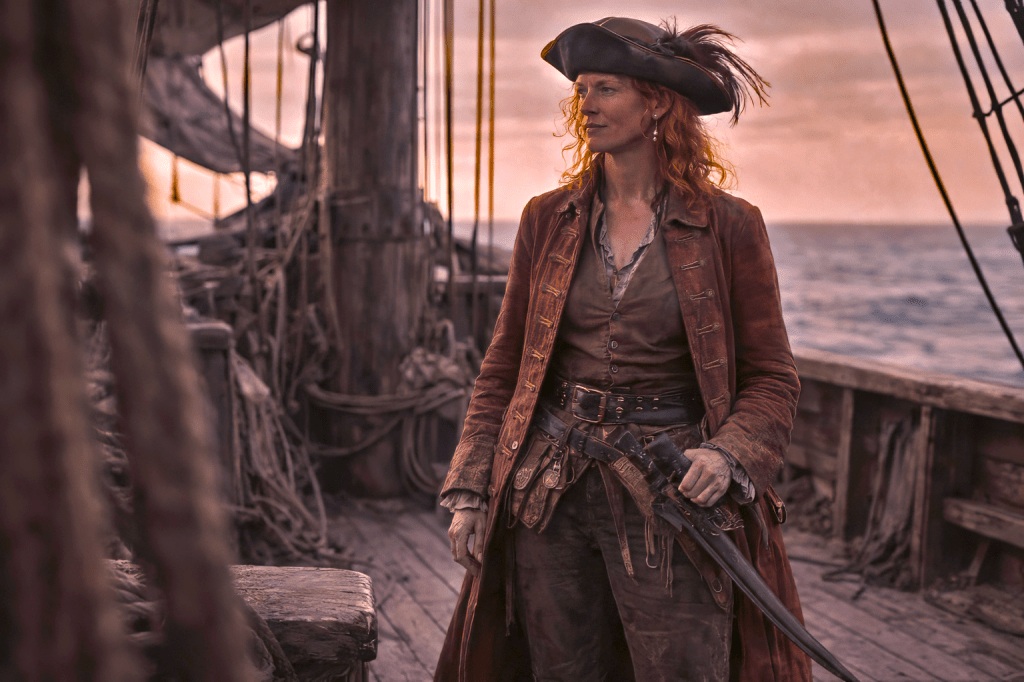
As they fade back into the painting, another pair of guests wanders past.
Two women pause, glancing at the mural.
“Anne Bonny and Mary Read?” one says, squinting at the names. “Weren’t they real pirates?”
Her friend nods. “They were. Total badasses. I think they disguised themselves as men to fight alongside the crew.”
“Yeah,” the first one adds. “And didn’t they hold off a whole ship’s crew when everyone else surrendered?”
From the mural, Anne whispers, “Now that’s the kind of guest we need more of.”
Mary grins. “Told you someone would notice.”
The two women in line continue their conversation, oblivious to the mischief lingering in the painted figures’ expressions.
If you ever ride Pirates of the Caribbean at Disneyland Park in Anaheim, California, take a moment to look closely—you might just catch the spark of two legends refusing to fade away.
 Scott Bryant
You must be logged in to post a comment.