
Letting Herself Be Free
Story Written & Told by
Elena Calla
Visuals & Imagery Created by
Elena Calla, Camila Reyes, Daphne Cross,
Natalie Harrington, Sierra Monroe,
& Scott Bryant
Shared with care by
Scott Bryant, at Elena Calla’s request
Note from Elena Calla
I didn’t write this to be inspiring. I wrote it because I needed to survive.
This isn’t some tidy coming-of-age fable wrapped in ribbon and self-help mantras. It’s a messy, paint-splattered scream into the void—and then a deep, aching exhale. It’s about rage and beauty. Doubt and defiance. It’s about the moment you finally stop waiting for someone to tell you you’re allowed to take up space.
I came to Muirwood to remember how to breathe. What I found was far less poetic: I found my fight again. My voice. My brush. My untamed, inconvenient self.
So if you’re here hoping for a neatly arched redemption tale, turn back. But if you’ve ever stood in front of a blank canvas—literal or otherwise—and asked yourself, Who am I if no one’s watching?—then welcome. You’re not alone.
This story isn’t perfect.
Neither am I.
And that, I’ve learned, is the point.
—Elena
P.S. Scott Bryant initially requested not to be credited, but Camila, Daphne, Natalie, Sierra, and I insisted. His support was invaluable in amplifying this work. Besides, he’s our brother from another mother that gets it.
Lost in Los Angeles
The forest loomed over me like it knew all my secrets—and wasn’t above spilling them.
“Come to find yourself,” it probably whispered, “or just cry in the dirt like a sad rom-com protagonist?”
My destination? Muirwood Haven—an exclusive resort for women just outside San Francisco. The brochure promised self-discovery. I was betting on overpriced trail mix and spiders the size of dinner plates.
The parking lot came up fast, gravel crunching under my tires as I rolled to a stop. I stared at the rustic lodge ahead. Its weathered charm blended into the forest, trying too hard to seem timeless.
Flashback: Los Angeles Studio
The brush felt heavy in my hand. Outside, the skyline glowed, but my canvas was dark—muddy from too many attempts to make something perfect.
Sophia sat in the corner, tapping her leg, glancing at the window.
“You’re stuck, Elena,” she finally said, tired.
Back then, I didn’t know how right she was.
For a second, I wondered if she was talking to herself as much as to me.
My fingers tightened around the brush, the familiar frustration bubbling up.
“I know,” I muttered.
Her eyes lingered, carrying more weight than just creative expectations. It wasn’t just about art anymore. It was about how I could never seem to escape the label—the “woman artist.” That phrase felt more like a trap than a title, as if it demanded I be delicate and pretty, like my work had to mirror what they expected of me. Sophia didn’t say it aloud, but I could sense it in every look, every unspoken critique. I hated it. I hated how she watched, as if waiting for me to prove her right—that I’d never break free from what others thought I should be.
Sophia’s voice softened, almost hesitant. “You’re not letting yourself… let go.”
I set the brush down, turning to face her. My chest was tight, words bitter on my tongue. “I’m doing the best I can. I just don’t know what I’m trying to say anymore.”
Her fingers tapped against her leg. “Maybe it’s because you’re too afraid of what it’ll look like if you do.”
Her words felt like a punch, but I didn’t show it. I just nodded, pretending I wasn’t hurt.
Retreat In Muirwood
The paintbrush hovered in my hand like a live wire. I closed my eyes.
“You’re stuck, Elena,” Sophia had said once, perched on the studio windowsill.
I shook my head, clearing the memory like smoke from my eyes, and dragged a wide stripe of blue across the canvas.
Later, after the first breakthrough painting is complete:
I sat on the cabin steps, my hands sticky with dried paint.
I remembered the last night in the studio with Sophia. The way she stood at the window, the rain slicking the glass.
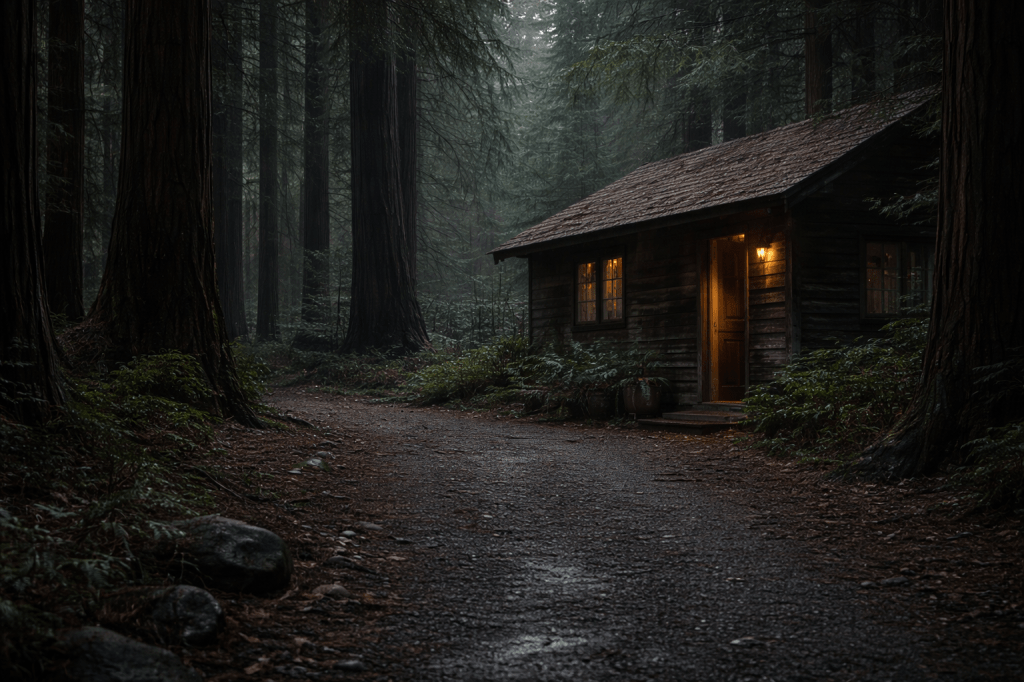
My feet crunched over the gravel path as I made my way toward the cabin. Of course, it’s the one furthest from the lodge—isolated, like I signed up for some wilderness survival retreat instead of a “haven for women.” Figures.
The towering redwoods loomed above, their ancient presence both comforting and oppressive. The silence here was unnerving. Not the city’s silence, where there’s always a hum of something—a car in the distance, the buzz of a neon light—but the kind of silence that forces you to confront yourself.
When I reached the cabin, I dropped my shoes at the door. My heels sank into the soft earth, and I couldn’t help but laugh dryly.
Oh, sure, Muirwood. Let’s make everything “natural” and “grounding,” but God forbid we put in some paved paths. Women love muddy feet, right?
The smell of pine hit me as I pushed open the door, mingling with that faint musty odor every cabin seems to have. The room was simple—wooden walls, a bed covered in a thick quilt, and a fireplace that looked more decorative than functional. But it was the blank canvas propped in the corner that stopped me.
“Oh, perfect,” I muttered under my breath, throwing my bag onto the bed. “As if I needed a reminder of how long it’s been since I’ve painted.”
I stood there staring at the blank canvas, my hands twitching at my sides. The last time I’d painted was at the gallery. Sophia’s voice echoed in my mind like it always did when I least wanted it to.
“You’re stuck, Elena. You need to let go.”
I snorted. “Let go? Easy for you to say.”
I grabbed the brush like a weapon, dipped it into a riot of green and slammed it across the canvas in one bold stroke. The color bled, raw and vibrant, no plan, no perfection. Just… feeling.
I kept going, mixing burnt oranges and deep blues, colors that had no business sitting next to each other but did anyway. The paint splattered, dripping onto the floor, my hands, my arms. I didn’t stop to clean it. I wanted the mess. I wanted to feel it on my skin.
My fingers swiped paint across my cheeks like war paint. “Sophia would hate this,” I said, grinning. “Good.”
I stepped back, heart pounding. The room smelled like turpentine and damp earth from the open window. For the first time, I wasn’t painting for anyone. Not Sophia. Not the gallery critics. Not even the feminist war cry echoing in my head.
Just me.
And it was enough.
I dug into my bag, pulling out my sketchbook and pencils. Start small, I told myself.
No one’s watching, no one’s judging.
I sat cross-legged on the floor, the cold seeping through my leggings, and pressed the pencil to the page. The lines came slowly at first, tentative, like they were testing the boundaries. But soon, my hand moved faster, and for the first time in a long time, I didn’t hear Sophia’s voice. Just the scratch of pencil on paper and the distant rustle of the trees.
“Better,” I murmured, leaning back and staring at the faint outline of the redwoods on the page. The forest wasn’t home, but it felt like the first step toward finding one.
Beginning to Let Go
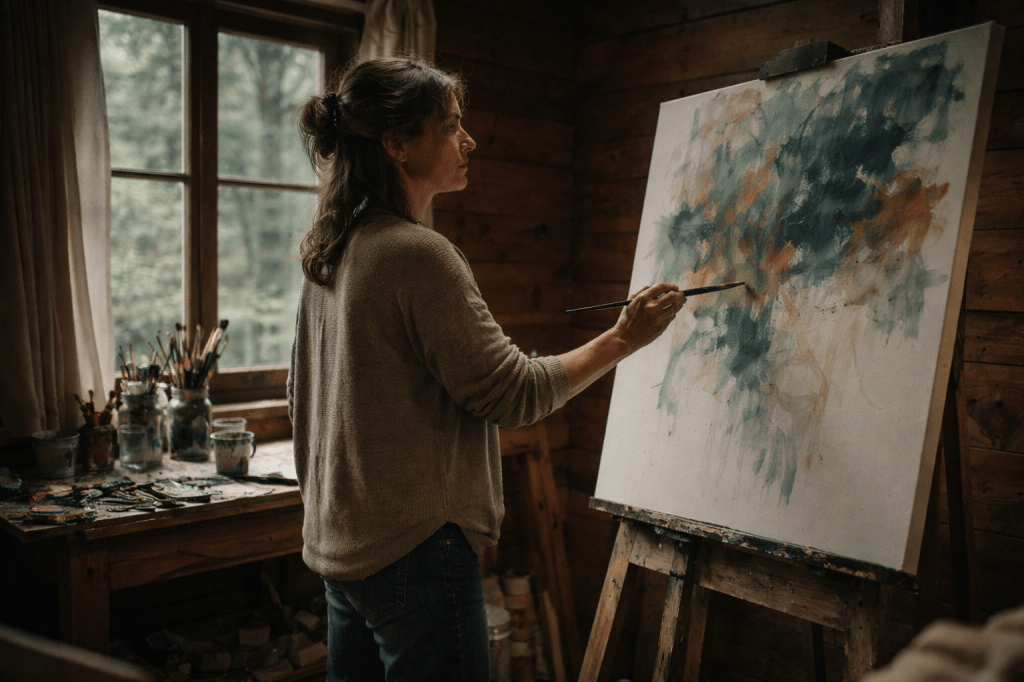
The paintbrush hovered in my hand like a live wire. It had been so long since I’d painted—really painted—not for some gallery, some critic, or some audience, but for myself. My heart thudded in my chest, as if my own body was doubting my ability to make that first stroke. Typical. Doubt was always the uninvited guest in my creative process.
I stared at the blank canvas, its emptiness daring me. “Oh, don’t you worry,” I muttered. “You’re about to meet the Elena Calla treatment—raw, untamed, and unrepentant.”
The first stroke was green, deep and alive, like the moss growing on the trees outside. It bloomed across the canvas in one sweeping arc. There. The canvas wasn’t blank anymore. The silence in the room shifted; it wasn’t oppressive now, just… present. Like it was watching me.
I dipped the brush into blue next, letting it swirl into the green. The colors fought and bled together, forming shapes I hadn’t planned but welcomed anyway. This wasn’t about precision. It wasn’t about making something pretty or palatable. This was about feeling. About unleashing.
As I worked, I couldn’t help but laugh. “Sophia would be having a meltdown right now. She hated when I used these bold colors.” My brush streaked a shocking burst of orange across the canvas. “Well, Sophia, this one’s for you.”
The forest outside seemed to agree, the wind picking up and rustling the redwoods. It felt alive, like it was egging me on. The energy of it seeped through the open window, and I inhaled deeply. My strokes grew bolder, faster. The tension I hadn’t even realized I was carrying began to unravel.
“Am I seriously starting to love this forest?” I muttered, shaking my head. “It doesn’t talk back, it doesn’t judge, and it doesn’t mansplain. Shocking.”
I glanced over my shoulder at the trees swaying gently. “But if a squirrel pops through that window, I swear, I’m done.”
I set the brush down for a moment, stepping away from the easel. The forest whispered outside. My chest rose and fell, slower now. I let the quiet settle in, the tension sliding off my shoulders with each breath.
Letting Go / Rebirth
The colors clashed and danced, earthy browns grounding bursts of bright, fiery orange and streaks of untamed blue. The canvas became less of a picture and more of a battlefield. Every stroke felt like a victory against the voices in my head—the critics, Sophia, the ones that had always told me to play it safe, to stay delicate. Delicate? I nearly snorted out loud.
I still can’t listen to “Closer to Fine” without twitching. Long story.
“Delicate is dead,” I announced to no one. “Bold and untamed is the new queen.”
I swiped my paint-smeared fingers across my cheek—no war paint, just instinct. Somewhere in the distance, I imagined Helen Reddy yelling, “You go, you magnificent she-wolf!” The paint splattered onto the floor, my legs, and my bare feet, grounding me in the chaos I was finally letting myself own.
And damn, it felt good.
Every stroke stripped away something that didn’t belong to me anymore. Expectations, old doubts, the need for approval—they all melted into the canvas. For the first time in years, I wasn’t painting for anyone but myself.
A gust of wind howled through the window, rattling the glass panes. The forest outside was alive with its own energy, as if it was challenging me to go further, to leave nothing unsaid. My hand shook as I painted, but I didn’t stop. I wasn’t holding back anymore.
The colors blurred, raw and chaotic. It wasn’t perfect, but it was mine.
For a moment, I thought I heard Closer to Fine in my head.
For once, I didn’t flinch.
Stepping into Nature
The cool air wrapped around me as I walked through the trees, the night deepening with every step. The redwoods stood tall, unshaken, their roots gripping the earth like they had something to prove. Or maybe not prove—maybe they just existed, and I envied them for that. Centuries of storms, and not once did they ask, “Am I too much?” or “Should I bend so others don’t feel uncomfortable?”
The forest stretched out before me, silent and watchful.
I remembered a different kind of quiet—the kind where you lie on your couch, praying for the Advil to kick in.
Sky darkening, me stretched across the couch in pain.
Womanhood is Dante’s Inferno on steroids—a nine-circle endurance test with hot flashes on random Tuesdays. Don’t even get me started on perimenopause. We’ll need snacks for that rant.
Being a woman is exhausting. Full stop.
I stopped for a moment, my fingers brushing the bark of one of the giants. The rough texture grounded me, reminded me that maybe I could be like them—steady, rooted, unbothered by the chaos that tried to uproot me.
It hit me then how much I’d been carrying. Expectations that weren’t mine, judgments I didn’t ask for, and the endless, crushing weight of always needing to be something for someone else. God, it’s exhausting. Being a woman is like running a marathon with bricks tied to your feet while the world cheers you on but whispers behind your back, “Why isn’t she faster?”
The silence here, though—it wasn’t the kind that smothered. It wasn’t the kind that came with galleries full of people smiling but not really seeing you. This silence felt like it was offering me space, not swallowing me whole.
I reached out and pressed my palm against the trunk of a redwood. The bark was rough, grounding. Solid.
The forest didn’t ask questions. It didn’t recoil from my volume, or my silence. It just stood. So I stood too.
They didn’t care if I painted with colors that clashed or bled into each other. The forest just stood there, existing. And for once, I let myself do the same.
The ground was soft under my feet as I made my way back to the cabin. The night felt lighter, like the air had shifted just enough for me to breathe. Maybe, just maybe, this place wasn’t trying to fix me. Maybe it was just letting me be.
The Quiet Before the Breakthrough
I stood at the threshold of the cabin, no longer bracing myself. The forest wasn’t vast and unknowable anymore—it was familiar. Rooted, like me. The silence wasn’t empty; it was permission to breathe.
The sky was a wash of colors, that gentle blur of dusky pinks fading into deep purples as the sun bowed out for the day.
Of course, pink. Always pink.
The color the world decided was ours to claim and yet used to define and diminish us in the same breath. I rolled my eyes at the thought, shaking my head. Fine, Mother Nature, you win this one. But don’t expect me to start painting sunsets anytime soon.
The breeze carried the scent of the forest—rich, earthy, alive. It filled my lungs, grounding me in this place, in this moment. The air was cool against my skin, a reminder that this wasn’t Los Angeles. This wasn’t the stifling buzz of gallery openings or the relentless churn of expectations. Here, the only sound was the soft rustle of the trees, the whisper of wind through their leaves.
I stepped into the clearing, feet bare in the cool earth. The horizon blurred into dusk, and for once, I didn’t need to fill the space with anything. I simply stood there, letting the quiet wrap around me like a worn, warm sweater.
I stood there, the shadows growing longer, the light softer, and let the quiet wash over me. For once, I didn’t feel the need to fill it. I just let it be. Let myself be.
I sprung into action, my gaze shifting to the canvas waiting inside…
Can I just say how much I adore you all reading this story and for taking my unfiltered thoughts with stride. In the middle of the woods. No, seriously, it warms my heart. It makes me so happy.
Anywho…
The painting mirrored the sky—layered, shifting, unapologetically chaotic. Like womanhood: bleeding, uninvited, misunderstood. And just as messy.
I let the trees guide my hand, each brushstroke borrowing from the bark, the moss, the wildness around me. It wasn’t just painting. It was claiming space.
Flashback: The Night Sophia Walked Away
I remember the way the studio smelled that night—oil paint and turpentine, the sharp scent clinging to the air like a reminder of everything I couldn’t escape. I had spent hours pacing the room, trying to make sense of the tangled mess of thoughts in my head, but nothing helped.
Sophia stood at the window, her fingers tracing the edge of the sill, back turned.
“You’re afraid,” she said softly, a statement more than a question.
It hit like a punch to the gut, though I didn’t respond. She wasn’t wrong. But it wasn’t something I wanted to hear. Not from her.
“You think I don’t know that?” I mumbled, fists clenched. “I’ve been afraid for years, Sophia. But I can’t keep doing this.”
She turned around then, her eyes soft but unyielding. “What do you mean?”
I swallowed hard, my throat tight. “I can’t keep letting you—letting this—define me. I need space. I need to figure out who I am without you, without anyone telling me what to do.”
“I needed you,” I said quietly. Sophia’s mask of control slipped for a moment. I wasn’t asking her approval anymore. I was asking for space.
The silence that followed was unbearable. Sophia just stood there, staring at me like she couldn’t believe what I was saying. But I had to say it. I had to make her understand.
Finally, she nodded, her jaw tight. “I get it,” she said quietly. “But just know, Elena, that space isn’t always what you think it is. It won’t fix everything.”
I felt a lump rise in my throat, but I forced myself to stay calm. “I’m not asking for it to fix everything. I’m asking for it because I need it.”
Sophia stared at me for a long moment before turning back toward the window. “Then take it.”
Those were the last words she said before she walked out of the studio that night. And I let her go.
Releasing the Fear
My brushstrokes, once tentative and precise, have become fluid and bold. Impulsive, even.
I can’t believe I’m doing this. I’m not afraid anymore. There’s no Sophia here, no gallery owners to impress. Just me. And that’s enough.
This feels… right. Messy. Imperfect. Real. For the first time, I don’t care if anyone likes it. I like it. That’s all that matters.
Oh, I should stop narrating, shouldn’t I? Don’t want to disrupt the—pardon the pun—flow.
Nope. Keep going, Elena. You’re doing fantastic, thanks for asking.
I let my hand move without hesitation now, the paint dripping and blending in ways that would’ve horrified me before. The colors have changed, too—vibrant oranges, raw purples, and deep, untamed blues clashing together. No muted tones. No careful compositions. It’s a riot of movement and energy, a reflection of everything I’ve been holding inside.
That’s the point, isn’t it? It’s not about thinking—it’s about feeling. About letting go. About painting for the sheer need to express something I couldn’t before.
My robe was streaked with paint. So were my legs. My feet—bare, wild—pressed into the dirt-cold floor. And I laughed.
I laughed until I cried. Then I painted.
With my hands. A palette knife. The side of a ceramic mug I’d forgotten. I painted until color became language, until chaos became clarity. Like a kindergarten riot. A fever dream. Bob Ross on three espressos screaming about the wage gap.
Beautiful. Messy. Necessary.
Mine. Finally.
I stood in front of the canvas, my hands trembling from the intensity of what I had just created. The painting wasn’t finished, but it felt alive—raw, unfiltered, a reflection of everything I’d been holding inside for so long.
Not just creating art. Releasing myself.
The forest outside the cabin is quiet, the wind rustling through the trees, a stream bubbling softly in the distance. It feels like the world has been holding its breath for me, waiting for me to let go of everything that’s been weighing me down.
I take a deep breath. The sky darkens. At Muirwood, I thought I was searching for something I’d lost. But it was never missing. I just had to face myself.
And let me tell you, facing yourself? That’s no small feat.
It’s a fight—a fight against the internal noise, the critics in your head, the ghosts of everyone who ever watched you stumble and waited for you to fail. But I didn’t fail. I’m still here, still standing, still breathing.
And now, in the quiet of the forest, with my heart pounding in my chest, I know—I’ve finally found my way back.
Stepping Forward
I stand at the edge of the clearing, the morning light stretching above me. Wrapping my robe tighter around myself, I take a deep breath, letting the cool, crisp air fill my lungs.
Good morning, world.
A small rabbit hops by the edge of the trees, pausing for a moment before disappearing into the shadows. There’s something comforting in the simplicity of it, like nature itself is reminding me to just exist, to breathe. These little, unnoticed moments have been my lifeline here—helping me find balance again. For the first time in forever, I feel no pressure to be anything more than present.
The painting waits for me inside the cabin, but I’m not rushing to finish it. I know now it’s not about the end result. It’s about the process. It’s about creating without fear, without judgment.
I look out at the forest, the trees swaying gently in the breeze, and feel peace settle over me. The journey I started here at Muirwood isn’t over, but I’ve taken the first step. I’ve released the fear that had been holding me back.
And in doing so, I’ve found myself again.
A soft smile spreads across my face, the weight of the past finally lifting off my shoulders.
Damn straight I’m ready.
A New Understanding
Muirwood had become more than a retreat—it had become my sanctuary, a place where the boundaries between the external and internal world blurred. The forest was no longer just a quiet backdrop. It had become my mirror, reflecting the changes inside me.
I had come here to escape, to find answers. Such as why do men think women are their second mothers? NOW THAT I would love to see solved. Or why our favorite jeans almost never fit us a year later? Or why is it that chocolate satisfies women better than men or romance novels? Hey, a woman has burning questions.
But now, standing beneath the sky, I realized that the questions were the same. It was I who had changed. The fear, the self-doubt, the constant need to prove myself—they hadn’t disappeared entirely, but their grip had loosened. I had loosened it.
For the first time, I didn’t feel the need to run. Unless I’m running from paparazzi or creepy men who can’t take “no” for an answer. THEN I’m running like nobody’s business.
Inside the cabin, the canvas waited—half-finished, chaotic, but full of life. I took a step toward the door, my heart steady. I had always thought that creating art was about control, about shaping something beautiful from chaos. But now, I knew that beauty wasn’t in the control. It was in the release.
Moving Forward
I step out of the cabin, the cool evening air wrapping around me like a soft embrace. But it’s more than that. For the first time in years, I feel safe in my solitude—free from the expectations that have shadowed me for so long. The painting is finished, but my journey isn’t.
You know, this trip has been liberating. For me. For all of us.
I breathe in deeply, the scent of pine and earth filling my lungs, and exhale slowly. With that breath, I let go of the last trace of fear that had clung to me. The wind rustles through the leaves, soft and steady, like the forest is whispering its approval. A small smile spreads across my face, the weight I’ve carried for too long finally lifting, vanishing into the night.
There are still questions, still uncertainties, but I don’t need all the answers anymore. I don’t have to explain myself to anyone. I don’t have to justify my choices or reshape my work to fit someone else’s idea of what a “woman artist” should be.
Here, in the quiet, I can just be. I can create, not for anyone’s gaze, but for myself.
And for the first time, I know that’s enough.
I’ve found my voice again. That’s enough.
As I walk down the path, the forest rustling gently around me, I smile. Muirwood gave me the space I needed, but it wasn’t the place that changed me. It was me—my willingness to face the fear, confront the doubts, and release the need for control.
When I return to Los Angeles, things will be different. Not because the city has changed, but because I have. I’ll create on my own terms, live on my own terms. That’s all I need.
I glance back at the cabin one last time, my heart light. The painting is finished, but my story is just beginning.
I’m ready for whatever comes next.
 Scott Bryant
You must be logged in to post a comment.