
If there’s one thing the late Chinese filmmaker King Hu understood, it’s that a single location can carry the weight of an entire story.
In Hu’s 1973 classic, The Fate of Lee Khan, the inn is more than just a setting—it’s a living, breathing character. It’s a battleground for wits and weapons, a space where identities shift, allegiances blur, and every glance or gesture could mean survival or death. Watching the film, I couldn’t help but marvel at how the confined space of the inn amplifies every moment of suspense.
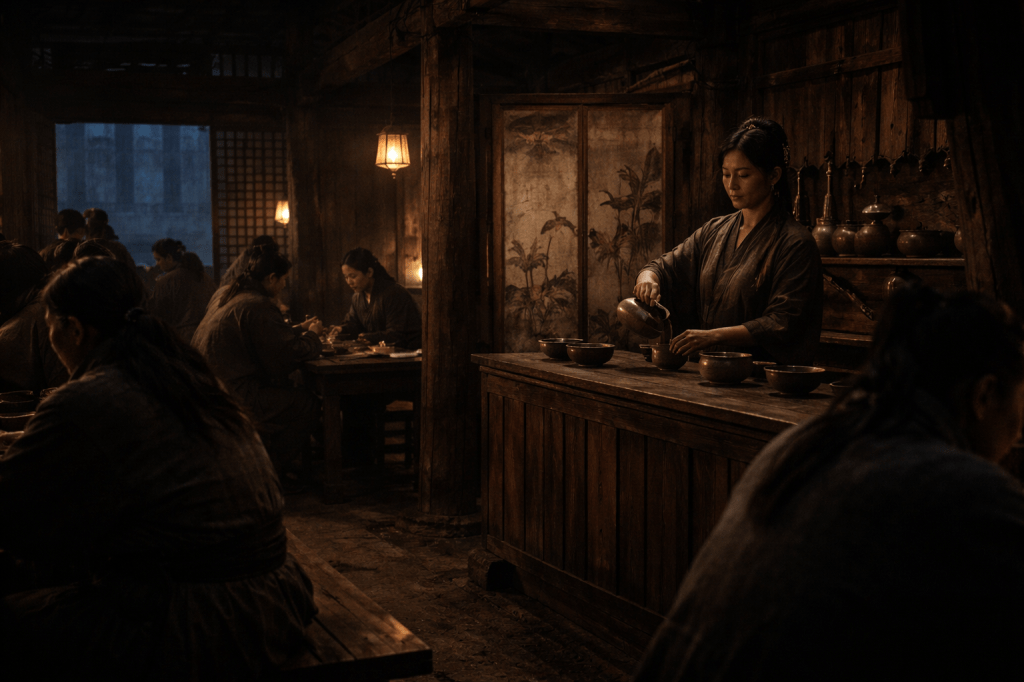
From the very beginning, the inn feels precarious, like it’s perched on the edge of chaos. Characters from all walks of life converge here—rebels, spies, and soldiers—each carrying their own secrets and agendas. The innkeeper, Wan Jen-mi (Li Hua Li), and her all-women staff, Hai Mu-tan (Angela Mao), Shui Mi-tao (Chin Hu), and Yeh Li-Hsiang (Helen Ma), become the heart of this precarious operation. With charm and cunning, they keep everything from unraveling in a place that’s far from neutral—it’s a powder keg waiting to ignite. As the characters’ hidden motives come to light, the tension builds, each moment more precarious than the last.
The film’s trailer beautifully captures the inn’s tense dynamics and choreography. Watch it here:
What makes the inn so compelling is how it compresses the action. Unlike sprawling landscapes or cityscapes that let characters roam free, the inn traps them together. Every interaction becomes a game of chess, where a single misstep could expose a hidden identity or trigger violence. The walls seem to close in, heightening the stakes with each passing moment. The suspense doesn’t just come from the possibility of physical conflict but from the constant maneuvering and mind games.
Visually, the inn is rich with detail. King Hu’s framing makes masterful use of doorways and screens, creating layers within layers, as if the space itself is full of secrets. The characters’ movements—whether they’re serving drinks, eavesdropping, or preparing for battle—feel like part of a larger choreography. It’s no wonder that when the fighting finally breaks out, it feels as much like a release as it does an escalation.
The inn also serves as a mirror for the characters’ inner struggles. For the women who work there, it’s both a stage and a shield. They must perform roles—smiling hostesses, dutiful employees—while concealing their true intentions. Their ability to navigate the power dynamics of the inn underscores their resourcefulness and resilience. They’re constantly underestimated by the men around them, which only makes their eventual triumphs more satisfying.
What I love most about the inn is its versatility. It’s a place of tension and danger, but it’s also where the characters find moments of camaraderie and solidarity. It’s a crucible that reveals who they really are, stripping away pretense and forcing them to confront their own limits. By the end of the film, the inn has transformed—not physically, but emotionally. It’s no longer just a backdrop; it’s a testament to everything the characters have endured and achieved.
In The Fate of Lee Khan, the inn reminds us that a well-crafted setting can elevate a story, turning it into something unforgettable. It’s a place where resilience, camaraderie, and the quiet strength of women drive the narrative, proving that even the smallest spaces can hold entire worlds.
 Scott Bryant
You must be logged in to post a comment.