
The Haunted Mansion at Disneyland California has always been one of my favorite attractions. From the moment you step into its shadowy foyer and into the stretching room, you’re transported into a world where the dead refuse to be forgotten, where every creak of a floorboard or flicker of candlelight tells a story. For me, it’s more than just a ride; it’s a space where imagination takes hold, where you can lose yourself in the lives—and afterlives—of its ghostly inhabitants.
Among them, two figures have always captured my attention: The Ghostly Bride and Madame Leota. While their stories are distinct in Disney’s official lore, I’ve always felt there was a connection between them that goes beyond the walls of the Mansion.
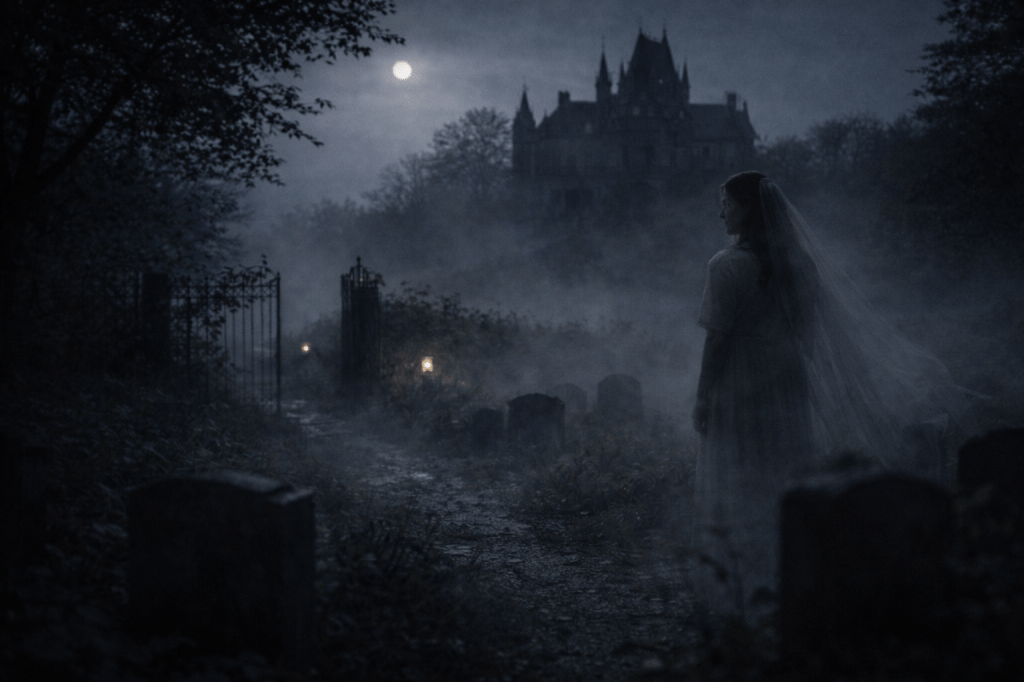
Two Ghosts Who
Captured My Imagination
For as long as I’ve gone to Disneyland, I’ve been mesmerized by Madame Leota’s presence. Her disembodied head floating in the crystal ball feels powerful, as if she isn’t just part of the Mansion—she is the Mansion, its anchor and guide.
The Bride, who appears in the attic scene and was once known as Constance Hatchaway, has always intrigued me in a quieter, more mysterious way. Her story—often framed as a tragic, patriarchal tale of a woman mourning the untimely deaths of multiple husbands—feels incomplete and, in many ways, reductive. She seems like more than a victim, more than the sum of her beating heart and ghostly veil.
Disney’s official narrative once painted Constance as a woman who married for wealth and disposed of her husbands with an axe. But what if that isn’t the full story? What if, rather than a villain or a victim, she was something more—a woman bound by circumstances, fighting for survival in a world that gave her little choice?
If you’ve never experienced Madame Leota’s séance or the attic scene in person (which just went through a storyline refresh), this Haunted Mansion ride-through by DocumentDisney captures their haunting presence perfectly:
A Ride That Sparked an Idea
It wasn’t until one particular ride-through in 2023—early in the morning, when I was the only one on the ride—that an idea struck me:
What if The Bride and Madame Leota were connected?
As my Doom Buggy passed from Madame Leota’s séance room to the ballroom and then to The Bride’s attic, the music shifted—a ghostly waltz echoing through the air. It felt like an invitation, a bridge between these two women.
I began to wonder: What if they weren’t just connected by the Mansion? What if they had been lovers, their bond transcending life and death?
Somehow, it felt as if strange, magical forces had guided me to that ride on that particular morning—by request of Madame Leota and The Bride.
Imagining Their Story:
Love Beyond Life and Death
Imagine this: Before the Mansion was haunted, it was alive with possibility—a sprawling Victorian home filled with candlelight and whispered secrets. It was there, perhaps, that The Bride and Madame Leota found each other.
The Bride, radiant and full of life, drawn to Leota’s quiet strength and mystical wisdom. And Leota, with her connection to the unseen, captivated by the Bride’s light.
But their love wasn’t meant to last. The Bride, trapped by the rigid expectations of her time, entered into four marriages, each ending in tragedy. One by one, her grooms met untimely deaths, leaving her wealthier but burdened by the weight of society’s demands. These deaths may not have been accidents but desperate acts of survival in a world that offered her few choices.
Meanwhile, Leota’s gifts bound her to a world beyond life, isolating her even as she grew more powerful. She may have tried to use her abilities to protect the woman she loved, but in the end, the forces around them—greed, judgment, and fear—drew them apart, leaving their love as fleeting as it was profound.
Eternal Love: Haunting Together
in the Mansion
Now, in the afterlife, their love remains—but it has changed.
The Bride lingers in the attic, her presence a mix of longing and regret. The dimly lit space is heavy with shadows, cobwebs draped across forgotten wedding gifts, and the faint creak of the floorboards beneath your Doom Buggy. Her beating heart pulses throughout the attic, its steady rhythm reverberating through the heavy stillness—a reminder of the love she lost and the freedom she never fully gained.
Meanwhile, Madame Leota, ever commanding in the séance room, seems to reach out with her incantations. It’s as if she’s searching for The Bride, protecting her, or calling her closer.
Their love manifests in the Mansion’s eerie beauty. The ghostly waltz in the ballroom feels like their story in motion—an eternal dance of connection and distance. The Bride’s sorrowful light and Leota’s resonant voice create a haunting conversation, one that spans the Mansion’s rooms and echoes in its halls.
And if you listen closely, maybe—just maybe—you’ll hear The Bride’s heart beating in time with Leota’s chants.
Why This Story Matters
Of course, The Haunted Mansion thrives on playful frights as much as ghostly romance—but perhaps, hidden within the playful haunts, these whispers of lost love remain.
Reimagining The Bride and Madame Leota as lovers doesn’t rewrite The Haunted Mansion’s lore—it layers my own interpretation onto it.
This version of their story suggests a love that transcends not only life and death but also the limitations placed on women’s lives. It challenges narratives that confine women to roles of victim or caretaker, instead envisioning them as powerful, complex, and deeply connected.
At its core, Disneyland isn’t just a place of nostalgia—it’s a space for reinvention. Every detail in the park, from a flickering lantern to a hidden melody, invites us to imagine new stories.
Because in the end, the Haunted Mansion is more than just a ride—it’s an invitation.
An invitation to dream. To re-imagine. Perhaps, in the end, The Bride and Leota never truly parted. Perhaps they are still here, waiting for those who listen.
 Scott Bryant
You must be logged in to post a comment.