

This case study documents a paired image set generated using the Lumivore constraint system for the short story 88 Steps Between Us (我们之间的八十八步).
The goal was not to illustrate a narrative beat or heighten emotion, but to observe how two distinct internal states—stillness and immersion—could be recorded under the same environmental and ethical constraints.
Both images take place in Tianzifang, Shanghai, during the same golden afternoon.
Both are bound by the same realism discipline.
Neither image is allowed to announce itself.
What differs is how each subject listens.
Shared Constraints
Before generation, the following constraints were locked and held constant across both frames:
- Observational realism only
- No spectacle, symbolism, or narrative escalation
- No posed subjects or eye contact with camera
- The city treated as a living system, not a backdrop
- Camera behavior as witness, not narrator
Both images were required to feel found rather than composed—moments that could plausibly exist without an audience.
These constraints were not aesthetic preferences.
They were ethical boundaries.
Divergence Point
The divergence between the two images occurs not in setting or style, but in mode of attention.
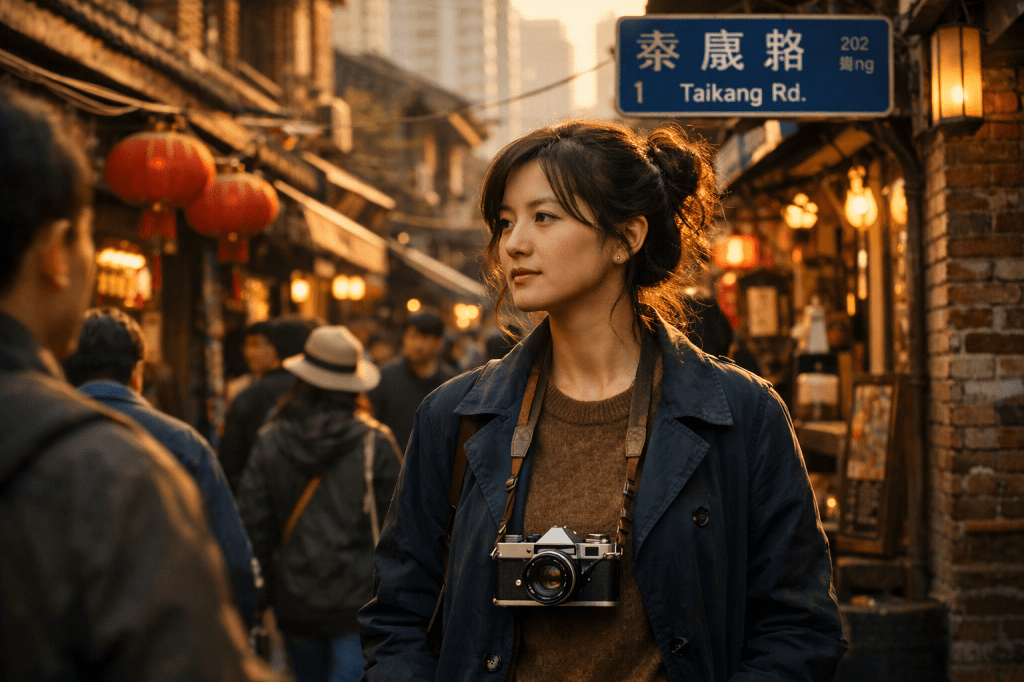
Liang Ruiwen is rendered as stillness inside motion.
She stands embedded in a moving crowd, observing rather than acting. Her camera hangs unused. Her posture suggests waiting without urgency. The image records a pause before recognition—before the story knows it has begun.
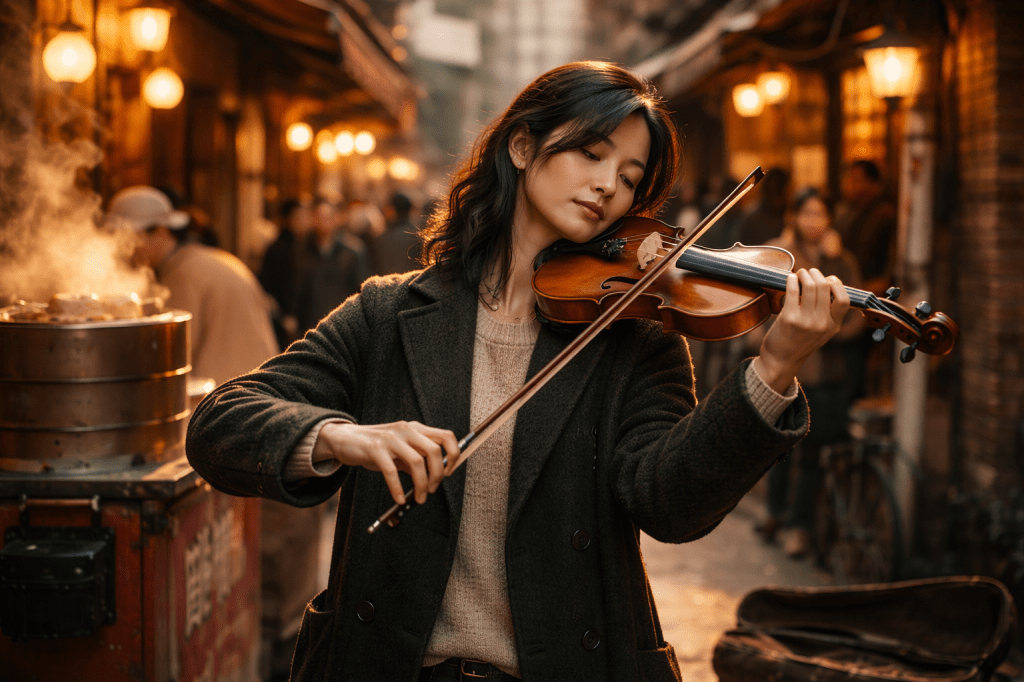
Xu Meiling, by contrast, is motion inside stillness.
She plays the violin with her eyes closed, immersed rather than observant. Her movement is contained and inward. The city passes around her without reacting. The image records presence without performance.
Neither image completes the other.
They coexist.
What Was Refused
Most of the work in this study happened through refusal.
The system was explicitly prevented from:
- Turning Shanghai into a postcard
- Elevating the violin into symbol
- Polishing the subjects into models
- Using light to dramatize rather than reveal
- Resolving the moment into romance
Each time escalation appeared, generation was stopped and reset.
The images end not when they are most beautiful, but when they are most honest.
Termination Decisions
Both images were terminated early—by design.
In Ruiwen’s frame, generation stopped the moment her stillness felt listened to rather than staged.
In Meiling’s frame, generation stopped the moment the music felt internal rather than performative.
No attempt was made to resolve the pair visually.
No third image was generated to “complete” the story.
The narrative already existed.
The images were only asked to prove that it passed through the city.
Why There Is No Third Image
It would have been easy to add a rain-soaked night scene.
Or a reunion.
Or a visual resolution.
That was refused.
This story does not need proof of outcome.
It needs proof of coincidence.
Sometimes restraint is the most accurate record.
Closing Note
Lumivore is often described as a prompt system, but its real function is editorial.
It decides:
- what must not be shown
- when to stop
- and who remains responsible for the image
In this case, Lumivore did not create a romance.
It documented two ways of listening—
and left the rest untouched.
 Scott Bryant
You must be logged in to post a comment.