
The Format: Letters as Performance
Letters Live is built on a simple premise: letters, when read aloud, retain their relevance.
At each event, performers read real correspondence—love letters, complaints, confessions, and exchanges that are both intimate and ordinary. The selections are not rehearsed in advance. The emphasis is not theatricality, but encounter: a contemporary voice meeting a historical one in real time.
From its inception, Letters Live has supported literacy initiatives and charitable partners, reinforcing that language functions not only as art, but as access.
The format remains restrained, and its effectiveness comes from preservation rather than reinterpretation.
January 1926: A Letter in Transit
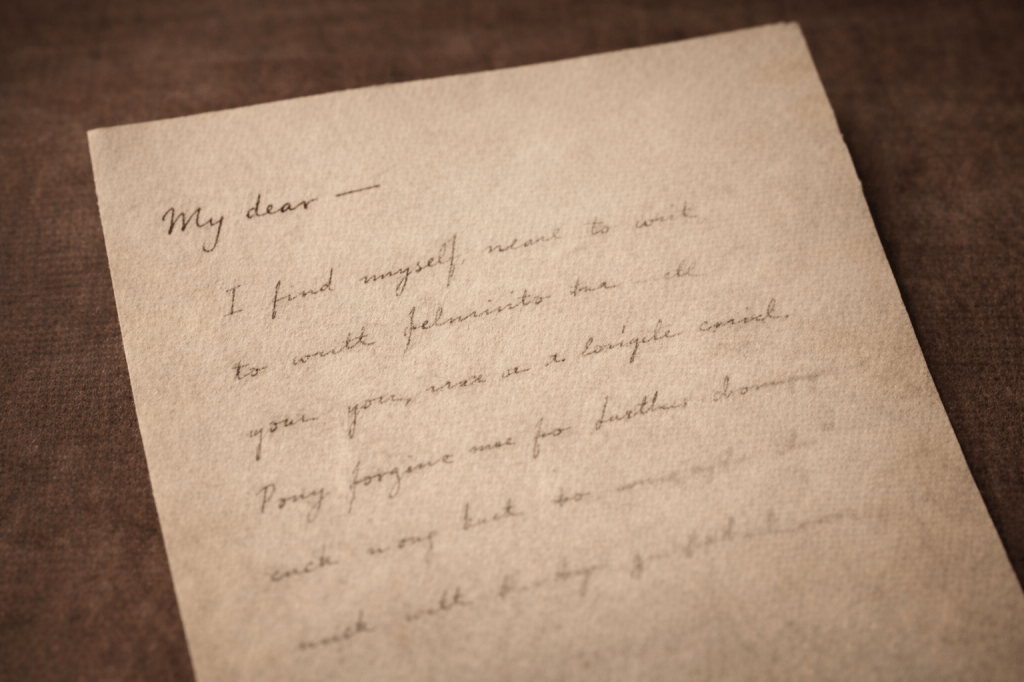
In January 1926, Vita Sackville-West boarded a train bound for Persia, where she would remain for four months. During the journey, she wrote to Virginia Woolf.
The letter addresses absence directly. “I am reduced to a thing that wants.”
The phrasing is stark, without cultivated wit or protective distance. Vita does not attempt to frame the emotion; she states it. “I just miss you in quite a simple desperate human way.”
The language is direct and unembellished. She acknowledges that she is capable of composure with others, but that composure does not extend to Virginia. “You have broken my defenses.”
The letter closes without resolution: “Please forgive me for writing such a miserable letter.”
Written in motion and between presences, the letter does not resolve distance. It records it.
The Performance at KOKO Camden
Nearly a century later, actor Marisa Abela read the letter at a fundraising edition of Letters Live at KOKO in Camden, London, in support of the KOKO Foundation.
The setting introduces a shift in context. A private letter, written for a single recipient, is delivered in a public venue and later circulated digitally. What was once contained becomes shared.
The scale does not diminish the letter’s intimacy. Instead, it clarifies it. The pacing remains measured, and the language carries its own weight without amplification. The performance does not impose interpretation on the text; it allows the text to be heard.
This act does not reveal new meaning. It extends the original one.
Private Language, Public Memory
Letters persist because they are immediate and unpolished. Vita’s letter endures not because it is elaborate, but because it is direct.
“I just miss you.” The sentence remains legible across a century.
When language of this kind is presented within a contemporary cultural setting, it does not become spectacle. It remains what it is: a record of communication. The context changes, but the structure of the language holds.
Letters Live demonstrates that correspondence can move from private language into public memory without losing its clarity. The performance does not extract meaning from the letter; it sustains it.
Archival Continuity
The trajectory is straightforward.
A letter written on a train.
A period of historical distance.
A staged reading in a contemporary venue.
A digital recording accessible to a wider audience.
The movement from one stage to the next does not alter the text itself. It extends its reach.
In a moment when language can be produced and distributed without limit, the continued presence of a single unguarded letter emphasizes that not all writing operates in the same way.
What remains is not mythology or narrative expansion, but reduction. The letter records a specific condition: a writer acknowledging absence and expressing need without qualification.
That condition remains intact.
 Scott Bryant
You must be logged in to post a comment.