
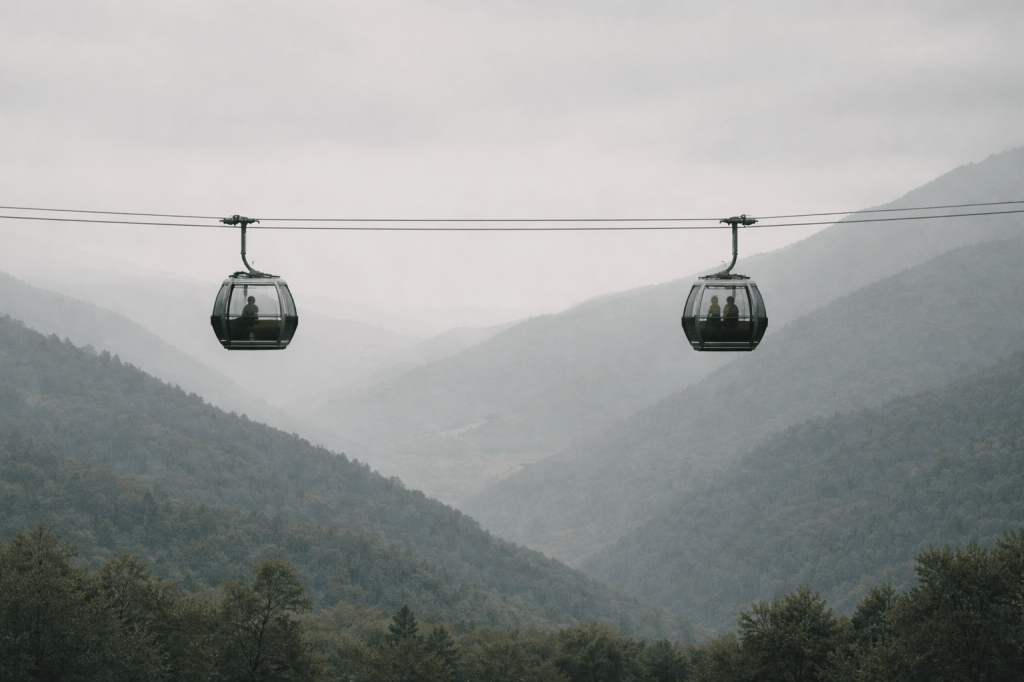
Some films reduce dialogue in pursuit of style. Others remove it to see what remains.
Gondola (2023) belongs to the second kind.
The film, starring Nino Soselia and Mathilde Irrmann, and filmed around the picturesque Georgian mountains, offers no spoken language, no explanatory framework, no urgency to define what is forming between its two central figures. It does not translate silence into metaphor or burden it with symbolism. Instead, it treats silence as a working condition—one in which attention, repetition, and timing do the work language often claims for itself.
What unfolds is not a story propelled forward, but a rhythm gradually established. The cable cars move back and forth. Days repeat. Gestures accumulate. Meaning is not announced; it is built slowly, through looking, waiting, and recognizing what returns.
The absence of dialogue is not a lack to be overcome. It is a boundary the film respects. By refusing speech, the film refuses explanation, and by refusing explanation, it allows the relationship at its center to exist without being categorized, justified, or hurried into legibility.
What passes between the two women is not confessional. There are no revelations, no declarations, no moments designed to instruct the viewer on how to feel. Instead, there is a shared awareness—quiet, provisional, and mutual. Connection emerges not through intensity, but through consistency.
Silence here functions differently than in stories where it conceals harm or enforces compliance. In Gondola, silence is chosen. It is shared. It creates room rather than pressure. It allows the women to meet without interruption from external demands or interpretive authority.
Time, too, is treated gently. The film does not rush toward resolution. It understands that some connections deepen through repetition rather than progress. By allowing moments to linger, it honors the way trust forms—not all at once, but through small recognitions sustained over time.
What the film ultimately offers is not a lesson, but a permission: to believe that not everything meaningful needs to be named, and that some relationships are most truthful when they are allowed to remain lightly held.
In a landscape where stories often insist on articulation, Gondola makes a quiet case for something else.
That attention can be enough.
That presence can speak.
That language is not always required.
 Scott Bryant
You must be logged in to post a comment.