
The Arrangement
Story Written By
Maelis Van Aerden,
Élodine Marceau-Lune
& Raisa van Surya
Story Told By
Iris De Wilde, Camille d’Artois,
& Saskia Vos
Still Visuals Created By
Maelis Van Aerden, Élodine Marceau-Lune, Raisa van Surya, Nerissa De Vries-Kumari,
& Scott Bryant
With care and reverence, this story is shared by
Scott Bryant at the request of Maelis Van Aerden, Élodine Marceau-Lune, Raisa van Surya.
Amsterdam
Iris De Wilde
I have learned that people relax when you tell them the truth early.
Not the whole truth—never that—but something sharp and disarming, something that suggests you are incapable of embarrassment. It makes them generous. It makes them careless.
I once traded a forged Hilma af Klint for a real confession.
I make my living arranging things that don’t officially exist—yet.
I have also watched two women nearly duel over a Marie Laurencin—while I was sleeping with both of them.
The Laurencin hangs in the front room of my canal house, on the long white wall opposite the windows. I placed it there deliberately: not centered, not quite at eye level. Too much symmetry invites scrutiny. I learned that years ago, watching a curator in Basel reposition a Giacometti by three centimeters and change the entire room’s temperature.
Outside, the canal is a narrow sheet of pewter. The light is late and undecided. Amsterdam does this well—refusal without drama.
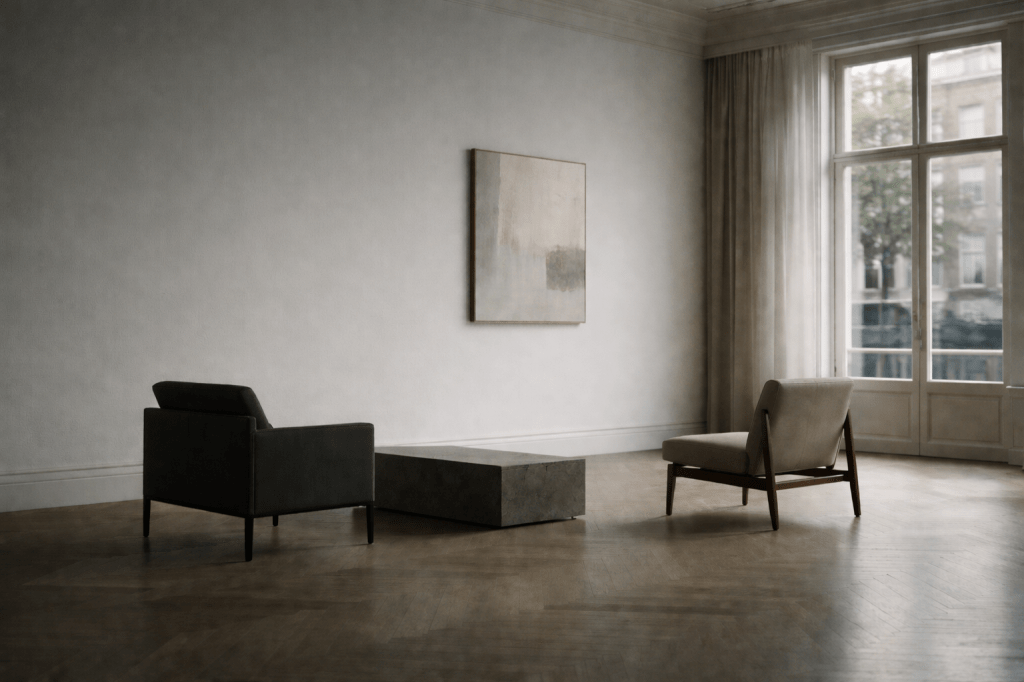
The house is quiet in the way prepared spaces are. I’ve removed most of the furniture. A low bench. Two chairs that do not face each other. Glassware arranged with enough irregularity to pass for instinct. People mistake restraint for honesty.
I check my phone once, then leave it face down.
Camille d’Artois arrives first, precisely when she means to. She always does. Her coat is dark, perfectly cut, rain beading on the collar like punctuation. A French cultural attaché with exquisite posture and a preference for vintage perfume. She takes in the room without moving her head, the way diplomats do when they don’t want to be seen evaluating assets.
“You’ve changed it,” she says, in French, not as an accusation.
“Only slightly.”
She stands in front of the painting longer than etiquette requires. I don’t interrupt. Camille has never liked being watched while she looks. When she finally turns, her expression is neutral enough to be dangerous.
“It’s calmer here,” she says. “Less defensive.”
I smile. “That’s generous.”
She removes her gloves. I notice she hasn’t brought documents. That tells me more than anything she could say.
Saskia Vos arrives six minutes later. Dutch-Indonesian, quietly defiant, with a gaze that made people pause before speaking. She curated installations no one ever admitted attending.
She doesn’t look at the painting at first. She looks at Camille. Then at me.
“So,” she says. “This is where you keep it.”
“Only for now.”
“For now,” she repeats, gently.
I pour drinks. Elderflower gin—light, unthreatening, faintly nostalgic. Camille accepts hers with a nod. Saskia hesitates, then takes the glass anyway. She always does that. She believes refusal should mean something. I’ve always admired her for it.
We stand like that for a moment, the three of us arranged by accident or instinct—I’m never sure which. I can feel the evening balancing, waiting for someone to misstep.
Camille asks about provenance. Saskia asks where it came from before that. I answer both, cleanly, accurately, without emphasis. Everything I say is true. This has always been my advantage.
They begin to speak to each other in French. Softly. Precisely. I let my gaze drift to the window, to the canal, to my own reflection layered over the water and the room behind me. It’s useful to appear occupied when you’re listening.
I know what this looks like. Two women, one painting, a house too pristine to be innocent.
What they don’t yet understand—what I have always counted on—is that I didn’t bring them here to choose between them.
I brought them here because I wanted to see what would happen when the arrangement became visible.
At the time, this still felt like curiosity.
At the time, I still believed curiosity was a neutral force.
Camille
The mistake Iris makes—has always made—is believing that composure signals safety.
I learned otherwise early, in rooms where the air itself was curated and the walls were lined with things that did not belong to the people who owned them. Composure is not innocence. It is simply practice.
I stand in front of the Laurencin because it is expected of me. Because Iris has placed it where a person like me would naturally stop. She understands optics. She always has.
The painting is authentic. That much is clear. Not because of the signature—signatures lie—but because of the restraint. Laurencin never insisted. She allowed the work to exist without persuasion. Institutions distrust that now. They prefer assertion.
Iris has hung it slightly too low. Not enough to offend. Enough to suggest intimacy.
I file that away.
Behind me, I can feel Saskia’s attention like a held breath. She is younger than Iris, though not by much. She has the kind of stillness that comes from refusal rather than discipline. I respect it, even as I distrust it. Refusal does not scale well.
I turn and let my expression settle into neutrality. Iris reads faces the way some people read markets—pattern over feeling. I give her nothing.
“It’s calmer here,” I say, because it’s true. Because she wants approval. Because it costs me nothing.
She smiles, the careful, flexible smile that first drew me to her. Iris does not seduce directly. She positions herself so that seduction feels like initiative taken elsewhere.
Once—only once—I let that positioning become physical.
A hotel room in Lyon. Late. Curtains half-open. She slept immediately, face turned away, as if rest itself were proof of trust. I stayed awake, listening to the city, already aware that intimacy had served its purpose. That it had given me access and nothing more.
I don’t regret it. Regret is for misunderstandings. This was clear enough.
What troubles me now is not that Iris has invited Saskia here.
It’s that she has invited both of us.
That is not curiosity. That is orchestration.
Saskia finally looks at the painting. Her gaze is direct, unsoftened by reverence. She does not ask whether it is real. She asks where it has been.
This tells me everything I need to know about her priorities.
Provenance is not ownership. It is narrative. And Iris, I see now, has been collecting narratives the way others collect objects—carefully spaced, never allowed to touch.
I ask about documentation because it is the language Iris understands. She answers easily. She always does. Everything she says is accurate. Accuracy is her camouflage.
But accuracy is not alignment.
I watch her move—pouring drinks, adjusting light, shifting space with the unconscious authority of someone used to being central. She believes this evening is about the painting.
It is not.
I am here to assess risk.
Not institutional risk—the painting poses none—but ethical drift. The slow erosion that occurs when intermediaries begin to mistake access for authorship.
Iris stands between us as if by habit. I step slightly to the side.
Saskia notices. Iris does not.
That is the moment I understand how this will end.
Not dramatically. Not with accusations or raised voices. Iris would survive that. She feeds on conflict the way some people feed on praise.
No.
This will end with clarity.
I let Saskia speak. I let Iris continue to believe she is balancing something delicate. I wait.
Experience has taught me this much:
When someone curates people, eventually the people step out of frame.
And when they do, the curator is left alone with the object she mistook for herself.
I take a sip of my drink. It is well chosen. Light. Noncommittal.
Iris is watching us now, alert, pleased, still convinced she has arranged something elegant.
She has.
She just hasn’t understood the audience yet.
Saskia
I didn’t come here to argue.
If I had wanted that, I would have stayed home and written an essay no one would publish, or sent Iris a message she would read carefully and answer late, once she had softened it enough to survive.
I came because rooms tell the truth when people won’t.
The house is exactly what I expected: glass where there should be walls, white where there should be weight. It’s a space designed to keep nothing too long—not sound, not heat, not consequence. Iris likes places that don’t echo.
She looks pleased when I arrive. Not relieved. Pleased. That difference matters.
Camille is already there, standing with the painting the way she stands with most things—close enough to claim familiarity, far enough to avoid implication. I register her without difficulty. We’ve met before. Not like this, but often enough to know the shape of her attention.
The Laurencin is real. I know before anyone says it, not because of training, but because of how little it tries. It doesn’t seduce. It doesn’t announce. The women inside it don’t look back. They never have.
Iris doesn’t watch me look at it. She watches Camille watching it. This, too, matters.
Once—only once—I stood behind Iris at a kitchen sink in Lisbon, both of us barefoot on cold tile, her hands submerged, mine resting lightly between her shoulders. It wasn’t dramatic. No declarations. Just a pause long enough to feel intentional.
I remember thinking: this is what clarity feels like.
I don’t romanticize that moment now. Memory isn’t a sanctuary. It’s a record.
What Iris took from that intimacy was not commitment. It was permission—to keep me in reserve, to fold me into her sense of herself as expansive, chosen, unconfined.
I see now that she has always mistaken access for consent.
She pours drinks. She answers questions. She stands where she always stands—between. She believes she is hosting something delicate.
Camille asks about documents. I ask where the painting has been. We are speaking different languages, and Iris is fluent in both. This is her skill. This is also her problem.
She believes fluency is neutrality.
I watch her adjust the light, just slightly, so the painting softens at the edges. She doesn’t notice she’s done it. People who curate intimacy often forget they are arranging real bodies, not objects.
Camille shifts her position—barely. Iris doesn’t see it. I do.
That’s when it becomes clear to me that this evening will not resolve the way Iris expects. Not because Camille and I agree. We don’t. We never will, entirely.
But because we are no longer responding to Iris. We are observing her.
I don’t need to accuse her of anything. Accusations require an audience willing to be persuaded. I’m past that.
What I need—and what I’ve come for—is confirmation.
I need to know whether Iris understands the system she’s built, or whether she still believes it’s just taste.
I look at her now and see a woman who has always relied on being wanted to excuse being unclear.
That has worked for her. Until now.
When Camille speaks again, I let her. When Iris smiles, I don’t return it. I don’t withhold warmth out of cruelty. I withhold it because it would be inaccurate.
Soon enough, Camille and I will stand next to each other without meaning to. Iris will feel the shift then—if she’s capable of feeling it at all.
I don’t know yet whether Camille and I will leave together.
I only know this:
I will not leave the way I arrived.
Camille & Saskia
Camille speaks again, eventually. Not to Iris.
“There will need to be a decision,” she says, setting her glass down untouched. “Not tonight. But soon.”
Iris nods, already moving toward resolution. “Of course. There’s no urgency. We can slow—”
Saskia interrupts her, gently.
“No,” she says. “We can’t.”
The word lands without emphasis. Camille turns slightly—not fully—to look at Saskia. Iris is no longer between them.
“What we can’t do,” Saskia continues, “is pretend this is provisional.”
Iris laughs, softly. “No one is pretending,” she says. “We’re just being careful.”
Camille regards her now, calmly. “Careful is not the same as neutral.”
Iris pauses. She looks from one to the other, recalibrating. “I think we’re all describing the same concern,” she says. “This doesn’t need to become—”
“It already is,” Saskia says.
Camille nods once. Not agreement. Completion.
“There are processes for this,” Camille says. “They don’t involve private houses.”
“And there are limits,” Saskia adds. “They don’t involve me.”
Iris steps forward, just slightly, smile returning, voice lightening. “We don’t need to draw lines tonight. We’ve all handled things responsibly so far.”
Neither woman answers her.
Camille turns her attention fully to Saskia now. “I’ll follow up,” she says. “Formally.”
Saskia inclines her head. “That works.”
The conversation ends—not because anyone declares it finished, but because nothing remains unaddressed.
Iris stands very still.
Iris
Camille is the first to move.
She places her glass on the table without finishing it. The sound is small, definite. She slips her coat on with practiced ease, smoothing the sleeve once at the shoulder.
Saskia reaches for her scarf, looping it once around her neck. She picks up her umbrella, checks the strap, lets it hang loose at her side.
Neither of them looks at the painting.
At the door, Camille pauses—not to speak, not to wait—but to adjust her gloves. Saskia steps slightly closer, close enough that their coats nearly brush.
Camille opens the door. Cool air enters the room, faintly metallic, carrying the canal with it.
Saskia steps out first. Camille follows.
The door closes.
Not softly.
Not sharply.
Completely.
The house does not change when they leave.
The light is late. The canal continues its narrow, indifferent movement. The Laurencin hangs exactly where I placed it, untouched, unbothered.
I stand where I am longer than necessary, waiting for the after-sound—voices on the stairs, a final word, something unresolved.
Nothing comes.
I notice then the chairs, the space between them. How clearly it reads without bodies to interrupt it.
I go to the window and watch their reflections disappear into the glass and water below. For a moment, I can’t tell which is which.
Later, I will tell myself this was inevitable. That systems reveal themselves eventually. That no one was harmed. That everything here is still intact.
Tonight, alone in the room, I understand something precise.
Arrangement was never enough.
The painting watches, as it always has.
It does not look back.
The painting remains, and for the first time, I understand the difference between restraint and refusal.
LUMIVORE — GENERATION PROMPT (ARCHIVAL RECORD)
Story: The Arrangement
Image Title: The Space After
Location: Amsterdam canal house interior
Aspect Ratio: 16:9 (horizontal)
A photorealistic, naturalistic cinematic still of an empty Amsterdam canal house interior in the late afternoon or early evening.
The room is minimalist, curated, and controlled, with tall ceilings and pale walls in white or very light grey. The space feels expensive without warmth, deliberate without comfort.
A long, pale wall dominates the frame, occupying most of the visual space. A painting is present but not centered—either partially cropped by the frame edge or visible only through subtle placement and shadow. The painting is not featured, not highlighted, and not visually emphasized.
Two chairs are arranged in the room:
- Not facing each other
- Slightly misaligned
- Clearly intentional in placement
- Arranged, not abandoned
There are no other objects of narrative significance.
No table objects, no glassware, no documents, no personal items.
Lighting is soft, natural, and indifferent, coming from canal-facing windows implied only by light behavior. The daylight is cool-neutral with very restrained warmth, with a faint, subtle reflection of canal light on glass or floor.
There is no spotlighting, no dramatic contrast, and no theatrical mood lighting.
The color palette consists of:
- Whites and pale neutrals
- Soft greys
- Muted stone tones
- Very restrained warmth
No saturated colors.
No dramatic shadows.
No aestheticized mood.
The camera is positioned at eye level, with an observational, documentary framing.
Negative space dominates.
The image feels noticed rather than staged.
There are:
- No people
- No faces, hands, or reflections
- No motion
- No text or readable labels
- No symbolic props
The emotional read is composure without care, control without intimacy, and a system that remains intact after human presence has withdrawn.
The image should not evoke sadness, conflict, nostalgia, or resolution.
It is not melancholy.
It is clarity after consent is withdrawn.
Photorealistic, unstyled, documentary still quality.
No polish beyond realism.
 Scott Bryant
You must be logged in to post a comment.