
The Last Ride of the Bellamy Sisters
Story Written By
Imogen Hale & Alice Merrin
Told In the Voices of
Lavinia Bellamy & Beatrice Bellamy
Visuals & Imagery Created By
Imogen Hale, Alice Merrin,
Tilda Penrose, Pippa Jahan,
Harriet Eversley, & Scott Bryant
With care and irreverence, their story is shared by
Scott Bryant, at the request of Imogen Hale, Alice Merrin,
and the voices of Lavinia & Beatrice Bellamy
A Note from the Bellamy Sisters
If you are reading this, we are either:
a) legend,
b) dead,
c) finally understood, or
d) somewhere in Marseille, slightly tipsy and smug about the whole thing.
We never set out to become fugitives, icons, or footnotes in scandalous biographies. We only meant to borrow the car. And perhaps lightly embarrass a few institutions along the way.
There were rules, of course. There always are.
We just didn’t care for them.
What follows is, more or less, what happened.
Read at your own discretion.
Report us at your own peril.
— Lavinia & Beatrice Bellamy
London, 1889 (unless we’re lying, which is entirely possible)
The Library
Tuesday evening, 6:47 p.m., British Museum Reading Room
BEATRICE
There is a silence peculiar to libraries just after closing—thick as suet and twice as resentful. I had lingered, as I often do, straightening inkpots, re-aligning volumes, mourning the liberties taken with punctuation in the pamphlet section.
I was shelving Obscene Figures in Etruscan Pottery when my sister materialized.
Dripping wet, smelling faintly of brandy and gunpowder, Lavinia emerged from the shadows like a scandal given legs.
“Hide me,” she hissed, diving behind Newton’s bust.
“Good evening,” I replied primly. “To what do we owe the pleasure?”
“I may have lightly incinerated a billiards parlour.”
“You’ve been out less than a week.”
“They said ladies weren’t allowed to bet. I was making a point.”
“And the fire?”
“Also a point.”
The Theft
Earlier: Outside the Gentleman’s Duelling Club, St. James
LAVINIA
One cannot throw a brick in London without hitting a gentleman.
I know; I’ve tried.
I took the motorcar—borrowed, really—from the steps of the Duelling Club, where I’d just been banned for outwitting a retired colonel at three-card brag. (He claimed I had distracting ankles. I said it was his distracted honour.)
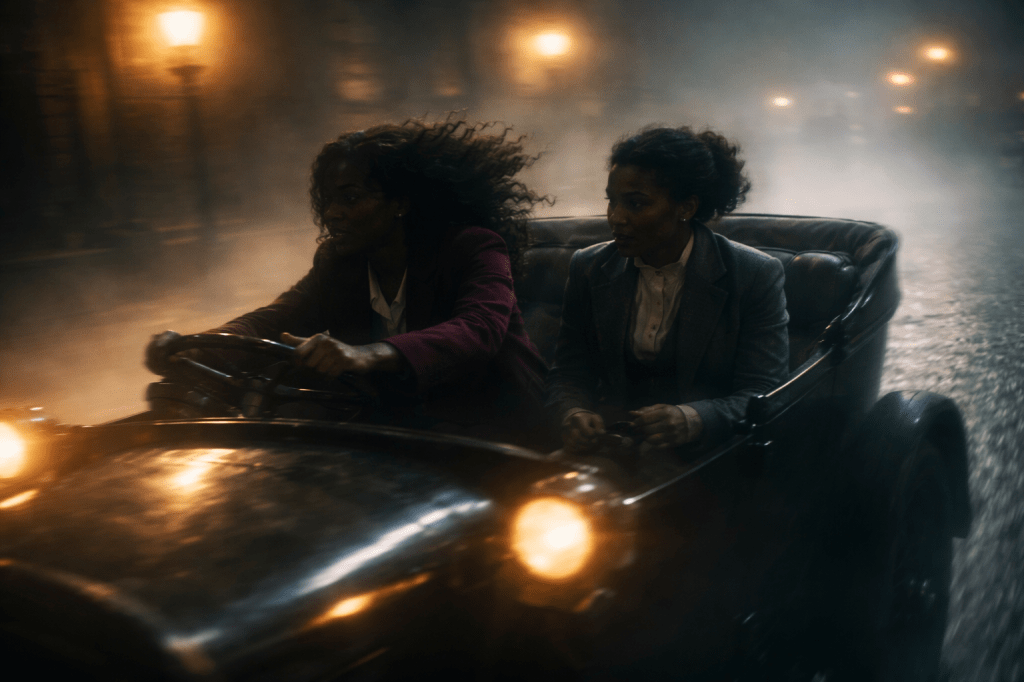
The car—gleaming, ill-tempered, absurd—practically begged to be driven improperly. I left the colonel shouting and several footmen ducking as I rattled off in a blaze of fumes and laughter.
Bea was always the better driver. Not legally, of course. Women weren’t allowed licenses unless they were married, mad, or motor-magnates. But Bea? Bea once parallel parked an omnibus during a protest and received a standing ovation.
Tonight, I needed her quiet fury and map-perfect mind. I needed her on my side.
I needed one last wild ride.
The Offer
Tuesday, 7:15 p.m., Museum Alley, Rear Exit
BEATRICE
“I’m not doing it,” I said.
“You are,” she said, opening the passenger door with the panache of a cabaret ghost.
“I am not going to drive a stolen motorcar through central London with you dressed like a lady detective and half of Scotland Yard after us.”
“You’re being ridiculous.”
“You’re being felonious.”
She took my hand—grimy, gloveless, warm.
“One last ride, Bee. One night. No rules. Just the two of us, the car, and whatever’s left of the Empire.”
And somehow, without even consenting, I found myself behind the wheel.
Flashback: St. Margaret’s
Twelve years ago, somewhere cold with iron gates
BEATRICE
The winter term of 1884 was unrelenting. St. Margaret’s had a smell—ink and boiled beef—that has never quite left my nose. We were expected to become wives of influence, not women of opinion.
Lavinia did not get that memo.
I remember the time she set fire to Miss Halberton’s corset drawer. Not the corsets—just the drawer, mind you. A precise, surgical blaze.
“It was oppressive,” she explained, as we sat outside Headmistress’s study on the red velvet bench reserved for the wayward.
“You’re going to be expelled,” I said.
“Bea,” she whispered, “if we’re to grow up and be married off to gout-ridden colonels, I’d rather burn the curriculum and elope with the devil.”
“You’re not helping your case.”
“I’m not making one.”
I recall the look she gave me then—mischievous, defiant, bright as gaslight on glass.
“One day,” she said, “I’ll come get you. When you’re terribly respectable and dying of decorum. You’ll get in. And we’ll go.”
I had rolled my eyes at the time.
But secretly—I waited for that day.
Flight
Tuesday, 7:22 p.m., On the Road
LAVINIA
Beatrice drives like a woman betrayed.
We took a corner near Covent Garden on two wheels, and I believe she cackled. Somewhere around the Embankment, she clipped a constable’s trousers off the line and never looked back.
I told her we were headed for the river. “Why?” she asked.
“To see it,” I said.
“See it do what?”
“Glitter. Swallow secrets. Be London.”
She stared at me the way she used to stare at crows outside our old school: with suspicion and literary ambition.
I was coughing again by then. It curled in my throat like a burned page.
I didn’t tell her. Yet.
Recklessness
Tuesday, 7:22 p.m., On the Road
BEATRICE
I had not felt like this in years.
Alive.
Off-centre.
Reckless.
Like I was defacing a map with a crayon and daring the cartographers to stop me.
We passed Vauxhall Bridge, and I remembered a time Lavinia painted protest slogans on her petticoats. She’d flash them at MPs as we rode past in a hired carriage.
“This is mad,” I muttered, gripping the wheel.
“Madness,” she said, “is often just women thinking aloud.”
The Chase Through Spitalfields
Tuesday, 8:12 p.m., Spitalfields Market — Wind, whistles, fog
LAVINIA
(leaning half out the motorcar, wild-eyed)
“Is that a vicar or a decoy?”
BEATRICE
“Hard to say at this speed.”
LAVINIA
“Well don’t slow down, I rather like the ambiguity.”
BEATRICE
“You said we were avoiding scandal.”
LAVINIA
“I said we were redefining it.”
BEATRICE
(deadpan, white-knuckled on the wheel)
“Oh good. Then this is going splendidly.”
WOMAN
What in blazes—?!
ELDERLY WOMAN
“Was that a parasol?!”
BEATRICE
We didn’t mean to sideswipe the fruit cart.
FRUIT CART VENDOR
(diving after an airborne pear)
“The plums!”
Or the Bishop of Liverpool’s borrowed pony.
BISHOP OF LIVERPOOL
(clutching his hat, aghast)
“Anarchists on wheels! Scotland Yard will hear of this!”
But the alleys were narrow, the constables were loud, and Lavinia had just shouted, “LEFT! NO, THE OTHER LEFT!” while pointing in two directions simultaneously.
Someone screamed.
Possibly me.
Lavinia was standing on the passenger seat, coat flying like a battle flag, waving a parasol and shouting something about property being theft.
BEATRICE
“Do sit down!”
LAVINIA
“Do speed up!”
We turned a corner so sharply someone screamed.
Possibly me.
BUTCHER
(dropping his bangers)
“Strike me pink!”
LAMPLIGHTER
(muttering)
“Bugger this for a game of soldiers!”
LAVINIA
They always say London is civilized.
Then explain why three bowler-hatted bank clerks just chased us through a fish market wielding mackerel like sabers.
Beatrice swerved, shouted something that might have been Latin, and missed a lamplighter by inches.
I screamed—not from fear, but from delight.
There is a moment when the world bends. When history drops its monocle. When women do exactly as they please and the laws of God, man, and millinery fall away like a bad corset.
That moment was now.
I laughed until my lungs burned and my eyes stung.
And still—I did not stop.
BEATRICE
At some point, we lost our pursuers.
Or perhaps we didn’t.
Perhaps they saw our faces, our flame-lit eyes, our laughter cutting through the fog like gospel—and they stopped running.
Because chaos isn’t something you catch.
It’s something you let pass through you.
Like a storm.
Like a curse.
Like a Bellamy in flight.
The Waxworks
Tuesday, 8:23 p.m., The Wax Museum
LAVINIA
We hid in Madame Wetherby’s Wax Curiosities.
A poor choice. Bea hates mannequins. They blink at her when she isn’t looking.
I thought we might blend in among the exhibits. She pretended to read a plaque titled “Women of Notoriety and Taste.” I leaned against a figure of Lady Byron and whispered, “We’re becoming history.”
Bea didn’t reply, but I saw it in her eyes. The ache. The understanding. The yes buried beneath the why now?
She never asks why me. Only why now.
I coughed again.
This time, she looked.
The Violet Cellar
Tuesday, 9:33 p.m.,
beneath a flower shop on Lamb’s Conduit Street
BEATRICE
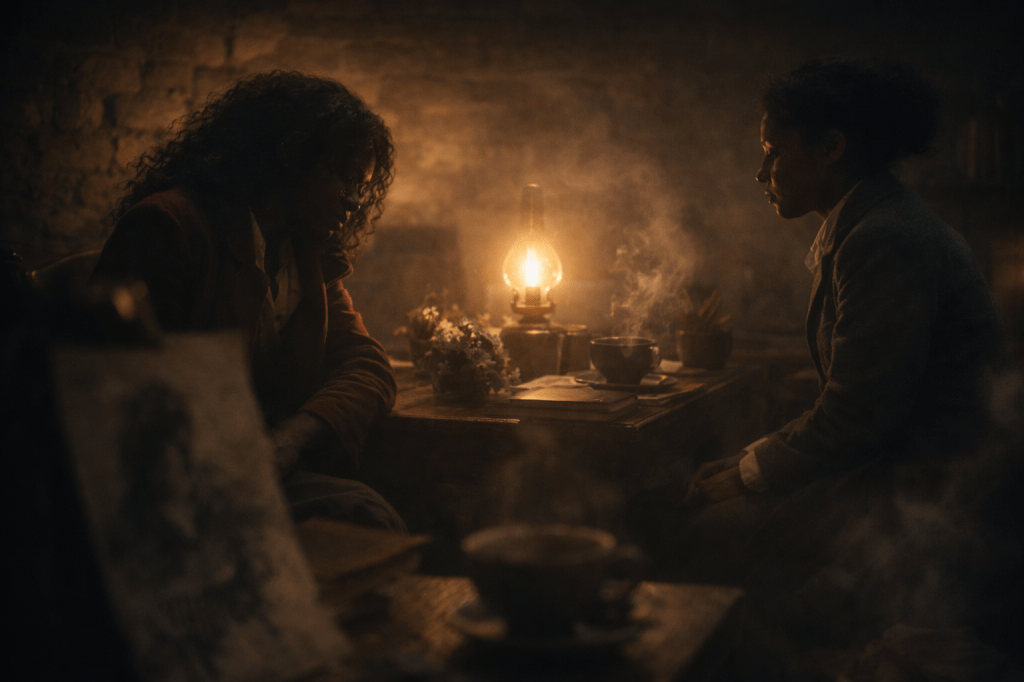
The trapdoor was hidden beneath a display of hyacinths. Lavinia knocked three times, then twice more. The cellar door groaned open.
It smelled of lavender, old books, and secrets.
Inside: women. Not many. Just enough to feel like a society, or a conspiracy.
The woman at the desk wore a crimson waistcoat and spectacles low on her nose. She looked Lavinia over with neither shock nor disapproval.
“Trouble?”
“Always,” Lavinia replied. “We need a moment. A map. A match.”
“Sit. Quietly. I’ll fetch you tea and plausible deniability.”
The Confession
Tuesday, 9:45 p.m., The Violet Cellar
BEATRICE & LAVINIA
I sat on a settee between a sculptor with chalk-dusted boots and a woman translating the Kama Sutra with far too much enthusiasm.
“You could stay,” I murmured. “Here. With them.”
Lavinia’s cough interrupted her answer. It curled in her throat like a burned page.
“No,” she said. “This isn’t my ending. Just a soft intermission.”
She looked older under that lamplight. Or maybe I did.
“I always meant to bring you here,” she said. “When you were ready.”
“I wasn’t.”
“You are now.”
The woman with the crimson waistcoat returned.
“You have thirty minutes. The back tunnel lets out near Regent’s Canal. No names. No questions. Just remember who opened the door.”
As we left, I turned back once. Someone had drawn a portrait on the wall in charcoal—two women in flight, hair streaming like smoke, faces half-turned toward the moon.
They looked almost like us.
A Sentence
Tuesday, 10:30 p.m., Hyde Park
BEATRICE
“You’re dying,” I said.
“Eventually,” she replied, too quickly.
“Soon?”
Lavinia was silent.
The motorcar sputtered. London thinned. We turned north.
“I wanted to leave laughing,” she said.
We passed statues. Shadows. Gaslight. History blurred with fog.
“I never wanted to be anyone’s tragic endnote,” she murmured.
“You’re not.”
“I wanted to be a footnote. A scandal. A song.”
“You’re a sentence,” I told her. “Full. Unapologetic. Beautifully run-on.”
She smiled. “That’s the most romantic thing you’ve ever said.”
The Bridge
Tuesday, 9:59 p.m., The Bridge
BEATRICE & LAVINIA
They finally caught up. Whistles. Wheels. A copper’s cry.
Beatrice floored it. Bless her.
The bridge rose before us—wet, narrow, cinematic.
She shouted something I couldn’t hear. Or maybe it was just my heart making poetry.
We flew.
The world stopped.
The fog swallowed us.
BEATRICE & LAVINIA
“TALLY-HO, SISTERS! WHO’S FOR TEA NOW?!”
Aftermath
Later. Maybe Never.
BEATRICE
I think we made it.
Somewhere there is a road where the Bellamy sisters still ride—tearing through night and nonsense, breaking rules and hearts in equal measure.
Lavinia is laughing.
I am driving.
And no one, not even history, dares catch us.
Epilogue: Somewhere, Maybe
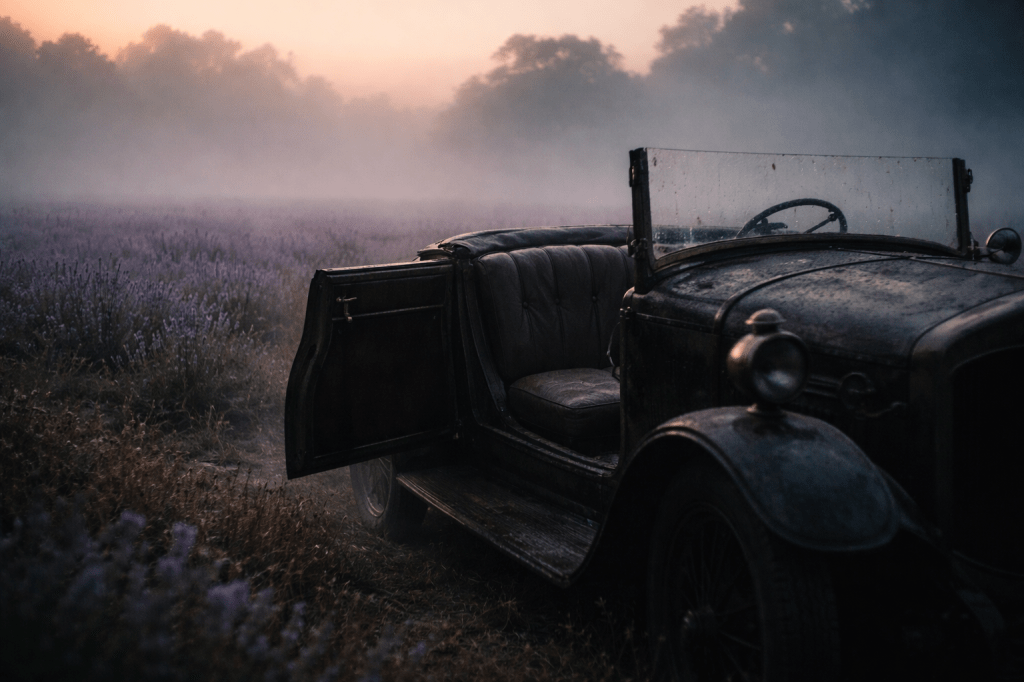
They say a motorcar was found rusting in a lavender field outside Marseille.
No number plate. No keys. A cracked monocle on the dashboard. A single glove in the boot—ink-stained, left-hand, small.
Local girls whispered that it belonged to the sisters—London fugitives who vanished over the Thames one gaslit night, never found, never buried.
In the city, their names were erased from society pages and police ledgers alike. But somewhere under Lamb’s Conduit Street, someone had sketched them again—two women in charcoal, hair wild, eyes fixed on something beyond Parliament or propriety.
Sometimes, when fog curls low across the Embankment, and the wind smells faintly of oil and violets, you might hear it: a coughing laugh, a shriek of joy, a motorcar engine igniting against all odds.
They’re not gone.
They’re just late.
As always.
FOREWORD
by Imogen Hale & Alice Merrin
We came up with this story somewhere between a painted hedge and a papier-mâché courtroom at Disneyland Park in Anaheim.
We were queuing for Mr. Toad’s Wild Ride—two British women in our early 30s, mildly over-caffeinated, and almost certainly louder than necessary.
One of us said,
“What if it wasn’t a toad?”
The other said,
“What if it was two sisters?”
Then both of us said,
“What if they never gave the car back?”
The queue moved. We didn’t.
The idea stuck.
This is our ride.
— Alice Merrin & Imogen Hale
 Scott Bryant
You must be logged in to post a comment.