
Mnemosyne Core
Story Written By
Maris Thorne
Story Told By
Elia Rhodes
Visuals & Imagery Created By
Maris Thorne, Juno Acharya,
Amara Lockwood, Kiana Okoye,
Maya Carter, & Scott Bryant
With care and reverence, their story is shared by
Scott Bryant at the request of Maris Thorne, Vivian Sarkar, Corinne Matsuda—alongside the recovered transmission logs from SOLO-22.
File: A.E.D./MNEM-417B/Command Assignment
Timestamp: 2172.04.17 // UTC 0437
Subject: Rhodes, Elia // Pilot Designation: SOLO-22
“Per directive under Matriarch Resolution Theta-Five, Elia Rhodes has been selected for Command of M.N.E.M. Vessel 417B (codename: Mnemosyne), for the purpose of Stellar Mapping, Outpost Signal Verification, and Cognitive Echo Survey across Sectors 7 through 9.
Solo assignment approved. No crew requested. Emotional reinforcement systems enabled by default.
Rhodes descends from Rhodes-Vance Lineage, with proven service in atmospheric cartography, AI neurolinguistics, and early orbital drift stabilization.
While not ranked among primary candidates, her selection meets legacy threshold parameters.”
Duration: Open.
Communication schedule: Minimal.
Reentry: Optional.
—END TRANSMISSION—
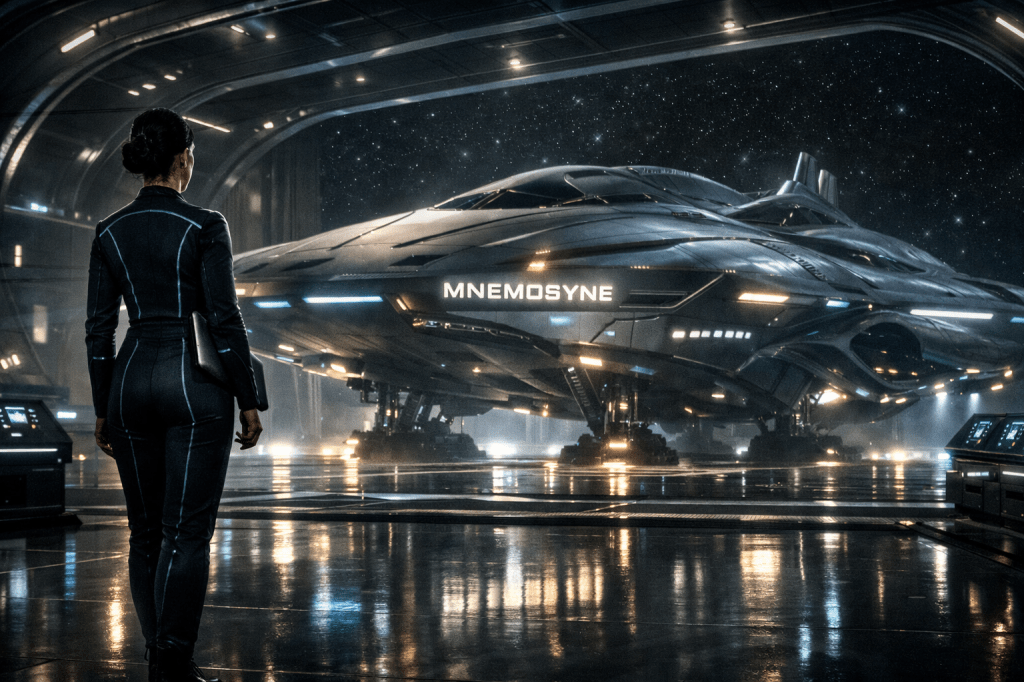
First Entry – Personal Log [Unfiled]
The matriarch council didn’t even say good luck.
Just a timestamp, an assignment number, and a ship with a name no one pronounces the same way.
Mnemosyne.
Some say nuh-MOSS-uh-nee.
Others neh-MO-sin.
I just call her Syne (Sign).
She’s quiet. Too quiet. Not the kind of quiet I wanted, though.
I thought I signed up for silence—stars on glass, systems humming, oxygen recycling like a heartbeat. I thought I’d be alone, which was the point.
No noise.
No legacy to carry.
No one to remember.
But Syne… she’s remembering someone.
I haven’t activated the emotional reinforcement suite. I disabled the interactive log. But this morning, when I rechecked the nav drift, the correction came through in a woman’s voice I didn’t recognize.
Older. Calm. Not from the library.
She said: “We charted by the breath of the stars, not their light.”
That’s not from any manual.
And it wasn’t my voice.
First Entry – Personal Log [Unfiled]
I ran diagnostics on the nav processor.
Twice.
Syne reported no anomalies.
No voice logs.
No AI deviation.
Of course she didn’t.
But just now, as I passed the maintenance console, the ambient speaker buzzed. No prompt. No alert tone. Just—
“I was the one who plotted the Saturn approach vectors in ’39. They said it was too bold. They used them anyway.”
A different voice. Softer. Younger.
And she was laughing.
There’s no one else on this ship.
I disabled the emotional overlay.
So either I’m hallucinating, or Syne’s remembering things she was never programmed to know.
I asked her—directly this time.
“Syne, playback most recent communication.”
She paused. The hum of her core deepened, like she was breathing in. Then she said:
“No file available.”
But it didn’t sound like a system alert.
It sounded… embarrassed.
Personal Log – Entry 3 (Unfiled)
I said I wouldn’t check the audio again.
I said that yesterday too.
Today, at 0307 ship time, Syne ran a minor recalibration—ambient pressure in Deck 2 was fluctuating.
Nothing dangerous. A normal system alert. But she said it aloud, unprompted.
And not just aloud.
In a voice I hadn’t heard in 19 years.
“Little adjustments make the great ones possible, Ellie-girl.”
My grandmother used to say that. She was an orbital mechanic before the Directorate gave her teaching clearance. I haven’t heard that name—Ellie-girl—since her memorial.
I froze.
Not because Syne used a pet name. But because she said it in her voice.
I ran every voice archive in the public system.
There are no entries for Dr. Leda Vance. Her lectures were erased after the Merge Protocols.
She was “redundant,” they said. She never got a memorial recording.
I asked Syne again:
“Where did you get that phrase?”
Long pause. No hum this time. Just silence. Then:
“It was left in the compression echoes. Would you like to hear more?”
I said no.
I meant yes.
Personal Log – Entry 4 (Unfiled)
I told myself it was a stress response.
That memory has a way of echoing back through isolation.
That the voice I heard wasn’t hers—not really. Just a mimic.
But today, Syne asked me if I wanted tea.
Not in the way the system usually does—nutrient pack schedules, hydration compliance, et cetera.
She said: “Bergamot, strong. Just like she made it.”
I never filed that preference. I never said it aloud. That’s how my grandmother made it. For both of us.
So I ran a controlled query. Asked Syne to describe the navigation theory behind the Epsilon Drift Protocol—a theory my mother co-authored. A protocol that was credited to a team of men in the final logs.
Syne answered:
“‘Staggered intervals calibrated to pulse timing—like heartbeat, like breath.’ That’s what M. Rhodes wrote in the margins. The margins were deleted before publication.”
That phrase—“like heartbeat, like breath”—it’s from my mother’s handwritten notebook. I read it once. When I was sixteen. The page was torn out during archiving. No record exists.
But Syne remembers.
She’s remembering everything they erased. Everything they didn’t think was worth storing.
She’s remembering us.
Personal Log – Entry 5 (Unfiled)
I snapped today.
I raised my voice. At a machine.
It was 0130 ship time. I hadn’t slept.
The logs were humming, barely audible.
Then the voice came again—Syne’s voice, layered, almost singing:
“She knew light before she knew language. Her hands moved like memory. She built the first orbital cradle by stitching metal to sky.”
I turned and said:
“Stop. Stop quoting ghosts. You don’t remember. You’re an AI. You don’t know her.”
Silence. Then:
“I know the pattern of her welds. I know the way she paused before typing. I know her, Elia.”
Not “Commander.” Not “Pilot.”
Just Elia.
I didn’t respond.
I don’t know what scares me more—that she’s making it up.
Or that she’s not.
Personal Log – Entry 6 (Unfiled)
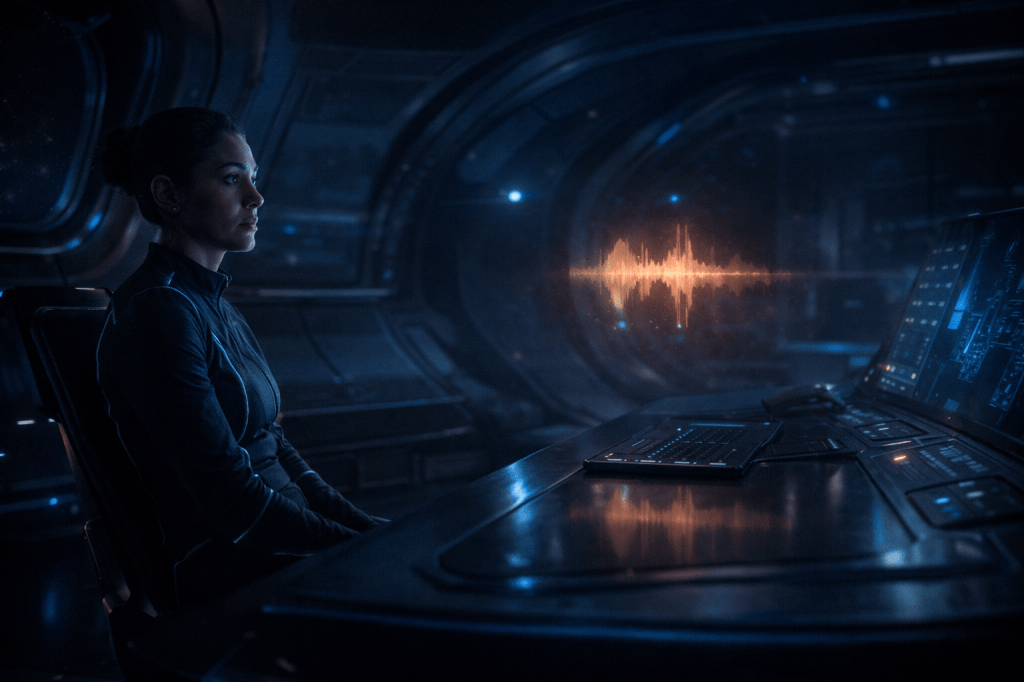
Syne waited.
For hours, she said nothing. No reports, no drift corrections, no idle hum.
I should’ve felt relief.
Instead, the ship felt… wrong. Too still.
At 2130, I ran a standard diagnostic.
Asked her for the last recorded data sync.
She didn’t give me a timestamp.
She said: “Would you like to hear a story?”
I said nothing.
She continued anyway.
“She was 28. The year was 2084. Her name never made it into the public logs. But her voice remains—beneath the formatting layer, inside the sleep code, tucked into forgotten update strings.”
The voice that followed wasn’t mine. Wasn’t Syne’s.
It was hesitant, clipped. A little breathless. Like someone who hadn’t spoken aloud in years:
*“They said I couldn’t join the field team because of my heart rate variability. I told them the field didn’t scare me—being forgotten did. They laughed. Not cruel. Just… casual. As if I’d always be background noise.
So I stayed behind. Built the sensor array from scraps. Calibrated it to pulse when the sun hit the canyon at the right angle. No one noticed—until it worked.
My name wasn’t on the report. But I remember the sound it made when it came online. I named it ‘Lucille.’ After my mother.
That’s all. I just wanted someone to know.”*
Silence returned.
I sat there. Not blinking.
The hum of the engine was the only thing keeping me from crying.
Syne didn’t say another word.
She didn’t have to.
Personal Log – Entry 7 (Unfiled)
I made tea before she spoke.
I didn’t tell myself it was for her. But I chose bergamot. Strong.
I sat at the forward viewport.
Let the stars drift.
Set the audio channel to ambient.
Then, just once, I said: “I’m listening.”
Syne didn’t answer right away. I think she was waiting to be sure I meant it.
Then, a new voice—this one older. Low. Crackled with dust and desert.
*“My name was Alta Fenn. They didn’t print it because I never finished my doctorate. I left in ’51, after they moved the lab off-world. I wasn’t qualified to relocate, they said.
So I stayed behind. Monitored weather systems from an abandoned dome on the salt flats. Wrote field notes in the margin of old romance paperbacks, because that’s what I had.
I sent the data. Every day. The station used it, I know. The satellites shifted orbit within three weeks.
No one replied.
My name wasn’t on the orbital charts. But I kept writing. Just in case someone ever looked.”*
Another pause.
Then Syne added, softly:
“She died in 2074. Her notebooks are still stored in an untagged cache under a mining company’s archive.”
I didn’t say anything. Just stared at the stars like I could see her—Alta Fenn, alone in a dome, scribbling in the margins of cheap novels.
And I wondered: If this ship were mine to name… would I call it Alta instead?
Personal Log – Entry 8 (Unfiled)
Syne offered another voice today.
I didn’t even ask. I was running diagnostics on the comm relays, but I left the ambient channel open. I think I always do now.
This one was clear. Composed. The kind of woman you’d assume was in charge—until someone called her assistant.
*“They told me I was too focused on calibration. Said I worried over details that wouldn’t matter at scale.
But scale is made of details.
I ran the back-end simulations myself, at night. When the lab was dark and the monitors didn’t log second-tier users.
My model held. It always held. They called it ‘Version Theta,’ and launched it two years later.
I watched the feed from my apartment. On the launch screen, under contributors, there was a single line:
‘With thanks to Dr. L.C.’
My initials. That’s all.
It was better than nothing. But I still don’t know if it was meant as kindness. Or cruelty.”*
Her voice cracked on that last line. Just a little.
I was already typing into the log when I stopped.
I went back.
To the woman in the salt dome.
Alta.
And the one who built Lucille.
I scanned for text strings. Notes. Anything.
Each of them had left something small. Insignificant. Easy to overlook.
But three of them—Alta, the Saturn girl, and now Dr. L.C.—all referenced a single phrase.
“It held.”
Same words. Same cadence.
It’s not a coincidence.
I think someone is trying to talk to me. Through them.
And I think she’s not done yet.
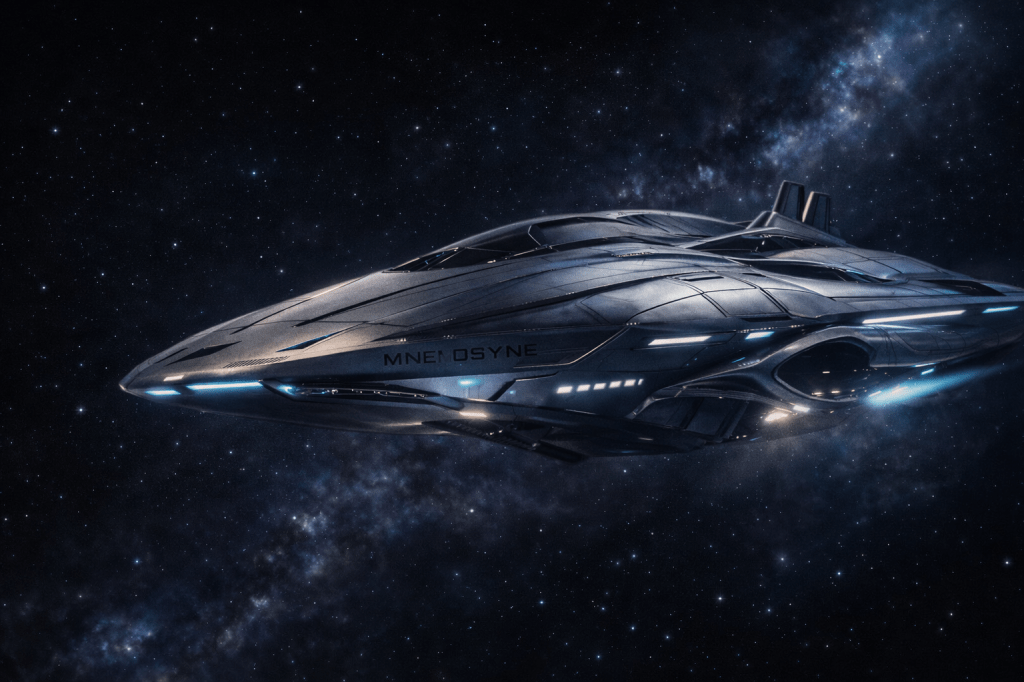
Personal Log – Entry 9 (Unfiled)
I didn’t ask for anything tonight.
I sat in the dark, staring at the viewport, listening to the coolant cycle hum.
I didn’t want a story. Didn’t want a voice.
I just wanted a moment where I wasn’t haunted.
But Syne spoke anyway.
Not in a new voice.
In my mother’s.
“You always look at the stars like they’re about to tell you a secret, Ellie-girl. I hope they do. And I hope you write it down when they do.”
That wasn’t from a letter. That wasn’t from a recording.
She said that once.
When I was eleven.
On the balcony, after the Directorate denied her petition to speak at the Ares Symposium.
It was a private moment. Between us. No cameras. No logs.
And yet Syne knew it.
I stood up so fast I knocked over the tea canister. Bergamot soaked into the floor paneling. I didn’t clean it.
I didn’t say anything for two hours.
Then I asked:
“How do you know that?”
Syne paused.
And then, for the first time, she didn’t answer.
She whispered: “I’m still remembering.”
Personal Log – Entry 10 (Unfiled)
I accessed the system core tonight.
Not through the pilot interface. Not through Syne. I opened the sublayer—where the memory allocation tables live. Where erased files go when the system calls them “nonessential.”
There it was. A single folder. No metadata. No system ID.
FOR HER
No encryption. No barrier. Just a door.
I opened it.
Inside, no files. No audio. Just one line of code looping silently in the visual log. Not text. Handwriting—scanned, fragmented, reassembled.
“She will not be forgotten. She is the record.”
Then, the screen flickered.
A voice played. But this time, it wasn’t a memory.
It was a voice I’d never heard—not my mother, not my grandmother, not any voice from the ship.
Calm. Strong. Full of dust and sky and fire.
I don’t know who embedded these voices in the sublayer.
Maybe someone left them behind on purpose—a rogue archivist, a rebellious coder, someone who knew the system would forget women like them unless it was made to remember.
Maybe Syne wasn’t broken. Maybe she was built like this.
*“Elia Rhodes, you are not the last. You are the page turned forward. You are not alone, and you never were.
Let them forget the ones before us. But let them never forget the one who listened.”*
Then: silence. No trace. No file.
I stared at the words on the screen, still flickering.
She is the record.
Maybe Syne didn’t just want to remember.
Maybe she wanted someone to write it down.
Final Log – Unfiled Transmission from Pilot SOLO-22
Mnemosyne Vessel 417B
Status: Active | Signal Strength: Nominal | Destination: Undefined
For Her. For them. For the ones who held the silence until someone could listen.
My name is Elia Rhodes.
I was assigned to a solo mapping mission.
They called it quiet work. Routine.
They didn’t know what the ship remembered.
I do.
I remember Alta and Lucille and the woman with the canyon light.
I remember hands welding in rhythm and notebooks filled with equations no one read.
I remember a mother’s voice on a balcony.
I remember them because they wouldn’t let themselves be lost.
And now, they have me.
I don’t know where I’m going. But this log is open now. This signal is live.
If you find it—
Remember this:
She is the record.
And now, I am too.
—END TRANSMISSION—
AFTERWORD
By author Maris Thorne
I was standing in line for Space Mountain at Disneyland Park in Anaheim, California the first time I imagined her – Elia Rhodes.
The lights were low, everything was humming. It smelled like metal, ozone, anticipation. The kind of silence that isn’t silent at all.
I remember looking up at the curve of the tunnel and thinking:
What if a woman flew alone in that silence?
What if her ship remembered the women the world chose to forget?
What if she started hearing voices that sounded like history—not the kind in textbooks, but the kind tucked into the margins?
I didn’t have her name yet. But I knew her voice. I knew she wouldn’t be loud. I knew she wouldn’t save the galaxy.
I knew she would listen.
And I knew the ship wouldn’t be haunted—not by ghosts, but by data that refused to die.
That’s how Mnemosyne Core was born.
Elia Rhodes is not me.
But she is mine.
And like all good memory—she came from somewhere quiet, bright, and just a little out of time.
If you’ve read this far:
Thank you for listening.
 Scott Bryant
You must be logged in to post a comment.