
Downriver, during that feud
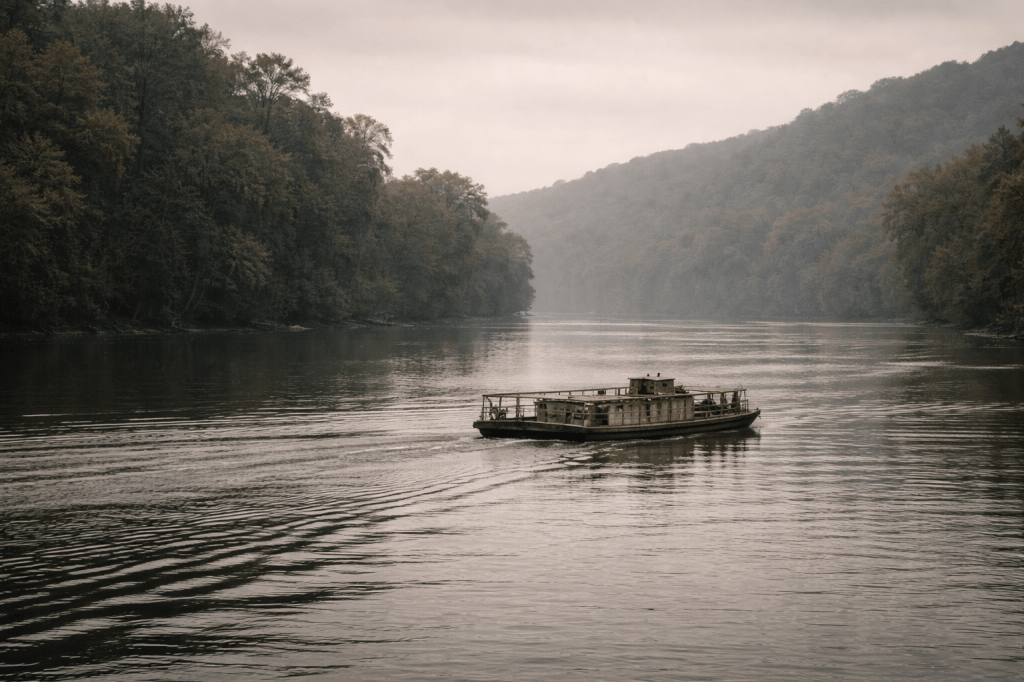
The boat had been moving long enough that the sound of it no longer felt new.
The paddle kept its own time — steady, unhurried — the way something does when it expects to last the whole day. The river was wide here, wider than it had been upriver, and calmer for it. The banks slid past without comment. Trees. A landing we did not stop at. Another bend.
We sat close, not because there was nowhere else to sit, but because the wind came down the river sharper than it had any right to. Someone had brought a shawl and passed it without asking. Someone else held the logbook on her knees, open more out of habit than purpose.
Nothing required writing yet.
The boat smelled of coal and damp wood and whatever the river had been carrying since morning. When the engine shifted, it sent a low vibration through the boards that made loose things remember themselves. A cup rattled. The pencil rolled and was caught before it could fall.
It might have stayed that way — just the sound, just the moving — if one of us hadn’t said it the way people do when they don’t mean to start anything.
“That feud,” she said.
Not loud. Not to anyone in particular. As if naming the weather.
We didn’t answer right away. The river doesn’t stop for conversation, and neither does a boat once it’s set on its course. But the word sat there between us, familiar enough that it didn’t need explaining.
“I was told,” another said after a moment, and stopped there, as if checking whether the rest of us would allow it.
She did go on. Slowly. Carefully. With the kind of details that arrive secondhand — a place described without names, a night everyone agreed had been dark, a woman seen once at a window though no one could say who saw her or from where.
“That part wasn’t in what I heard,” someone said, not unkindly.
“No,” she agreed. “I might’ve added it.”
We smiled at that, because we all knew how it happened. How a story grows hands where there were none. How a face appears where there was only a light left burning too late.
The pencil hovered above the page, uncertain what it was meant to record — the river’s condition, or the way we kept circling back to women we would never meet, awake somewhere upriver, listening the way we once had.
The boat kept moving.
So did the telling.
The pencil did touch the page then, though no one said what ought to be written. The line came out crooked, the way it does when the boards shift under your hand. The river’s condition was marked because that was easy. Clear enough. Moving steady. Wind from the north, sharper than expected.
Below that, nothing.
“I had heard it was nearer the fork,” one of us said, as if distance might make the difference. “Closer than people want to say.”
“That’s not how it reached me,” another answered. “They said it happened farther down, where the trees thin out and there’s room for sound to travel.”
“Well,” the first said, considering this, “that already feels like a better story.”
We laughed — softly, because laughter carries more than words do, and there was no reason to give it help. Someone added that whenever a story includes trees thinning conveniently at the right moment, it’s usually been walked a little too far from where it started.
“That doesn’t mean it didn’t happen,” the second said.
“No,” the third agreed. “Just that it’s been tidied.”
That seemed fair. Most things are, by the time they reach people who weren’t there.
The version we’d all heard agreed on very little. A night. A sound. A house or something like one. After that, everything loosened. In one telling, a woman had stepped outside just before it happened — not because she heard anything, but because she couldn’t sleep and thought the air might help. No one knew who first said that. It didn’t belong to anyone.
“She wouldn’t have done that,” one of us said, almost smiling. “Not in that cold.” Another shrugged. “Someone always gives her a reason to be awake.” We let it stand anyway — the woman at the door, listening — because it felt wrong to leave her inside without warning.
“I don’t believe she said that,” one of us said at last, not sharply. “It sounds like something someone wished she’d said.”
There was a pause, then a nod. That happened often. Words put into women’s mouths once they weren’t there to keep them out.
Still, we kept the story moving between us. Adjusting it slightly. Taking turns smoothing what felt too cruel, roughening what felt too clean. When someone added a detail that clearly couldn’t be known — a look exchanged, a hand held in the dark — no one stopped her. We only smiled and said, “That part’s yours.”
She accepted that without offense.
The logbook lay open, patient. A place made for certainty, holding none of it. The pencil rested across the page as if it might roll again if left unattended.
Outside, the river widened a little more. The sound of the paddle softened as the water deepened, and for a while no one spoke at all. We were thinking, not about the men everyone else was thinking about, but about the women who would be waking now, upriver or down, listening for sounds they would later be asked to explain.
Nothing else was written.
The boat went on.
The story shifted again after that, as stories do when they’ve been handled too long. Someone said she’d heard there was a child in the house, though no one could say where that came from. Someone else said there couldn’t have been — the timing didn’t allow it — and then paused, reconsidering. “Well,” she added, “maybe that’s why they keep adding one.”
We understood. A child changes the weight of a thing. Makes it harder to set down.
Another detail followed — the least believable of all — that one of the women involved had known the trouble was coming days before. That she’d said so out loud and been laughed at. We didn’t argue with that version either, though it asked more of belief than the rest. “Everyone wants her warned,” one of us said. “Even if it’s late.”
The pencil moved then, not to write any of it, but to draw a small line in the margin, as if marking where the story had passed beyond what a log could hold. The page was filling in its own way — not with facts, but with the space they left behind.
We fell quiet after that. Not because there was nothing left to say, but because we had said what we came for. The river had widened again, smoothing itself out, the paddle’s sound thinning until it was more rhythm than noise. A landing appeared ahead and slipped past without notice.
Somewhere — upriver, downriver — women were waking, or not sleeping at all. We didn’t know their names. We didn’t know what was true of what we’d told. We only knew we would think of them later, when the boat had gone on without us and the river had narrowed again.
The logbook was closed.
The boat kept moving.
 Scott Bryant
You must be logged in to post a comment.