
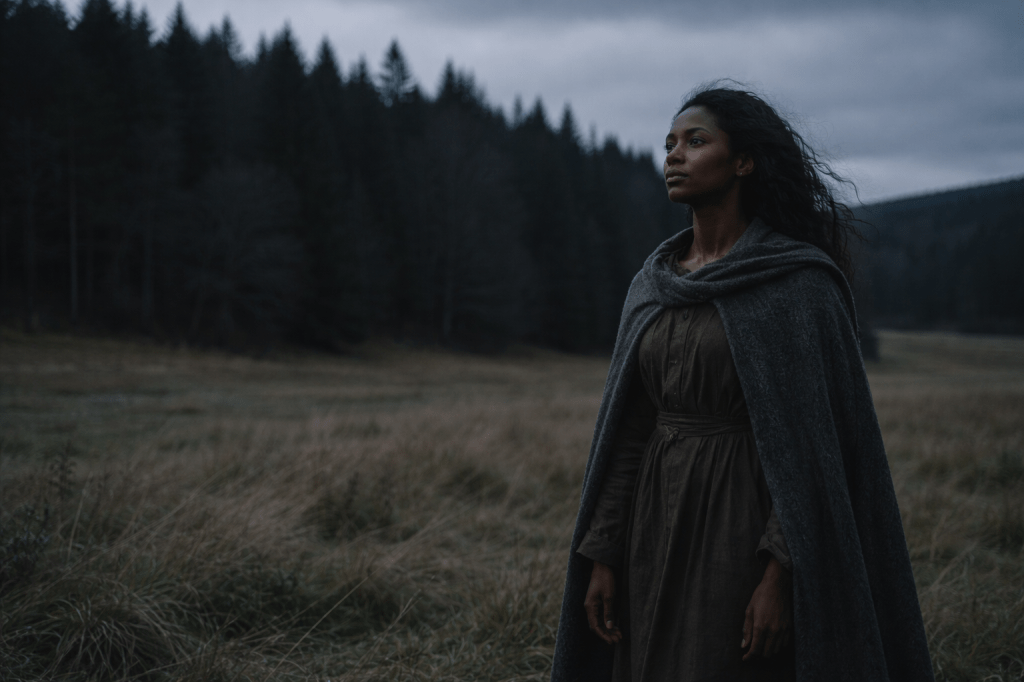
I learned early that telling the truth is not the same as being believed.
When it happened, I spoke once—clearly, carefully, the way you do when you think accuracy will be enough. I remember watching the faces around me settle into something else, something easier. Not disbelief exactly. Replacement.
After that, I stopped trying to correct the world. I concentrated instead on not letting it rearrange me.
The road was longer than I expected. Not in distance, but in how it stretched time. The woman who rode beside me spoke often, loudly, as if volume itself could make a claim hold. She called me by the name she was wearing now. She spoke of the city ahead as if she had dreamed it into being. When she laughed, people turned toward her. When I spoke, they glanced away, already finished listening.
The first time she told them I was nothing, I thought it was a misunderstanding. The second time, I realized it was instruction.
By the third, I understood the lesson well enough to stop interrupting it.
There are moments when a life turns without ceremony. No sound. No witness. Only a quiet internal movement, like a knot pulled through cloth. I remember thinking—not dramatically, not with despair—that this was a hinge I would not be allowed to name again.
I gave up the word for myself first. That was the easiest thing to release. Names invite questions, and questions demand answers. I had learned the cost of answers.
Work did not ask who I had been.
Geese do not care what you were called before you learned how to walk beside them. They require attention, consistency, an understanding of weather. They notice if your hands are gentle. They notice if your presence steadies them or makes them skittish. They respond to rhythm, not story.
I was good at it almost immediately. That surprised me. Or maybe it shouldn’t have. I had always been good at noticing what others overlooked.
The land knew me before people did.
There is a particular kind of freedom in being underestimated. It is not a loud freedom. It does not arrive with relief. But it gives you room. The space to listen. To observe without performance. To let your body relearn itself without explanation.
Years passed in ways that did not feel like years until I looked back and found them stacked behind me. I grew stronger. Not in the way people admire, but in the way fences admire posts that don’t move. My hands hardened. My shoulders changed. My voice lowered from disuse.
I learned the sound geese make when something is wrong. I learned how frost smells before it shows itself. I learned that hunger is not always the worst discomfort a body can endure.
I did not forget who I had been. But I stopped rehearsing her.
Sometimes news drifted in, as news does. The woman who took my place married well. She wore silks that caught the light. She was admired for her stillness, her obedience, her beauty. People said she had softened the city. People said she was kind.
I believed them. People can be many things and still be thieves.
At night, I slept without dreams. That, too, was a skill learned slowly. I trained my thoughts the way you train animals—firmly, without cruelty. I did not revisit the past unless it arrived on its own. I did not imagine confrontations. I did not practice speeches that would never be spoken.
I learned to let memory pass through me without lodging.
There was a time, once, when someone asked me if I had family.
I paused longer than necessary. Not because the answer was complicated, but because it no longer mattered. The truth had changed shape. I said, “Not nearby.” This was accurate enough to be believed.
Accuracy, I learned, is a private thing.
What surprised me most was not that I survived, but that I did not become bitter. The world had not singled me out. It had simply continued in the way it often does—rewarding the confident, absorbing the quiet. I found no satisfaction in resenting that. Resentment requires an audience, even if only an imagined one.
I preferred to keep my interior unobserved.
There were days I thought of speaking again. Not to reclaim anything—by then I understood that reclamation was a story people tell to make endurance look like victory—but to test the sound of my voice against the air. I practiced alone sometimes, in fields where no one could hear. The words came out strange, unused. I did not recognize myself in them.
Eventually, I stopped trying.
There is a dignity in continuity that does not rely on acknowledgment.
The geese aged. I aged with them. New hands came and went. New people arrived who never asked where I came from. They accepted the version of me that existed because it functioned. I was trusted with small things. Then larger ones. Keys. Accounts. Decisions made without ceremony.
Trust, I learned, grows sideways.
I was not unhappy. That is important. The story does not hinge on sorrow. There were mornings I woke with a sense of rightness, the clean satisfaction of knowing exactly what was expected of me and meeting it. There were evenings filled with quiet that did not ache.
Once, years later, I saw her from a distance.
She was older than I remembered, though so was I. She stood in a place designed to display her. People leaned toward her when she spoke. I felt no surge, no urge. Just a faint recognition, like noticing a scar you no longer feel.
She did not see me.
That, too, was accurate.
I left without drama. I did not watch her longer than necessary. Curiosity is another kind of attachment, and I had learned to live without it.
There is a temptation, in stories, to believe that being unseen is the same as being erased. It is not. Erasure requires consent. I never gave mine.
What I lost was not myself, but the version of myself that needed the world to agree.
I learned instead to carry my life internally, the way some people carry water across long distances—carefully, without spilling, without showing how heavy it is. My body became the archive. My habits the record.
No one ever returned what was taken. I did not wait for it. Waiting is a negotiation, and I had withdrawn from those.
In the end—if there is an end—I understood something simple and unremarkable:
A life does not require witnesses to be real.
Only continuity.
Only breath.
Only the quiet decision, made again and again, not to disappear.
I lived.
That was enough.
 Scott Bryant
You must be logged in to post a comment.