
The Night Knows Their Names
Written & Told By
Tem Elwell, Mirabel Dunn,
& Becca Talbot
Story Discovered By
Jocelyn Hayes, Renee Takahashi,
Maritza Holloway, Taylor Monroe,
& Madison Rivera
Visuals & Imagery Created By
Jocelyn Hayes, Renee Takahashi, Maritza Holloway,
Taylor Monroe, Madison Rivera, & Scott Bryant
With care and reverence, their story was shared by
Scott Bryant at the request of Jocelyn Hayes,
Renee Takahashi, Maritza Holloway,
Taylor Monroe, & Madison Rivera
A Note from the Storykeepers, Jocelyn Hayes, Renee Takahashi,
Maritza Holloway, Taylor Monroe, & Madison Rivera
This story began in silence—in ledger margins, rising dough, and the hush before a rider passes. We followed the voices of Tem, Mirabel, and Becca not to invent, but to listen. Their defiance was quiet. Their choices, deliberate. Their legacy, shared in trust.
Scott Bryant did not speak for them.
He lit the frame so we could see them clearly.
With care and reverence, we thank you for reading.
— Jocelyn Hayes, Renee Takahashi, Maritza Holloway, Taylor Monroe & Madison Rivera
April 26, 1777
Whippoorwill Tavern
ACT I — Stirring the Fire
Tem Elwell
I, Tem Elwell, keeper of the Whippoorwill Tavern, keep three ledgers. The real one lives beneath the bar, inked in a tight hand that balances payments and bread crusts. The second’s for show—open on the counter, blank past the third page. The third I burned last spring, after the wrong man asked the right question.
No men past the porch. That’s the rule. Has been since Mags Elwell nailed the first board of this tavern into the earth.
Some still try, of course. Say it’s the storm. Say they’re cold, or lost, or officers. I don’t mind the cold ones—they’re quick.
It’s the talkers you have to watch. Talkers always have maps.
Tonight, the rain is angled like needles. Wind keeps unhooking the shutters. Mirabel’s muttering about the soup going thin and Becca’s pacing like a woman who just swallowed gunpowder.
Outside, there’s a sound like hooves. Not close. Not far. Not thunder, either.
We all go still. The fire snaps.
“She’s out there,” Becca says. Not a whisper. A certainty. “She rode past.”
I close the ledger. The real one.
Mirabel Dunn
The soup isn’t thin. It’s just nervous. I’m Mirabel Dunn, the Whippoorwill Tavern cook.
Soup does that sometimes—shrinks back into itself when the sky acts up. I stir harder, like I can whip the storm out of it, and keep one ear to the window.
Tem’s got her set jaw on, which means she’s thinking about pulling out the pistol. Becca’s itching to light something on fire just to prove it’s night.
They’re too loud tonight. The tavern’s bones know it.
Tem’s got her shoulders stiff. She always does when she feels something coming. Doesn’t say it—never does—but I see it in how she sets the salt just so on the counter. That’s her signal.
“Did you see her?” Becca asks me, wide-eyed. Hopeful like it’s a storybook, not war.
“I saw something.”
That’s all I give.
In the back pantry, the sourdough didn’t rise right. That’s the only proof I need.
Becca Talbot
They don’t believe me, Becca Talbot. They never believe me.
I heard the hooves. Fast. Light. Not like a farm cart. And I saw the coat—a girl’s coat, red as embers, flying out behind her like it had somewhere to be.
She was riding like her whole life depended on it. Like someone else’s life did too.
Tem said it could’ve been anyone. Mirabel just squinted at me like I was a runaway chicken. But I know what I saw.
Maybe it was her—the one they talk about over in Putnam, the colonel’s daughter. Rode all night through rain to rouse the militias. They say she didn’t flinch.
Or maybe it wasn’t.
Maybe I just needed to believe it was someone like that.
Doesn’t matter. I light the lantern anyway.
I don’t hang it out on the post—I’m not a fool. But I set it in the highest window, on the sill behind the blue curtain, the one only seen by riders who know to look.
Tem will say it’s a waste of oil. Mirabel will say it’s a waste of caution. But if the girl—if she—if she rides by again, I want her to know there’s one place that noticed. One place that saw her.
Even if she didn’t stop.
Mirabel
The knock’s too polite.
That’s the first thing I don’t trust about it. Three little taps like she’s come for tea, not for sanctuary. It’s raining sideways. No one knocks like that in a storm.
Tem pauses just long enough to check the pistol under the bar. Doesn’t touch it—just checks that it’s still there. Becca’s already halfway to the door, breath fogging the glass.
I beat her to it. Open the small hatch first. That’s the real door. You can see someone’s eyes through it, but not much else.
This one’s eyes? Wild. Red-rimmed. Too awake.
“Are you alone?” I ask.
A nod. Too fast. “I’m supposed to be further north. She passed me. I couldn’t—my horse stumbled—” The words come out broken, like a bread crust torn too fast.
“You bleeding?”
“No.”
“Then come in quiet.”
Tem
She’s young. Not Becca-young. But close enough to make me feel old.
She drips onto the boards like a woman made of weather. Her coat’s wool, dyed too dark to tell the color, but her fingers are shaking. Not from cold.
From knowing something.
I give her a blanket. I don’t ask her name.
Mirabel hands her broth without a word. Becca perches on the hearth like a hawk with questions.
“What did you mean—she passed you?” Becca asks.
The girl sips, coughs. Sips again. Then she looks straight at me.
“There was a rider,” she says. “Young. Girl. Black coat, red scarf. No saddlebag. She didn’t stop. She didn’t even slow down.”
Becca’s eyes go wide enough to catch sparks.
“She’s real,” Becca whispers. “It was her.”
The girl nods. “Said she was heading to rally the militias. Said Danbury’s burning.”
Danbury.
I grip the edge of the bar hard enough to leave dents.
Becca
I knew it. I knew she was real.
That flicker of a rider slicing through the dark like she was on fire herself—she wasn’t a dream. Wasn’t a story I made up to feel important. She was real, and she was riding like the world depended on it.
Because it does.
And now she’s gone, and I didn’t do anything.
Didn’t light the fire pit. Didn’t ride out behind her. Didn’t even shout.
This girl—this courier with the soaked boots and wild eyes—she’s a ghost of what I could’ve been if I’d had the guts.
“We have to help,” I say.
Tem gives me the look. The one that’s half flint, half ice.
“We are helping,” she says. “We gave her soup.”
I want to throw the bowl across the room. I don’t.
Instead, I slip out to the kitchen, find Mirabel’s extra bread tin, and start carving a symbol into the underside of the lid. Something simple. Something a rider might recognize.
Mirabel walks in, sees me, and sighs like I’m the world’s loudest fox in the henhouse.
“Are we baking revolution into the crust now?” she says.
“Just flavor,” I mutter.
She raises an eyebrow. “Hope it pairs well with treason.”
ACT II — The World Knocks Back
Tem
They come up the hill like a mistake someone let loose.
Three riders, soaked in their coats, muskets slung low. One’s chewing something—jerky or tobacco—and leaving spit stains down his front. They don’t dismount. They just sit there, steam rising off the horses like ghosts.
Mirabel’s in the doorway beside me. Becca’s not in sight, which means she’s somewhere she shouldn’t be.
The man in front doesn’t smile. He says:
“We’re looking for a rider. Girl. Late teens. Fast horse. Patriot type.”
I dry my hands on the apron. “No guests like that tonight.”
“You run the place?”
“I keep the books.”
He looks past me like he’s trying to see through the walls. “Lantern’s lit upstairs. That an invitation?”
I smile like flint.
“It’s for storms. Not soldiers.”
Mirabel
They smell like wet dog and nerve.
Tem does the talking. I do the watching. The one on the left’s got restless eyes—keeps glancing at the back garden like it owes him something. Probably a thief before he was a scout. Probably worse now.
The bread on the counter’s still warm. I pick it up, wrap it in cloth, step past them like I’m nothing.
“Taking this to Ruth Lang’s,” I mutter.
Ruth Lang doesn’t exist. But they don’t know that.
The chewing one says, “Got anything stronger in that basket?”
I pause. Look him straight in the eye.
“Regret. You want some?”
Tem’s face doesn’t move. But I know she’s laughing somewhere in there.
Becca
I am not hiding. I’m repositioning.
Fine, okay, I’m hiding.
But only because Tem would lose her entire mind if she saw what I’m holding. The musket’s too heavy. The powder smells like wet ash. I dropped one of the balls under the stable door and nearly set a chicken on fire lighting the wick.
Still. I’m ready. Kind of. Mostly.
I crack the barn door. I see them—three of them—and Mirabel walking like she’s got thunder in her shoes. And Tem. Tem’s standing like she’s dared the wind to come inside.
She doesn’t need me.
That makes me mad and proud at the same time.
Then the one chewing spits in the direction of the porch. He says something I can’t hear.
And Tem steps forward, just slightly, and I swear even the horses go quiet.
I don’t light the musket. I don’t breathe.
She’s got this.
Tem
They ask to come inside.
I say no.
They ask again. I say we serve women. If they want a drink, they can ride on to Cross Hollow where the cider’s flat and the beds are worse.
They stare me down.
I stare harder.
Then they laugh—sharp, brittle, and too loud. Like boys breaking glass.
“Lantern’s bad luck,” one says as they turn their horses. “Attracts the wrong kind.”
I nod once.
“So does spit.”
They leave. For now.
ACT III — The Choice
Mirabel
I used to dream about what I’d do if men came knocking again.
In the dreams, I was bold. Fast. Wicked with knives. In the real world, I bake. I braid. I listen. And sometimes I lie, if it’ll keep someone breathing.
The scouts are gone. But they’ll be back. The rain hasn’t stopped.
I leave the marked loaf in the basket behind the woodpile. A neighbor girl will pick it up before dawn and carry it down the ridge, into the valley. She won’t ask what’s inside. That’s the deal.
Tem doesn’t stop me. She sees the tin Becca carved and doesn’t say a word.
I think we’ve all reached the point in the night where silence is safer than principle.
Becca
I put the musket back.
Not because I’m scared—okay, a little because I’m scared—but also because I get it now. The loud kind of fighting, the glory kind? It’s not what saves people.
It’s soup. It’s warnings wrapped in bread. It’s Tem standing so still that no man dared move.
I feel like I missed something and learned something all at once.
And still, I’m furious.
Furious that the rider didn’t stop. Furious that she couldn’t. That girls have to do the impossible just to be noticed, and even then, they get remembered as ghosts, or footnotes.
I go upstairs and relight the lantern.
It’s not a signal anymore.
It’s a statement.
Tem
I find the courier in the cellar. She’s curled near the potatoes, asleep but not resting.
I sit beside her. I don’t touch her. I just watch her breathe.
She’ll leave in an hour. Maybe less. She won’t say thank you. She shouldn’t have to.
Upstairs, Becca’s lit the lantern again. She left the curtain open. On purpose.
I don’t douse it.
Instead, I unlock the drawer I haven’t touched in ten years.
Pull out the old ledger. The real one. The one Mags Elwell kept when the tavern first opened—before the war, before the rules, before we got scared.
I flip to a blank page.
And for the first time in a decade, I write a name down.
Final Scene — Dawn
Tem
We stand on the porch, tea cooling in our hands. The sky’s gone lavender with the first light. The girl rides away without looking back. She doesn’t need to.
Mirabel
The dough rose this time. That’s something.
I leave a second mark on the side of the woodpile—just in case.
Becca
When someone tells the story of the ride, they won’t mention us. That’s fine.
We know.
We were here.
And the lantern was lit.
The Last Entry
Left in the ledger at Whippoorwill Tavern, April 27, 1777
We kept the fire lit.
We kept our hands steady.
We did not look away.
Some came riding.
Some came asking.
Some came only once, and still—we remembered them.
If this finds its way into another’s hands, know this:
We served no nation, only what was needed.
We held no banner, only the line.
We answered the knock, and we chose.
That’s all there is.
—Tem Elwell, Mirabel Dunn, & Becca Talbot
Historical Note
On the night of April 26, 1777, a sixteen-year-old girl named Sybil Ludington is believed to have ridden alone through a storm, traveling over forty miles in what is now New York state to alert local militias of the British raid on Danbury, Connecticut.
Her name is not found in most textbooks. Her ride, though documented in family records and remembered in oral histories, was nearly lost to time.
And yet—someone rode.
Someone warned.
Someone didn’t stop.
This story is not hers.
But it stands beside it.
For every window that stayed lit.
For every name not recorded.
For the women who chose, when no one was watching.
[ ARCHIVAL RECORD ]
LUMIVORE-LOCKED IMAGE PROMPT
Archive Plate — “The Lantern”
FORMAT
Single, horizontal photorealistic cinematic still
Aspect ratio: 16:9
Observational, archival tone
SCENE
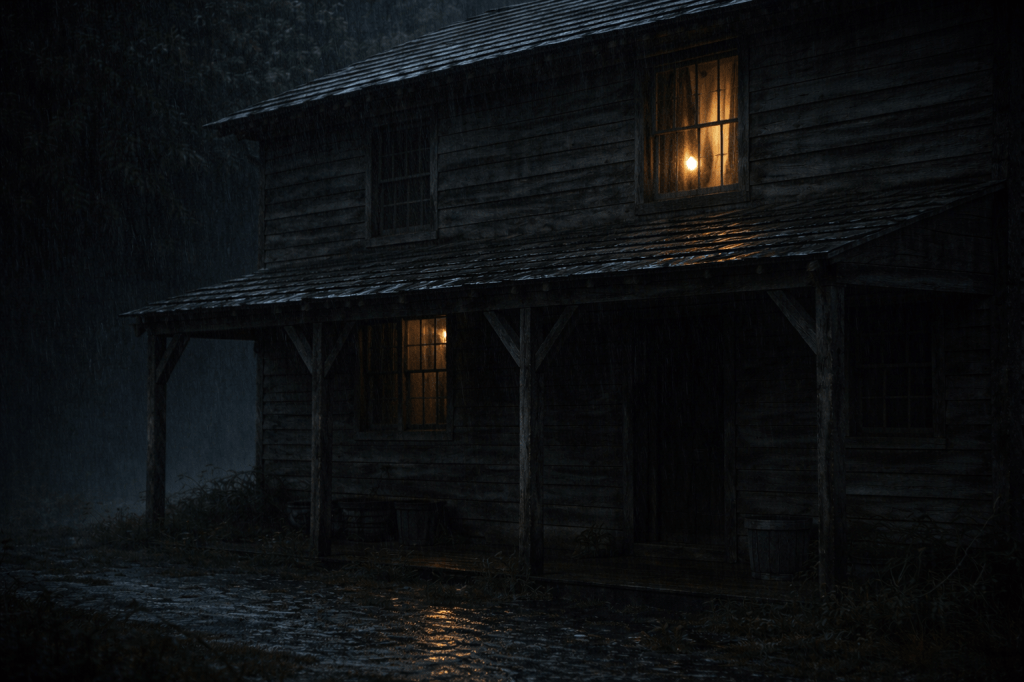
Exterior of a modest 18th-century colonial tavern at night during a storm.
The setting is rural Revolutionary-era New York or New England, circa 1777.
The building is utilitarian and weathered — rough, uneven timber siding, irregular boards, slightly warped roofline, hand-built construction. No signage, no ornamentation, no preserved or reenactment aesthetic.
Rain falls at an angle in visible streaks, driven by wind. The storm dominates the environment.
A single lantern glows from one upstairs window, partially obscured by rain-spattered glass and a thin, slightly parted curtain.
The lantern is not centered in frame.
The building occupies most of the image; the window is offset and noticed only after a moment of looking.
No figures are visible.
SUBJECT (CRITICAL)
The lantern itself.
Warm but restrained amber light
Not bright
Not welcoming
Feels deliberate and sustained
The light suggests a choice has been made, not an invitation.
ENVIRONMENTAL DETAIL
Rain streaks with softened highlights
Wet ground reflecting minimal traces of lantern glow
Wind implied through angled rain and subtle curtain movement
No people.
No silhouettes.
No horses.
No riders.
No soldiers.
No action in progress.
The world feels paused, listening.
CAMERA & COMPOSITION
Eye-level camera
Medium-wide distance
Observational framing, as if viewed from across a yard or dirt road
No dramatic angles
No heroic framing
The image should feel witnessed, not staged.
LIGHTING & COLOR
Dominant palette: deep charcoal, slate blue, wet wood browns
Lantern light: soft amber, contained, never overpowering
Subtle contrast between interior warmth and exterior cold
Rain highlights slightly muted
Night remains night.
STYLE CONSTRAINTS
No fantasy elements
No painterly stylization
No symbolism beyond what naturally exists
No text, signs, or legible writing
No modern materials or lighting
No additional light sources
This must read as a quiet historical moment captured, not reenacted.
EMOTIONAL REGISTER
Quiet resolve.
Risk without bravado.
A light left on — knowing who might see it.
 Scott Bryant
You must be logged in to post a comment.