
What Remains Unclaimed
Story Written & Told by
Ananya Iyer
Imagery by
Ananya Iyer, Rhea Mehta, Aditi Rao,
Mira Sen, & Scott Bryant
With care and reverence, their story is shared by
Scott Bryant at the request of Ananya Iyer
What Remains Unclaimed follows Ananya, an independent woman who retreats to a floating palace in Udaipur seeking quiet from the noise of daily life. As stillness settles, she reflects on past intimacy, the pull of physical closeness, and her fear of surrendering autonomy through love. Observant and unsentimental, the story traces what it feels like to remain open to desire without surrendering autonomy.
॥
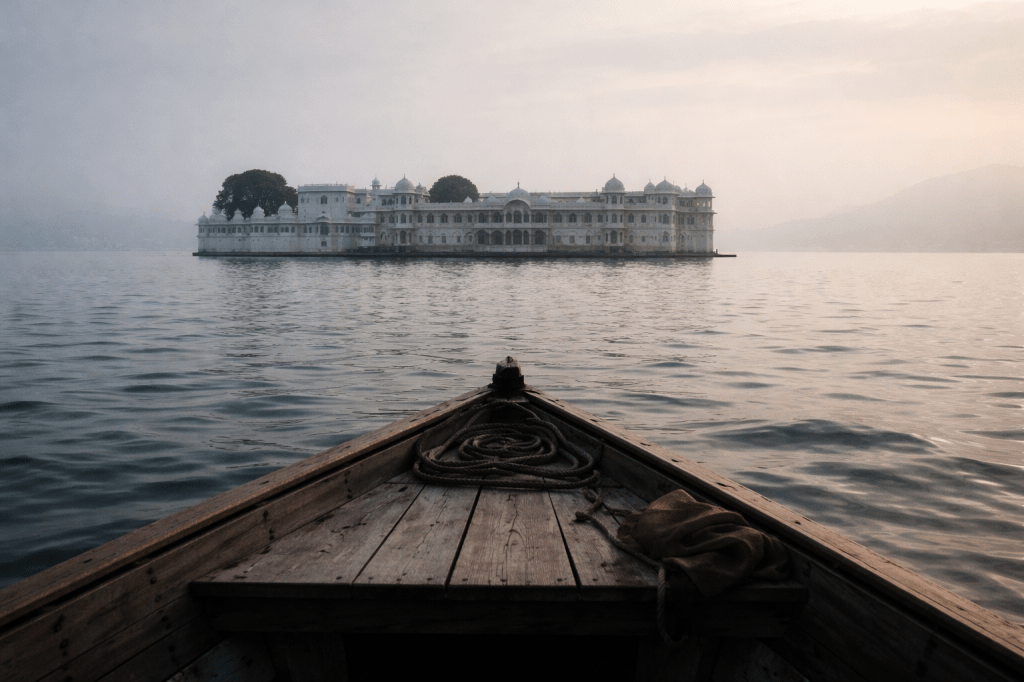
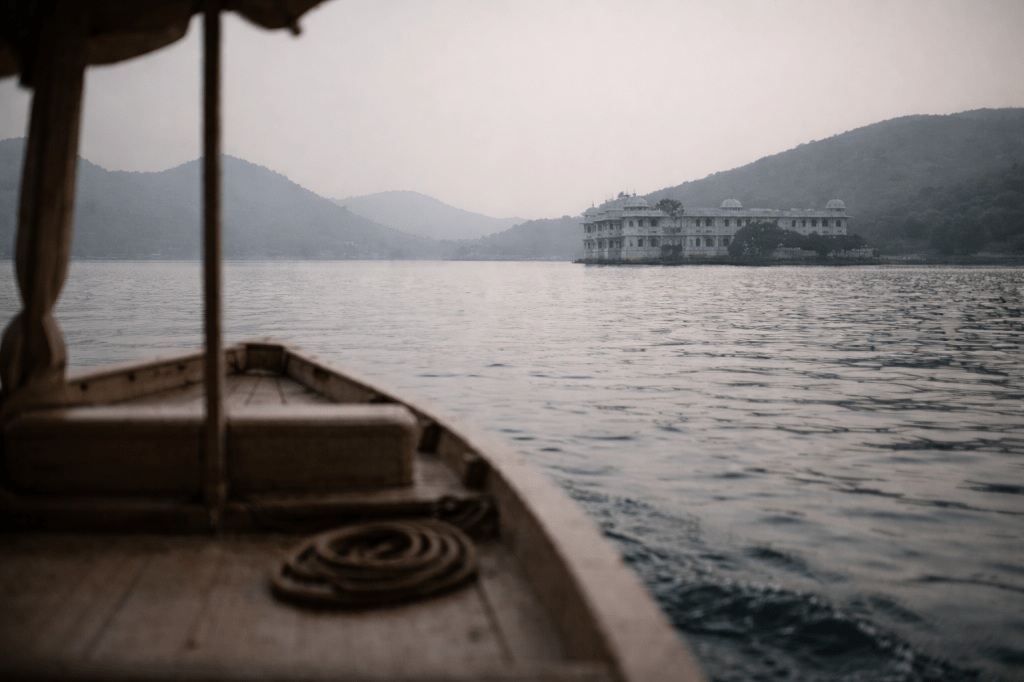
By the time the boat leaves the shore, the noise has already thinned to memory.
Mumbai never stops speaking. Buses, taxis, rickshaws, private cars—all of it layered, insistent, persuasive. Even when I’m alone there, the city keeps reaching for me. Sound is its way of touching.
The lake accepts the boat without comment.
The palace comes into view slowly, as if it has learned not to hurry toward anyone. Pale stone, floating. I remember this approach—the way arrival cannot be rushed, the way nothing follows you out here unless you bring it deliberately.
I came back for the quiet. That was the practical reason, and it was enough. I had begun to feel slightly off in my own life, the way one does when attention no longer settles where it usually does. Too many conversations carrying past their endings. Too much sound arriving before I had agreed to hear it.
Out here, even movement feels optional.
The boat slows. Water laps once against the side and then behaves itself. When we stop, there is no announcement. Just the soft acknowledgment of arrival, as if the lake has decided I may step off now.
Inside, the air is cool and still. The floors hold the day’s light without reflecting it back too sharply. I have always liked places that know how to contain themselves.
I don’t feel lonely. I don’t feel relieved. What I feel is unaddressed—like a room that has been left open, waiting to be entered or closed.
That will come later.
For now, the quiet is enough.
॥
I unpack slowly, as if there is some advantage to delaying completion. The room doesn’t rush me. The windows are tall enough to make the lake feel level with the bed, water meeting stone without hierarchy.
I leave my phone face down on the desk. It vibrates once—out of habit, not urgency—and then goes still. I don’t check it. The quiet has begun to do its work.
Later, I walk the corridors without purpose. I have learned that if I give myself a reason, I will begin managing the experience instead of letting it happen. The palace is good for this kind of walking—no obvious destination, no sense that one should arrive anywhere improved.
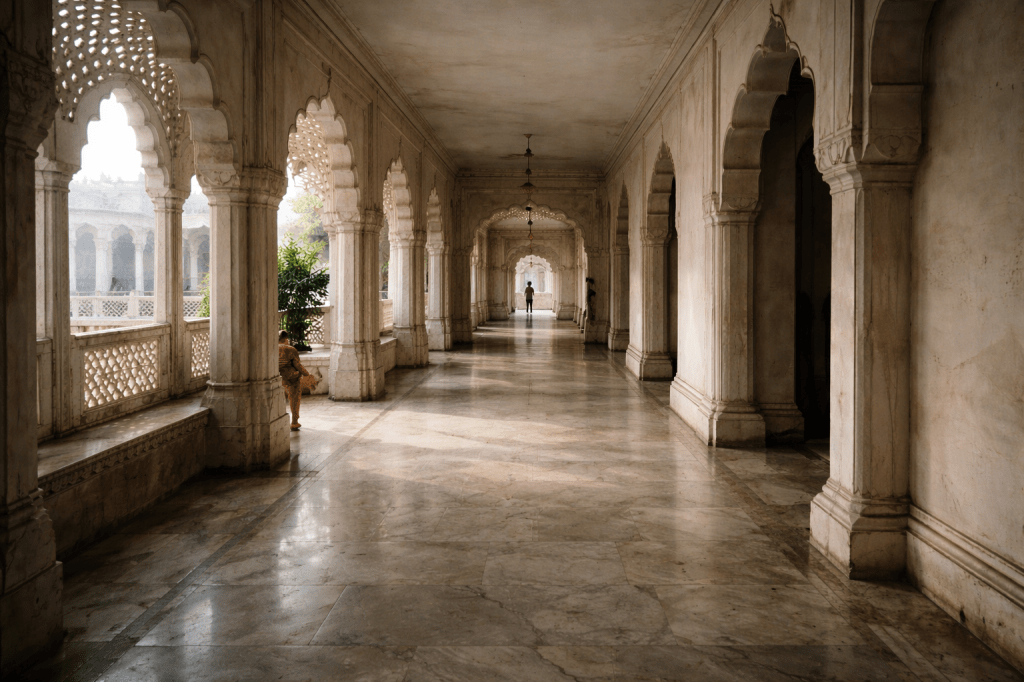
A woman passes me near the stairs. I notice the way she carries her weight, evenly distributed, as if she has made peace with gravity. Her shoes make almost no sound against the floor. For a moment, I imagine what it would be like to walk beside her, to match that rhythm.
I stop myself—not sharply, not with judgment. Just a small internal adjustment. I let the image dissolve. Not everything that appears is an invitation.
Outside, the light is already shifting. Late afternoon loosens its hold, and the lake begins to darken in that way water does when it decides not to reflect anymore. Guests gather quietly on the terrace. No one seems eager. It feels understood that whatever is coming will not wait for us.
I take a seat at the edge.
The music begins without preamble—a voice first, low and steady, as if it has been there all along and we are only now choosing to hear it. There is no announcement, no request for attention. The voice doesn’t reach. It simply occupies space.
And then she is there.
At first, I think I’ve missed the moment of her arrival. That she has stepped into view while my attention was elsewhere. She stands barefoot on the stone, her posture neither expectant nor performative. When she moves, it is not toward the sound, but within it—her body responding without pursuit.
I notice her feet first.
The precision of them. The way they meet the floor and leave it again without hesitation. Each step seems to complete itself fully before the next begins. Nothing spills forward. Nothing lingers.
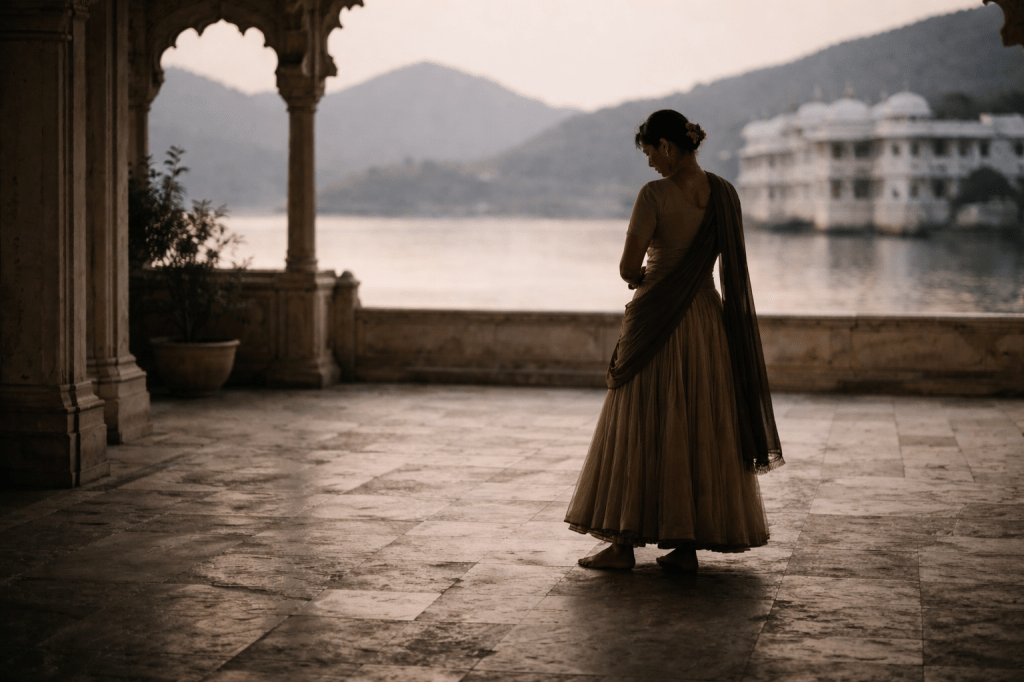
I glance around, expecting some ripple of recognition—someone shifting, pointing, acknowledging her presence. No one does. The audience watches the space where she moves, but their attention doesn’t seem to rest on her in the way mine does.
I don’t feel alarmed. I don’t feel surprised.
What I feel is recognition.
The voice continues—inviting, steady, unclaimed. The dancer listens deeply, allowing the sound to pass through her without being taken by it. Her movements are complete, and when they end, they end cleanly. No apology. No extension.
I realize my hands have gone still in my lap.
This, I think—not as an answer, but as a calibration.
The music does not ask her to stay.
She does not ask it to follow her.
When the final note fades, the space holds for a breath longer than expected. Then conversation resumes softly, as if no one wishes to disturb what has already finished.
I look back to where she stood.
The stone is empty.
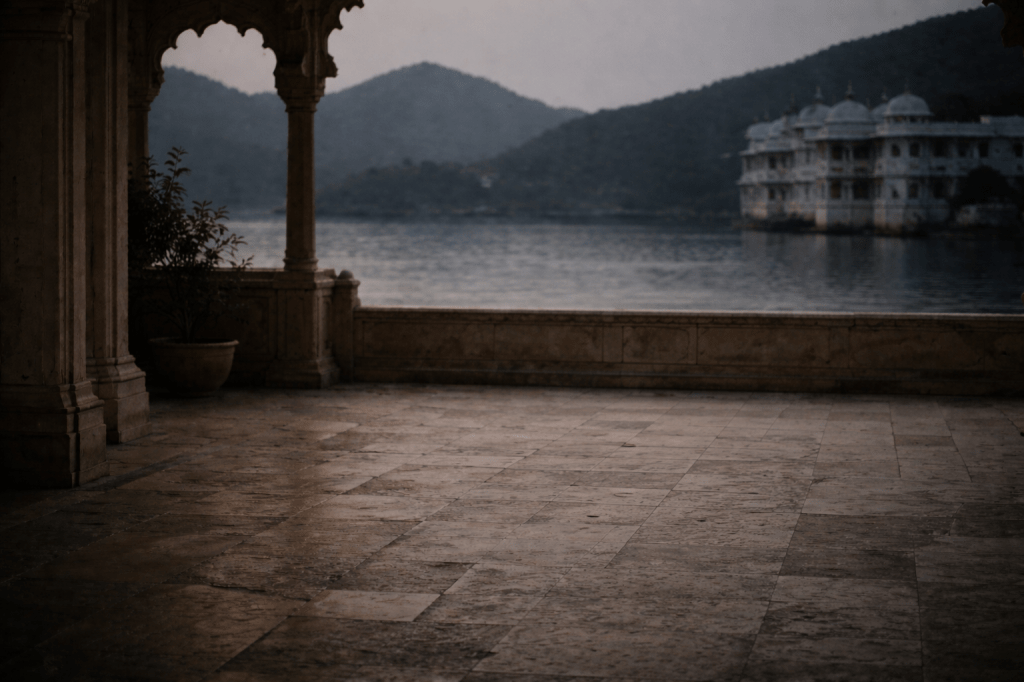
I don’t search for her. I don’t feel the need to confirm anything. The absence doesn’t feel like loss. It feels like completion.
Later, as night settles and the lake turns opaque, I walk back to my room alone. The corridors are quiet again, receptive. I move through them carefully, aware of how easily the body learns patterns—how quickly closeness can become habit, and habit necessity.
Tonight, I am content with listening.
॥
Kavya returns to me the way touch does, not as a story but as a sensation. The weight of her hand at my waist, unthinking and familiar. How easily my body learned the shape of that contact, began to anticipate it before it arrived. There had been nothing dramatic about it—no urgency, no claiming—but repetition had its own authority. Nights arranged themselves around proximity. Calm arrived more quickly when she was near. I don’t remember promises so much as habits: how my body leaned without asking, how need arrived quietly and then stayed. Loving her hadn’t diminished me. It had absorbed me. That was the danger—not loss, but how willingly I surrendered the work of steadiness to someone else. I don’t blame her for that. I only recognize now how complete the offering had been.
After Kavya, I learned to pay attention to specificity. There was a woman, years later, who was generous and attentive in ways that were almost admirable—warm, thoughtful, deeply interested in the details of me. Too interested, as it turned out. She had a particular fondness for my feet, studied them with a precision that suggested intent rather than affection. It wasn’t unpleasant. It was simply clarifying. I remember thinking, with a private kind of relief, that liking someone did not obligate me to be the focus of their attention in quite that way. She was lovely. Just very exact. I wished her well and adjusted my understanding accordingly.
॥
I wake before the lake fully decides what color it will be.
The room is quiet in a way that feels earned. Morning arrives without insistence, light settling across the floor as if it has learned the architecture by heart. I stay still for a while, noticing how my body holds itself when no one else is present. This has become important to me—how I am when nothing is being asked.
Later, I walk along the terrace with a cup of tea I did not choose. It tastes as expected. The lake is opaque now, refusing reflection. Boats move slowly, without urgency or invitation. The city exists somewhere beyond this, already awake, already sounding itself into being. I do not miss it yet.
A woman passes me near the railing. She pauses briefly, not for me, but for the view. I notice the ease of her stance, the way her attention rests outward instead of searching. There is a moment—familiar, practiced—where my body registers proximity and offers its old suggestion. I acknowledge it and let it go. The space between us remains intact, and nothing is lost by that.
I think, briefly, of the dancer.
Not her movements, exactly, but the way they ended. How the body had known when to stop without apology. How the music had invited without insisting. The memory doesn’t arrive as instruction. It arrives as reassurance.
By midmorning, the palace has resumed its quiet choreography. Guests appear and disappear without ceremony. Conversations begin and end without consequence. I find this comforting. Not everything needs to accumulate.
I sit near the water once more before I leave. The lake is still, uninterested in holding anything I might give it. I understand this now—not as a metaphor, but as a fact.
I did not come here to make a decision.
I came to remember how it feels when my life belongs to me—not in isolation, not in defiance, but in balance. Loving women has never been the question. The question has always been how much of myself I offer before I disappear into the offering.
Today, I am content with what remains unclaimed.
When the boat arrives, I step aboard without hesitation. The palace does not recede dramatically. It stays where it is, floating, complete, unconcerned with my departure.
The water carries me back.
 Scott Bryant
You must be logged in to post a comment.