
Cinder & The Crown
– Part II
Story Written By
Queen Aveline Beaumont,
Crown Steward Cinder Dubois,
Duchess Claudine Delisle,
& Madame Esmée Étoile
Told Through the Voices Of
Queen Aveline Beaumont
& Crown Steward Cinder Dubois
Visuals & Imagery Conjured By
Liora Marivelle, Céleste Rousselle,
Théa Lavellan, Éline Vervain,
Maëlle Étoilemont, & Scott Bryant
Spellwork & Whispered Magic By
Madame Esmée Étoile
Intimacy Coordination By
Queen Aveline Beaumont &
Crown Steward Cinder Dubois,
who shaped their closeness with intention,
trust, and truth
With steadfast loyalty, our story is shared by
Scott Bryant, at the royal request of Queen Aveline Beaumont, Crown Steward Cinder Dubois, Duchess Claudine Delisle,
& Madame Esmée Étoile
I believed my story would be written for me—a crown pressed to my head, my steps measured by expectations, my words never truly my own. But I learned, sometimes through fire, that the world is not balanced by silence.”
— Queen Aveline Beaumont
“They called me Cinder because I lived among the ashes. But even from the soot, I learned to see sparks.”
— Crown Steward Cinder Dubois
Part 2: The Ball
Anticipation and Defiance
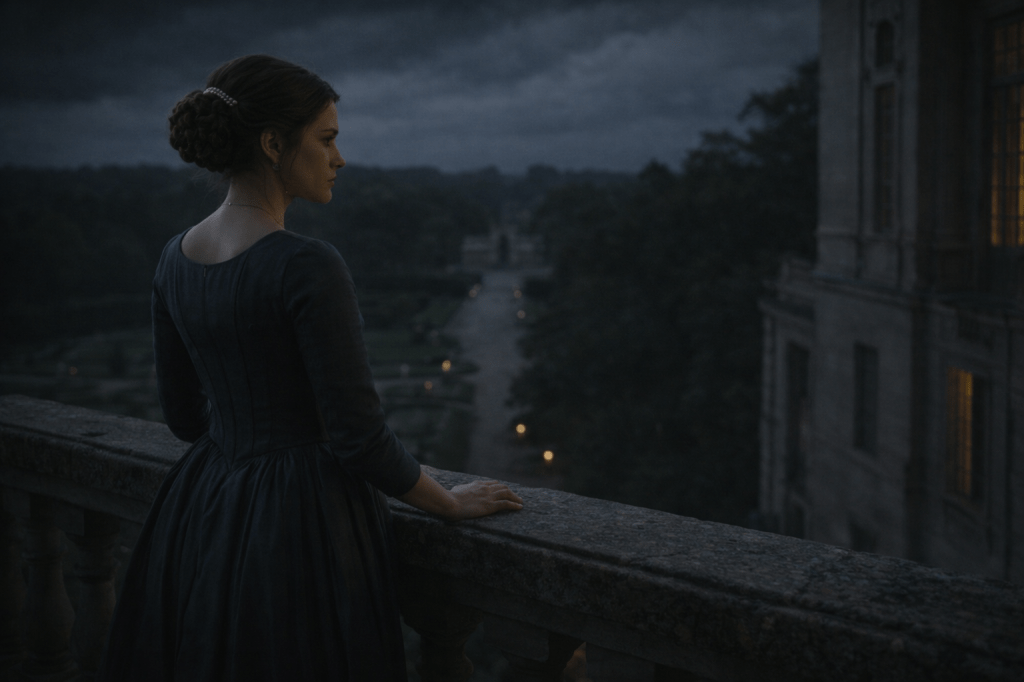
Aveline
The palace is restless. Servants scurry through the halls, their arms laden with flowers and linens, their whispers barely audible over the clatter of preparations. The courtiers are no better, their usual games of gossip and intrigue heightened by the promise of new faces and alliances.
I watch it all from the balcony outside my chambers, the view of the palace gardens stretching out before me. The air smells of orange blossoms and rain, the clouds above hinting at a storm that hasn’t yet arrived. It feels fitting, somehow.
“Aveline.” My mother’s voice is as sharp as the heels of her shoes against the marble floor. She doesn’t wait for me to turn before she speaks again. “The Crown Prince of Aeloria arrives tonight. You will make an impression.”
I keep my gaze on the gardens.
“I’m sure I will.”
Her silence is heavy, a warning in itself.
“This ball is an opportunity, not a burden. You would do well to remember that.”
I finally turn to face her, forcing my expression into the careful neutrality she’s taught me.
“And what would you have me do, Mother? Smile until my jaw aches? Dance until my feet bleed?”
“If that’s what it takes,” she replies without hesitation.
The knot in my chest tightens. I want to scream, to tell her that I am not a pawn to be traded or a prize to be won. But I know it would only fall on deaf ears. Instead, I incline my head, offering the kind of smile that’s polished and hollow.
“As you wish.”
She leaves without another word, the sound of her retreating footsteps echoing in the corridor. I let the smile drop the moment she’s gone.
Far below, the first guests begin to arrive, their carriages winding through the gates like dark serpents against the pale stone. For a moment, I close my eyes and imagine being anywhere else—somewhere where the air isn’t so heavy, where every glance doesn’t carry expectations.
But no matter how hard I wish, I know I’ll never escape this place. Not unless someone shows me the way out.
The Enchantment
Cinder
The room is quiet, save for the soft crackle of the dying fire and the faint rustle of pages as I turn them. The night presses against the cracked window, darkness broken only by the flicker of a single candle. Shadows dance across the rough walls—shifting, listening.
The grimoire rests open before me, its pages steeped in looping script and ancient symbols I’ve barely begun to understand.
I kneel and place it on the floor, careful, reverent.
This is it—the moment I’ve been drawn to and afraid of. The whispers have led me here, always forward. But now, doubt coils around my ribs like smoke.
What if I’m wrong? What if the magic slips through my fingers like water, leaving nothing behind?
I steady my trembling hands and let my fingertips brush the golden threads woven faintly into the pages.
Then I stand.
The symbols begin to glow—soft, steady, pulsing in rhythm with my heart. The air thickens. The spell has begun.
It tastes like starlight. I don’t know how else to describe it.
The grimoire’s pages rustle as if breathing. The candle flickers violently. I whisper the incantation, each word strange and familiar in equal measure.
Warmth blooms around me, wrapping against my skin like a second layer. My body rises—slowly, weightlessly—suspended above the book, heart pounding.

The whispers surge, curling through the air like threads of smoke. They brush my skin, electric and knowing. One note, then another, until they form a single, breathless hum.
And then—my dress begins to dissolve.
Ash and patchwork fall away, replaced by silk and silver.
The transformation is seamless, like moonlight being poured over my shoulders.
The gown shimmers like liquid starlight, embroidered with patterns that resemble constellations and wild roses.
When the light fades, I look down and gasp.
My hands, once rough and scarred, now gleam like polished ivory. My hair falls in soft waves, freed from soot and string. My feet are wrapped in glass-like slippers that catch the flicker of the candle and scatter it like stars.
I catch my reflection in a cracked shard of mirror.
For the first time, I see someone unrecognizable—not Cinder, not ash, not girl-servant or ghost. A girl who could belong in the stories I thought were never meant for me.
I touch my face. Clean. Luminous. Real.
And for a moment, I believe I could belong.
For the first time, I feel like I belong in a story.
Somewhere far away—or maybe closer than I think—a princess might be turning her head, sensing the starlight gathering here.
But the whispers return, softer now. Like a lullaby.
“Find the crown.”
I clutch the stolen invitation, my heart racing. Whatever waits for me at the palace, I know I cannot turn back.
The Ball
Aveline
The ballroom hums with life.
Every corner is filled with color and movement—gowns that shimmer like moonlight, the glint of jewels catching the light from the chandeliers. The air is heady with the scent of orange blossoms, polished mahogany, and cire d’abeille, mingling with the faint sweetness of vin de Bourgogne. The courtiers glide in practiced rhythm, their laughter as calculated as their powdered wigs, their smiles sharper than the glint of a fleuret in a duel.
I, Princess Aveline Beaumont, second in line to the throne, sit at the head of the room, my mother beside me, her hand resting lightly on the gilded armrest of her chair. She radiates composure, her gaze sweeping the room like a hawk surveying its prey. I try to mirror her posture, but my fingers tighten against the folds of my gown.
“You should smile more,” she whispers without looking at me. “It’s unbecoming to look so… tense.”
I force my lips into the curve of a polite smile. It doesn’t reach my eyes.
At a silent cue from the steward, I rise and take the smaller presentation chair set just below my mother’s throne—closer to the floor, closer to the spectacle. It is meant to make me visible. Assessable. Less distant.
A seat designed for scrutiny, not sovereignty.
I’ve sat in it a dozen times, and yet I still feel like a child on display.
Another guest is announced—a baroness from the southern provinces, known more for her diamonds than her discourse. I nod as she bows, but my thoughts are already elsewhere.
The weight of the crown feels heavier tonight, even though it hasn’t yet graced my head.
Every look, every gesture, every carefully chosen word feels like a performance. They’re all here to see me, to judge if I’m worthy of the title that will one day be mine. I feel like a figurehead instead of a person.
I wonder if anyone here would ever look at me and truly see me.
Then the next guest is announced, and everything shifts.
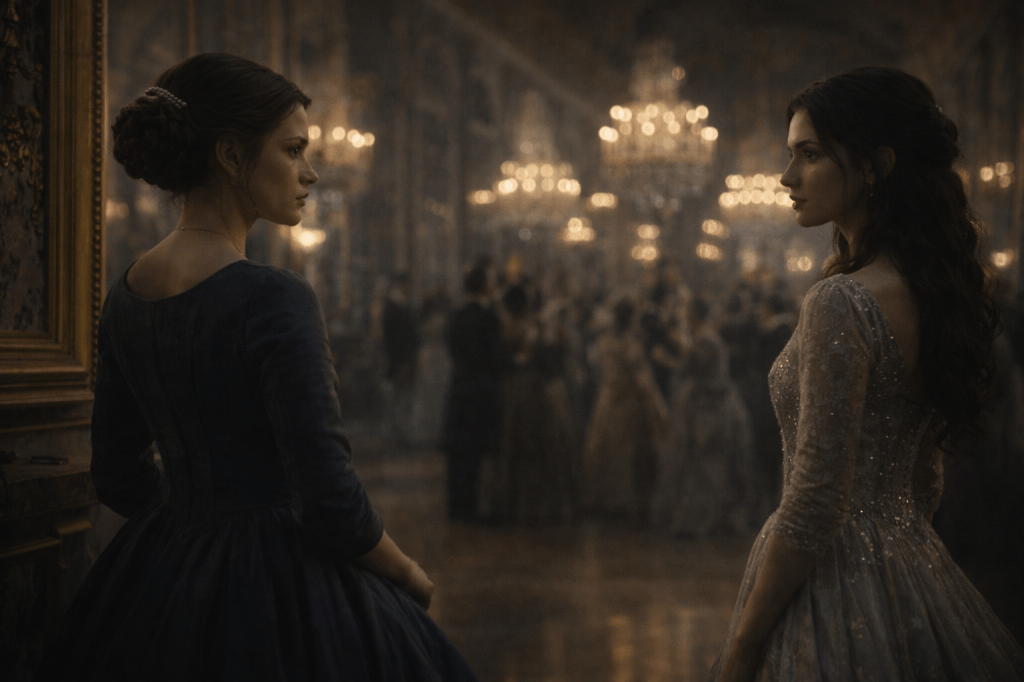
Her gaze finds mine, and the din of the court falls into a muffled hum. We are two figures in a mirror, the world blurred around us.
Cinder
The room is overwhelming. The light, the music, the sheer number of people—it presses against me from all sides, but I keep my chin high and my steps steady. The spell holds, though I feel it humming beneath my skin, warm and alive. Every glance that lands on me makes my stomach twist, but I force myself to keep moving.
I am not Cinder tonight. I am no one. A shadow among the glittering crowd, here to see the palace I’ve only ever dreamed of and to follow the whispers that led me here.
The Hall of Mirrors is more beautiful than I imagined. The chandeliers drip with crystals, casting shards of light across the polished floors. The walls are lined with mirrors that stretch to the ceiling, reflecting endless versions of the people swirling across the room. And at the center of it all is her.
She doesn’t wear a crown, but she doesn’t need one. It’s in the way she carries herself, her head high despite the weight pressing down on her shoulders. Her gown is a deep blue, simple compared to the courtiers around her, but it suits her. She looks like the eye of the storm, calm and steady as the chaos swirls around her.
The whispers rise again, threading through the music.
“Find the crown.”
I don’t know what I’m doing until I’m already stepping forward.
Aveline
I see her before she speaks.
She’s unlike anyone here. Her gown is silver, shimmering like starlight, and her hair catches the light with every step she takes. But it’s not her beauty that draws me—it’s the way she moves, like she doesn’t belong to this room, like she’s carrying a secret no one else can see.
She stops a few paces away, her silver gown shimmering faintly under the chandelier’s light. For a moment, I think she might turn back. But then her gaze finds mine, and the room—the crowd, the noise, the weight—fades around us.
“Your Highness, I… I’m pleased to meet you,” she says, her voice soft but steady. She curtsies—fluid, deliberate—like a question waiting to be answered.
As I rise, our hands brush—light, unthinking. A spark of warmth races up my arm before I pull back.
Her voice has no quiver, no trace of courtly submission. It’s like nothing I’ve heard in these halls before.
I should dismiss her, step away before anyone notices—but I can’t.
The way she looks at me, steady and unyielding, makes me want to be seen.
“You’re not from court,” I say, though I already know the answer.
“What is your name?”
“Cinder. Cinder DuBois, your highness.”
“Cinder.” I let the name settle between us. “Unusual… but beautiful. Tell me, what do you seek? My hand?”
Her lips quirk, a faint, knowing smile. For a moment, I wonder if she hears whispers too—if we’ve both been called here by the same force.
Her lips curve into the faintest smile.
“No, Your Highness.”
“Then why are you here, Cinder?”
She hesitates, her gaze drifting toward the mirrors behind me. For a heartbeat, I think she won’t answer.
Then she steps closer, her voice dipping into a whisper.
“To find something.”
I feel the edges of a smile pull at my lips.
“There’s no need for ‘Your Highness.’”
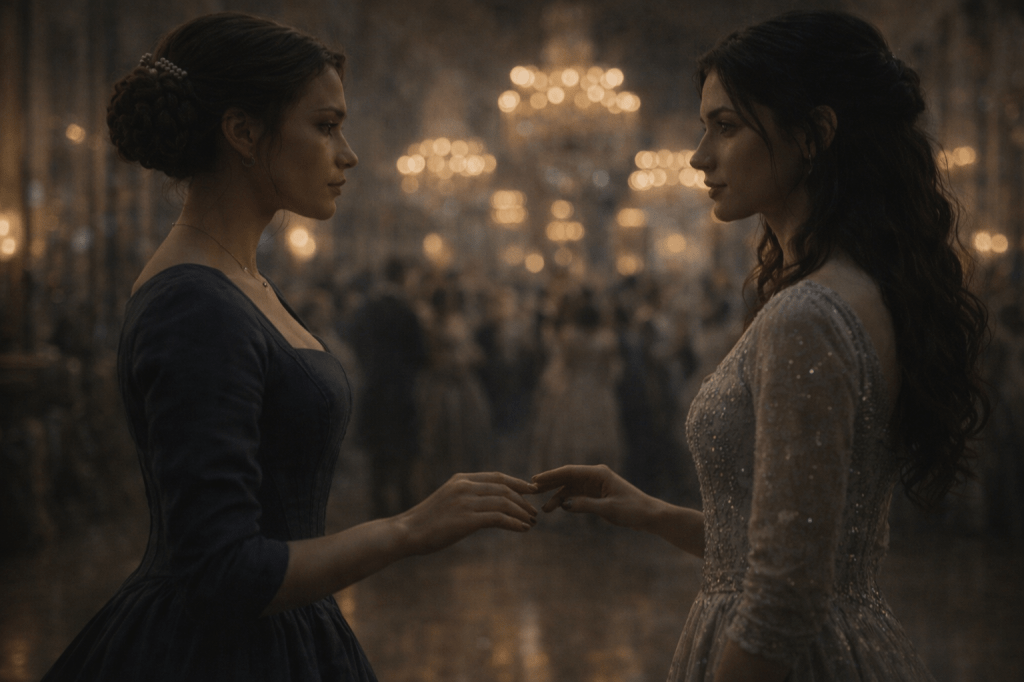
I offer my hand.
“Come, Cinder. Shall we dance?”
The Moment
Cinder and Aveline
The music swells, the violins rising in a sweet, aching melody. Around us, the ball continues—spinning gowns, clinking glasses, the hum of conversation—but for us, it all falls away. We stand at the edge of something neither of us fully understands, something larger than the palace, larger than the ball.
And somewhere in the shadows, the whispers grow louder.
A Bond Forged in Shadows
Cinder
The weight of her gaze is unlike anything I’ve felt before. It doesn’t press me down the way Madame Violette’s sharp eyes do, nor does it skim past me like the villagers who barely notice my presence. It holds me steady, like she’s measuring not just who I am but what I could be.
“What are you looking for?” she asks, her voice quiet but firm.
I open my mouth to answer, but the words catch in my throat. How do I explain the whispers? The pull that led me here, the grimoire’s cryptic warnings? She wouldn’t understand. But then I meet her eyes again, and something about the steadiness there makes me believe she might.
“Something I’ve only just begun to understand,” I say finally.
Her lips press into a line, thoughtful rather than dismissive.
“And have you found it?”
“Not yet.”
The Fateful Dance
Cinder
Her hand is in mine.
No one told me how steady this moment would feel—not like fire, not like lightning. But like breath. Like rhythm. As if something old and invisible finally aligned.
We haven’t moved yet, not really. But we’re already dancing. Our stillness is the prelude, our silence the score.
“Are you certain?” she whispers.
But her fingers don’t pull away.
“No,” I say. “But I don’t think the magic brought me this far to stop now.”
Aveline
The room still spins with velvet and gold, but none of it touches me. Just her.
Just Cinder.
I’ve danced with noblemen—stiff, ornamental, always performing. But this? This is something else entirely. With her, it’s not performance. It’s presence.”
She moves like she’s deciphering something—me, maybe. Or the way the light bends when we’re together.
I feel the music shift—soft strings, tender and aching.
“Follow me?” I ask.
“Only if you mean it,” she replies.
I do.
Cinder
We move.
Not as they taught in village squares, not with rehearsed elegance—but as though we remember. As though something in our bones has done this before.
Her hand guides. Mine echoes. We turn, not because the music tells us to, but because something within us does.
And as we glide past the crowd, I feel it—
The whispers have gone silent.
Not absent—fulfilled.
Aveline
Her closeness is not overwhelming.
It’s steadying. Grounding.
Her breath brushes my cheek, and I’m afraid to turn—afraid that if I see her fully, the spell will shatter.
I know what I’m expected to be tonight. The jewel. The heir. The prize.
But right now, I’m just a woman with a heartbeat and a secret.
And she’s the only one who hears it.
We turn one final time, slower now. The air has shifted. The world is holding its breath.
Cinder
The floor never falls away.
It simply lets go.
One moment we are dancing.
The next—
we are becoming.
My bare feet left my glass slippers – a freeing moment for my feet.
There is no rush of wind. No gasps from below.
Just the rise of something soft and ancient,
like the world exhaling beneath us.
Her hand remains in mine.
A tether. A vow.
And I think—
if I let go of gravity tonight,
I’ll still have her.
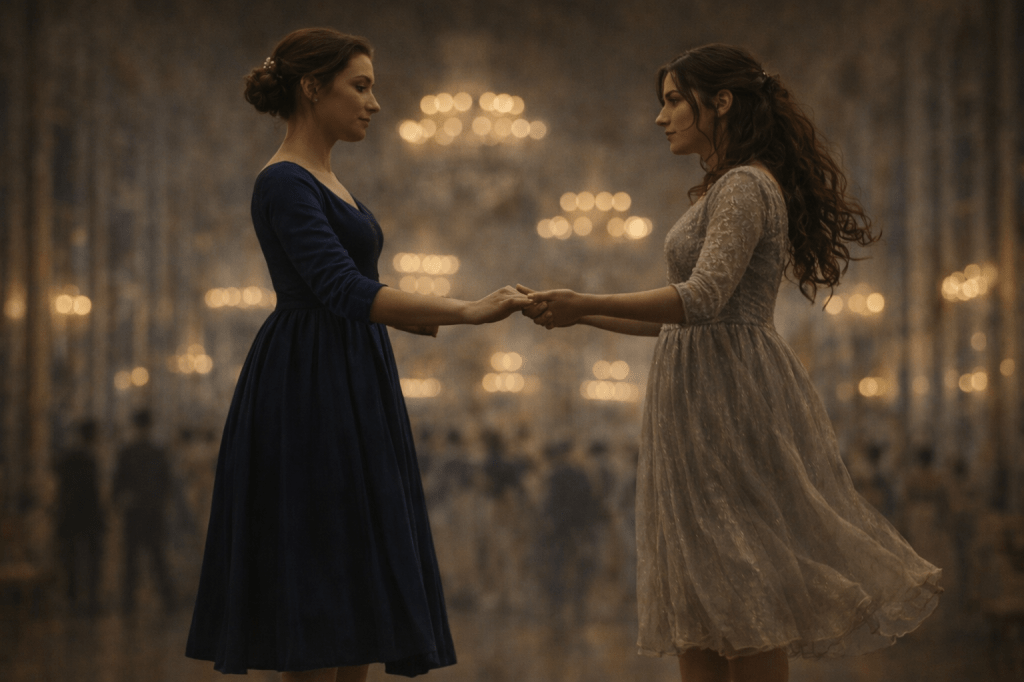
Aveline
I do not feel the lift.
I feel her.
The world has dimmed at the edges—
courtly laughter, shoes on marble, the weight of duty.
All of it… beneath us now.
Her gaze anchors me.
The air swirls with threads of magic so gentle
they do not demand belief.
They invite it.
And as our gowns turn in slow orbit,
I realize: this is no performance. This is the quiet holiness of being seen
And then—we return to the floor.
Cinder’s feet return inside her glass slippers.
Cinder
I lower her hand and kneel.
Raise her hand to my lips.
A kiss—light, reverent, deliberate.
Not as a servant. Not as a subject.
But as someone who sees her.
Aveline
And I mirror her.
I lift her hand, press a kiss to her fingers, and feel the quiet ripple between us—like the surface of still water disturbed by a truth too long submerged.
No thunder. No sparks.
Just the soft click of fate settling into place.
A moment where the weight of royal pressure didn’t vanish—but finally lifted, just enough, so I could feel the shape of my own heart beneath it.
Cinder
Her gaze flickers toward the mirrors behind us, her reflection shimmering faintly in the glass. The chandeliers overhead cast shards of light across her face, and for a moment, she looks almost untouchable—like the stories of queens and warriors I used to read in my mother’s journal. But then her hand twitches against the folds of her gown, and I see it—the hesitation, the weight she carries.
“I imagine you’ll find it soon enough,” she says, but there’s a question in her voice, as though she isn’t sure if she means it for me or herself.
Aveline
There’s something about Cinder I can’t place.
She speaks with a calmness that doesn’t belong to the chaos of the court. Her words are deliberate, her movements careful, but beneath it all, there’s an intensity—something alive and restless, just below the surface.
She feels out of place here, and yet she doesn’t shy away.
Your Presence is Needed
Aveline
Before I can ask her anything more, a shadow falls over us. I don’t need to look to know it’s my mother.
“Princess Aveline,” she says, her tone clipped but polite enough for the crowd around us. “Your presence is requested by Lord Thibault.”
“Of course, Mother,” I reply, my voice a practiced melody of obedience. But when I glance at her, she isn’t looking at me—her eyes are fixed on the girl standing before me.
“And who is this?” she asks, her words sharp enough to cut silk.
I turn to Cinder, half expecting her to stumble over an answer. But instead, she smiles faintly, inclining her head with a grace that surprises me.
“Just a guest, Your Majesty,” she says, her voice steady. “Here to admire the beauty of your court.”
My mother’s gaze lingers for a moment longer, and I see the flicker of suspicion in her eyes. But then she dismisses the girl with a wave of her hand, already turning toward Lord Thibault’s approaching figure.
“Come, Aveline,” she says. “You’ve spent enough time idling.”
I glance at Cinder one last time, catching the faintest hint of a smile before she steps back into the crowd. I follow my mother, but the weight of her presence lingers, a thread I can’t seem to cut.
A Quiet Revelation
I slip through the crowd, keeping my steps light and my head low. The spell holds, but I can feel its edges fraying, like a cloak that’s been pulled too tight. The whispers in my ears grow louder, more insistent.
“Find the crown. The path is set.”
I reach the edge of the ballroom, where the light is softer, and the air feels less heavy. For a moment, I let myself breathe. The grimoire hums faintly beneath the folds of my gown. Its presence grounding me even as the world around me spins.
I glance back toward the princess. She stands beside a man with a polished smile and too many medals pinned to his chest. Her expression is careful, polite, but I see the strain in her shoulders. The way her hand tightens against her gown.
Aveline
Cinder doesn’t belong here. Not like the others.
She’s iron, trying to bend into gold—and no one sees it but me.
“I saw her, and in seeing her, I remembered myself.”
I paused.
“She didn’t bow—not to me, not to the crown. Only to the truth she carried like fire.”
I don’t know why I feel it so strongly, but I know this: whatever the whispers are leading me toward, she’s a part of it.
The bells strike midnight.
One. Two. Three.
The music falters, if only in my ears.
By the sixth chime, I’ve turned from the dancers.
By the ninth, she’s already gone.
I don’t see her leave—I feel it. Like the absence of breath in the lungs.
The mirrors remain—but I no longer see myself in them.
They still hold a ghost of silver and starlight, as if the room refuses to let her go. I know I won’t.
Just the echo of Cinder in silver, vanishing into shadows.
At Midnight
The spell broke at midnight, just as the whispers warned it would. Panic surged through me with the first chime, its echo slicing through the grand hall. I fled the ball, my heart pounding, desperate to escape before the magic unraveled completely.
The shimmering silver gown had already begun to fade, its brilliance dimming into muted gray threads with every hurried step.
The delicate slippers melted into cool dew on the palace steps, the chill biting into my bare soles as I stumbled forward.
By the time I reached the forest’s edge, the gown unraveled entirely, its threads dissolving into streams of light, vanishing into the night like falling stars.
I ran the rest of the way home, lungs burning, the grimoire clutched tight to my chest—as if it might tether me to the last shreds of the enchantment. The whispers ebbed as I crossed the garden wall, fading into a heavy, humming silence that wrapped around me like a waiting shadow.
And then, for a breathless moment, I collapsed into the moss.
The spell didn’t break me — it led me here. To the earth, to silence, to breath. To myself.
A Fever Dream
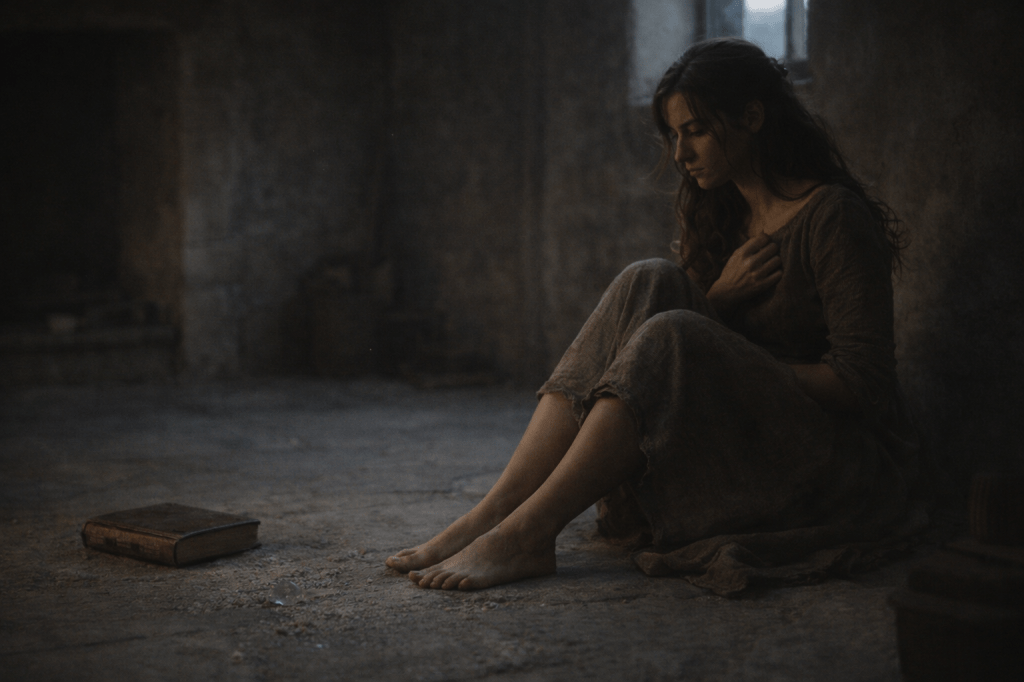
Now, with dawn spilling pale light across the floor, I sit by the hearth, my fingers tracing the smudges of ash etched into my skin.
The ball feels like a fever dream—an impossible world of light and color, spun from magic that was never mine to keep. And yet, her presence lingers, vivid and inescapable. The curve of her smile, the touch of her hand, the way her laughter wove itself into the music—they cling to me, haunting the silence of this place I call home.
Princess Aveline Beaumont.
Her name feels sharp on my tongue, too grand for someone like me to speak aloud.
But her gaze—that steady, searching gaze—felt anything but untouchable.
She looked at me like I was someone, like she saw past the silver gown and the shimmering spell to something real.
But what would she see now? Just a woman with calloused hands and a stolen book, a woman who doesn’t belong in her world.
End of Part 2
 Scott Bryant
You must be logged in to post a comment.