
Flip Tilt Jackie Pott
Story Written By
Marla Quinn & Tina Russo
Story Discovered By
Tessa Rowe, Jayda Morrison,
Cleo Nguyen, Lexie Vaughn,
& Kira Brooks
Visuals & Imagery Created by
Tessa Rowe, Jayda Morrison,
Cleo Nguyen, Lexie Vaughn,
Kira Brooks, & Scott Bryant
With care and reverence, their story was shared by
Scott Bryant at the request of Tessa Rowe, Jayda Morrison,
Cleo Nguyen, Lexie Vaughn, & Kira Brooks
A Note from Marla Quinn & Tina Russo
(Recovered from a letter left in a mint-colored folder inside a cracked Emberline cabinet, March 2024)
We wrote this story with bruises still fading.
Not because we were trying to exorcise something—but because we didn’t want to forget how it felt to be alive inside the noise, the neon, the heat, and each other.
Flip Tilt Jackie Pott isn’t a metaphor. It’s not about pinball, though we loved the machines. It’s not about derby, though the bruises were real. It’s about what happens in the in-between—the silence between coin drop and launch, the half-second between blowout and confession, the space where women carry everything and still show up for each other.
This is a story built from sweat and flirtation, strategy and fear, grief that stayed quiet too long, and joy that came in sideways.
It is very queer. It is very 1978. It is not sanitized.
We hope you feel that.
We hope this lives in you a little longer than you expected.
And if it makes you want to kiss someone, fix a machine, or lace up again—then good.
It was supposed to.
With soft knuckles and full hearts,
Marla & Tina
A Queer Arcade Love Story (With Bruises)
Insert Coin to Begin
My name’s Flippa Ball.
She used to call me that like it was both a compliment and a warning.
Who? Jackie Pott.
Thanks for asking, but my real name’s not important for this story.
Nor is Jackie’s.
We met on a derby track.
We finished in a pinball arcade.
And if you think that sounds like love—
you’re not wrong.
But it was never that simple.
Not at Electra’s Arcade.
Electra’s Arcade – 1978
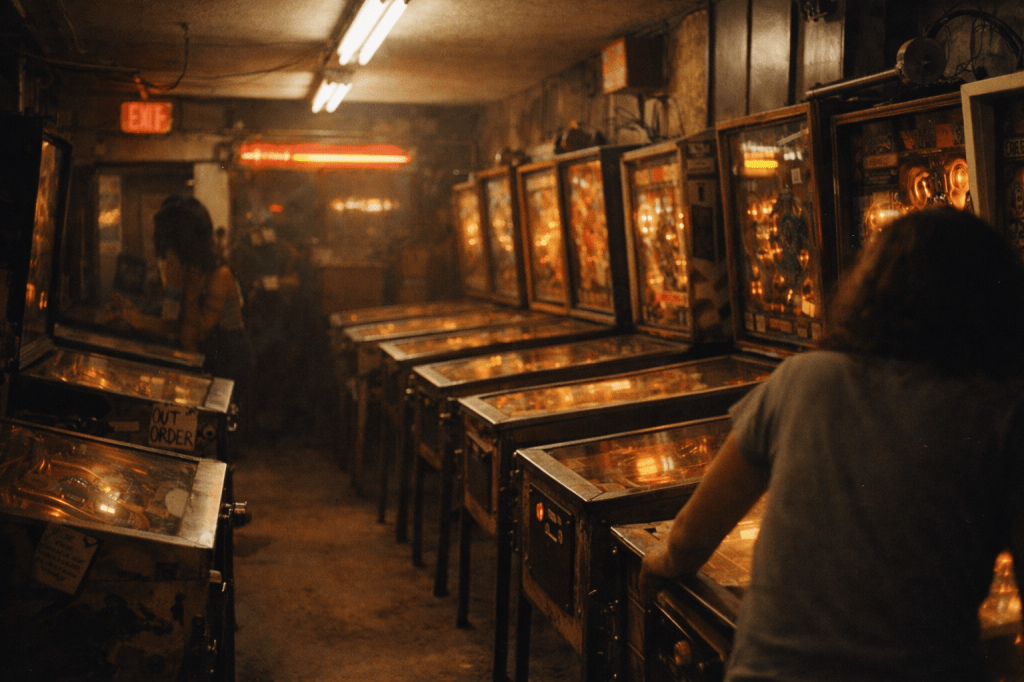
FLIPPA
I hear the all-women arcade before I see it. A low hum, like the sound a machine makes when it’s thinking. Electra’s. Still half-lit, still half-dead, still the best place in the city to feel like a coin that never dropped.
I shoulder open the glass door, let the buzz and neon settle into my skin like glitter from a past life. Same flickering sign. Same mildew in the corners. Same smell of dust and solder and cola syrup gone flat.
And Jackie Pott.
Bent over a busted pinball machine with her sleeves rolled up and her head down. Like the last five years didn’t pass. Like the derby days never ended. Like I didn’t spend nights skating circles around ghosts just trying to remember what her voice sounded like.
She’s working on one of the two HOT FLASH pinball machines. Of course she is. A machine that breaks hearts, shorts circuits and keeps it hot.
Her kind of girl.
Not the bodily kind our mothers and grandmothers know it.
JACKIE
I know she’s here before I see her. The rhythm shifts. Electra’s has its own kind of music—pop bumpers, chime units, teenage groans—but Flippa Ball always adds her own beat.
I don’t look up.
Hot Flash needs my full attention. She’s touchy when handled wrong. So I keep my eyes on the playfield and my fingers in the guts, pretending I don’t hear those slow, deliberate footsteps on the linoleum.
One wrong twist and it’s out of service.
She stops beside me. Lets the silence hang like perfume. She wants me to be first. I won’t.
FLIPPA
“Still in the guts, huh?”
JACKIE (muffled)
“Still trying to break ’em?”
FLIPPA
I smirk, lean a little closer.
“You always were curious..”
She smells like orange soda and electricity. Dangerous.
“What was that one’s name? The blocker with the bad bleach job and the thighs of vengeance. Arma-Gretta? Miss Blox-A-Lot?
…or your favorite, Big Bad VaGina Wolf?”
JACKIE
I don’t even pause.
“It was Fort Knox-It-Out.”
FLIPPA
I chuckle, low and familiar. Like slipping into a jacket I used to love.
“Damn, girl. That’s right. She hit like you owed rent on your ribs. Should have called herself Lordy Land Lady”
JACKIE
“I finished the match.
Can’t say the same for you—knocked out by Miss-She-Gone.”
FLIPPA
“With a cracked elbow and a broken lace.
But yeah, you finished it.
I remember ‘cause you wouldn’t let me carry your bag. Even though I offered.
Nicely.
And Miss-She-Gone? I let her.
Just being nice.
Better it was her and not Barb-Bra-Rilla.
That girl’s feral.
Too carnal-feral for my tastes.”
JACKIE
I slide out from under the cabinet. Finally meet her eyes.
“You didn’t offer nicely. You said, ‘You walk like a busted marionette, let me handle it.
No strings attached.”
FLIPPA
I grin.
“That’s my nice.”
JACKIE
“I didn’t let you carry it ‘cause I knew I’d follow you if I did.”
FLIPPA
And just like that, the lights behind my ribs start blinking again.
“Guess I should’ve offered again.”
Doubles
JACKIE
We never played doubles. Not once. Not in derby. Not in anything.
Flippa doesn’t share spotlight. I don’t like sharing rhythm. But here we are, shoulder to shoulder, lining up on Cosmic Stingray like it’s the last dance of the night.
I let her press Start. I watch her fingers on the flipper buttons. She still taps before the launch, like she’s introducing herself to the machine.
“Just don’t flip out.”
FLIPPA
Jackie doesn’t speak when she plays.
Not to me. Not to the machine. Just breathes through her nose and reads the angles like she wrote them. Like geometry was always her first language and I was just an accent she picked up for fun.
We’re up against two sorority girls with trucker hats, clueless as hell.
They joke. We don’t—
We play like we remember each other in rhythm.
JACKIE
She nudges the table. Not hard. Just enough. It’s the same move she used to use coming around the curve at turn two. A shift in weight. A lean into momentum. I remember.
We clear the first multiball like it’s nothing. Her right flipper, my left. The center lane. We don’t talk. We don’t need to.
She smiles after the drain, looks at me like she just said something.
FLIPPA
I could kiss her right now.
But I don’t.
I just hold the flipper down too long, let the ball trap itself there, and say:
“You wanna take the next one?”
JACKIE
She hands me the machine like it’s an apology. Or an invitation.
I take it.
After the Bout – 1975 (Flashback)
FLIPPA
Back then, the Lady Buc-Anne-Neers locker room smelled like sweat, Tiger Balm, and borrowed lipstick.
Our entire team—Air-Rotica, Her-Spañola, Sinner-Ella, Pep Smear, Foxxi Trot, Mista-Ree, Glady-Ate-Her, Switchcraft, Nancy Drew Blood, Rue Morgue, Wreckquiem, Bruise Control, TNTina—and us, Flippa Ball and Jackie Pott—was buzzing about the big win against the Red Baron-Nessies.
Same buzz we had after we took down the Girl-axy Fempire, the Marilyn SlamRoes, the Belle Ringers, and Dana’s InfHERno.
That Dana. “Cass-A-Nova”
My ex. Still has the same signature move: ghost and pivot.
Or that time we held off the Sue-Shi Rollers in sudden death overtime.
You guessed it, that Sue, “Femme Noir”.
Jackie’s ex. She was a mystery no one could figure out.
Or when Glady-Ate-Her juked the She Shanties so hard the ref threw up.
And the bout against the Tragedy of Oh-Thell-Nos?
That one turned into a near-riot.
We won by one point.
But I wasn’t watching the scoreboard. I was watching Jackie.
Jackie Pott.
Sitting on the bench with her knee wrapped in ice and her jersey collar hanging loose—still taping her fingers like the match hadn’t ended.
She fumbled with the athletic tape, the kind that always stuck wrong when your hands were still shaking. I crouched in front of her and reached for her fingers.
“Let me,” I said.
She didn’t pull away. Just watched me wrap the same knuckles I’d seen break three months earlier. My hands were steady. Hers weren’t. But she still didn’t say a word.
“You skate like someone lit a fuse under you.”
She didn’t smile. Just nodded. Like she already knew. Like she didn’t want to hear it from me.
JACKIE
She offered me a soda.
Not water.
Soda. Cherry. Warm. Never cold.
I took it. Didn’t drink it. Just held it. Let the condensation make my palms slick. She sat beside me. Too close, too casual.
She touched my wrist when I tried to stand.
Said, “Don’t be brave yet. We already won.”
That almost did it. That almost ruined me.
FLIPPA
We didn’t kiss. We didn’t even look at each other long enough for it.
But the heat was there. In the way her breath hitched. In the way I turned my face sideways, like I might.
We never talked about it again.
Until now.
The Disappearance (Flashback)
FLIPPA
It happened like this:
I showed up late to the rec center one Thursday, laces half-tied, a bruise blooming under my left eye like it was trying to become something. Jackie’s seat on the bench was empty.
Just a half-drunk bottle of orange soda, sweating through the label. One skate lace curled on the floor like a question mark.
No note. No word. No final lap.
I waited through drills. Warm-ups. Match.
Said I was fine. Said I didn’t care.
Said she probably just needed a break.
But she never came back. And no one asked why.
Because that’s the thing about women like Jackie Pott.
They leave quiet.
So quiet, you don’t even know you’ve been left until you stop moving.
The Coin Drop (Unseen)
FLIPPA
I stood by the coin drop.
A quarter between my fingers.
Flip. Catch.
Flip. Catch.
The HOT FLASH marquee washed my jaw in red-orange—
every question I didn’t ask.
I wasn’t ready to leave.
I slid the coin back into my pocket
and followed the hum.

The Machine in the Back
JACKIE
There’s a room behind the change counter. No one really uses it. Just storage, wires, old score reels. I started fixing it up last winter. Told Denna I needed a clean space to work. Truth was, I needed a place where I could think without the noise.
I open the door and nod for her to follow.
FLIPPA
It’s warmer back here. Quieter, too. Jackie’s world. Tidy chaos. There’s a workbench under a lamp with no shade. Tools hung on a pegboard in neat rows. And in the center of the room—something covered by a sheet.
She doesn’t say a word. Just walks over and pulls it off.
JACKIE
“It’s not done. Not even close. But it glows. Metallic red trim. Glass-top slick. Custom paint. Bumper caps hand-etched. A table built from scratch.”
“I call her Emberline.”
FLIPPA
I blink. Slow.
“Sister, that’s not a machine name. That’s a girl you write poems for.”
JACKIE
“I don’t write poems.”
FLIPPA
I take a step closer. Trace the curve of the pinball cabinet with my fingers.
“You building her for the league?”
JACKIE
I shake my head.
“She’s not for them.”
FLIPPA
That lands somewhere soft.
I look at her. She looks back.
For the first time tonight, neither of us says anything clever.
Friction at the Flippers
FLIPPA
I stare at Emberline. Her glass shines too bright. Like a spotlight. Like a dare.
I rest my hands on the cabinet but don’t press start.
Instead, I say:
“Maybe you should find someone else to play her. Someone who won’t tilt the whole damn table just by breathing.”
It comes out sharp. Hot. I regret it the second it lands—but I don’t take it back.
JACKIE
I don’t look at her. I just pick up a rag and wipe down the flipper buttons like that’ll make this easier.
“You were always louder when you wanted to leave.”
FLIPPA
I flinch. But I laugh, too. Bitter. Familiar.
“That supposed to stop me?”
JACKIE
“No. Just supposed to remind you I know the pattern.”
I finally meet her eyes. And she doesn’t blink. Doesn’t smirk. Just holds me there.
FLIPPA
I hate how much she sees. How easy I still am in her hands. Like a machine she built herself.
I press Start.
The machine hums like forgiveness.
Bonus Round
FLIPPA
She lets me play her.
Emberline.
The machine hums when I touch the flipper. Not in a glitchy way—something warmer. Like she knows I’m here. Like she’s been waiting.
I send the first ball flying and feel Jackie watching. Not hovering. Not correcting. Just… watching.
JACKIE
She plays different now.
No showboating. No hip-sway. Just focus. Rhythm. Precision. I can see her ribs move when she breathes between shots.
Controlled.
Collected.
Like every shot keeps the lights on inside herself. Like if she stops, the room goes dark.
FLIPPA
I rack up a bonus I don’t notice. I just play. Trap the ball. Hold it. Let it roll.
“You still know how to calibrate a tilt.”
JACKIE
“I never wanted her to fight you.”
FLIPPA
I press the left flipper. Light. Tap tap. Like Morse code.
“That a metaphor?”
JACKIE
I step closer.
“Only if you want it to be.”
She doesn’t move when I turn to her. Doesn’t look away when I step into her space. She just… waits. Like she always has.
FLIPPA
I’ve waited long enough.
I kiss her.
She doesn’t tilt.
She doesn’t even blink.
She just kisses me back.
Like we’ve been playing this round for years.
High Score
JACKIE
Flippa’s name blinks across the scoreboard. Not her derby alias. Not some joke handle. Just five simple letters.
F-L-I-P-P.
I save it. Lock it in. No one else will play Emberline like that. No one else will even try.
FLIPPA
The ball drains. The lights fade. I breathe out.
Jackie steps beside me and rests a hand—light—on my shoulder.
She doesn’t say it.
She doesn’t have to.
JACKIE
I was never scared to lose.
Only scared I’d never get to watch her win.
FLIPPA
The machine resets. The room hums low and steady.
I smile.
“Jackie Pott, you romantic freak.”
She grins.
Game over.
Insert coin to continue.
Morning After (Soft Epilogue)
JACKIE
The arcade is still asleep.
Sunlight creeps in through the blinds, striping the repair room in lines of gold and dust. I sit on a stool by the workbench, sipping cold coffee from a plastic cup. My hands are dirty. My heart’s still warm.
FLIPPA
I’m barefoot, sitting cross-legged on Emberline like she’s a throne. My jacket’s slipped off one shoulder. My hair’s a mess. I’ve never looked less like a showgirl.
And I’ve never felt more like myself.
Jackie doesn’t say anything. She doesn’t need to.
I roll the extra ball between my fingers like a coin I might flip. But I won’t. Not this time.
“Hey.”
She looks up.
“You ever think maybe we stopped skating too soon?”
JACKIE
I smile without showing teeth.
“Nah.”
A pause. A sip.
“I think we just started playing the right game.”
FLIPPA
I nod. Lean back. Close my eyes.
Somewhere in the distance, a pinball machine boots up—just one long tone in an empty room.
A promise, maybe.
The game we never finished.
A Note from Tessa, Jayda, Cleo, Lexie & Kira
(Typed, stained, and left beside Emberline with a Polaroid of the final score)
We didn’t go looking for a story like this.
But once we found it, we couldn’t walk away.
What Marla and Tina left behind wasn’t just a script. It was a heartbeat. It pulsed through every crumpled scorecard, every scratch on the cabinet, every photo with someone cropped out.
We followed the clues. We argued about the timeline. We cried in the darkroom. And when the lights on Emberline flickered for the first time in twenty years, we knew we weren’t just telling their story.
We were finishing a game that never got a last ball.
As five queer women, we felt every jagged edge of what Marla and Tina buried in this world: the longing, the friction, the joy that came in sideways. We saw ourselves—not just in the love, but in the silence. In the tape. In the tilt.
We also want to acknowledge Scott Bryant—who, though not one of us in identity, honored the rhythm, reverence, and radiant queerness of this story without ever asking to center himself in it.
He listened. He lit the machines. He helped the visuals hum.
He never tried to speak over us. He made sure our voices rang clear.
This was never his story to tell.
But he treated it like something sacred. And for that—we’re grateful.
Thank you, Marla. Thank you, Tina.
You tilted the world and we caught the tilt.
– T, J, C, L & K
 Scott Bryant
You must be logged in to post a comment.