
Dracula
Oregon Ballet Theatre
October 11th, 2025 – 2pm Matinee
Keller Auditorium, Portland, Oregon
❖
Featuring Isaac Lee (Dracula), Kangmi Kim (Svetlana),
Bailey Shaw (Frederick), Zuzu Metzler (Flora),
and Giovanny Garibay (Renfield)
❖
Music by Franz Liszt, in an arrangement by John Lanchbery,
Seattlemusic Orchestra conducted by Ermanno Florio
Notes from a Saturday matinee, when some stories cannot be spoken — they must be felt, carried through shadow and light.
Archival Preface: The Dance of Shadows: Ballet strips the myth to its bones: desire, surrender, immortality, and the choreography between them. Where the “Dracula” play offered wit and dialogue, the ballet offers breath and silence — gestures that flicker like candlelight across the stage.
I write this not as a critic, but as an archivist of atmosphere — preserving how a myth moved, literally, through the body.
❖
A Matinee of Velvet and Whispers
On a calm, overcast Saturday afternoon, I made my way to Keller Auditorium in downtown Portland for Dracula.

Wearing my red coat — and passing the haunting ballet poster fluttering near the trees — I stepped inside the lobby.

The Playbill
Tucked off to the side, away from the flow of arriving patrons, I opened the Dracula playbill. A letter from Artistic Director Dani Rowe immediately caught my attention.
Rowe stated in her letter the Dracula ballet “blends classical technique with sweeping theatricality—ornate sets, hauntingly beautiful costumes, and a score that chills and enchants in equal measure.”
I already couldn’t wait for the curtain to rise — and I hadn’t even made it to Performance Perspectives yet.
Inside the Ritual: Company Class
Before Count Dracula rose from the shadows, the dancers of Oregon Ballet Theatre revealed something even more extraordinary — the discipline beneath the drama.
The transformation began not with fangs or fog, but with muscle, repetition, and music.
Before Performance Perspectives, a pre-show event led by OBT historian Melanie Summers, I was invited to witness company class unfold live onstage. It was not a glimpse into performance, but into preparation — the quiet, exacting ritual that happens before the spotlight ever arrives.
Dancers, still in warm-up gear and not yet cloaked in character, moved through an hour-long class of jumps, turns, and traveling phrases. A live pianist accompanied them, the air filled with the soft percussion of slippers against wood. Summers joked that it was “front-row seating without front-row prices,” but what we were really seeing was vulnerability — bodies waking, recalibrating, remembering.
“They’ve already been in class for over an hour,” she explained, preparing themselves for the immense physical demands ahead.
What followed was a study in intelligence as much as athleticism. Dancers learned new combinations every thirty to sixty seconds, training not only muscle but fast-twitch memory — the ability to recall, adapt, and execute instantly. Summers spoke of the stage itself: how humidity, fog, and floor responsiveness subtly alter choreography, how dancers adjust in real time so their landings remain quiet, safe, and seemingly effortless.
At one point, a line of dancers traveled from upstage to downstage, rehearsing grand allegro — powerful jumps that demand both force and restraint. It was work stripped of illusion, yet already hypnotic.
There were lighter moments — a laugh at the instructor’s Vlad the Impaler shirt, a note about pointe shoes being banged backstage to dull their sound — and then, at the end, something gentler. The final port de bras. Dancers bowing to imaginary applause.
“They’re taking a moment to breathe,” Summers said softly.
What struck me most was the intimacy of it all. They weren’t performing yet, but they were sharing something more vulnerable: the scaffolding behind the spectacle. The breath before the bite.
It felt less like a warm-up and more like a ritual — a private language of discipline and grace before the darkness of Dracula descended.
They weren’t performing yet.
But already, the spell was forming.
Performance Perspectives:
The Calm Before the Curtain
What follows is not a behind-the-scenes aside, but a lens — one that reshaped how every shadow, lift, and silence would later land.
After company class ended and the dancers disappeared backstage to begin their full transformation, the theater settled into a different kind of pause. The house lights remained up. The curtains stayed closed. Somewhere beyond them, fog machines hissed, costumes were pulled on, makeup thickened into character.
A projection screen unfurled, and Melanie Summers stepped forward — part historian, part storyteller.
She traced the lineage of the production: Ben Stevenson’s original choreography, John Lanchbery’s Liszt-based score, and Dominic Walsh’s meticulous re-staging. She spoke of scenic designer Thomas Boyd’s sets, inspired by medieval woodcuts and German Expressionist cinema, and Tony Tucci’s lighting — shadow and flame etched into motion.
Then came the details that would echo later: Dracula’s thirty-pound cape, its vast wingspan shaped by hidden rods; the sheer logistics of more than seventy costumes; dancers shifting roles at impossible speed — peasants becoming brides, joy turning spectral in minutes.
“Controlled chaos,” Summers called it.
By the time she reached the flying sequences — rigging guided by counterweights, cables, and sheer human strength — the room was quiet with awe. Nothing was automated into ease. Everything was earned.
“These sequences can’t be fully rehearsed until we’re in the theater,” she explained. “They’re practiced again right before each act — for safety, timing, precision.”
By the end of the talk, the mechanics of Dracula had not demystified the performance. They had deepened it.
“You’re about to see towering sets, fog, and even an exploding chandelier,” Summers said. “What happens next is art — but also a miracle we get to witness twice today.”
When the screen lifted and the house began to fill, the magic felt ready.
The lecture lights still glowed.
But behind the curtain, the shadows were stirring.
Dancers Pulling Double Duty
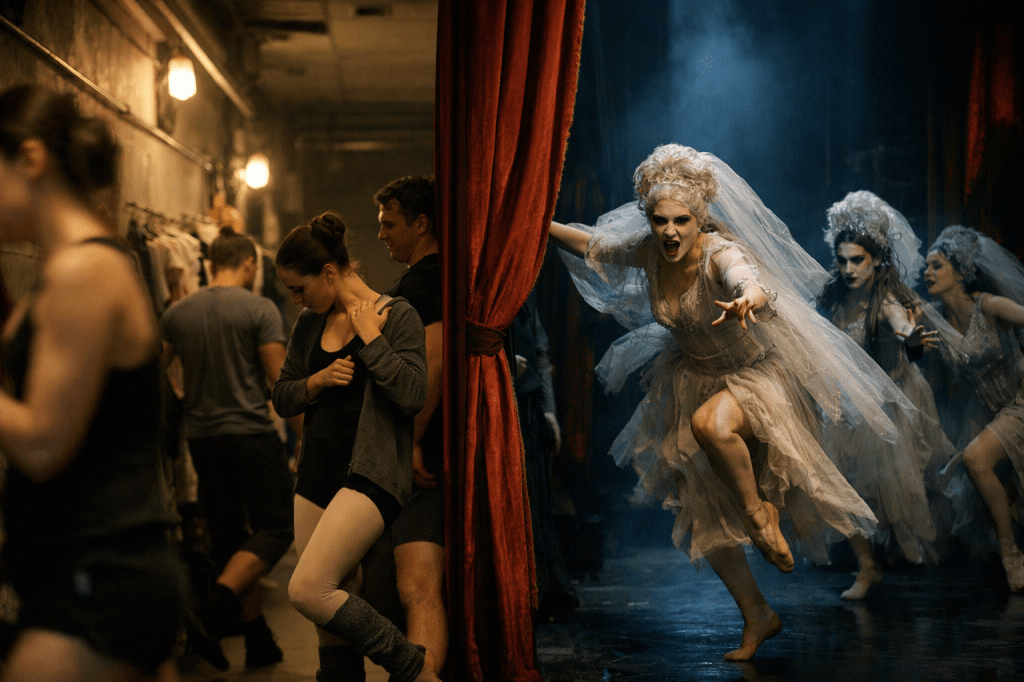
The dancers’ transformations were as physical as they were visual.
Many of the Brides we would later see hovering in Dracula’s castle were, only an act earlier, village peasants — laughing, clapping, dancing in full daylight. Then, in minutes, they returned veiled and spectral, adorned with ornate wigs and pallid makeup.
Backstage, Summers described it as “absolute controlled chaos.” Costume changes happened at speed. Makeup was stripped away and reapplied. Bodies shifted roles without pause.
She joked that she kept checking on the Brides, asking if they felt all right — if they looked a little pale. Some took her seriously before realizing it was the makeup doing its work.
Even humor, here, pointed back to effort. Layers of theatrical paint went on, came off, and went on again — especially during a matinee, when the entire transformation would happen twice in one day.
What struck me was how little of this strain showed once the curtain rose. Onstage, the shifts felt seamless. The labor vanished into illusion.
Performance Perspectives:
The Art and Physics of Dracula in Flight
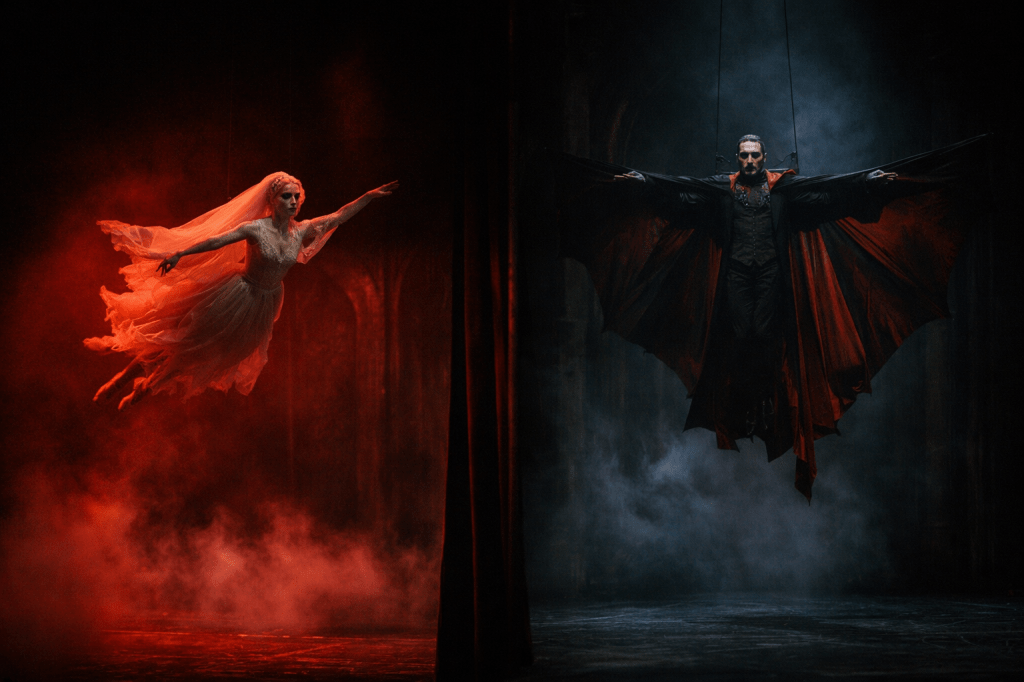
When Summers turned to the subject of flight, the room grew quiet with awe.
Flying in Dracula, she explained, is not magic — it is sweat, coordination, and trust. In Dracula’s case, the system is both manual and automated, guided by operators who control ascent and descent with joystick precision. Nothing floats without intention.
The Brides’ flight relied on older methods: counterweights and rigging, dancers moving back and forth in carefully timed exchanges. By the time the riggers finished a sequence, Summers noted, they were often breathless.
Flora’s flight was the most striking example of labor made invisible. At the end of Act III, when she streaks across the stage toward Dracula’s bedchamber, the effect is created entirely by human force — a rigger standing high on a ladder, pulling hard, jumping down, handing the line to another, momentum passed from body to body.
None of these moments can be fully rehearsed until the company moves into the theater itself. On the Keller Auditorium stage — where nearly three thousand seats demand precise sight lines — spacing, timing, and cues shift. Flight and fight sequences are practiced again just before each act, out of necessity and safety.
By the end of the talk, Summers hadn’t demystified the ballet. She had sharpened it.
“You’re about to see towering sets, fog, and even an exploding chandelier,” she said. “What happens next is art — but also controlled chaos. A miracle we get to witness twice today.”
When the screen lifted and the house began to fill, the magic felt ready.
By the end of the talk, Summers hadn’t demystified the ballet.
She had sharpened it.
The Language of Partnership:
“Pas de Deux“
In her program letter, Artistic Director Dani Rowe wrote that Dracula moves effortlessly between tenderness and terror — that one moment you are watching a pas de deux as gentle as any in the classical canon, and the next you are pulled into darkness.
That shift is the ballet’s emotional engine.
In classical ballet, the pas de deux is built on trust: balance, counterweight, surrender. One body leans because another is there. What makes Dracula unsettling is not that it abandons this language — but that it keeps it, even as its meaning corrodes.
In Act II, the duet between Svetlana and Frederick glows with youthful ease. Their lifts feel light, mutual, unguarded — a choreography of shared future. But by Act III, the same physical grammar has been claimed by Dracula. The shapes remain beautiful. The timing remains precise. What changes is intention.
Every lift becomes a negotiation.
Every moment of surrender risks becoming possession.
The pas de deux does not fracture — it darkens. Trust is still required, but now it is dangerous. Balance becomes control. Devotion slips toward hunger.
By the time Svetlana stands in Dracula’s bedchamber, the audience already understands the stakes — not because they were explained, but because they have been felt. The body remembers what the mind may resist.
Transported To Transylvania

With the Performance Perspective concluded, I took my seat in Orchestra A, Aisle 2, Row G, Seat 10 ready to be transported from the real world to the world of Transylvania.
A day before Dracula opened, Oregon Ballet Theatre released a trailer showing highlights from the 2022 production, which I had watched multiple times the night before to prepare for the world I was about to be swept in for two hours.
What follows are archival-style visual recreations and written impressions of each act.
🎨 Visual Notes
Inspired by the ballet’s haunting stagecraft and the legacy of Expressionist cinema, all accompanying images follow an Expressionist Noir Ballet style — blending shadow play, motion, and myth.
Act I – The Crypt of Dracula’s Castle
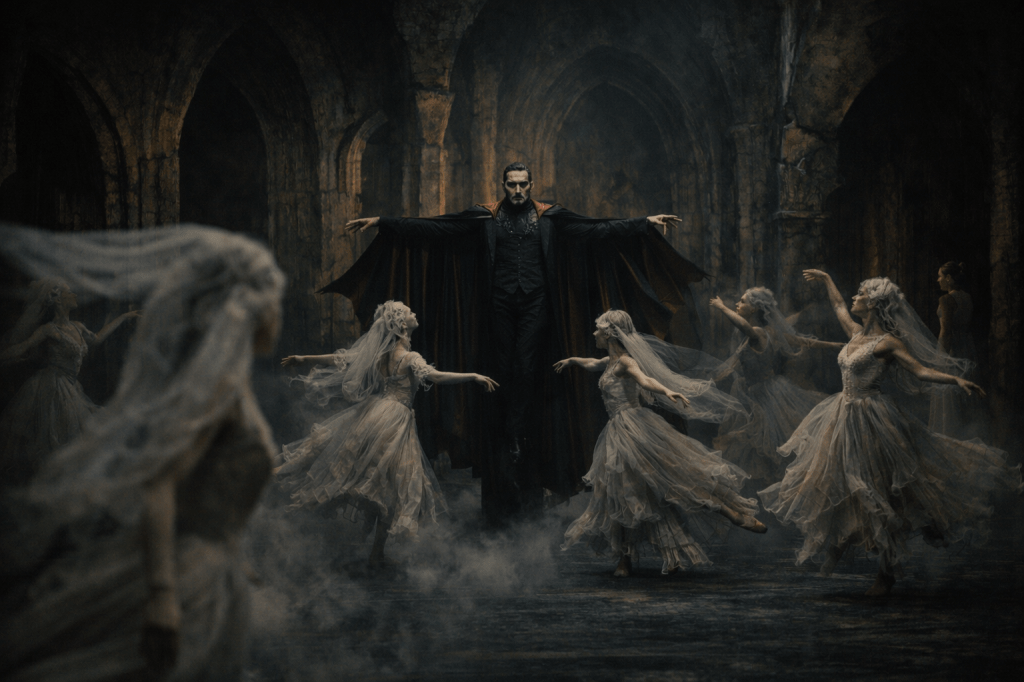
The curtain rose into smoke and shadow. We were in the crypt — a cavernous space haunted by Dracula’s Brides, who moved like forgotten memories brought back to life. Their sharp, deliberate choreography was eerie and beautiful, and then Dracula (performed by Isaac Lee) himself emerged, cloaked in power and silence.
Then Flora (performed by Zuzu Metzler) was dragged in by Renfield (performed by Giovanny Garibay) — Dracula’s mad scientist, as agile and unhinged as a Cirque du Soleil performer — and the mood shifted from eerie to tragic. She wasn’t just another victim — she was offered like a gift to darkness.
That final image of her, caught between worlds, stayed with me long after the act ended. Especially during the first 20-minute intermission of the show.
Act II – The Village
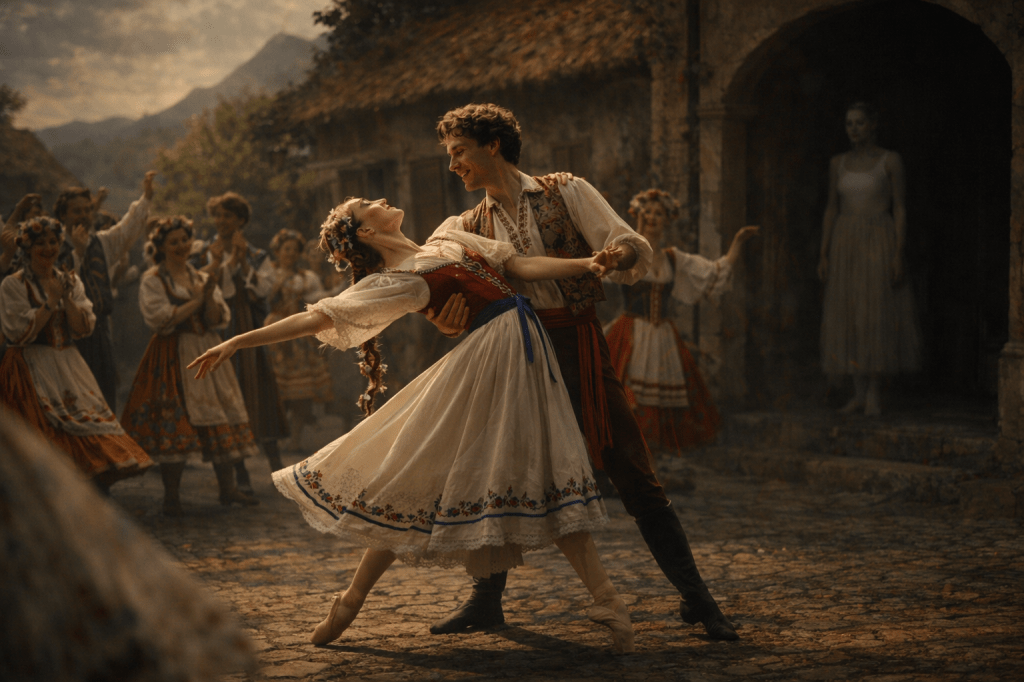
The Carpathian village burst with light and laughter — dancing feet, clinking mugs, the priest’s (played by James Johnson) hand raised in blessing. But not all joined in. At the edge of the revelry stood an old woman (performed by Ruby Mae Lefebvre) with a necklace of garlic, her eyes fixed on the distant castle no one dared name.
Svetlana (performed by Kangmi Kim) and Frederick’s (played by Bailey Shaw) love felt tender and sincere — their pas de deux full of youthful warmth, even as the innkeeper mother (performed by Hannah Davis) blessed them with approval and the inkeeper father (performed by Brian Simcoe) eyed them with the kind of patriarchal caution that only softened when promises of future children were made.
Even from the orchestra level, you could feel the joy — vibrant and infectious, if occasionally hemmed in by tradition — as if we’d stepped into a different ballet altogether.
But beneath the celebration, unease crept in. The old woman gave Svetlana a necklace of garlic and pointed toward the looming silhouette of Count Dracula’s castle. Her warning lingered.
Then Flora stumbled into the village — pale, marked, and wrong — and everything shifted. Her attack on the villagers sent a rupture through the revelry. Joy cracked like glass. The priest, trembling but resolute, raised his crucifix in a desperate attempt to ward off the evil that had taken hold — of Flora, of Dracula, of the night itself.
Dracula’s arrival — flanked by Renfield and the black coach — crashed down like a storm splitting the sky. As Flora ripped the garlic necklace from Svetlana.
He didn’t just abduct Svetlana. He shattered the world we’d just been welcomed into.
And with that, the curtain fell again — another twenty-minute intermission, with shadows trailing behind it.
Featured Dancer:
Kangmi Kim as Svetlana
The role of Svetlana for the matinee performances were danced by Kangmi Kim, a company artist with Oregon Ballet Theatre who joined in 2021 after apprenticing since 2019. Originally from Seoul, South Korea, Kim brought a striking emotional clarity to Svetlana’s journey — from innocence in the village to haunted resolve in Dracula’s lair. Her incredible pas de deux moments shimmered with both vulnerability and strength, especially in the ballet’s final act, where each gesture felt like both a memory and a warning.
Act III – The Bedroom of Count Dracula
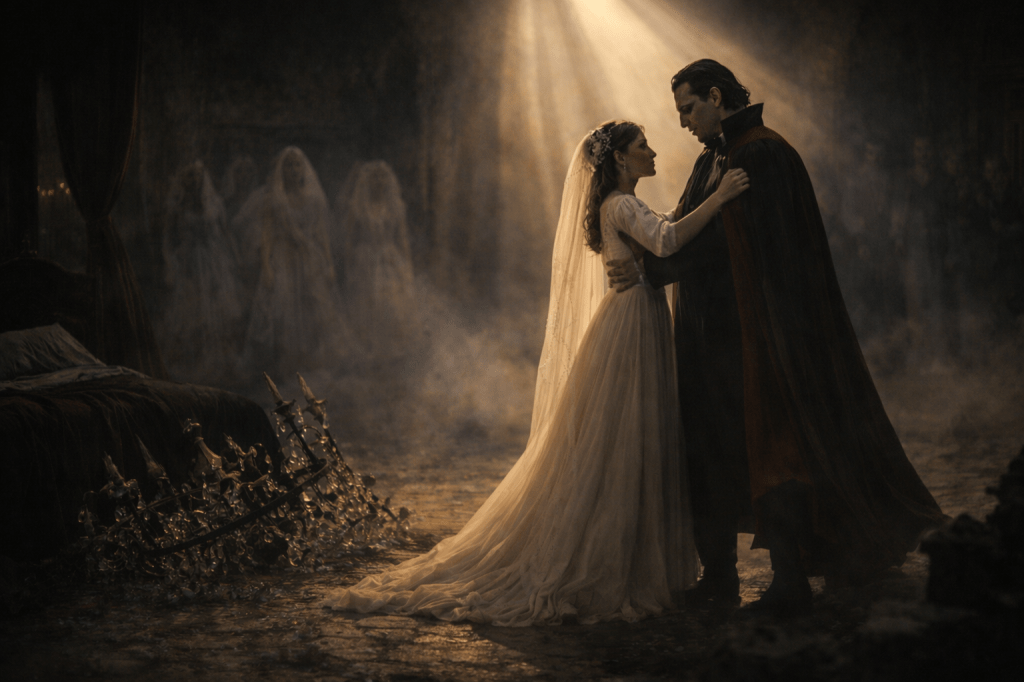
This final act felt like a fever dream. The Brides hovered. Svetlana reappeared in a bridal gown. The set was all flickering light and looming threat. Dracula moved with terrifying stillness — every gesture controlled, every lift measured, possessive, inevitable.
The final moments were breathless. Flora’s flight. The fight between Dracula, Renfield and the Brides against Frederick, the innkeeper father, the priest, and several men from the village. The chandelier. The flood of daylight. And then, that quiet, tender pas de deux between Frederick and Svetlana — after everything. It was fragile and solemn, not triumphant. A kind of love touched by grief.
And then, the performers took their bows to roaring applause and cheers.
Closing
What Dracula left behind was more than a tale of horror or romance — it was the sensation of movement suspended in shadow, of myth embodied and then vanished.
As Dani Rowe so perfectly phrased it: “It is not just a performance — it’s an immersion.”
As the lights dimmed and the audience rose, I wasn’t walking away from a story. I was carrying it — in breath, in stillness, in the echo of bodies that danced darkness into something unforgettable.
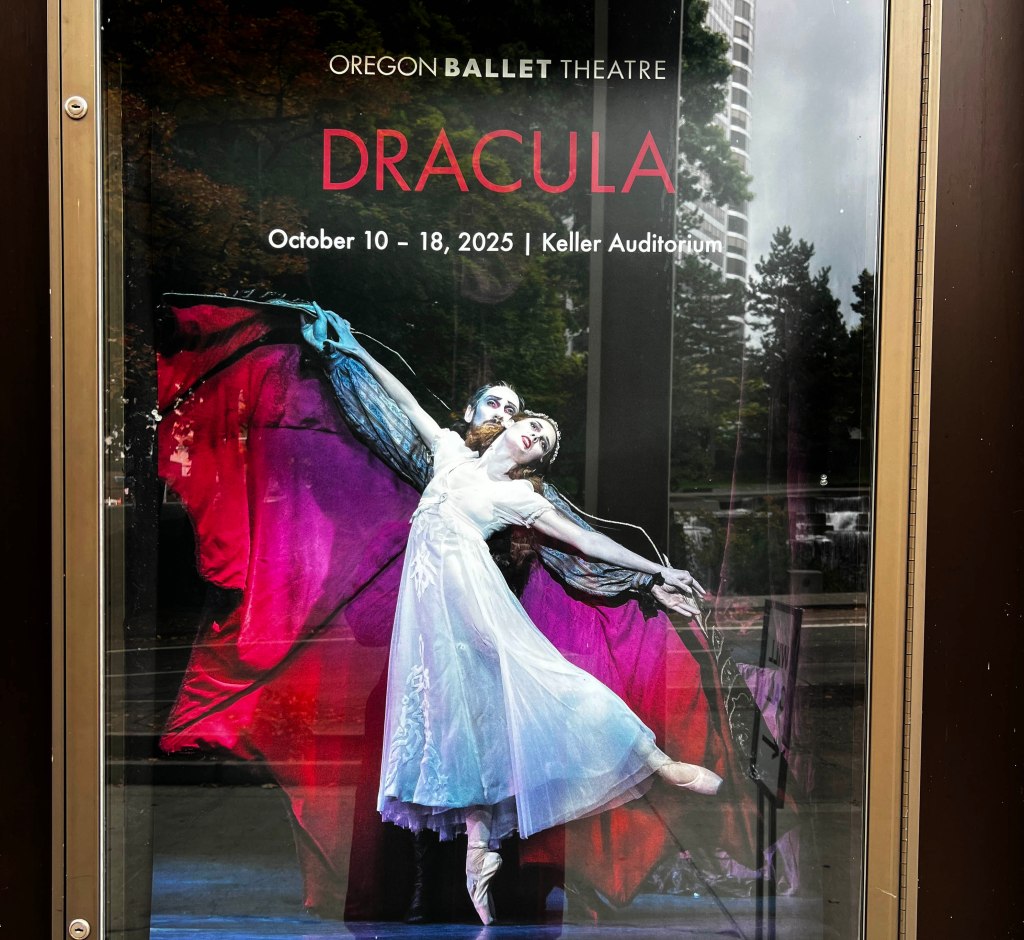
Making my way out of Keller Auditorium for the trek home, I snapped a photo of the poster that would later that night would become one of my favorite documented photos so far: spectral and seasonal, as if spirits lingered just behind the glass.
Archival Note: I do not claim the title of professional archivist, but I write with an archivist’s intention. These notes preserve more than what was staged — they preserve what stayed.
Earlier that morning, I stood before another kind of stage — the portrait of Infanta María Ana de Austria at the Portland Art Museum. Read that reflection here.
 Scott Bryant
You must be logged in to post a comment.