
Dracula
Oregon Ballet Theatre
October 11th, 2025 – 2pm Matinee
Keller Auditorium, Portland, Oregon
Featuring Isaac Lee (Dracula), Kangmi Kim (Svetlana),
Bailey Shaw (Frederick), Zuzu Metzler (Flora),
and Giovanny Garibay (Renfield)
Music by Franz Liszt, in an arrangement by John Lanchbery,
Seattlemusic Orchestra conducted by Ermanno Florio
❖
Production Context
Oregon Ballet Theatre’s Dracula combines classical ballet structure with theatrical staging, integrating large-scale scenic design, lighting, and mechanical effects into a continuous performance system. The production moves between village and castle environments, using contrast in lighting, choreography, and staging to organize the narrative across three acts.
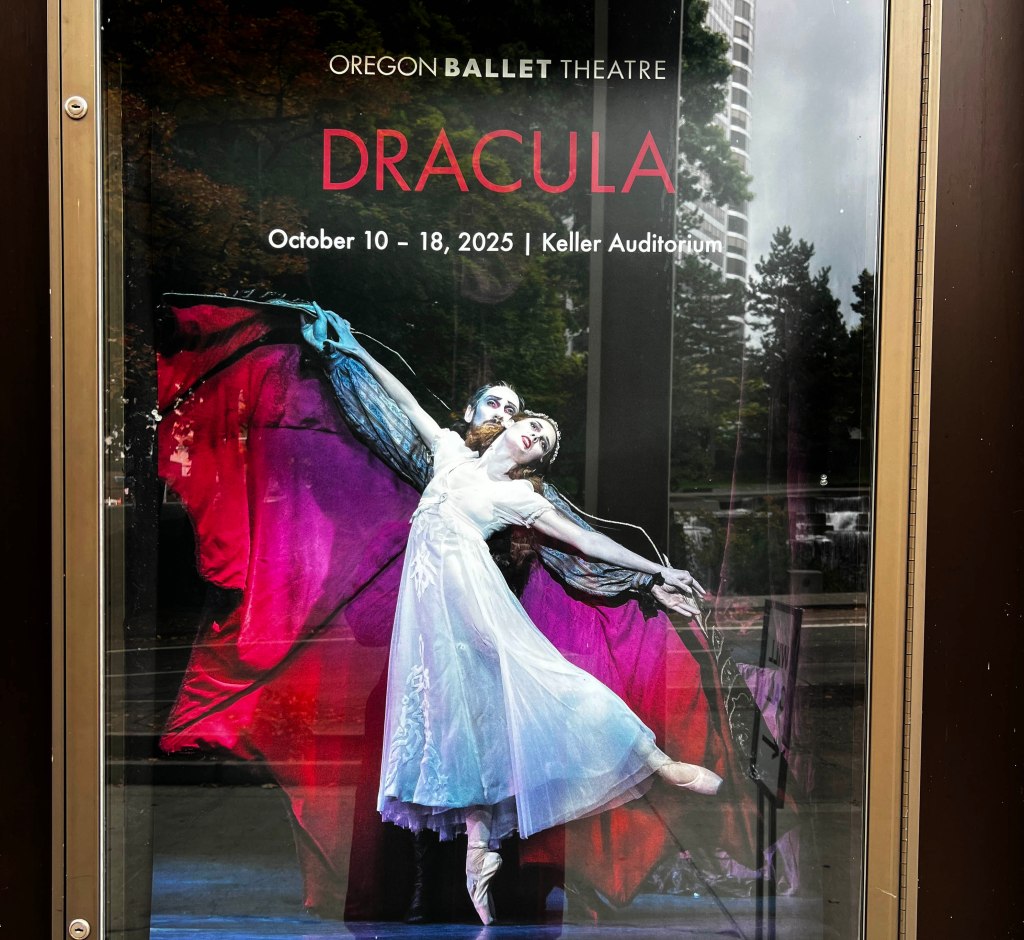
Wearing my red coat — and passing the haunting ballet poster fluttering near the trees — I stepped inside the lobby.
Performance Perspectives:
The Calm Before the Curtain
Prior to the performance, an open company class was conducted onstage as part of the Performance Perspectives program.
The class revealed the physical preparation underlying the performance. Dancers worked through sequences of jumps, turns, and traveling combinations, accompanied by live piano. Instruction emphasized rapid memorization and adaptation, with new combinations introduced at short intervals. The focus extended beyond strength and technique to include timing, spatial awareness, and responsiveness to changing conditions.
Environmental factors were also addressed. Variations in stage surface, humidity, and atmospheric effects such as fog require adjustments in landing, balance, and movement quality. The class functioned as both physical preparation and calibration to the specific conditions of the Keller Auditorium stage.
The session concluded with controlled port de bras and formal bows, marking the transition from preparation to performance.
Performance Perspectives:
Staging and Technical Systems
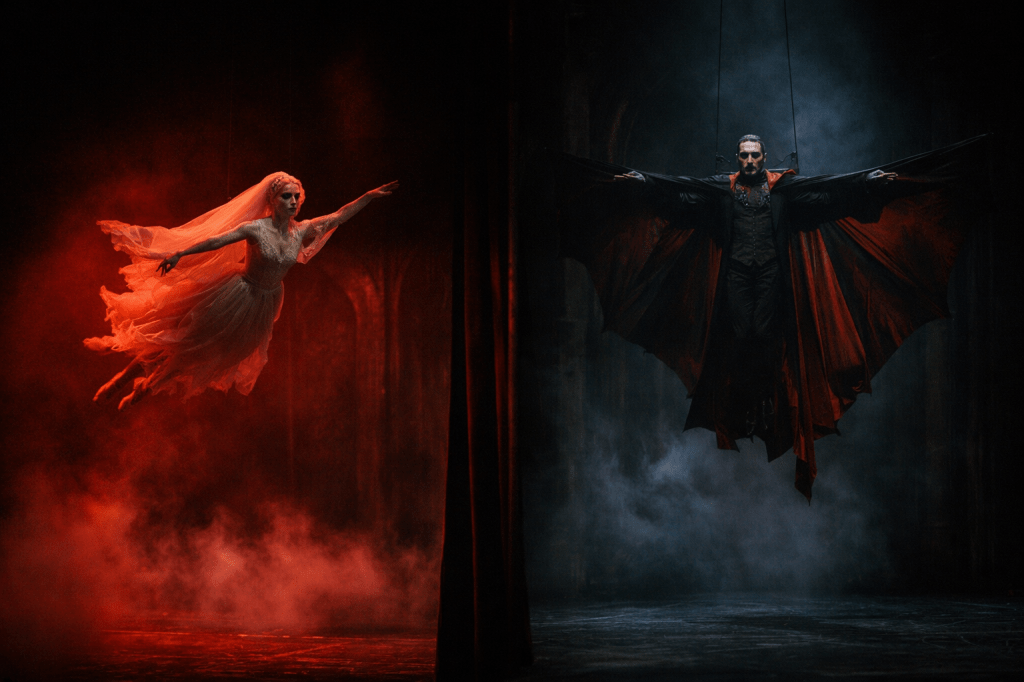
A pre-show talk led by historian Melanie Summers outlined the production’s technical and logistical framework.
The staging incorporates large scenic elements influenced by medieval woodcut imagery and German Expressionist visual language. Lighting design emphasizes contrast, using shadow and directional illumination to define spatial boundaries and movement.
Costume design operates at scale, with over seventy garments in rotation. Quick changes are required to support role transitions, with dancers shifting between village and supernatural figures within short intervals. This produces what was described as “controlled chaos” backstage, while maintaining continuity onstage.
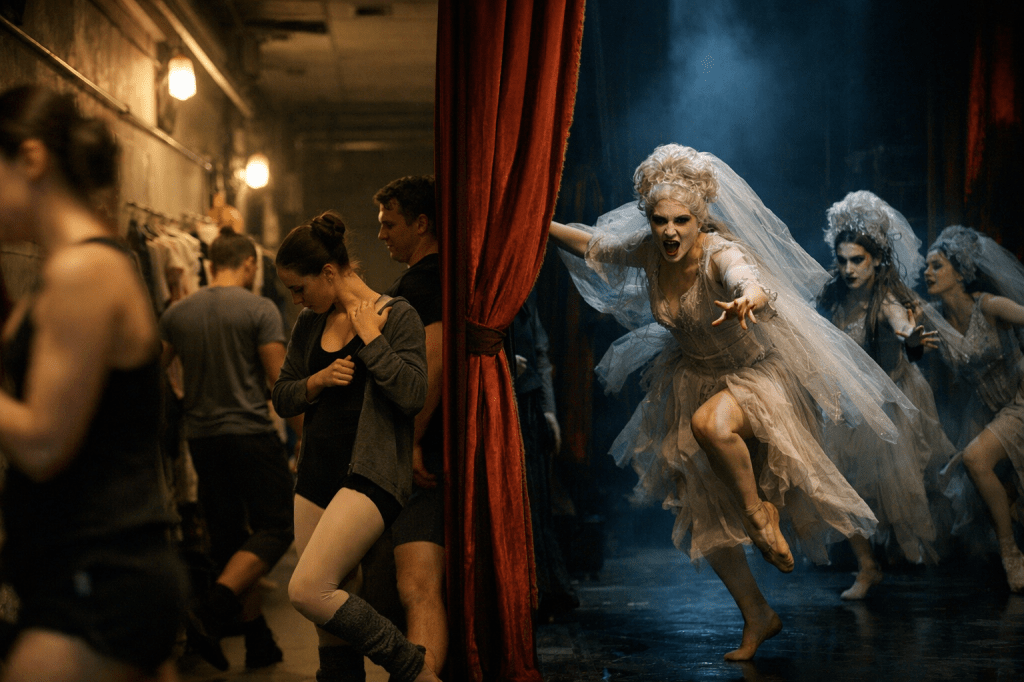
Mechanical systems are central to the production. Flying sequences rely on both manual rigging and controlled systems operated in real time. Counterweights, cables, and coordinated human effort generate lift and movement. These sequences cannot be fully rehearsed outside the performance space and are recalibrated prior to each act for safety and precision.
The integration of these elements does not reduce the theatrical effect. It defines it.
Performance Structure
Act I — Castle Environment
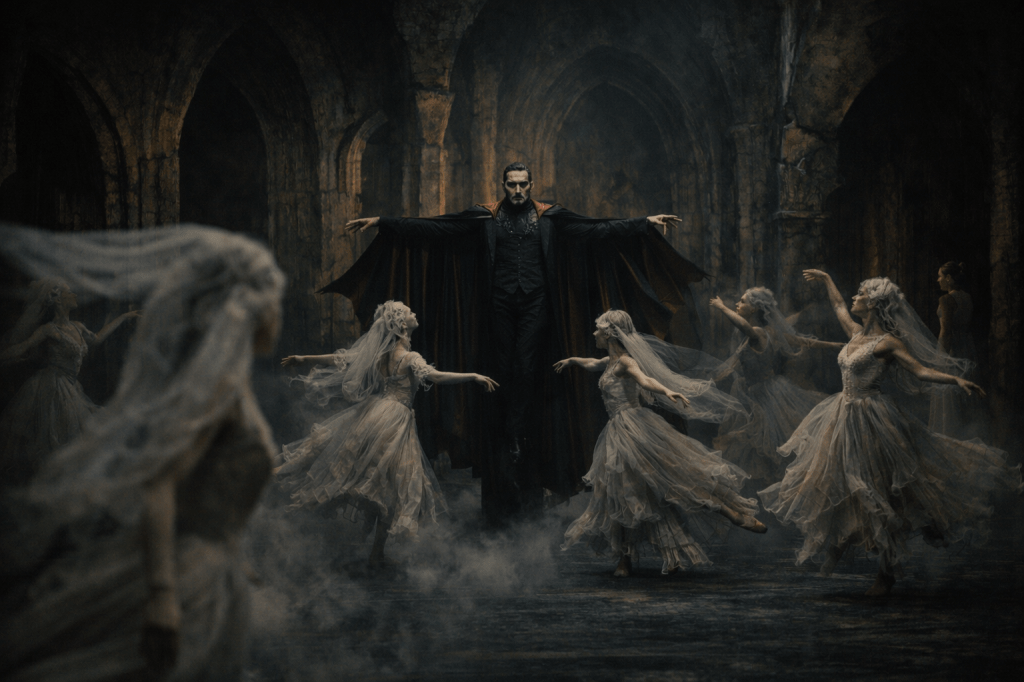
The opening act establishes Dracula’s domain through confined spatial design, low lighting, and controlled movement. Choreography emphasizes restraint and repetition, with ensemble figures operating in coordinated patterns that reinforce the environment as structured rather than expansive.
The introduction of Flora shifts the dynamic from abstraction to consequence, positioning the castle not only as a setting but as an active system.
Act II — Village Environment
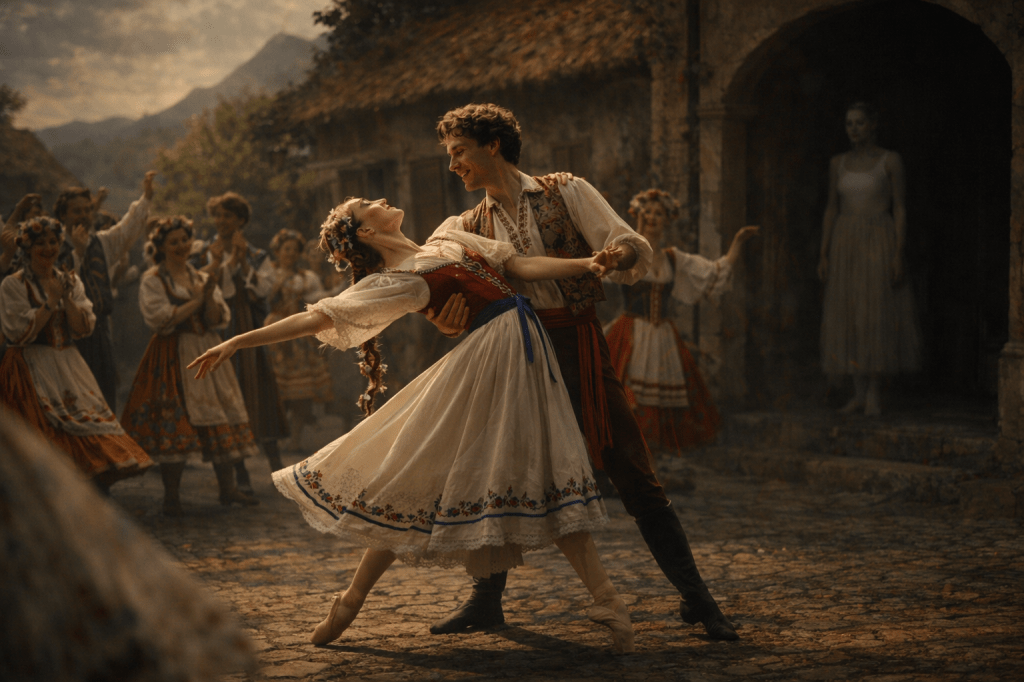
The second act expands spatially and visually. Lighting increases, and choreography becomes more open, incorporating group formations and rhythmic movement associated with communal activity.
The pas de deux between Svetlana and Frederick establishes a contrasting movement language built on balance, shared weight, and mutual timing. This structure introduces a reference point that will later be altered.
The act transitions through disruption rather than escalation. The arrival of Flora reintroduces the castle’s influence, compressing the environment and signaling the shift back toward confinement.
Act III — Interior / Constrained Space
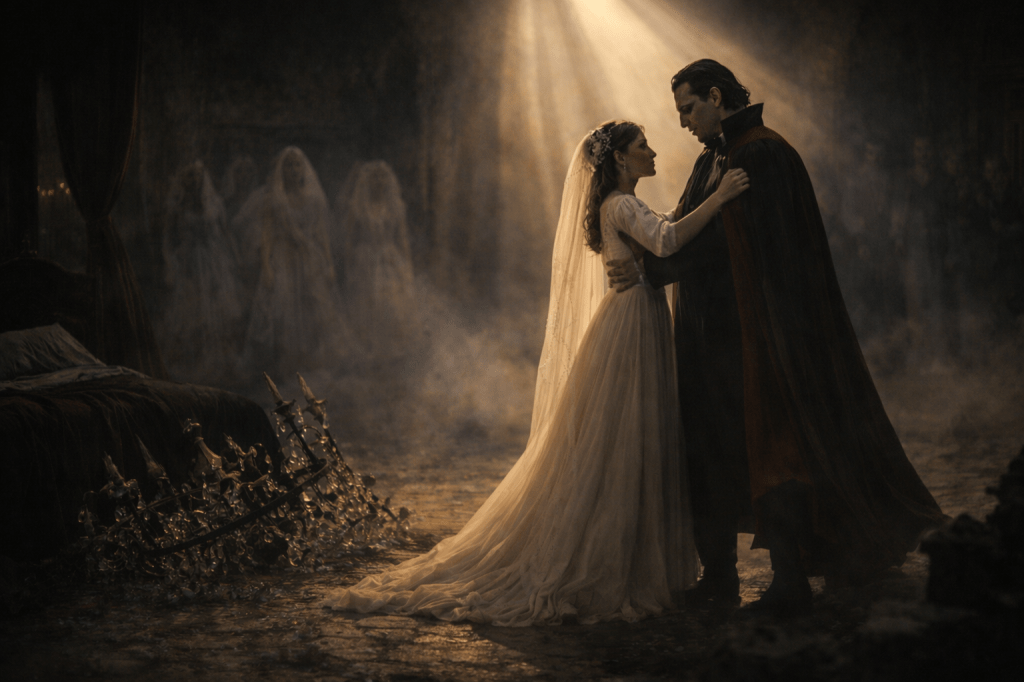
The final act returns to a controlled environment, combining elements of the earlier acts within a more restricted spatial framework.
The pas de deux structure persists but is redefined. Movement vocabulary remains consistent, but the underlying conditions shift from mutual support to imposed control. Lifts and positions are executed with the same precision, but their meaning is altered by context.
Flight sequences and mechanical effects reach their most visible integration in this act. These elements operate within the same system described in the pre-performance material, emphasizing coordination rather than illusion.
The final duet between Svetlana and Frederick resolves the movement language established earlier, returning to balance under changed conditions.
❖
Observation
The production operates through the coordination of multiple systems: choreography, staging, lighting, costume, and mechanical design. Each element functions independently while contributing to a unified structure.
The performance does not rely on narrative explanation. It is organized through movement, spatial control, and repetition. The result is a work that is read through structure rather than dialogue.
 Scott Bryant
You must be logged in to post a comment.