
Permanent Collection — European Galleries
Portland Art Museum – Portland, Oregon
October 11, 2025
It was mid-morning Saturday in downtown Portland, Oregon. The sky held a steady grey, and the city moved quietly, without urgency.
I had a few hours before heading to Keller Auditorium for the Oregon Ballet Theatre’s Dracula performance and its pre-show talk. With time to move through the city, I made my way toward the Portland Art Museum.

Inside, I began with the permanent collection. By the time I reached the European galleries on the second floor, the atmosphere had shifted. The space felt suspended—quiet in a way that suggested attention rather than absence.
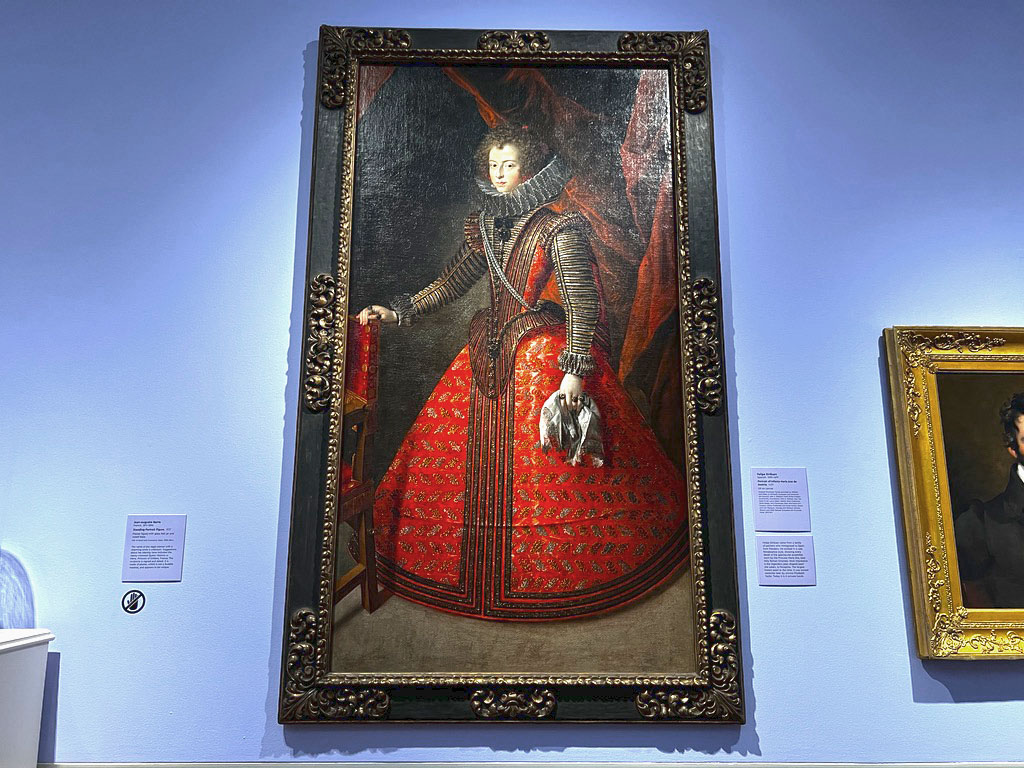
And there she was.
Infanta María Ana de Austria, painted by Felipe Diriksen in 1630, stood in stillness that felt both composed and immovable. Her crimson gown held the light of the gallery with a subdued intensity, drawing the eye without requiring it. The red was immediate, but not loud—something sustained rather than declared.
The portrait was painted in 1630 as she prepared to leave Madrid for Vienna, where she would marry Ferdinand III and become Holy Roman Empress—a moment of departure as much as display.
Her presence was structured. The ribbed bodice, the measured fall of fabric, the placement of her hands—each element felt deliberate, as if arranged to communicate something beyond likeness. This was not simply a portrait. It was an image built to endure.
In that sense, it reads almost like a court-approved image of the seventeenth century—a constructed image designed to travel, to represent, to affirm position within a larger system of visibility and power.
Her hand rests lightly on a chair. The other holds a white glove, suspended rather than worn. The gesture feels incomplete, or perhaps intentionally paused. It suggests refinement, but also distance—an object held between use and display.
A Flemish Eye in Spain
Diriksen’s approach reflects a lineage shaped by Northern European precision and Spanish court formality. The painting operates through detail and control. Surfaces are defined carefully; textures remain distinct; nothing dissolves into atmosphere.
The result is less an interpretation than a declaration.
Every element—the structure of the gown, the geometry of the space, the stillness of the figure—contributes to a single effect: continuity. The Infanta is presented not only as a person, but as a figure already positioned within a future that extends beyond the frame.
The Infanta’s Presence
Standing before the painting, the first thing that settles is the red.
It does not overwhelm. It stabilizes.
The gown reads less as fabric and more as structure, shaping the space around her as much as it defines her body. The ruff at her neck forms a boundary—precise, contained, unyielding.
Her face remains young, but the expression resists intimacy. The gaze is directed outward, but not toward the viewer. It holds its position, as if meant to be seen across distance rather than encountered up close.
Her impassive expression, often read as distance, was not incidental but trained—part of Habsburg decorum designed to project authority through restraint.
There is no visible movement. And yet, the image does not feel static.
It holds.
The glove in her hand introduces a small point of interruption—something soft within an otherwise controlled composition. It draws attention not through contrast, but through restraint. It is present without being emphasized, like a detail that remains unresolved.
The longer you stand there, the more the room begins to quiet around it. Sound recedes. Movement slows. The painting begins to define the space rather than occupy it.
The Pearl’s Journey
The jewel paired a large diamond, El Estanque, with the pear-shaped pearl later called La Peregrina—the “wandering pearl.”
Its shape is distinct, teardrop-like, positioned precisely against the structured red of her bodice. In this context, it functions as part of the composition: a point of brightness within a system of control.
Yet the pearl carries its own trajectory.
Centuries later, it would appear again—this time worn by actor Elizabeth Taylor. The setting changes, the context shifts, but the object remains. It moves across time, across systems, across forms of visibility.
In Diriksen’s portrait, it belongs to lineage. In Taylor’s era, it becomes something else—no longer tied to court structure, but to presence within a different kind of spectacle.
The object persists. The meanings around it change.
Echoes of Power and Image
Portraits like this operate through performance.
Stillness is not incidental. It is constructed.
In the seventeenth-century Spanish court, portraits functioned as instruments of statecraft—circulated among royal courts, securing alliances and shaping perception before a figure ever arrived.
The Infanta’s image would have traveled, carrying with it a version of her that remained fixed regardless of context.
Viewed now, that same structure reads differently.
The control remains visible, but so does its cost. The precision that once signaled stability begins to suggest constraint. The stillness that once affirmed authority begins to feel imposed.
And yet, the presence persists.
Not as resistance, and not as submission—but as something that remains intact within the structure itself.
A Glimpse of Continuity
When I stepped away from the painting, the gallery returned to motion.
Footsteps, quiet conversation, the subtle movement of others passing through the space.
Outside, the October light remained muted.
The image stayed with me—not as a statement, but as a condition. A figure held within a system of display, continuing to exist within it, long after the system itself has shifted.
In the European gallery of the Portland Art Museum, Infanta María Ana de Austria is no longer only a subject of rank or lineage.
She remains—structured, composed, and still present.
Portrait of Infanta María Ana de Austria, 1630
Felipe Diriksen (Spanish, 1590–1679)
Oil on canvas
82 5/8 x 46 1/2 inches
 Scott Bryant
You must be logged in to post a comment.