
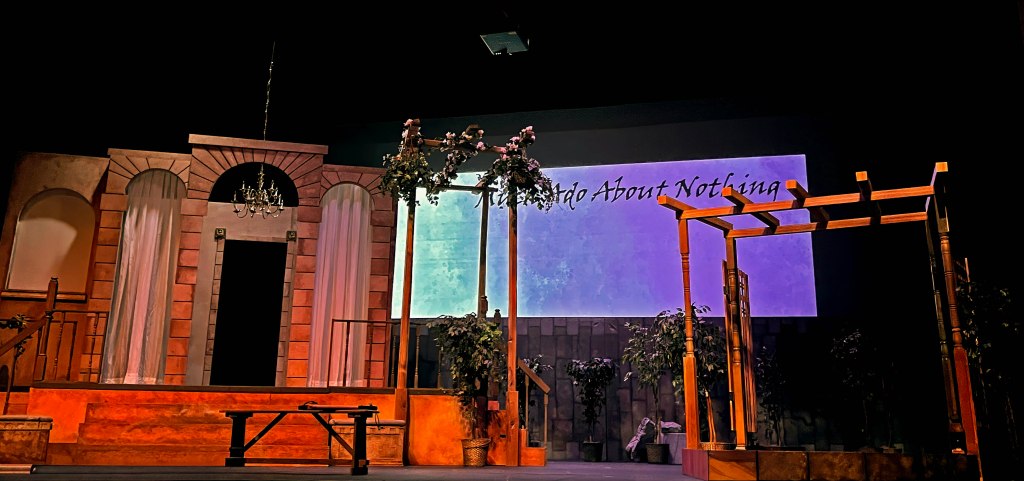
There is a moment in Much Ado About Nothing when nothing dramatic seems to happen.
Two people are close.
A gesture is made.
Others watch from a distance and believe they understand what they are seeing.
In Portland Community College Theatre’s production, that moment was simple and unadorned: Borachio kisses Margaret. The kiss is not emphasized, explained, or lingered over. It exists only long enough to be noticed.
What follows—accusation, certainty, collapse—unfolds not because of the kiss itself, but because of what the observers think it proves.
Evidence, Not Transgression
The kiss itself was not staged as provocation. It did not ask to be read as scandal, nor did it call attention to itself as a “reinterpretation.” It functioned as Shakespeare intended: as evidence.
Borachio’s role in the deception has always relied on creating a convincing image. Claudio and Don Pedro are not fooled by passion, but by confidence. They believe because they want to believe—because the image aligns with what they already fear.
Casting Borachio and Margaret as women did not alter that logic. Instead, it stripped the moment of familiar explanatory shortcuts. The kiss could no longer be subconsciously filed away as a default heterosexual signal. It simply became what it always was: a fragment of behavior misread by those who never ask questions.
The deception worked not because of who kissed whom, but because proximity was mistaken for understanding.
When Gender Stops Doing the Work
Much of Much Ado is usually carried by assumptions the audience doesn’t notice it’s making. Gender often does that work invisibly: explaining desire, explaining motive, explaining certainty.
This production removed that crutch.
With Borachio, Conrade, members of the Watch, and messengers played by women, and Dogberry played as non-binary (they/them), gender stopped operating as an organizing principle. Characters were no longer legible by default. Actions had to stand on their own.
The result was subtle but powerful. Claudio’s error no longer read as a tragic misunderstanding born of masculine codes of honor. It read as something more unsettling: a choice to believe a narrative without ever seeking intimacy or clarification.
The play’s cruelty sharpened—not because it became harsher, but because it became clearer.
Who Is Believed, and Why
Dogberry has always been an outsider to authority—linguistically, socially, and structurally. Making that marginality explicit through non-binary casting did not add comedy. It clarified the irony already embedded in the text.
The truth arrives through the least trusted voice.
This production made visible something Shakespeare already understood: that authority is often wrong precisely because it assumes its own coherence. Dogberry’s errors are verbal, not moral. Claudio’s are moral, disguised as certainty.
When truth finally surfaces, it does not do so through eloquence or status. It arrives accidentally, sideways, and far later than it should have.
Watching from a Distance
What lingered after this production was not the cleverness of the casting, but the discomfort of recognition.
The most dangerous characters in Much Ado are not villains. They are spectators. People who believe that seeing is the same as knowing. People who mistake observation for understanding.
By removing default assumptions—about gender, about authority, about desire—this production returned the play to its core question:
What happens when we trust what we think we see more than the people we claim to love?
The answer, as Shakespeare already knew, is not comedy. It is damage—quiet at first, confidently assumed, and undone only when it is almost too late.
 Scott Bryant
You must be logged in to post a comment.