
Cultural Notes — Global Cinema
Some films arrive as discoveries.
Others arrive as rediscoveries.
Chess of the Wind, directed by Mohammad Reza Aslani and first screened in 1976, belongs to the latter category. Today it is widely recognized as one of the most unusual works of Iran’s pre-revolution cinema, but for decades it was believed lost.
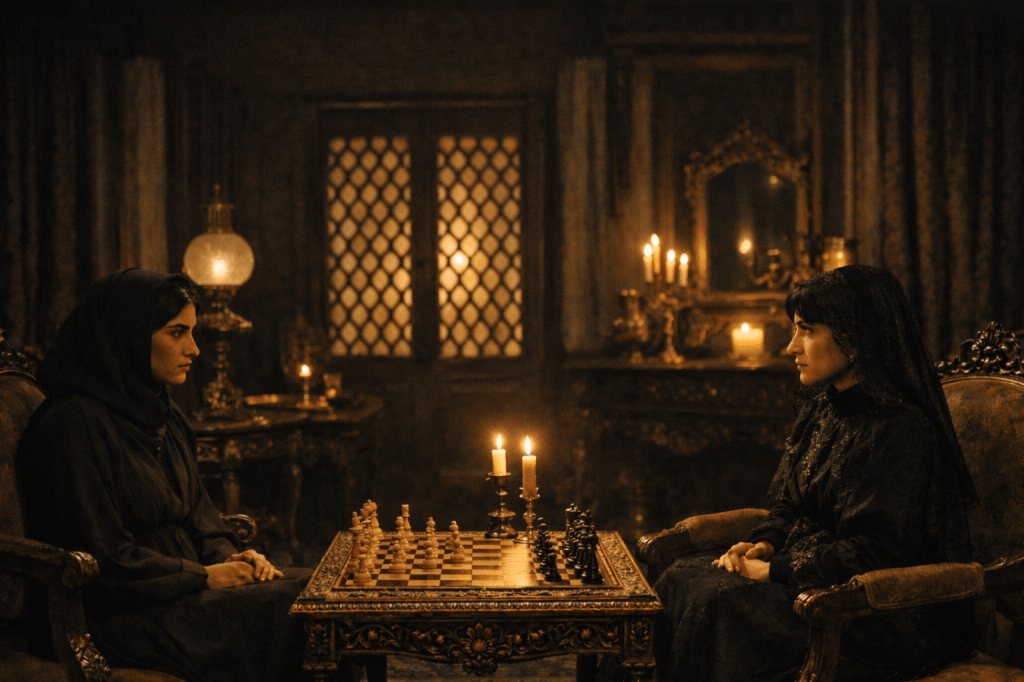
The film unfolds almost entirely within the interior of a wealthy household following the death of its matriarch. Members of the family circle one another cautiously as questions of inheritance and authority begin to surface. Servants move quietly along the edges of the rooms. Alliances shift. Conversations take place in dimly lit corridors and candlelit salons.
The atmosphere resembles less a traditional mystery than a slow, suffocating game of strategy. The title proves fitting. Characters drift through the mansion like pieces on an unseen board.
Visually, the film is striking. Interiors are heavy with shadow. Light filters through lattice windows and reflects off carved furniture and patterned carpets. Figures are framed in doorways or mirrors, as if the house itself were observing the intrigue unfolding within it. The result feels closer to a gothic chamber drama than to conventional narrative cinema.
When the film premiered, contemporary critics reportedly reacted with confusion. Some found its pacing unusually deliberate, while others felt its visual style leaned too heavily toward European art cinema. Within only a few years, however, the revolution would transform Iran’s political and cultural landscape, and the cinematic environment that produced the film largely disappeared.
Many films from the pre-revolution era fell out of circulation, and Chess of the Wind was widely believed to have been destroyed.
Decades later, the original negative was unexpectedly rediscovered in Tehran and restored, allowing the film to reemerge for international audiences.
Seen today, Chess of the Wind feels almost haunted by its historical moment. The decaying mansion, the fragile hierarchies within it, and the quiet struggle for control can easily be read as a portrait of a social order nearing collapse.
Whether intentional or not, the film now appears as a cinematic artifact from the final years of pre-revolution Iranian culture — a world captured in candlelight just before it vanished.
 Scott Bryant
You must be logged in to post a comment.